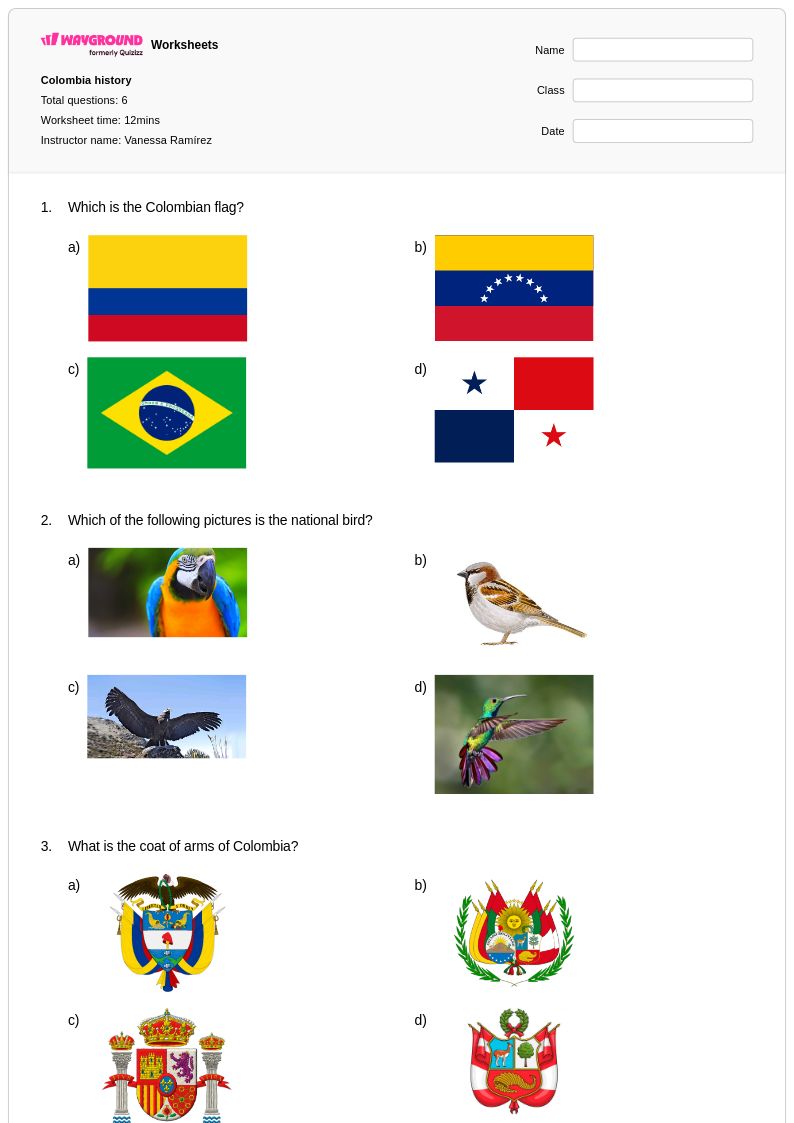
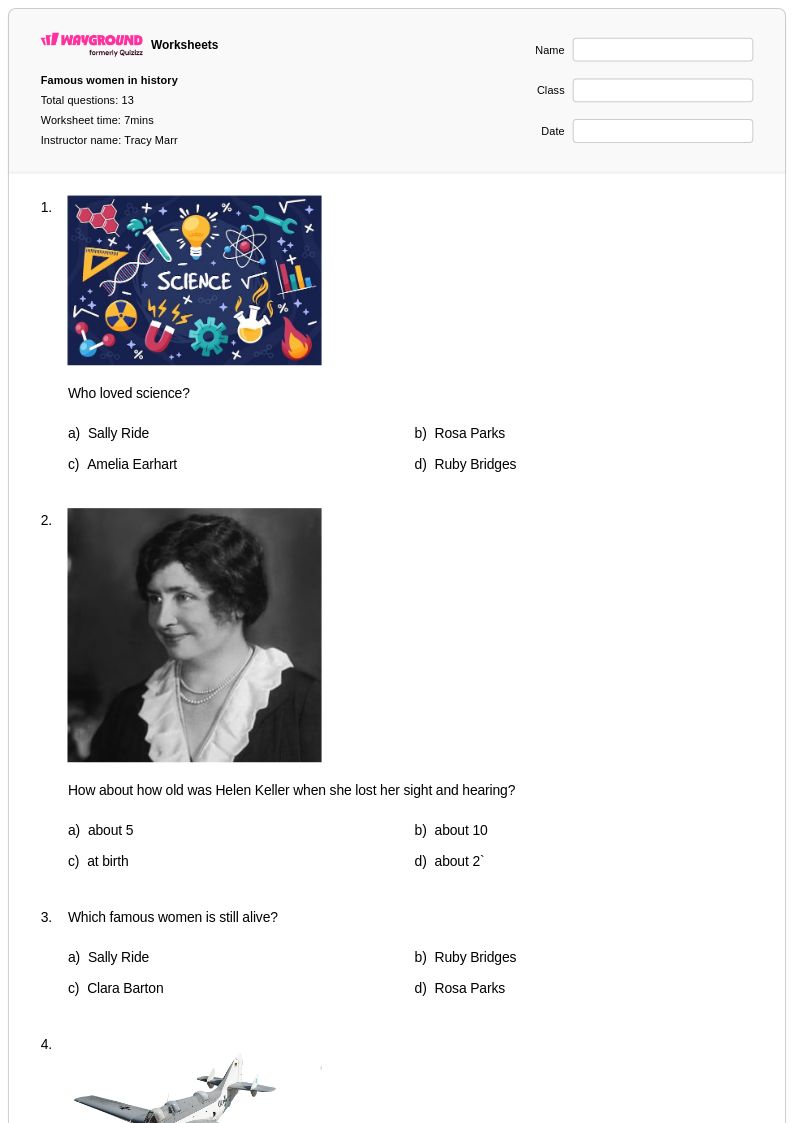
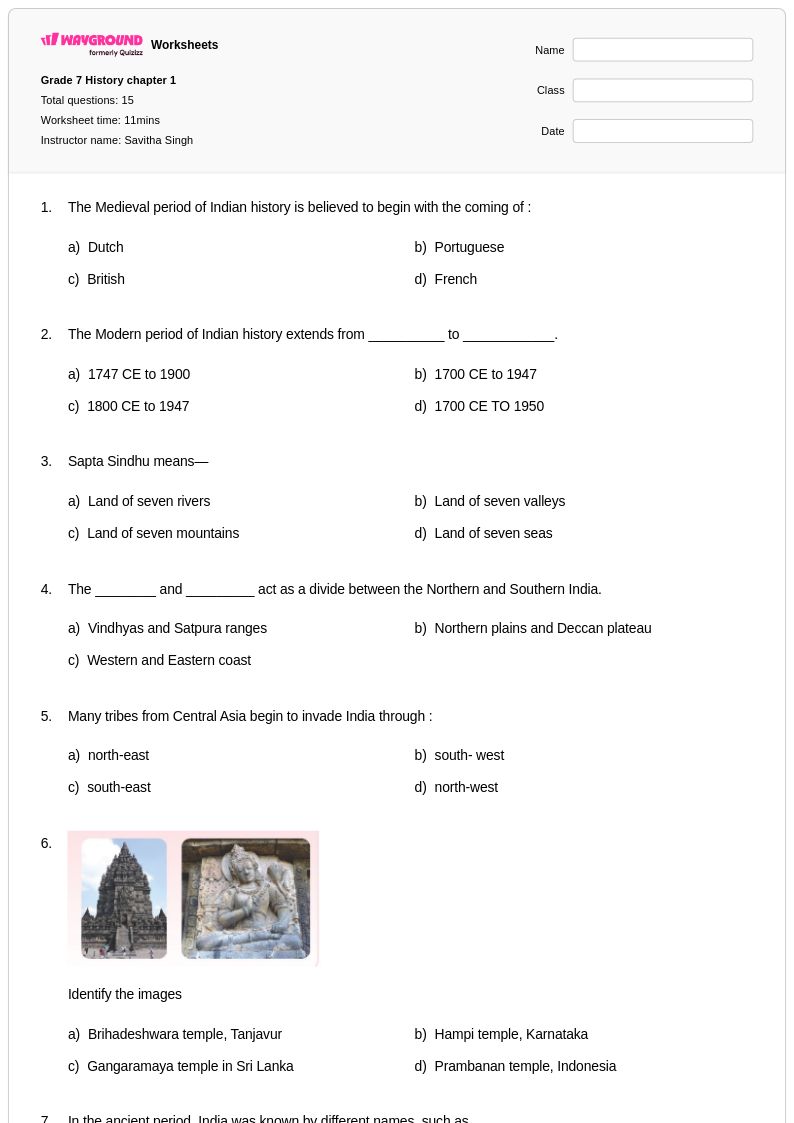
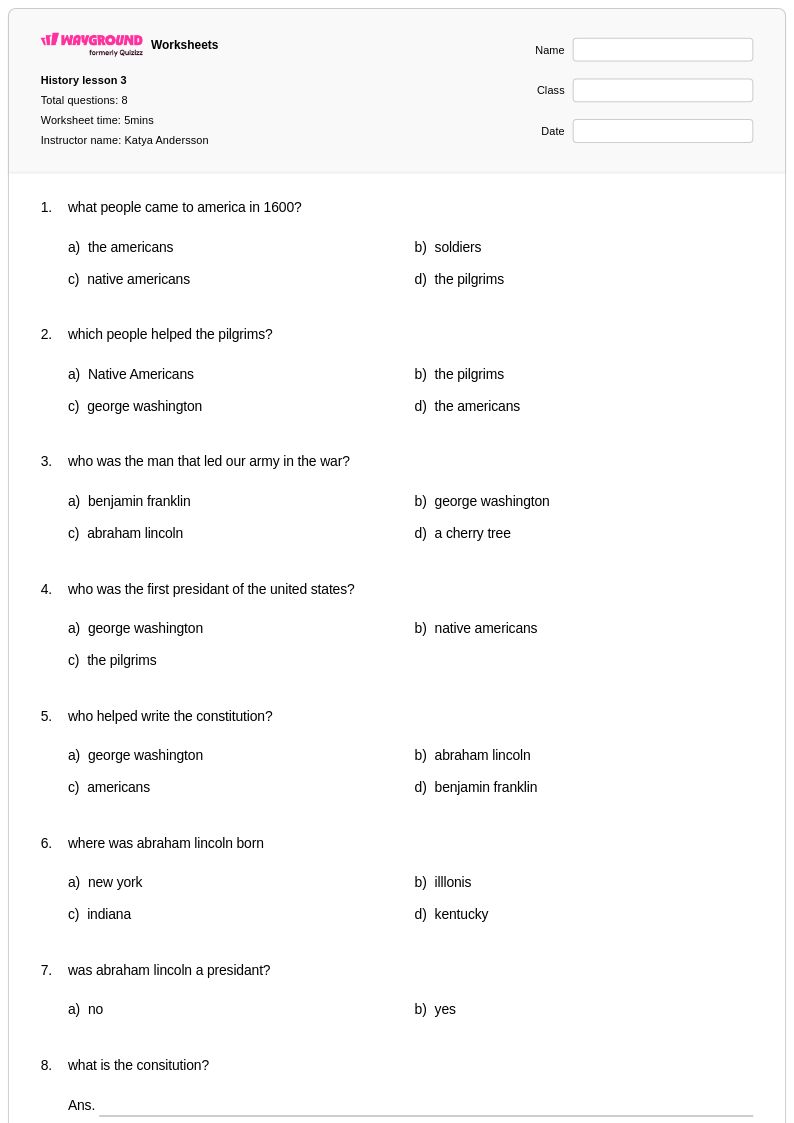
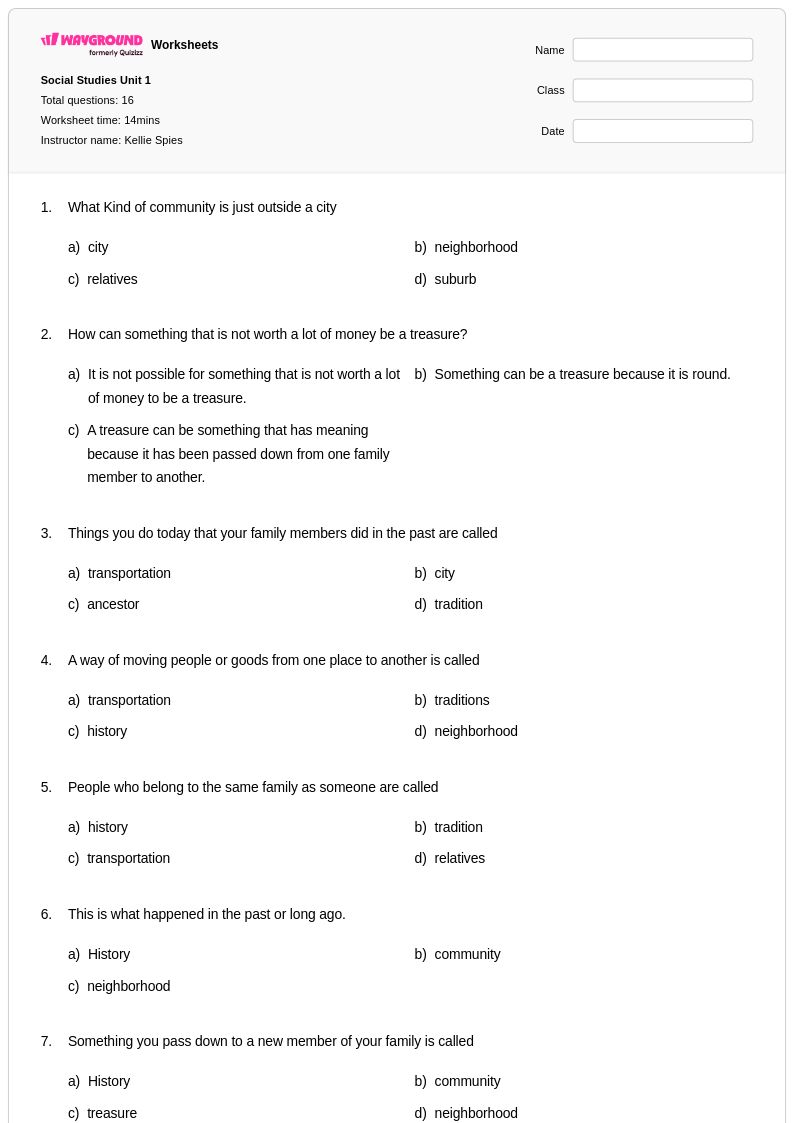
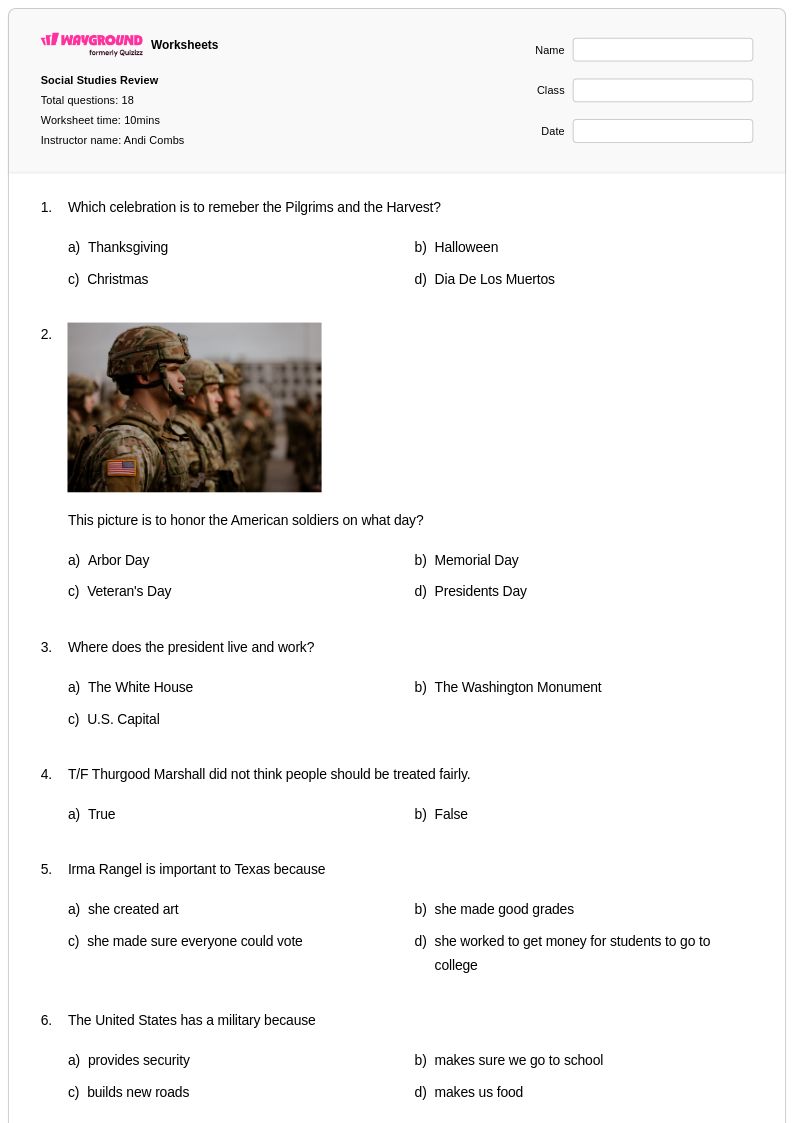
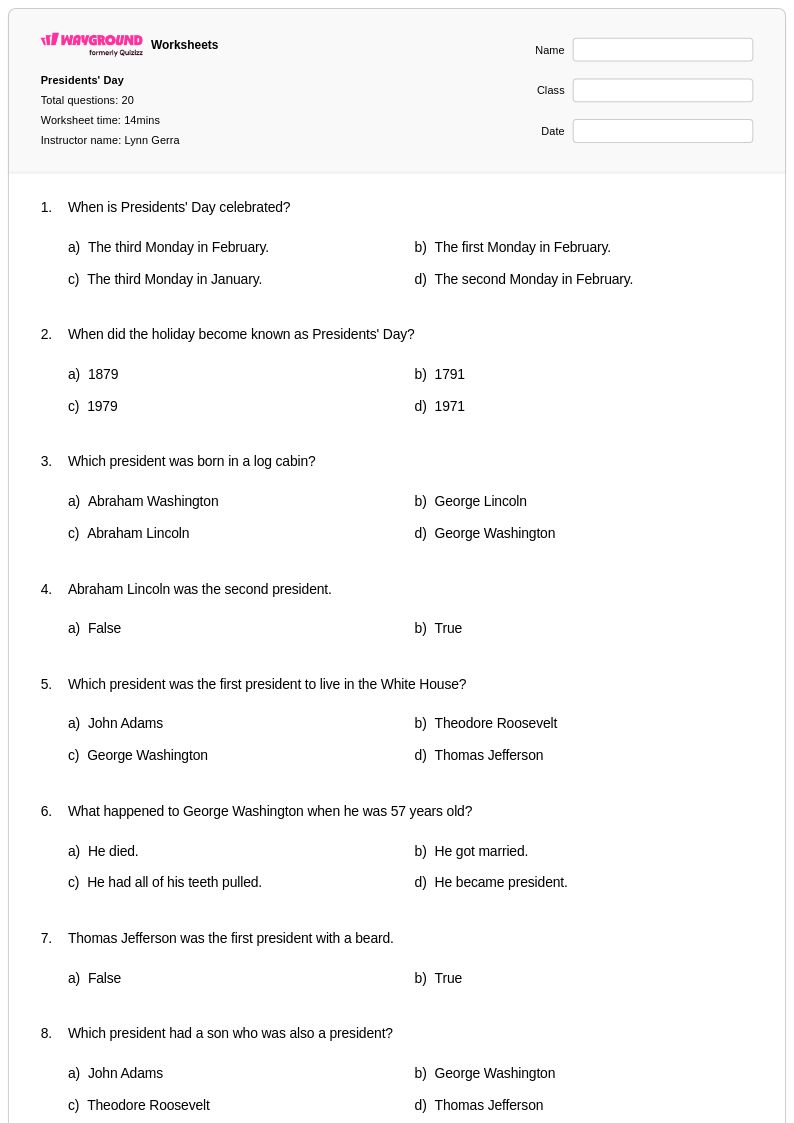
Explore Wayground's free Class 2 history worksheets and printables that help young learners discover past events, important figures, and historical concepts through engaging practice problems with complete answer keys.
Class 2 history worksheets available through Wayground (formerly Quizizz) provide young learners with engaging opportunities to explore foundational concepts about the past and develop critical thinking skills essential for historical understanding. These carefully designed printables introduce second graders to key historical themes including family traditions, community changes over time, historical figures, and the concept of chronology through age-appropriate activities and practice problems. Students strengthen their ability to sequence events, compare past and present, and understand how people lived in different time periods while building vocabulary related to historical concepts. Each worksheet comes with a comprehensive answer key, allowing teachers to efficiently assess student progress and understanding, and the free pdf format ensures easy access for classroom use and home practice.
Wayground (formerly Quizizz) empowers educators with an extensive collection of millions of teacher-created history resources specifically designed for Class 2 learners, featuring robust search and filtering capabilities that allow teachers to quickly locate materials aligned with their curriculum standards and learning objectives. The platform's differentiation tools enable educators to customize worksheets to meet diverse learning needs, while the availability of both printable and digital formats, including downloadable pdfs, provides maximum flexibility for various instructional settings. These comprehensive resources support teachers in planning effective history lessons, providing targeted remediation for struggling learners, offering enrichment opportunities for advanced students, and delivering consistent skill practice that builds students' historical thinking abilities and content knowledge throughout the academic year.
FAQs
How do I teach historical thinking skills to middle and high school students?
Historical thinking requires students to move beyond memorizing dates and events toward analyzing why events happened, how they connect, and what they mean. Effective strategies include sourcing (asking who created a document and why), contextualizing (placing sources within their historical moment), and corroborating (comparing claims across multiple sources). Structured practice with primary source analysis and cause-and-effect organizers helps students build these habits over time. Starting with a familiar topic, such as the American Revolution or World War 2, allows students to apply new analytical frameworks to content they already partially know.
What exercises help students practice reading and interpreting historical timelines?
Timeline exercises work best when they ask students to do more than sequence events, pushing them to identify patterns, turning points, and causal relationships across time. Effective practice tasks include calculating time spans between events, grouping events into broader historical eras, and explaining why a specific event marks a shift in a period. Having students construct their own timelines from a set of provided events also reinforces sequencing and periodization skills. Worksheet-based timeline activities that include answer keys allow teachers to check for accuracy and address common errors, such as confusing BCE and CE dating.
What are the most common mistakes students make when analyzing primary sources?
The most frequent error is treating a primary source as objective fact rather than as a perspective shaped by the author's identity, purpose, and context. Students often summarize what a document says without asking who wrote it, when, and for what audience, which undermines the entire analytical exercise. Another common mistake is cherry-picking a single source to support a claim without corroborating it against other evidence. Teachers should explicitly model the sourcing process and provide scaffolded worksheets that prompt students to identify author, audience, purpose, and point of view before drawing any conclusions.
How can I help students understand the difference between primary and secondary sources?
A primary source is an original document or artifact created at the time of the historical event, such as a speech, letter, photograph, or treaty, while a secondary source interprets or analyzes primary sources after the fact. Students often confuse the two because the distinction depends on how a source is being used, not just what type of document it is. A practical classroom strategy is to pair a primary source, such as Martin Luther King Jr.'s 'I Have a Dream' speech, with a secondary source analyzing the speech, and ask students to compare what each tells them and what each leaves out. Regular practice with labeled examples builds the habit of asking 'Was this created during the event or about the event?'
How do I differentiate history instruction for students with varying reading levels?
Differentiation in history often centers on text accessibility, since many primary sources and historical documents are written at a challenging reading level. Strategies include providing leveled versions of the same document, using graphic organizers to reduce the cognitive load of dense text, and pairing visual sources like maps and photographs with written ones. On Wayground, teachers can enable the Read Aloud accommodation so questions and content are read to students who need it, and they can adjust font sizes and display themes through Reading Mode for students who require visual accessibility support. These accommodations can be assigned to individual students without notifying the rest of the class, keeping the experience seamless.
How do I use Wayground's history worksheets in my classroom?
Wayground's history worksheets are available as printable PDFs for traditional classroom use and in digital formats for technology-integrated environments, giving teachers flexibility regardless of their classroom setup. Teachers can print and distribute worksheets directly or assign them digitally, and can also host them as an interactive quiz on Wayground for real-time student engagement. Each worksheet includes a complete answer key, which supports efficient grading and makes it easier to review answers with the class. The digital format also allows teachers to apply student-level accommodations such as extended time or reduced answer choices for learners who need additional support.
What history topics are covered in Wayground's worksheet collection?
Wayground's history worksheet collection spans ancient civilizations through modern world history, covering topics such as Ancient Egypt, Ancient China, Mesopotamia, the Roman Republic and Empire, the Byzantine Empire, Medieval and Feudal Japan, the Renaissance, the Reformation, the French Revolution, the Industrial Revolution, the American Revolution, the Great Depression, World War 2, the Cold War, and U.S. History. The collection also includes worksheets on notable historical figures such as Alexander the Great, Mansa Musa, Rosa Parks, and Emmett Till, as well as skill-based topics like primary source analysis, reading timelines, and historical thinking. This breadth makes it practical for teachers to find materials aligned to nearly any unit in a standard K-12 history curriculum.