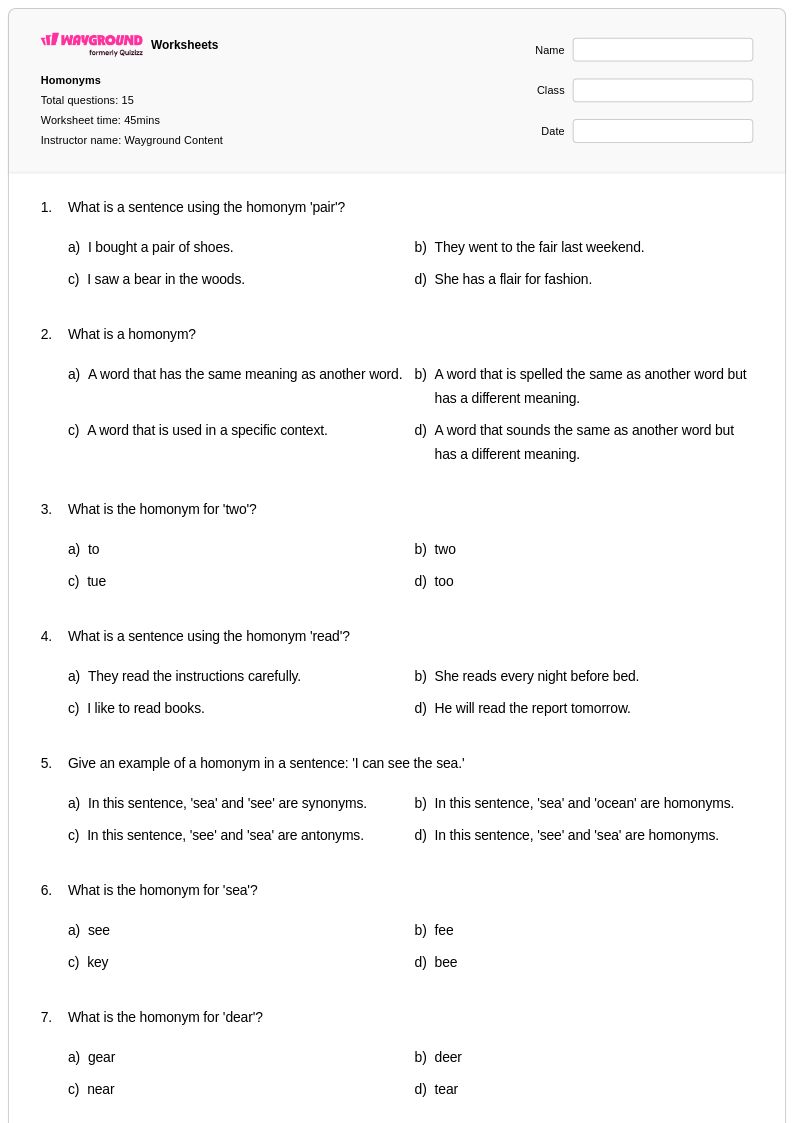
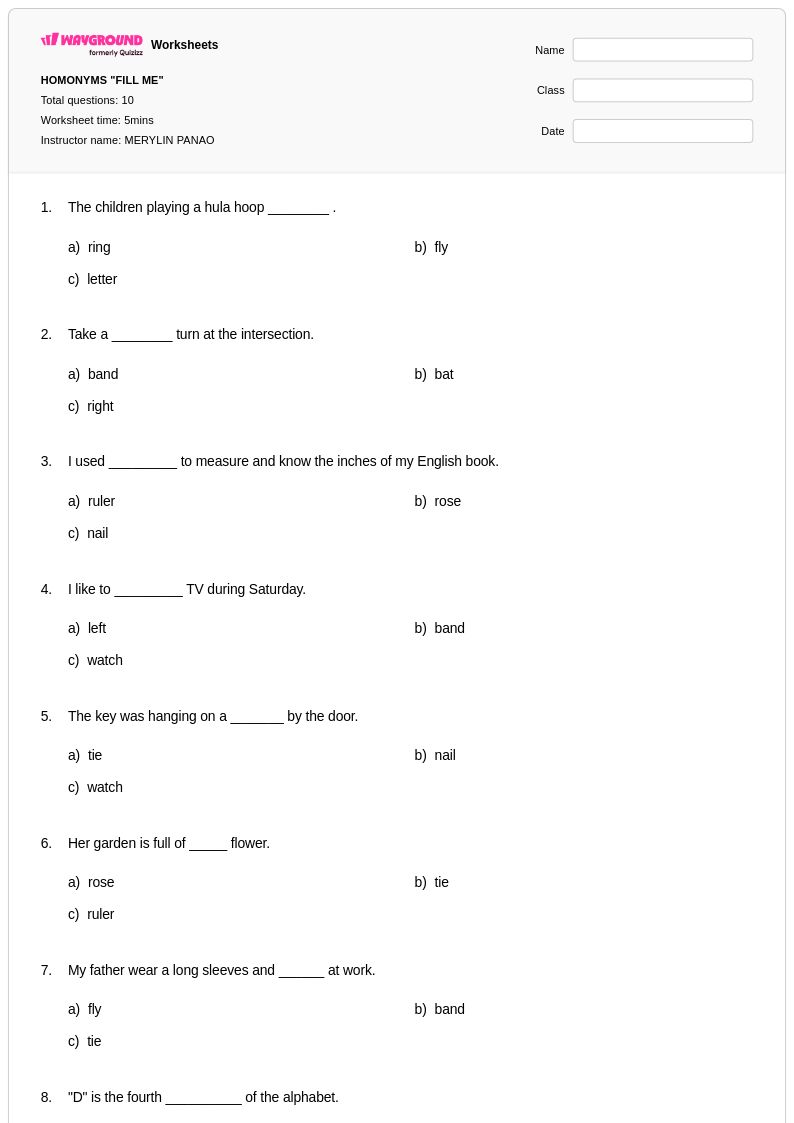
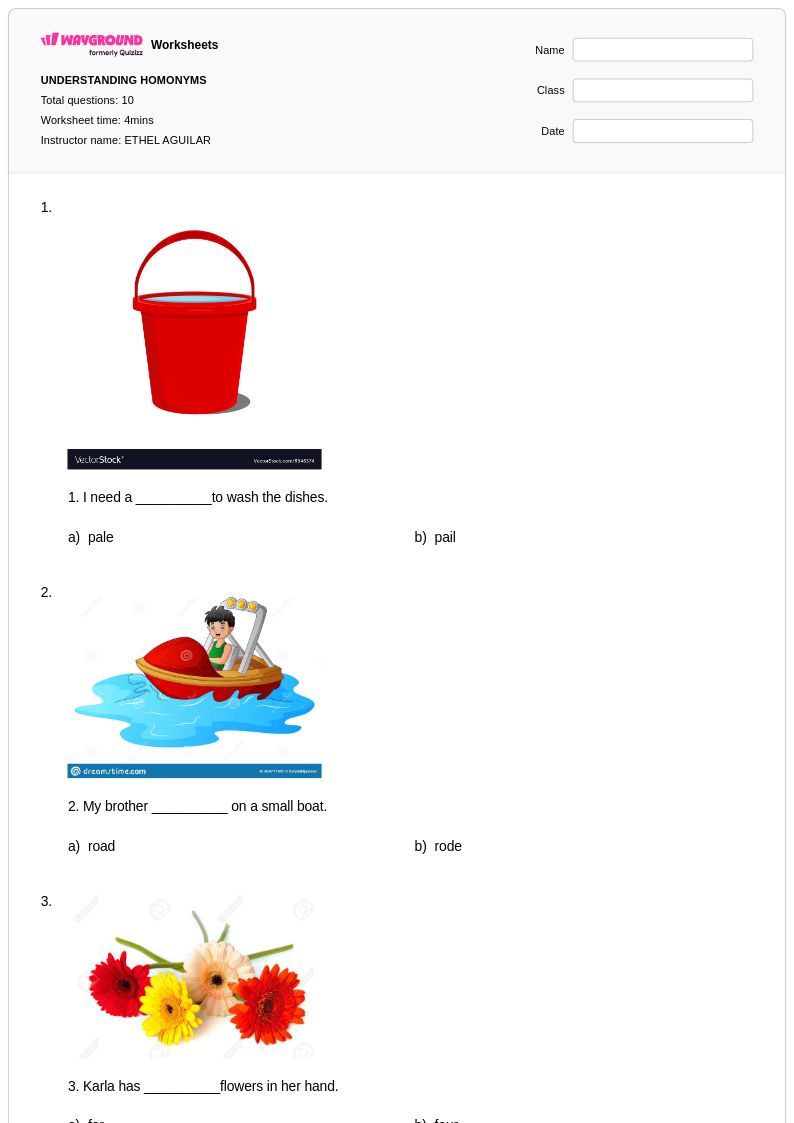
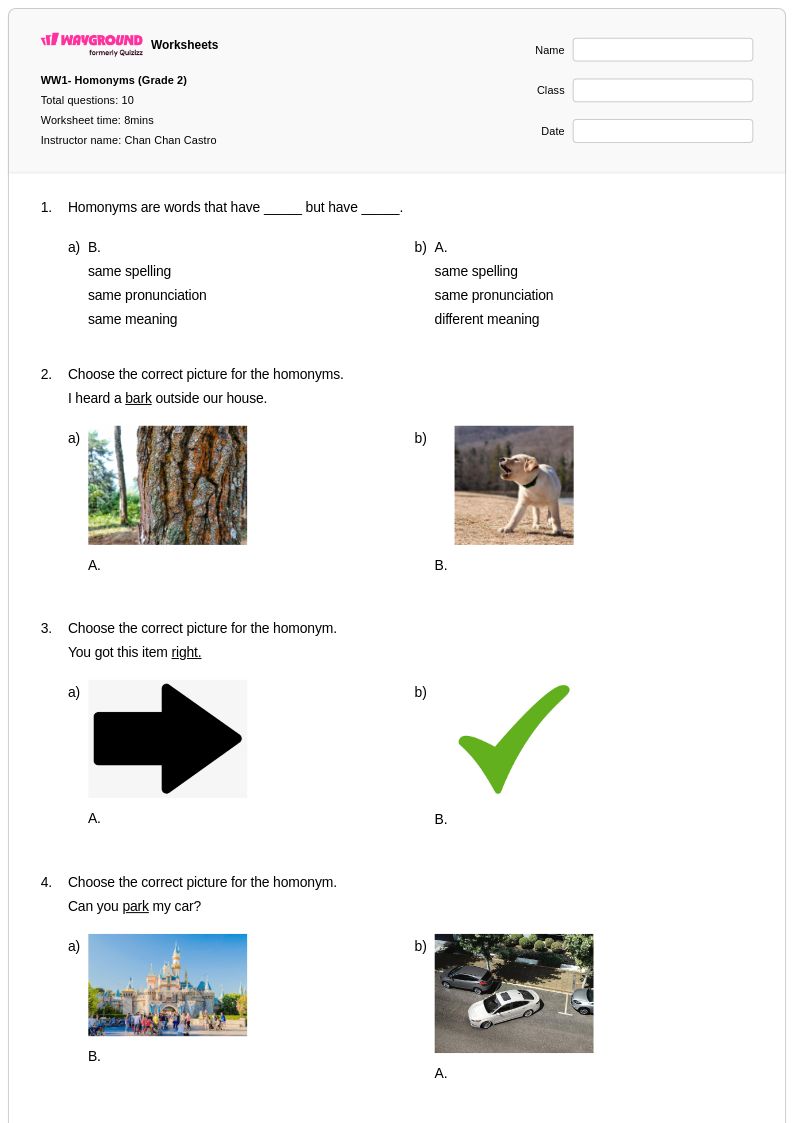
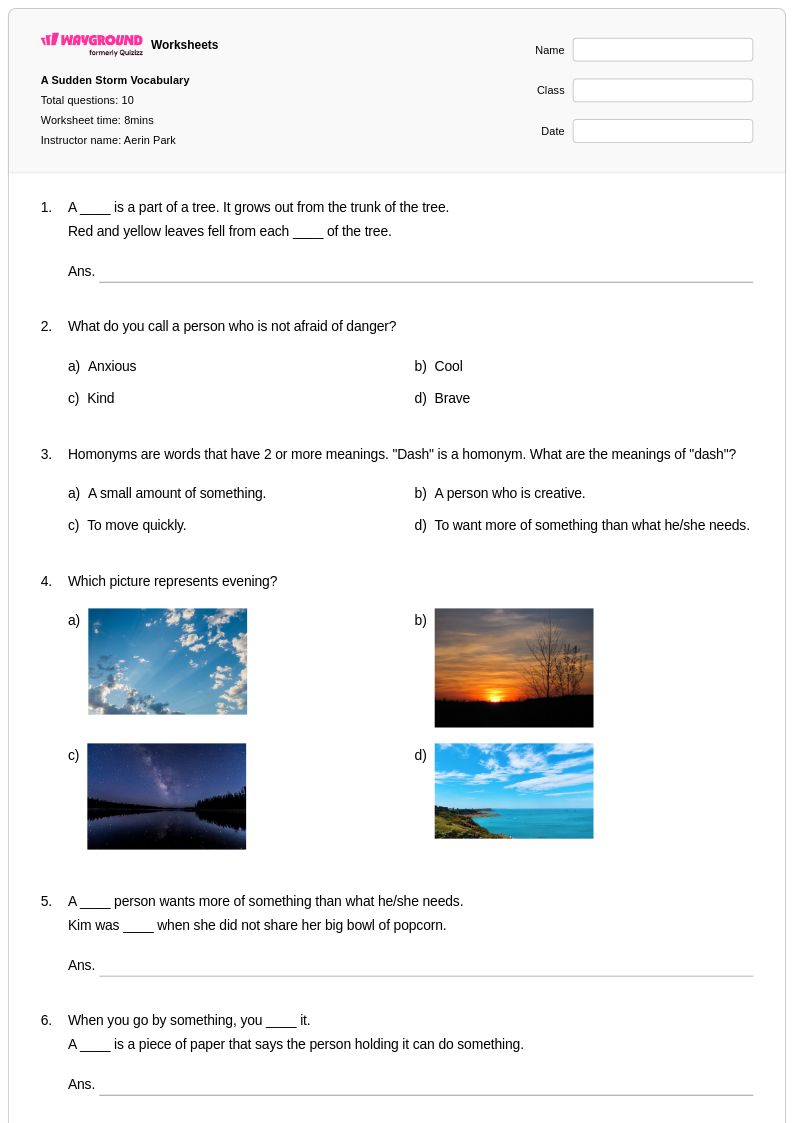
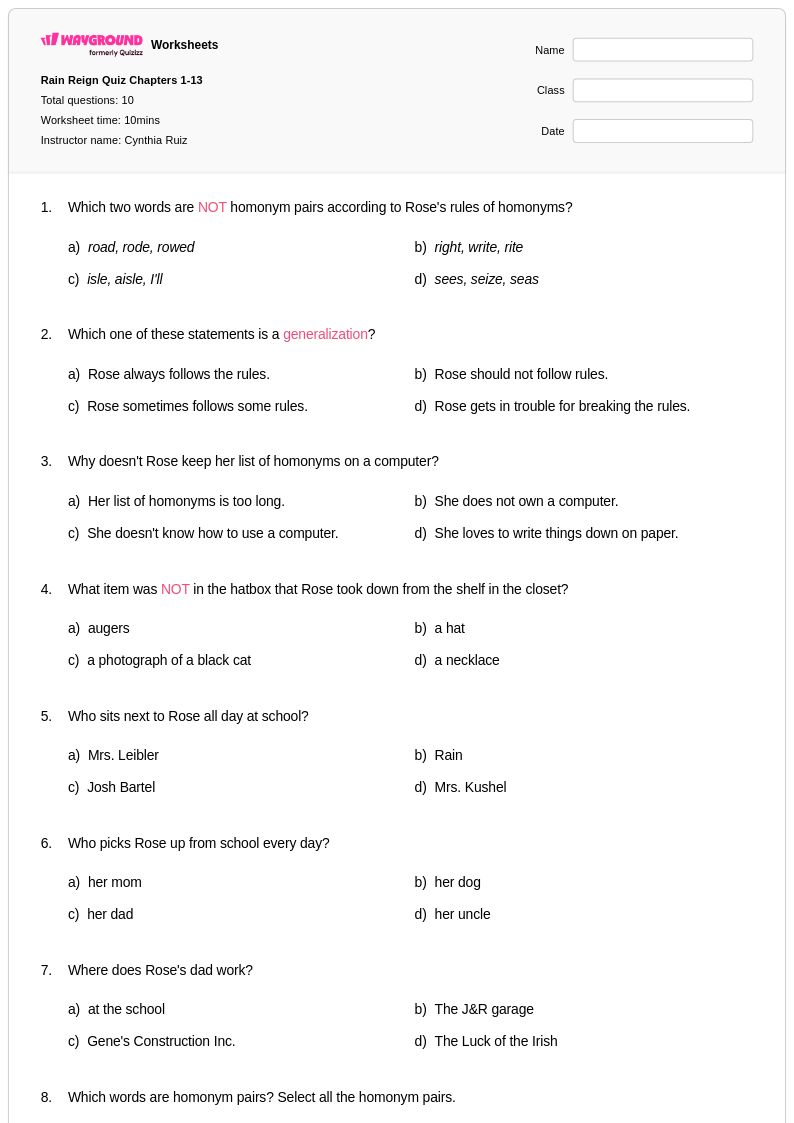
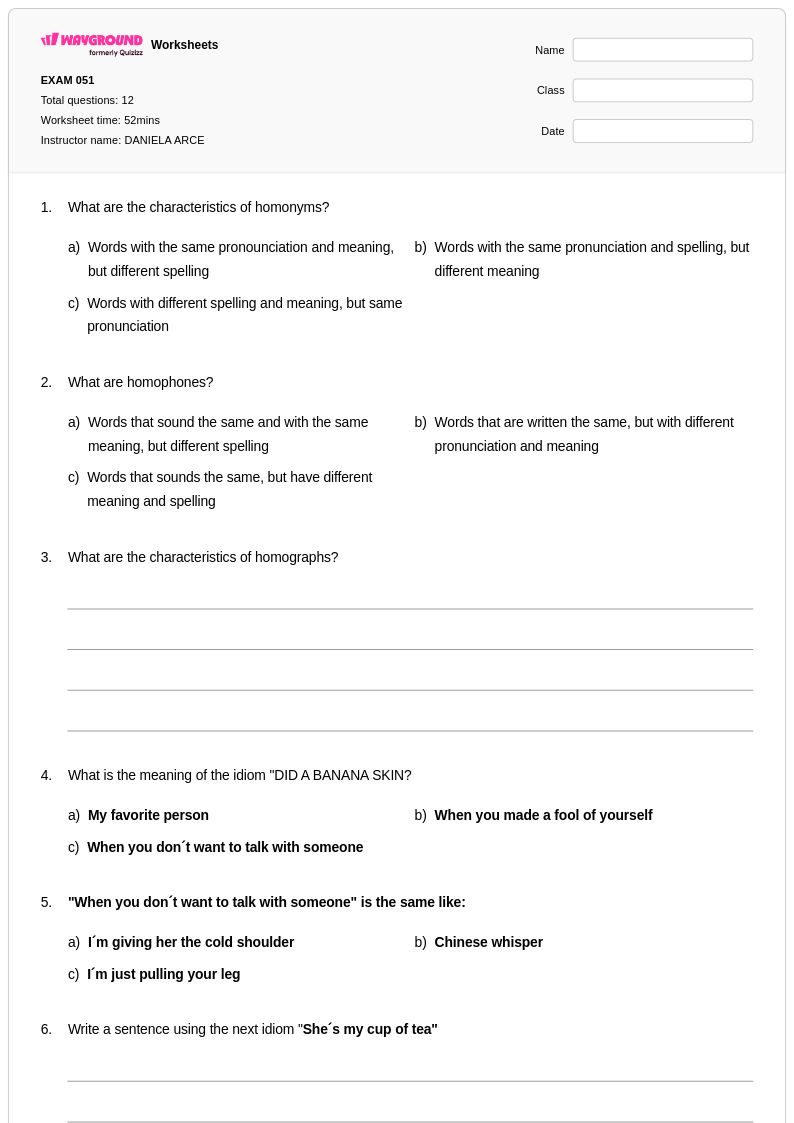
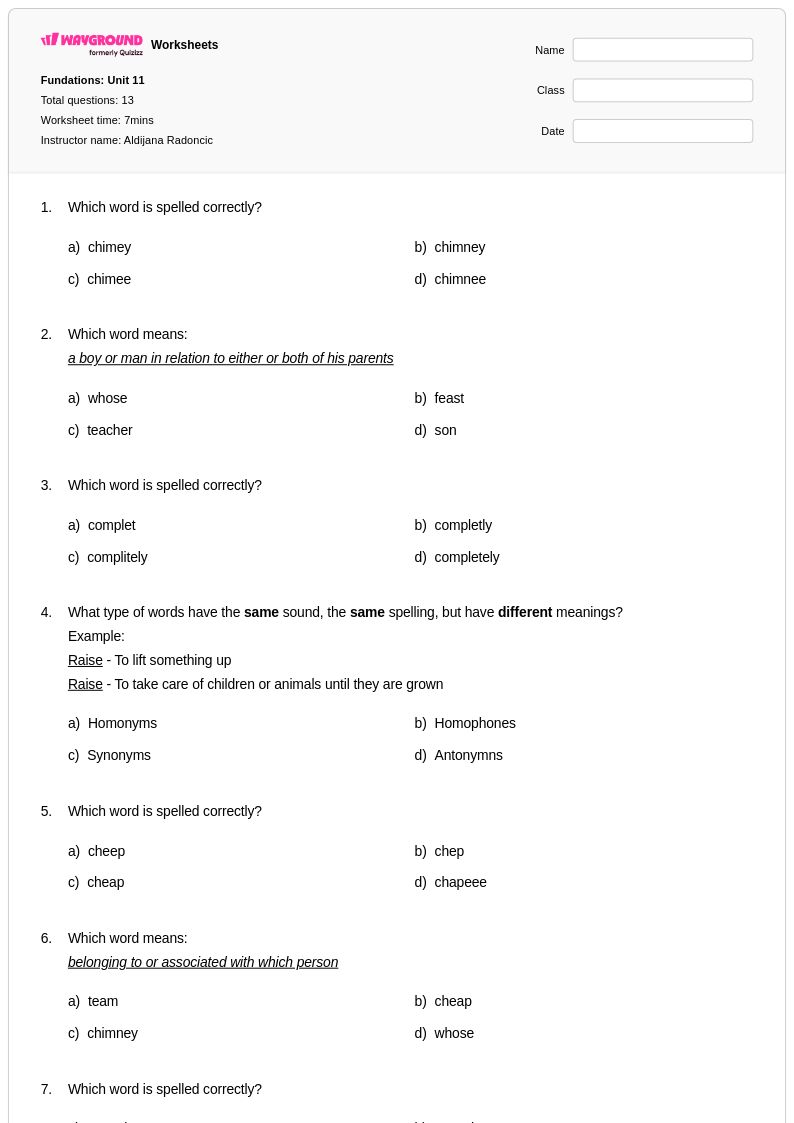
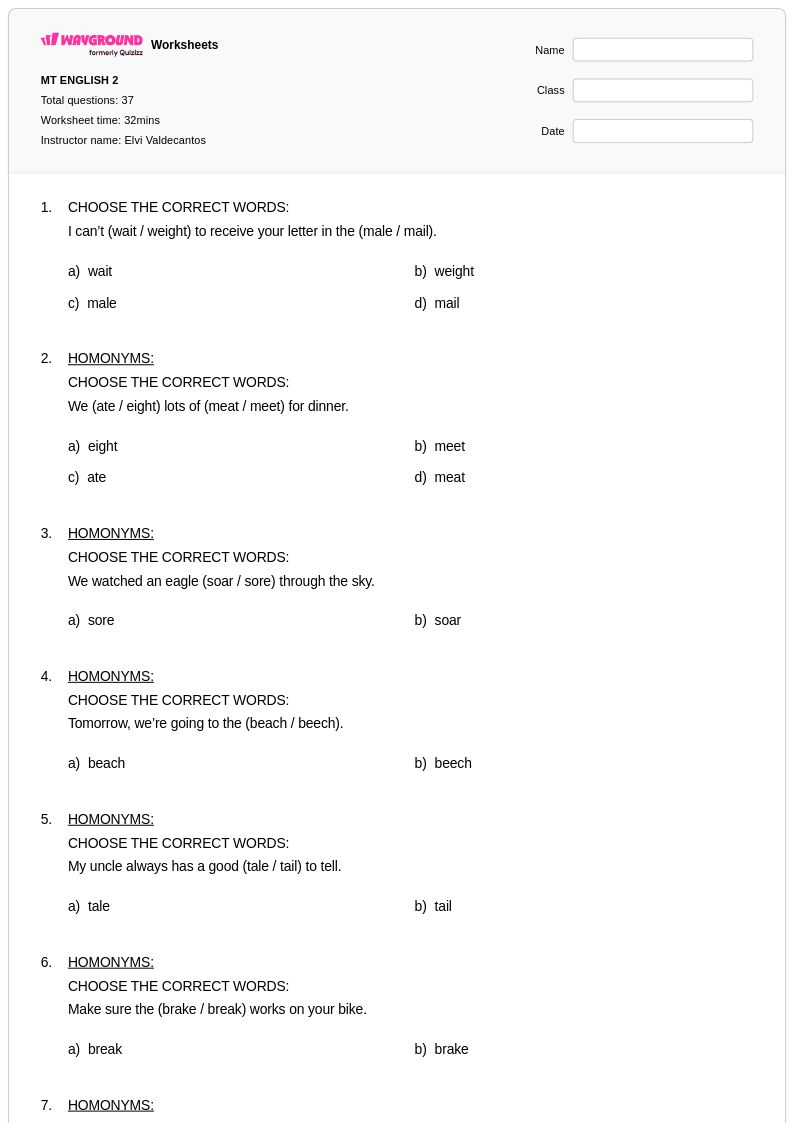
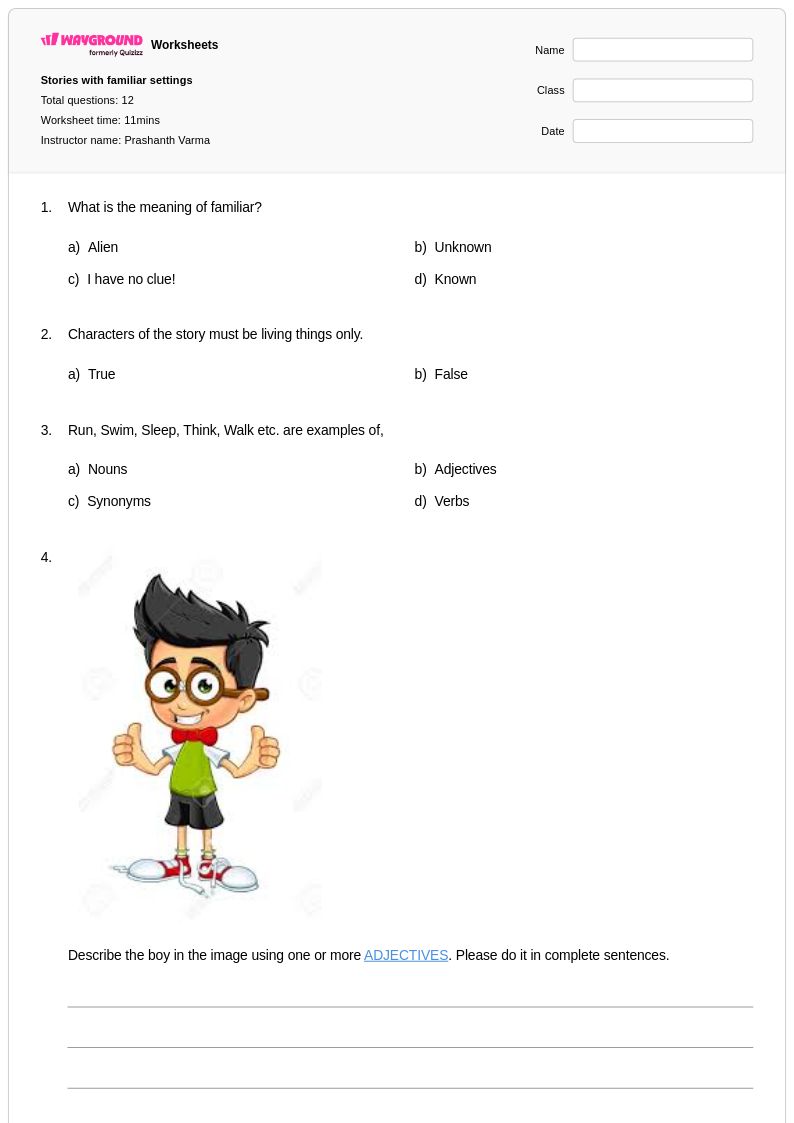
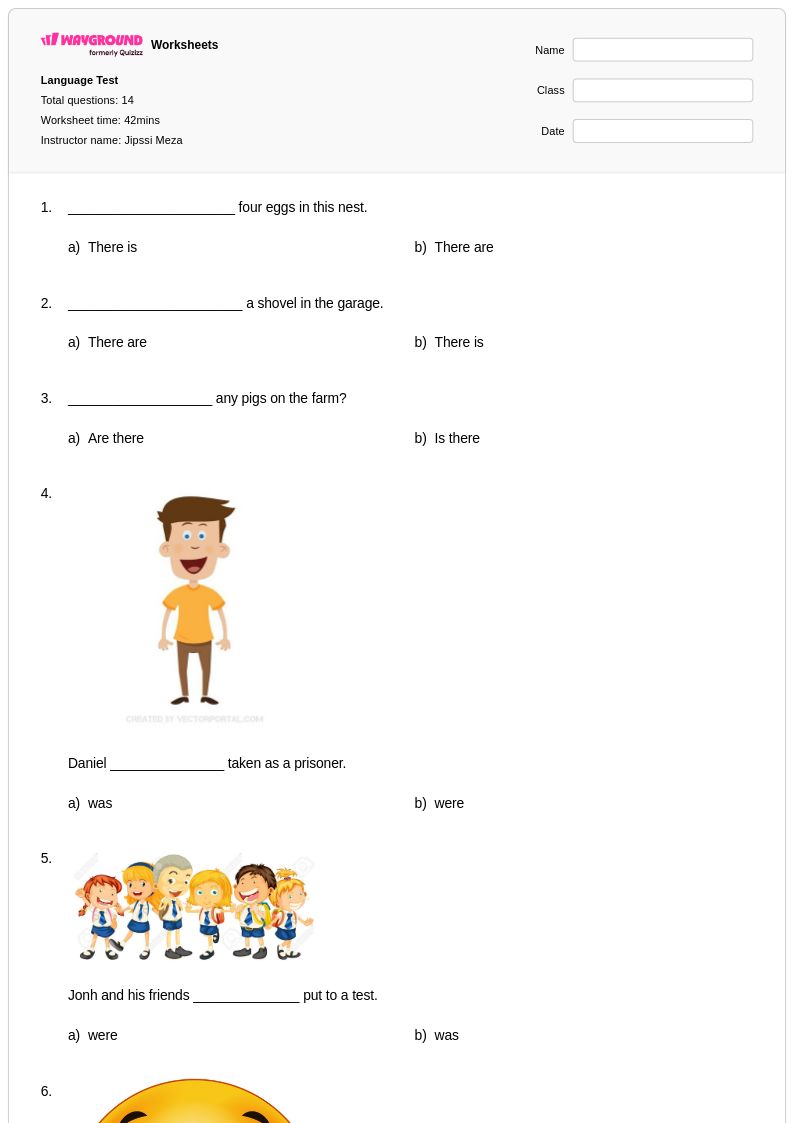
Explore Wayground's free Class 2 homonyms worksheets and printables that help students master words with identical spellings but different meanings through engaging practice problems and comprehensive answer keys.
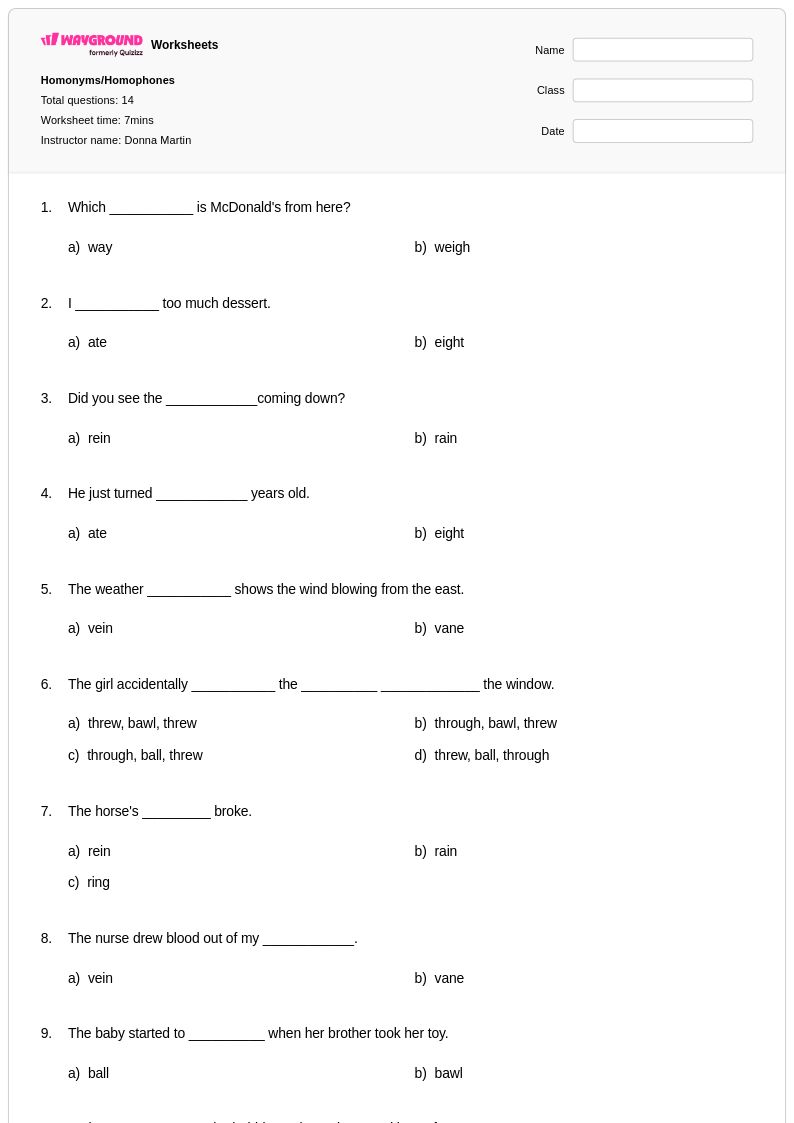
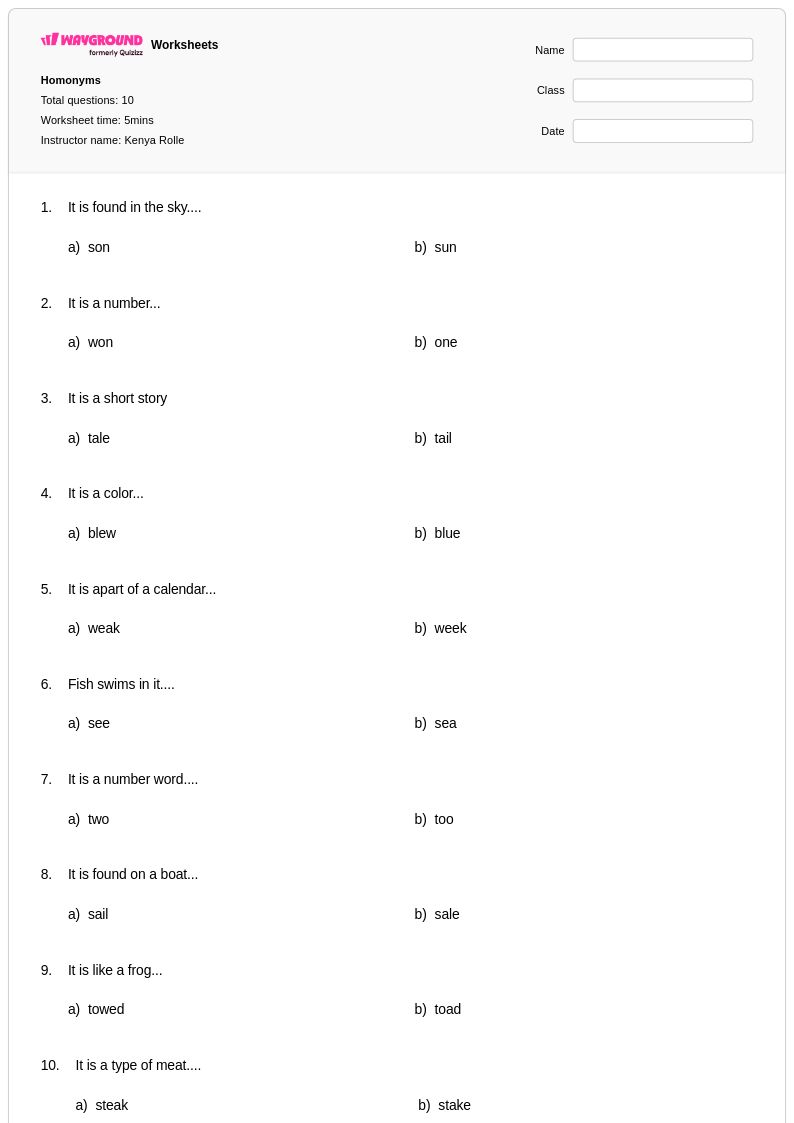
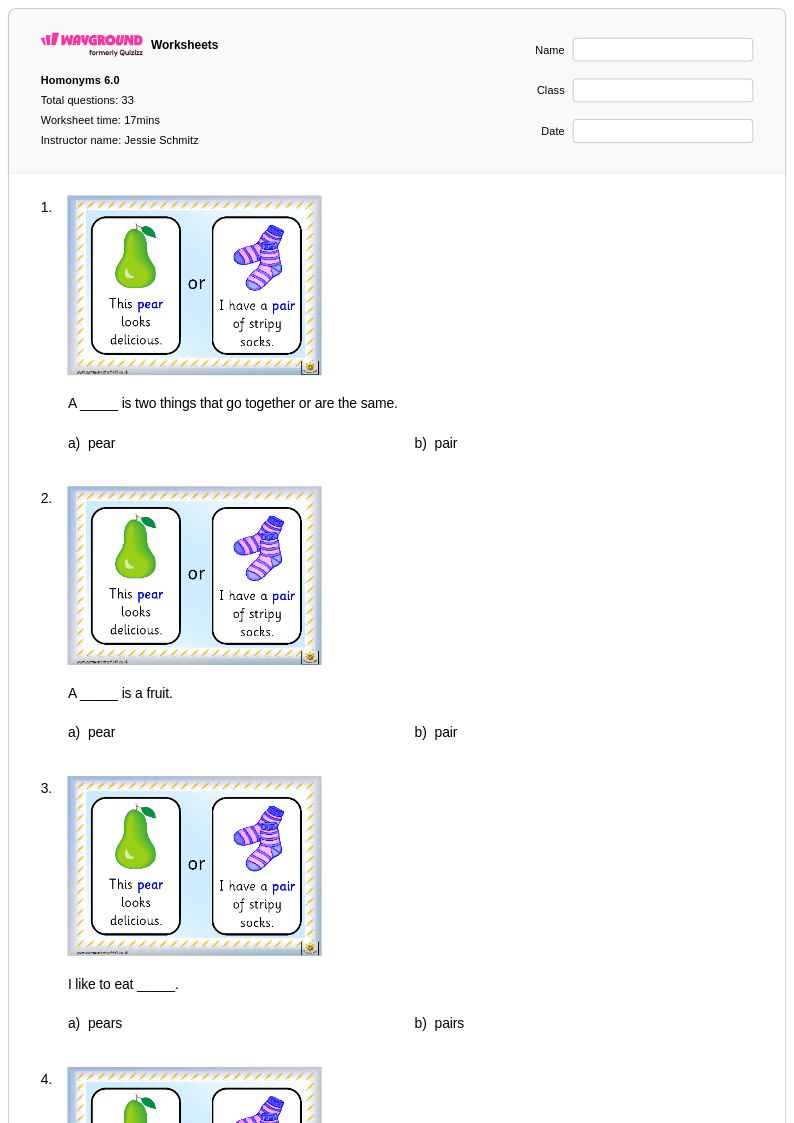
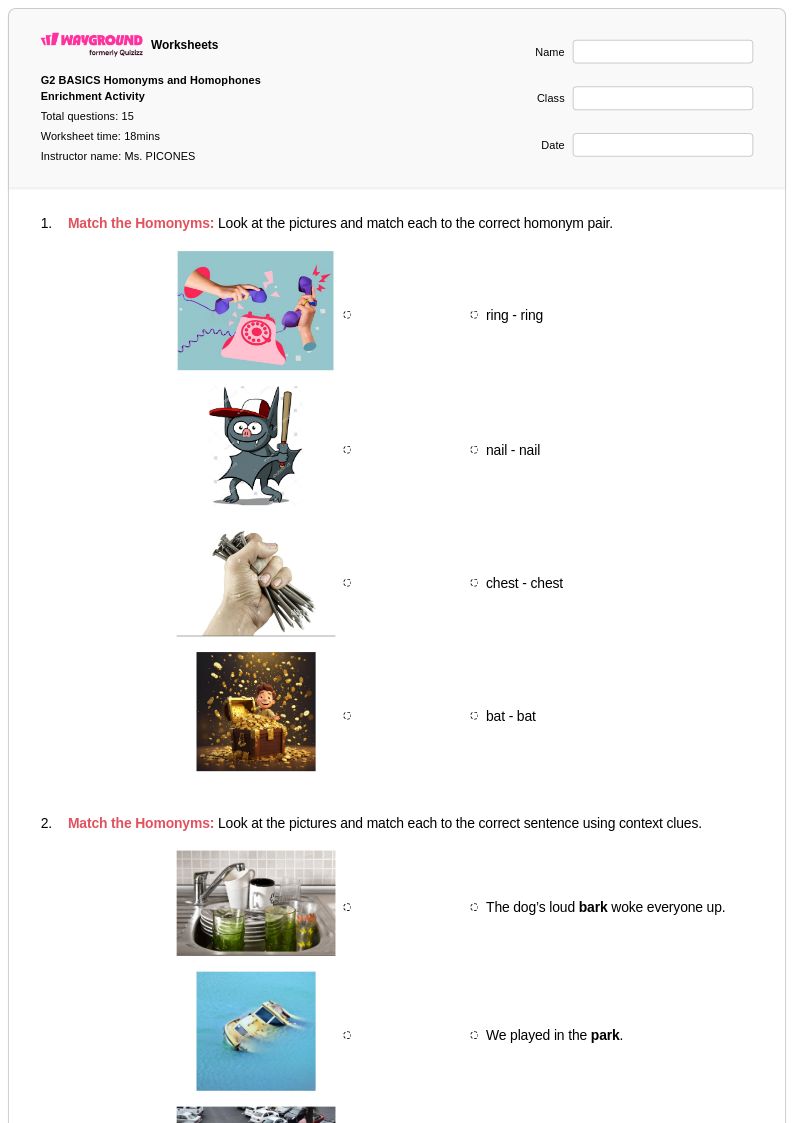
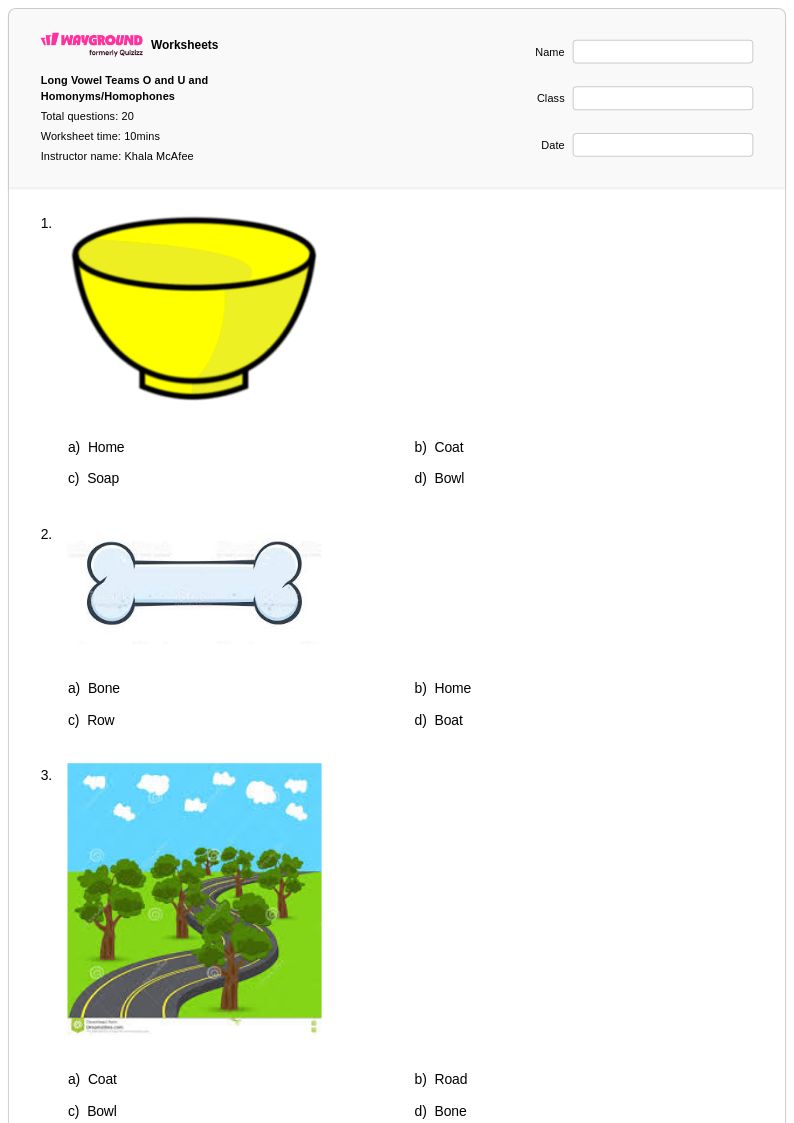
Homonyms worksheets for Class 2 students available through Wayground (formerly Quizizz) provide essential foundational practice for young learners developing vocabulary recognition and reading comprehension skills. These carefully designed educational resources help second-grade students distinguish between words that sound the same but have different meanings and often different spellings, such as "to," "too," and "two" or "there," "their," and "they're." The worksheets strengthen critical thinking abilities as students learn to use context clues to determine correct word usage, building both their reading fluency and writing accuracy. Each printable worksheet includes comprehensive practice problems that gradually increase in complexity, accompanied by detailed answer keys that enable both independent learning and teacher-guided instruction, making these free educational materials invaluable for consistent skill development.
Wayground (formerly Quizizz) supports educators with an extensive collection of teacher-created homonym worksheets, drawing from millions of high-quality resources specifically designed for Class 2 language instruction. The platform's robust search and filtering capabilities allow teachers to quickly locate materials that align with specific learning standards and individual student needs, while built-in differentiation tools enable seamless customization for diverse learning levels within the same classroom. These homonym worksheet collections are available in both printable pdf formats for traditional paper-based learning and digital formats for interactive classroom engagement, providing educators with flexible options for lesson planning, targeted remediation, and enrichment activities. Teachers can efficiently organize skill practice sessions, track student progress, and adapt instruction based on individual learning outcomes, ensuring that every second-grade student develops strong foundational vocabulary skills essential for reading comprehension success.
FAQs
How do I teach homonyms to students who keep confusing them?
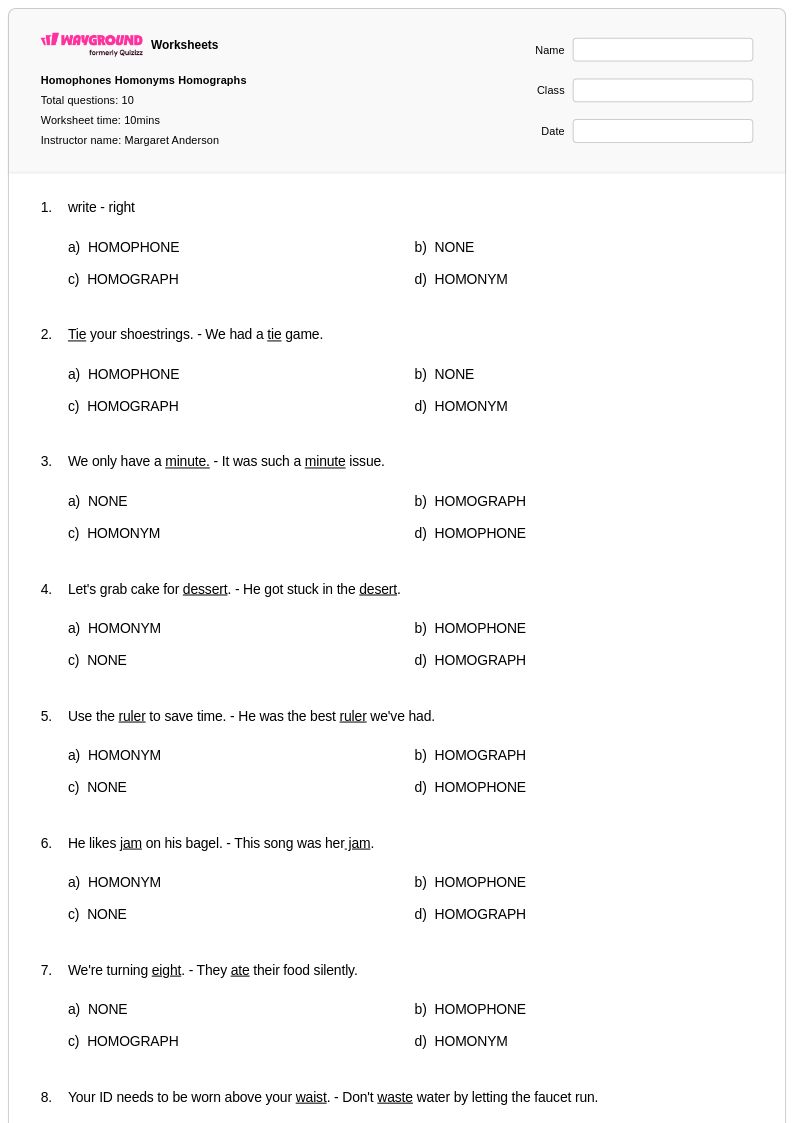
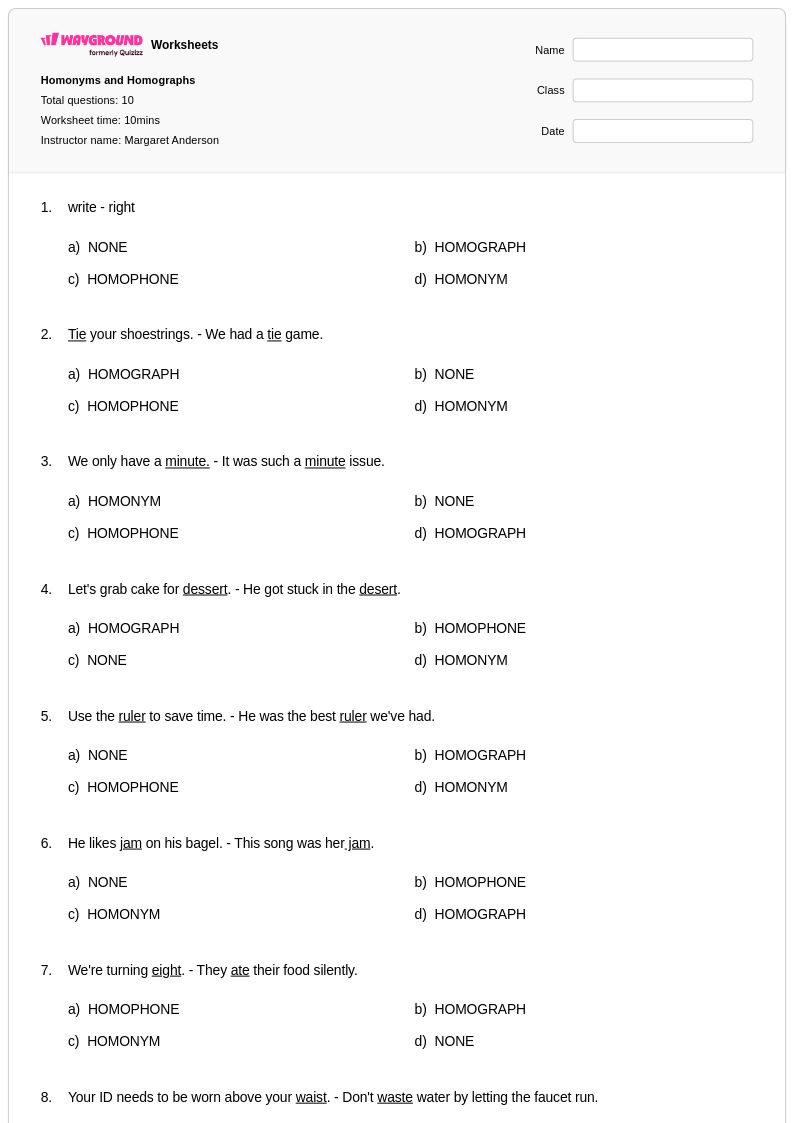
The most effective approach is to teach homonyms in context rather than in isolation. Present each word in a complete sentence and have students analyze meaning clues before identifying which form is correct. Grouping commonly confused pairs like 'their/there/they're' or 'to/too/two' into focused mini-lessons helps students build pattern recognition over time rather than trying to memorize all homonyms at once.
What kinds of exercises help students practice homonyms effectively?
Fill-in-the-blank exercises where students select the correct homonym based on sentence context are particularly effective because they simulate real writing decisions. Sentence-rewriting tasks, matching definitions to word forms, and error-correction activities also reinforce accurate usage. Repeated low-stakes practice with the same high-frequency pairs — such as 'break/brake' and 'their/there/they're' — builds automaticity faster than covering many pairs in a single session.
What mistakes do students most commonly make with homonyms?
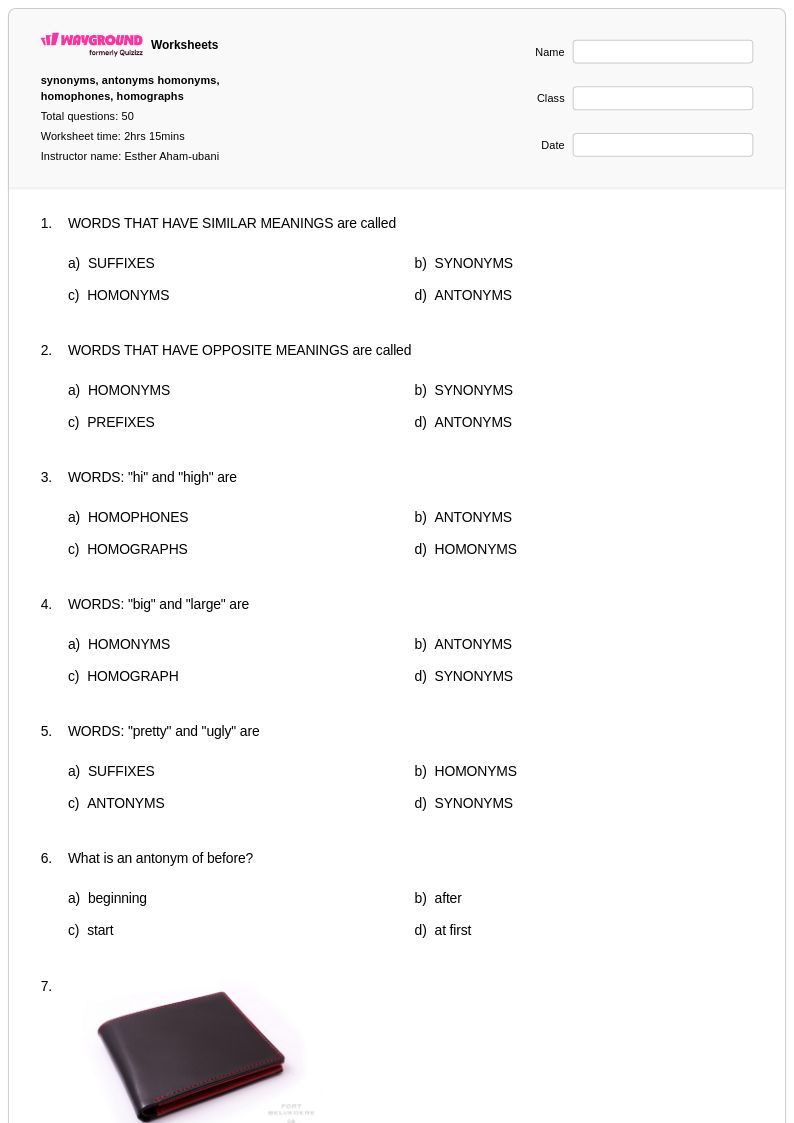
Students most frequently confuse homonyms that are phonetically identical but have high-frequency usage in different grammatical roles, such as 'their,' 'there,' and 'they're' or 'to,' 'too,' and 'two.' A common error pattern is relying on spelling familiarity rather than meaning — students write the word they've seen most often regardless of context. Another persistent mistake is treating homophones and homonyms interchangeably, which can cause confusion when definitions are introduced.
How can I use homonym worksheets to support students at different skill levels?
For struggling students, start with worksheets focused on two-word pairs with clear contextual clues and consider enabling Wayground's reduced answer choices accommodation to lower cognitive load during digital practice. More advanced students benefit from open-response tasks that ask them to write original sentences using each homonym correctly. Wayground also supports extended time and read-aloud settings for individual students, so accommodations can be applied without disrupting the rest of the class.
How do I use Wayground's homonym worksheets in my classroom?
Wayground's homonym worksheets are available as printable PDFs for traditional classroom use and in digital formats for technology-integrated environments, giving teachers flexibility regardless of their classroom setup. You can assign them as independent practice, homework, or structured review, and Wayground also allows you to host worksheets as a live quiz so students complete them interactively. Each worksheet includes a complete answer key, so grading and self-assessment are built in.
Are homonym worksheets appropriate for English language learners?
Homonym worksheets can be very effective for English language learners, but context scaffolding is essential since ELL students often lack the incidental exposure to these word pairs that native speakers have. Worksheets that pair each word with a definition and use it in a complete sentence provide the context cues ELL students need most. Wayground's read-aloud feature can also support ELL students by letting them hear the word pronounced as they read, reinforcing the phonetic similarity that makes homonyms challenging in the first place.