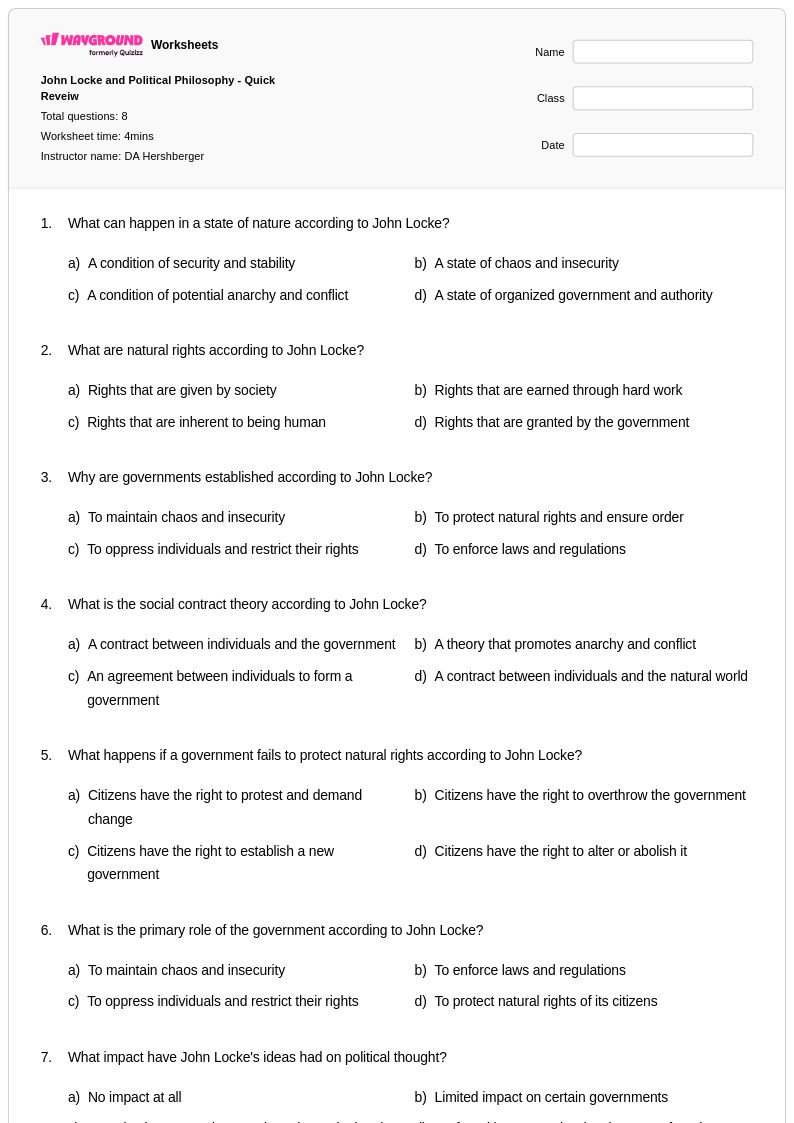
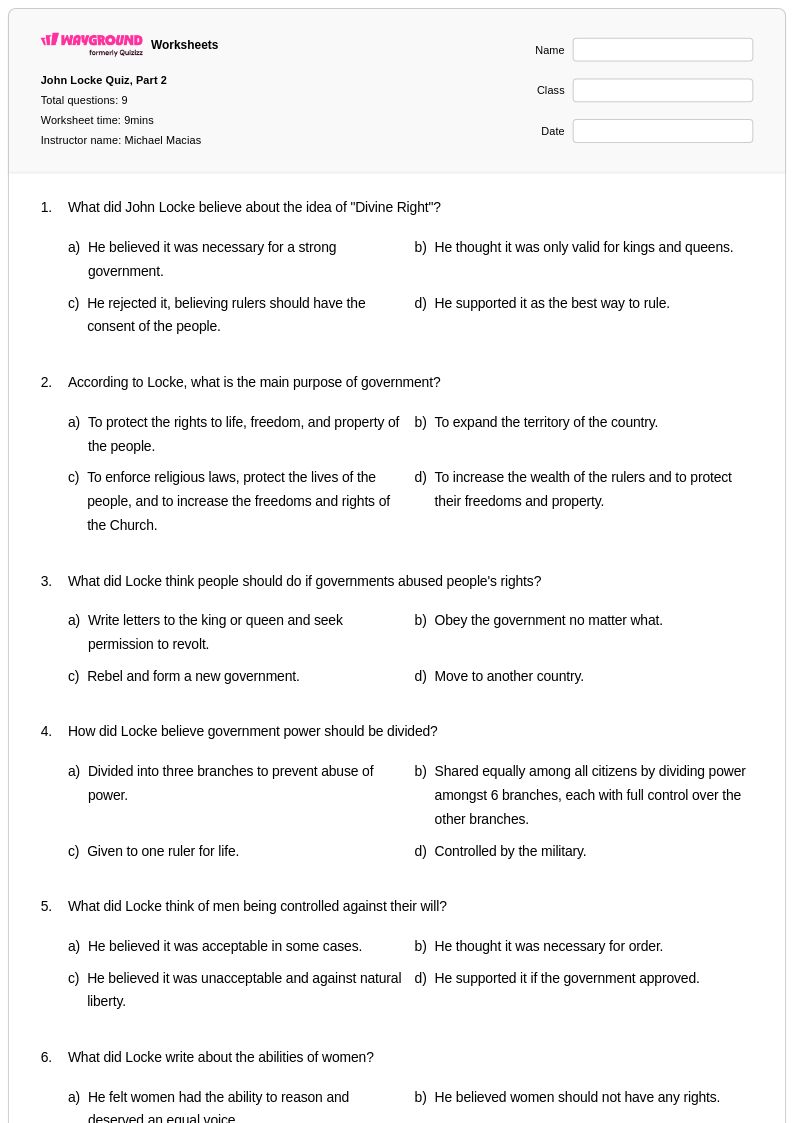
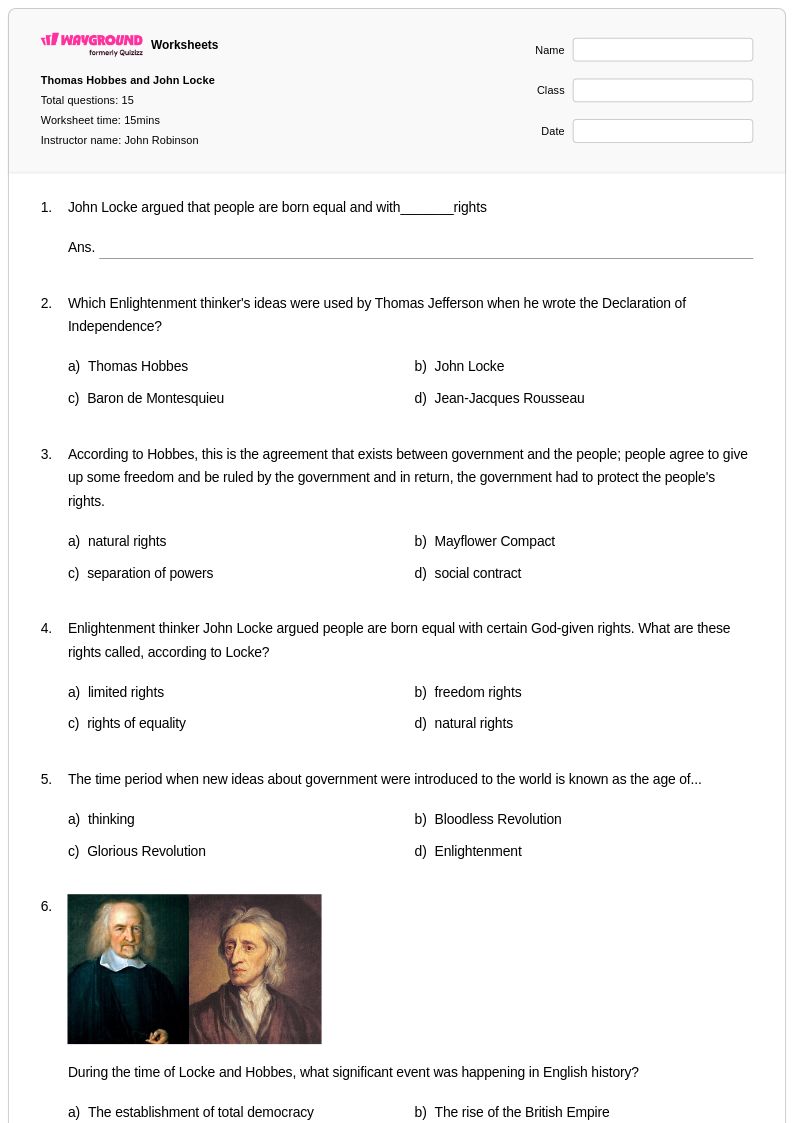
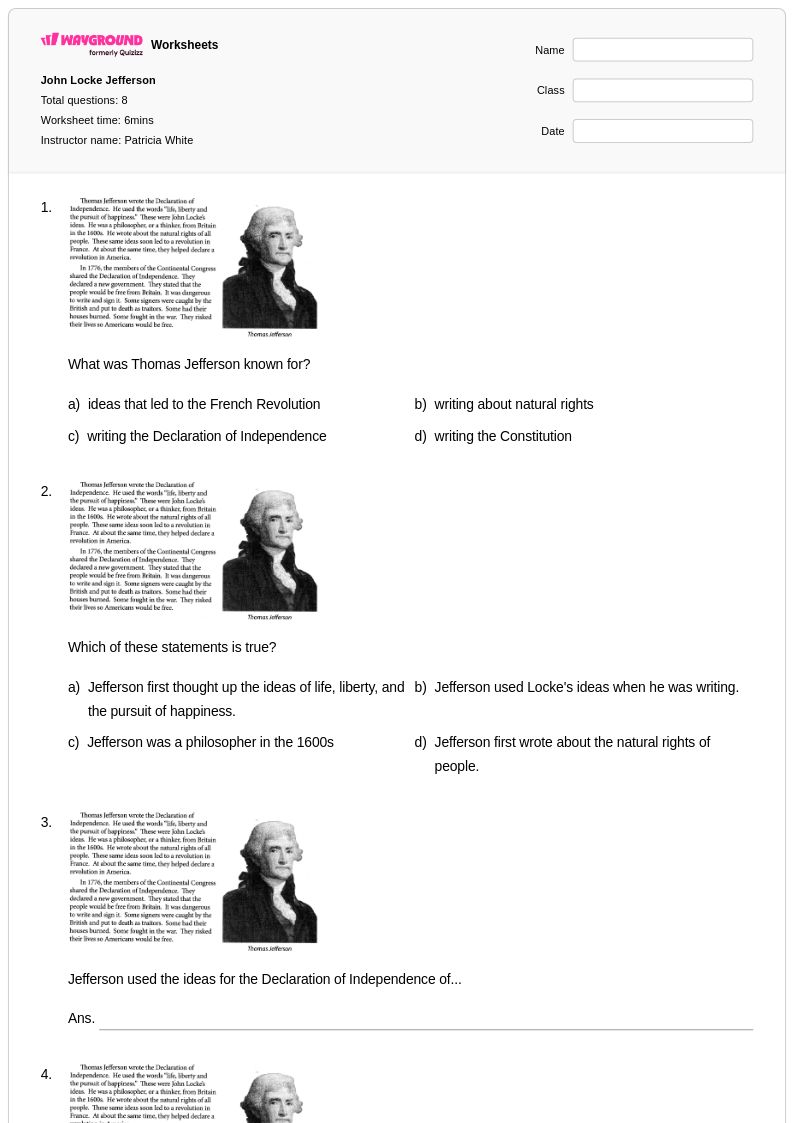
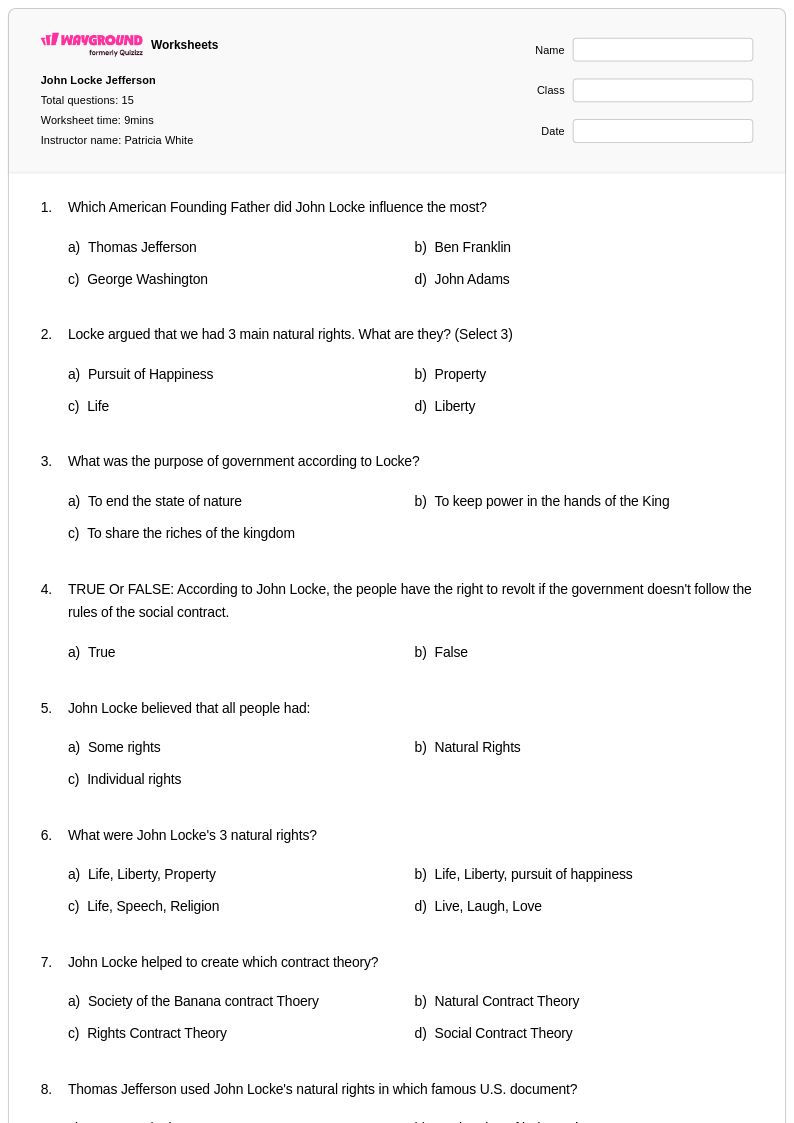
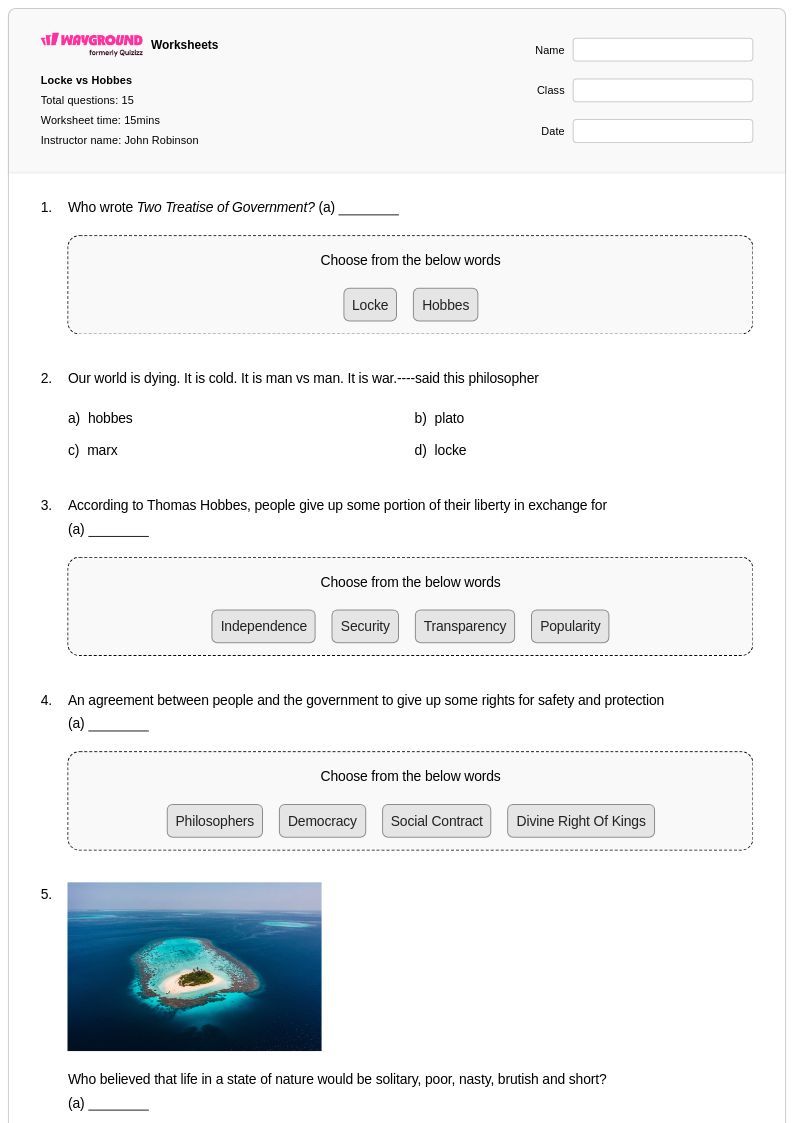
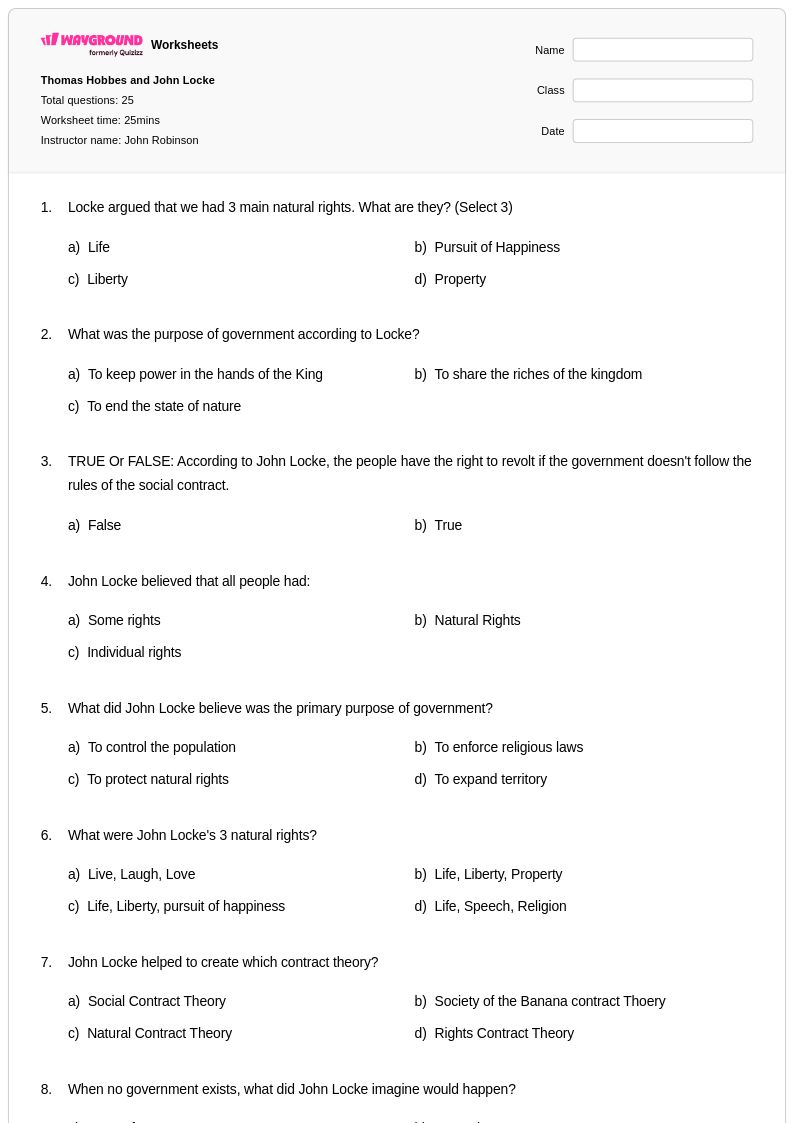
Explore John Locke through Wayground's comprehensive collection of free worksheets and printables, featuring practice problems and answer keys to help students understand his influential political philosophy and Enlightenment ideas.
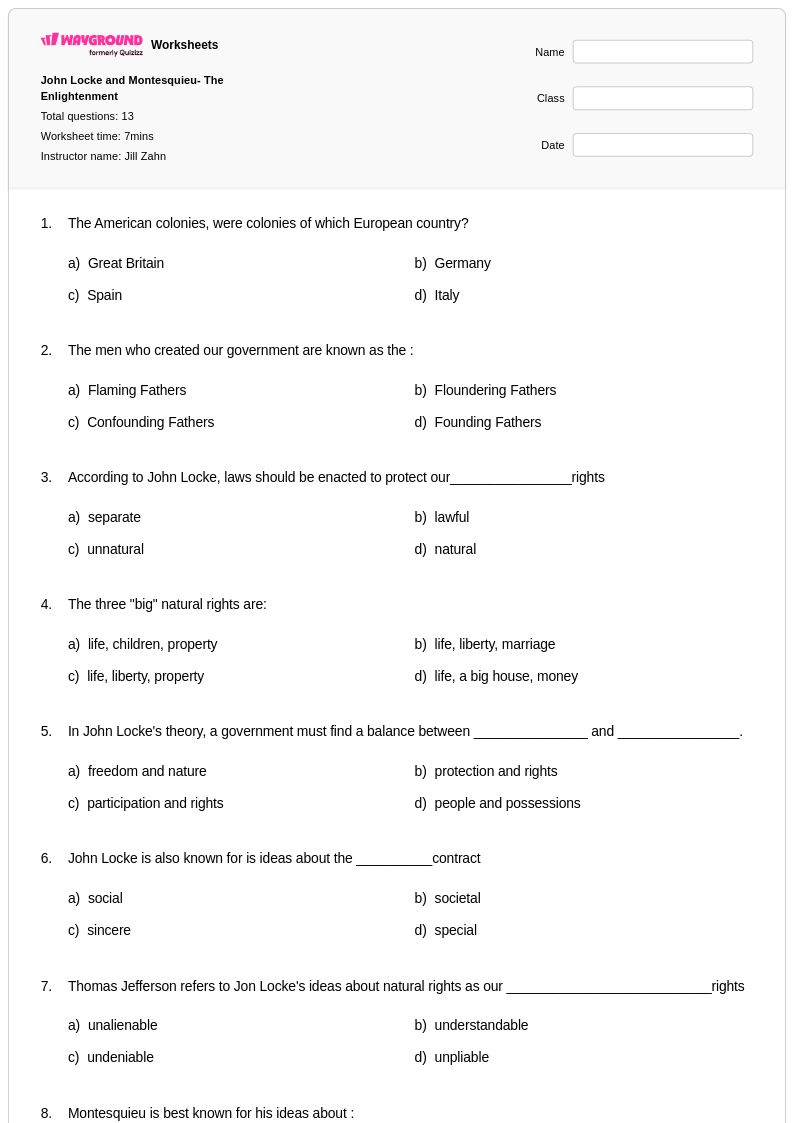
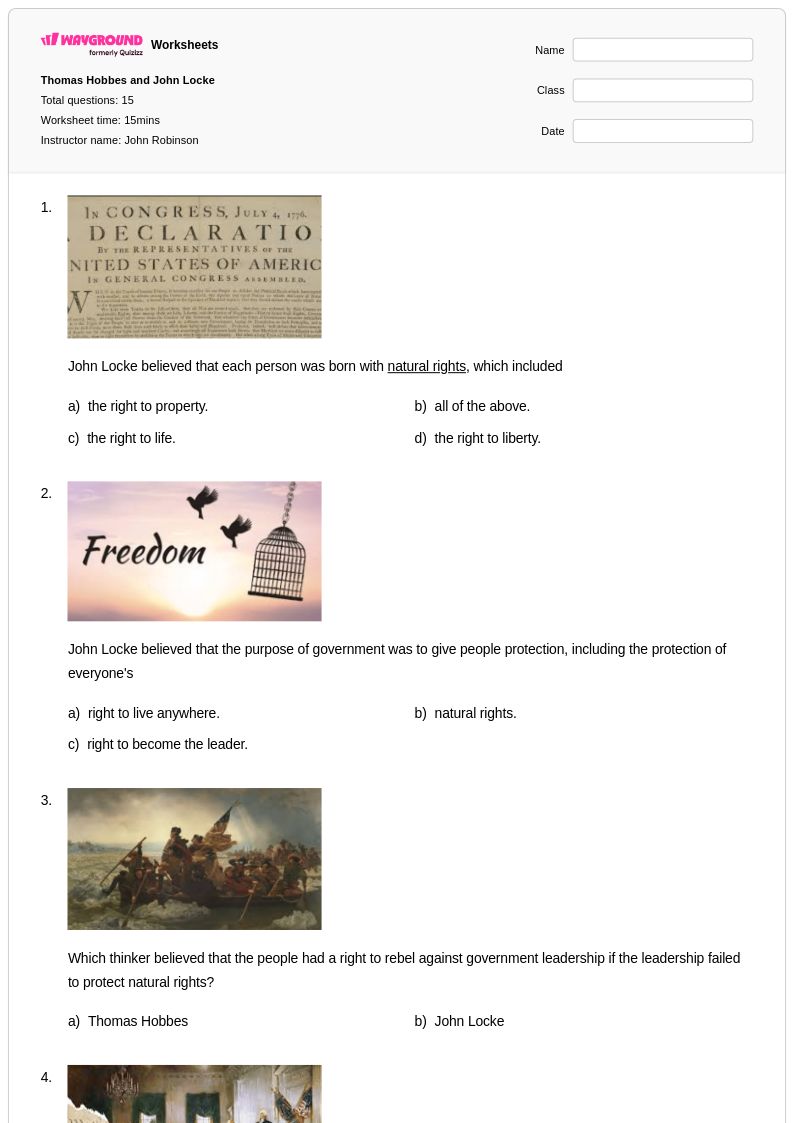
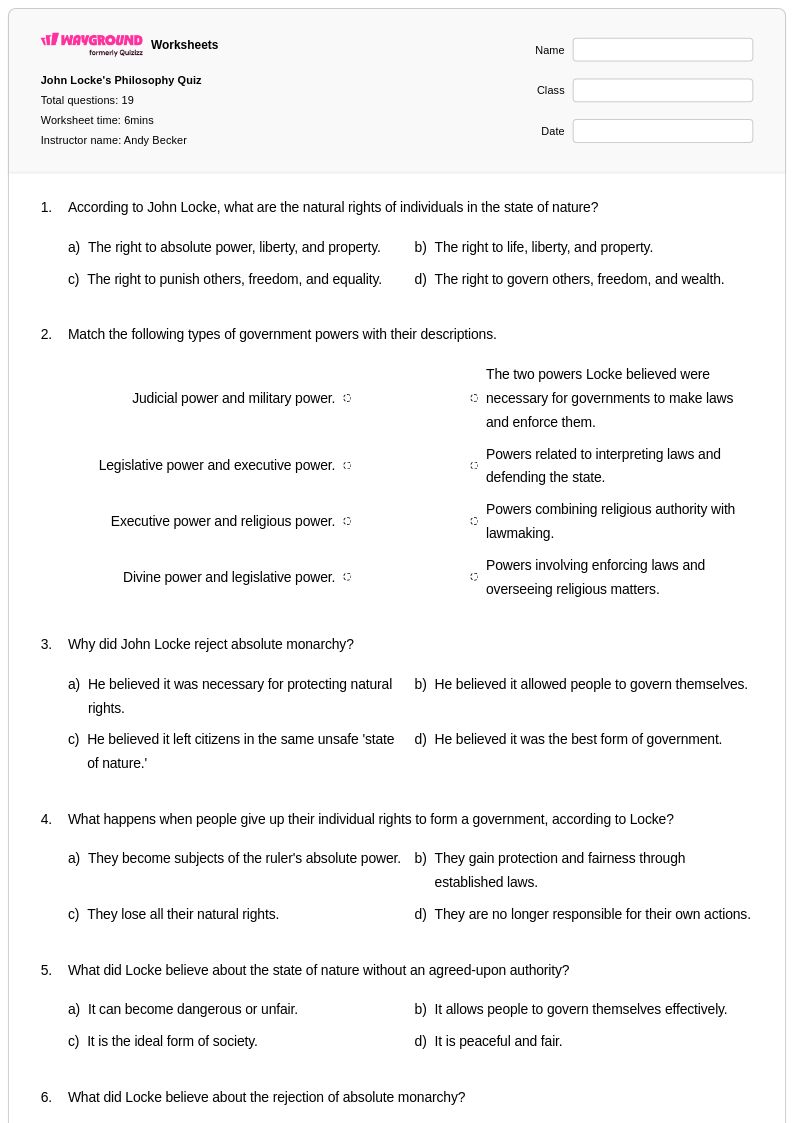
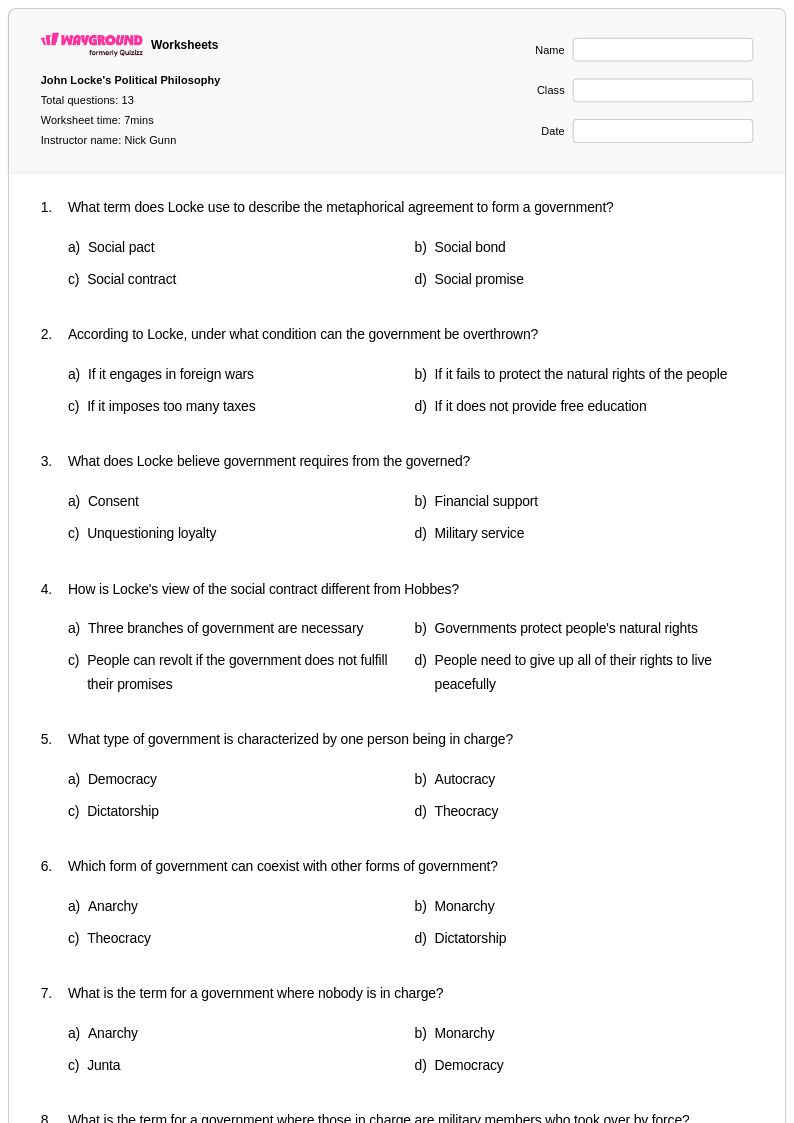
John Locke worksheets available through Wayground provide students with comprehensive materials to explore the philosophical foundations that shaped modern democratic thought and political theory. These expertly crafted resources guide learners through Locke's revolutionary concepts including natural rights, social contract theory, and the principles of limited government that directly influenced the American Revolution and Constitution. Students engage with primary source excerpts, analytical questions, and practice problems that develop critical thinking skills while examining how Locke's ideas about life, liberty, and property transformed political philosophy. Each worksheet includes detailed answer keys and explanations, making these free printables valuable tools for both independent study and classroom instruction as students trace the intellectual roots of democratic governance.
Wayground's extensive collection of John Locke worksheets draws from millions of teacher-created resources, offering educators powerful search and filtering capabilities to locate materials perfectly aligned with their curriculum standards and student needs. Teachers can easily customize these digital and printable pdf resources to support differentiated instruction, whether providing remediation for struggling learners or enrichment activities for advanced students ready to tackle complex philosophical concepts. The platform's flexible tools enable educators to modify content, adjust difficulty levels, and create targeted practice opportunities that help students master essential skills in historical analysis, philosophical reasoning, and understanding cause-and-effect relationships in intellectual history. This comprehensive approach to worksheet management streamlines lesson planning while ensuring students receive consistent, high-quality practice with one of history's most influential political philosophers.
FAQs
How do I teach John Locke's political philosophy in a social studies or history class?
Teaching John Locke effectively starts with grounding students in the historical context of the Enlightenment and the political instability of 17th-century England, which shaped his ideas. From there, introduce his core concepts in sequence: natural rights (life, liberty, and property), the social contract, and the principle of limited government with the right to revolution. Using primary source excerpts from 'Two Treatises of Government' alongside guided questions helps students engage analytically rather than passively absorbing definitions. Connecting Locke's ideas to their direct influence on the Declaration of Independence and the U.S. Constitution gives students a concrete anchor for understanding why his philosophy still matters.
What exercises help students practice understanding John Locke's ideas?
Effective practice exercises for John Locke include primary source analysis tasks where students annotate excerpts from his writings and identify key philosophical claims. Cause-and-effect mapping activities that trace how Locke's ideas about natural rights influenced specific passages in founding documents build analytical skills. Compare-and-contrast exercises pairing Locke with Hobbes or Rousseau deepen understanding by requiring students to articulate meaningful distinctions between Enlightenment thinkers. Short constructed-response prompts asking students to explain concepts like the social contract in their own words are especially useful for checking comprehension and building academic writing skills.
What are common misconceptions students have about John Locke's philosophy?
One of the most frequent misconceptions is that students conflate Locke's social contract with Hobbes's, not recognizing that Locke viewed the natural state as peaceful rather than chaotic, which leads to a fundamentally different justification for government. Students also commonly misread Locke's concept of 'property' as referring only to physical possessions, when Locke used it broadly to encompass life and liberty as well. Another error is assuming Locke believed government authority was absolute once established, when in fact his argument explicitly includes the right of citizens to overthrow a government that violates natural rights. Clarifying these distinctions early prevents compounding errors in essay responses and document-based questions.
How can I use John Locke worksheets to prepare students for document-based or essay assessments?
John Locke worksheets that include primary source excerpts with analytical questions are particularly effective for building the skills students need on document-based questions (DBQs) and constructed-response assessments. Having students practice identifying Locke's central argument, evaluating his evidence, and connecting his ideas to historical outcomes mirrors the exact cognitive demands of AP and state-level assessments. Worksheets with guided prompts that ask students to trace the influence of Locke's philosophy on documents like the Declaration of Independence give them a rehearsed analytical framework they can apply independently during testing.
How do I use Wayground's John Locke worksheets in my classroom?
Wayground's John Locke worksheets are available as printable PDFs for traditional classroom use and in digital formats for technology-integrated environments, so they work whether students are in the room or learning remotely. Teachers can also host worksheets as a quiz directly on Wayground, which is useful for formative assessment or independent practice with automatic tracking. Each worksheet includes a complete answer key, reducing prep time and making them practical for both direct instruction and self-paced independent study.
How do I differentiate John Locke instruction for students at different reading and skill levels?
Differentiation for a topic as text-heavy as John Locke's philosophy often requires adjusting both the complexity of source material and the level of scaffolding in analytical tasks. On Wayground, teachers can apply student-level accommodations including Read Aloud for students who struggle with dense philosophical texts, reduced answer choices to lower cognitive load on comprehension questions, and extended time for students who need additional processing time. These accommodations can be assigned to individual students without notifying the rest of the class, so differentiation happens seamlessly within a single shared assignment.