Free Printable Landmark Supreme Court Cases Worksheets for Class 12
Explore Wayground's comprehensive collection of free Class 12 Landmark Supreme Court Cases worksheets and printables with answer keys, helping students analyze pivotal constitutional decisions and their lasting impact on American law and society.
Explore printable Landmark Supreme Court Cases worksheets for Class 12
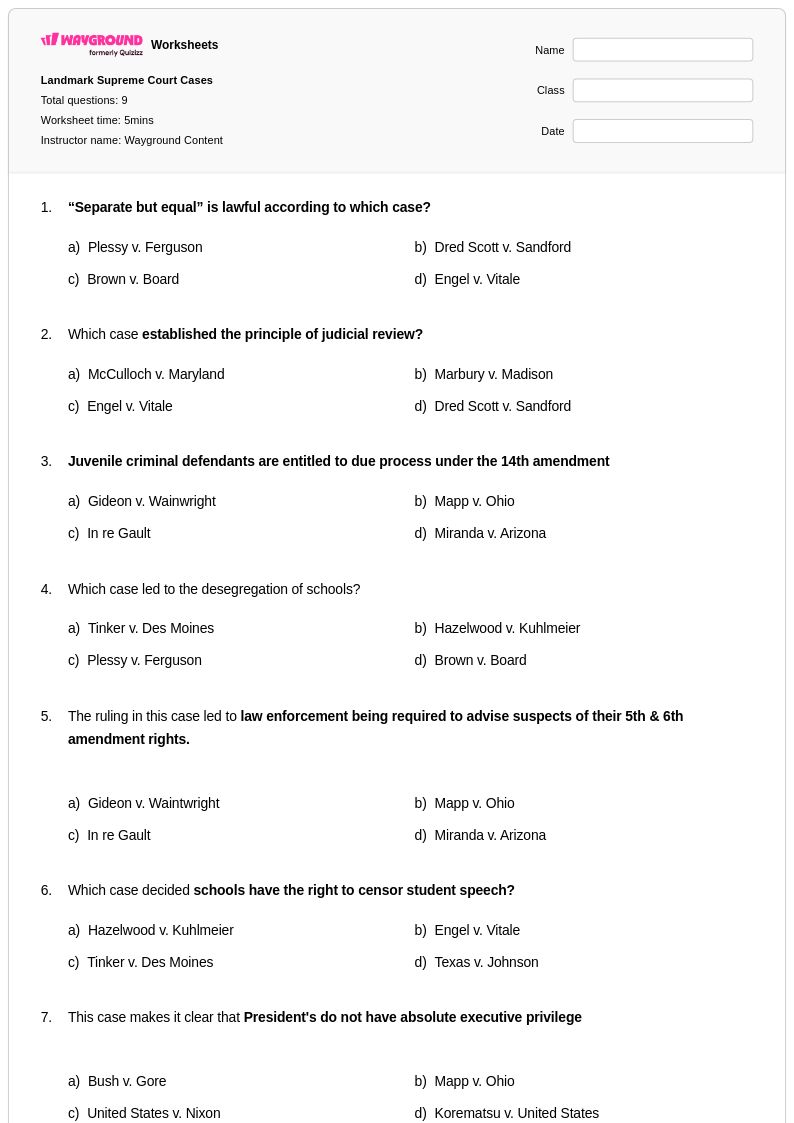
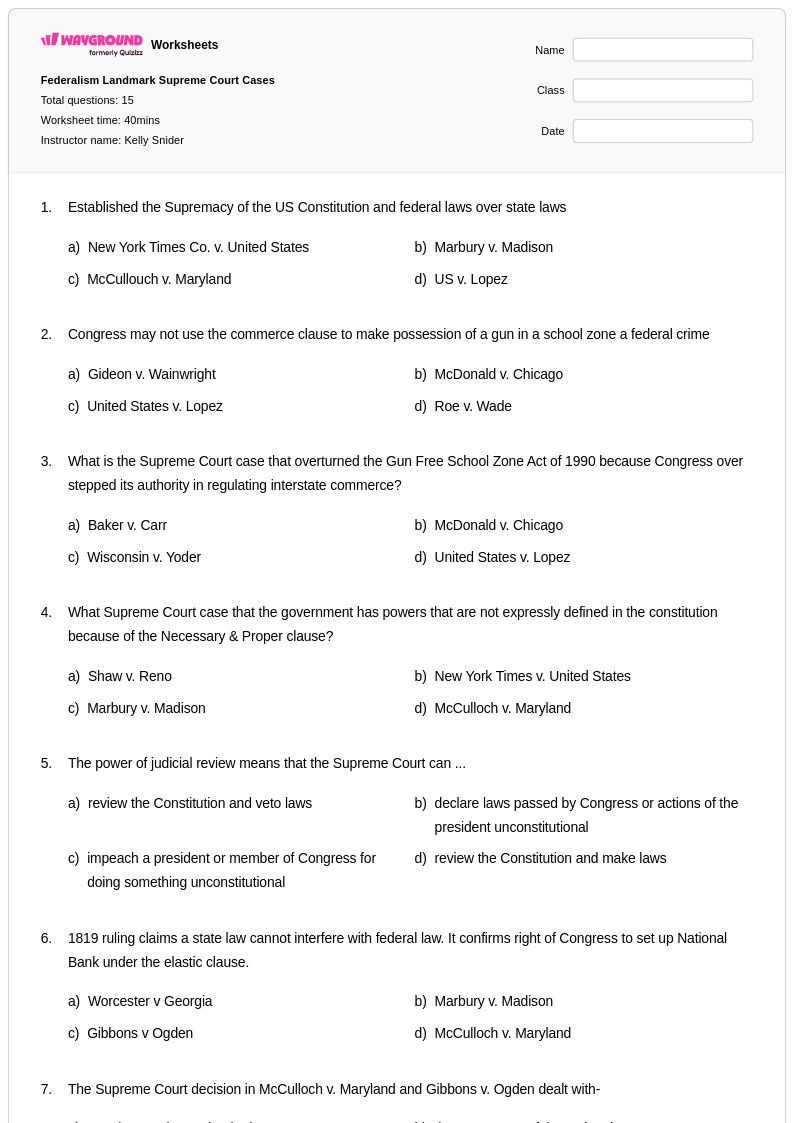
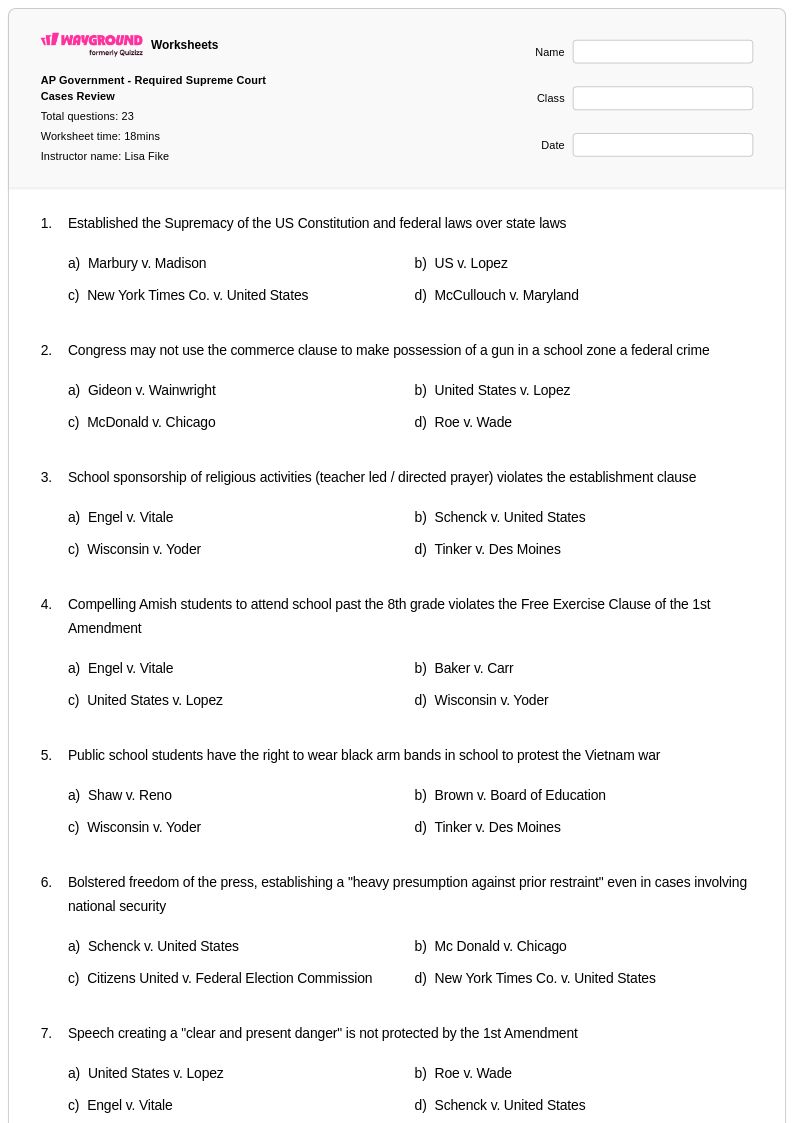
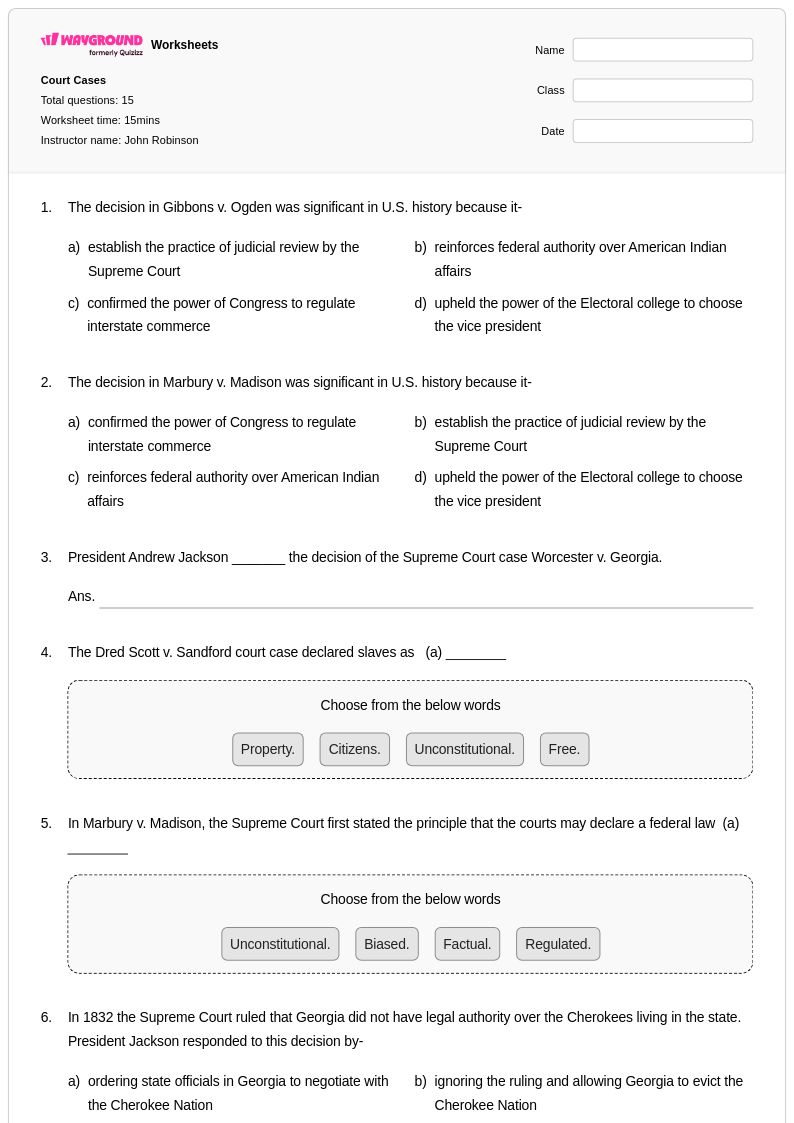
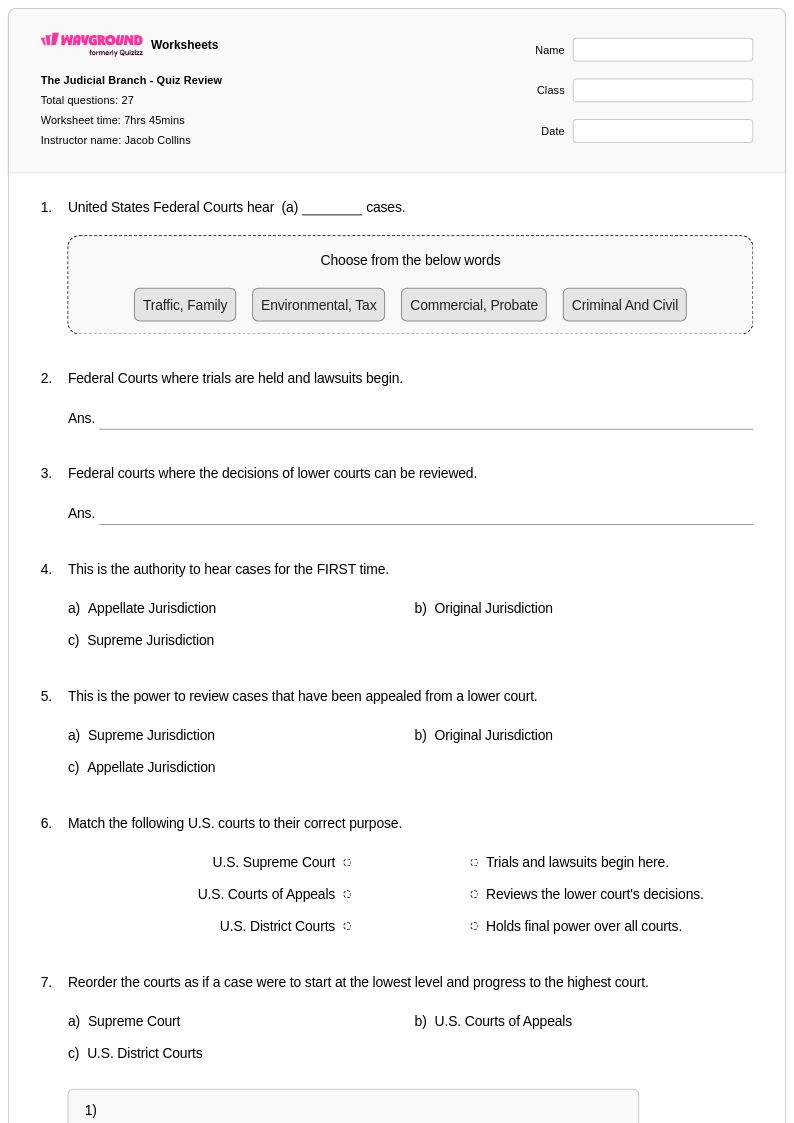
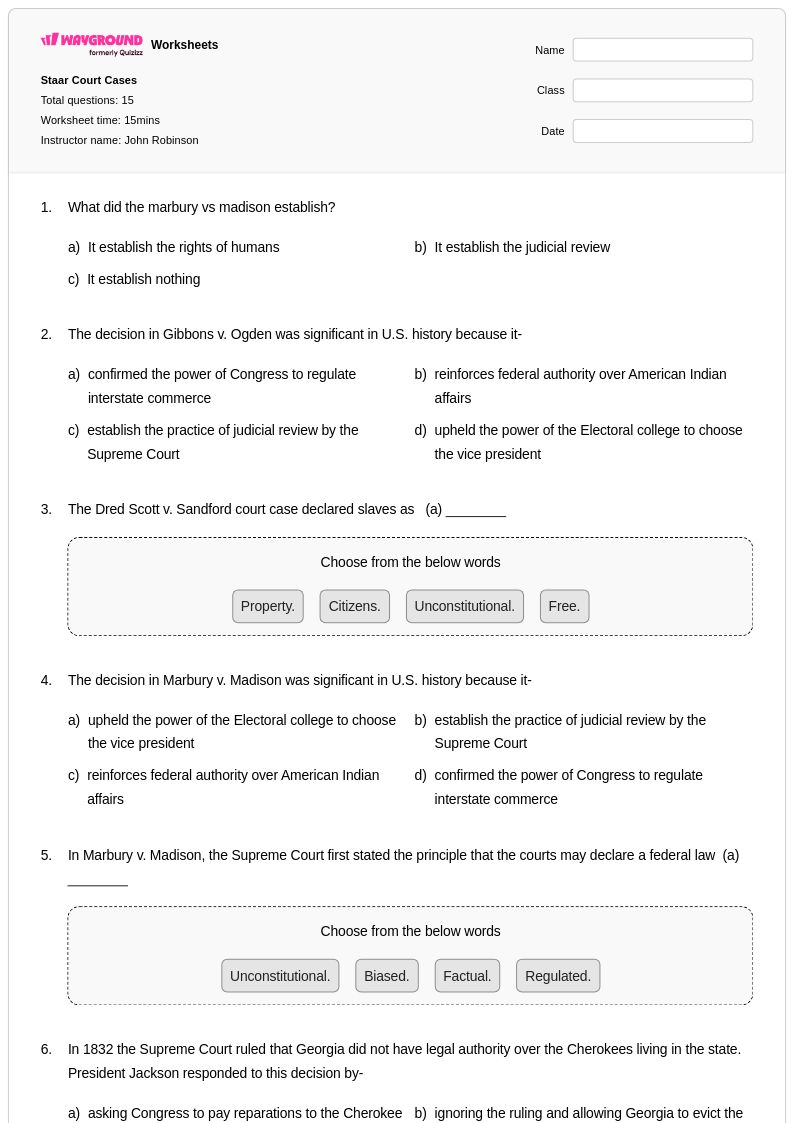
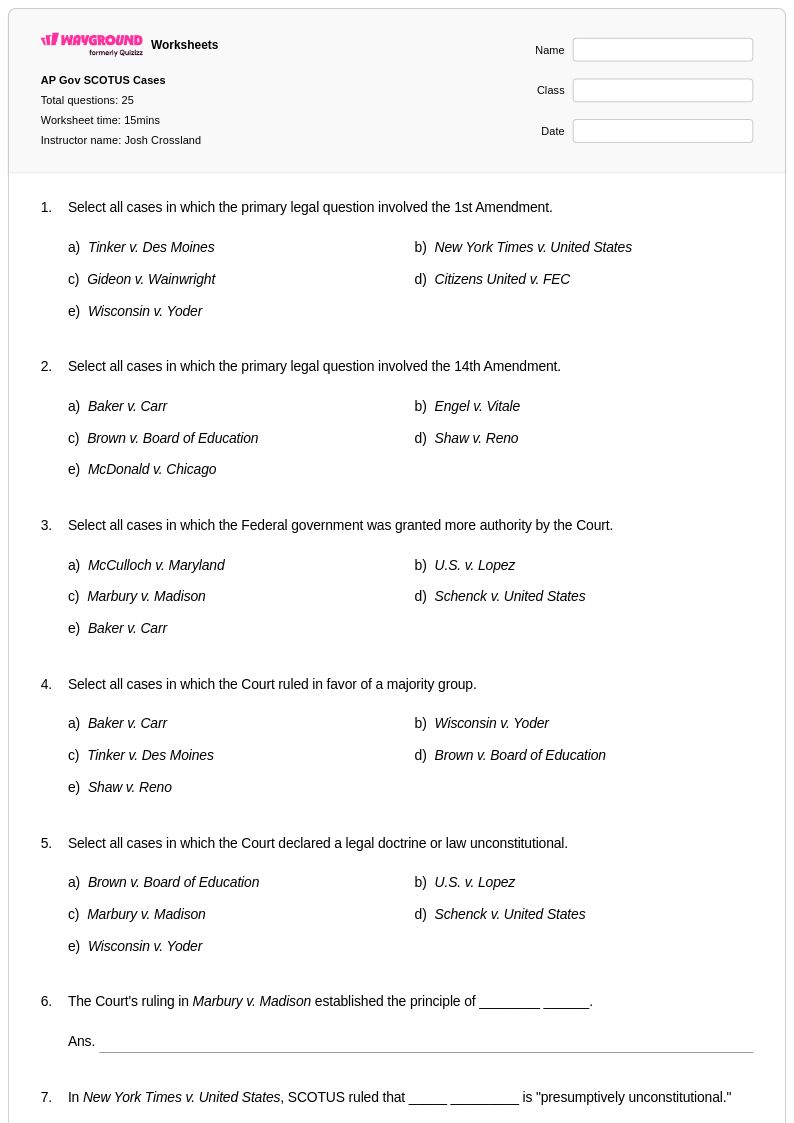
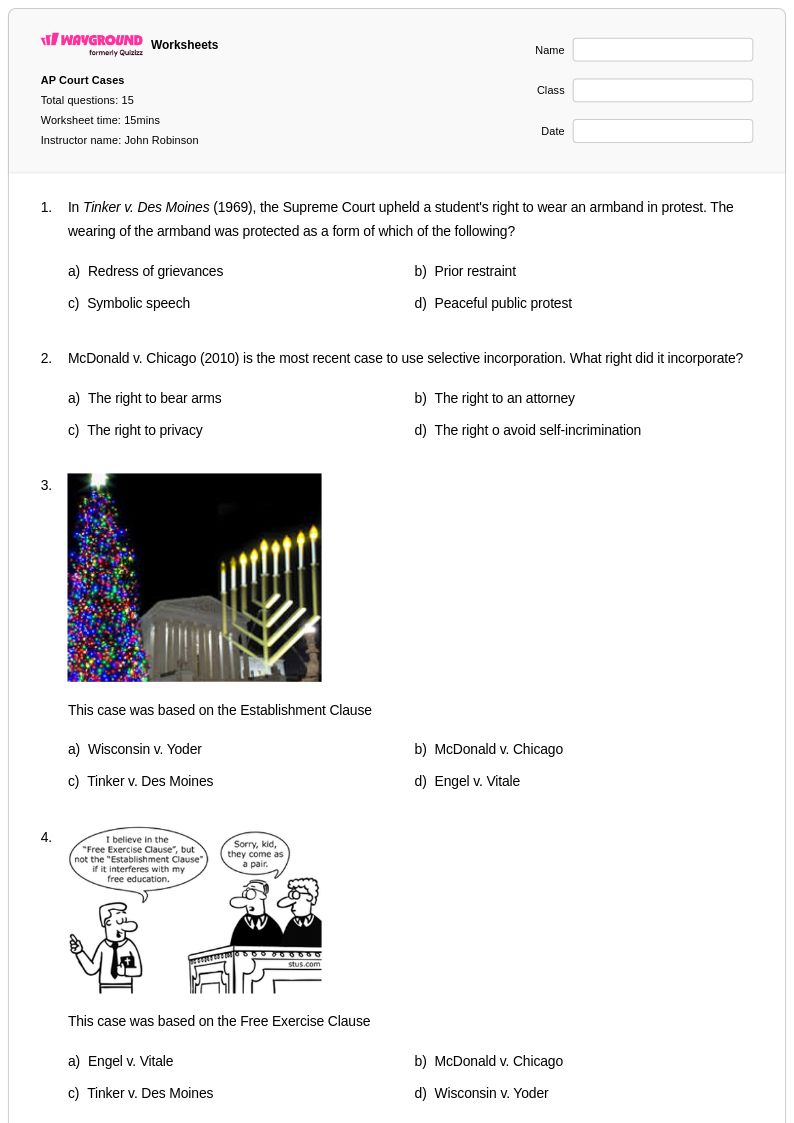
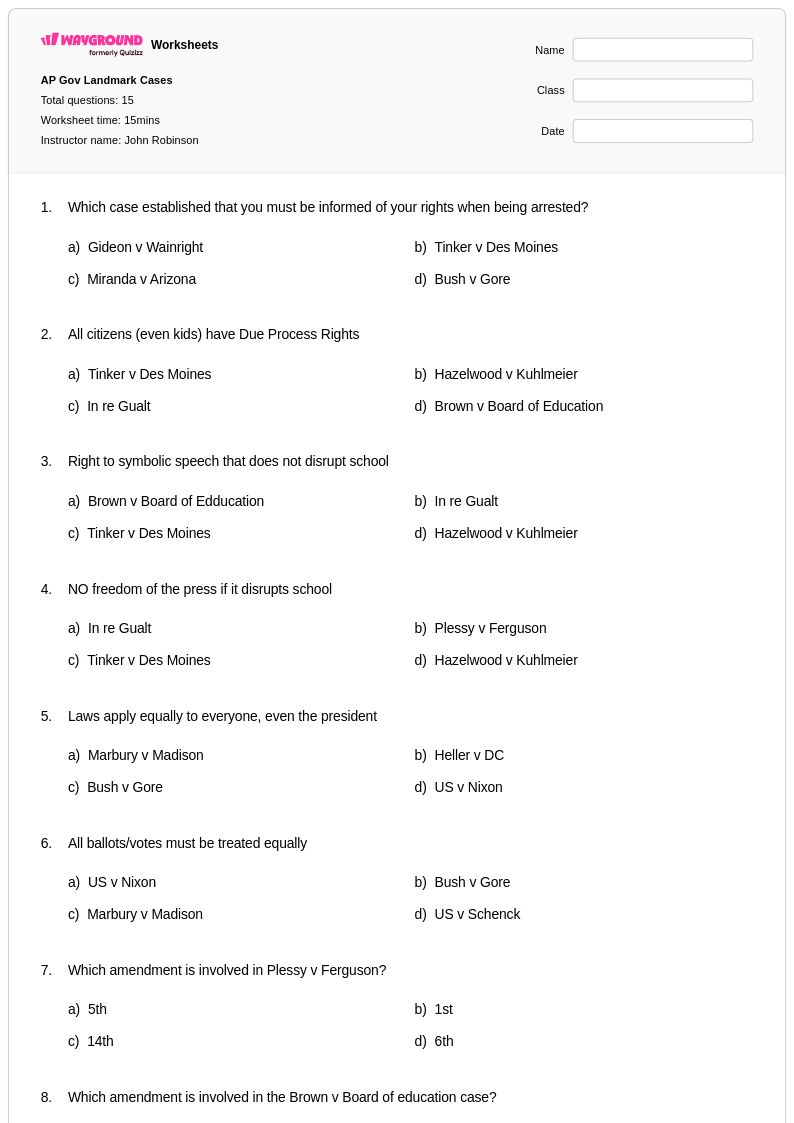
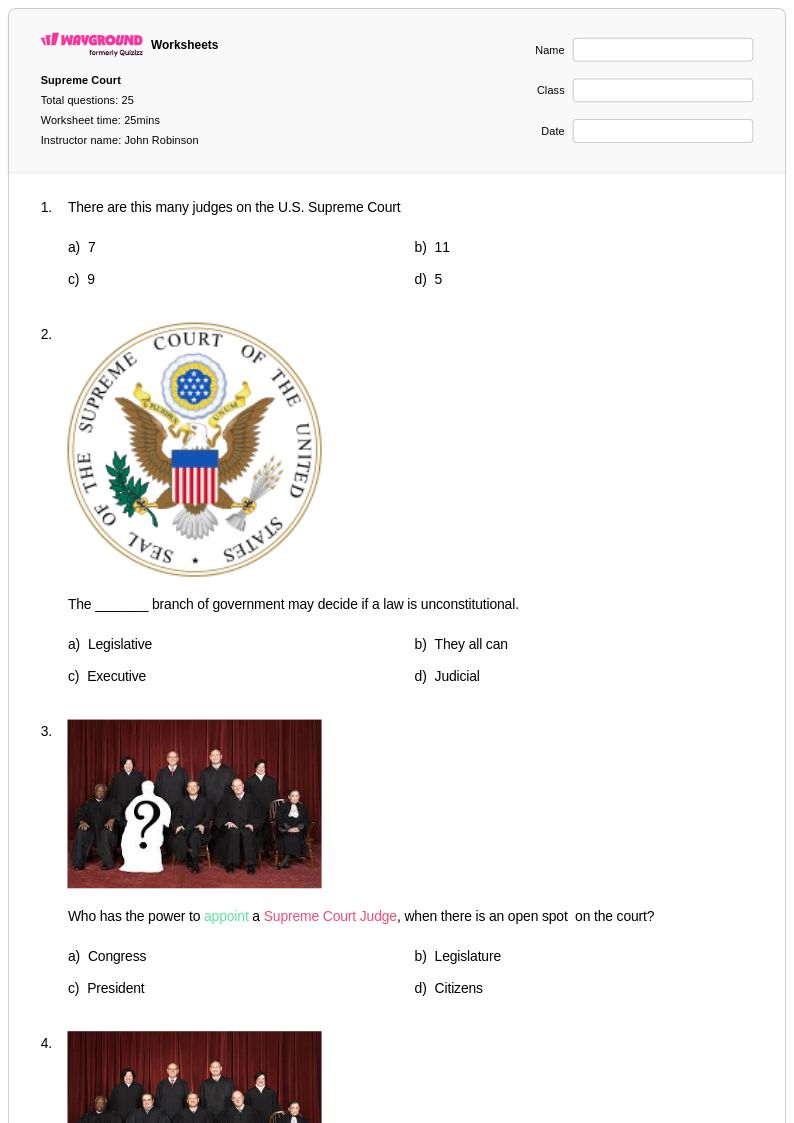
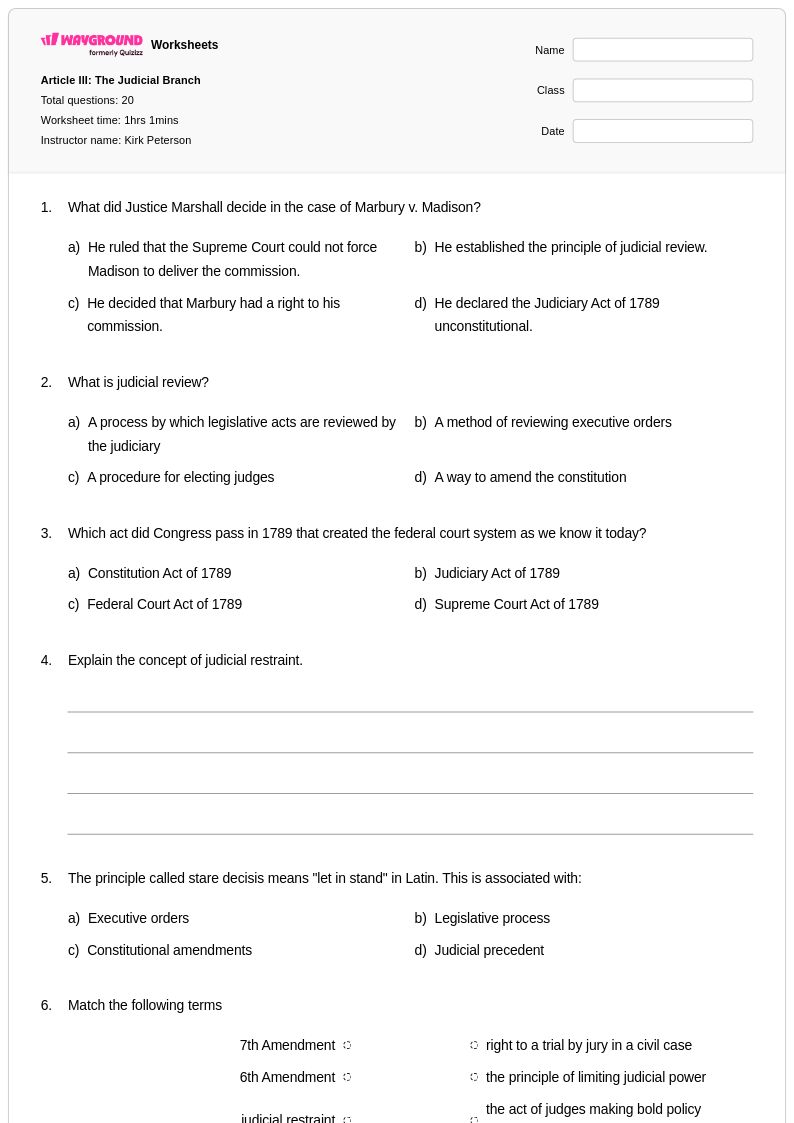
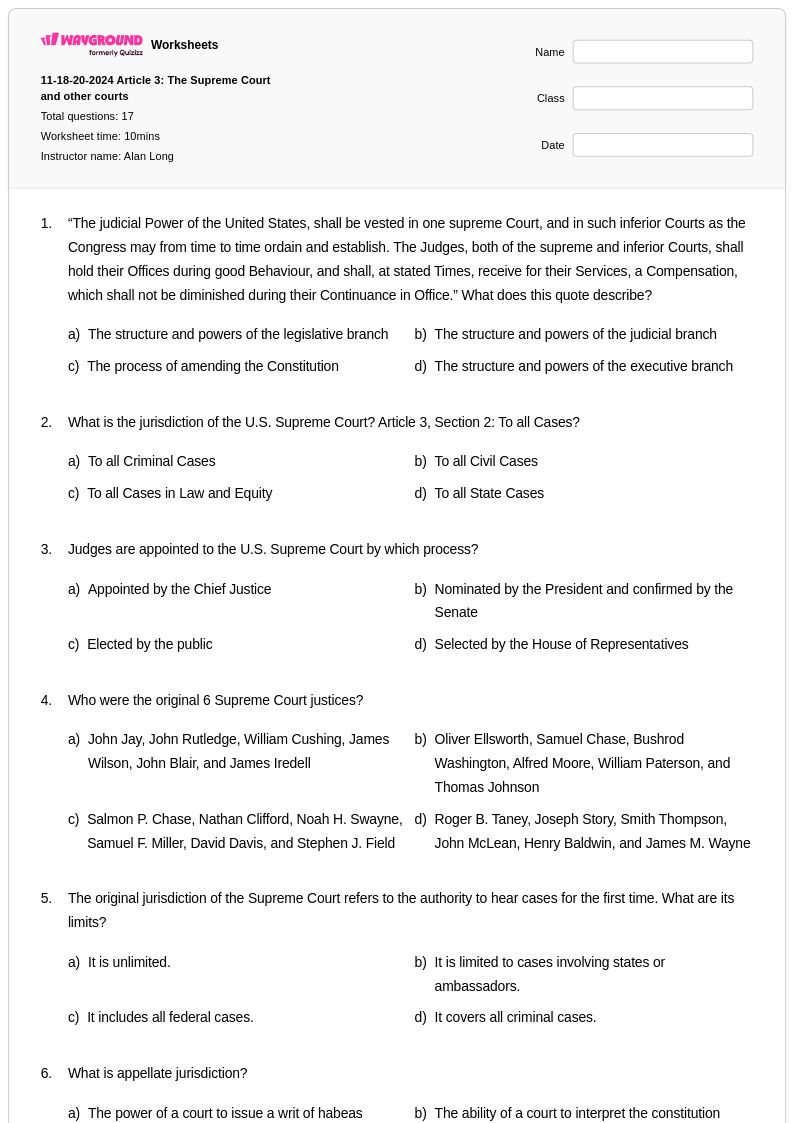
Landmark Supreme Court Cases worksheets for Class 12 students available through Wayground (formerly Quizizz) provide comprehensive coverage of the most influential constitutional decisions that have shaped American law and society. These expertly designed educational resources strengthen students' analytical skills by examining pivotal cases such as Marbury v. Madison, Brown v. Board of Education, Miranda v. Arizona, and Roe v. Wade, among others. Each worksheet collection includes detailed case studies, constitutional analysis activities, and practice problems that challenge students to evaluate legal reasoning, understand judicial precedent, and connect historical decisions to contemporary issues. The materials feature complete answer keys and are available as free printables in pdf format, enabling educators to seamlessly integrate rigorous constitutional law content into their civics curriculum while developing students' critical thinking and legal literacy skills.
Wayground (formerly Quizizz) empowers educators with access to millions of teacher-created resources specifically designed for landmark Supreme Court case instruction, featuring robust search and filtering capabilities that allow instructors to locate materials aligned with state and national civics standards. The platform's differentiation tools enable teachers to customize worksheet difficulty levels and content focus areas, accommodating diverse learning needs while maintaining academic rigor appropriate for Class 12 students. These flexible resources are available in both printable and digital formats, including downloadable pdf versions, making them ideal for various instructional settings and learning modalities. Teachers can efficiently plan comprehensive units on constitutional law, provide targeted remediation for students struggling with legal concepts, offer enrichment opportunities for advanced learners, and facilitate ongoing skill practice in legal analysis and constitutional interpretation.
FAQs
How do I teach landmark Supreme Court cases in a civics or U.S. history class?
Start by grounding students in the constitutional question at the center of each case before introducing the ruling itself. Use primary source excerpts from majority opinions alongside case summaries to help students trace the legal reasoning, not just the outcome. Connecting each decision to a specific constitutional amendment or clause (such as the 14th Amendment in Brown v. Board of Education or the 6th Amendment in Gideon v. Wainwright) gives students a concrete framework for analysis. Sequencing cases chronologically or thematically around civil rights, federalism, or due process helps students see how precedents build on one another over time.
What are the most important landmark Supreme Court cases students need to know?
The cases most consistently covered in K-12 civics instruction include Marbury v. Madison (judicial review), McCulloch v. Maryland (federal supremacy), Brown v. Board of Education (equal protection), Gideon v. Wainwright (right to counsel), Miranda v. Arizona (self-incrimination protections), Tinker v. Des Moines (student free speech), and Roe v. Wade (privacy rights). Each of these cases establishes or significantly expands a constitutional principle that continues to shape American law and governance. Mastery of these cases is typically required for AP Government, state civics assessments, and U.S. history standardized tests.
What exercises help students practice analyzing Supreme Court cases?
Effective practice exercises include case brief templates (IRAC format: Issue, Rule, Analysis, Conclusion), constitutional clause matching, and opinion-writing tasks where students argue from either the majority or dissenting position. Comparing two cases that address the same constitutional principle, such as Plessy v. Ferguson and Brown v. Board of Education, reinforces how legal precedent evolves. Practice problems that ask students to apply a ruling's logic to a hypothetical scenario are especially useful for developing transferable legal reasoning skills.
What mistakes do students commonly make when analyzing Supreme Court cases?
The most common error is treating a ruling's outcome as self-evident rather than analyzing the constitutional reasoning that produced it. Students frequently confuse the facts of a case with the legal question being decided, or they conflate the majority opinion with the final 'correct' answer without engaging with dissents. Another frequent misconception is assuming that Supreme Court decisions are permanent, when in fact later cases can overturn or narrow prior rulings. Guiding students to distinguish between the holding of a case, its precedential value, and its broader social impact corrects most of these patterns.
How can I use Wayground's landmark Supreme Court cases worksheets in my classroom?
Wayground's Supreme Court case worksheets are available as printable PDFs for traditional classroom use and in digital formats for technology-integrated learning environments, including the option to host them as a live quiz directly on Wayground. Printable versions work well for close-reading and annotation activities, while digital formats support self-paced review, homework assignments, and formative assessment. Both formats include complete answer keys, making them practical for independent work, sub plans, or remediation without additional teacher preparation. Teachers can also apply student-level accommodations such as read aloud, extended time, and reduced answer choices through Wayground's settings to support diverse learners using the same materials.
How do I differentiate Supreme Court case instruction for students at different reading levels?
Differentiation works best when the complexity of the source text is adjusted without simplifying the constitutional concept itself. Pair struggling readers with plain-language case summaries while providing grade-level or above-grade-level students with excerpts from the actual opinion. On Wayground, teachers can enable the Read Aloud accommodation for individual students who benefit from audio support, and Reduced Answer Choices for students who need reduced cognitive load on assessment questions. These accommodations can be configured per student so that the rest of the class receives default settings without disruption.