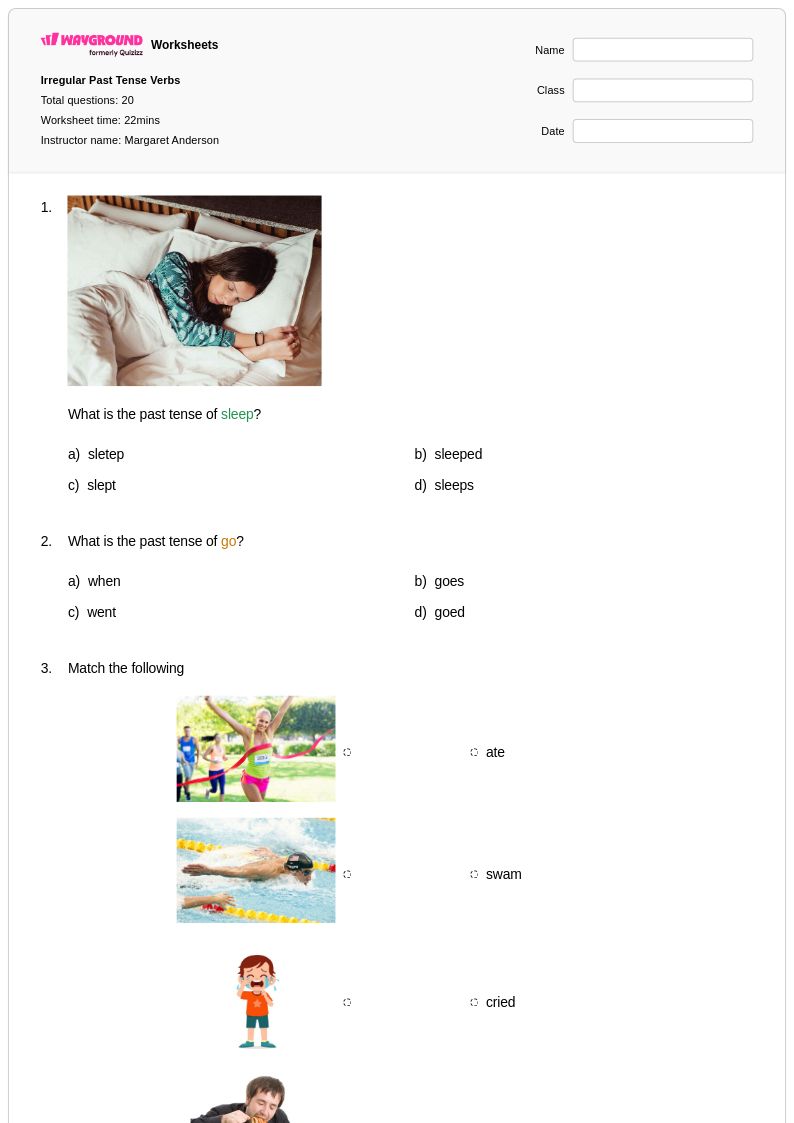
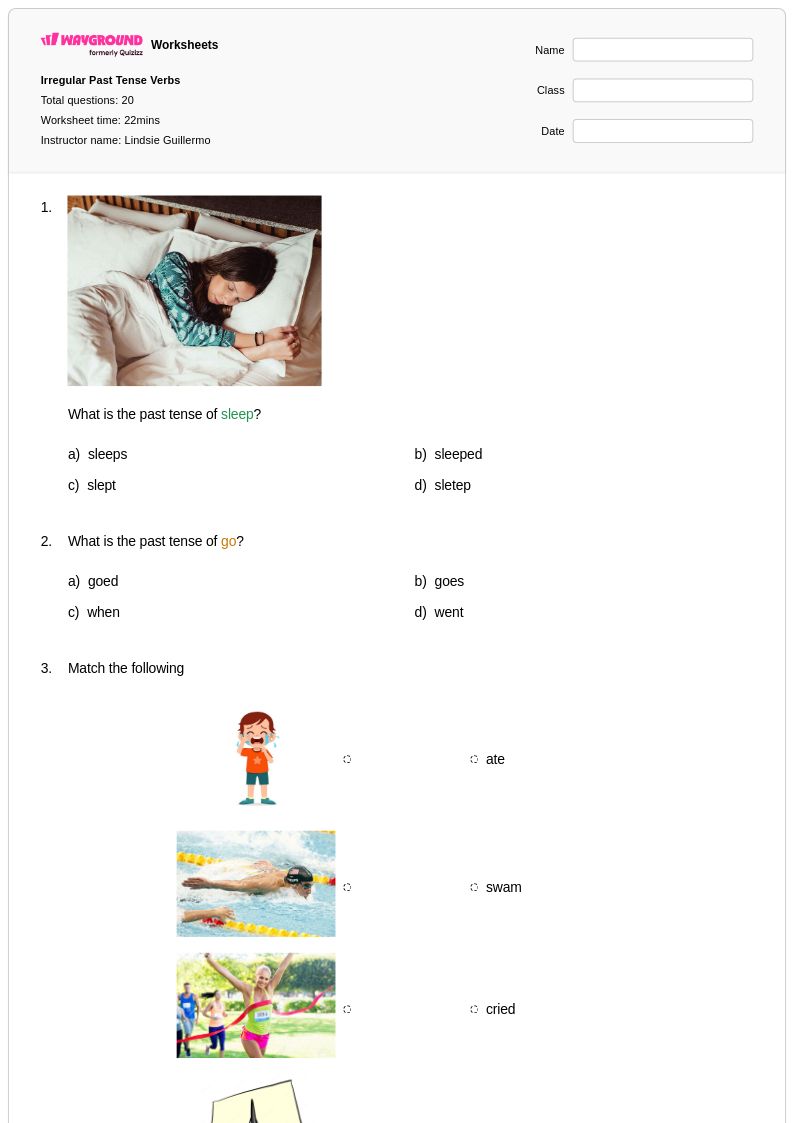
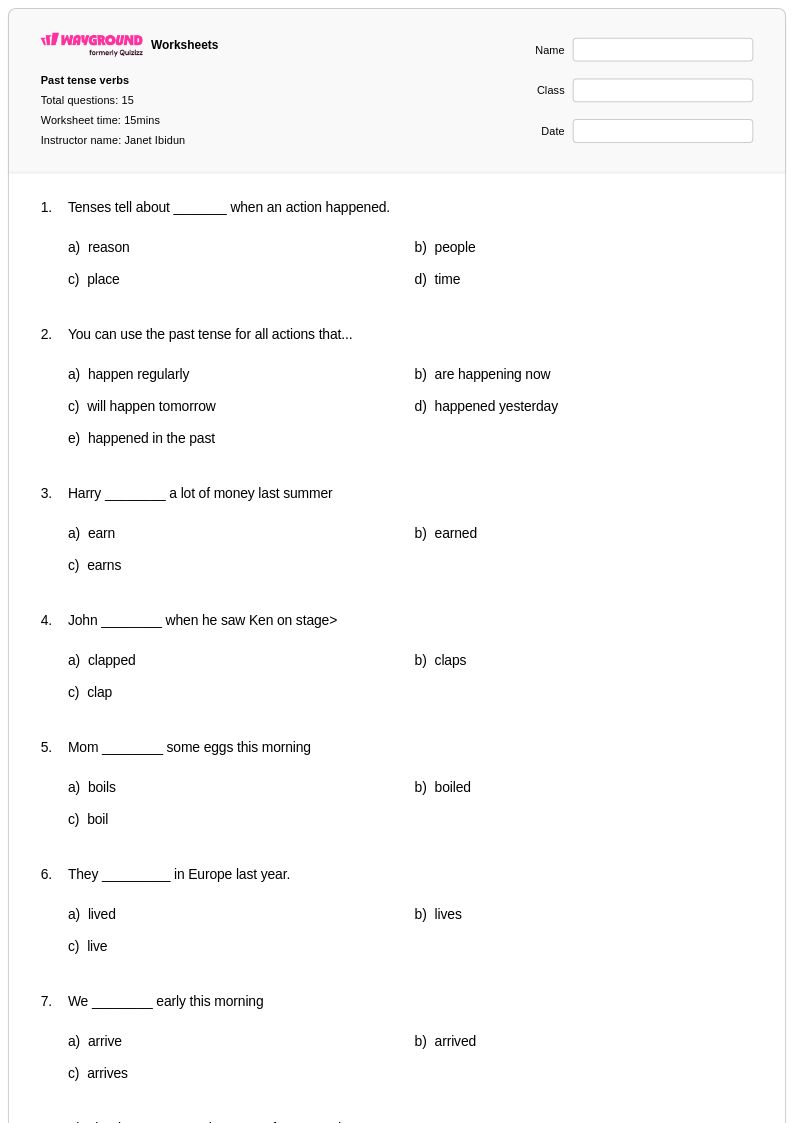
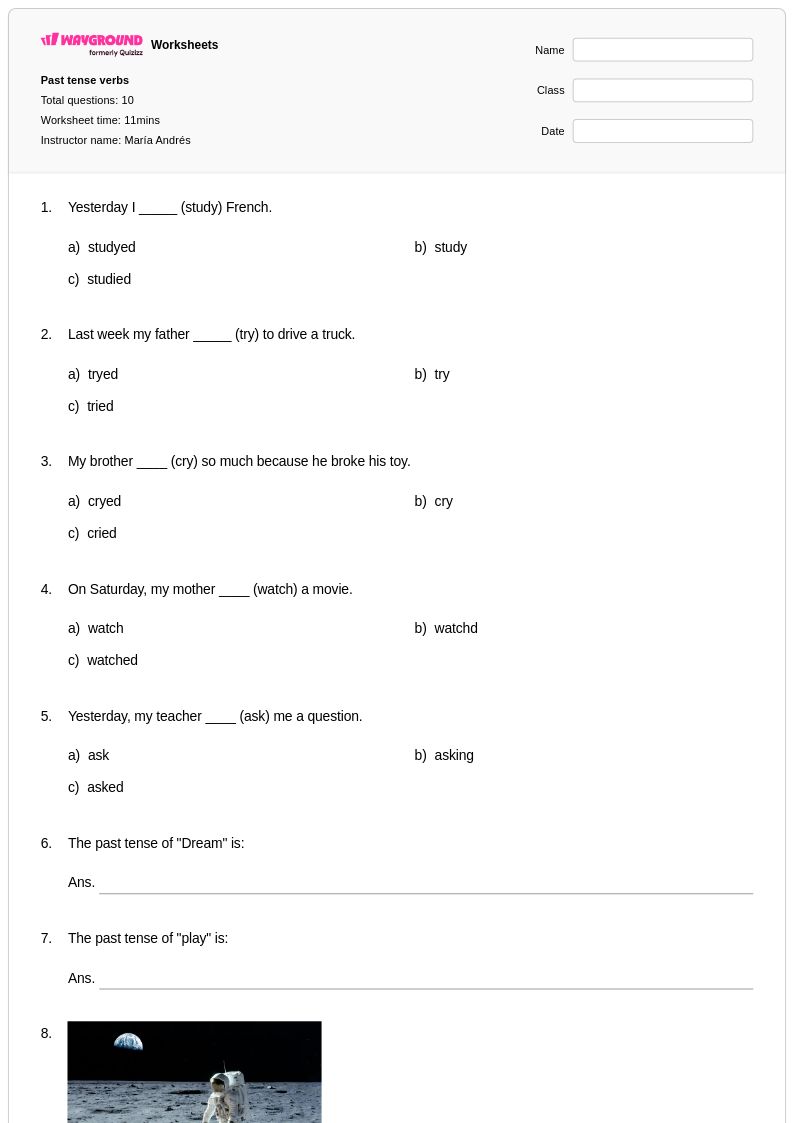
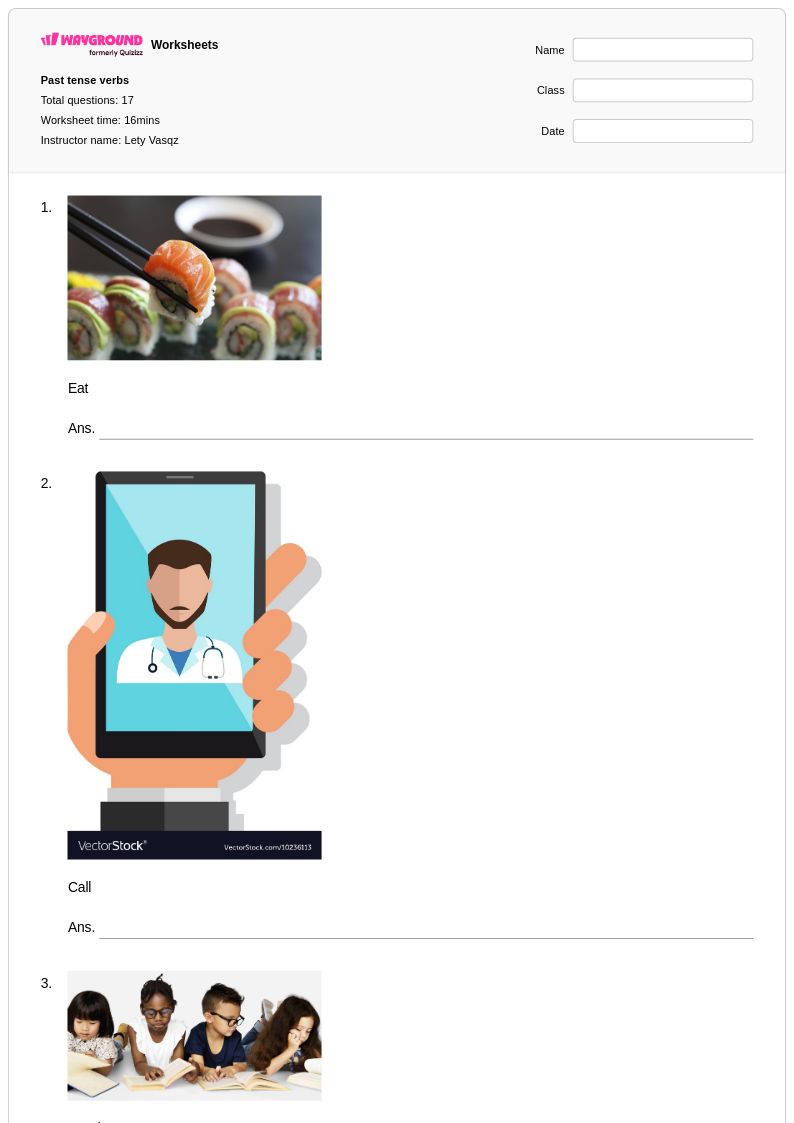
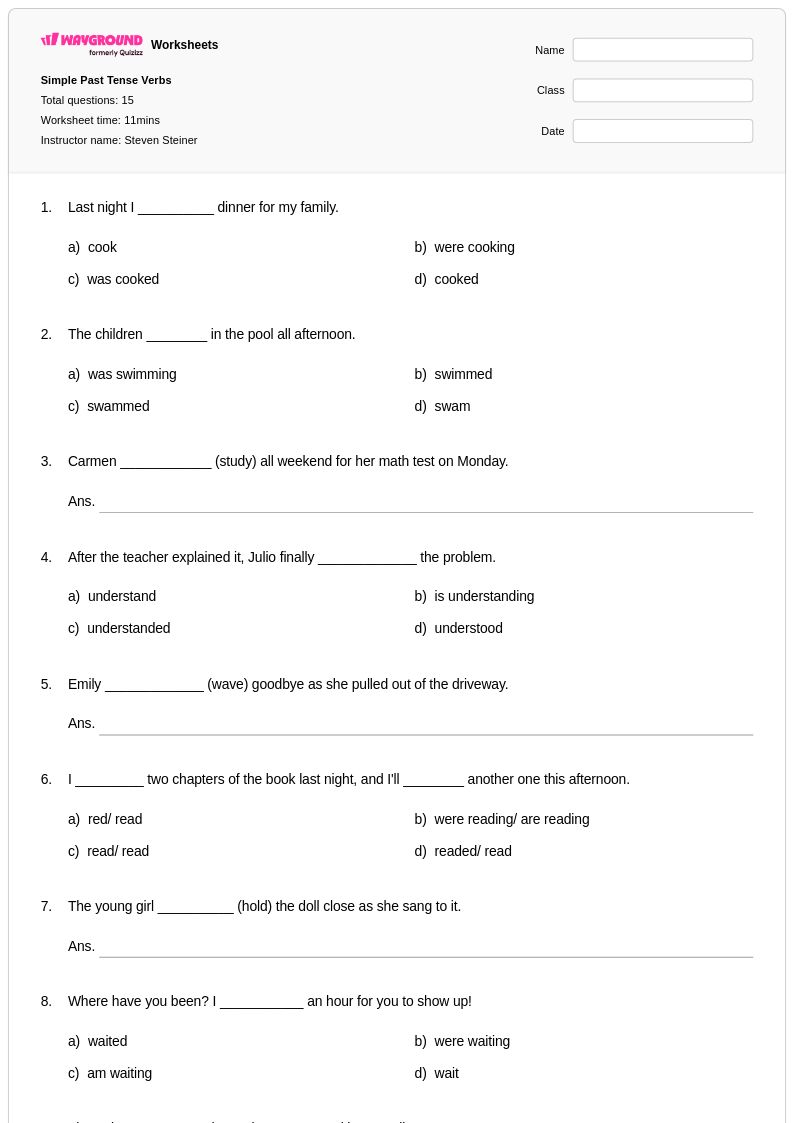
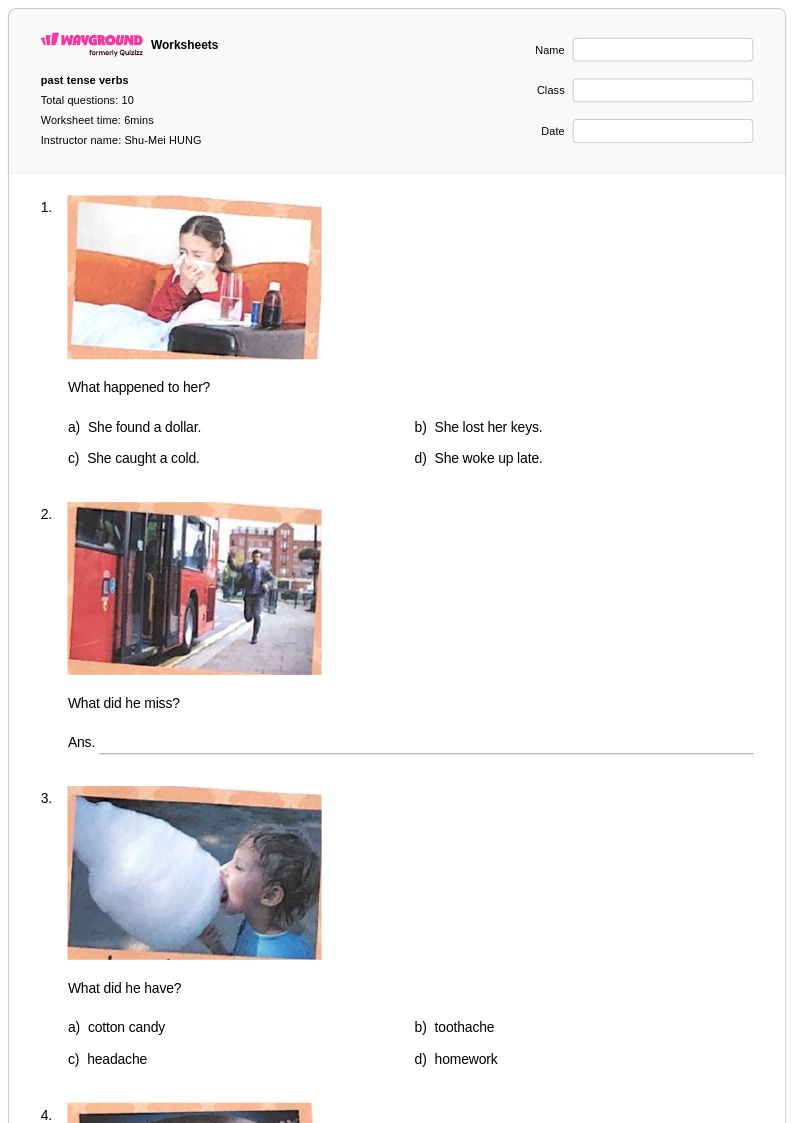
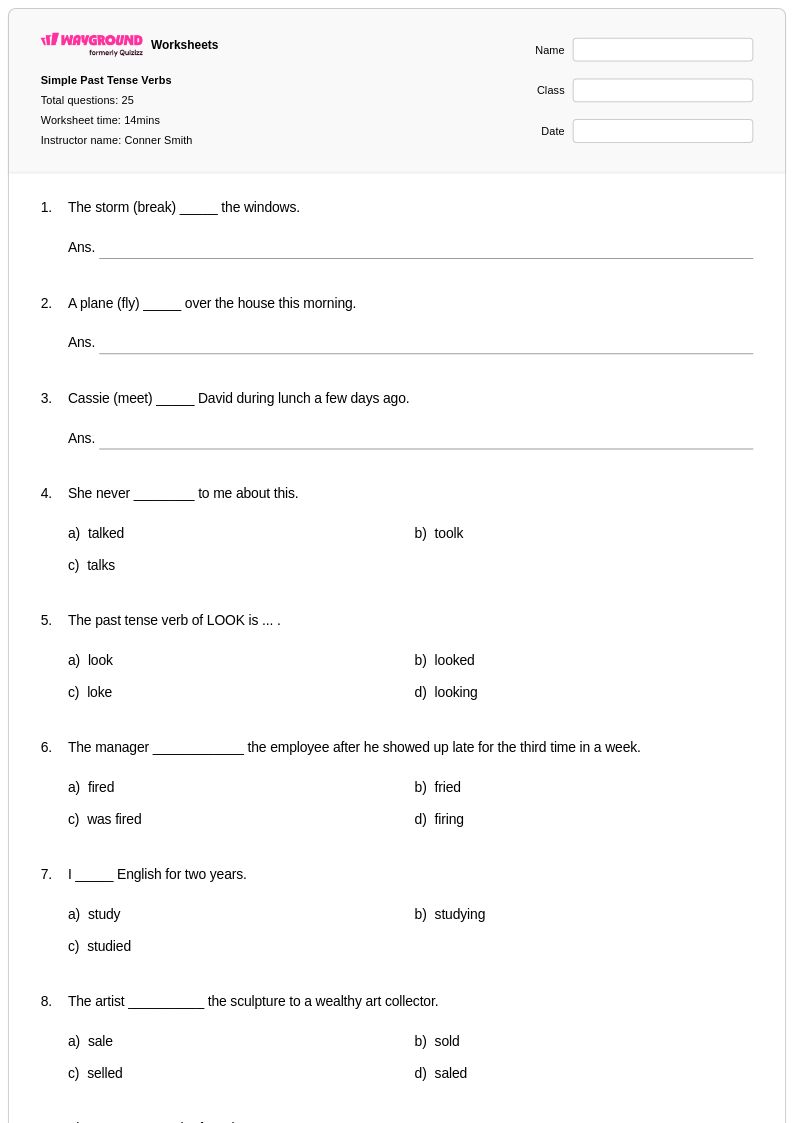
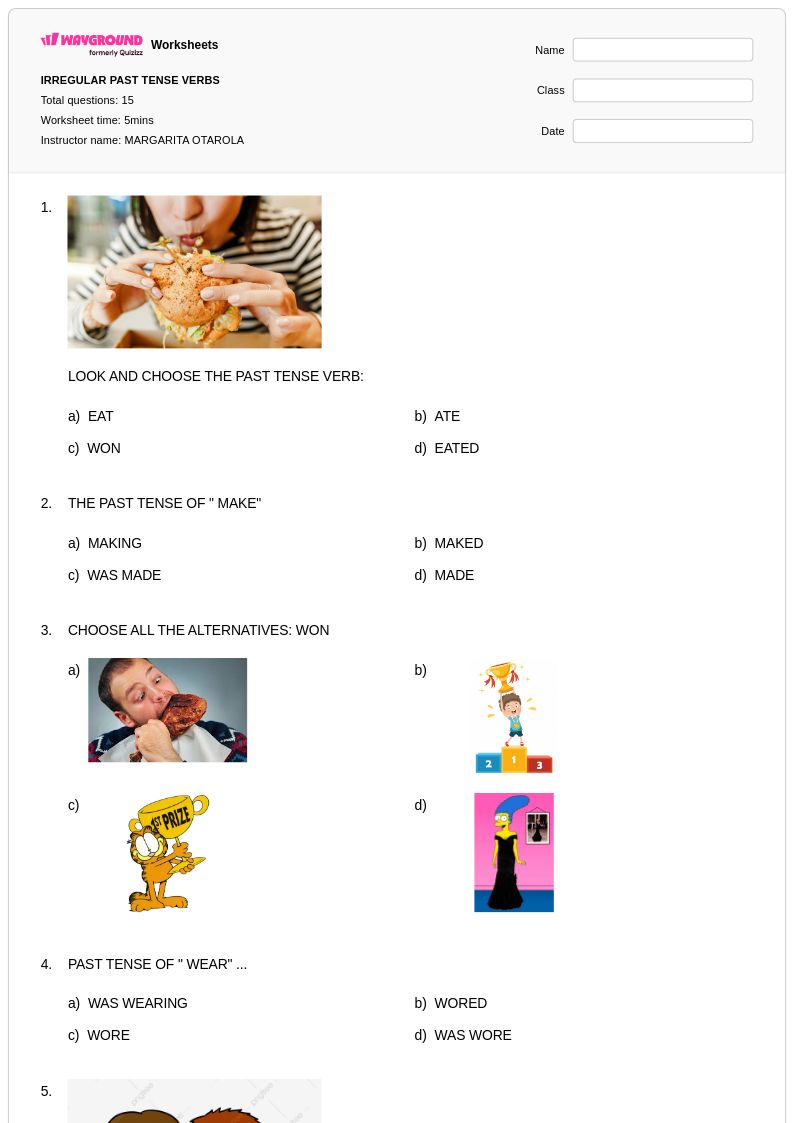
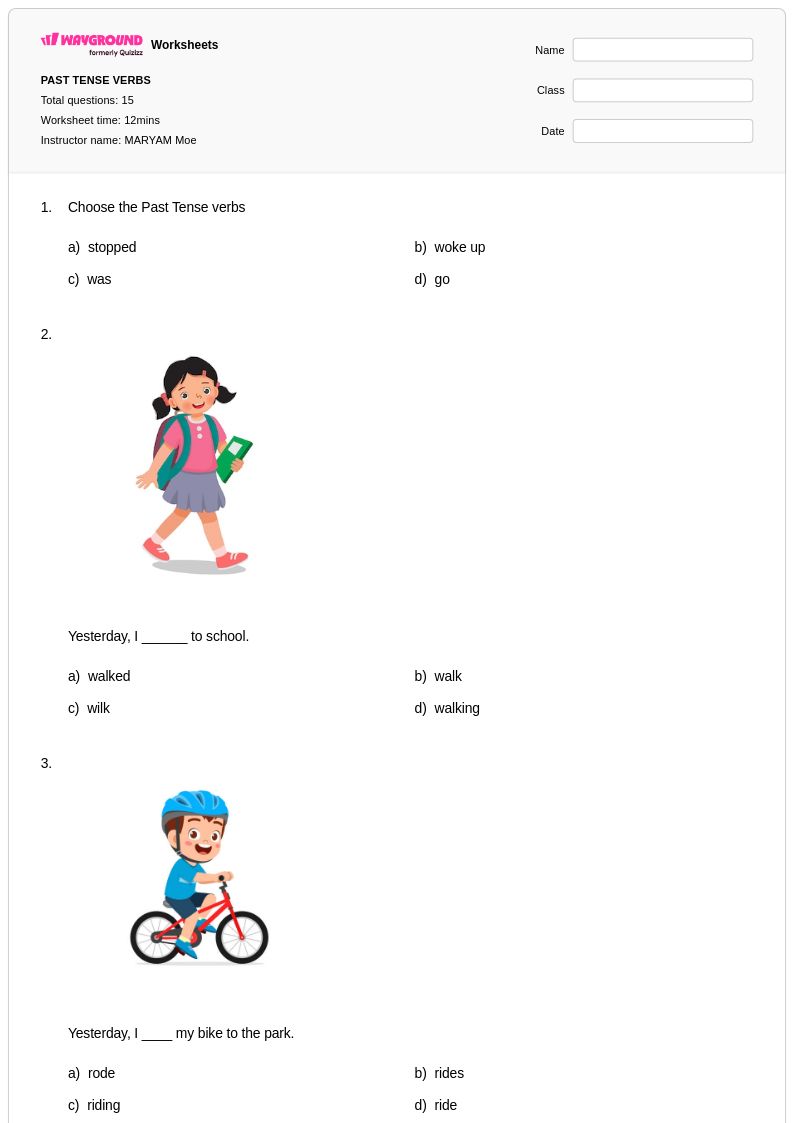
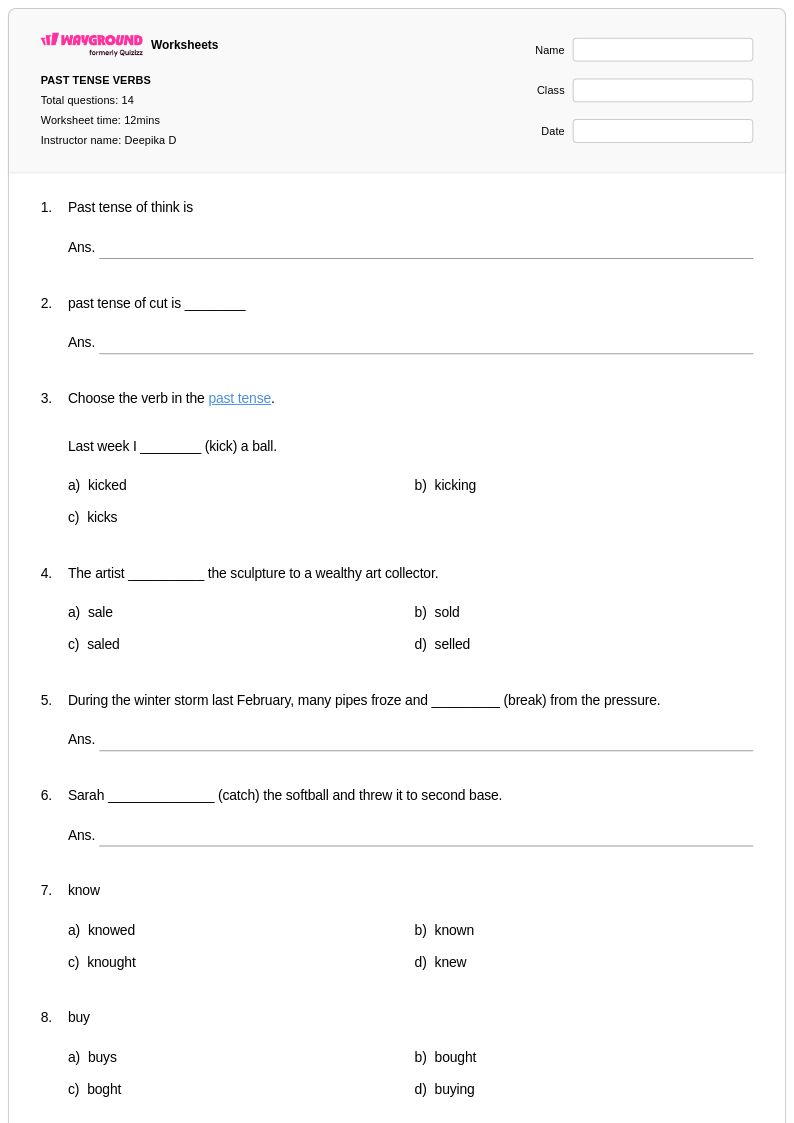
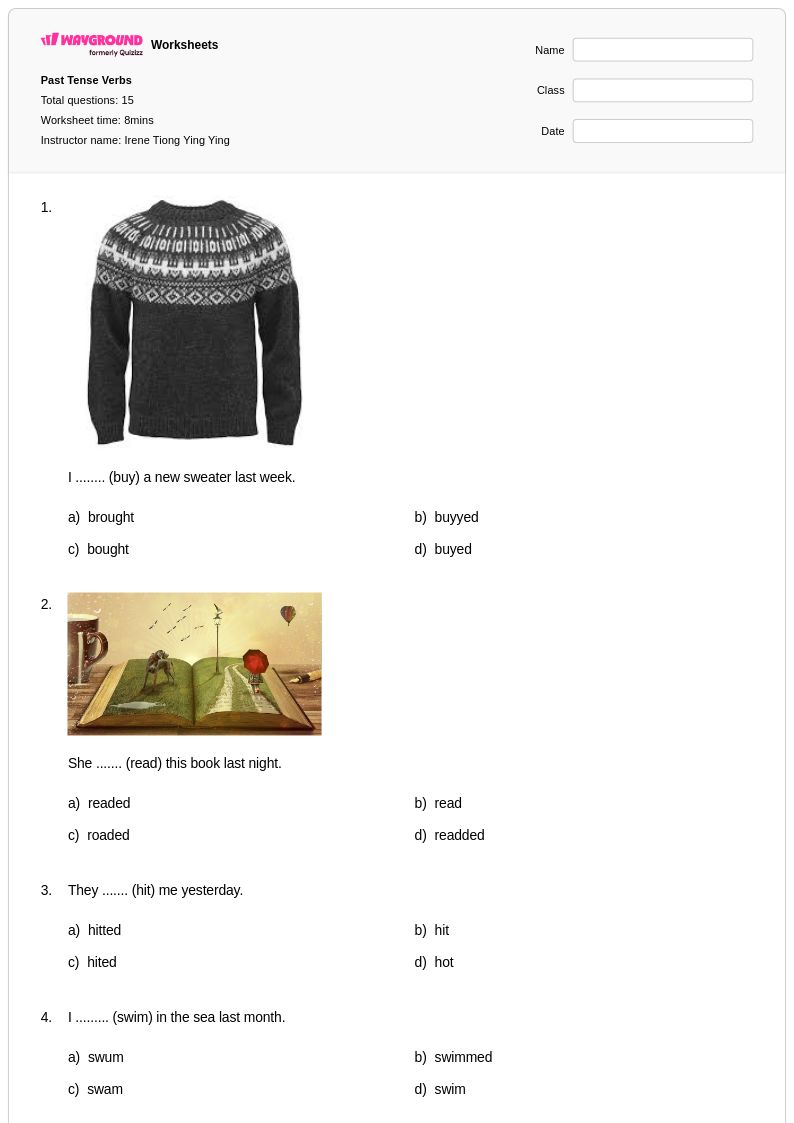
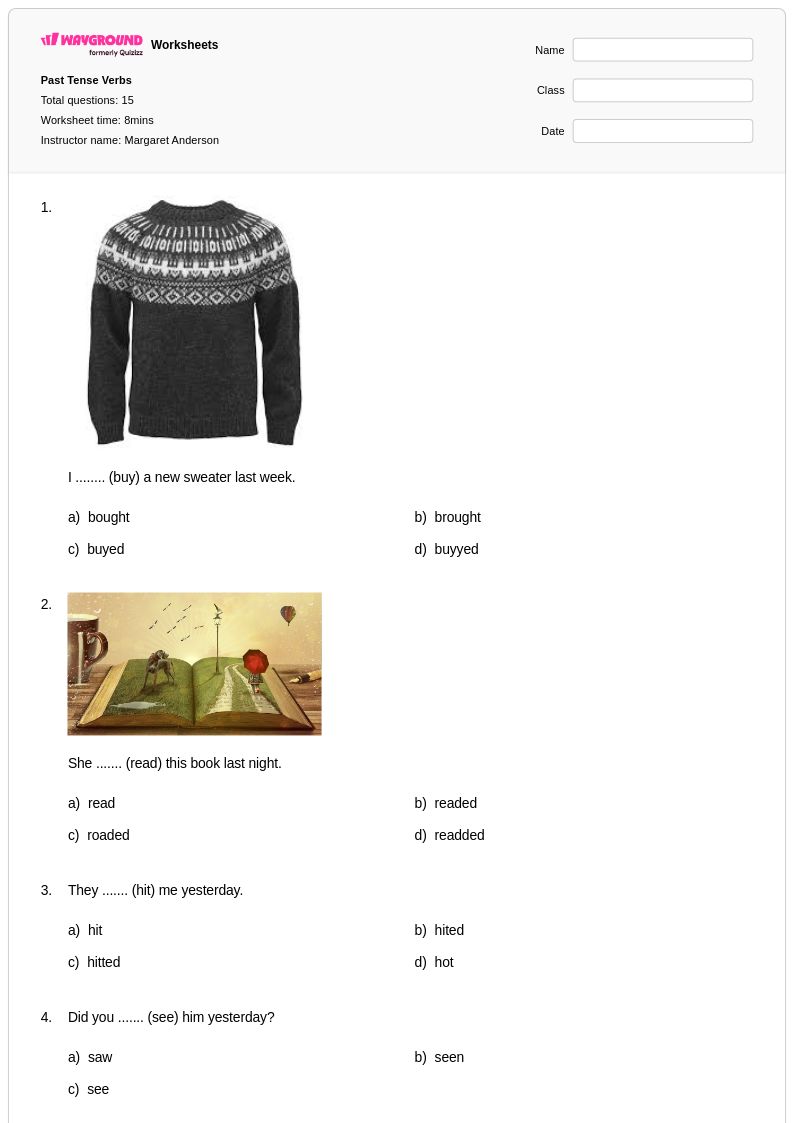
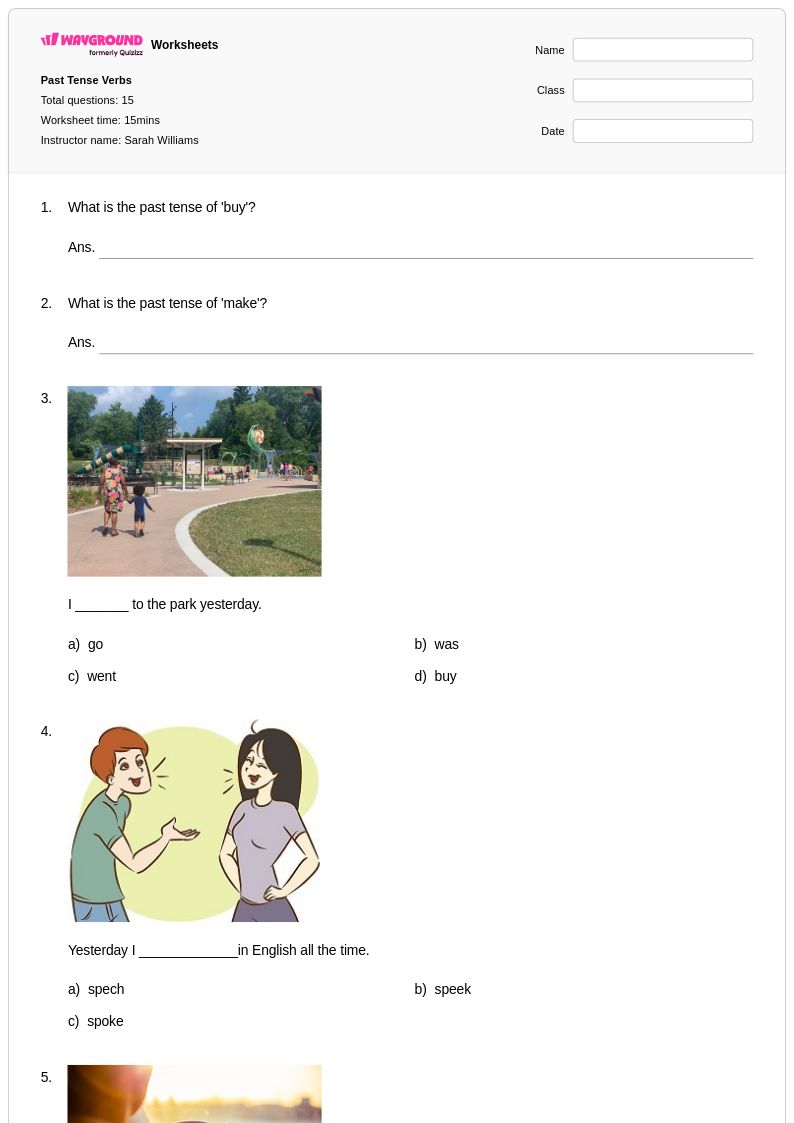
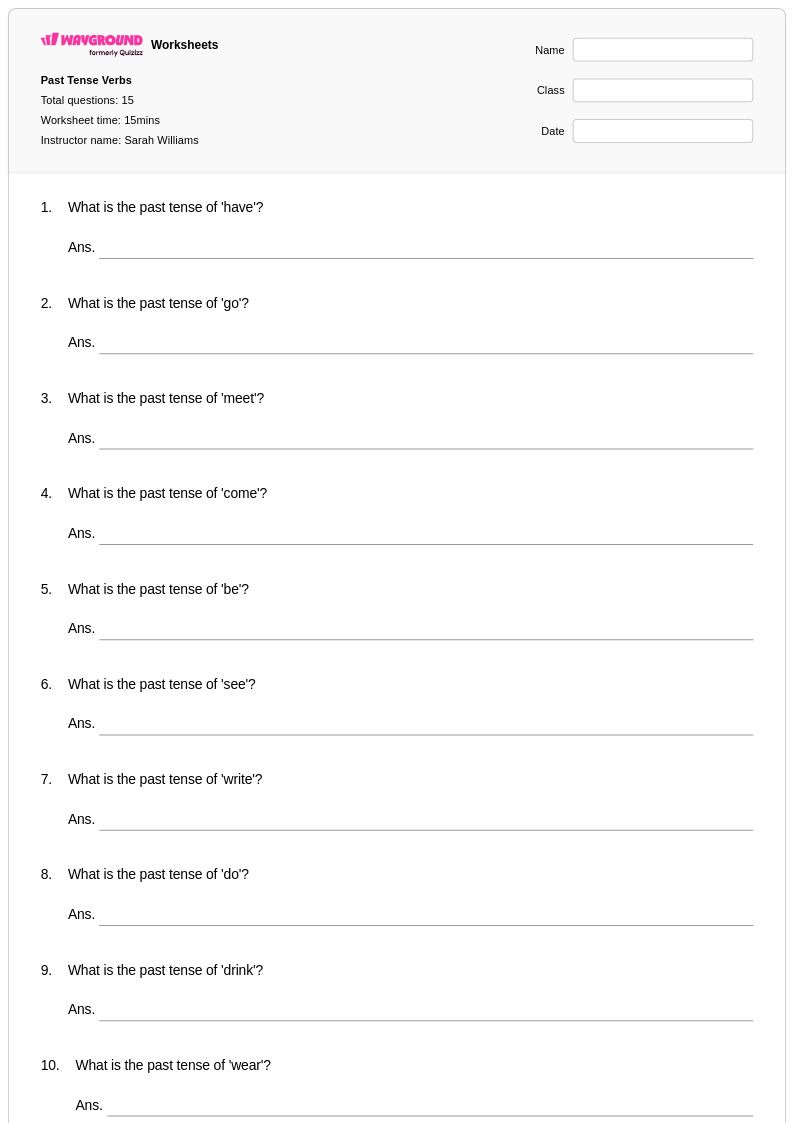
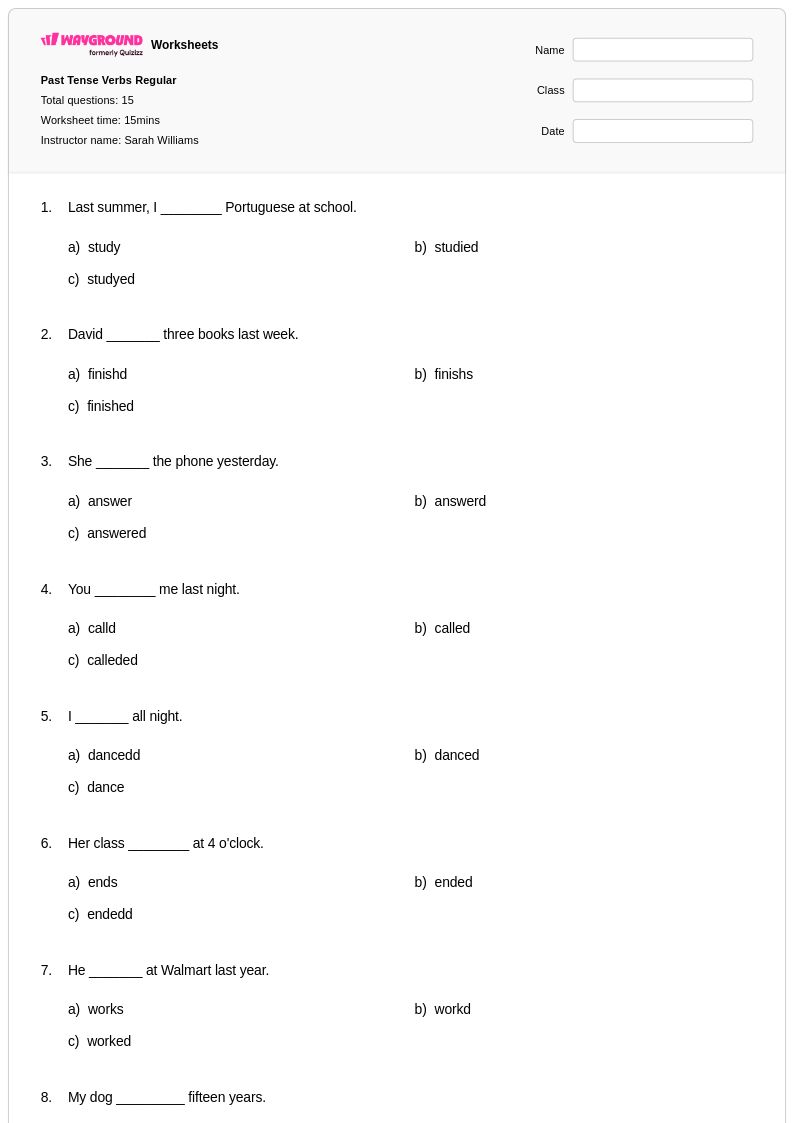
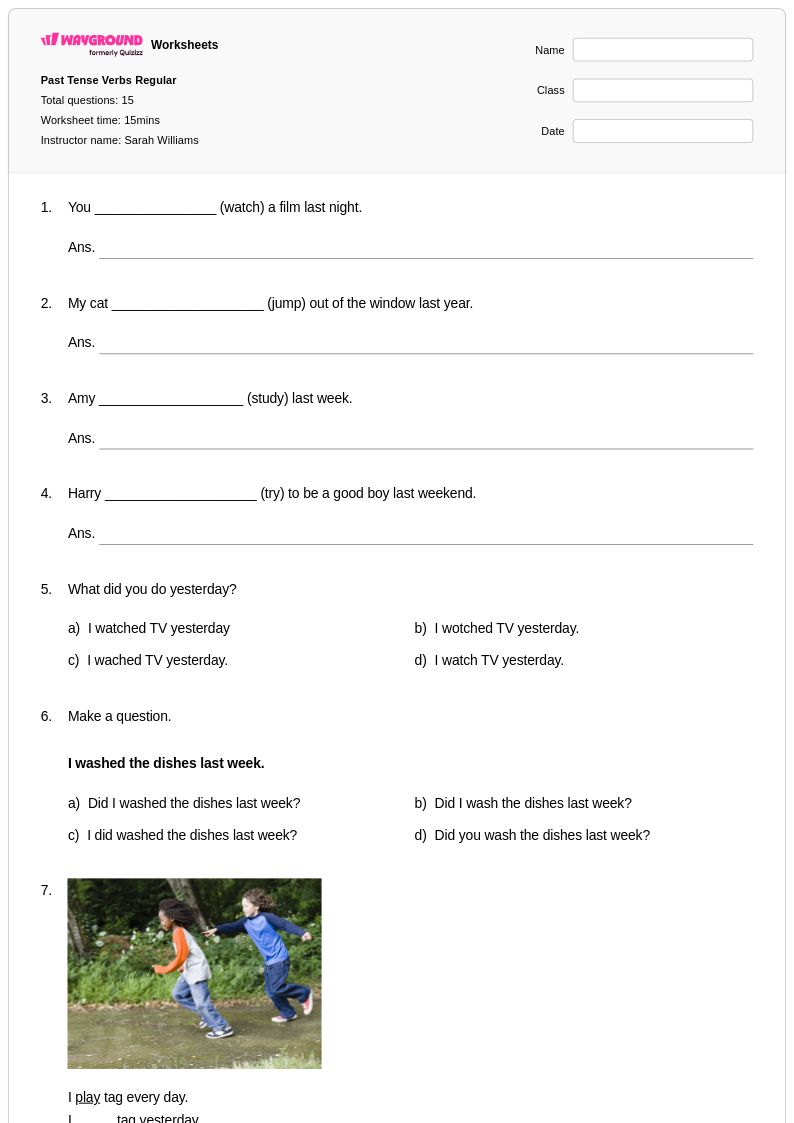
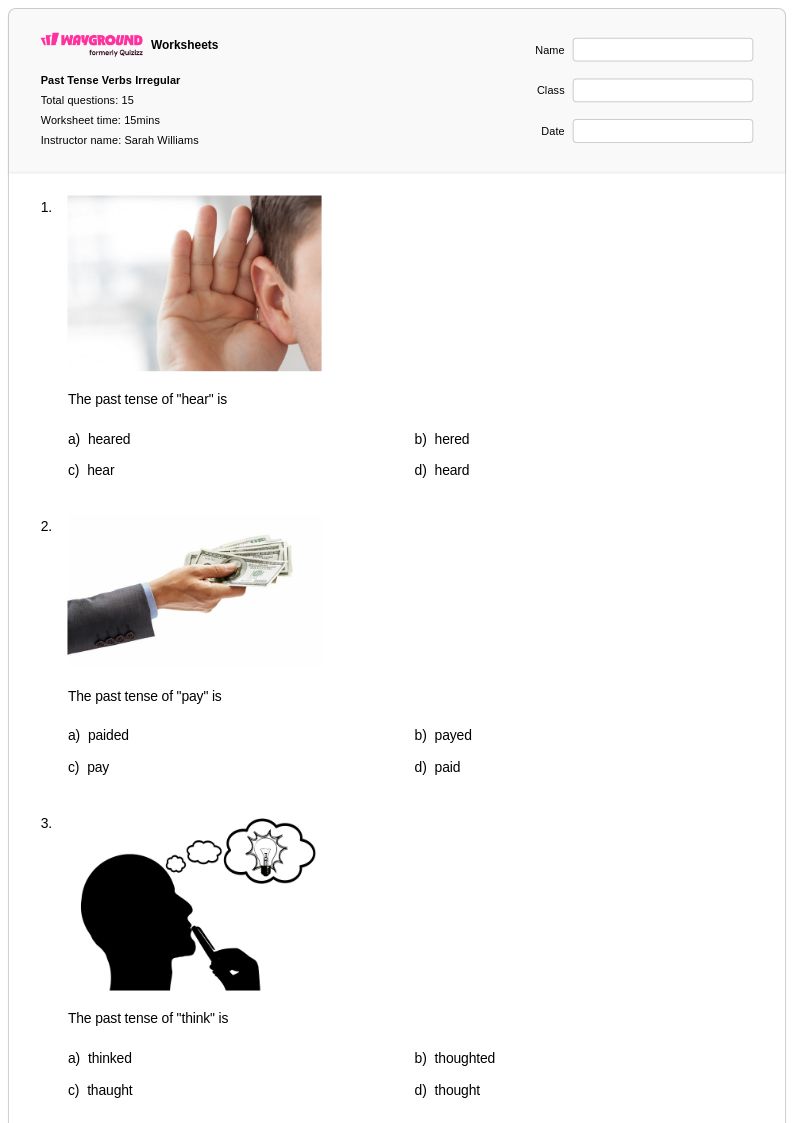
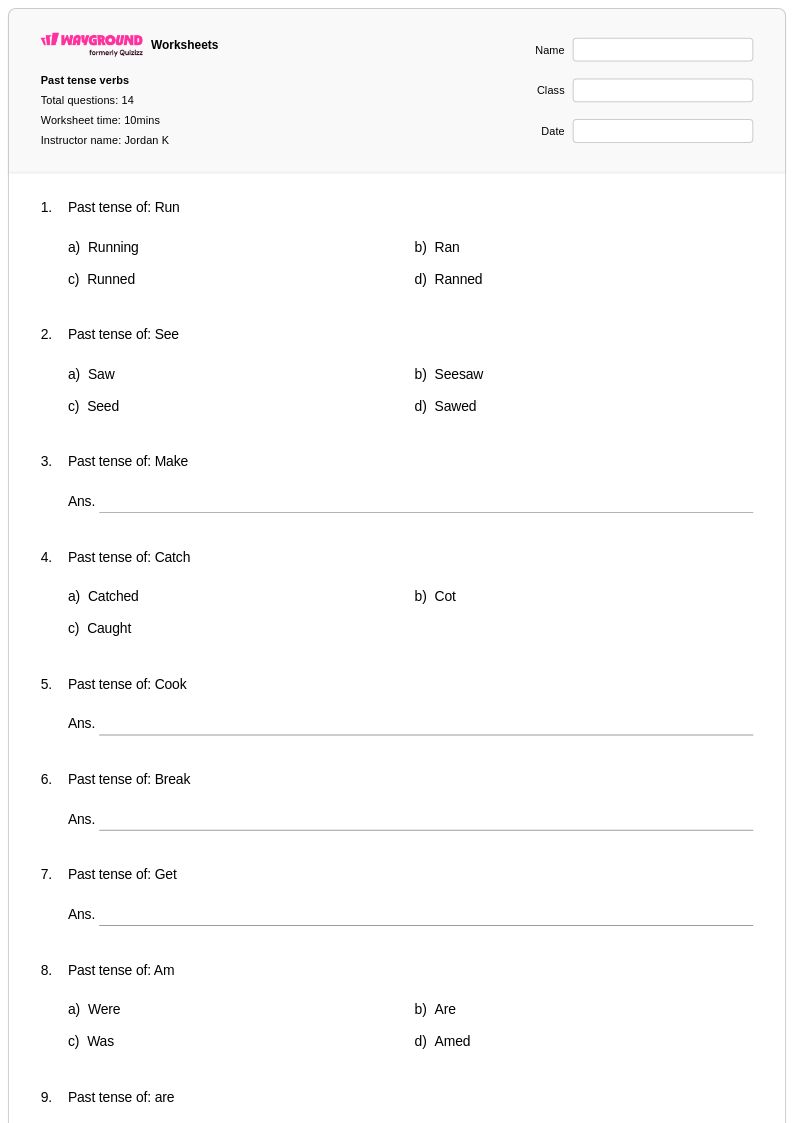
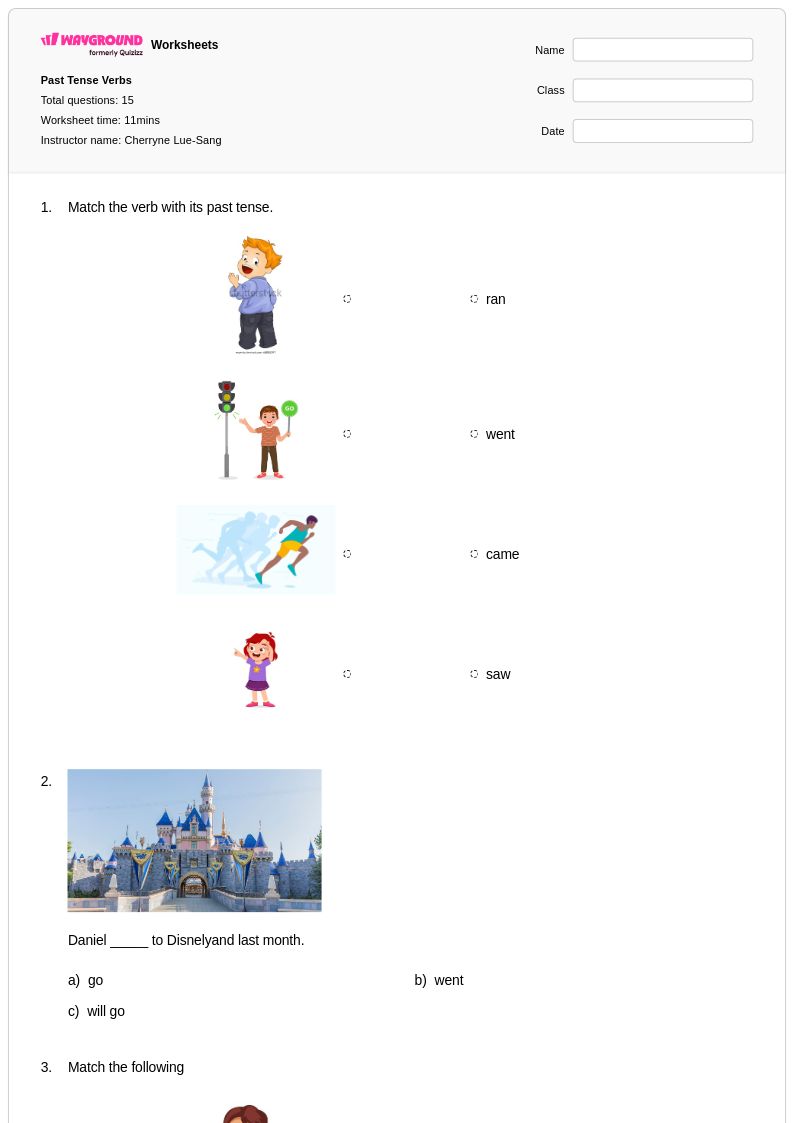
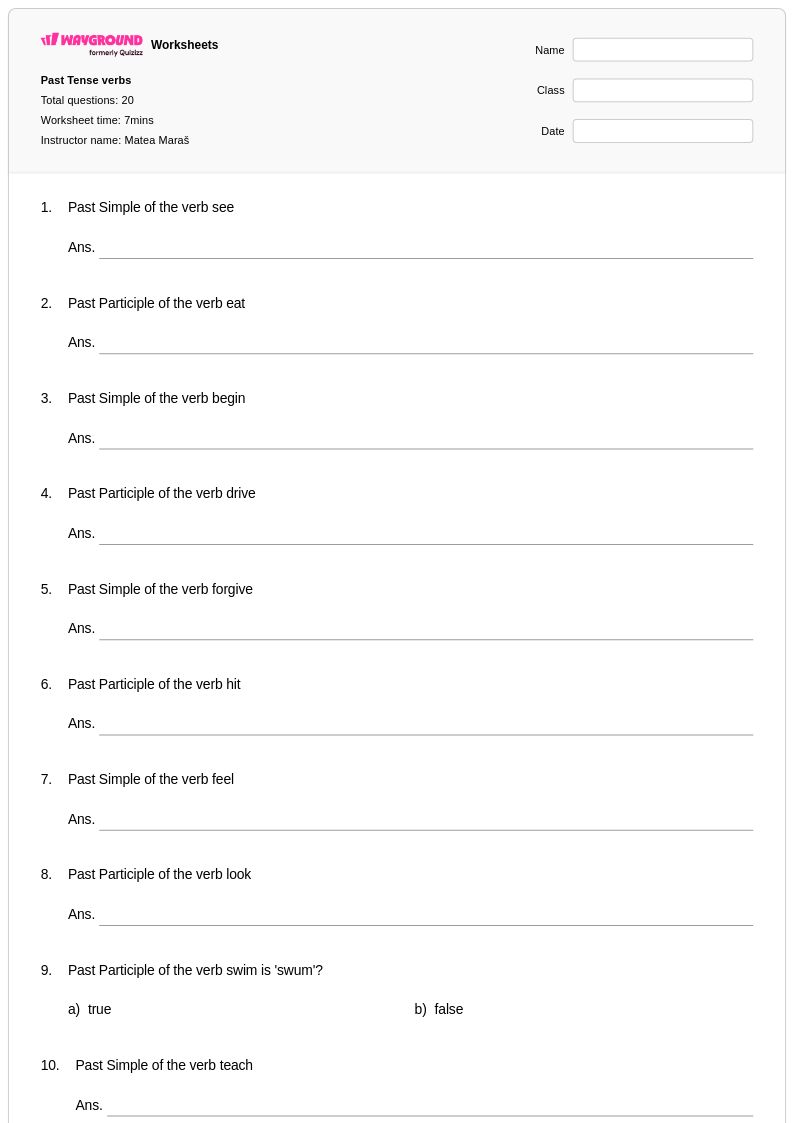
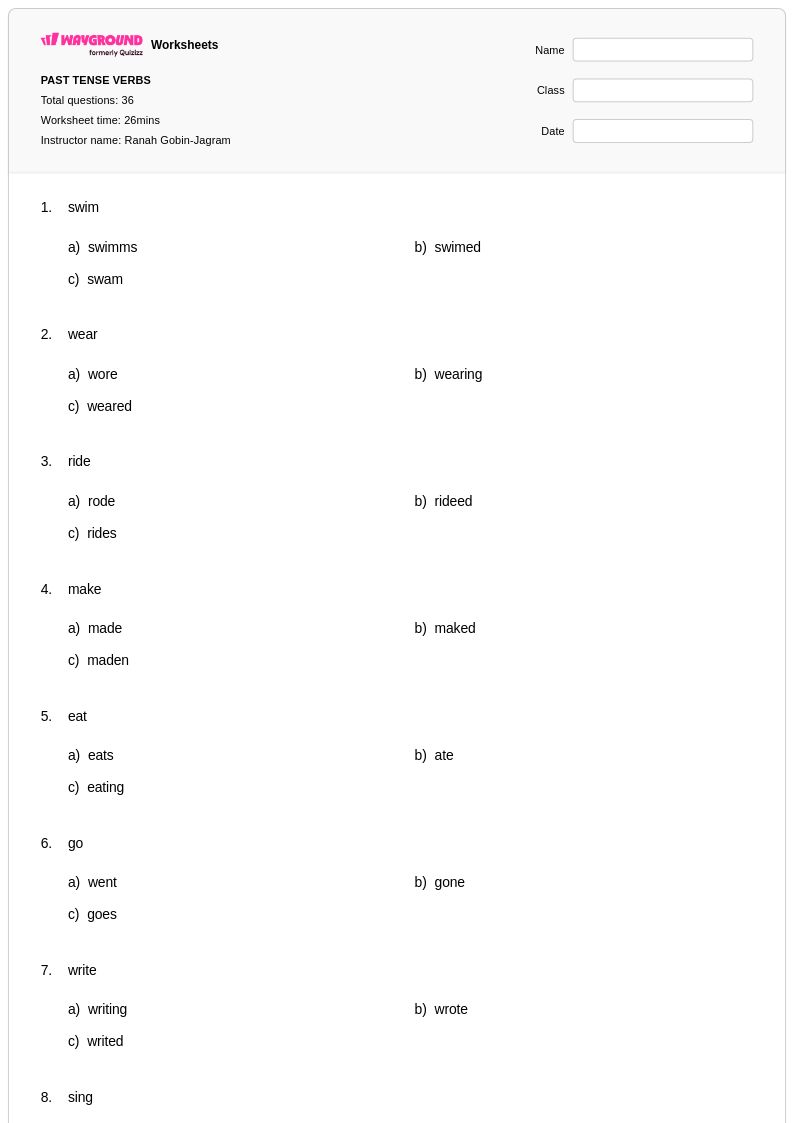
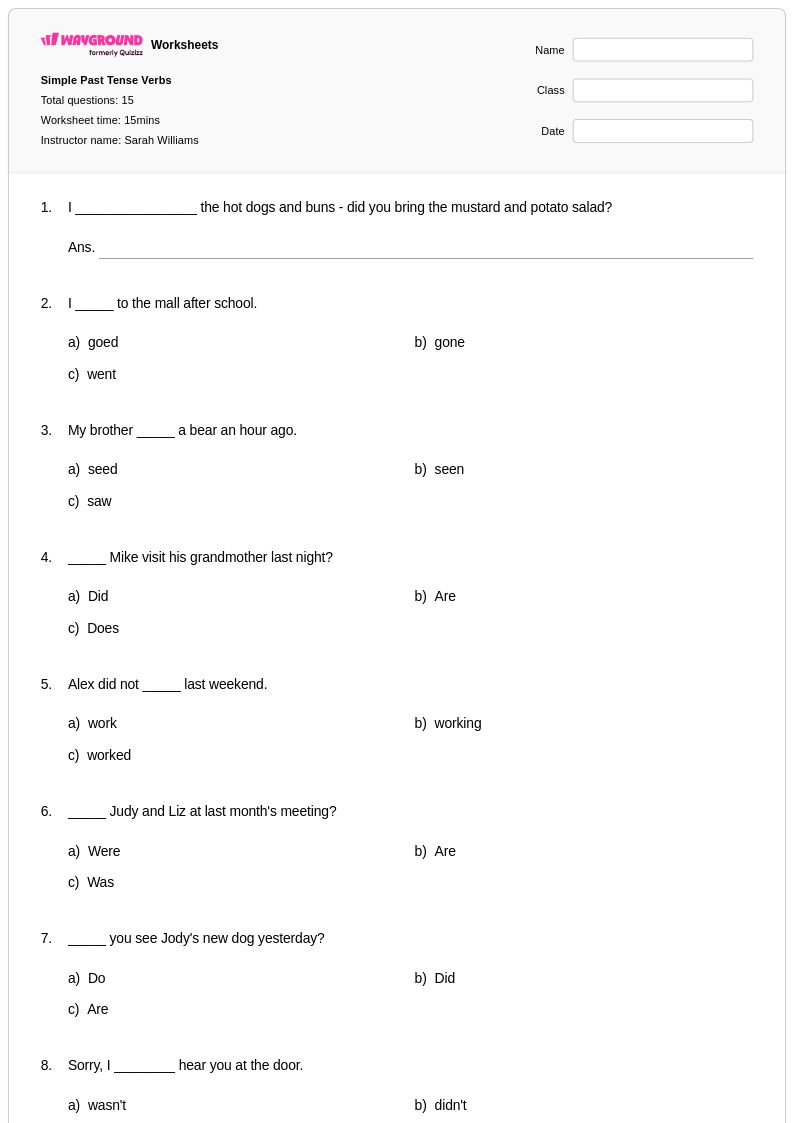
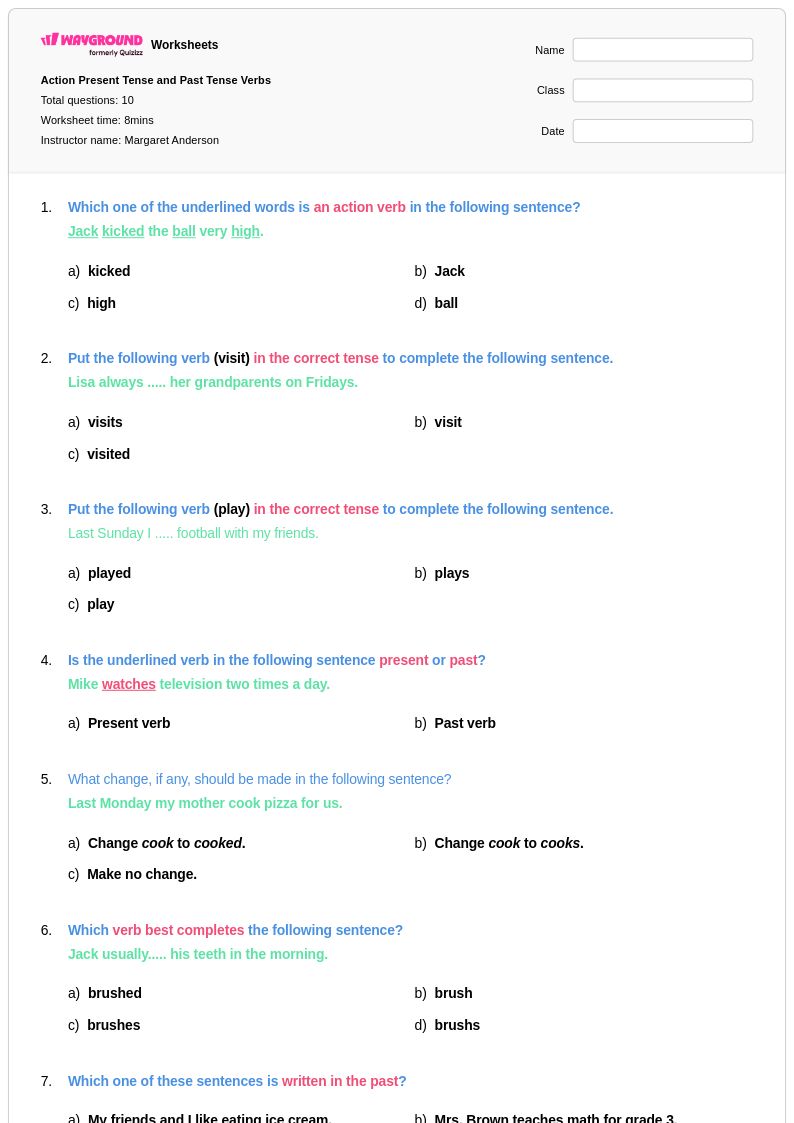
Wayground's free past tense verbs worksheets provide printable PDF practice problems and answer keys to help students master identifying and using past tense verb forms correctly.
Past tense verbs form the foundation of narrative writing and historical discourse, making these Wayground worksheets essential tools for developing students' understanding of how actions and events are expressed in earlier time frames. These comprehensive worksheet collections focus specifically on helping learners master regular and irregular past tense formations, from simple transformations like "walk" to "walked" to complex irregular patterns such as "go" to "went" and "bring" to "brought." Each worksheet includes carefully structured practice problems that progress from basic identification exercises to advanced application in sentence construction and paragraph writing, with complete answer keys provided to support both independent study and classroom instruction. Available as free printables in convenient pdf format, these resources strengthen students' ability to recognize past tense patterns, apply correct verb forms in context, and develop confidence in using temporal language structures across various writing genres.
Wayground, formerly Quizizz, empowers educators with an extensive library of millions of teacher-created resources specifically designed to address past tense verb instruction at multiple proficiency levels. The platform's advanced search and filtering capabilities allow teachers to quickly locate worksheets that align with specific learning standards while offering robust differentiation tools to accommodate diverse student needs within the same classroom. These customizable materials are available in both printable pdf format for traditional classroom use and digital formats for interactive learning environments, enabling seamless integration into any instructional approach. Teachers can efficiently plan targeted lessons, provide focused remediation for struggling learners, offer enrichment opportunities for advanced students, and create consistent skill practice routines that reinforce past tense verb mastery through varied and engaging worksheet activities that adapt to individual learning trajectories.
FAQs
How do I teach past tense verbs to students who struggle with irregular forms?
Start by establishing a strong foundation with regular past tense verbs, where students apply the -ed rule consistently, before introducing irregular forms in small, grouped clusters. Grouping irregular verbs by pattern (e.g., 'bring/brought', 'think/thought', 'catch/caught') helps students recognize internal logic rather than treating each form as an isolated memorization task. Repeated exposure through sentence-level practice, not just word lists, is the most effective way to build retention of irregular past tense forms.
What exercises help students practice past tense verb forms?
Effective practice exercises include verb transformation tasks (converting present tense sentences to past tense), fill-in-the-blank activities that require selecting the correct past tense form in context, and sentence-writing prompts that require students to apply both regular and irregular past tense verbs accurately. Progressing from identification exercises to full sentence construction ensures students can both recognize and produce correct past tense forms, which are two distinct skills that require separate reinforcement.
What are the most common mistakes students make with past tense verbs?
The most frequent error is over-regularization, where students apply the -ed rule to irregular verbs and produce forms like 'goed' instead of 'went' or 'bringed' instead of 'brought.' Students also commonly confuse past tense with past participle forms, writing 'he gone' instead of 'he went.' Additionally, English language learners may omit the -ed ending entirely in informal writing because the pronunciation of regular past tense endings (-ed, -d, -t) is subtle and inconsistent.
How does past tense verb instruction connect to narrative writing?
Past tense verbs are the grammatical backbone of narrative writing because most stories, personal recounts, and historical accounts are written in the past tense. Students who cannot confidently produce correct past tense forms will produce narratives with inconsistent verb tense, which disrupts coherence and is one of the most penalized grammar errors in writing assessments. Teaching past tense verbs explicitly within the context of narrative sentences and paragraphs, rather than in isolation, reinforces both grammatical accuracy and writing fluency simultaneously.
How do I use past tense verb worksheets effectively in my classroom?
Wayground's past tense verb worksheets are available as printable PDFs for traditional classroom use and in digital formats for technology-integrated learning environments, and can also be hosted as a quiz directly on Wayground. Use identification and transformation exercises as guided practice during whole-class instruction, then assign sentence-construction and paragraph-level tasks as independent work to assess whether students can apply past tense forms without scaffolding. Complete answer keys are included with each worksheet, making them equally effective for self-paced independent study, small-group instruction, or homework review.
How can I differentiate past tense verb practice for students at different skill levels?
For students who are still mastering regular past tense, focus practice on consistent -ed transformations before introducing irregular forms. For more advanced students, move to paragraph-level editing tasks where they must identify and correct tense inconsistencies within a longer piece of writing. On Wayground, teachers can apply individual accommodations such as reduced answer choices to lower cognitive load for struggling learners, or enable Read Aloud so students can hear questions read to them, all without other students being notified of those settings.