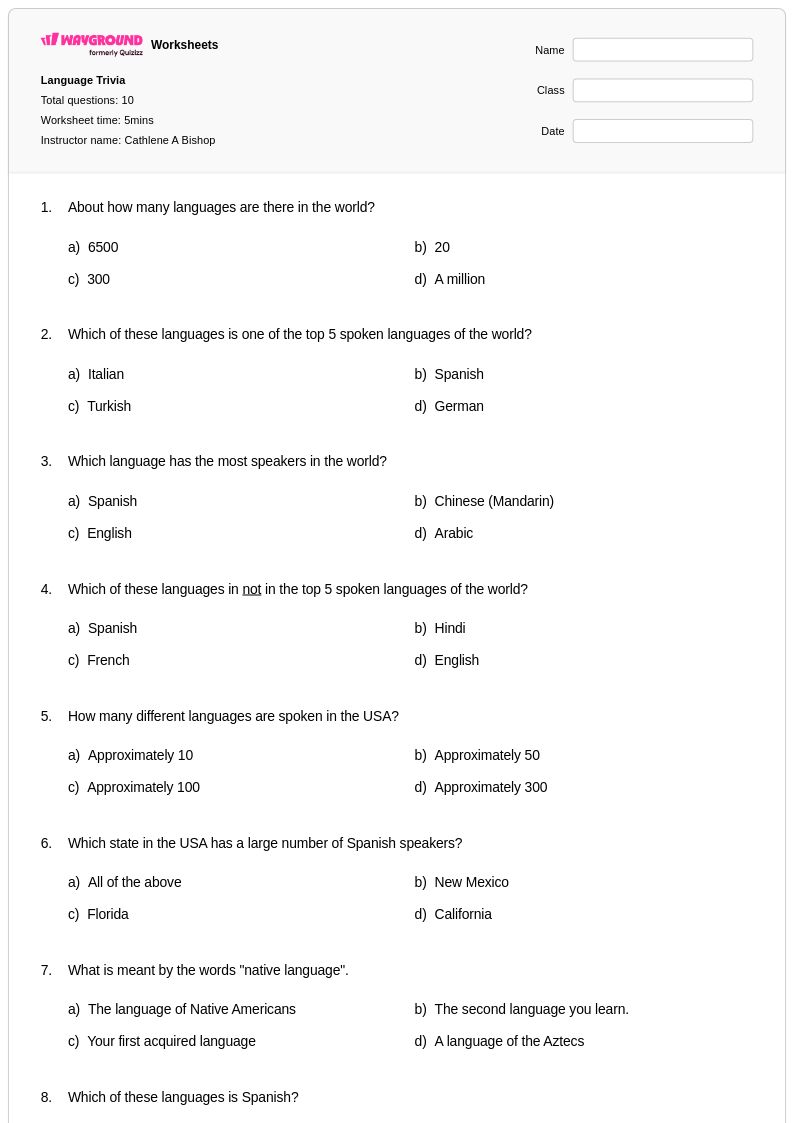
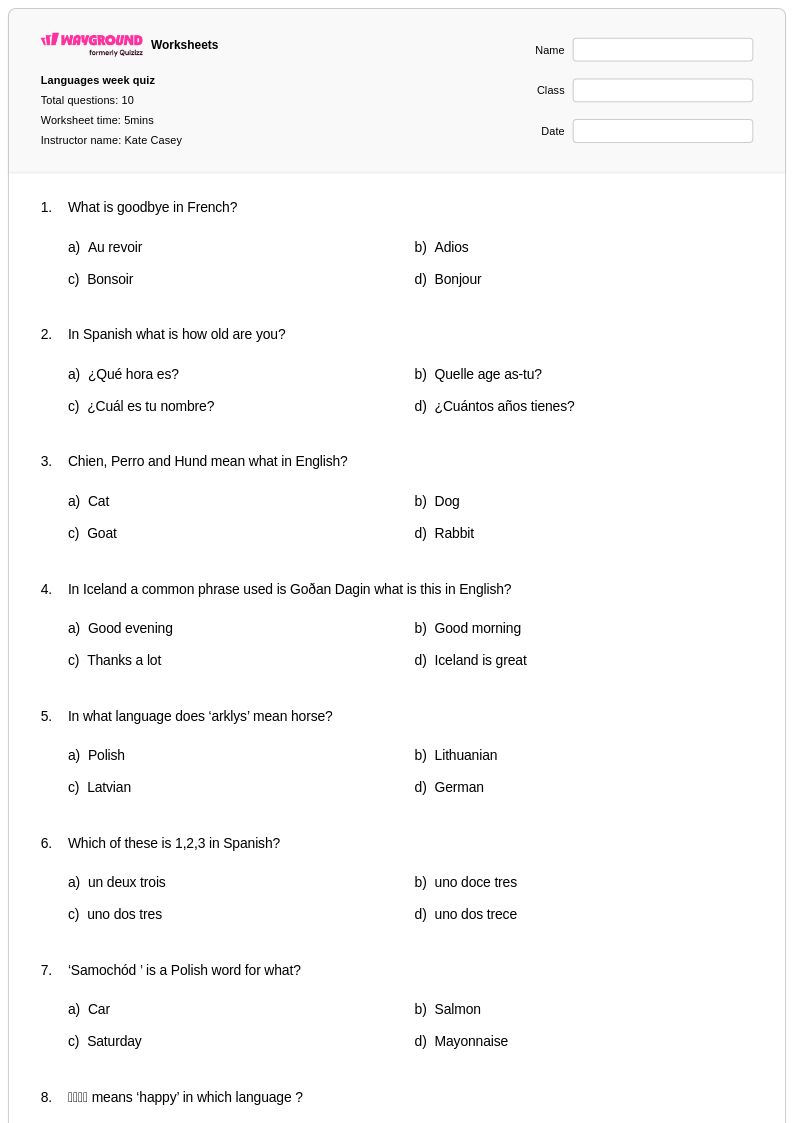
Class 10 Punjabi worksheets from Wayground offer comprehensive printables and practice problems to help students master vocabulary, grammar, and language skills with included answer keys and free PDF downloads.
Punjabi language worksheets for Class 10 students available through Wayground (formerly Quizizz) provide comprehensive practice in reading, writing, speaking, and listening skills essential for intermediate-level proficiency. These carefully designed educational resources focus on expanding vocabulary, mastering Gurmukhi script formation, understanding grammatical structures, and developing conversational abilities in authentic contexts. Students engage with practice problems that cover verb conjugations, sentence construction, cultural expressions, and reading comprehension passages that reflect Punjabi literature and contemporary usage. Each worksheet collection includes detailed answer keys that support independent learning and self-assessment, while printable pdf formats ensure accessibility for both classroom instruction and home study. The free resources encompass diverse activities from basic script practice to complex literary analysis, strengthening foundational skills while building cultural awareness and communication confidence.
Wayground (formerly Quizizz) empowers educators with millions of teacher-created Punjabi language resources that streamline lesson planning and support differentiated instruction for Class 10 classrooms. The platform's robust search and filtering capabilities allow teachers to quickly locate worksheets aligned with specific learning objectives, whether targeting beginning script learners or advanced speakers seeking cultural enrichment activities. Flexible customization tools enable educators to modify existing content for remediation or create challenging extensions for accelerated learners, while both printable and digital formats accommodate diverse classroom environments and individual learning preferences. These comprehensive worksheet collections support systematic skill practice across all language domains, helping teachers provide targeted interventions for struggling students while offering enrichment opportunities that deepen cultural understanding and linguistic sophistication for heritage speakers and second-language learners alike.
FAQs
How do I teach Punjabi to students who have never been exposed to the language before?
Start with Gurmukhi script recognition before introducing vocabulary or grammar, since students cannot read or write Punjabi without first internalizing the script. Use repetitive tracing and matching exercises to build letter familiarity, then layer in basic vocabulary tied to familiar categories like family, numbers, and colors. Introducing tone variations early with consistent audio models helps students avoid pronunciation habits that are difficult to unlearn later.
What exercises help students practice Punjabi vocabulary and grammar effectively?
Fill-in-the-blank exercises using postpositions and verb conjugations are particularly effective for building grammatical accuracy, since these features differ significantly from English structure. Vocabulary matching activities that pair Gurmukhi script with transliterations and meanings reinforce both reading and word retention simultaneously. Reading comprehension passages drawn from authentic cultural contexts extend practice beyond mechanical drills and build real communicative competence.
What mistakes do students commonly make when learning Punjabi?
One of the most common errors is misapplying tone — Punjabi is a tonal language with three distinct tones, and students frequently flatten words to a neutral pitch, changing meaning entirely. Students also tend to place postpositions incorrectly, often translating English preposition placement directly into Punjabi. Verb conjugation errors, particularly around gender agreement, are persistent because Punjabi verbs change form based on both tense and the gender of the subject.
How can I differentiate Punjabi instruction for students at different proficiency levels?
For beginners, prioritize Gurmukhi alphabet tracing and script recognition worksheets before introducing any vocabulary or grammar content. Intermediate learners benefit from sentence-building exercises that target postpositions and basic verb conjugations. Advanced students can work through reading comprehension passages that incorporate authentic cultural texts, which builds both language proficiency and contextual understanding. On Wayground, teachers can also enable accommodations such as Read Aloud support and reduced answer choices for individual students who need additional scaffolding.
How do I use Punjabi worksheets from Wayground in my classroom?
Wayground's Punjabi worksheets are available as printable PDFs for traditional classroom distribution and homework assignments, as well as in digital formats for technology-integrated or online learning environments. Teachers can also host worksheets as interactive quizzes directly on Wayground, enabling real-time student responses and automatic scoring. The included answer keys support both teacher-led correction and independent student review, making the materials flexible for in-class practice, homework, or self-paced learning.
How do I support students with learning differences in a Punjabi language class?
Students who struggle with script recognition benefit from larger font sizes and high-contrast display settings to reduce visual processing load. For students with reading difficulties, enabling Read Aloud functionality allows questions and content to be read aloud automatically, removing decoding as a barrier to demonstrating language knowledge. On Wayground, these accommodations — including extended time and reduced answer choices — can be assigned to individual students without alerting the rest of the class, so differentiation stays discreet and manageable.