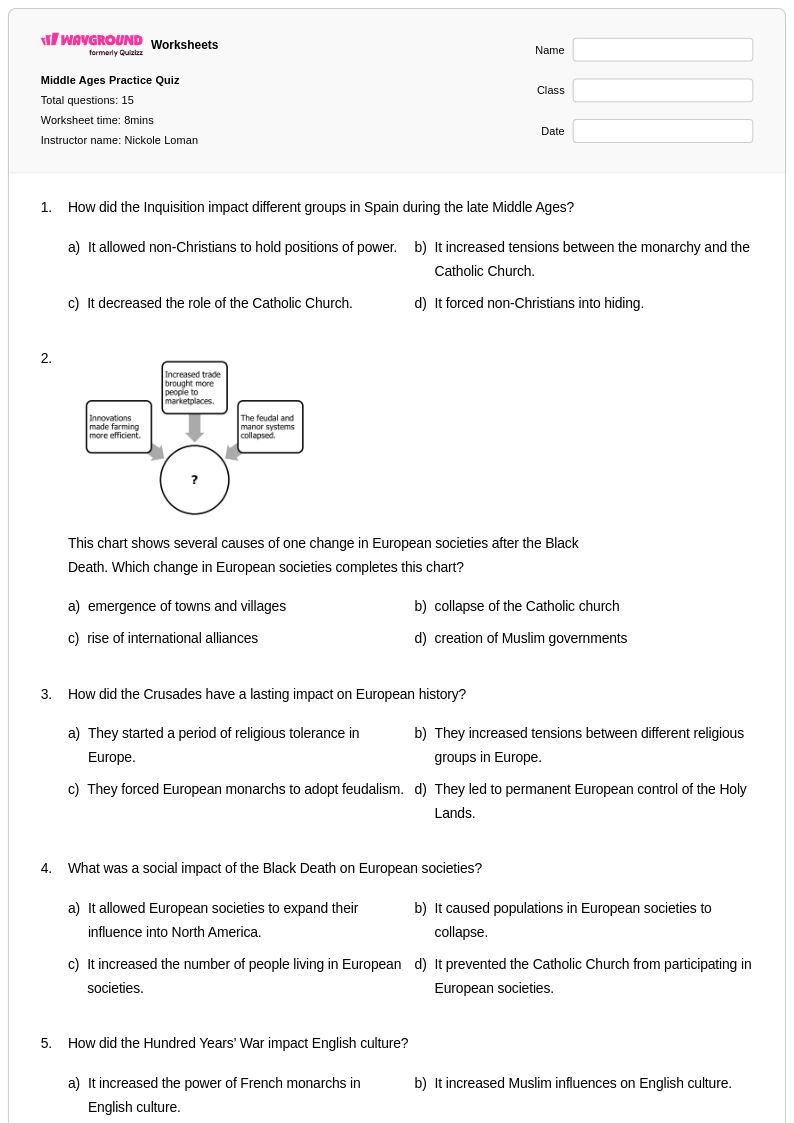
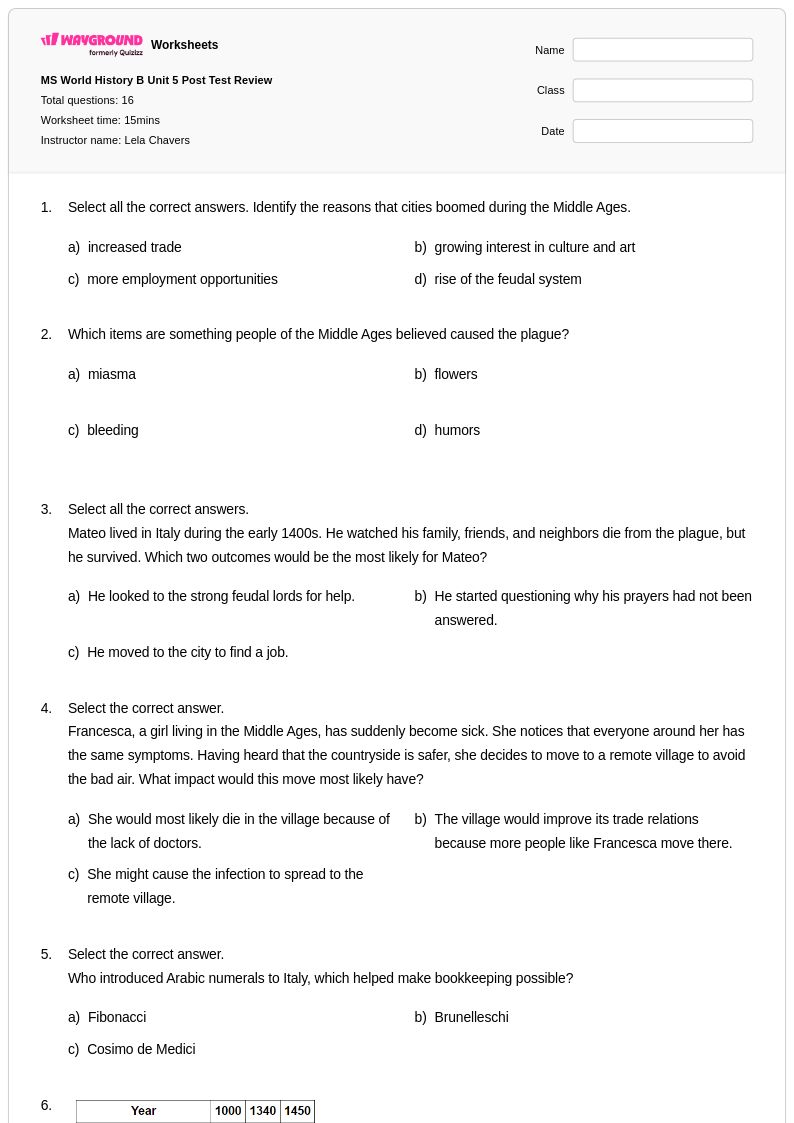
Class 8 students can explore the devastating impact of the Plague through our comprehensive collection of free World History worksheets, featuring printable PDFs with practice problems and answer keys to deepen understanding of this pivotal medieval event.
Explore printable The Plague worksheets for Class 8
The Plague worksheets available through Wayground (formerly Quizizz) provide Class 8 students with comprehensive resources to explore one of history's most devastating pandemics and its profound impact on medieval European society. These educational materials guide students through critical examination of the Black Death's origins, transmission patterns, and catastrophic effects on 14th-century populations, while developing essential analytical skills needed for advanced historical inquiry. Students engage with primary source documents, demographic data, and comparative analysis exercises that strengthen their ability to evaluate cause-and-effect relationships and understand how disease outbreaks shaped social, economic, and religious institutions. The collection includes detailed answer keys and free printables that support independent learning, along with practice problems that challenge students to synthesize information about mortality rates, social upheaval, and long-term consequences of pandemic disease on European civilization.
Wayground (formerly Quizizz) empowers educators with millions of teacher-created resources specifically designed to support Class 8 World History instruction on medieval pandemics and their historical significance. The platform's robust search and filtering capabilities enable teachers to quickly locate standards-aligned materials that match their curriculum requirements, while differentiation tools allow for customization based on individual student needs and learning objectives. These flexible worksheet collections are available in both printable and digital formats, including downloadable PDF versions that facilitate seamless integration into classroom instruction, homework assignments, and assessment preparation. Teachers can leverage these comprehensive resources for targeted skill practice, remediation of complex historical concepts, and enrichment activities that deepen student understanding of how epidemic diseases influenced the trajectory of European development, making lesson planning more efficient while ensuring students receive rigorous, engaging content that builds critical thinking skills essential for historical analysis.
FAQs
How do I teach the Black Death and the plague to middle or high school students?
Teaching the plague effectively requires grounding students in the historical context of 14th-century Europe before examining causes, spread, and consequences. Start with demographic data to make the scale of mortality tangible, then move into social and economic disruption, such as labor shortages, the decline of feudalism, and shifts in religious authority. Using primary source documents alongside analytical questions helps students develop historical thinking skills rather than just memorizing facts.
What kinds of exercises help students practice analyzing the impact of the Black Death?
Effective practice exercises for the plague include analyzing demographic charts showing population decline, evaluating primary sources such as chronicles and Church records, and completing cause-and-effect organizers that map the social, economic, and cultural consequences of the Black Death. Document-based questions (DBQs) are particularly useful because they ask students to synthesize multiple perspectives and connect historical evidence to broader patterns of change over time.
What misconceptions do students commonly have about the plague and the Black Death?
A common misconception is that the Black Death was solely a European event, when in fact it spread across Asia, the Middle East, and North Africa with equally devastating consequences. Students also frequently conflate all plague outbreaks as a single event rather than understanding that bubonic plague recurred in waves across centuries. Another error is oversimplifying the cause, attributing the spread entirely to rats rather than understanding the role of fleas, trade routes, and urban density in transmission.
How do I connect the Black Death to contemporary understanding of disease and public health?
One of the most powerful instructional moves is asking students to compare medieval responses to plague, such as quarantine in Ragusa or flagellant movements, with modern public health interventions. This comparison helps students see both continuity and change in how societies respond to epidemic disease and builds transferable analytical skills. Worksheets that include data analysis tasks or require students to evaluate the effectiveness of historical responses are especially effective for this kind of thinking.
How can I use Wayground's plague worksheets in my classroom?
Wayground's plague worksheets are available as printable PDFs for traditional classroom use and in digital formats for technology-integrated or hybrid learning environments, making them flexible across different instructional settings. Teachers can also host the worksheets as a quiz directly on Wayground, enabling formative assessment with built-in answer keys that allow students to verify their understanding of complex historical causation and change over time. The platform's differentiation tools let teachers customize materials for varied skill levels, supporting both students who need remediation and those ready for enrichment.
How do I differentiate plague history instruction for students at different skill levels?
For students who need additional support, simplify primary source texts with scaffolded reading guides and focus questions before asking for independent analysis. Advanced students benefit from comparative tasks, such as evaluating plague responses across different civilizations or analyzing long-term economic effects like the decline of serfdom. On Wayground, teachers can apply individual accommodations such as read-aloud support, reduced answer choices, and extended time to specific students without disrupting the experience for the rest of the class.