

Wayground
CRE week 2 Real Estate Management Quiz - Printable Social studies Worksheets University - Wayground

CRE week 2 Real Estate Management Quiz

Jacob Duque

Created by Jacob Duque

70 questions

University

Social studies

Updated Sept 2025

CRE Week 2 Real Estate Management Quiz is a Grade 13 Business assessment covering the responsibilities, processes, asset types, financial metrics, and transaction concepts used in real estate management. Students distinguish property, portfolio, and asset management; identify asset-manager responsibilities in acquisitions, business planning, and disposition assistance; classify life sciences and multifamily properties; and interpret concepts including DSCR, cap rate, NOI, IRR, present value, debt yield, and lease types. The 70-question assessment includes 67 multiple-choice questions and 3 open-ended questions, giving students practice selecting accurate definitions, matching formulas to real estate metrics, recognizing management activities, and explaining responsibilities in their own words. It works as a review or knowledge check for learners studying commercial real estate and asset management. This free printable worksheet includes a complete answer key for efficient grading and feedback.

Worksheet settings

Font size

S
M
L
XL
WaygroundWorksheets

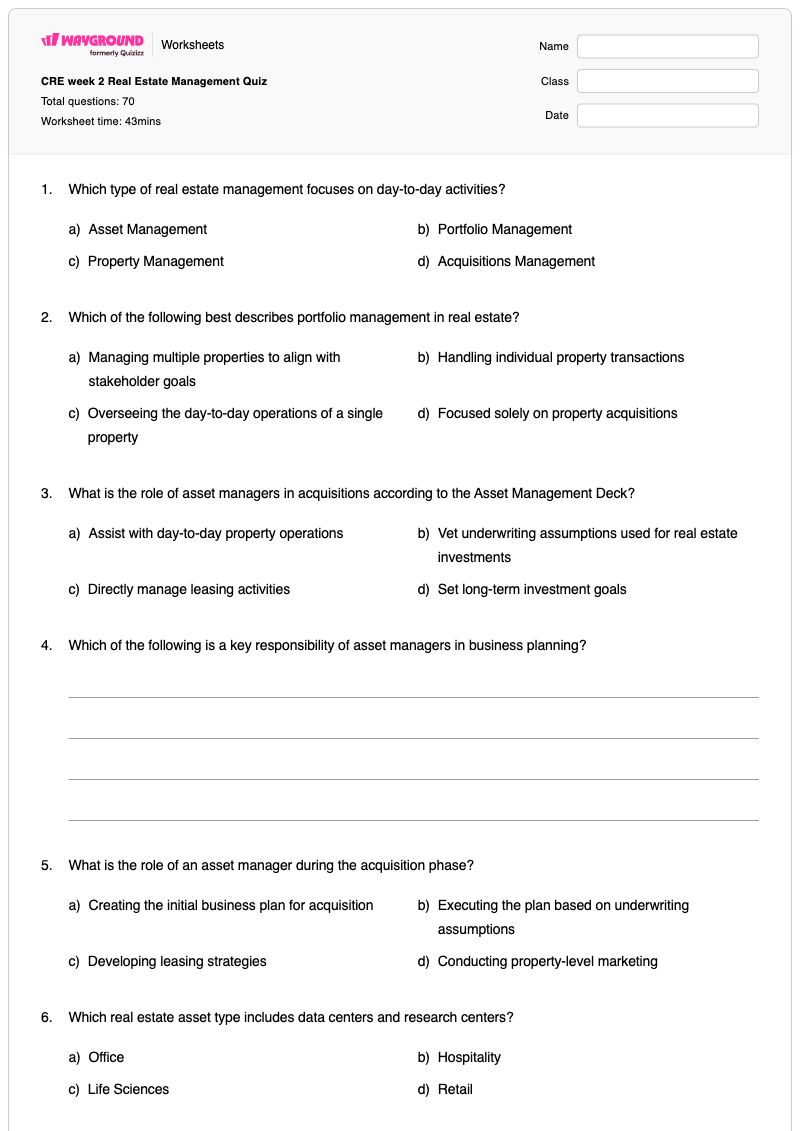
CRE week 2 Real Estate Management Quiz

Total questions: 70

Name
Class
Date
1.

Which type of real estate management focuses on day-to-day activities?

a)

Asset Management

b)

Portfolio Management

c)

Property Management

d)

Acquisitions Management

2.

Which of the following best describes portfolio management in real estate?

a)

Managing multiple properties to align with stakeholder goals

b)

Handling individual property transactions

c)

Overseeing the day-to-day operations of a single property

d)

Focused solely on property acquisitions

3.

What is the role of asset managers in acquisitions according to the Asset Management Deck?

a)

Assist with day-to-day property operations

b)

Vet underwriting assumptions used for real estate investments

c)

Directly manage leasing activities

d)

Set long-term investment goals

4.

Which of the following is a key responsibility of asset managers in business planning?

4 lines
5.

What is the role of an asset manager during the acquisition phase?

a)

Creating the initial business plan for acquisition

b)

Executing the plan based on underwriting assumptions

c)

Developing leasing strategies

d)

Conducting property-level marketing

6.

Which real estate asset type includes data centers and research centers?

a)

Office

b)

Hospitality

c)

Life Sciences

d)

Retail

7.

Which of the following real estate classes includes urban highrises and garden apartments?

a)

Multifamily

b)

Retail

c)

Industrial

d)

Office

8.

What does the Debt Service Coverage Ratio (DSCR) measure?

a)

The ratio of debt to equity

b)

The ratio of NOI to total debt service

c)

The percentage of debt paid off annually

d)

The ratio of loan value to property value

9.

Which formula is used to calculate the capitalization rate (Cap Rate)?

a)

NOI / Total Debt

b)

Sale Price / NOI

c)

NOI / Sale Price

d)

Total Revenue / NOI

10.

Which of the following is true about Net Operating Income (NOI)?

a)

It includes debt service

b)

It is equivalent to EBITDA for companies

c)

It is the gross revenue of a property

d)

It accounts for taxes and depreciation

11.

Which investment metric factors in the time value of money and projects the total return?

a)

Cap Rate

b)

Debt Yield

c)

Net Present Value (NPV)

d)

Internal Rate of Return (IRR)

12.

Which of the following best describes "Disposition Assistance" in asset management?

a)

Developing leasing strategies

b)

Forecasting equity multiples and IRRs at different sale dates

c)

Managing day-to-day property operations

d)

Monitoring tenant lease renewals

13.

Which of the following formulas calculates the present value of a property?

a)

NOI / Cap Rate

b)

NOI × Cap Rate

c)

Gross Revenue - Expenses

d)

Loan Amount / Project Cost

14.

Which of the following is NOT typically part of a commercial real estate lease?

a)

Triple Net

b)

Gross Lease

c)

Termination Clause

d)

Non-amortizing Loan

15.

What is the purpose of a Debt Yield in real estate?

a)

To measure the risk of a property investment

b)

To determine the interest rate on a loan

c)

To assess the profitability of a property

d)

To evaluate the lender's return on investment

16.

Evaluate the risk of leverage by comparing NOI to loan amount. Debt yield is calculated by dividing NOI by the loan amount, indicating the risk level associated with a property's debt.

a)

Measure the property's revenue growth

b)

Evaluate the risk of leverage by comparing NOI to loan amount

c)

Calculate the loan-to-value ratio

d)

Determine the internal rate of return on investment

17.

What does LTV (Loan-to-Value) measure? LTV compares the amount of the mortgage to the appraised value, assessing leverage.

a)

Ratio of mortgage amount to appraised property value

b)

Ratio of loan amount to NOI

c)

Loan service coverage ratio

d)

Value of a property based on NOI and cap rate

18.

Which of the following defines Net Operating Income (NOI)? NOI is a property's gross income minus operating expenses and is a key metric in evaluating profitability.

a)

Gross Revenue - Operating Expenses

b)

Sale Price × Cap Rate

c)

Property Value × Cap Rate

d)

Gross Revenue + Operating Expenses

19.

In commercial real estate, which of the following is a component of 'Operating Expenses'?

a)

Interest payments

b)

Management fees

c)

Capital improvements

d)

Sale proceeds

20.

What does the Internal Rate of Return (IRR) represent in real estate?

a)

The rate at which NOI grows

b)

The discount rate that makes the net present value (NPV) of cash flows zero

c)

The sale price divided by NOI

d)

The total operating expenses as a percentage of revenue

21.

Which of the following best defines the term "Unlevered IRR"?

a)

The rate of return including debt

b)

The rate of return excluding debt

c)

Cash flow after debt payments

d)

Rate of return after capital expenditures

22.

What is the main difference between levered and unlevered cash flows?

a)

Levered cash flow accounts for debt, while unlevered does not

b)

Levered cash flow excludes capital expenditures

c)

Unlevered cash flow accounts for taxes and interest

d)

Levered cash flow is before tax, and unlevered is after tax

23.

Which of the following asset types typically trades at the lowest cap rates?

a)

Office buildings

b)

Warehouses

c)

Multifamily properties

d)

Retail strip malls

24.

What does "Gross Lease" mean in commercial real estate?

a)

The tenant pays all operating expenses

b)

The landlord pays all operating expenses

c)

The tenant pays a proportionate share of taxes

d)

The tenant pays for common area maintenance only

25.

Which of the following best describes a Triple Net (NNN) Lease?

a)

Tenant pays rent only

b)

Tenant pays rent plus all operating expenses

c)

Tenant pays rent plus property taxes, insurance, and maintenance

d)

Tenant pays rent plus capital expenditures

26.

What is the primary difference between Fixed and Floating Rate loans in commercial real estate?

a)

Fixed rate loans have lower interest rates

b)

Floating rate loans have constant interest rates

27.

Which of the following is true about CMBS (Commercial Mortgage-Backed Securities)?

a)

They are short-term loans for property acquisition

b)

They are securitized loans sold on secondary markets

c)

They are non-recourse loans with fixed rates

d)

They have lower loan-to-value ratios than typical loans

28.

What is the Debt Service Coverage Ratio (DSCR) used to assess?

a)

Property value relative to loan amount

b)

The ability of a property’s NOI to cover its debt payments

c)

The profitability of a development project

d)

The interest rate on a floating loan

29.

What does the term "CapEx" refer to in commercial real estate?

a)

Operating expenses

b)

Net operating income

c)

Capital expenditures for property improvements or repairs

d)

Cash flow after debt service

30.

In real estate financing, what does "Recourse" mean?

a)

The lender can seize other assets beyond the secured property

b)

The loan must be paid back within a fixed term

c)

The loan cannot exceed the property's value

d)

The lender can only seize the property as collateral

31.

Which of the following is a characteristic of a Non-Recourse loan?

a)

The lender can go after the borrower's other assets

b)

The lender can only seize the property as collateral

c)

The loan must be repaid before any equity is distributed

d)

The loan is typically short-term and variable rate

32.

What is the equity multiple in real estate?

a)

Total cash flows divided by total cash invested

b)

Cash flow after debt service divided by NOI

c)

Total revenue divided by operating expenses

d)

NOI divided by the loan amount

33.

What role does market research play in asset management?

a)

Identifying the highest rental prices for a property

b)

Ensuring properties are competitive and resilient in their market

c)

Conducting property-level maintenance assessments

d)

Reviewing tenant lease agreements for renewal

34.

Which of the following real estate terms is synonymous with "purchase price"?

a)

Cap rate

b)

Property value

c)

Loan amount

d)

Net present value

35.

What is a "spread" in relation to debt in real estate financing?

a)

The difference between NOI and loan payments

b)

The interest rate added to a benchmark rate

c)

The difference between purchase price and appraised value

d)

The total loan amount divided by equity

36.

What does "Basis Points" (Bips) measure in real estate finance?

a)

Loan term in months

b)

A unit of measure for interest rates and percentages

c)

The number of payments made over a loan period

d)

The number of tenants in a property

37.

Which of the following is an example of "unlevered cash flow"?

a)

Cash flow after debt service

b)

Cash flow without considering interest or debt payments

c)

Cash flow after operating expenses and debt payments

d)

Cash flow before taxes and depreciation

38.

What is the main focus of asset managers when promoting operational efficiency?

a)

Identifying tenant improvement needs

b)

Reducing operating costs and leveraging economies of scale

c)

Monitoring long-term investments

d)

Developing leasing agreements for new tenants

39.

Which of the following best describes the Loan-to-Cost (LTC) ratio?

a)

Loan amount divided by the total project cost

b)

NOI divided by the total loan amount

c)

Purchase price divided by loan amount

d)

Debt service divided by the project cost

40.

What is typically included in a Debt Service Coverage Ratio (DSCR) calculation?

a)

Gross Revenue and Total Expenses

b)

NOI and Total Debt Service

c)

Loan Amount and Cap Rate

d)

Operating Expenses and Taxes

41.

Which type of loan allows the borrower to pay off part or all of the loan before maturity without penalty?

a)

Fixed-rate loan

b)

Floating-rate loan

c)

Non-recourse loan

d)

Prepayment-penalty-free loan

42.

What type of lease places all operating expenses, including taxes and insurance, on the tenant?

a)

Gross Lease

b)

Triple Net (NNN) Lease

c)

Modified Gross Lease

d)

Ground Lease

43.

Which of the following is a feature of a "Partially Amortizing Loan"?

4 lines
44.

A partially amortizing loan is characterized by which of the following?

a)

The entire loan is repaid in equal installments

b)

A portion of the loan is paid regularly, with a lump sum due at maturity

c)

The loan is repaid over the project's lifetime

d)

The loan does not include interest payments

45.

What is the "Debt Yield" used to assess in real estate finance?

a)

The ratio of debt service to NOI

b)

The annual return on NOI relative to loan amount

c)

The ratio of loan amount to property value

d)

The loan-to-cost ratio on a development project

46.

In what type of real estate investment is "Cap Rate" most commonly used?

a)

Retail

b)

Industrial

c)

Office

d)

All of the above

47.

Which formula is used to determine the Loan-to-Value (LTV) ratio?

a)

Loan Amount / Total Debt

b)

Loan Amount / Property Value

c)

NOI / Cap Rate

d)

Loan Amount / Total Project Cost

48.

What is the primary function of "market research" for asset managers?

a)

Forecasting rent growth

b)

Understanding the competitive landscape to improve property positioning

c)

Analyzing tenant creditworthiness

d)

Monitoring construction costs

49.

What is the Internal Rate of Return (IRR) used to estimate in a real estate investment?

a)

The current market value of the property

b)

The total return on an investment over a specific period, considering the time value of money

c)

The operating expenses compared to gross revenue

d)

The cash flow after taxes

50.

Which of the following would increase the Cap Rate for a property?

a)

Decreased property value with stable NOI

b)

Increased property value with decreasing NOI

c)

Decreased NOI with increased property value

d)

Stable NOI with stable property value

51.

Which type of commercial real estate asset is typically associated with the highest Cap Rates?

a)

Multifamily

b)

Office

c)

Retail strip malls

d)

Hospitality

52.

Which of the following factors could lead to a lower Internal Rate of Return (IRR)?

a)

Lower interest rates

b)

Lower operating expenses

c)

Higher initial investment and longer holding period

d)

Increased revenue from rent

53.

What does a "bridge loan" in commercial real estate typically provide?

a)

Long-term fixed-rate financing for stabilized properties

b)

Short-term financing for property acquisitions or repositioning

c)

Construction financing for development projects

d)

Permanent financing for income-producing properties

54.

What does the "Equity Multiple" measure in real estate investments?

a)

The total profit earned on an investment

b)

The ratio of total cash inflows to total cash outflows

c)

The percentage of ownership in a property

d)

The annual return on investment

55.

What does the equity multiple measure in relation to total cash flow?

a)

Total cash flow divided by NOI

b)

The percentage of debt in relation to equity

c)

Total cash returns divided by the amount of equity invested

d)

NOI divided by total cash flow

56.

In a "Modified Gross Lease," who typically pays for property taxes?

a)

The landlord pays all taxes

b)

The tenant pays all taxes

c)

The landlord and tenant share the responsibility based on the lease agreement

d)

Taxes are paid by a third-party management company

57.

Which of the following is an example of a "non-recourse" loan?

a)

A loan that allows the lender to pursue other assets of the borrower

b)

A loan where the lender can only seize the secured property in case of default

c)

A loan where the borrower must guarantee repayment with personal assets

d)

A loan with a fixed interest rate and full amortization

58.

Which of the following types of real estate would likely have the most volatile cash flows?

4 lines
59.

What does "Full Amortization" mean in the context of a loan?

a)

The loan is paid off in full over the loan term with regular payments

b)

The loan requires a lump sum payment at the end of the term

c)

The loan payments include interest but not principal

d)

The loan has a variable interest rate and requires regular refinancing

60.

What is the primary function of asset managers when working with a property’s budget?

a)

Create the budget without input from other team members

b)

Approve and monitor the budget with input from leasing agents and property managers

c)

Submit the budget to stakeholders without modifications

d)

Focus solely on marketing and leasing activities

61.

What is the purpose of "Disposition Assistance" in real estate asset management?

a)

Assisting tenants with lease renewals

b)

Helping evaluate and plan the sale of properties

c)

Monitoring tenant satisfaction

d)

Overseeing property maintenance activities

62.

Which of the following defines "Market Research" in the context of asset management?

a)

Developing long-term leasing strategies

b)

Understanding the market trends, competitors, and tenant demands to position properties competitively

c)

Monitoring rent payments and financial obligations of tenants

d)

Calculating NOI and other financial ratios

63.

Which of the following types of real estate is associated with the lowest cap rates due to lower risk?

a)

Office buildings

b)

Multifamily properties

c)

Retail strip malls

d)

Industrial warehouses

64.

What role does sustainability play in asset management?

a)

Reduces property taxes

b)

Increases operating costs due to compliance

c)

Provides cost-saving opportunities and operational efficiency

d)

Increases rental income from tenants

65.

What is the primary advantage of using Cap Rate as a valuation tool in real estate?

a)

It accounts for future cash flow growth

b)

It provides a snapshot of the property’s rate of return at a specific point in time

c)

It includes debt service payments in the calculation

d)

It only applies to commercial properties

66.

What is the difference between Cap Rate and IRR in real estate investments?

a)

Cap rate accounts for the time value of money, while IRR does not

b)

IRR accounts for the time value of money, while Cap Rate is a simple ratio

c)

Cap Rate measures total return, while IRR only measures equity return

d)

IRR is used to calculate operating expenses, while Cap Rate is used to calculate value

67.

Which of the following would NOT be considered an operating expense in real estate?

a)

Property management fees

b)

Insurance and taxes

c)

Debt service payments

d)

Maintenance and repairs

68.

Which type of real estate is characterized by data centers and research laboratories?

a)

Retail

b)

Life Sciences

c)

Office

d)

Industrial

69.

What is the significance of Debt Service Coverage Ratio (DSCR) in real estate finance?

a)

It measures the amount of equity invested

b)

It assesses the property’s ability to cover debt payments with NOI

c)

It evaluates the overall value of the property

d)

It measures the total debt relative to the property value

70.

Which of the following is true about "Full Recourse" loans in real estate?

a)

The lender can only seize the property in case of default

b)

The borrower is personally liable, and the lender can pursue other assets

c)

The loan is secured only by the value of the property

d)

The loan has no penalty for prepayment

WaygroundAnswer Key

CRE week 2 Real Estate Management Quiz

Total questions: 70

1.
c)

Property Management

2.
a)

Managing multiple properties to align with stakeholder goals

3.
b)

Vet underwriting assumptions used for real estate investments

4.
n/a
5.
b)

Executing the plan based on underwriting assumptions

6.
c)

Life Sciences

7.
a)

Multifamily

8.
b)

The ratio of NOI to total debt service

9.
c)

NOI / Sale Price

10.
b)

It is equivalent to EBITDA for companies

11.
d)

Internal Rate of Return (IRR)

12.
b)

Forecasting equity multiples and IRRs at different sale dates

13.
a)

NOI / Cap Rate

14.
d)

Non-amortizing Loan

15.
d)

To evaluate the lender's return on investment

16.
b)

Evaluate the risk of leverage by comparing NOI to loan amount

17.
a)

Ratio of mortgage amount to appraised property value

18.
a)

Gross Revenue - Operating Expenses

19.
b)

Management fees

20.
b)

The discount rate that makes the net present value (NPV) of cash flows zero

21.
b)

The rate of return excluding debt

22.
a)

Levered cash flow accounts for debt, while unlevered does not

23.
c)

Multifamily properties

24.
b)

The landlord pays all operating expenses

25.
c)

Tenant pays rent plus property taxes, insurance, and maintenance

26.
a)

Fixed rate loans have lower interest rates

27.
b)

They are securitized loans sold on secondary markets

28.
b)

The ability of a property’s NOI to cover its debt payments

29.
c)

Capital expenditures for property improvements or repairs

30.
a)

The lender can seize other assets beyond the secured property

31.
b)

The lender can only seize the property as collateral

32.
a)

Total cash flows divided by total cash invested

33.
b)

Ensuring properties are competitive and resilient in their market

34.
b)

Property value

35.
b)

The interest rate added to a benchmark rate

36.
b)

A unit of measure for interest rates and percentages

37.
b)

Cash flow without considering interest or debt payments

38.
b)

Reducing operating costs and leveraging economies of scale

39.
a)

Loan amount divided by the total project cost

40.
b)

NOI and Total Debt Service

41.
d)

Prepayment-penalty-free loan

42.
b)

Triple Net (NNN) Lease

43.
n/a
44.
b)

A portion of the loan is paid regularly, with a lump sum due at maturity

45.
b)

The annual return on NOI relative to loan amount

46.
d)

All of the above

47.
b)

Loan Amount / Property Value

48.
b)

Understanding the competitive landscape to improve property positioning

49.
b)

The total return on an investment over a specific period, considering the time value of money

50.
a)

Decreased property value with stable NOI

51.
d)

Hospitality

52.
c)

Higher initial investment and longer holding period

53.
b)

Short-term financing for property acquisitions or repositioning

54.
b)

The ratio of total cash inflows to total cash outflows

55.
c)

Total cash returns divided by the amount of equity invested

56.
c)

The landlord and tenant share the responsibility based on the lease agreement

57.
b)

A loan where the lender can only seize the secured property in case of default

58.
n/a
59.
a)

The loan is paid off in full over the loan term with regular payments

60.
b)

Approve and monitor the budget with input from leasing agents and property managers

61.
b)

Helping evaluate and plan the sale of properties

62.
b)

Understanding the market trends, competitors, and tenant demands to position properties competitively

63.
b)

Multifamily properties

64.
c)

Provides cost-saving opportunities and operational efficiency

65.
b)

It provides a snapshot of the property’s rate of return at a specific point in time

66.
b)

IRR accounts for the time value of money, while Cap Rate is a simple ratio

67.
c)

Debt service payments

68.
b)

Life Sciences

69.
b)

It assesses the property’s ability to cover debt payments with NOI

70.
b)

The borrower is personally liable, and the lender can pursue other assets

FAQs

What does the CRE Week 2 Real Estate Management Quiz cover?

This Grade 13 Business quiz covers how property, portfolio, and asset management differ, along with asset-manager responsibilities during acquisitions, business planning, and disposition assistance. Its 67 multiple-choice and 3 open-ended questions also ask students to identify real estate asset types, recognize formulas for DSCR, cap rate, and present value, and distinguish metrics such as NOI, IRR, and debt yield.

How can I use this quiz to teach real estate management concepts?

Use the quiz after introducing the management hierarchy: begin with day-to-day property management, then connect portfolio management to multiple properties and asset management to investment planning and execution. Before students answer the metric questions, have them explain what each formula or measure is intended to evaluate, such as NOI in relation to cap rate or debt service in relation to DSCR. Finish with the open-ended items so students apply the role definitions rather than only recognizing them in multiple-choice options.

What mistakes should I watch for when students complete this real estate management quiz?

Watch for students confusing property management’s day-to-day focus with portfolio management’s oversight of multiple properties, or treating an asset manager as the person directly handling leasing and operations. Students may also select formulas based on familiar terms rather than matching NOI to the stated calculation, confuse IRR with cap rate, or identify a non-amortizing loan as a commercial lease type. Review the open-ended responses for whether students explain an asset manager’s business-planning responsibility instead of naming a general property operation.

How do I assign and grade this real estate management worksheet?

The CRE Week 2 Real Estate Management Quiz is available as a printable PDF and as a digital quiz on Wayground, with a complete answer key for the 67 multiple-choice and 3 open-ended questions. For printable submissions, you can scan student work with the Wayground for Teachers app to support grading. The PDF option also gives schools a way to reduce screen use when appropriate.

How can I differentiate this real estate management quiz for my students?

Use the worksheet’s Advanced Settings to adjust font spacing or choose a larger font size for the multiple-choice options, formulas, and open-ended prompts. You can also enable a dyslexia-friendly font or translate the quiz into another language, helping students access the role definitions and real estate metric questions without changing the assessment format.

Where can I find more worksheets like this on Wayground?

Wayground offers a comprehensive collection of free printable worksheets and practice problems across subjects, with downloadable PDFs and answer keys to help students master essential skills and concepts. Browse more resources at https://wayground.com/en-us/worksheets.