

Wayground
Financial Literacy 3rd Grade - Printable Mathematics Worksheets class 3 - Wayground

Financial Literacy 3rd Grade

10 questions

3rd - 3rd Grade

Mathematics

Financial Literacy 3rd Grade is a free printable Mathematics worksheet for Grade 3 students. It uses 10 multiple-choice questions to build practical understanding of money and everyday financial decisions. Students identify how work experience and hours worked can affect income, recognize why borrowers repay interest, and explain how limited supply can influence prices. The worksheet also asks students to determine the value of pictured bills and coins, identify possible or impossible combinations for a given amount, and interpret money earned or spent in familiar situations. These items help students connect coin-and-bill computation with financial literacy concepts such as income, savings, borrowing, interest, and supply. A complete answer key is included, making this free printable worksheet useful for independent practice, review, or a short Grade 3 math assessment.

Worksheet settings

Font size

S
M
L
XL
Worksheets

Financial Literacy 3rd Grade

Total questions: 10

Name
Class
Date
1.

Ms. Patterson works for a company. Which factor would most likely affect the amount of money Ms. Patterson gets paid by the company?

a)

The size of Ms. Patterson’s family

b)

The amount of money Ms. Patterson has to pay in bills

c)

The amount of money Ms. Patterson saves every month

d)

The work experience Ms. Patterson has

2.

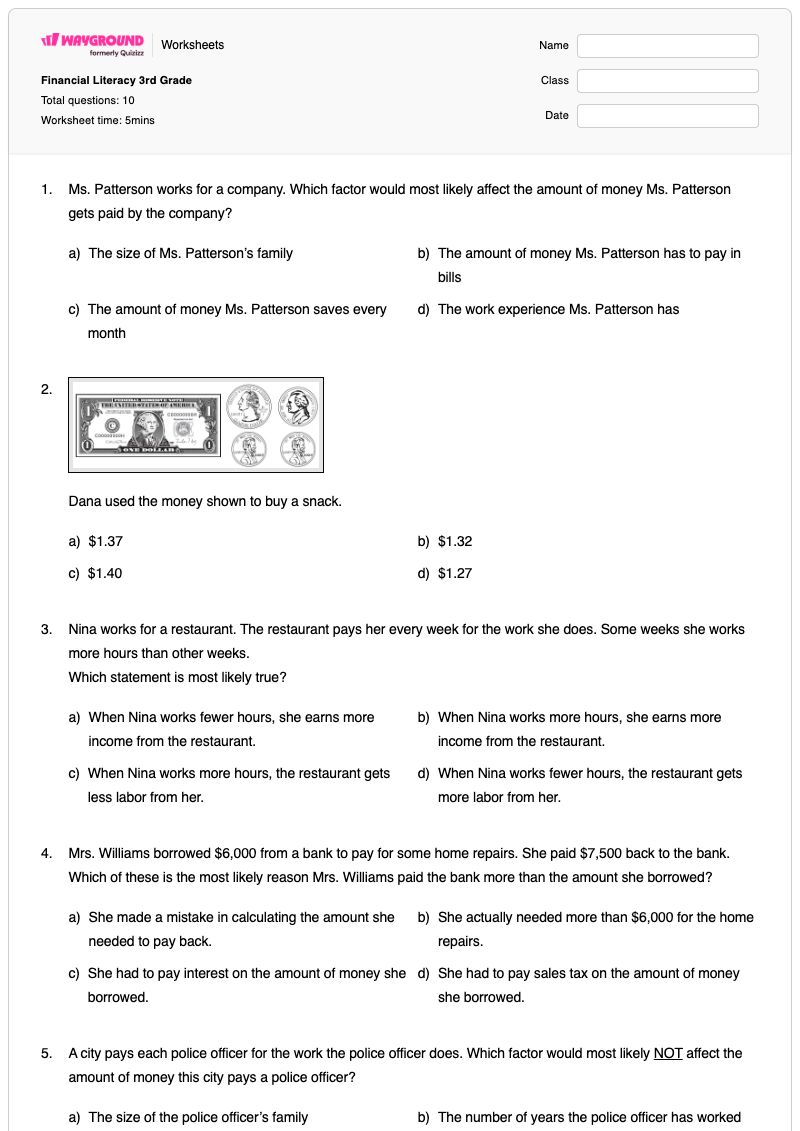
Dana used the money shown to buy a snack.

a)

$1.37

b)

$1.32

c)

$1.40

d)

$1.27

3.

Nina works for a restaurant. The restaurant pays her every week for the work she does. Some weeks she works more hours than other weeks.

Which statement is most likely true?

a)

When Nina works fewer hours, she earns more income from the restaurant.

b)

When Nina works more hours, she earns more income from the restaurant.

c)

When Nina works more hours, the restaurant gets less labor from her.

d)

When Nina works fewer hours, the restaurant gets more labor from her.

4.

Mrs. Williams borrowed $6,000 from a bank to pay for some home repairs. She paid $7,500 back to the bank. Which of these is the most likely reason Mrs. Williams paid the bank more than the amount she borrowed?

a)

She made a mistake in calculating the amount she needed to pay back.

b)

She actually needed more than $6,000 for the home repairs.

c)

She had to pay interest on the amount of money she borrowed.

d)

She had to pay sales tax on the amount of money she borrowed.

5.

A city pays each police officer for the work the police officer does. Which factor would most likely NOT affect the amount of money this city pays a police officer?

a)

The size of the police officer’s family

b)

The number of years the police officer has worked for the city

c)

The special skills that the police officer has

d)

The level of education that the police officer has

6.

Charlie emptied his piggy bank and counted $5.63 in savings. Which set of bills and coins could NOT BE the total amount of money that was in Charlie’s piggy bank?

a)
b)
c)
d)
7.

Bad weather destroyed most of the peaches on the peach trees in an orchard.This will have an effect on the price of the remaining peaches. Which statementbest describes the effect on the price?

a)

The price will likely increase, because there are more peaches available to buy.

b)

The price will likely decrease, because there are more peaches available tobuy.

c)

The price will likely increase, because there are fewer peaches available tobuy.

d)

The price will likely decrease, because there are fewer peaches available tobuy.

8.

Claire borrowed $20 from her mom in order to buy game tokens at a festival. Hermom said Claire would have to pay the money back with interest. Which statement best explains what Claire’s mom meant?

a)

She expected Claire to pay back only the money she borrowed.

b)

She expected Claire to pay back only part of the money she borrowed.

c)

She expected Claire to keep the money she borrowed and not pay any of it back.

d)

She expected Claire to pay back the money she borrowed plus an additional amount of money.

9.

Owen received the coins and bills shown when he sold lemonade.

What is the value of the coins and bills Owen received?

a)

$8.85

b)

$9.00

c)

$9.10

d)

$8.90

10.

Inez did laundry. She found $6.47 in the pocket of her dad’s pants. Which of the following could NOT represent the amount of money Inez found?

a)
b)
c)
d)
Answer Key

Financial Literacy 3rd Grade

Total questions: 10

1.
d)

The work experience Ms. Patterson has

2.
b)

$1.32

3.
b)

When Nina works more hours, she earns more income from the restaurant.

4.
c)

She had to pay interest on the amount of money she borrowed.

5.
a)

The size of the police officer’s family

6.
b)
7.
c)

The price will likely increase, because there are fewer peaches available tobuy.

8.
d)

She expected Claire to pay back the money she borrowed plus an additional amount of money.

9.
c)

$9.10

10.
c)

FAQs

What does this Grade 3 financial literacy worksheet cover?

This worksheet uses 10 multiple-choice questions to practice counting bills and coins, identifying factors that affect income, understanding borrowing and interest, and recognizing how fewer available goods can raise prices. Students apply these ideas to situations involving wages, savings, purchases, loans, and the price of peaches, building both money-value skills and basic financial reasoning.

How can I use this worksheet to teach Grade 3 students about income, interest, and prices?

Introduce the money vocabulary before students begin, including income, savings, borrowing, interest, and supply. As students work through the multiple-choice scenarios, ask them to explain why work experience or hours worked can affect pay, why a borrower repays more than the original loan, and why a smaller supply of peaches can lead to a higher price. Follow up by having students justify how they counted the bills and coins in the purchase and lemonade examples.

What mistakes should I watch for when students complete this financial literacy worksheet?

Students may confuse personal expenses or family size with factors that determine a worker’s pay, or overlook the relationship between hours worked and income. They may also treat interest as part of the original loan rather than an additional amount repaid, reverse the effect of fewer peaches on price, or miscount coins and bills when finding totals and checking equivalent money combinations. Remind students to read carefully for questions asking what could not represent an amount.

How do I assign and grade this financial literacy worksheet?

The worksheet is available as a printable PDF and as a digital quiz on Wayground, and it includes a complete answer key for checking the 10 multiple-choice responses. For printable submissions, you can grade student work by scanning it with the Wayground for Teachers app. The PDF option can also support classrooms that are reducing screen time.

How can I differentiate this Grade 3 money worksheet for my students?

In the worksheet’s Advanced Settings, adjust font spacing or choose a larger font size to make the money scenarios and answer choices easier to read. You can also apply a dyslexia-friendly font or translate the worksheet into another language while students work with the bills-and-coins and financial reasoning questions.

Where can I find more worksheets like this on Wayground?

Wayground offers a comprehensive collection of free printable worksheets and practice problems across all subjects, with downloadable PDFs and answer keys to help students master essential skills and concepts. Browse more resources at https://wayground.com/en-us/worksheets.