

Wayground
Math Using Sig Figs - Printable Chemistry Worksheets - Wayground

Math Using Sig Figs

20 questions

10th - 10th Grade

Chemistry

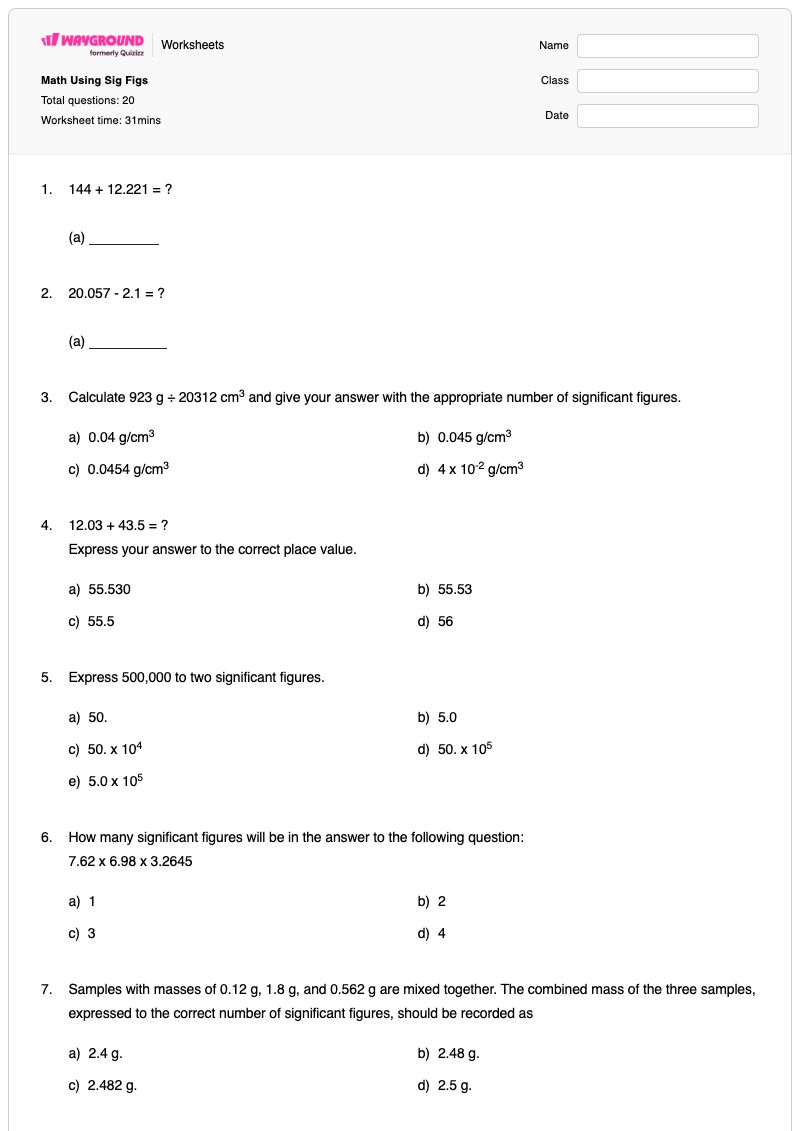
Math Using Sig Figs is a free printable Grade 10 chemistry worksheet that builds accuracy with significant figures, decimal-place rules, and scientific notation. Students complete 20 questions: 3 fill-in-the-blank calculations and 17 multiple-choice items. The practice includes addition and subtraction rounded to the correct place value, multiplication and division reported with the correct number of significant figures, and identifying significant figures in values such as 500,000. The worksheet also applies these skills to chemistry-style measurements, including mass totals, density, and volume, while reinforcing how exponents behave when multiplying, dividing, adding, or subtracting numbers in scientific notation. It is useful for guided practice, independent classwork, homework, or a review assessment after instruction. A complete answer key is included so teachers can check both calculation results and students’ understanding of rounding conventions.

Worksheet settings

Font size

S
M
L
XL
Worksheets

Math Using Sig Figs

Total questions: 20

Name
Class
Date
1.

144 + 12.221 = ?

(a)  

2.

20.057 - 2.1 = ?

(a)  

3.
Calculate 923 g ÷ 20312 cm3 and give your answer with the appropriate number of significant figures.
a)
0.04 g/cm3
b)
0.045 g/cm3
c)
0.0454 g/cm3
d)
4 x 10⁻² g/cm3
4.

12.03 + 43.5 = ?

Express your answer to the correct place value.

a)

55.530

b)

55.53

c)

55.5

d)

56

5.

Express 500,000 to two significant figures.

a)

50.

b)

5.0

c)

50. x 104

d)

50. x 105

e)

5.0 x 10⁵

6.
How many significant figures will be in the answer to the following question:
7.62 x 6.98 x 3.2645
a)
1
b)
2
c)
3
d)
4
7.

Samples with masses of 0.12 g, 1.8 g, and 0.562 g are mixed together. The combined mass of the three samples, expressed to the correct number of significant figures, should be recorded as

a)

2.4 g.

b)

2.48 g.

c)

2.482 g.

d)

2.5 g.

8.

The dimensions of rectangular solid are measured to be 1.27 cm, 1.3 cm, and 2.5 cm. The volume should be recorded as

a)

4.128 cm3.

b)

4.12 cm3.

c)

4.13 cm3.

d)

4.1 cm3.

9.
When performing the calculation 34.530 g + 12.1 g + 1222.34 g the final answer must have
a)
Three significant figures
b)
One decimal place
c)
Two decimal places
d)
Three decimal places
10.

If you have a number in scientific notation with a negative exponent, what does this tell you?

a)

You have a negative number

b)

You have a very large number

c)

Nothing

d)

You have a very small number

11.

When multiplying two numbers in scientific notation, what do you do with the exponents?

a)

Add them

b)

Subtract them

c)

Multiply them

d)

Leave them alone

12.

When subtracting two numbers in scientific notation, what do you do with the exponent?

a)

Leave them alone

b)

Leave them alone (But only if they match)

c)

Subtract them

d)

Add them

13.

When dividing two numbers in scientific notation, what do you do with the exponents?

a)

Add them

b)

Subtract them

c)

Multiply them

d)

Leave them alone

14.

Complete the operation:


(6 x 10^5) X (1 x 10^10)

a)

7 x 10^15

b)

6 x 10^-5

c)

6 x 10^15

d)

6 x 10^50

15.

Complete the operation:


(4 x 10^3) + (8 x 10^3)

a)

1.2 x 10^4

b)

1.2 x 10^3

c)

12 x 10^3

d)

12 x 10^4

16.

Complete the operation:


(8 x 10^-3) / (4 x 10^-8)

a)

2 x 10^-11

b)

2 x 10^-5

c)

2 x 10^5

d)

2 x 10^11

17.

How do you write the number 0.000023 in scientific notation?

a)

2.3 x 10^5

b)

2.3 x 10^-5

c)

23 x 10^4

d)

23 x 10^-4

18.

Convert this number to standard notation:


7.1 x 10⁴

(a)  

19.
Divide (7.78 x 10 ^8) / (9.67 x 10 ^-9) and express in scientific notations.
a)

8.05 x 10 ^16

b)

8.04 x 10 ^15

c)

8.046 x 10 ^15

d)

8.06 x 10 ^16

20.
Multiply (2.45 x 10 ^4) x (8.78 x 10 ^6) and express in scientific notations.
a)
2.15 x 10 ^15
b)
2.15 x 10 ^14
c)

2.15 x 10 ^11

d)
2.10 x 10 ^15
Answer Key

Math Using Sig Figs

Total questions: 20

1.
156
2.
18.0, 1
3.
c) 0.0454 g/cm3
4.
c)

55.5

5.
e)

5.0 x 10⁵

6.
c) 3
7.
d)

2.5 g.

8.
d)

4.1 cm3.

9.
b) One decimal place
10.
d)

You have a very small number

11.
a)

Add them

12.
b)

Leave them alone (But only if they match)

13.
b)

Subtract them

14.
c)

6 x 10^15

15.
a)

1.2 x 10^4

16.
c)

2 x 10^5

17.
b)

2.3 x 10^-5

18.
71,000, 71000, 71,000., 71000.
19.
a)

8.05 x 10 ^16

20.
c)

2.15 x 10 ^11

FAQs

What does the Math Using Sig Figs worksheet cover?

This Grade 10 chemistry worksheet uses 3 fill-in-the-blank calculations and 17 multiple-choice questions to practice significant figures, decimal-place rounding, and scientific notation. Students apply the rules to addition, subtraction, multiplication, and division, including chemistry measurements such as mass, density, and volume.

How can I use this worksheet to teach significant figures and scientific notation?

Introduce the distinction between decimal-place rules for addition or subtraction and significant-figure rules for multiplication or division, then model one calculation from each section. Use the scientific-notation items to have students explain why exponents are added when multiplying, subtracted when dividing, and matched before adding or subtracting.

What mistakes should I watch for on this significant-figures worksheet?

Students may round addition and subtraction by counting significant figures instead of using the least precise decimal place, as in the 12.03 + 43.5 item. They may also miscount significant figures in values such as 500,000, apply the wrong exponent operation in scientific notation, or report a density or volume with more precision than the measurements support.

How do I assign and grade the Math Using Sig Figs worksheet?

The worksheet is available as a printable PDF and as a digital quiz on Wayground, and it includes a complete answer key for all 20 questions. For printable submissions, teachers can scan student work with the Wayground for Teachers app to grade it efficiently.

How can I differentiate this significant-figures worksheet for my students?

In the worksheet’s Advanced Settings, adjust font spacing or choose a larger font size to make the calculation choices and scientific-notation expressions easier to read. You can also apply a dyslexia-friendly font or translate the worksheet into another language while keeping its fill-in-the-blank and multiple-choice format.

Where can I find more worksheets like this on Wayground?

Wayground offers a broad collection of free printable worksheets and practice problems across subjects, with downloadable PDFs and answer keys to support essential skills and concepts. Browse more resources at https://wayground.com/en-us/worksheets.