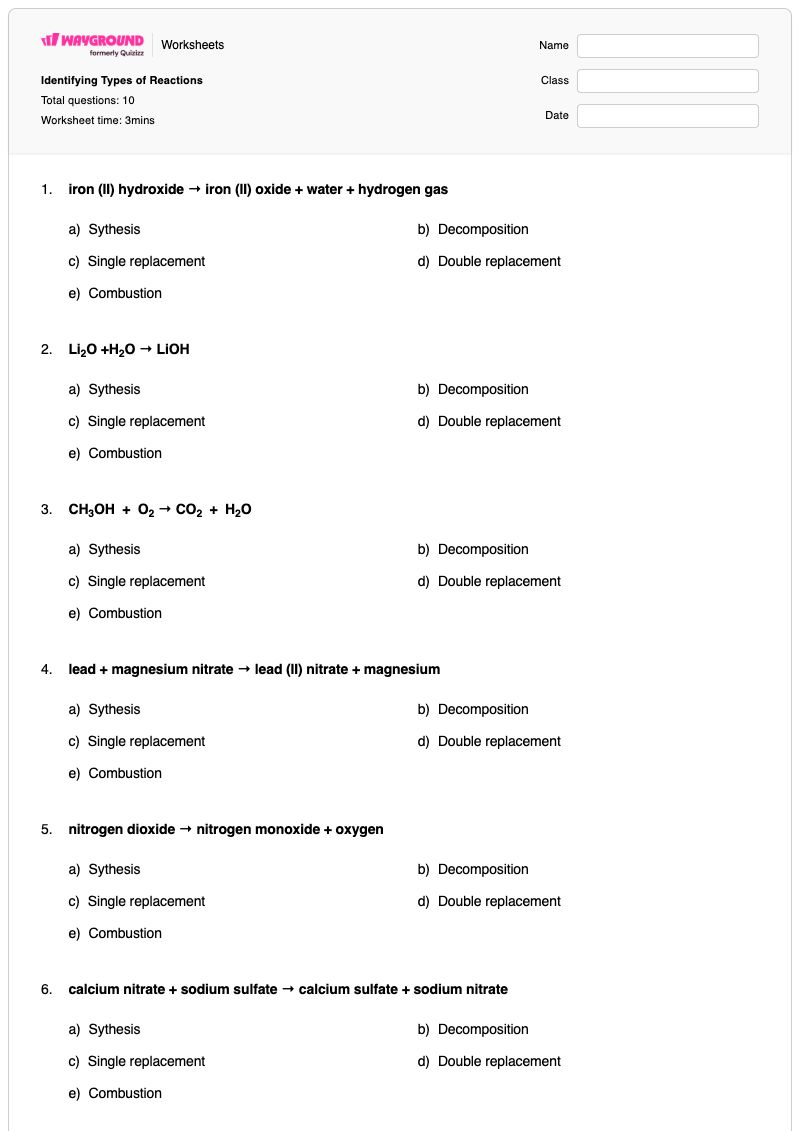
Identifying Types of Reactions is a Grade 10 science worksheet that helps students classify chemical equations as synthesis, decomposition, single replacement, double replacement, or combustion. Its 10 multiple-choice questions present equations in both word and chemical form, including examples such as lithium oxide reacting with water, methanol reacting with oxygen, and compounds breaking into simpler substances.
Students strengthen their ability to recognize reaction patterns by examining the number and arrangement of reactants and products rather than relying only on memorized names. The worksheet is useful for chemistry practice, review, or a quick formative assessment after introducing reaction types. It is a free printable worksheet with a complete answer key for checking student understanding.
Worksheet settings
Font size
S
M
L
XL
Worksheets
Identifying Types of Reactions
Total questions: 10
Name
Class
Date
1.
iron (II) hydroxide → iron (II) oxide + water + hydrogen gas
a)
Sythesis
b)
Decomposition
c)
Single replacement
d)
Double replacement
e)
Combustion
2.
Li2O +H2O → LiOH
a)
Sythesis
b)
Decomposition
c)
Single replacement
d)
Double replacement
e)
Combustion
3.
CH3OH + O2 → CO2 + H2O
a)
Sythesis
b)
Decomposition
c)
Single replacement
d)
Double replacement
e)
Combustion
4.
lead + magnesium nitrate → lead (II) nitrate + magnesium
What does the Identifying Types of Reactions worksheet cover?
This Grade 10 science worksheet asks students to classify 10 chemical equations as synthesis, decomposition, single replacement, double replacement, or combustion. The multiple-choice format builds recognition of reaction patterns, such as one compound breaking apart in decomposition or elements combining to form a compound in synthesis.
How can I use this worksheet to teach the five types of chemical reactions?
Introduce the five reaction categories with one representative equation pattern at a time, then have students use the 10 multiple-choice items to identify the pattern they see. Ask students to explain which reactants and products led to each choice, especially when comparing synthesis with decomposition or single replacement with double replacement.
What mistakes should I watch for when students complete this reaction-types worksheet?
Students may confuse synthesis and decomposition by focusing on the substances' names instead of the equation structure. They may also mistake single replacement for double replacement: the former replaces one element in a compound, while the latter involves two compounds exchanging components. Combustion items may be missed when students do not recognize a substance reacting with oxygen to produce carbon dioxide and water.
How do I assign and grade this Identifying Types of Reactions worksheet?
Wayground provides this worksheet as a printable PDF and as a digital quiz, with a complete answer key for all 10 multiple-choice questions. For printable submissions, you can scan student work with the Wayground for Teachers app to help grade responses. The PDF option can also support schools that are reducing screen time.
How can I differentiate this reaction-types worksheet for my students?
Use the worksheet's Advanced Settings to adjust font spacing or choose a larger font size if students need more room to read the chemical equations and answer choices. You can also apply a dyslexia-friendly font or translate the worksheet into another language, helping students access the synthesis, decomposition, replacement, and combustion items.
Where can I find more worksheets like this on Wayground?
Wayground offers a comprehensive collection of free printable worksheets and practice problems across all subjects, including downloadable PDFs and answer keys to support mastery of essential skills and concepts. Browse more resources at https://wayground.com/en-us/worksheets.

 Worksheets