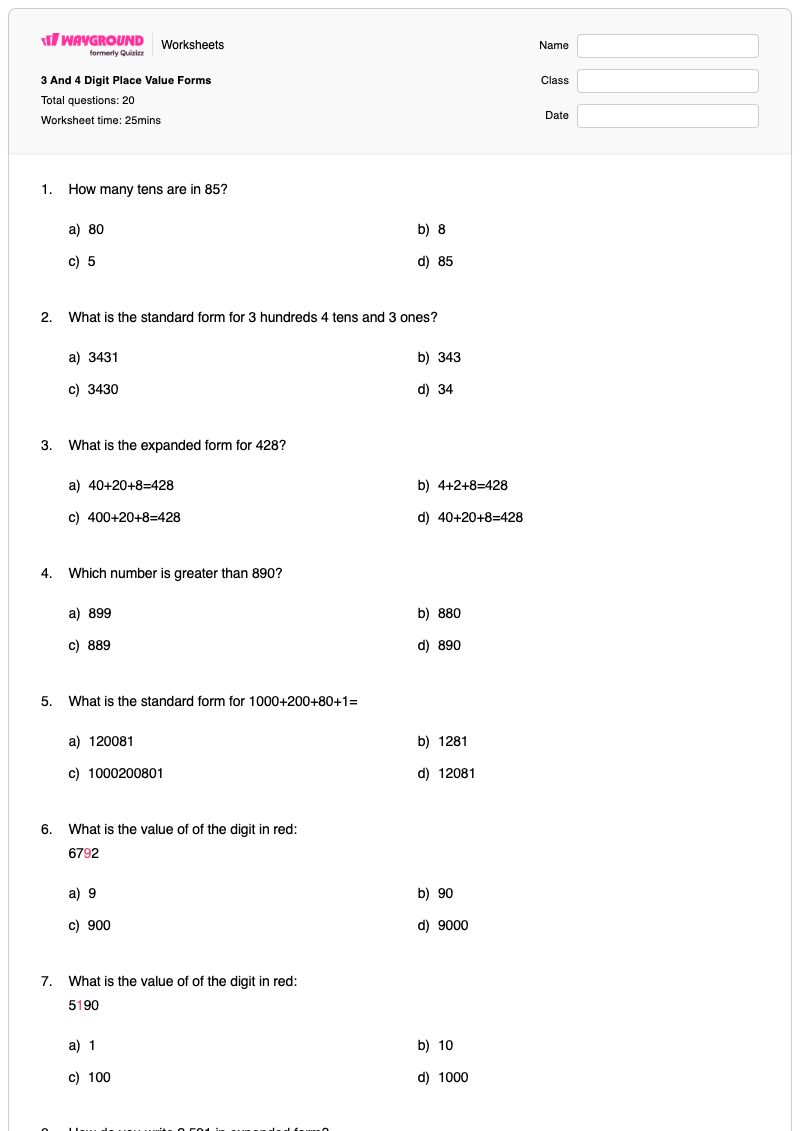
3 And 4 Digit Place Value Forms is a Grade 3 mathematics worksheet with 20 multiple-choice questions that develops place-value understanding through several connected representations. Students identify the number of tens in a number, name the position and value of selected digits, interpret base-ten pieces, and convert between standard and expanded forms for three-, four-, and larger-digit numbers. They also compare numbers, select a number greater than a given value, and order numbers from greatest to least.
This free printable worksheet gives students focused practice choosing the correct representation or comparison from four answer options. It is useful for introducing or reviewing place value, checking whether students connect each digit to its value, and identifying errors such as confusing a digit with its place value. A complete answer key is included, making the worksheet practical for independent work, small-group instruction, homework, or quick assessment.
Worksheet settings
Font size
S
M
L
XL
Worksheets
3 And 4 Digit Place Value Forms
Total questions: 20
Name
Class
Date
1.
How many tens are in 85?
a)
80
b)
8
c)
5
d)
85
2.
What is the standard form for 3 hundreds 4 tens and 3 ones?
a)
3431
b)
343
c)
3430
d)
34
3.
What is the expanded form for 428?
a)
40+20+8=428
b)
4+2+8=428
c)
400+20+8=428
d)
40+20+8=428
4.
Which number is greater than 890?
a)
899
b)
880
c)
889
d)
890
5.
What is the standard form for 1000+200+80+1=
a)
120081
b)
1281
c)
1000200801
d)
12081
6.
What is the value of of the digit in red: 6792
a)
9
b)
90
c)
900
d)
9000
7.
What is the value of of the digit in red: 5190
a)
1
b)
10
c)
100
d)
1000
8.
How do you write 2,591 in expanded form?
a)
200 + 5 +10 + 900
b)
2,000 + 500 + 90 + 1
c)
20,000 + 5,000 + 900 + 1
d)
2,000 + 500 + 10 + 9
9.
What is the standard form of the number one thousand three hundred fifty-seven?
a)
10,357
b)
1,305
c)
1,357
d)
13, 507
10.
Put the following numbers in order from greatest to least...
1,234 / 1,567 / 1,143
a)
1,567 / 1,143 / 1,234
b)
1, 567 / 1,234 / 1143
c)
1,234 / 1,567 / 1,143
d)
1,143 / 1,234 / 1,567
11.
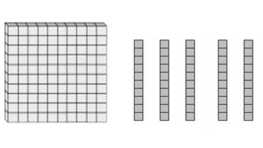
What number is shown with these base ten pieces?
a)
520
b)
105
c)
150
d)
120
12.
Compare the 2 numbers
3,456 O 465
a)
465 > 3,456
b)
3,456 > 465
13.
There are 765 students at our school. What is this number in expanded form?
a)
765
b)
seven hundred sixty-five
c)
600 + 70 + 5
d)
700 + 60 + 5
14.
How do you write twenty-one thousand, six hundred fifty-six in standard form?
a)
21,566
b)
2,656
c)
21,656
d)
210, 656
15.
What place value position is the 7 in, in the following number? 7,496
a)
ones
b)
tens
c)
hundreds
d)
thousands
16.
What is the standard form of 800+5+20?
a)
528
b)
852
c)
825
d)
258
17.
What place value position is the 7 in, in the following number? 372
a)
ones
b)
tens
c)
thousands
d)
hundreds
18.
Which number is the greatest?
a)
8,341
b)
8,431
c)
8,134
d)
8,143
19.
What number is the greatest
a)
4,589
b)
4,598
c)
4,958
d)
4,985
20.
What number has three hundreds, zero tens, and nine ones?
a)
903
b)
309
c)
930
d)
390
Answer Key
3 And 4 Digit Place Value Forms
Total questions: 20
1.
b) 8
2.
b) 343
3.
c) 400+20+8=428
4.
a) 899
5.
b) 1281
6.
b) 90
7.
c) 100
8.
b) 2,000 + 500 + 90 + 1
9.
c)
1,357
10.
b)
1, 567 / 1,234 / 1143
11.
c) 150
12.
b)
3,456 > 465
13.
d)
700 + 60 + 5
14.
c)
21,656
15.
d) thousands
16.
c) 825
17.
b) tens
18.
b) 8,431
19.
d)
4,985
20.
b) 309
140 %
Browse by subjects
Browse by grades
Browse by format
FAQs
What does this place-value worksheet cover?
This Grade 3 worksheet uses 20 multiple-choice questions to practise reading and representing numbers by place value. Students convert between standard and expanded forms, identify the value and position of digits, interpret base-ten pieces, compare numbers, and arrange numbers from greatest to least. The varied question format helps students connect written numbers with the quantities and positions they represent.
How can I use this worksheet to teach standard and expanded form?
Introduce the worksheet by modelling one number in base-ten pieces, standard form, and expanded form, such as 428 = 400 + 20 + 8. Then have students explain how each digit contributes its value before completing the multiple-choice items independently or with a partner. Use the comparison and ordering questions afterward to discuss how students compare digits from the greatest place-value position first.
What mistakes should I watch for on this place-value worksheet?
Watch for students selecting a digit instead of its value, such as choosing 9 rather than 90 when 9 is in the tens place. Students may also omit a zero place when writing expanded form, reverse the order of numbers from greatest to least, or confuse standard form with number names. In the base-ten-piece item, check that students count each hundreds, tens, and ones piece according to its value rather than treating each piece as one object.
How do I assign and grade this worksheet?
The worksheet is available as a printable PDF and as a digital quiz on Wayground, so you can use the multiple-choice place-value questions for paper practice or online assignment. It includes a complete answer key, and printable submissions can be graded by scanning student work with the Wayground for Teachers app. The printable format can also support schools that are reducing screen time.
How can I differentiate this place-value worksheet for my students?
Use the worksheet’s Advanced Settings to adjust font spacing or font size so the standard-form, expanded-form, and comparison choices are easier to read. You can also enable a dyslexia-friendly font for students who benefit from that presentation, or translate the place-value questions into another language. These changes apply to the worksheet file itself while preserving its multiple-choice format.
Where can I find more worksheets like this on Wayground?
Wayground offers a broad collection of free printable worksheets and practice problems across subjects, with downloadable PDFs and answer keys to support essential skills and concepts. Browse more resources at https://wayground.com/en-us/worksheets.

 Worksheets