
Recommended Topics for you
- 10 More 10 Less
- 1:1 Correspondence
- Ab Pattern
- Abacus
- Adding and Subtracting Integers
- Additive and Multiplicative Relationships
- Arithmetic Reasoning
- Base 10 Blocks
- Base 10 Number System
- Base Ten Place Value
- Before and After Numbers
- Binary Code
- Binary Coding
- Binary Number System
- Binary Numbers
- Bonds to 5
- Classification of Real Numbers
- Classifying Numbers
- Classifying Rational Numbers
- Classifying Real Numbers
- Color Patterns
- Common Multiples
- Comparing and Ordering Real Numbers
- Comparing Integers
- Comparing More and Less
- Comparing Numbers: Greater Than
- Comparing Numbers: More or Less Than
- Comparing Rational Numbers
- Comparing Real Numbers
- Comparing Same and Different
- Comparing Sets
- Comparing Whole Numbers
- Comparison of Numbers
- Compatible Numbers
- Consecutive Integers
- Counting and Matching
- Counting and Operations with Manipulatives
- Counting Backwards
- Counting by 100s
- Counting by Ones
- Counting Collections
- Counting Numbers to 100
- Counting Objects to 20
- Counting Sequences
- Counting to 100
- Counting to 30
- Counting to 5
- Decimal to Binary Conversion
- Distance on a Number Line
- Dot Patterns
- Estimating Differences
- Estimating Sums
- Estimation
- Evaluating Powers
- Expanded Form
- Expanded Notation
- Exponent Laws
- Exponent Operations
- Exponential Properties
- Exponentiation
- Exponents
- Factor Rainbow
- Factor Trees
- Finding Missing Numbers on a Number Line
- Forming Numbers
- Forward Counting
- Fraction, Decimal, and Percent Conversion
- Fractional and Negative Indices
- Greater Than Less Than
- Greater Than Less Than Symbols
- Greater Than Symbol
- Greatest Common Divisor
- Greatest Common Multiple
- Growing Patterns
- Hundreds, Tens, and Ones
- Identifying Integers
- Identifying Place Value
- Integer Operations
- Integer Rules
- Integer Story Problems
- Integer Word Problems
- Integers and Rational Numbers
- Integers on a Number Line
- Intervals
- Irrational Numbers
- Least Common Factor
- Letters and Numbers
- Matching Numbers
- Math Fact Fluency
- Math Facts
- Mathematical Properties
- Mental Calculation
- Mental Math
- Missing Number Problems
- Multi-digit Numbers
- Multiplying and Dividing Integers
- Multiplying and Dividing Negative Numbers
- Multiplying and Dividing Rational Numbers
- Multiplying Rational Numbers
- Naming Numbers
- Number and Operations in Base Ten
- Number Bases
- Number Chart
- Number Comparison: More and Less
- Number Correspondence
- Number Decomposition
- Number Families
- Number Formation
- Number Forms
- Number Grid
- Number Names
- Number of the Day
- Number Ordering
- Number Patterns
- Number Sentences
- Number Sequences
- Number Sequencing
- Number Sublevels
- Number Systems
- Number Theory
- Number Tracing
- Number Words
- Number Writing
- Numbers 0-10
- Numbers 11-20
- Numbers to 1000
- Numbers to 20
- Numeracy
- Numeral Recognition
- Numerals
- Object Counting
- One More, One Less
- One-to-one Correspondence
- Operations with Negative Numbers
- Opposite Integers
- Ordering Integers
- Ordering Rational Numbers
- Ordinal Numbers
- Organizing Real Numbers
- Partner Numbers
- Partners for 10
- Pattern Recognition
- Patterning
- Patterns and Sequencing
- Place Value and Regrouping
- Place Value Grouping
- Place Value in Millions
- Place Value Manipulatives
- Place Value of Whole Numbers
- Place Value Relationships
- Place Value: Billions
- Place Value: Hundred Thousands
- Place Value: Hundreds
- Place Value: Numbers to a Million
- Place Value: Tens and Ones
- Place Value: Thousands
- Plotting Numbers on a Number Line
- Plotting on a Number Line
- Positive and Negative Integers
- Power of a Product
- Powers of 10
- Powers of Ten
- Prime Factorization
- Prime Factors
- Properties of Integers
- Properties of Numbers
- Properties of Rational Numbers
- Properties of Real Numbers
- Quantity Comparison
- Rational Number Operations
- Rational Numbers on a Number Line
- Real Number System
- Reciprocals
- Recognizing Numbers 1-100
- Relationships Between Place Values
- Repeating Patterns
- Representation of Integers
- Rounding and Place Value
- Rounding Numbers
- Rounding to 10 and 100
- Rounding to Nearest 10
- Rounding to Nearest 100
- Rounding to Tens and Hundreds
- Rounding to the Nearest 10
- Rounding to the Nearest Hundred
- Rounding to the Nearest Thousand
- Rounding Whole Numbers
- Same Vs Different
- Scientific Notation
- Seriation
- Set Builder Notation
- Set Notation
- Sets
- Significant Digits
- Sorting by Colors
- Square Numbers
- Square Roots
- Standard Notation
- Subitizing
- Subtracting Negative Integers
- Teen Numbers
- Ten More Ten Less
- Tens Frame
- Three-digit Numbers
- Touch Math
- Touch Point Math
- Touch Points
- Two-digit Numbers
- Understanding Zero
- Value Assessment
- Value of Digits
- Ways to Make 5
- Whole Number Operations
- Word Form
- Writing Number 5
- Writing Numbers in Words
- Zero Pairs
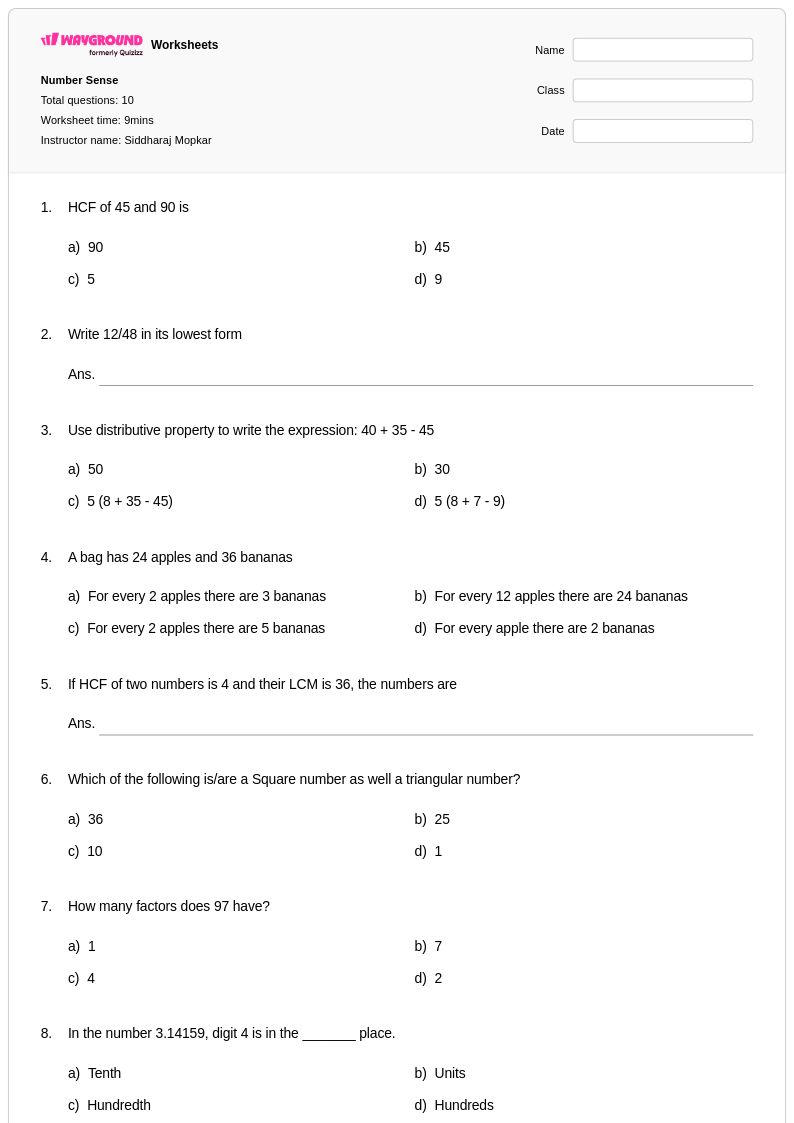
10 Q
6th - 8th
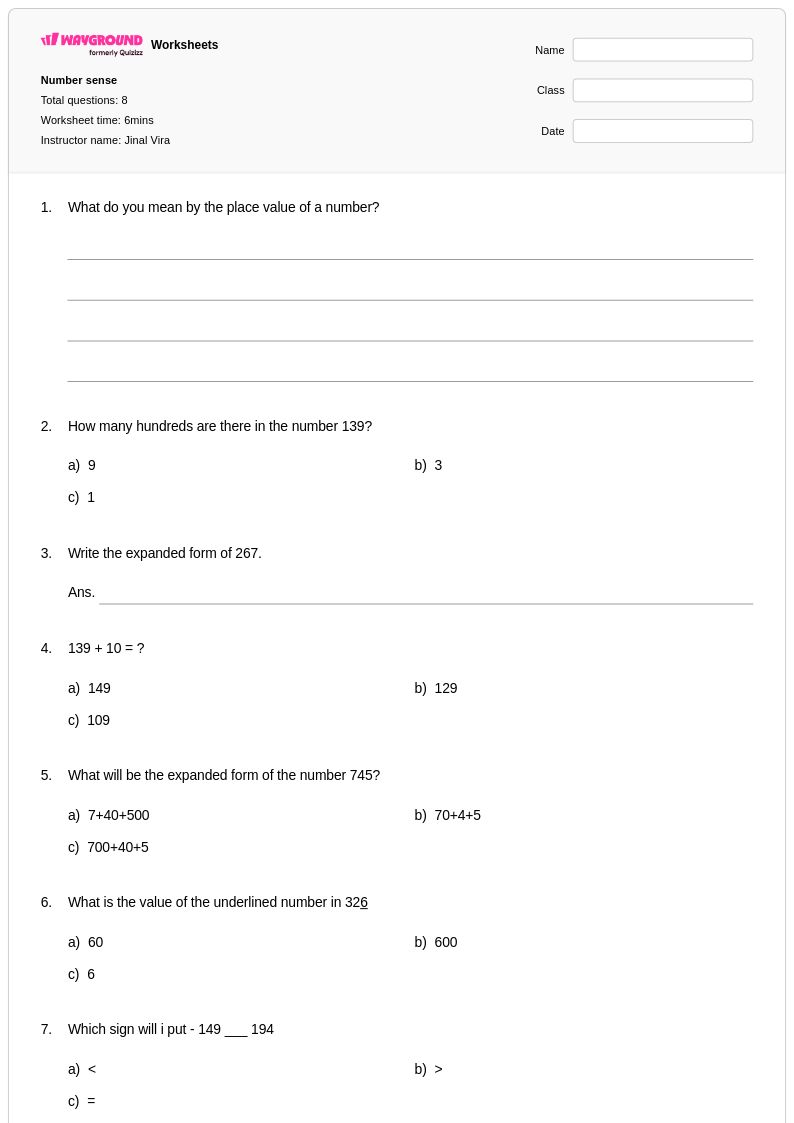
8 Q
2nd - 3rd
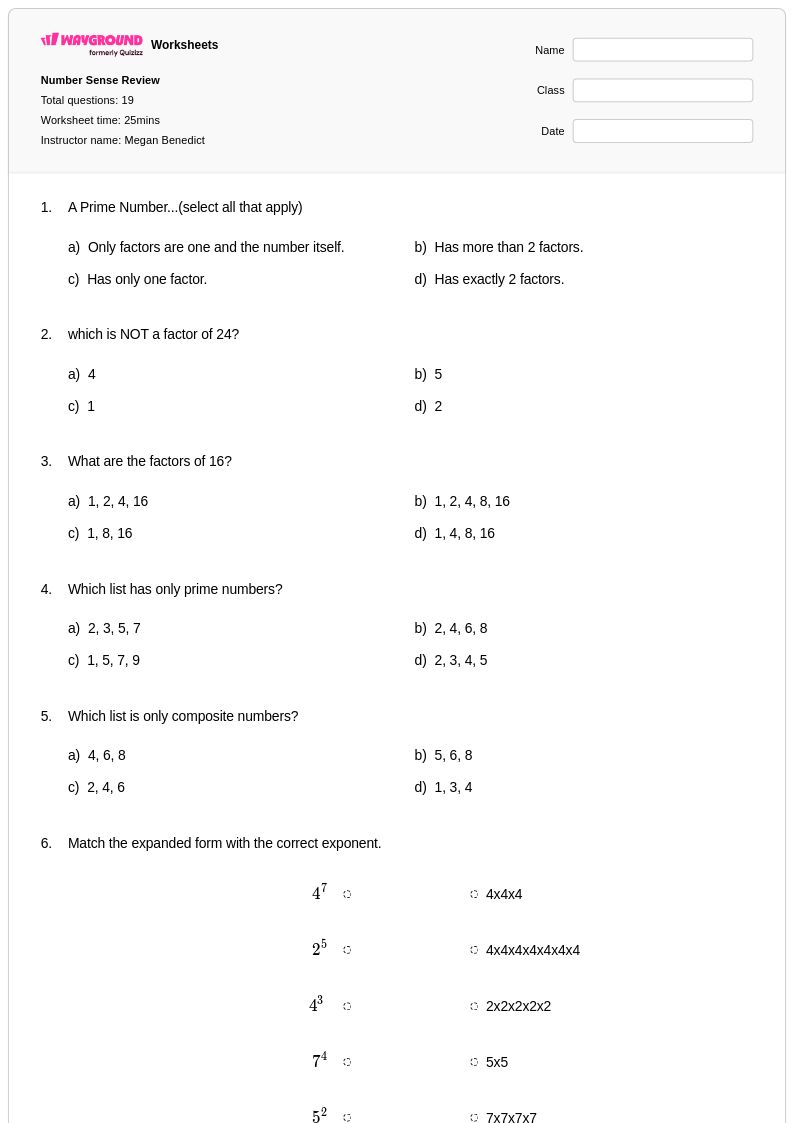
19 Q
6th - 8th
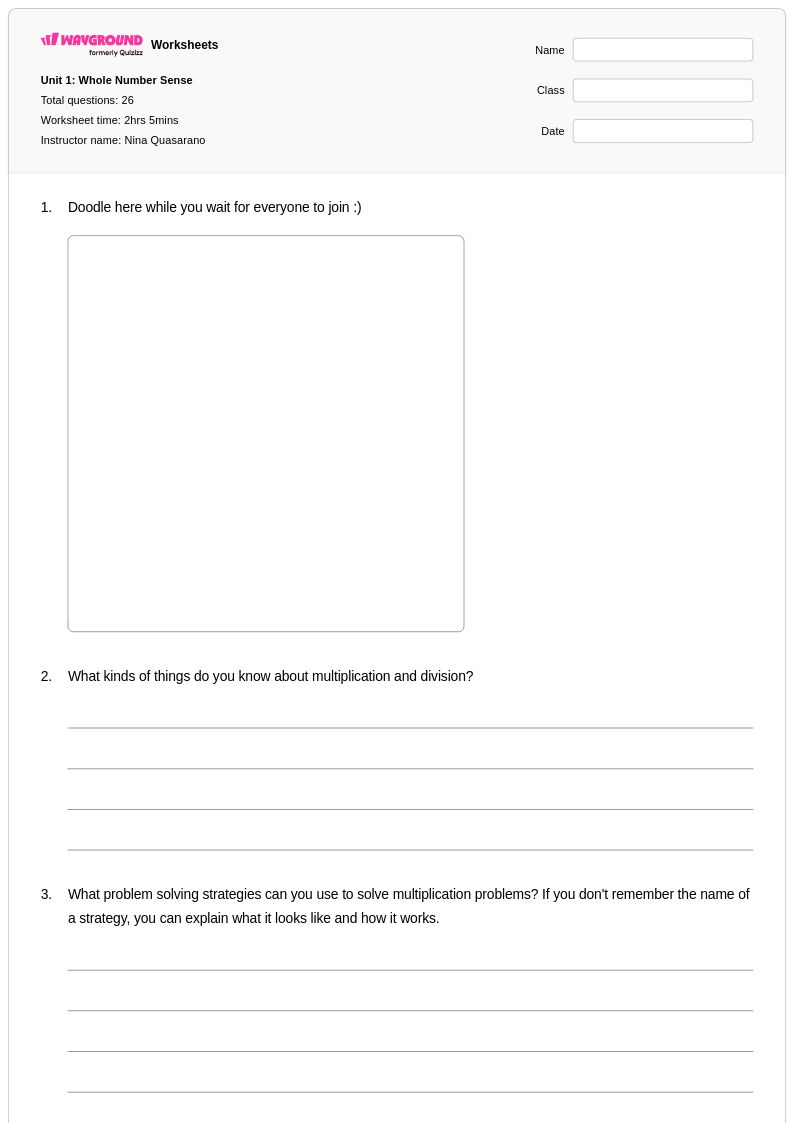
26 Q
4th
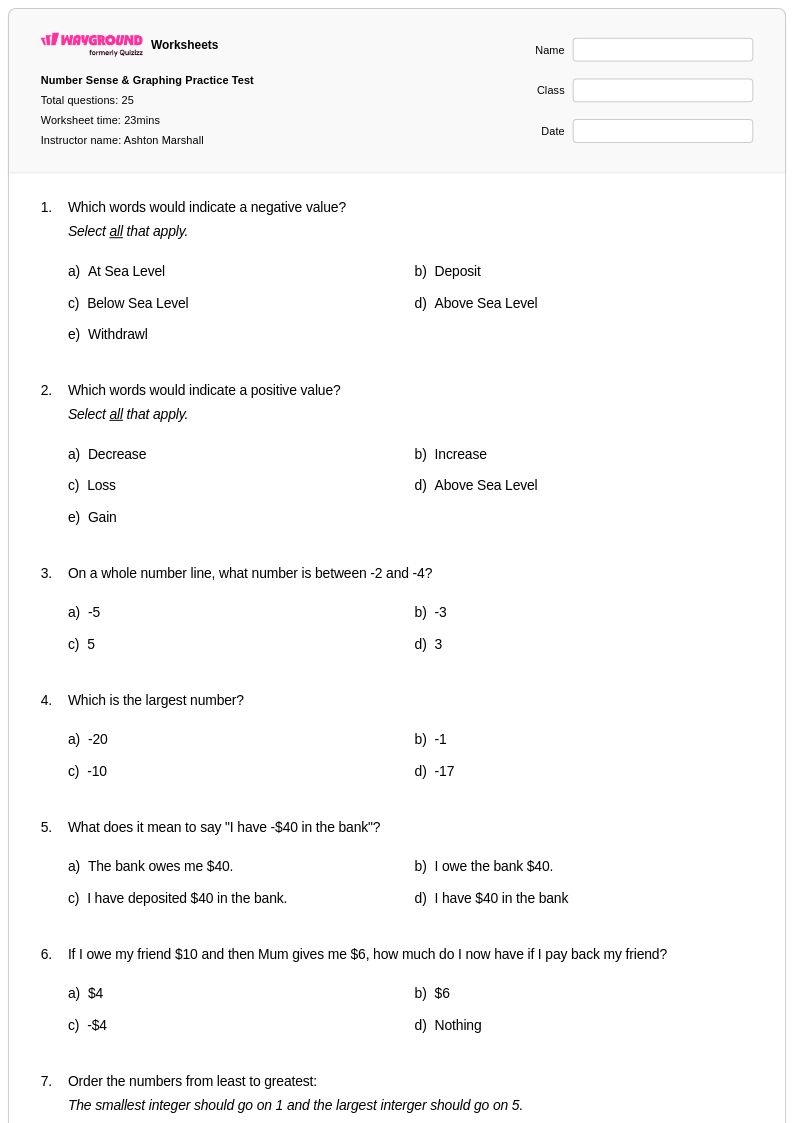
25 Q
6th
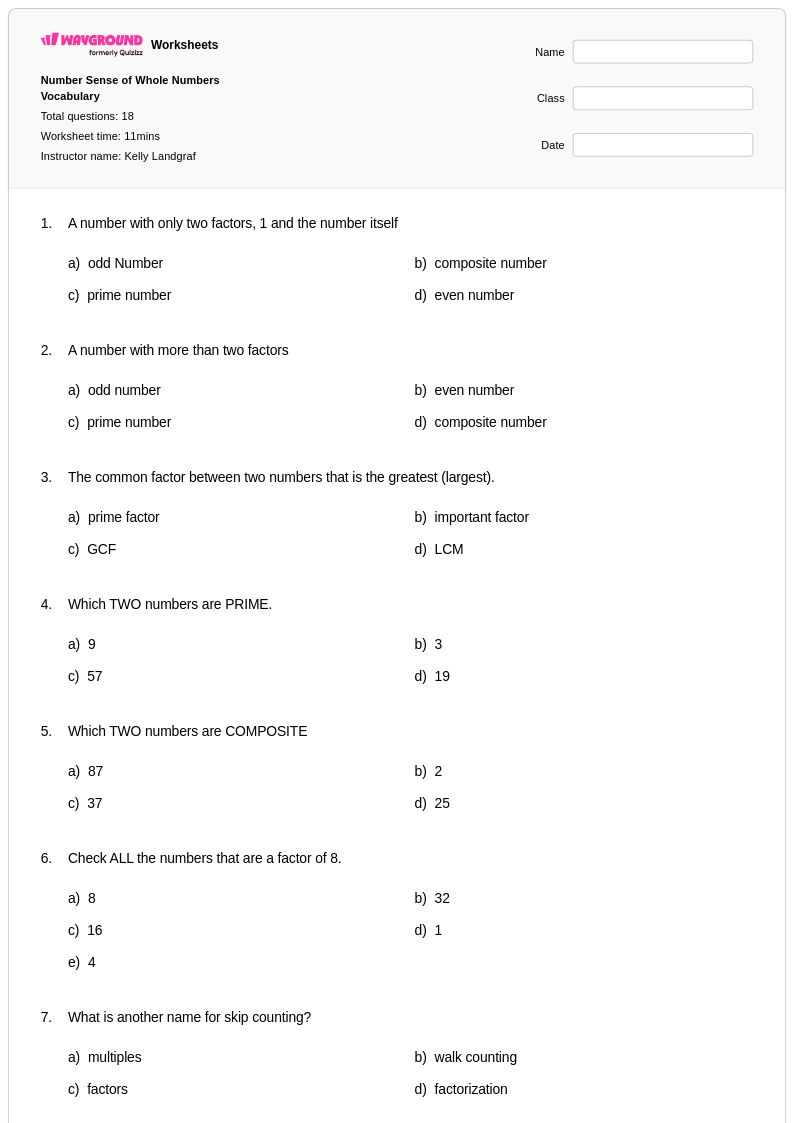
18 Q
6th
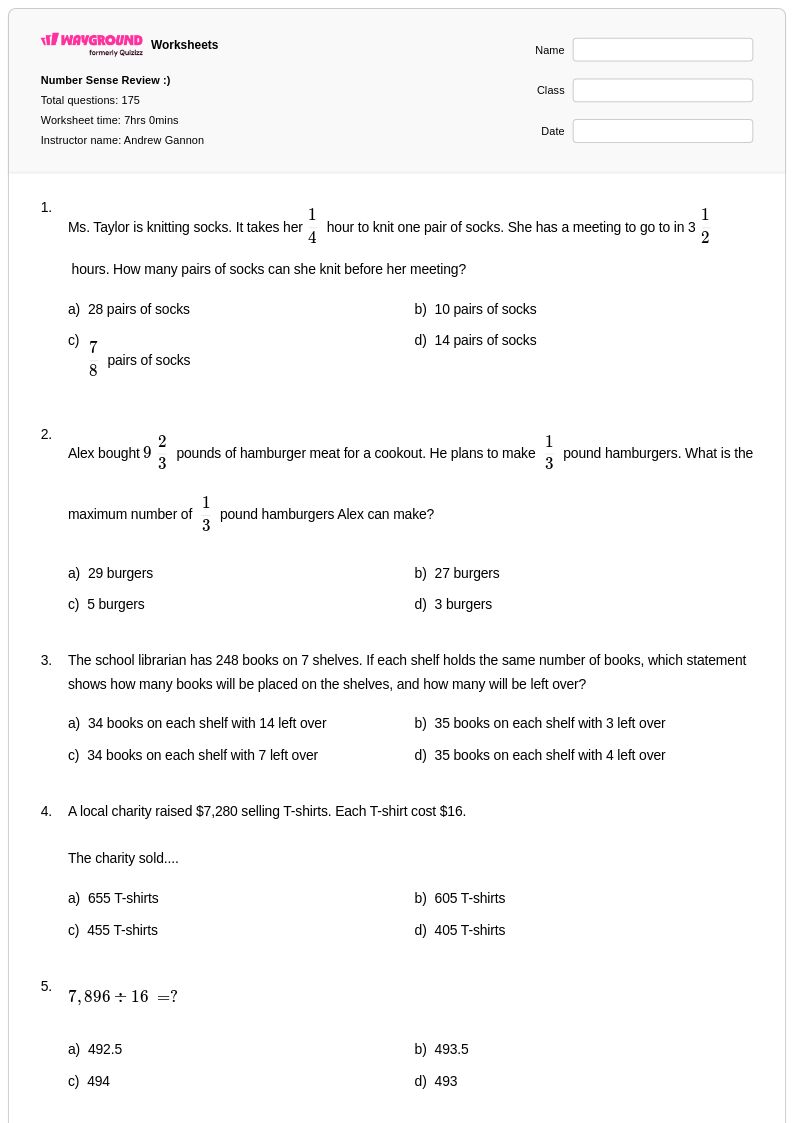
175 Q
6th
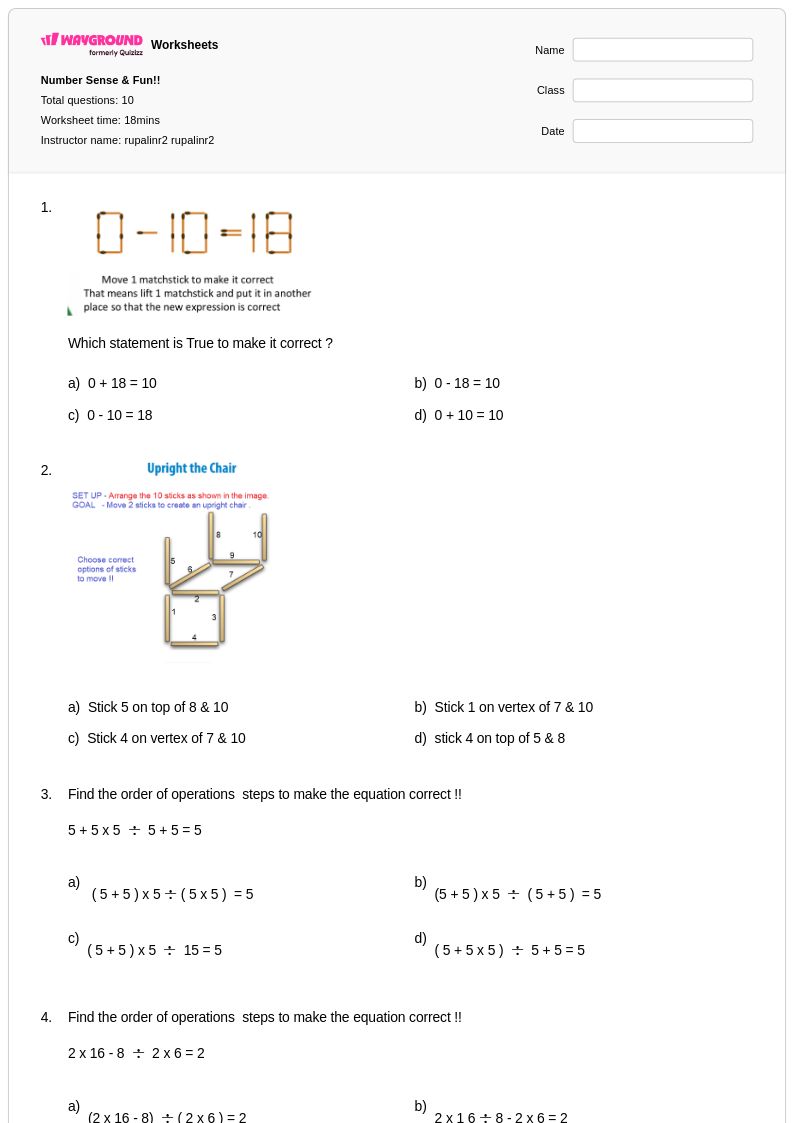
10 Q
6th - 8th
15 Q
3rd - 4th
11 Q
7th
37 Q
8th
15 Q
5th
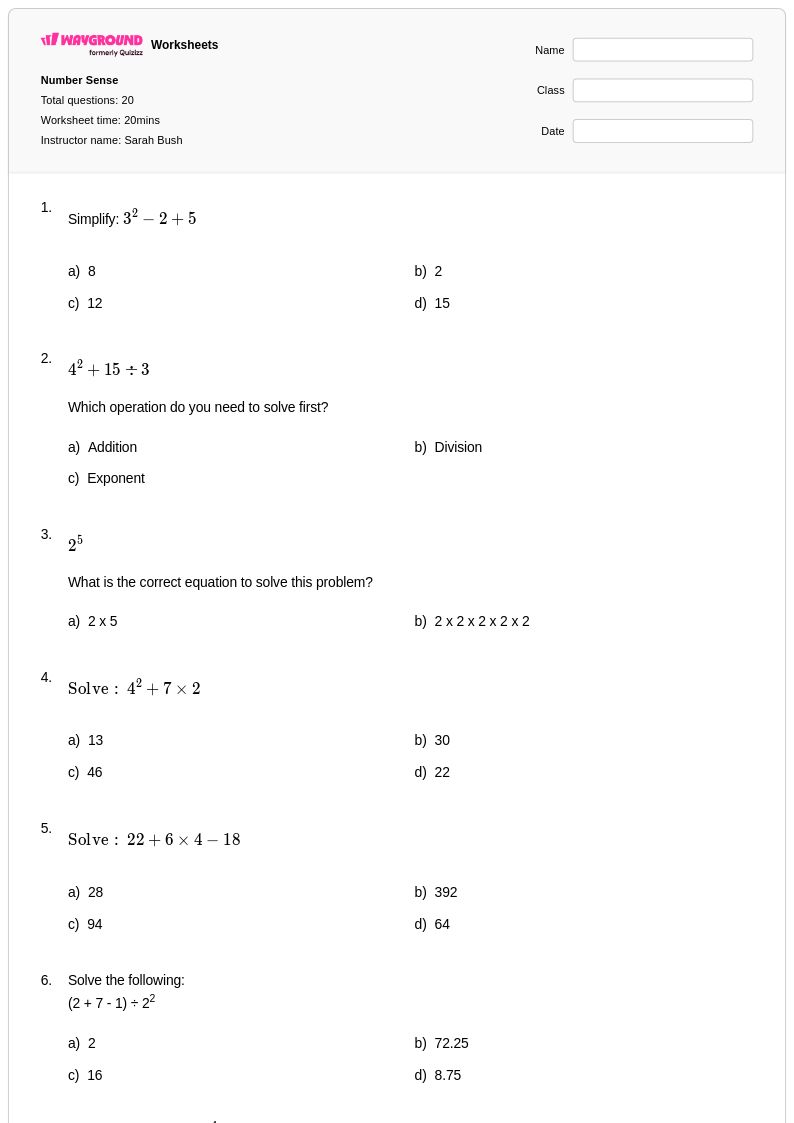
20 Q
6th
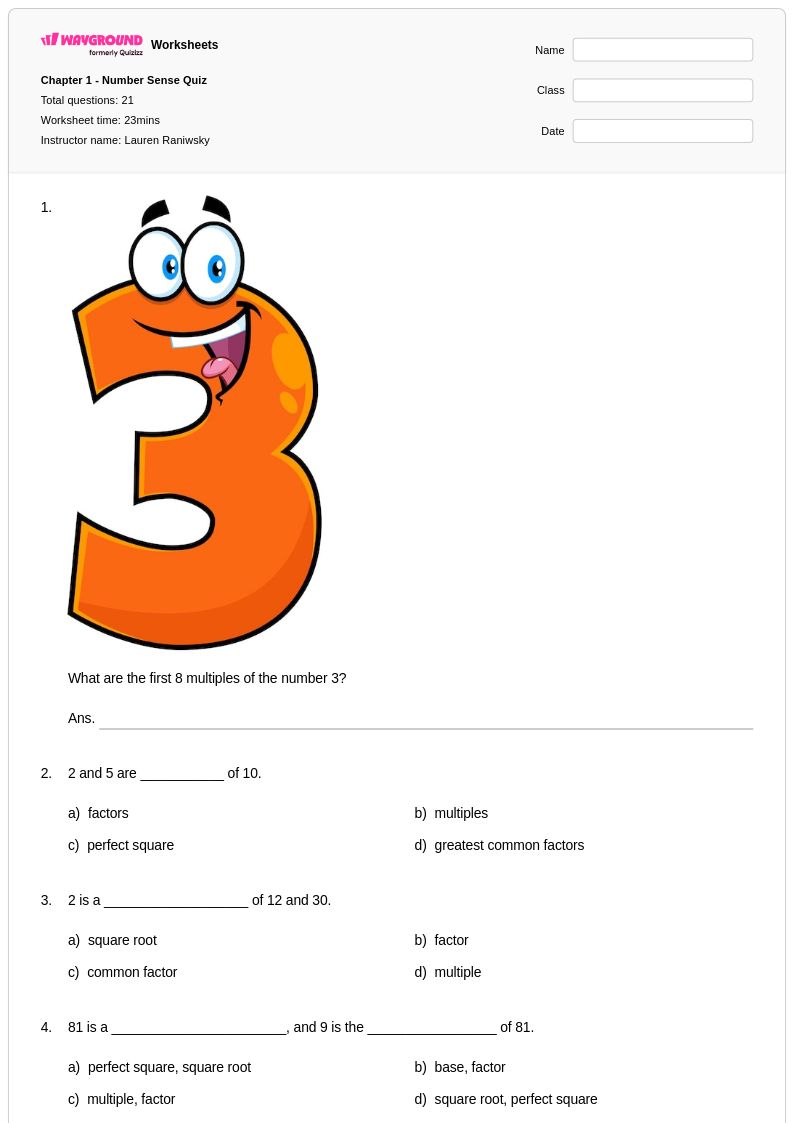
21 Q
7th
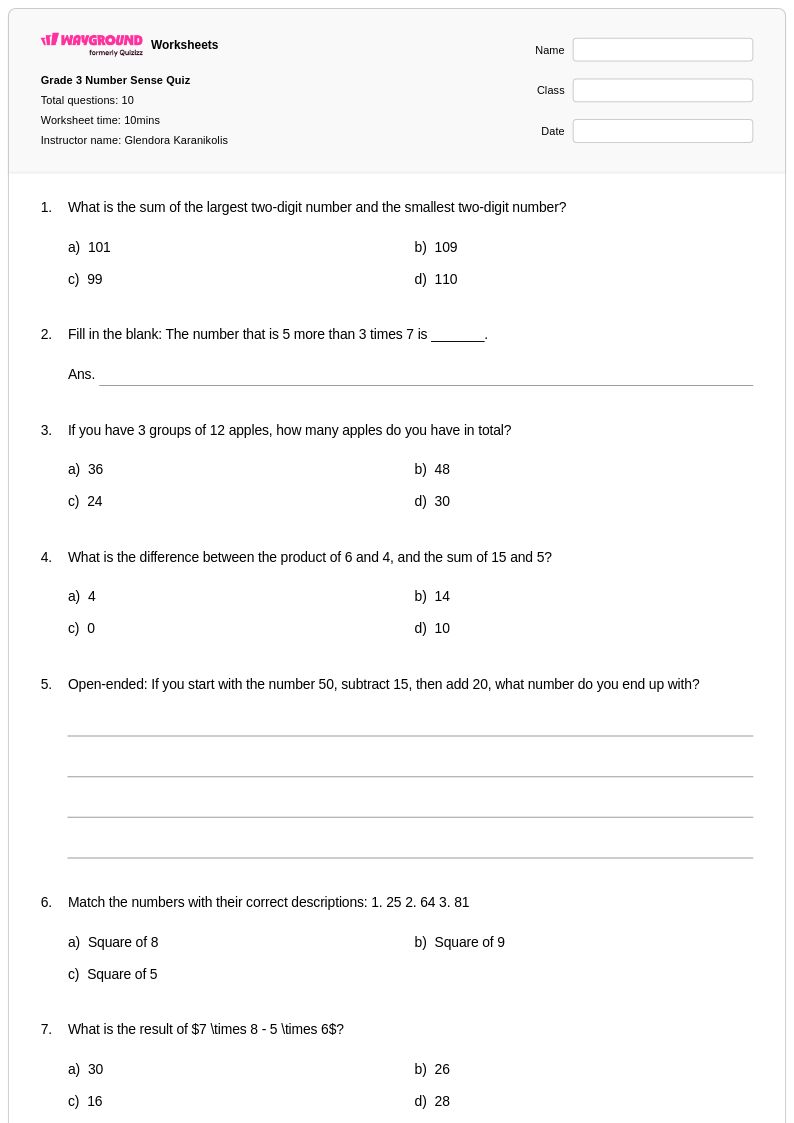
10 Q
3rd
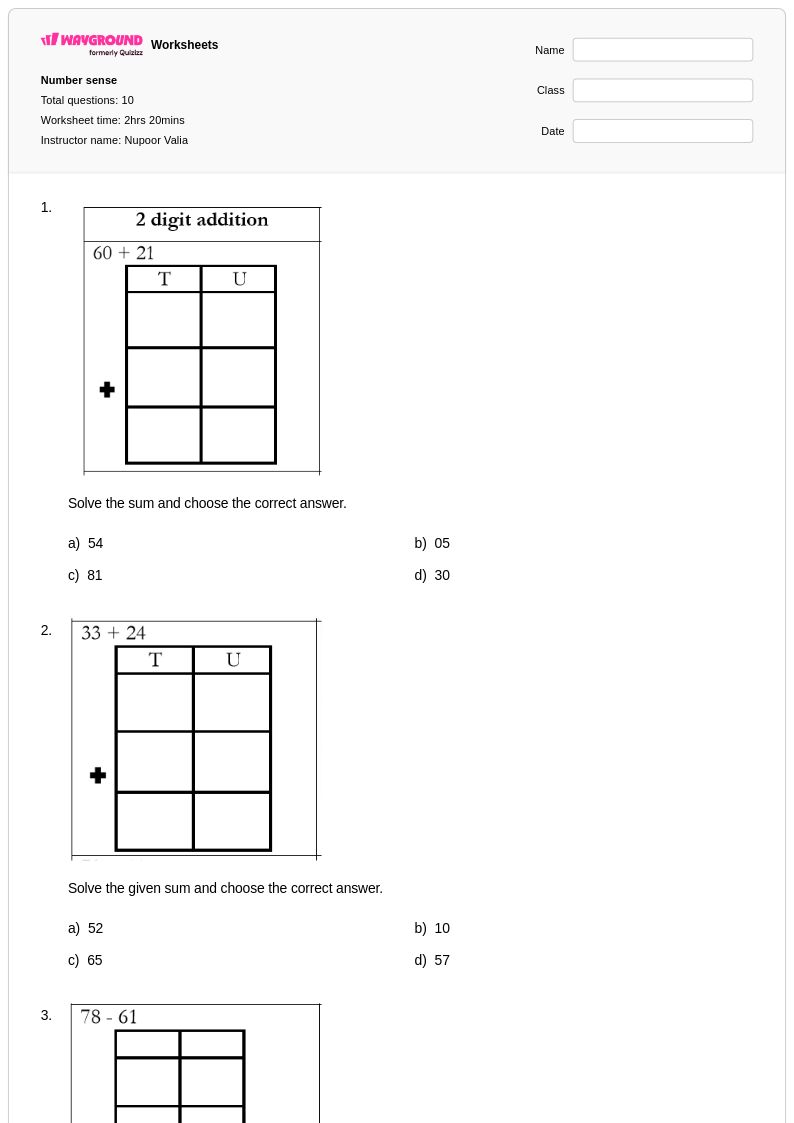
10 Q
2nd
25 Q
6th
30 Q
7th
122 Q
6th
20 Q
3rd
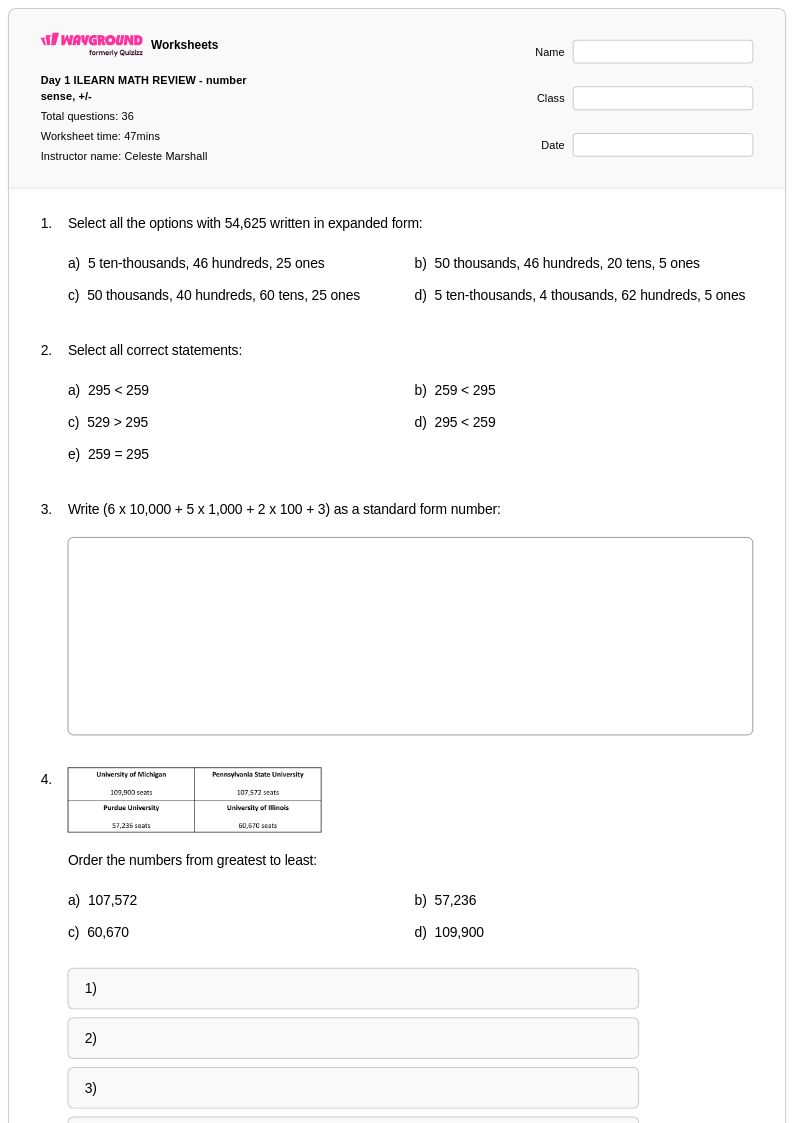
36 Q
4th
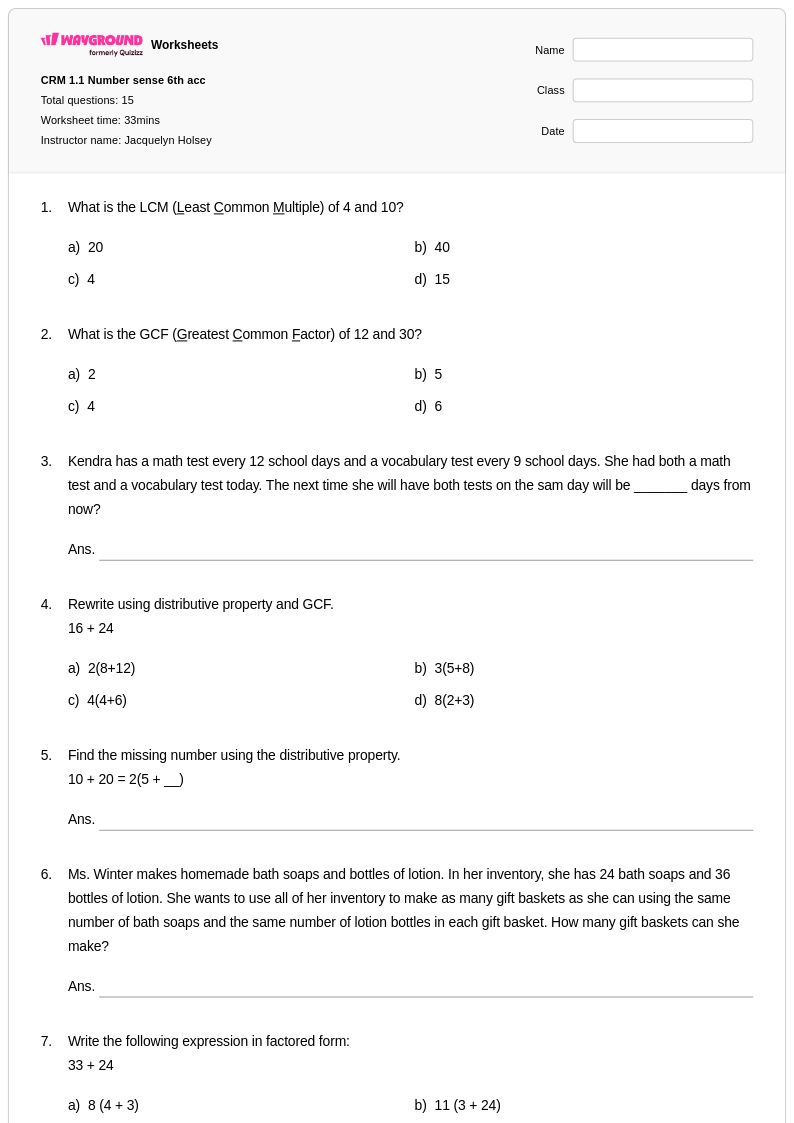
15 Q
6th
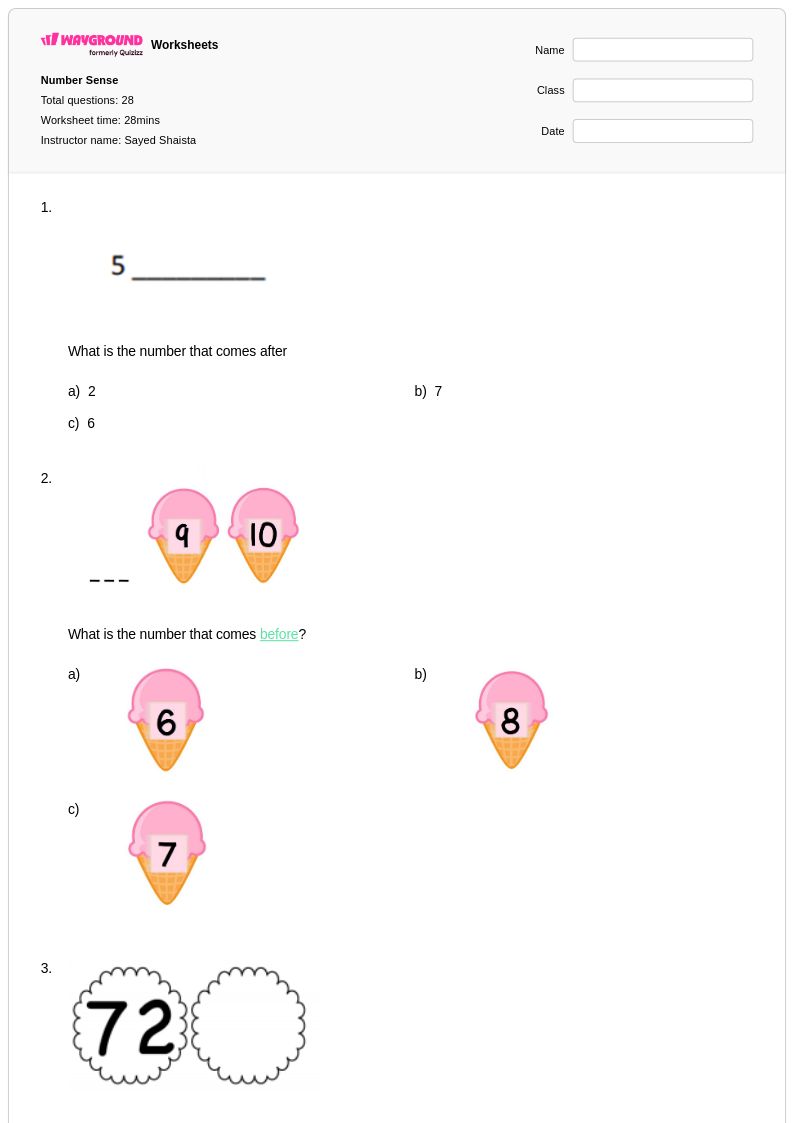
28 Q
1st
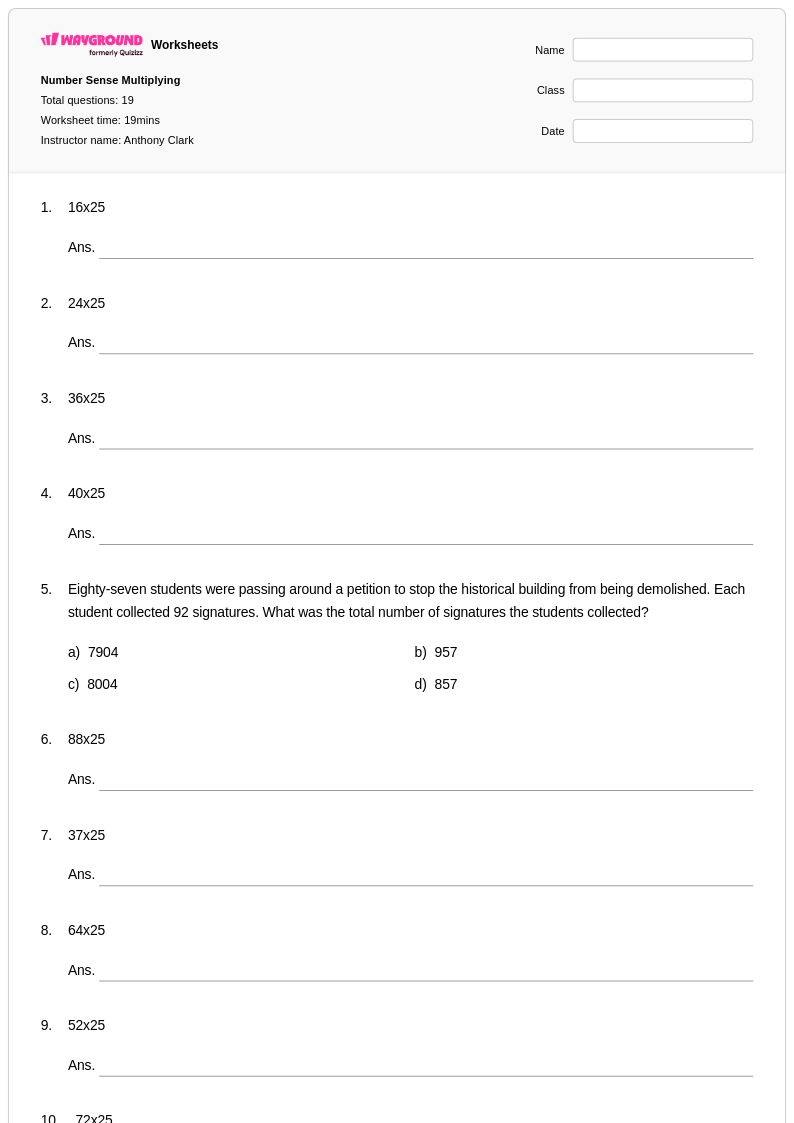
19 Q
7th - Uni
Explore Worksheets by Grade
Explore Number Sense Worksheets by Topics
- 10 More 10 Less
- 1:1 Correspondence
- Ab Pattern
- Abacus
- Adding and Subtracting Integers
- Additive and Multiplicative Relationships
- Arithmetic Reasoning
- Base 10 Blocks
- Base 10 Number System
- Base Ten Place Value
- Before and After Numbers
- Binary Code
- Binary Coding
- Binary Number System
- Binary Numbers
- Bonds to 5
- Classification of Real Numbers
- Classifying Numbers
- Classifying Rational Numbers
- Classifying Real Numbers
Explore Worksheets by Subjects
Explore printable Number Sense worksheets
Number sense worksheets available through Wayground (formerly Quizizz) provide comprehensive practice opportunities for students to develop fundamental mathematical understanding and numerical fluency. These carefully crafted resources strengthen essential skills including place value recognition, number comparison and ordering, estimation strategies, and the relationships between different number representations. Students engage with practice problems that build conceptual understanding of how numbers work, from recognizing patterns in counting sequences to understanding the magnitude and relative size of different values. Each worksheet comes with a complete answer key, making it simple for educators to provide immediate feedback and support student learning. These free printables offer structured practice that helps students internalize number relationships and develop the mathematical reasoning skills necessary for more advanced mathematical concepts.
Wayground (formerly Quizizz) supports educators with an extensive collection of millions of teacher-created number sense resources that can be easily accessed through robust search and filtering capabilities. Teachers can quickly locate worksheets that align with specific mathematical standards and learning objectives, while differentiation tools allow for seamless customization to meet diverse student needs and ability levels. The platform's flexibility enables educators to utilize these materials for initial instruction, targeted remediation, or enrichment activities, with resources available in both printable pdf format and interactive digital versions. This comprehensive approach to skill practice empowers teachers to efficiently plan lessons, assess student understanding, and provide personalized learning experiences that strengthen foundational number sense concepts across various instructional contexts.
FAQs
What is number sense in math?
How can I teach number sense effectively?
What types of exercises build number sense?
What are common signs of poor number sense in students?
How does the curriculum sequence number sense skills?
How can I use these worksheets with my students?
How can I find number sense worksheets for a specific grade level?