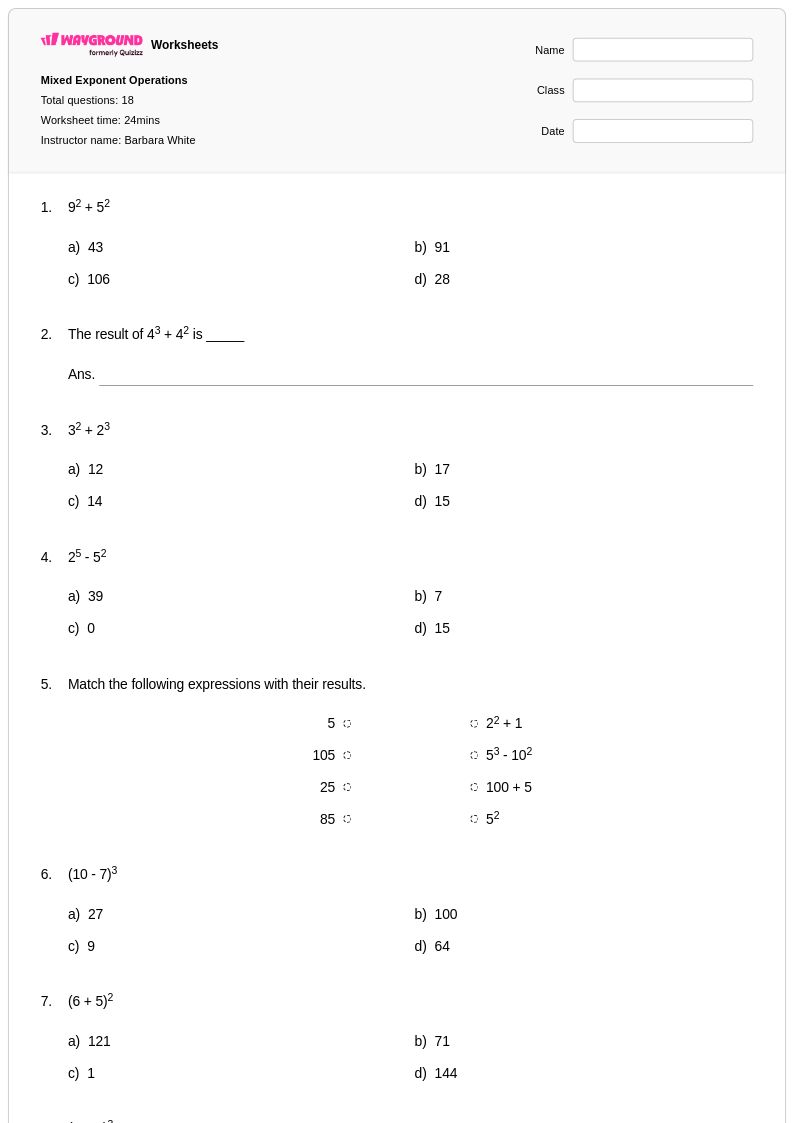
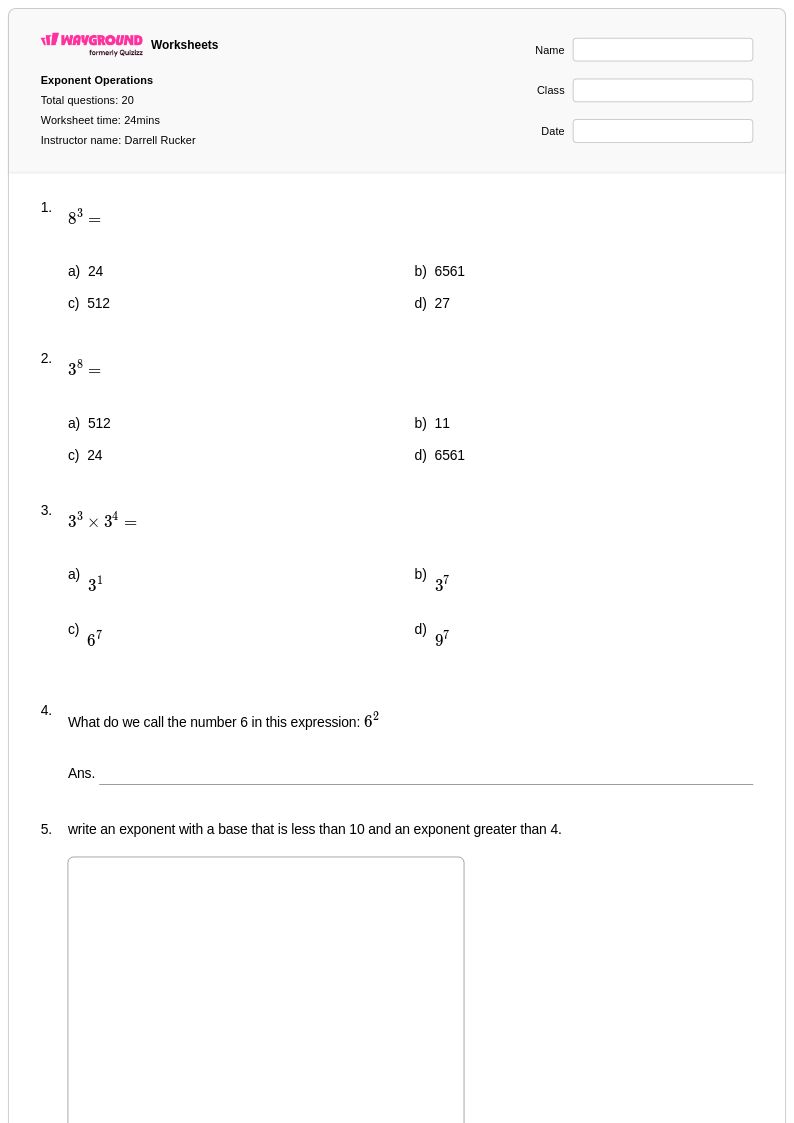
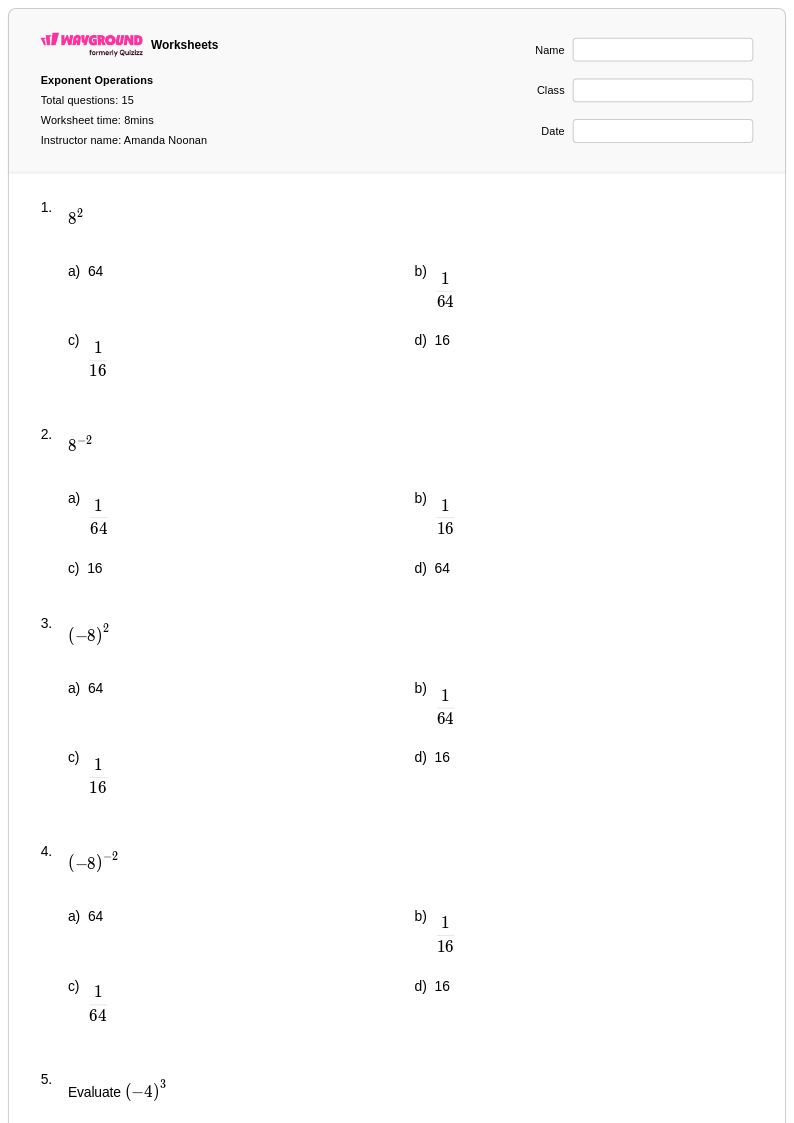
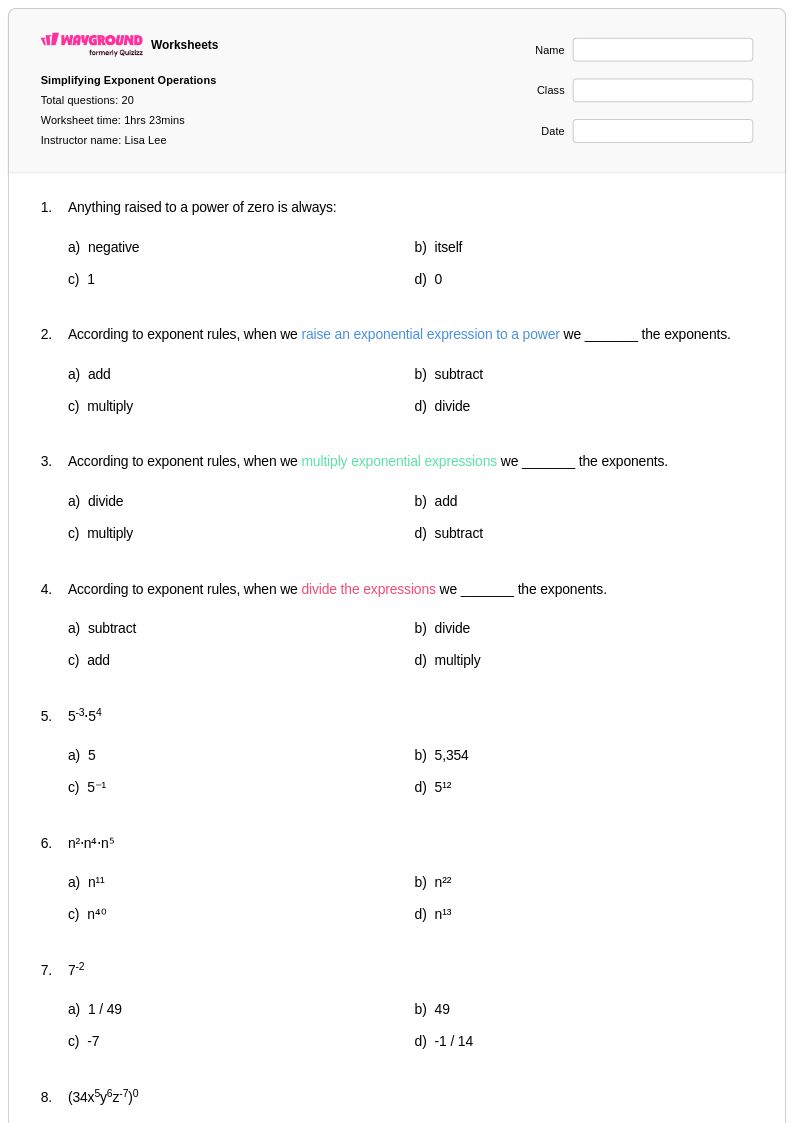
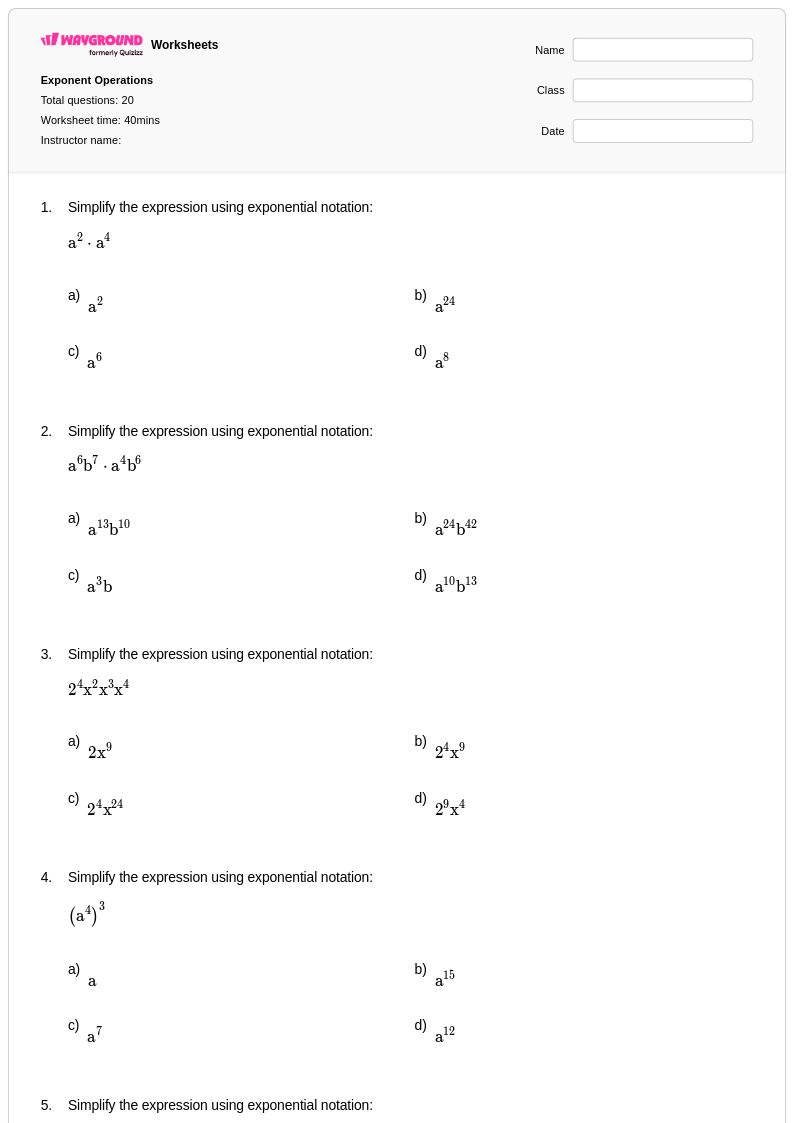
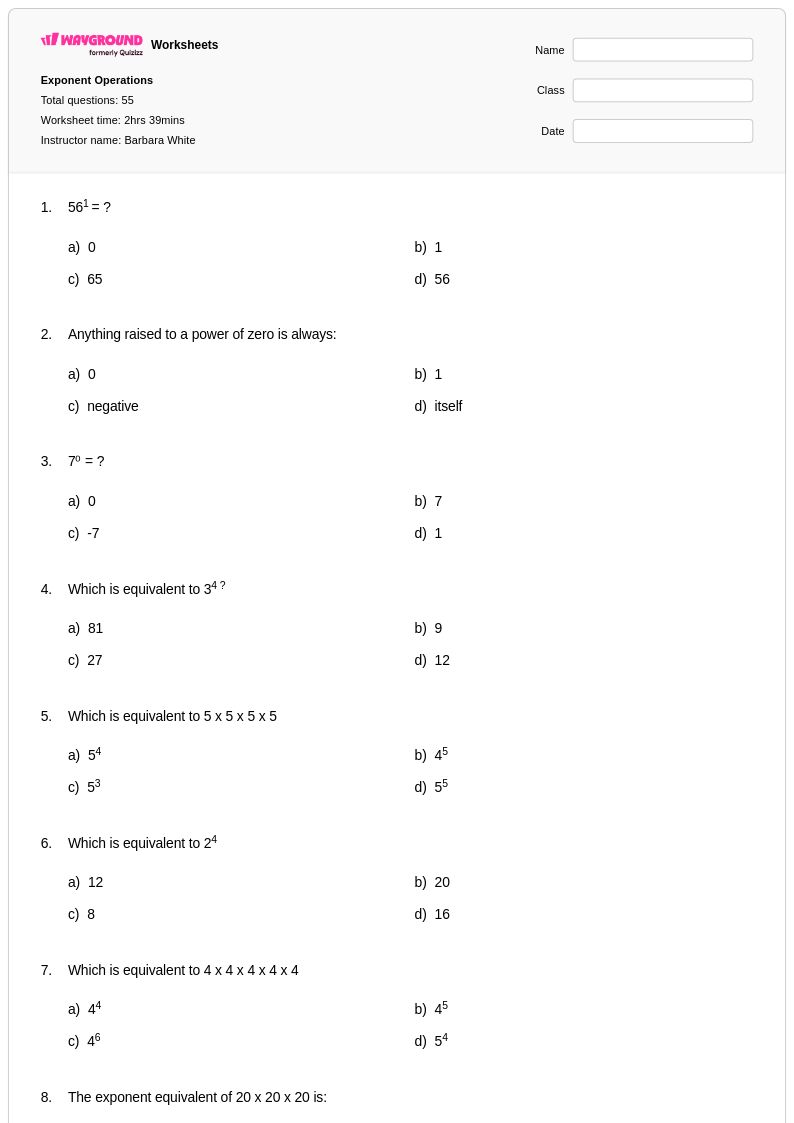
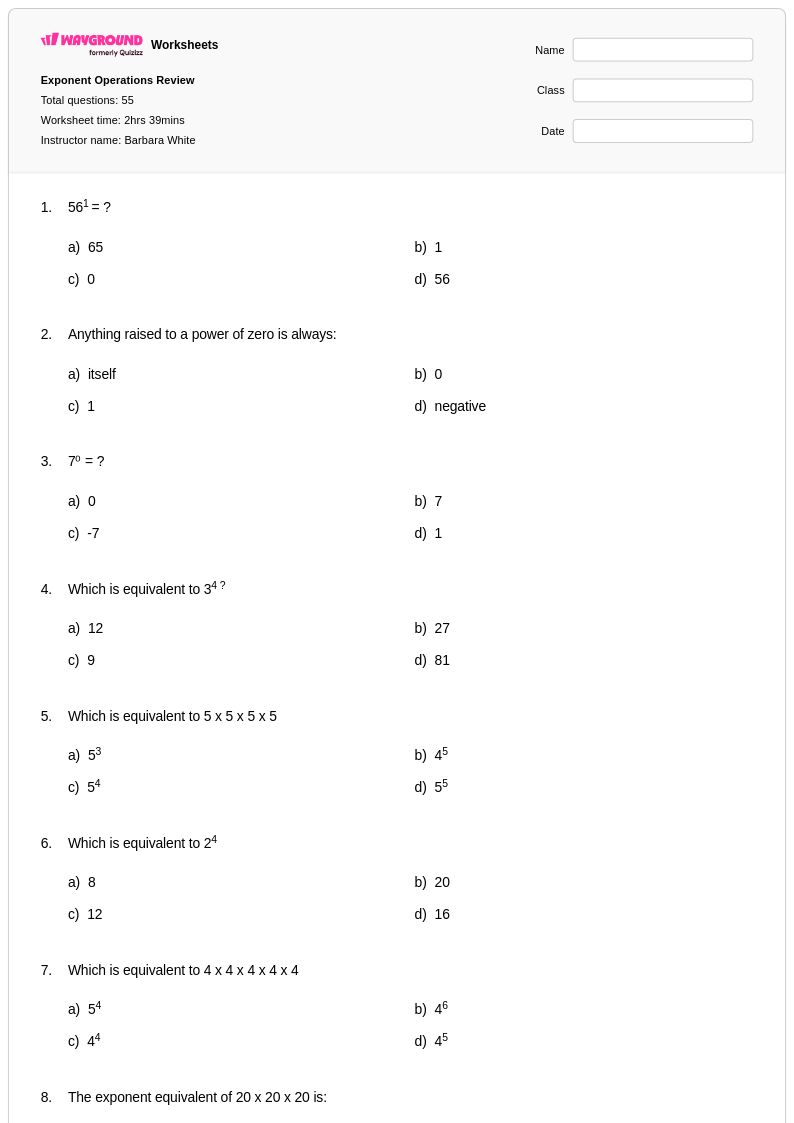
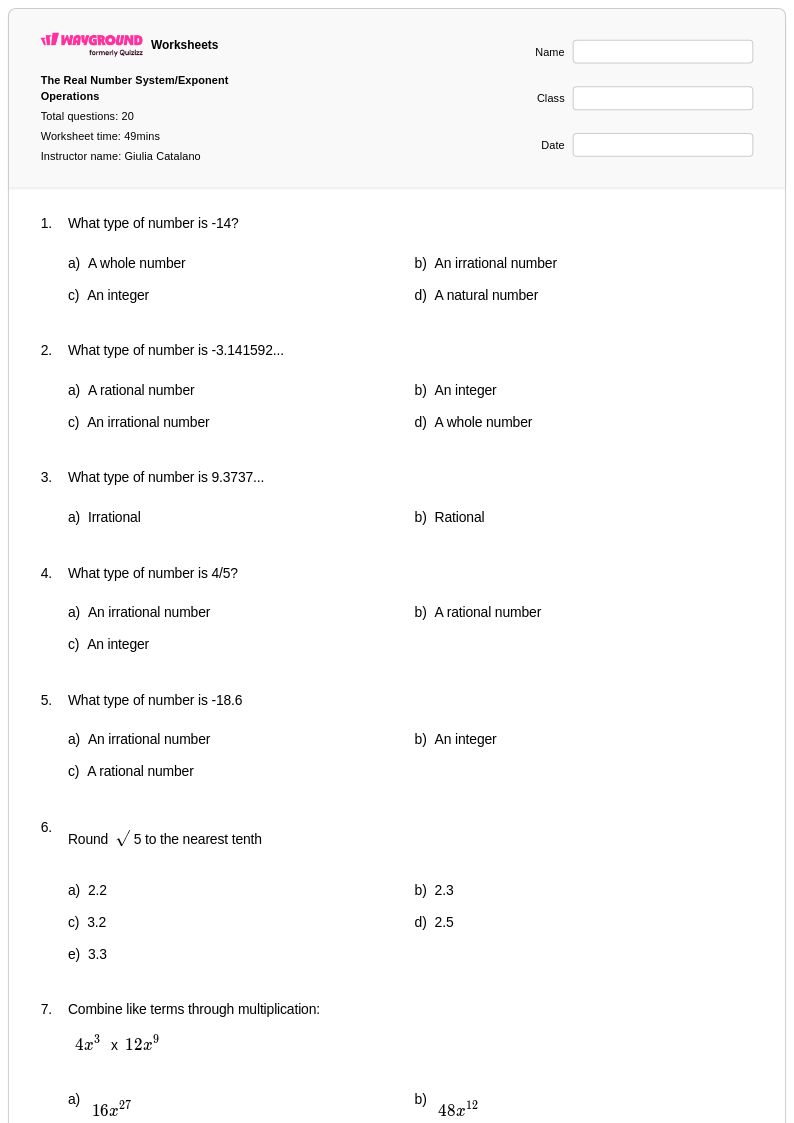
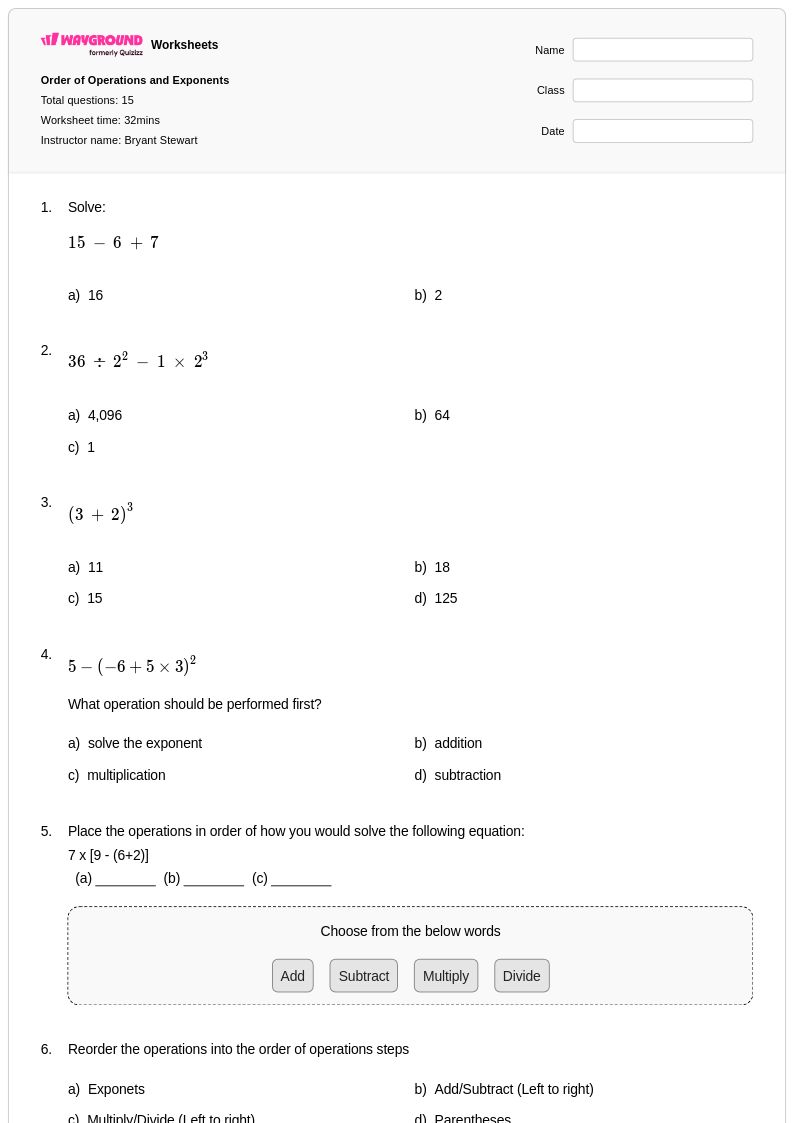
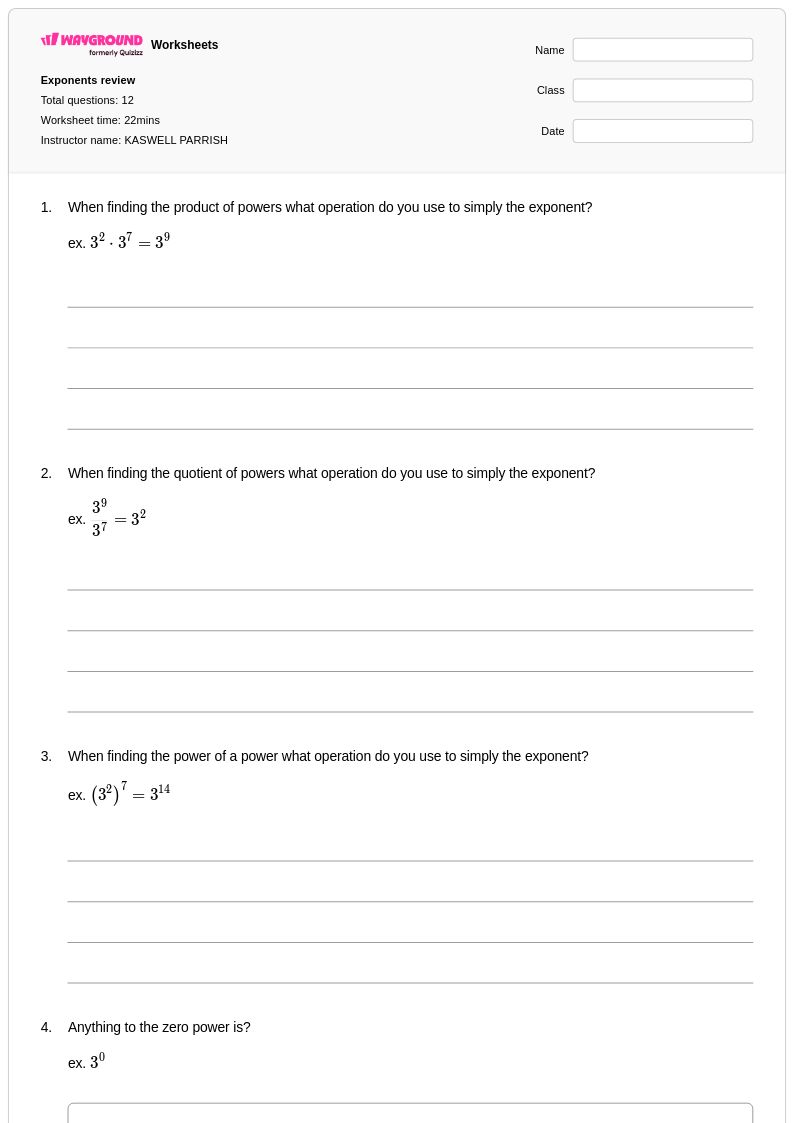
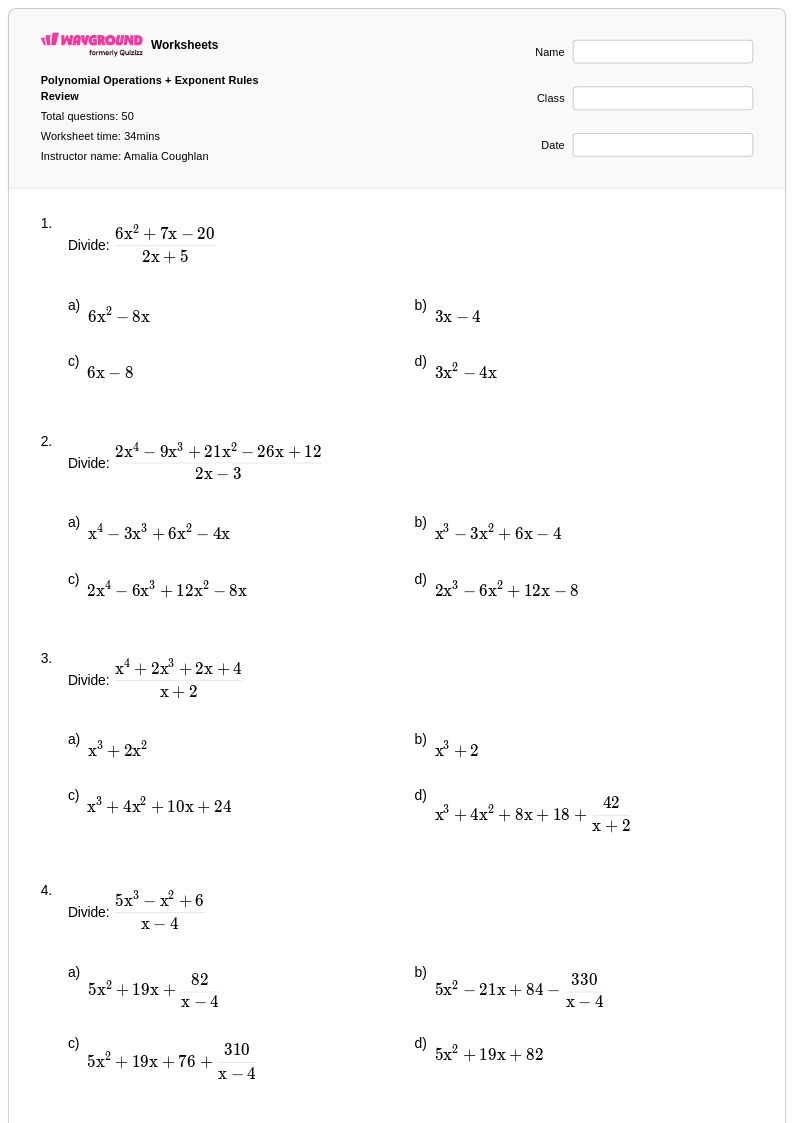
Master exponent operations with Wayground's comprehensive collection of free worksheets and printables, featuring practice problems and answer keys to help students build strong mathematical foundations in powers and exponential expressions.
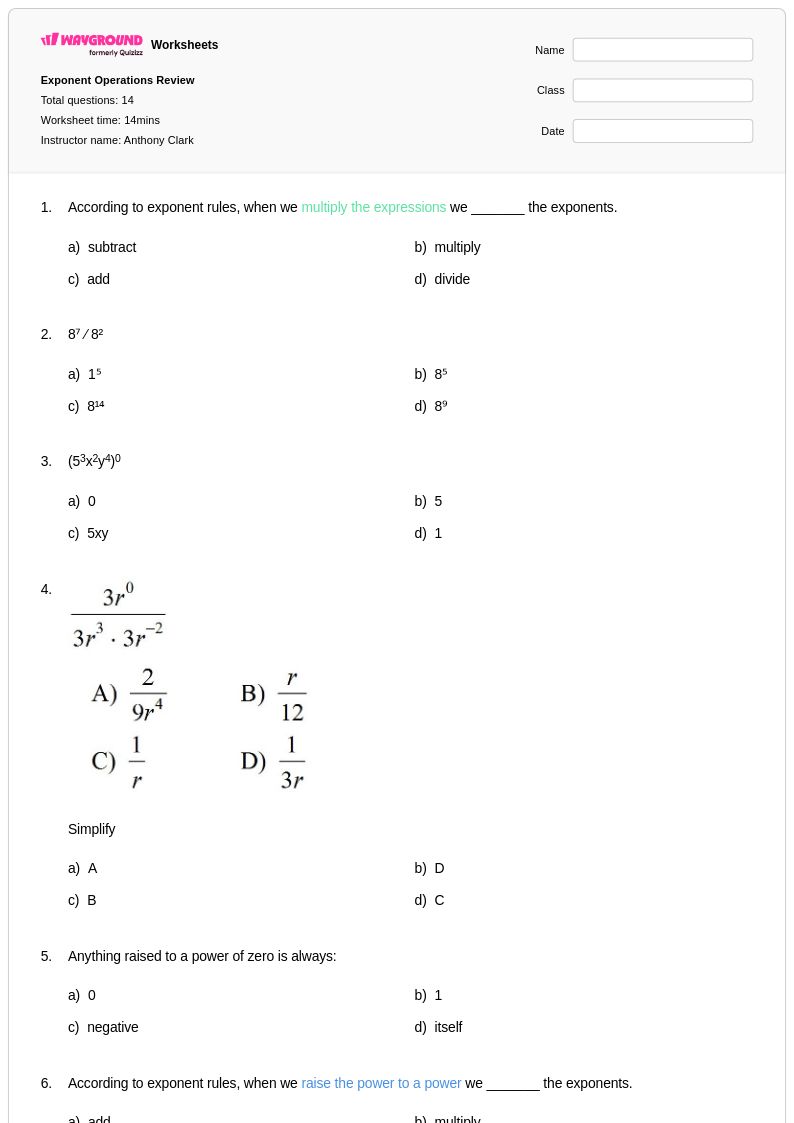
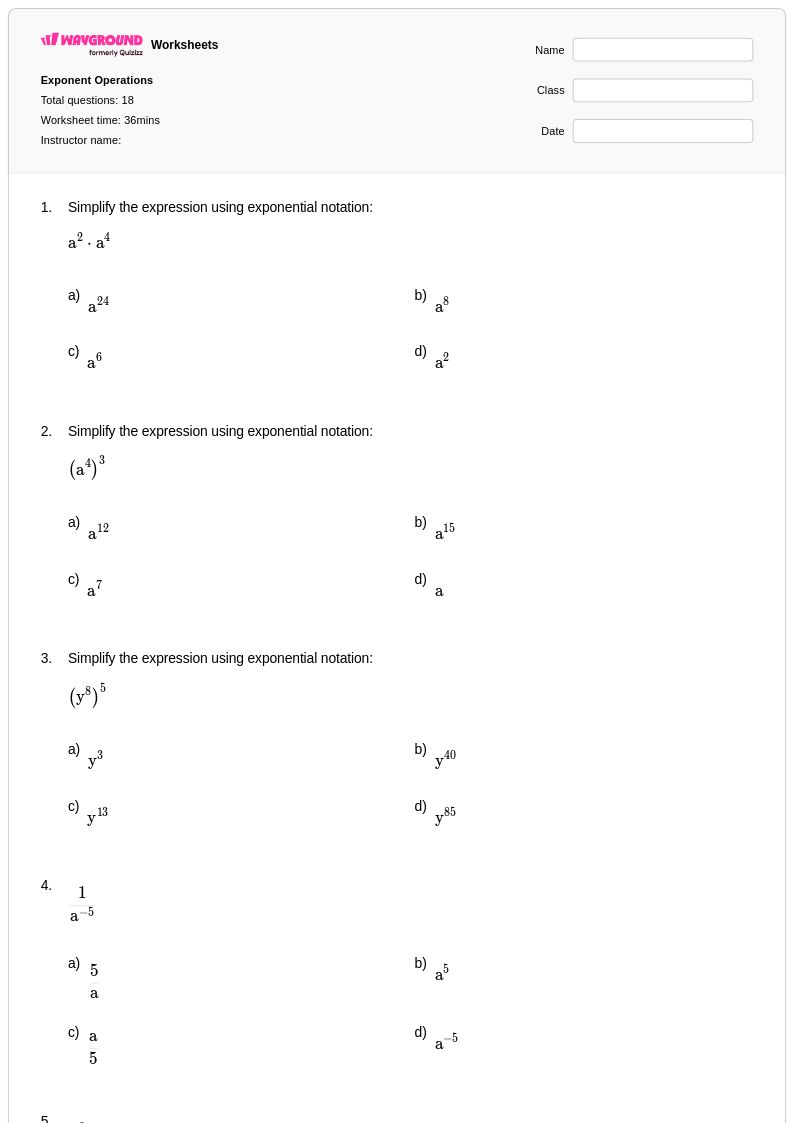
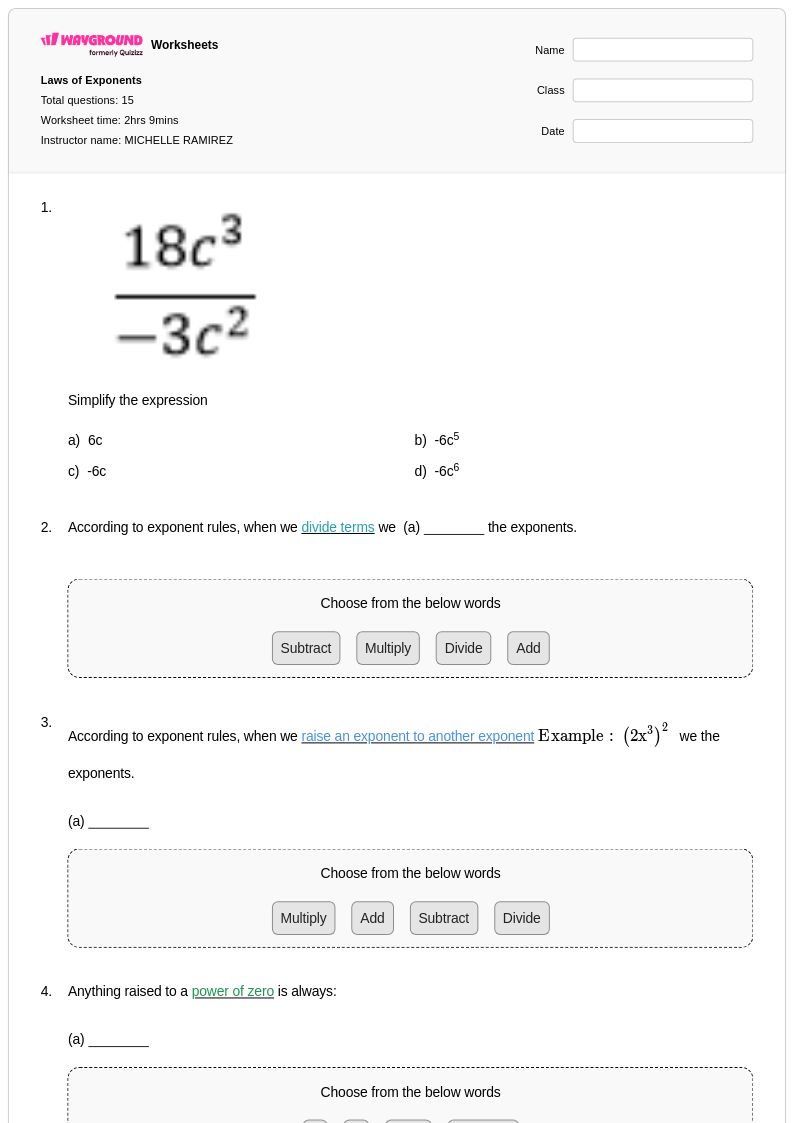
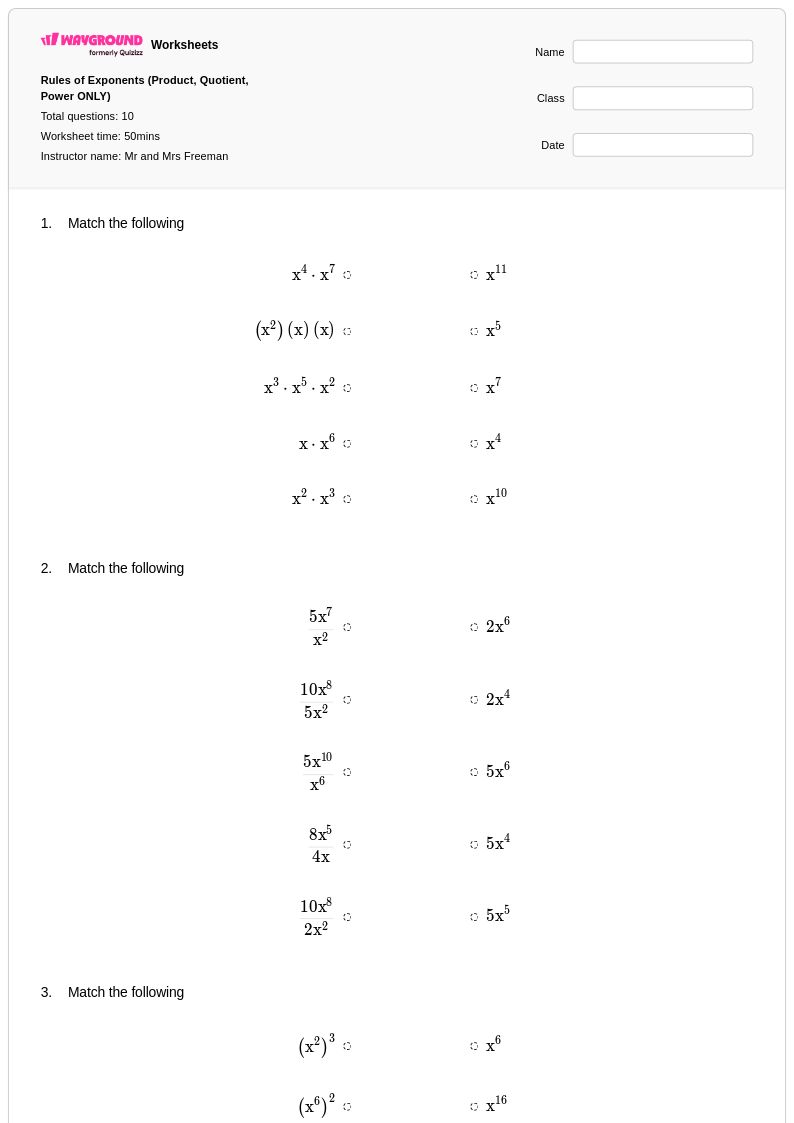
Exponent operations worksheets available through Wayground (formerly Quizizz) provide comprehensive practice with the fundamental rules and procedures that govern working with exponential expressions. These carefully crafted resources strengthen students' ability to multiply and divide powers with the same base, raise powers to powers, work with negative and zero exponents, and apply the laws of exponents in algebraic contexts. Each worksheet collection includes detailed answer keys and step-by-step solutions that help students verify their work and identify areas for improvement. The free printable materials offer structured practice problems ranging from basic exponential notation to complex multi-step applications, ensuring students develop fluency with these essential mathematical operations through repeated, targeted practice.
Wayground (formerly Quizizz) supports mathematics educators with an extensive library of millions of teacher-created exponent operations resources that can be easily searched, filtered, and customized to meet diverse classroom needs. The platform's robust differentiation tools allow teachers to modify worksheets for various skill levels, while standards alignment features ensure content matches curriculum requirements and learning objectives. These flexible materials are available in both printable pdf format and interactive digital versions, making them ideal for traditional classroom instruction, homework assignments, remediation sessions, and enrichment activities. Teachers can efficiently plan lessons around specific exponent rules, create targeted practice sets for struggling students, and design challenging extensions for advanced learners, all while accessing high-quality content that has been tested and refined by educational professionals worldwide.
FAQs
How do I teach exponent operations?
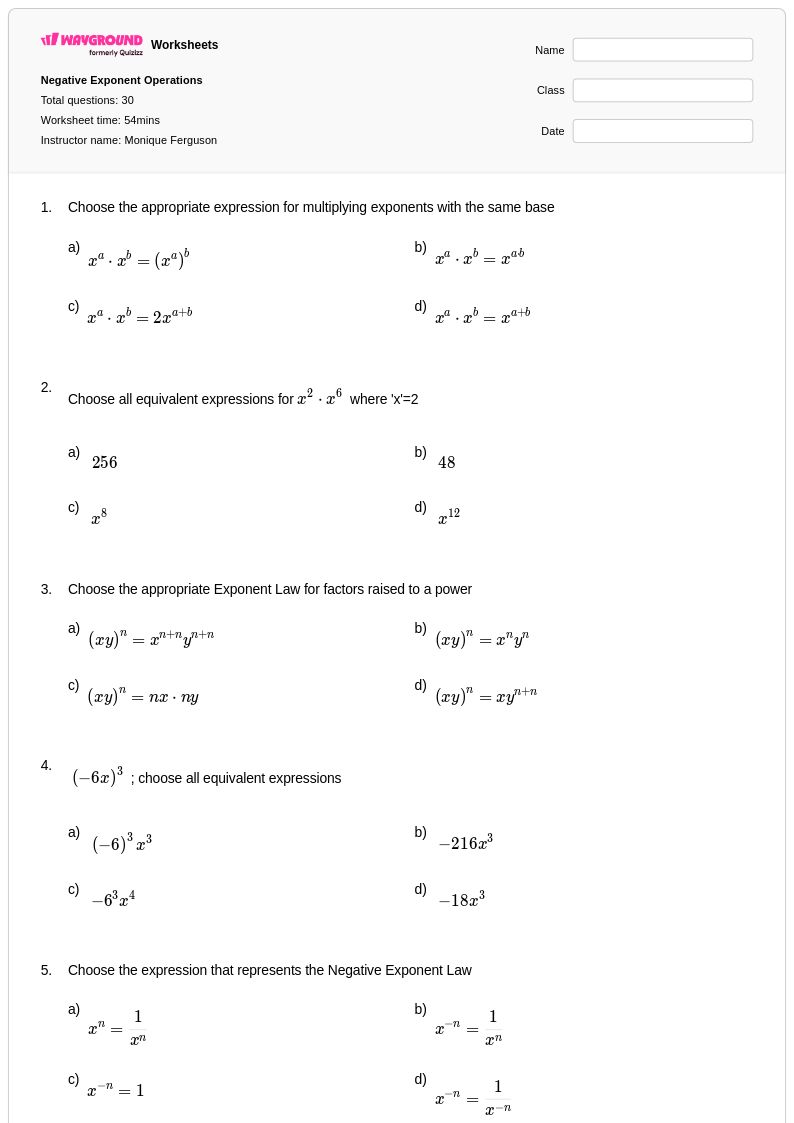
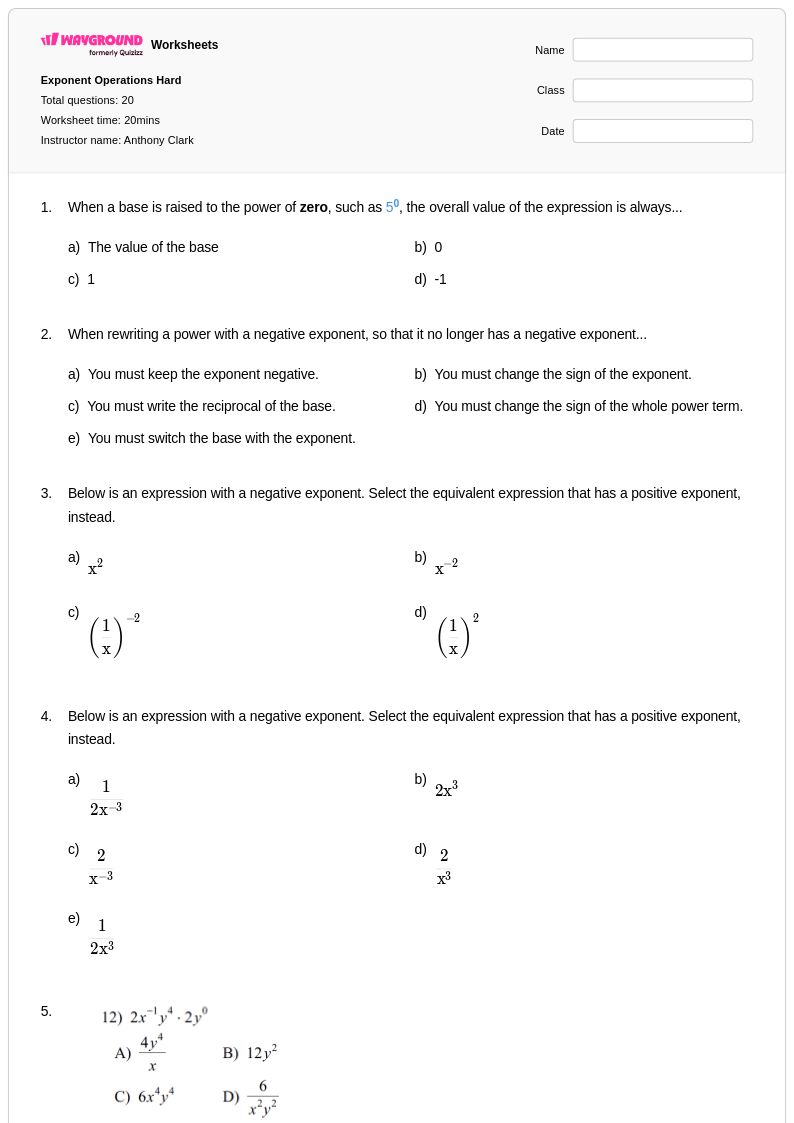
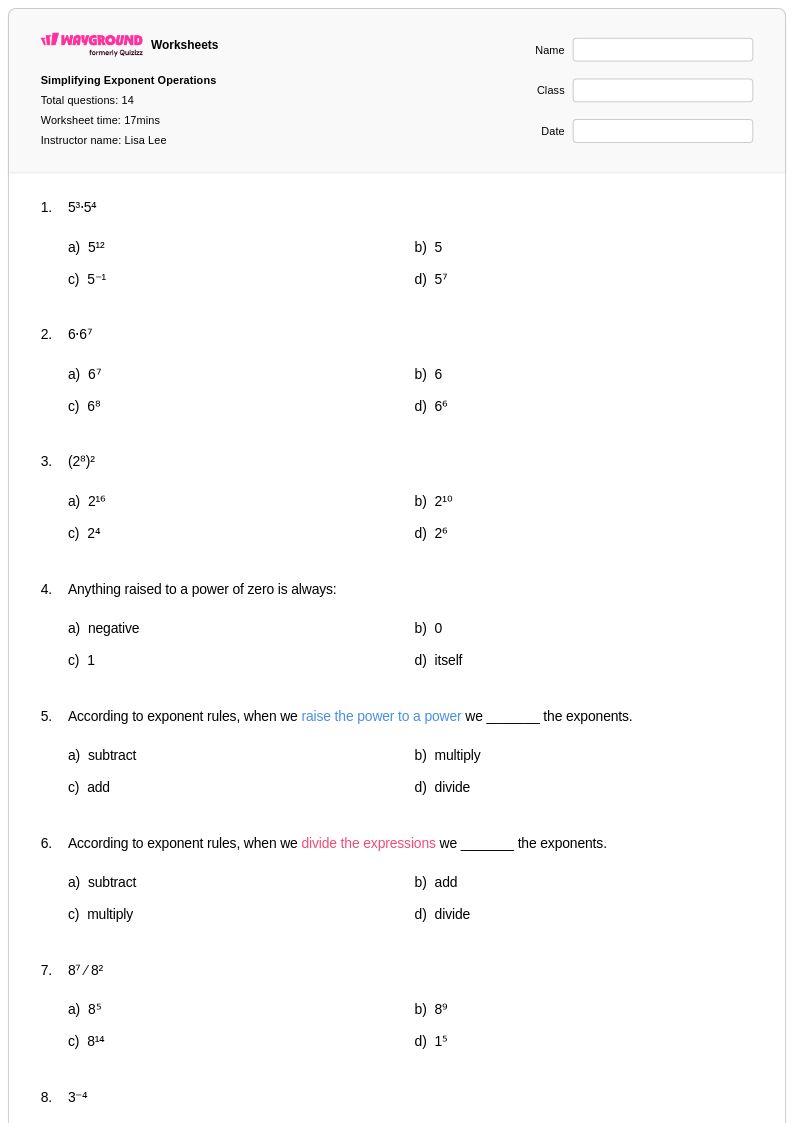
Start with the meaning of exponential notation before introducing any rules — students who understand that x³ means x·x·x can derive the product rule themselves rather than memorizing it cold. From there, sequence the rules deliberately: product rule, quotient rule, power of a power, then zero and negative exponents. Negative exponents trip up the most students, so anchor them concretely: x⁻² = 1/x² because the quotient rule demands it, not as an arbitrary definition.
What exercises help students practice exponent operations?
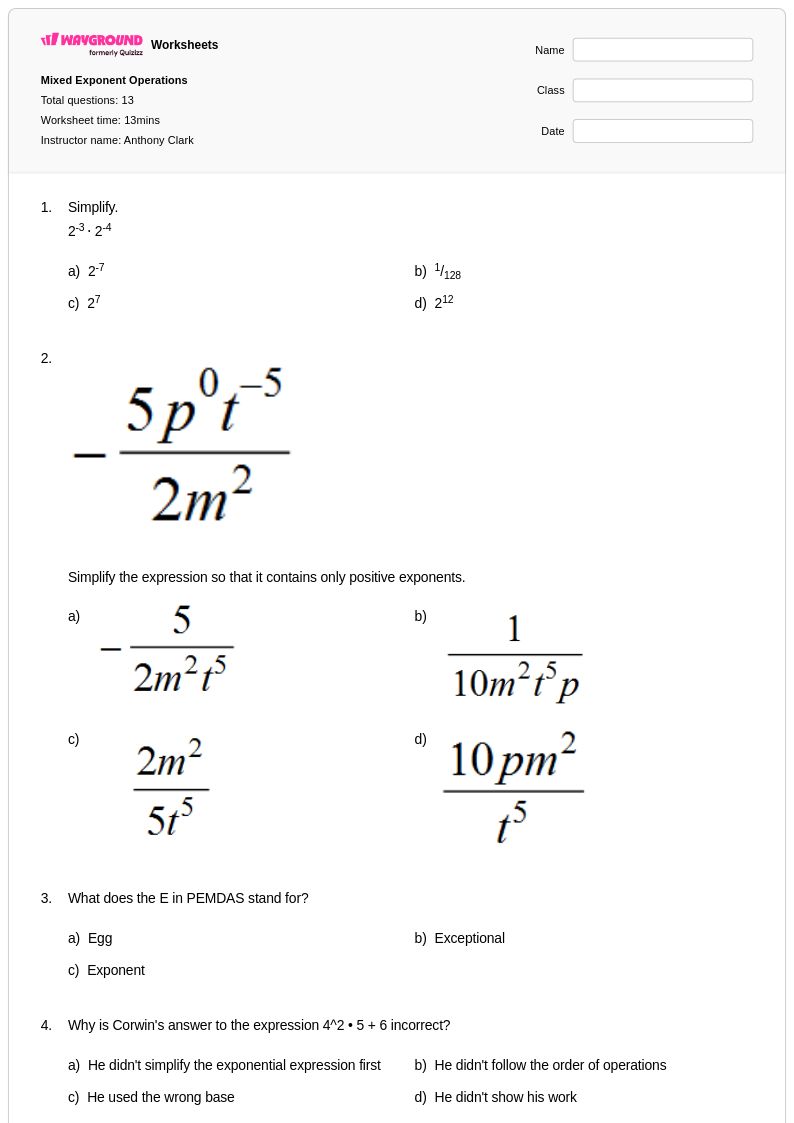
The most effective practice moves from single-rule isolation to mixed-rule problems. Start with sets that target one rule at a time — multiplying powers with the same base, then dividing, then power of a power — before giving students expressions that require applying two or three rules in sequence. Simplifying expressions like (2x³y⁻²)² / (4x⁻¹y) forces students to track multiple rules simultaneously, which is where real fluency develops.
What mistakes do students commonly make with exponent operations?
Three errors come up constantly. First, students add exponents when they should multiply bases — writing 3² · 3³ = 9⁵ instead of 3⁵. Second, they misapply the power of a power rule to sums, treating (x + y)² as x² + y². Third, negative exponents get interpreted as negative numbers — x⁻² becomes -x² in their work rather than 1/x². The last two are the most persistent and worth dedicating explicit error-analysis time to.
How do I use Wayground's exponent operations worksheets in my class?
Each worksheet comes with a complete answer key, so students can self-check immediately after working through problems — useful for independent practice or homework. If you're running a digital session, you can host the worksheet as an interactive quiz on Wayground. If you prefer paper, download the printable PDF and use the Wayground for Teachers app to scan and grade student submissions without manual marking.
Are exponent operations aligned to Common Core standards?
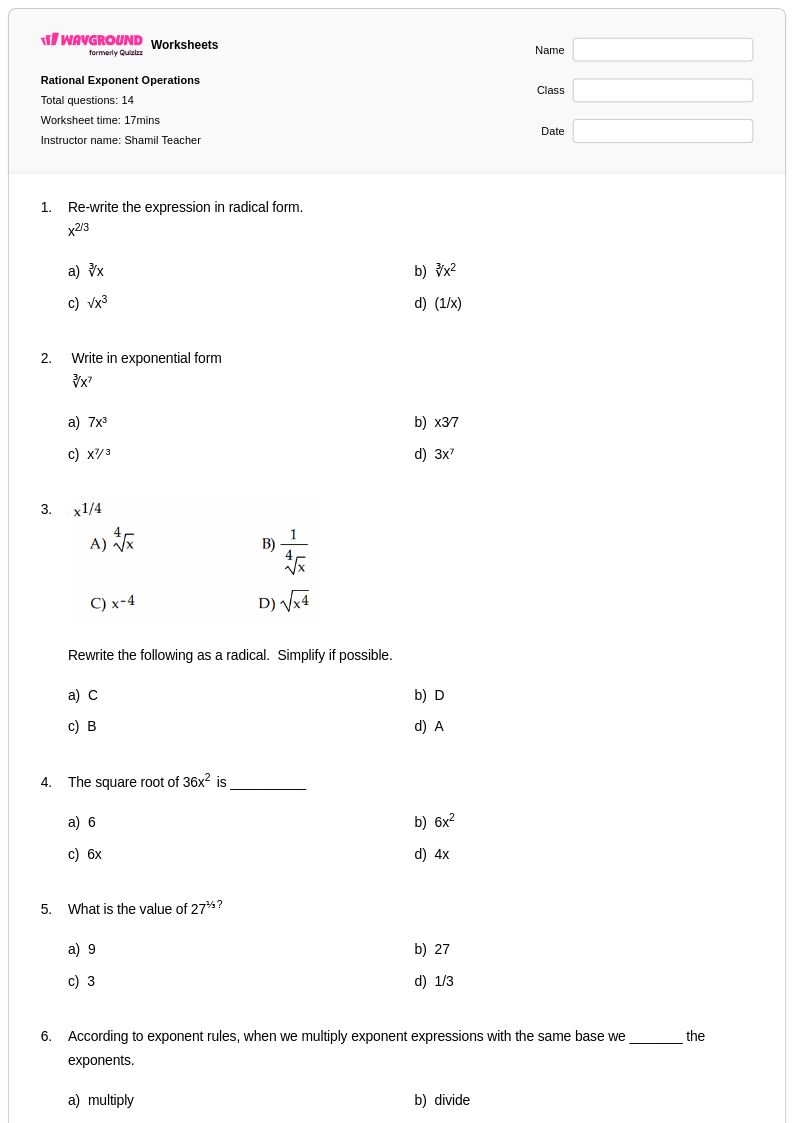
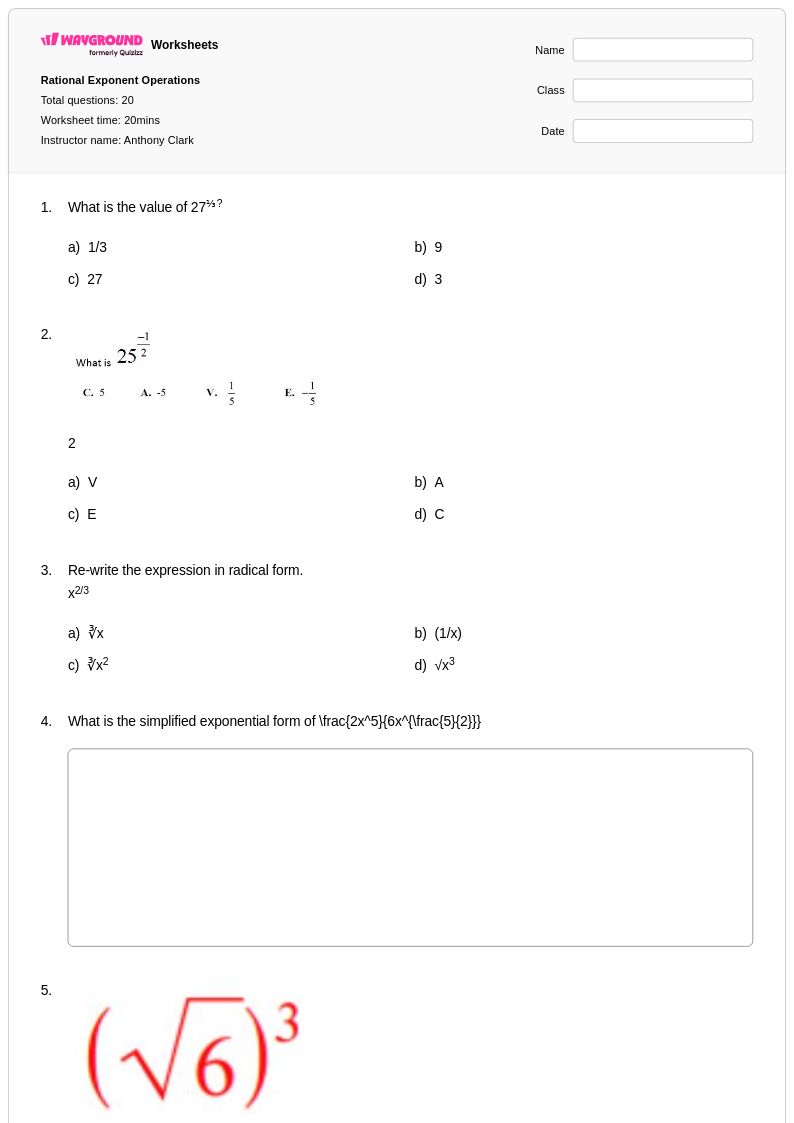
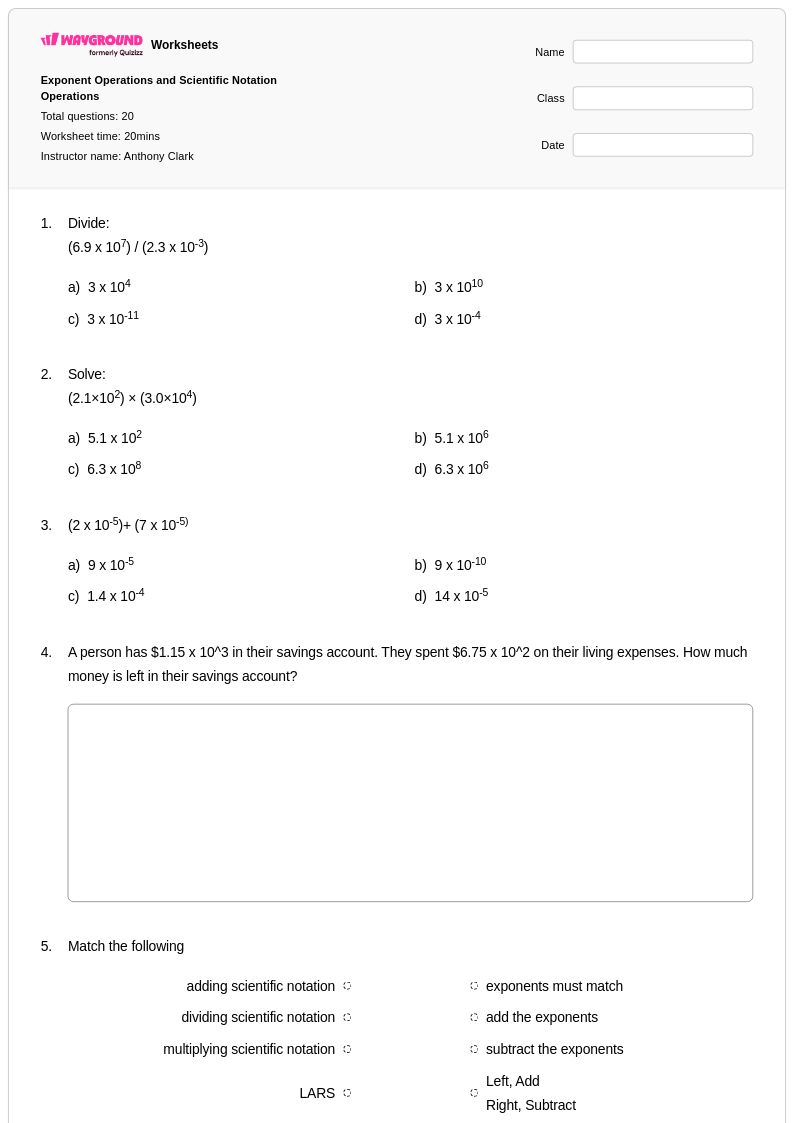
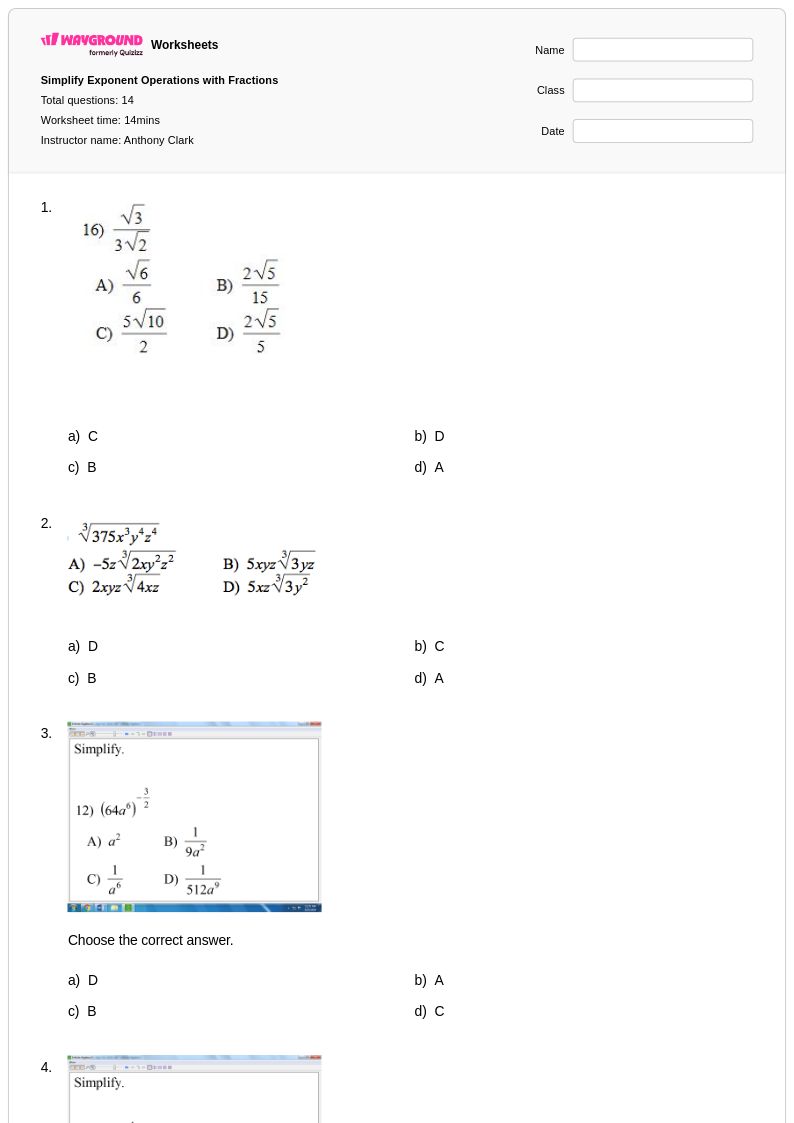
Yes. Common Core introduces integer exponents in Grade 8, where students learn the product, quotient, and power rules and apply them to scientific notation. By high school, the expectation expands to rational exponents and connecting exponential expressions to radical form — so a student who can't fluently apply the quotient rule in 8th grade will struggle to rewrite x^(2/3) meaningfully in Algebra II. These worksheets address the foundational rules that sit at the base of that progression.
How can I differentiate exponent operations practice for mixed-ability classes?
For students who are still shaky on the rules, Wayground's reduced answer choices accommodation lowers the cognitive load so they can focus on applying one rule at a time without being overwhelmed by options. For students with reading barriers, the Read Aloud feature handles question text. At the worksheet level, you can generate a version with a dyslexia-friendly font or larger font size for accessibility — same problems, adjusted presentation — without any student knowing their copy differs from a classmate's.
What grade level covers exponent operations?
The core rules — product, quotient, power of a power, zero and negative exponents — are typically taught in Grade 8 and reinforced in Algebra I (often Grade 9). Students revisit and extend the concept in later courses when rational exponents and exponential functions enter the picture. If a student is encountering these rules for the first time, Grade 8–9 materials are the right starting point.