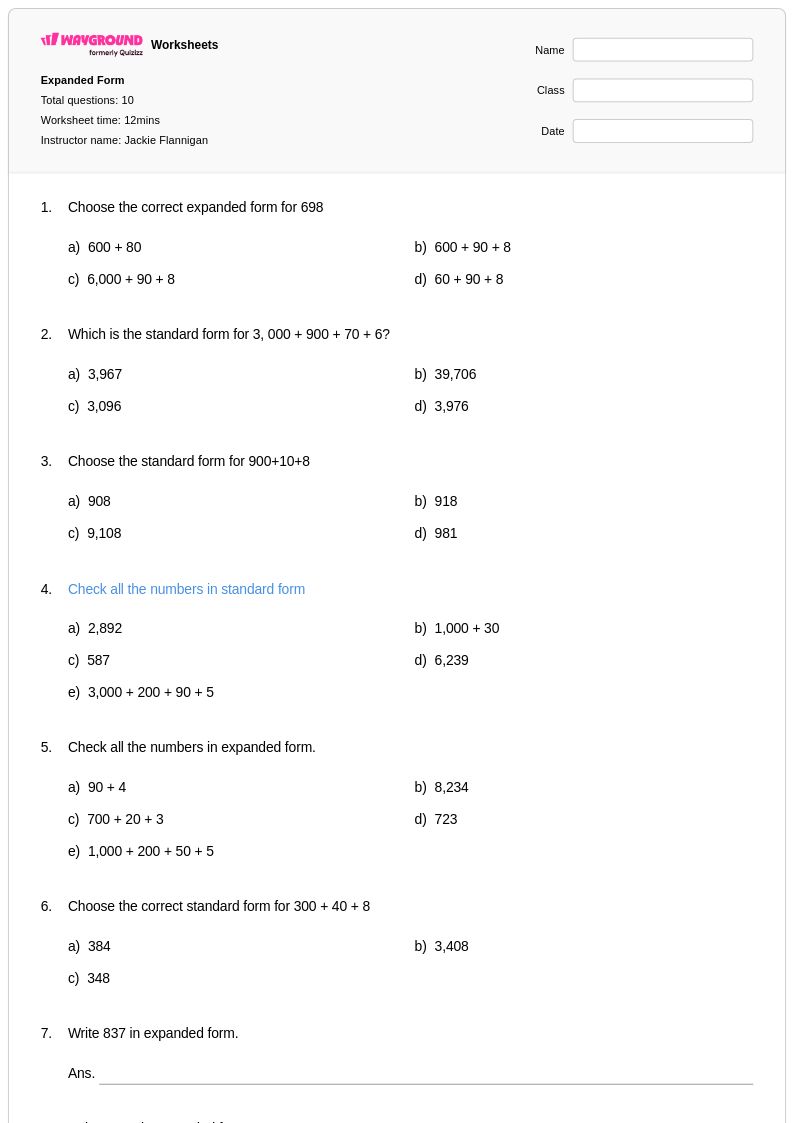
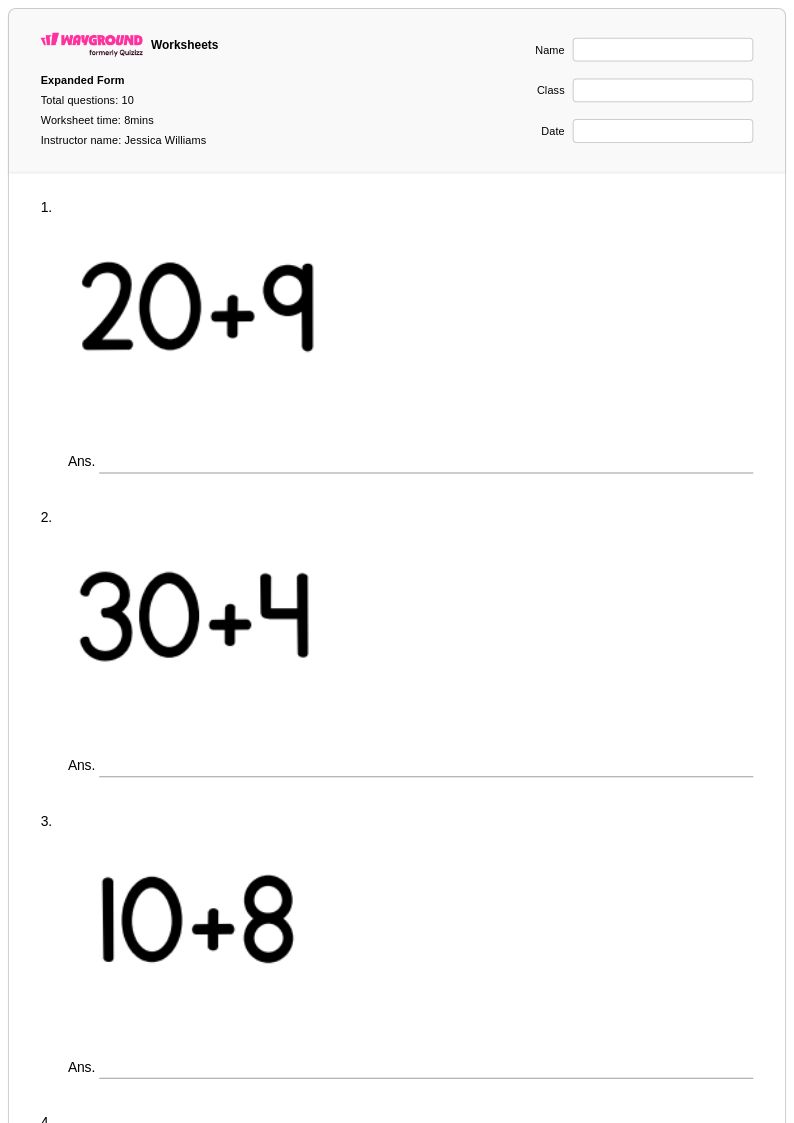
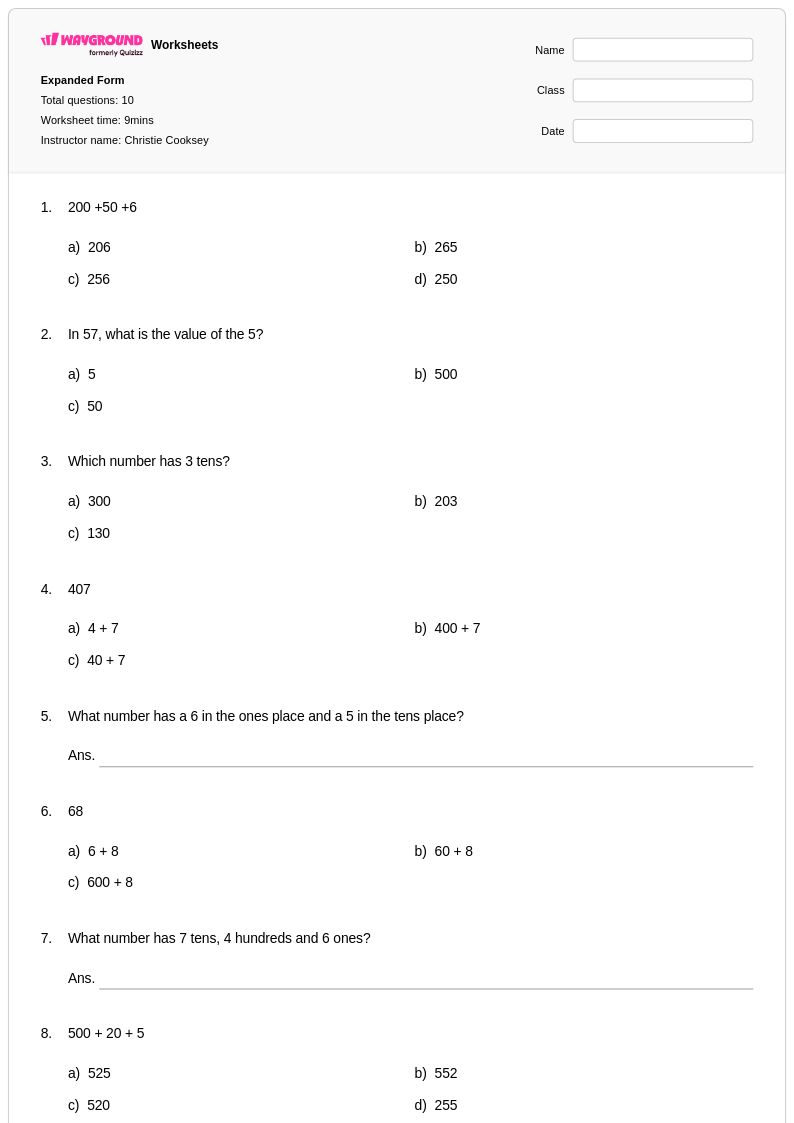
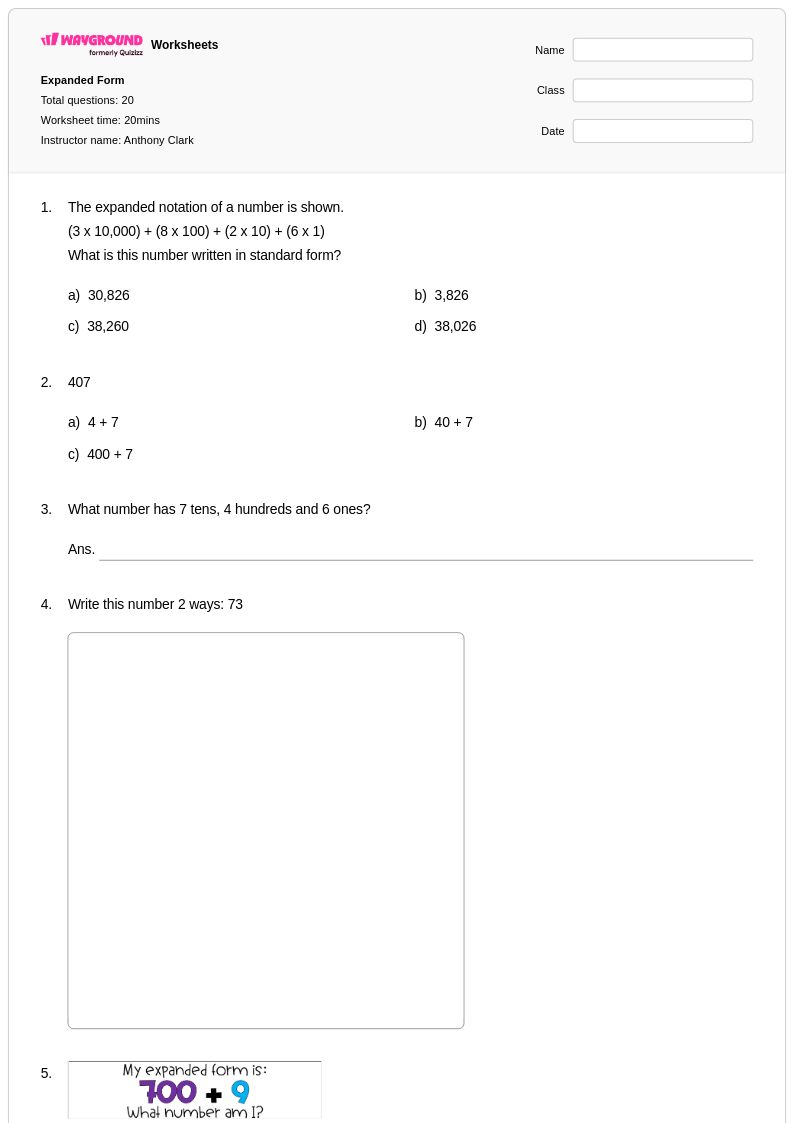
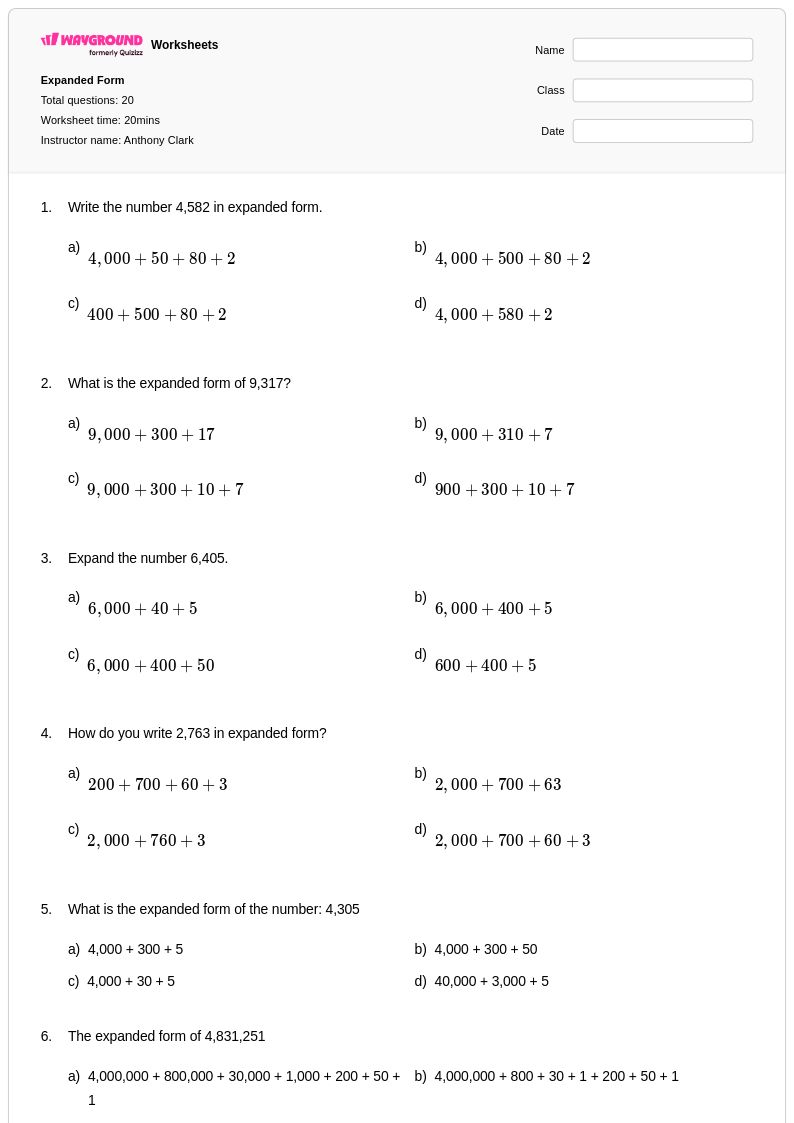
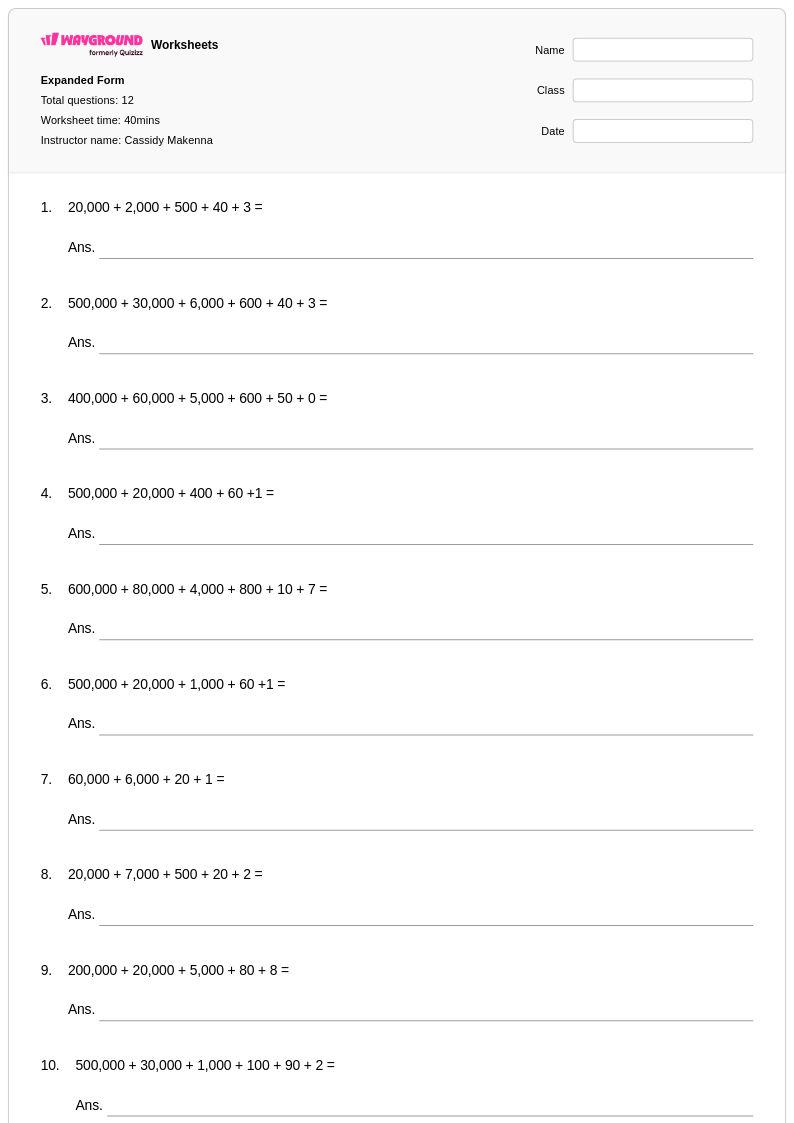
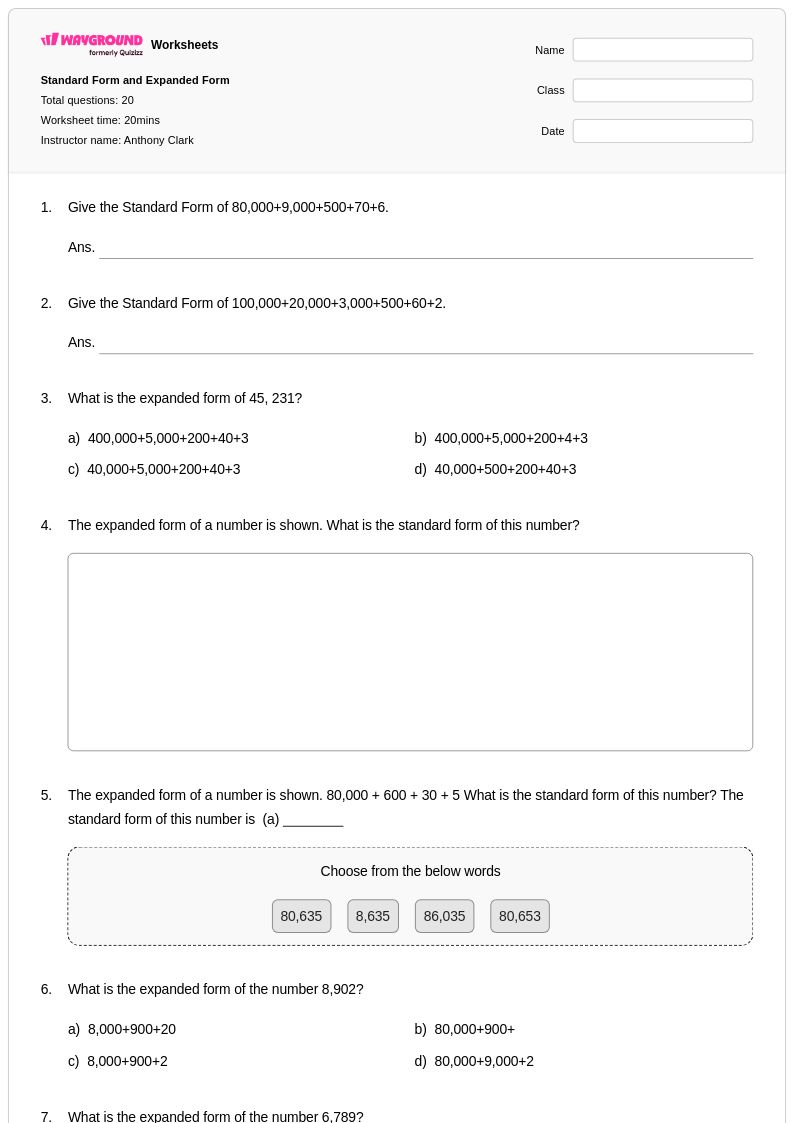
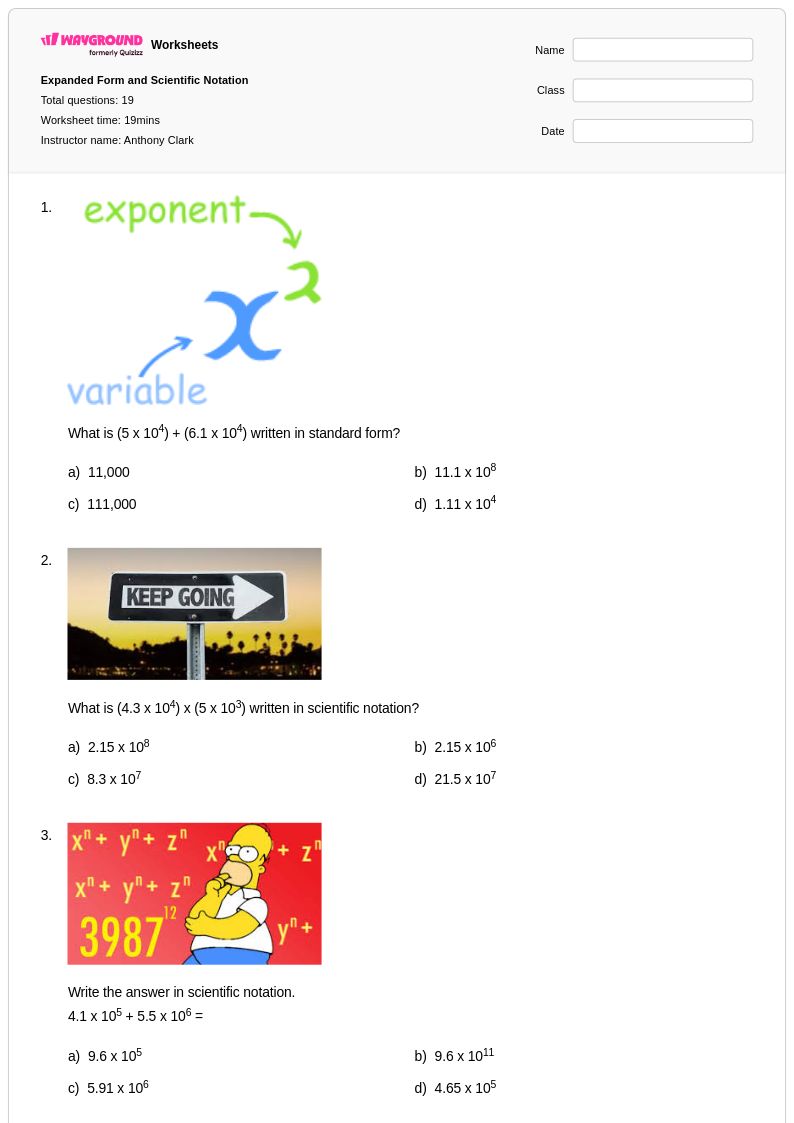
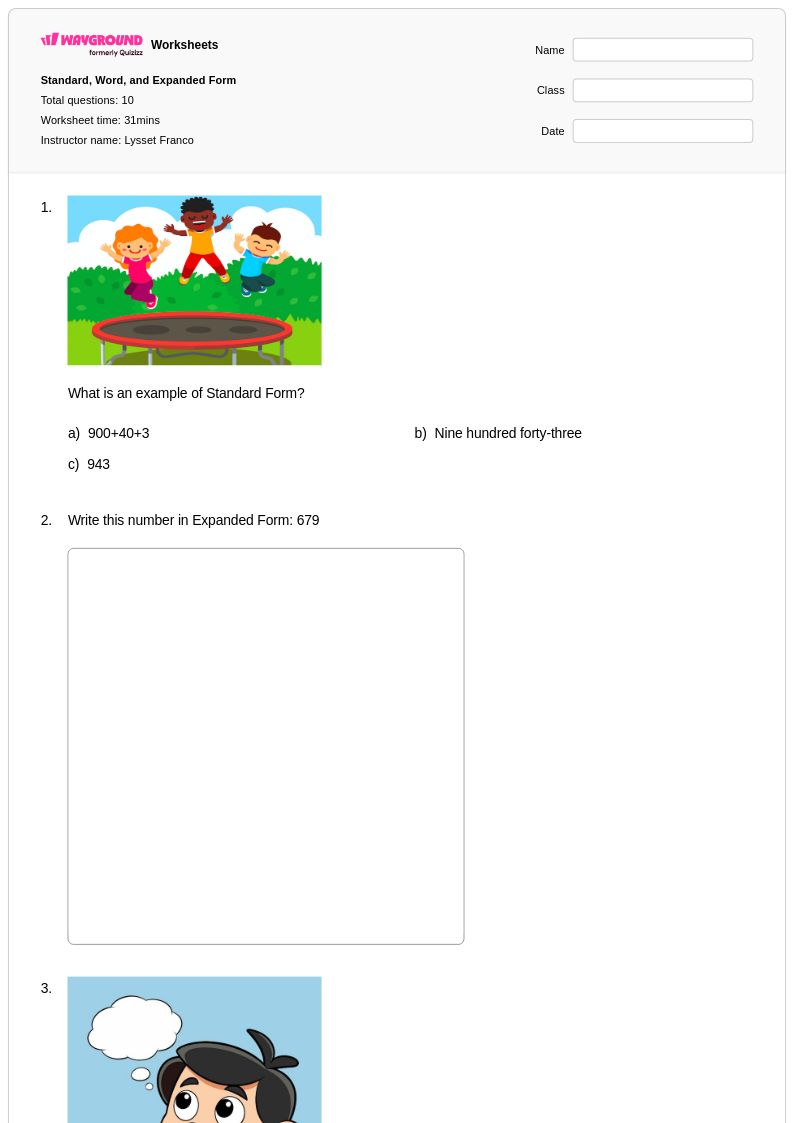
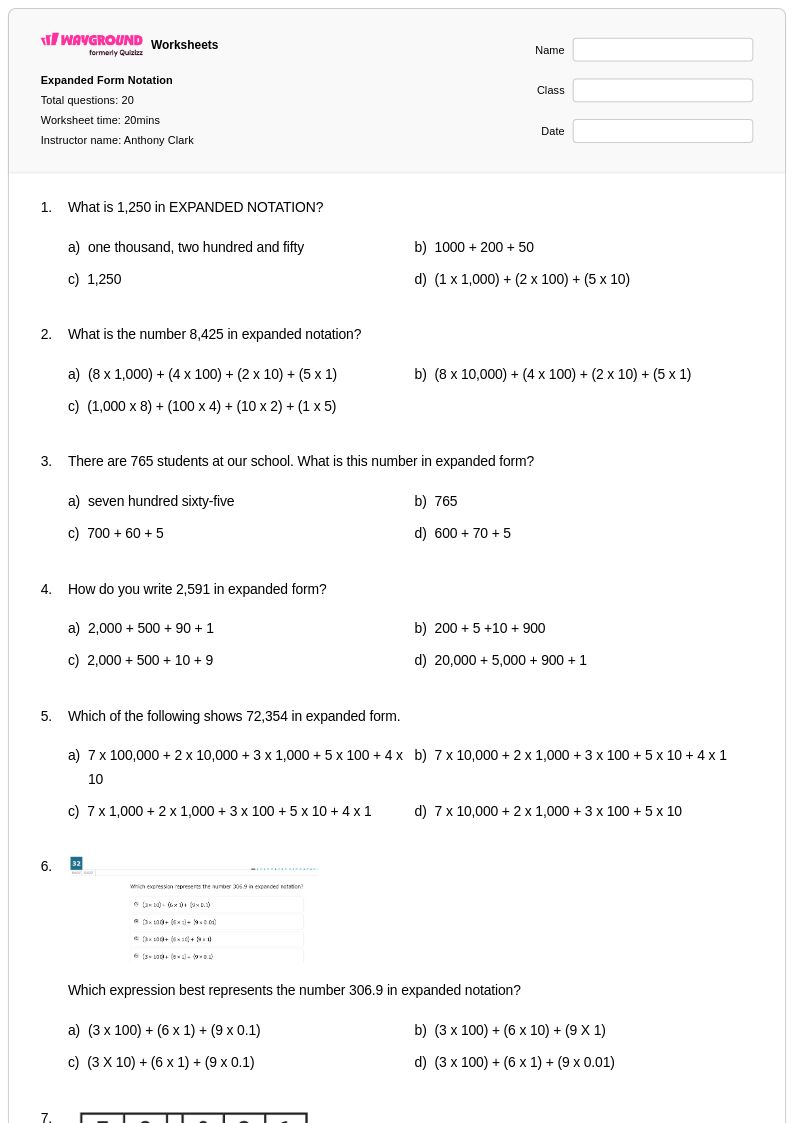
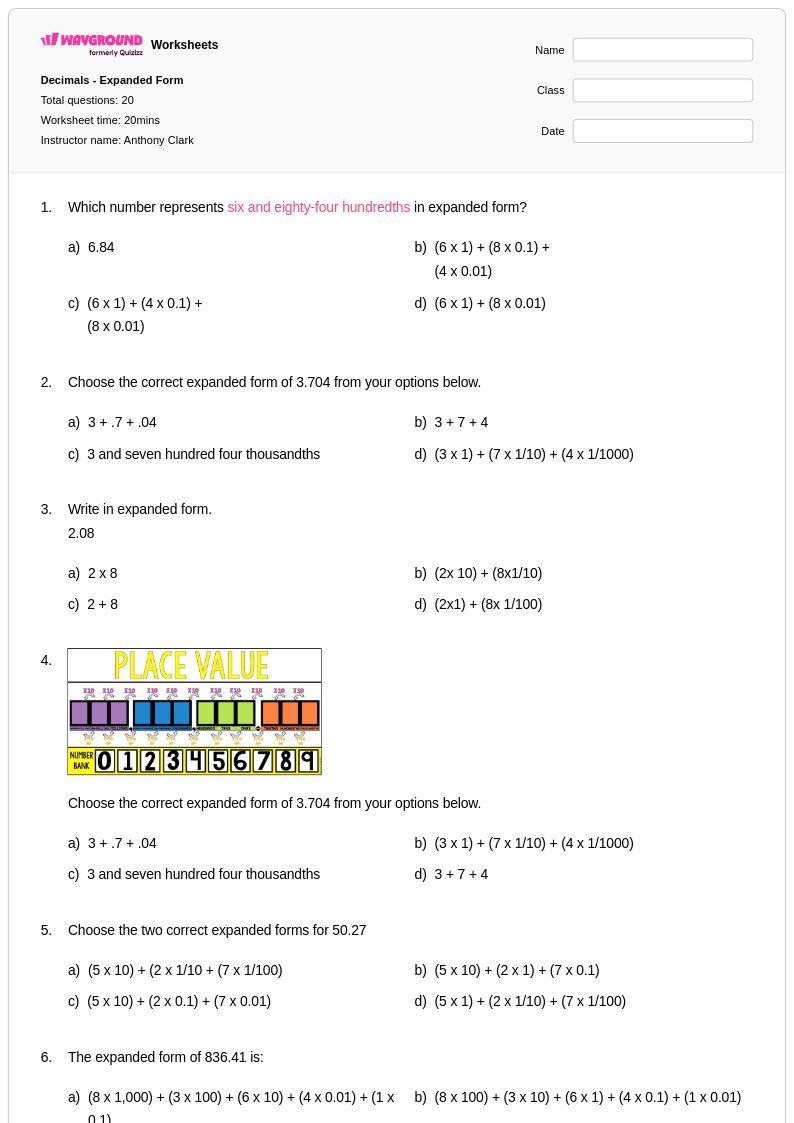
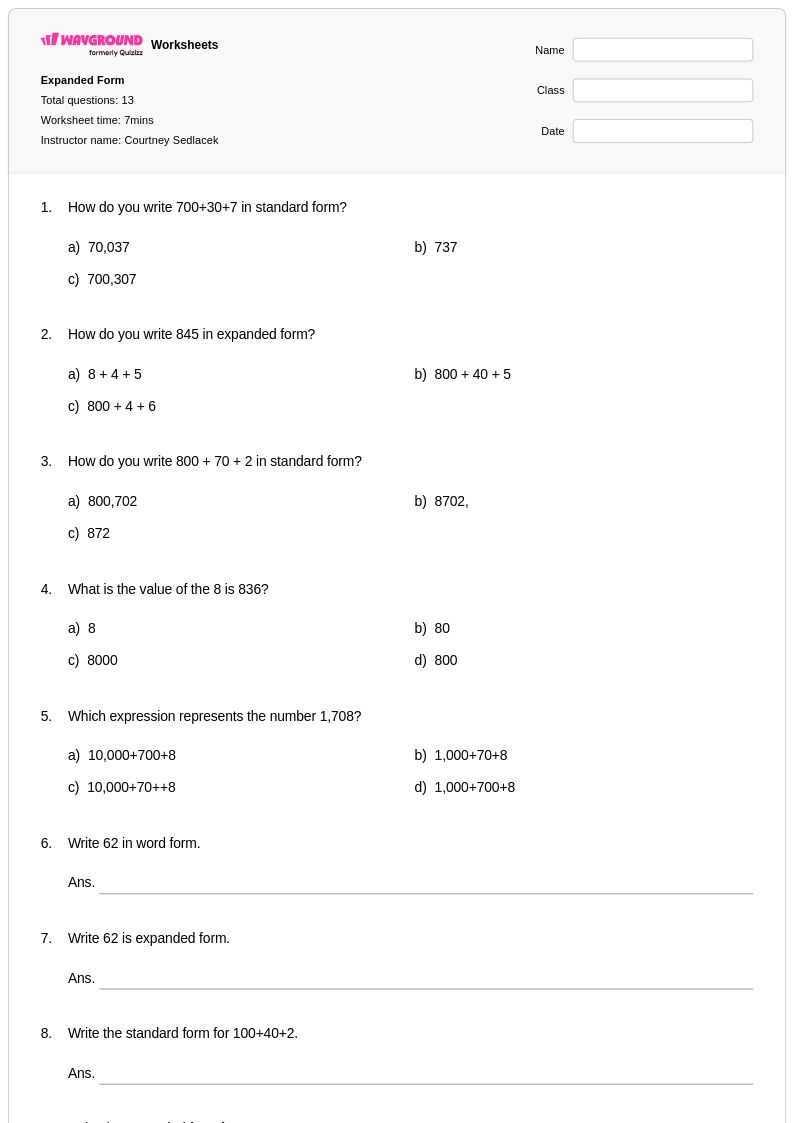
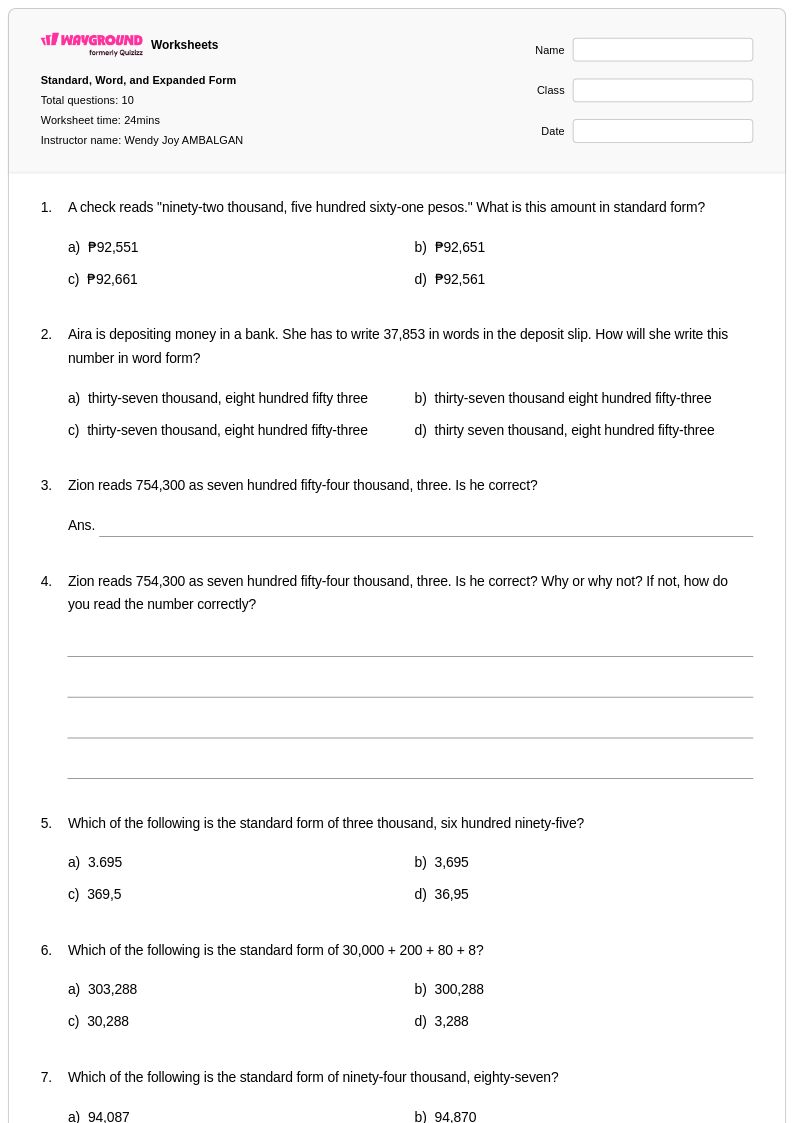
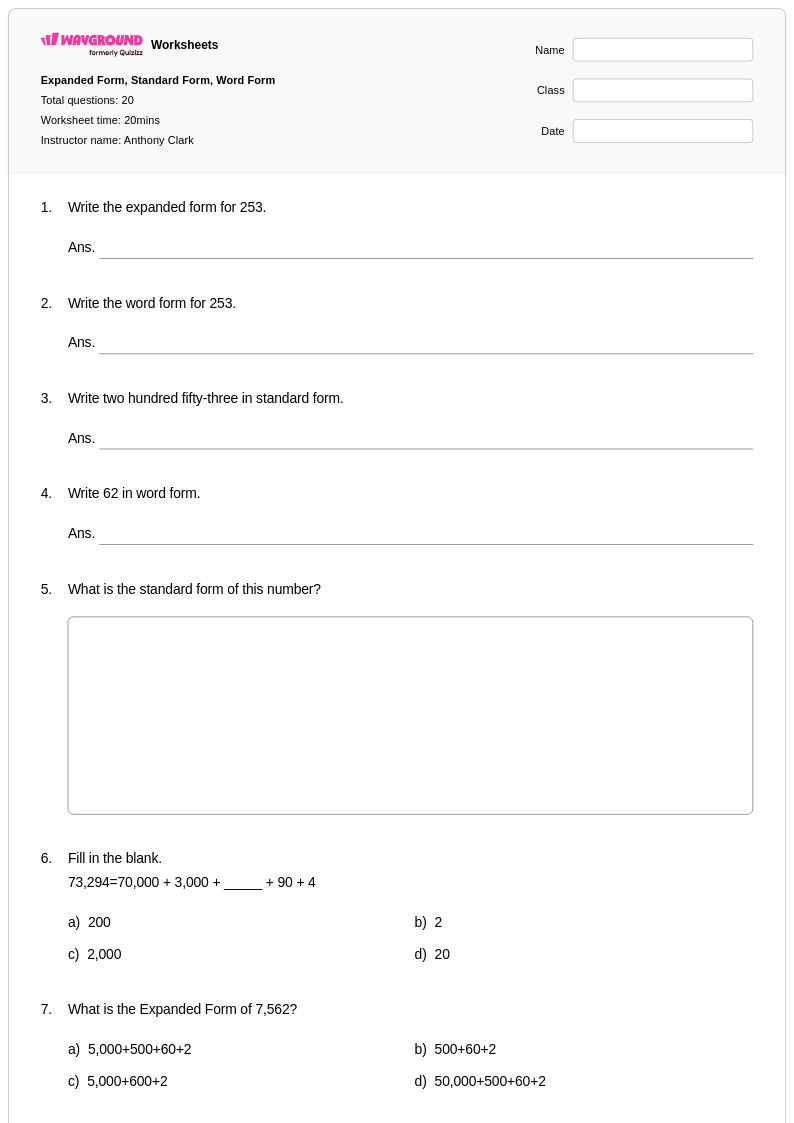
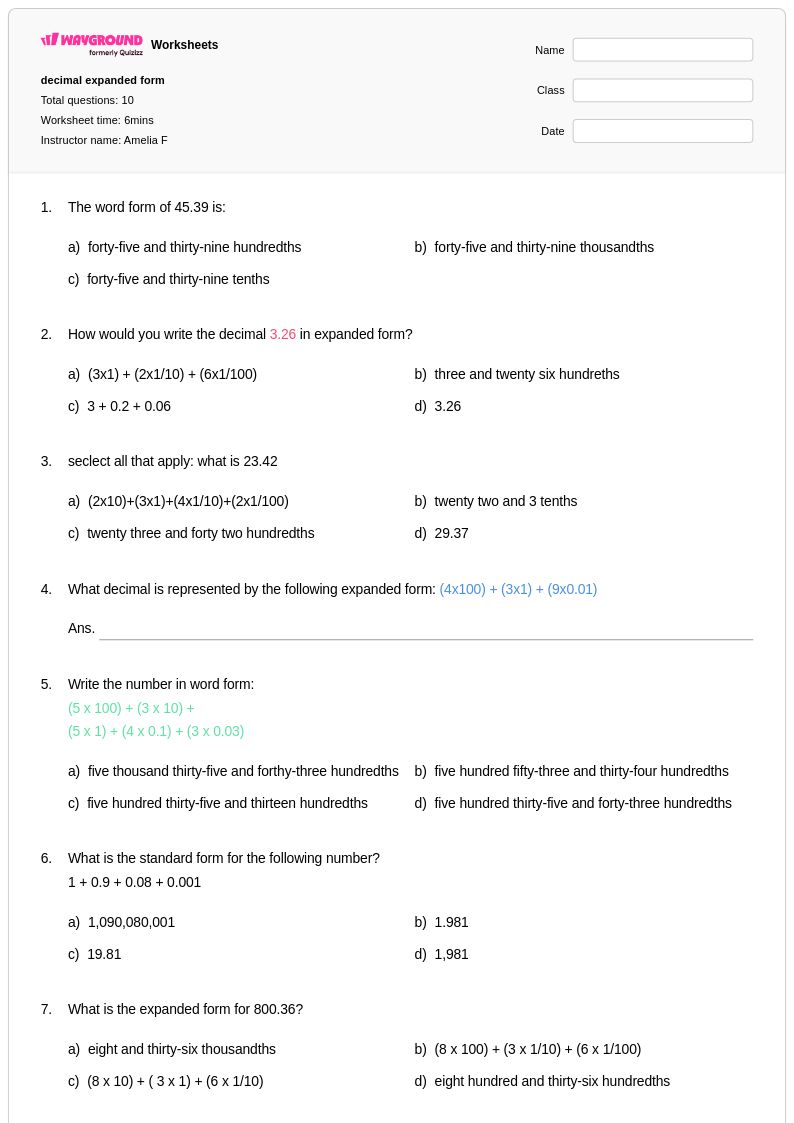
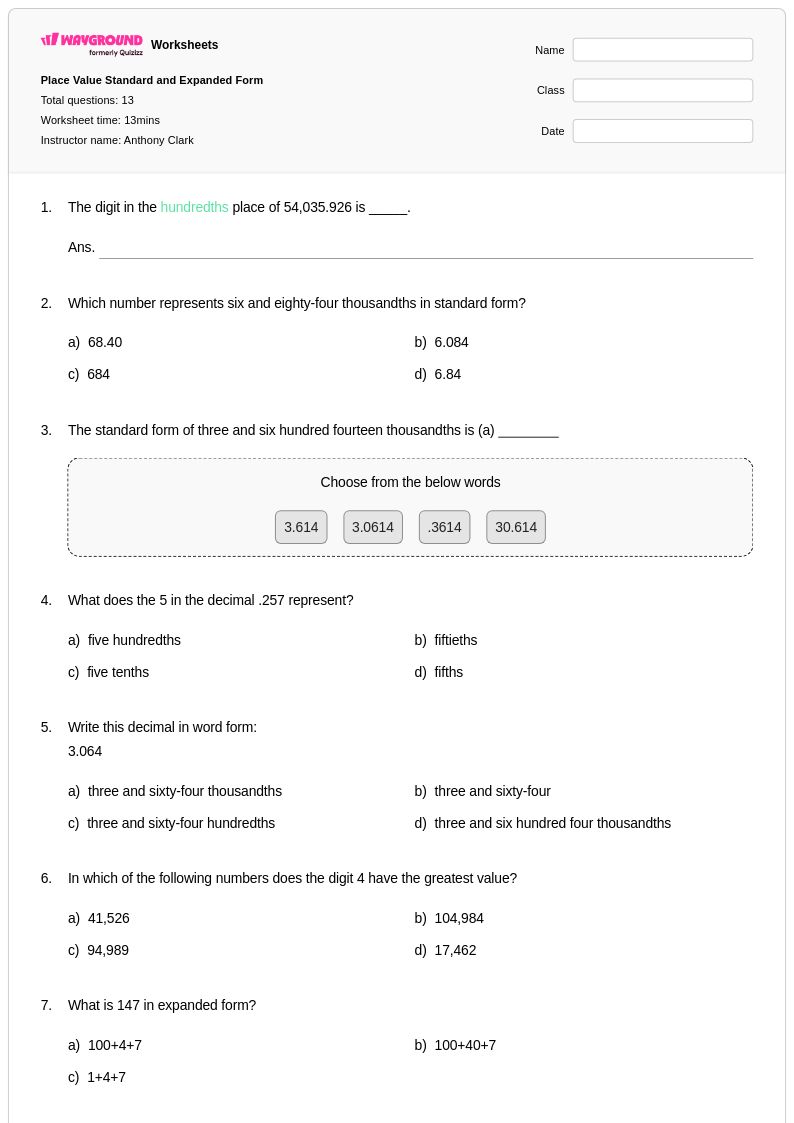
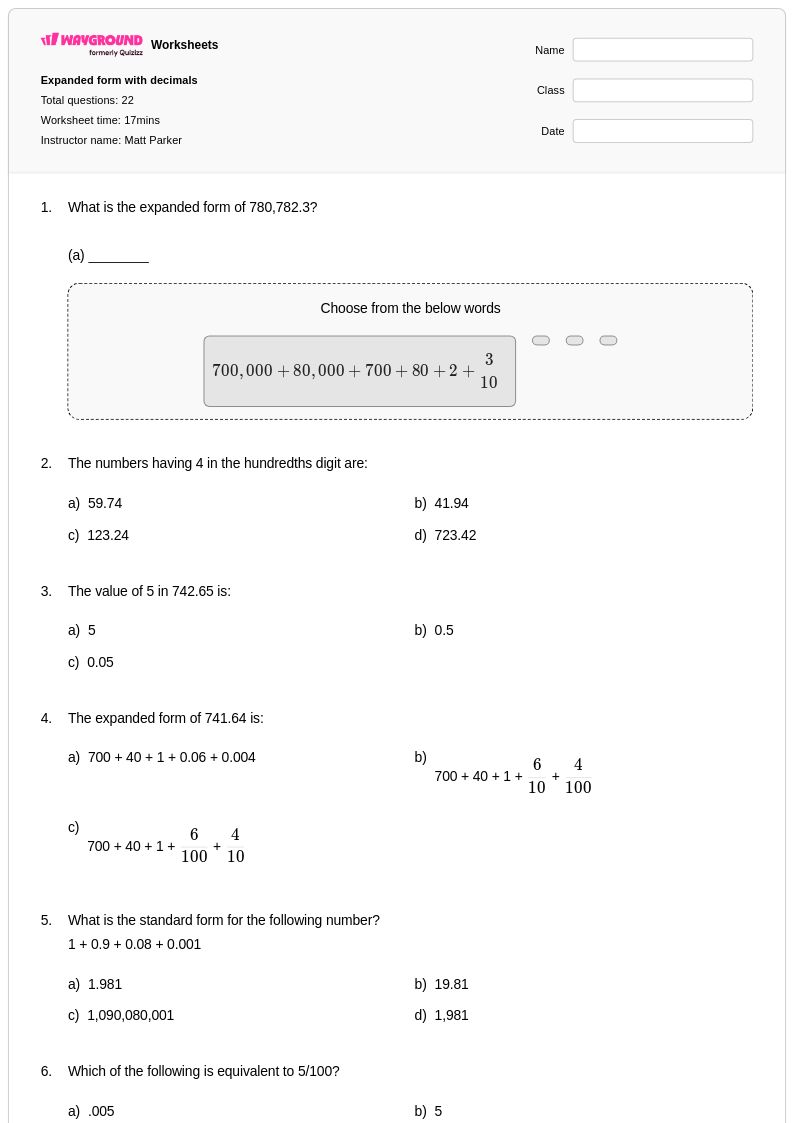
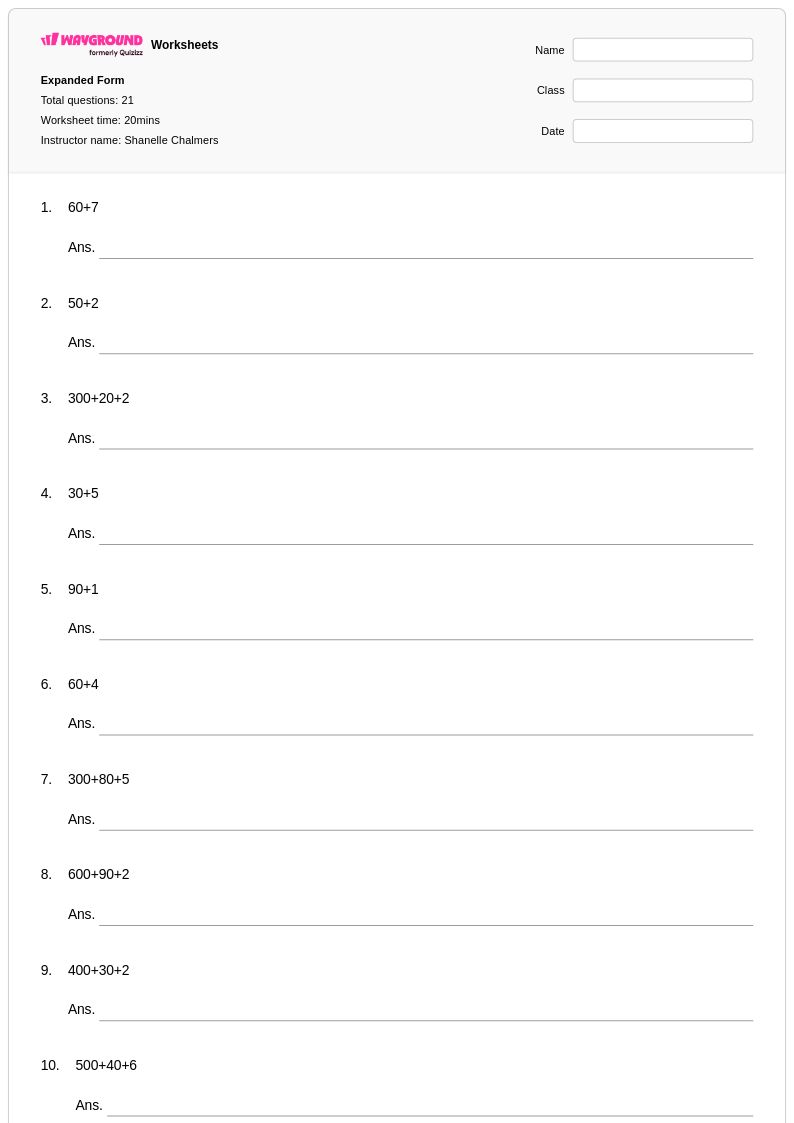
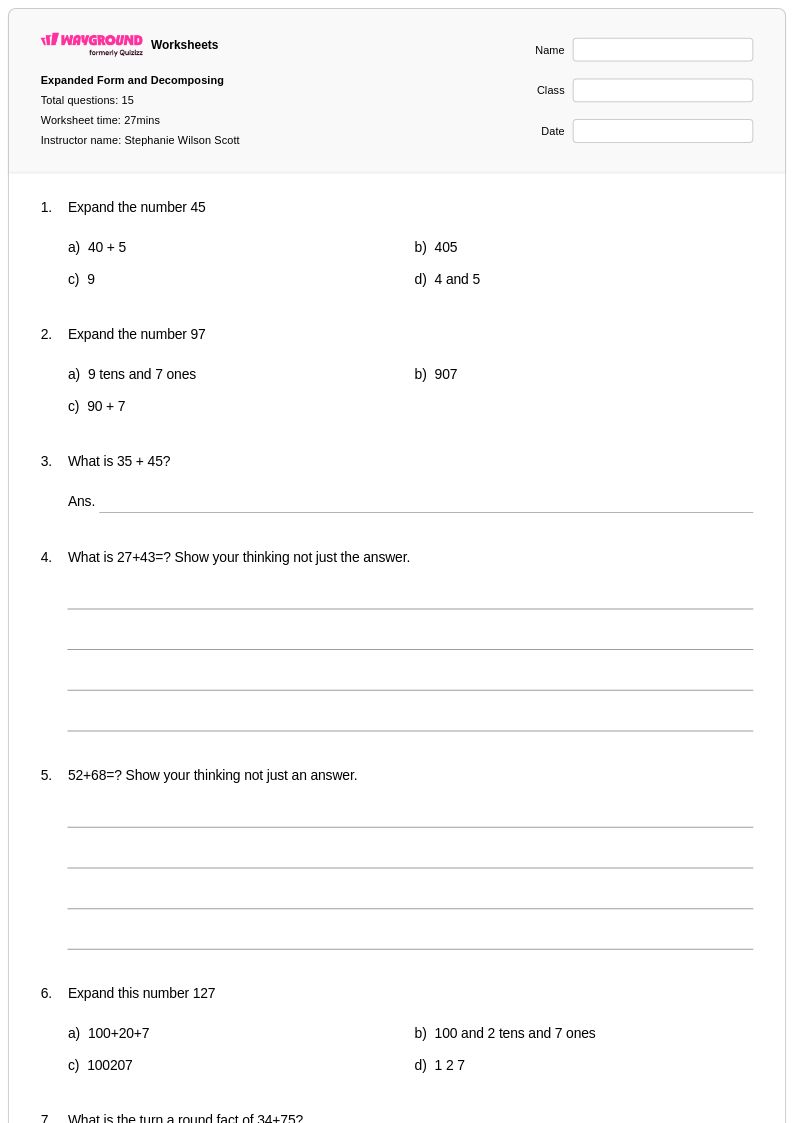
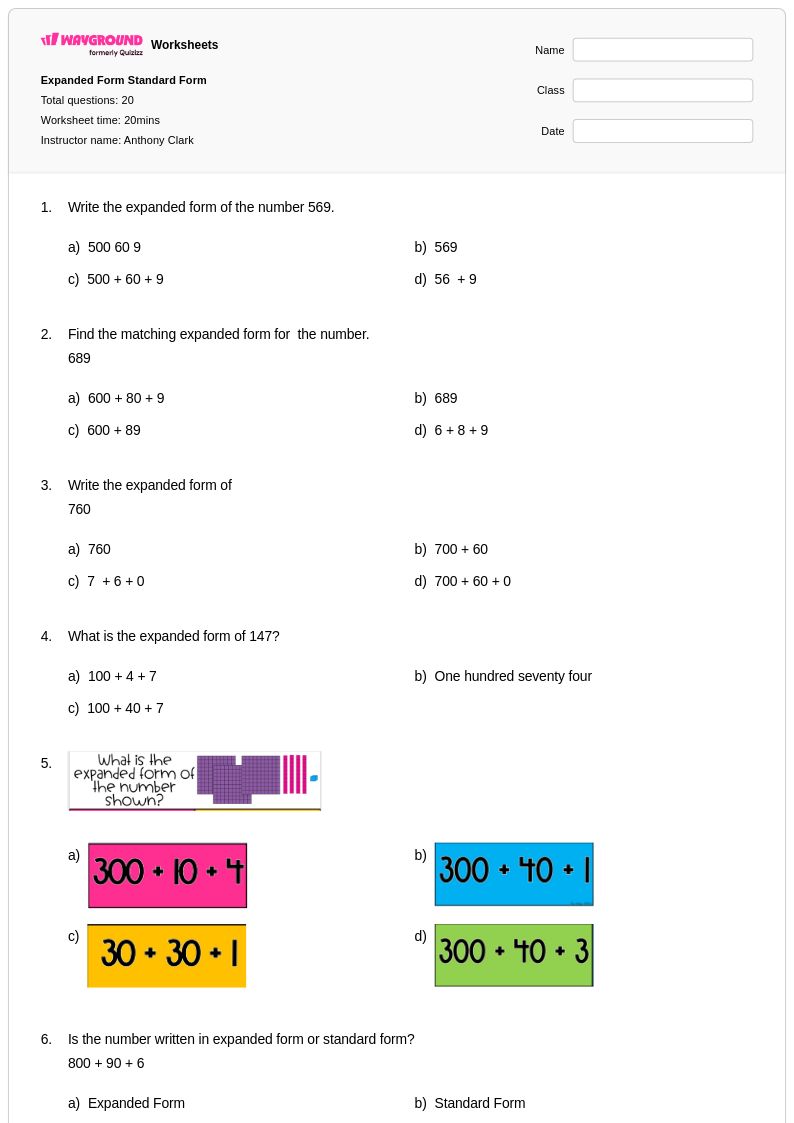
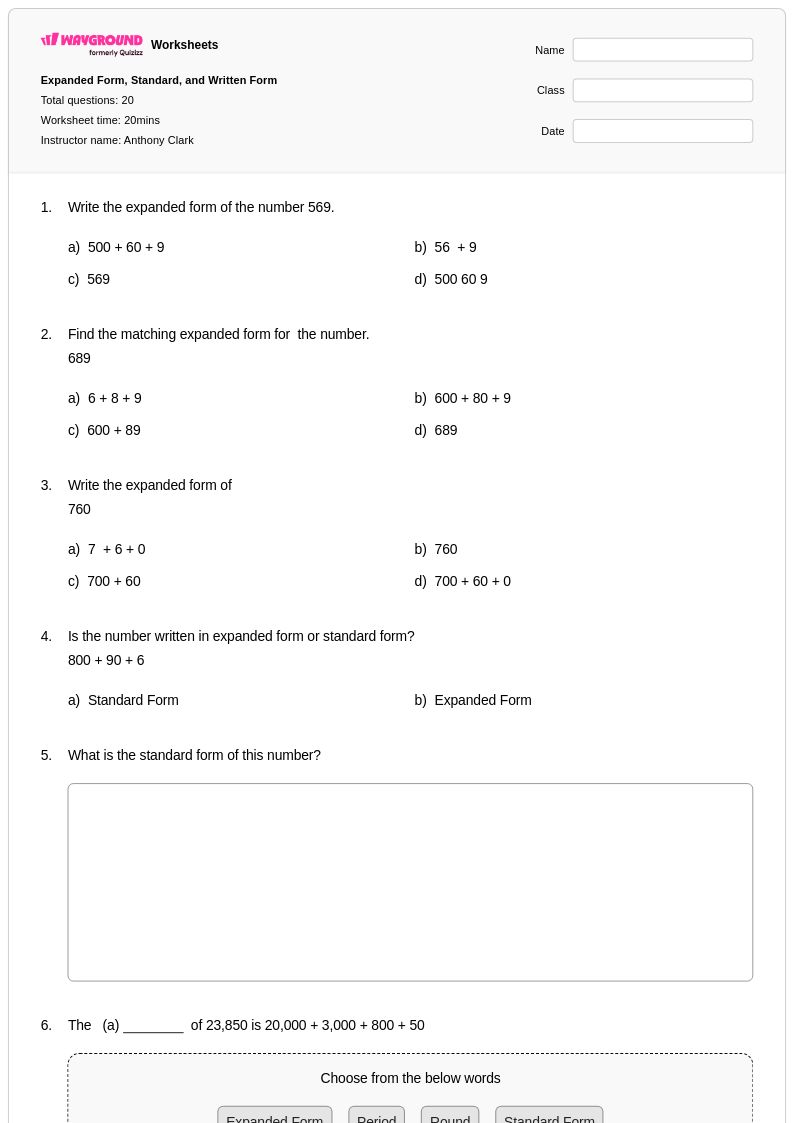
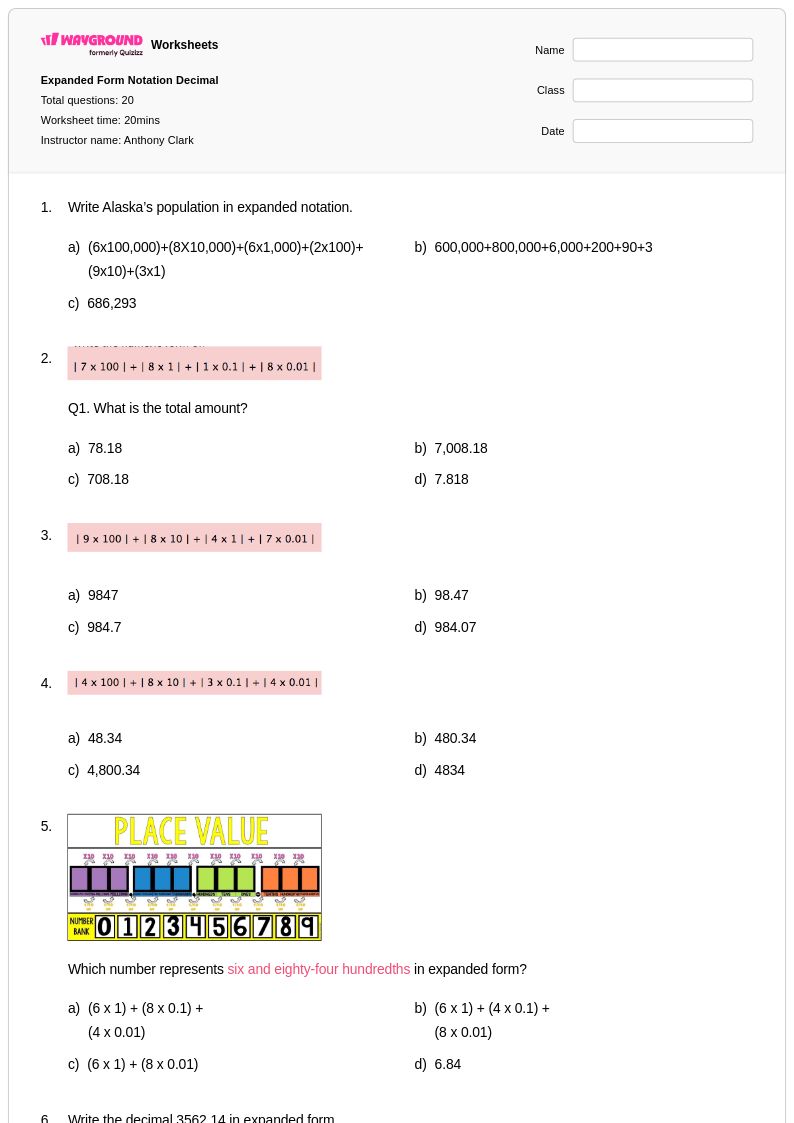
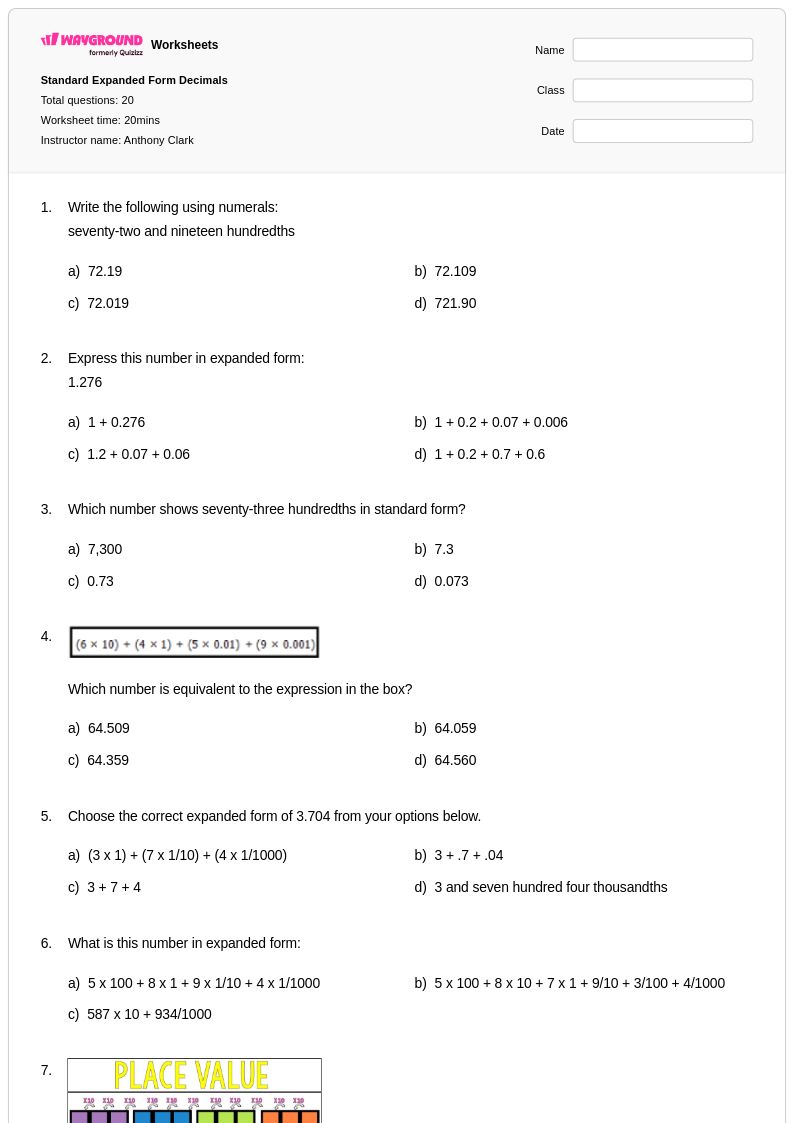
Discover free expanded form worksheets and printables that help students master breaking down numbers into their place value components through engaging practice problems with comprehensive answer keys.
Expanded form worksheets available through Wayground (formerly Quizizz) provide students with essential practice in decomposing numbers into their place value components, a fundamental skill that strengthens mathematical number sense and prepares learners for advanced arithmetic operations. These comprehensive worksheets guide students through the process of breaking down numbers into hundreds, tens, and ones, helping them visualize how digits represent different values based on their position within a number. The collection includes varied practice problems that progress from simple two-digit numbers to more complex multi-digit expressions, with each worksheet featuring a complete answer key to support independent learning and self-assessment. Teachers can access these free printables in convenient PDF format, making them ideal for classroom instruction, homework assignments, or targeted intervention sessions focused on place value understanding.
Wayground (formerly Quizizz) empowers educators with millions of teacher-created expanded form resources that streamline lesson planning and provide flexible differentiation options for diverse learning needs. The platform's robust search and filtering capabilities allow teachers to quickly locate worksheets aligned with specific standards and skill levels, while built-in customization tools enable educators to modify content for remediation or enrichment purposes. These expanded form materials are available in both printable and digital formats, including downloadable PDFs that can be easily distributed to students or integrated into existing curriculum frameworks. The extensive collection supports teachers in delivering systematic place value instruction, conducting formative assessments, and providing targeted skill practice that builds the foundational number sense skills essential for mathematical success across all grade levels.
FAQs
How do I teach expanded form to elementary students?
Start with physical base-ten blocks so students can see that 47 is literally four tens and seven ones before they write 40 + 7. Once the concrete step clicks, move to drawing place value charts, then to writing expanded notation without any visual aid. The key is not rushing past the hands-on stage — students who skip it often memorize the procedure without understanding why each digit holds a different value.
What exercises help students practice expanded form?
The most effective practice mixes both directions: converting standard form to expanded form and converting expanded form back to standard form. Students who can only go one way often don't fully own the concept. Mixed-direction problems, plus occasional 'what's wrong here?' error-correction exercises, build the flexibility that shows real understanding.
What mistakes do students commonly make with expanded form?
The most common error is dropping zeros — writing 305 as 300 + 5 instead of 300 + 0 + 5, or worse, as 30 + 5. Students also frequently misread the tens place in three-digit numbers, writing 347 as 300 + 4 + 7. Both errors signal that the student is pattern-matching digit positions rather than thinking about actual value, so targeted practice with zero-containing numbers is worth prioritizing.
How do I use Wayground's expanded form worksheets in my classroom?
Each worksheet comes with a complete answer key, so students can self-check during independent practice or you can use it for quick formative assessment. If you're running a digital session, you can host the worksheet as an interactive quiz on Wayground. If you prefer paper, download the PDF, print it, and grade submissions later using the Wayground for Teachers app, which lets you scan or capture student work directly.
How does expanded form fit into the Common Core math progression?
Common Core builds place value understanding systematically across grades. Students begin with two-digit numbers in Grade 1, extend to three-digit numbers in Grade 2, and work up to multi-digit whole numbers through Grade 4 before moving into decimal place value in Grade 5. Expanded form is the notation that makes this progression visible — it forces students to articulate the value of each digit rather than treating a number as an undifferentiated string of symbols, which directly supports later work with addition, subtraction, and rounding algorithms.
How can I differentiate expanded form practice for mixed-ability classes?
For students who need more support, Wayground's Read Aloud accommodation reads questions aloud, which helps when a student's reading level is getting in the way of their math work. Reduced answer choices lowers the cognitive load for students who understand place value but get overwhelmed by too many options at once. For layout-based needs, you can generate an alternate version of the same worksheet with a larger font or dyslexia-friendly typeface without creating a separate assignment.
Can expanded form worksheets be used across multiple grade levels?
Yes. The concept scales with the size of the numbers: two-digit numbers for early second grade, three-digit for late second and third, four- and five-digit for fourth grade, and decimals in fifth. Wayground's collection spans this range, so you can pull a simpler version for remediation or a more complex one for enrichment without leaving the same topic.