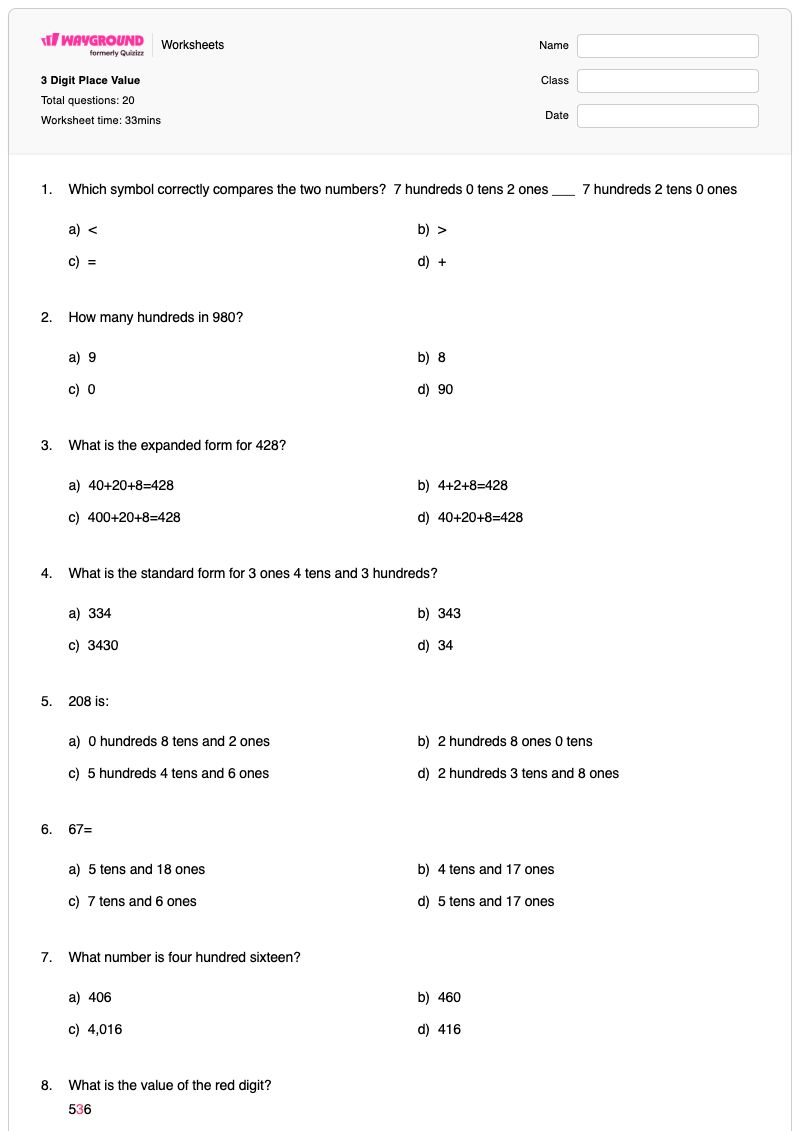
This free printable 3 Digit Place Value worksheet helps Grade 2–3 students represent, read, compare, and decompose three-digit numbers. Across 20 multiple-choice questions, students identify the number of hundreds, tens, and ones; write numbers in standard and expanded form; determine a digit’s place value; interpret base-ten blocks; and compare numbers using greater-than and less-than symbols.
The questions also include regrouped place-value representations, such as expressing 67 as 5 tens and 17 ones or interpreting 3 hundreds, 16 tens, and 4 ones. These items help students connect concrete models, verbal descriptions, expanded notation, and numerals while checking their understanding through selected-response practice. Designed for classroom practice, review, or assessment, this worksheet is available as a free printable PDF and includes a complete answer key for efficient checking.
Worksheet settings
Font size
S
M
L
XL
Worksheets
3 Digit Place Value
Total questions: 20
Name
Class
Date
1.
Which symbol correctly compares the two numbers? 7 hundreds 0 tens 2 ones ___ 7 hundreds 2 tens 0 ones
a)
<
b)
>
c)
=
d)
+
2.
How many hundreds in 980?
a)
9
b)
8
c)
0
d)
90
3.
What is the expanded form for 428?
a)
40+20+8=428
b)
4+2+8=428
c)
400+20+8=428
d)
40+20+8=428
4.
What is the standard form for 3 ones 4 tens and 3 hundreds?
a)
334
b)
343
c)
3430
d)
34
5.
208 is:
a)
0 hundreds 8 tens and 2 ones
b)
2 hundreds 8 ones 0 tens
c)
5 hundreds 4 tens and 6 ones
d)
2 hundreds 3 tens and 8 ones
6.
67=
a)
5 tens and 18 ones
b)
4 tens and 17 ones
c)
7 tens and 6 ones
d)
5 tens and 17 ones
7.
What number is four hundred sixteen?
a)
406
b)
460
c)
4,016
d)
416
8.
What is the value of the red digit? 536
a)
500
b)
30
c)
6
d)
300
9.
What is the following number? 3 hundreds 16 tens 4 ones
a)
364
b)
3164
c)
464
d)
434
10.
300 + 20 + 9=
a)
239
b)
329
c)
920
d)
932
11.
What is the value of the blue digit? 321
a)
300
b)
30
c)
3
12.
What is the value of these base ten blocks?
a)
330
b)
3330
c)
333
d)
331
13.
What number is shown by the base 10 blocks?
a)
434
b)
332
c)
334
d)
344
14.
What number is shown with these base ten pieces?
a)
520
b)
105
c)
150
d)
120
15.
468 684
a)
>
b)
<
16.
301 256
a)
<
b)
>
17.
a)
513, 805, 315
b)
513, 315, 805
c)
315, 513, 805
18.
a)
671, 371, 770
b)
770, 671, 371
c)
770, 371, 671
19.
a)
486, 468, 428
b)
428, 486, 468
c)
428, 468, 486
20.
a)
181, 108, 346
b)
346, 181, 108
c)
346, 108, 181
Answer Key
3 Digit Place Value
Total questions: 20
1.
a) <
2.
a) 9
3.
c) 400+20+8=428
4.
b)
343
5.
b)
2 hundreds 8 ones 0 tens
6.
d) 5 tens and 17 ones
7.
d) 416
8.
b) 30
9.
c) 464
10.
b)
329
11.
a) 300
12.
c) 333
13.
d) 344
14.
c) 150
15.
b) <
16.
b) >
17.
c)
315, 513, 805
18.
b)
770, 671, 371
19.
c)
428, 468, 486
20.
b)
346, 181, 108
140 %
Browse by subjects
Browse by grades
Browse by format
FAQs
What does this 3 Digit Place Value worksheet cover?
This Grade 2–3 mathematics worksheet uses 20 multiple-choice questions to practise representing and comparing three-digit numbers. Students identify hundreds, tens, and ones; convert between standard and expanded form; find the value of a digit; read base-ten blocks; and interpret regrouped forms such as 3 hundreds, 16 tens, and 4 ones.
How can I use this worksheet to teach three-digit place value?
Introduce the worksheet by modeling one number with a place-value chart or base-ten blocks, then connect the model to its standard and expanded forms. Have students explain how they know which comparison symbol belongs between two numbers and discuss why a representation such as 5 tens and 17 ones can still equal 67. Use the multiple-choice options as prompts for students to identify and correct place-value reasoning errors.
What mistakes should I watch for when students complete this place-value worksheet?
Watch for students who read a digit by its face value instead of its position, such as choosing 3 instead of 30 for the tens digit in 536 or 300 for a digit in the ones place. Students may also confuse the order of hundreds, tens, and ones when converting verbal descriptions to numerals, or overlook regrouping in forms such as 3 hundreds, 16 tens, and 4 ones. When comparing numbers, check that they compare the highest place first rather than focusing on a lower digit.
How do I assign and grade this 3 Digit Place Value worksheet?
You can assign this worksheet as a printable PDF or as a digital quiz on Wayground. It includes a complete answer key, and printable submissions can be graded by scanning student work with the Wayground for Teachers app. The printable format also gives schools an option for reducing screen time while students practise place-value representations.
How can I differentiate this three-digit place-value worksheet for my students?
Use the worksheet’s Advanced Settings to adjust font spacing or increase the font size so the number forms, comparison symbols, and base-ten block questions are easier to read. You can also enable a dyslexia-friendly font or translate the worksheet into another language. These options can make the multiple-choice place-value items more accessible without changing the skills being assessed.
Where can I find more worksheets like this on Wayground?
Wayground offers a comprehensive collection of free printable worksheets and practice problems across subjects, with downloadable PDFs and answer keys to support mastery of essential skills and concepts. Browse more resources at https://wayground.com/en-us/worksheets.

 Worksheets


