This Grade 2 mathematics worksheet helps students represent and interpret three-digit numbers using place value. Across 10 multiple-choice questions, students identify the value of a digit in the hundreds, tens, or ones place; write numbers in expanded and word form; build numbers from place-value parts; and read a number represented by base-ten blocks. Items include numbers such as 382, 528, 673, and 702, giving students practice with both standard and equivalent representations.
Use this free printable worksheet to check whether students can connect concrete models, number names, expanded notation, and standard form. The questions also reinforce the importance of zero as a placeholder, as in “seven hundred two,” and require students to combine hundreds, tens, and ones in the correct place-value order. It includes a complete answer key for efficient review, independent practice, homework, or a quick formative assessment.
Worksheet settings
Font size
S
M
L
XL
Worksheets
Place Value - 3 Digit Numbers
Total questions: 10
Name
Class
Date
1.
What is the value of the 8 in 382?
a)
8
b)
800
c)
80
d)
82
2.
What is the expanded form for the number 528?
a)
528
b)
five hundred twenty- eight
c)
5+ 2 + 8
d)
500 + 20 + 8
3.
What is 4 hundreds + 3 tens + 5 ones?
a)
400
b)
435
c)
4305
d)
354
4.
What is 673 in word form?
a)
six hundred seventy
b)
six hundred and seventy- three
c)
six hundred seventy- three
d)
six seven three
5.
What is the value of the 6 in 649?
a)
600
b)
6
c)
60
d)
64
6.
What is 473 in expanded form?
a)
4 + 7 + 3
b)
400 + 7 + 3
c)
400 + 70 + 3
d)
four hundred seventy - three
7.
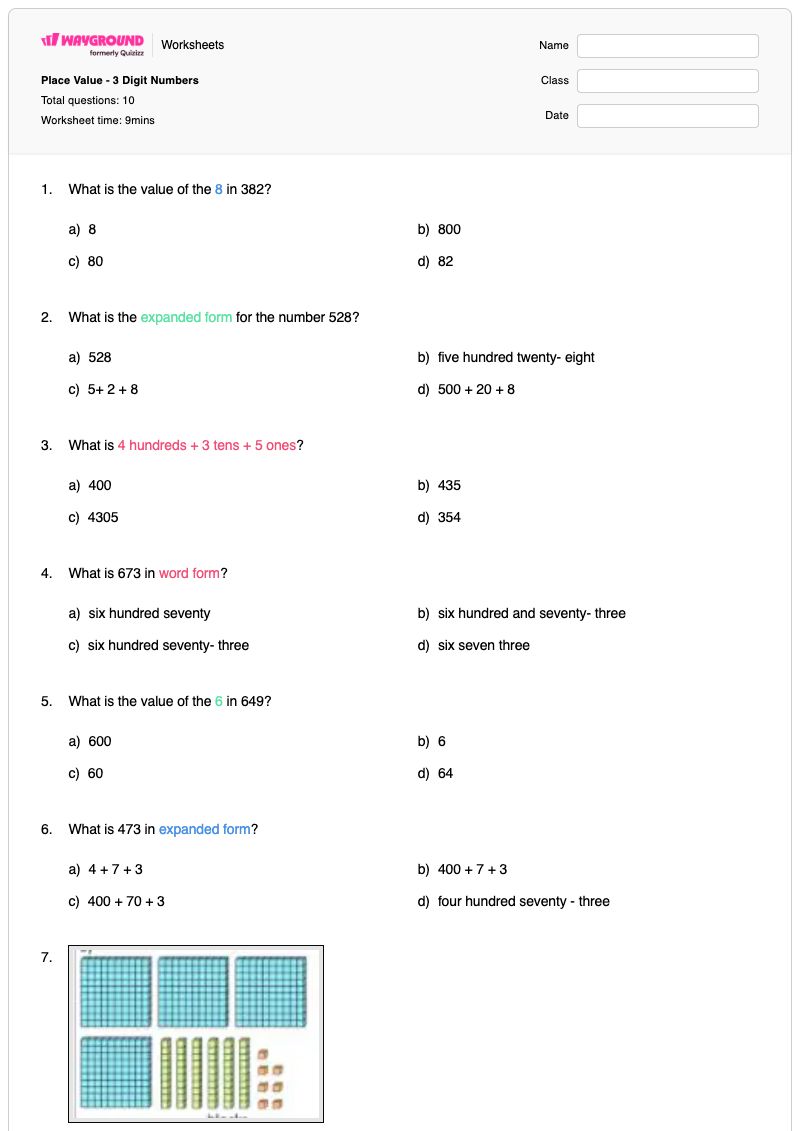
What is the value of the base ten blocks shown?
a)
413
b)
467
c)
17
d)
457
8.
What is seven hundred two in number form?
a)
700
b)
720
c)
712
d)
702
9.
What is 531 in word form?
a)
500 + 30 + 1
b)
five hundred
c)
five hundred thirty - one
d)
five hundred and thirty - one
10.
How much is 3 tens + 7 ones + 2 hundreds?
a)
372
b)
237
c)
3072
d)
37
Answer Key
Place Value - 3 Digit Numbers
Total questions: 10
1.
c)
80
2.
d)
500 + 20 + 8
3.
b)
435
4.
c)
six hundred seventy- three
5.
a)
600
6.
c)
400 + 70 + 3
7.
b)
467
8.
d)
702
9.
c)
five hundred thirty - one
10.
b)
237
140 %
Browse by subjects
Browse by grades
Browse by format
FAQs
What does the Place Value - 3 Digit Numbers worksheet cover?
This Grade 2 worksheet uses 10 multiple-choice questions to assess how students interpret three-digit numbers by place value. Students find the value of a digit, convert between standard, expanded, and word forms, and determine a number from hundreds, tens, ones, or a base-ten block representation. Completing these items builds connections among the different ways a three-digit number can be represented.
How can I use this worksheet to teach three-digit place value?
Introduce hundreds, tens, and ones with base-ten blocks, then model how the same number can be written in standard, expanded, and word form. Work through one example from the worksheet, such as separating 528 into 500 + 20 + 8, and ask students to explain what each digit contributes. Students can then complete the multiple-choice items independently and justify why the selected representation matches the number.
What mistakes should I watch for when students complete this worksheet?
Watch for students choosing the digit itself instead of its place value, such as answering 6 rather than 600 for the 6 in 649. Students may also write expanded form as 5 + 2 + 8 instead of 500 + 20 + 8, or confuse the order of hundreds, tens, and ones when combining parts. In word-form items, check that students distinguish a number such as 702 from 700 or 720 and recognize that the zero represents no tens.
How do I assign and grade this place-value worksheet?
On Wayground, you can assign this worksheet as a printable PDF or as a digital quiz, and it includes a complete answer key for all 10 multiple-choice questions. For printable submissions, scan student work with the Wayground for Teachers app to grade it efficiently. The printable format also offers an option for schools working to reduce screen time.
How can I differentiate this three-digit place-value worksheet for my students?
In the worksheet’s Advanced Settings, adjust font spacing or choose a larger font size to make the place-value questions and answer choices easier to read. You can also apply a dyslexia-friendly font or translate the worksheet into another language while keeping the multiple-choice practice on expanded form, word form, and base-ten representations.
Where can I find more worksheets like this on Wayground?
Wayground offers a broad collection of free printable worksheets and practice problems across subjects, with downloadable PDFs and answer keys to support essential skills and concepts. Browse more resources at https://wayground.com/en-us/worksheets.

 Worksheets