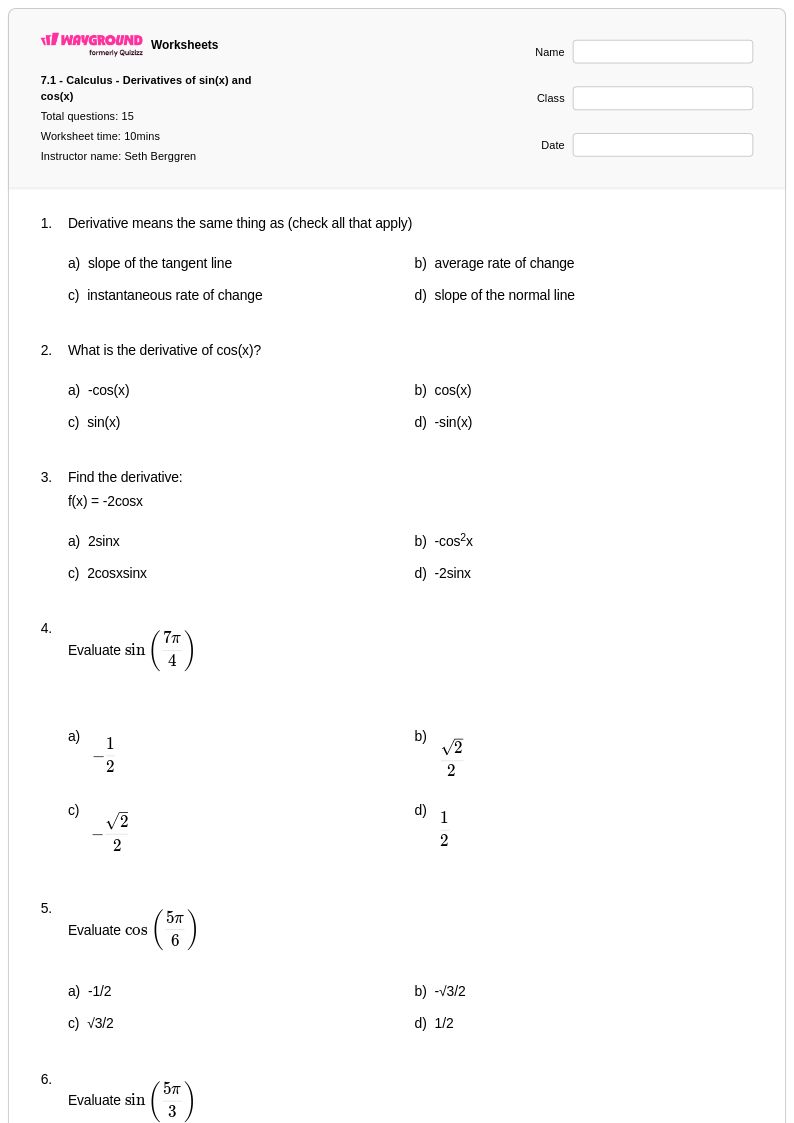
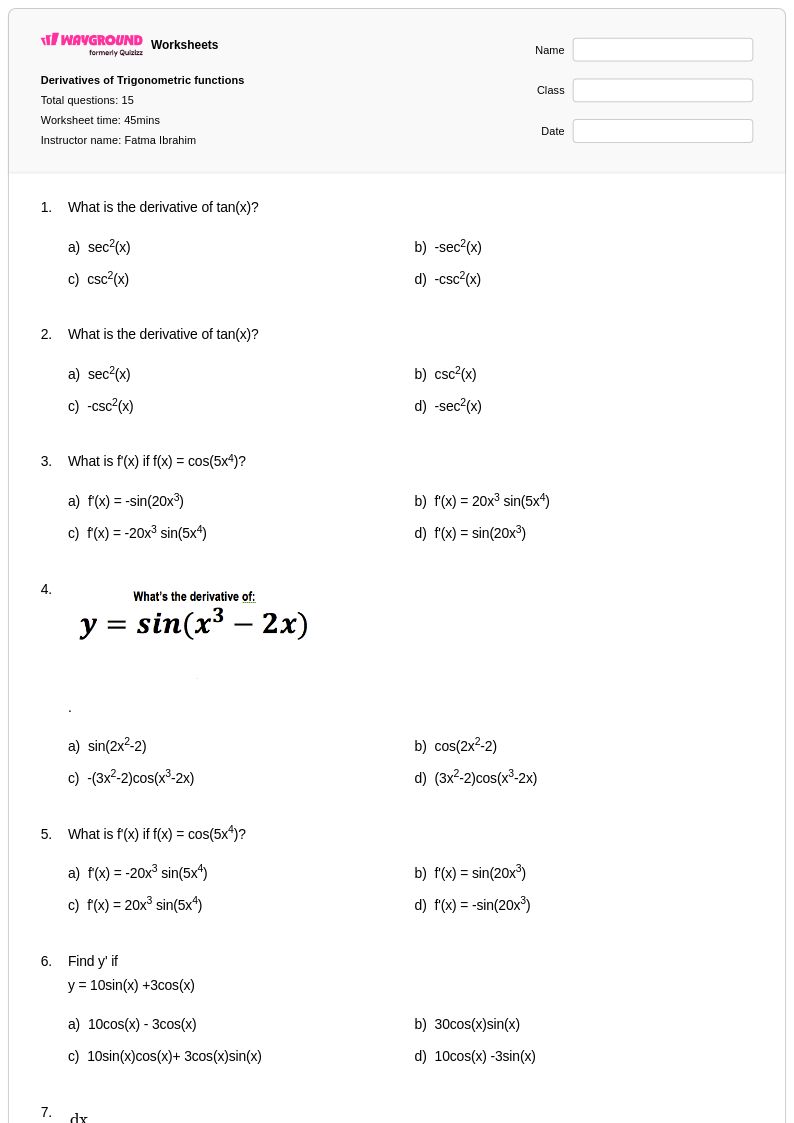
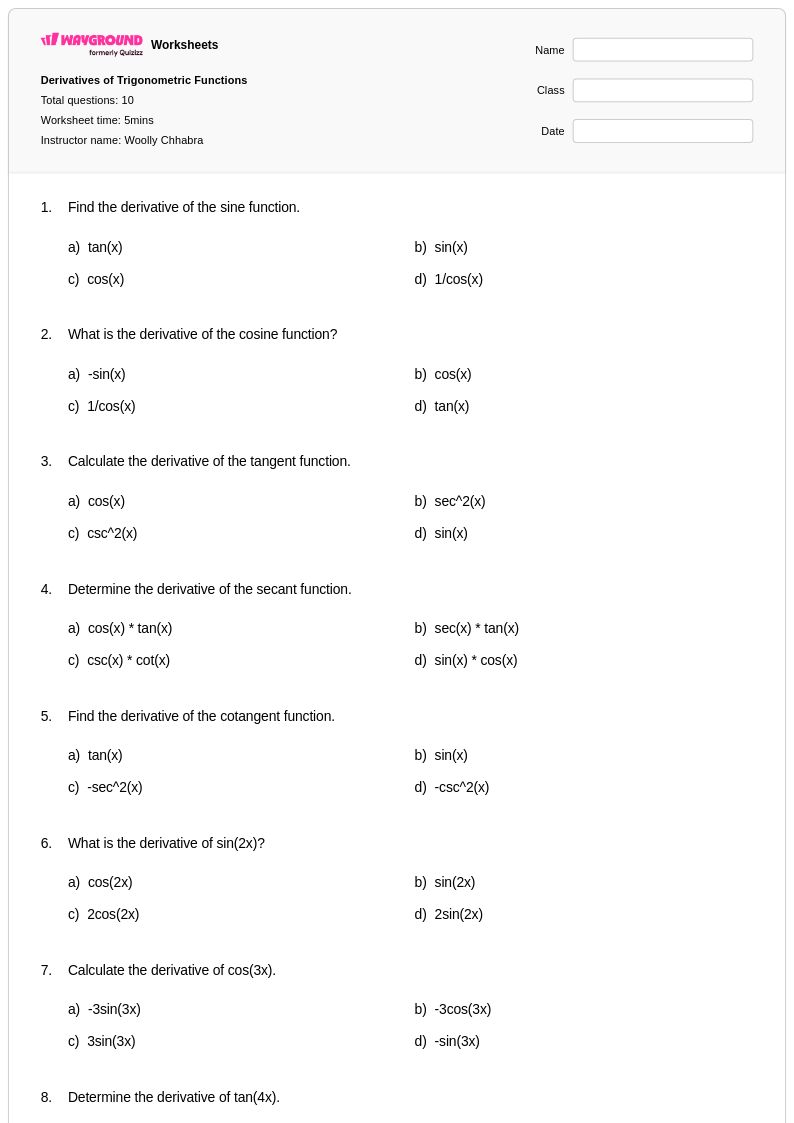
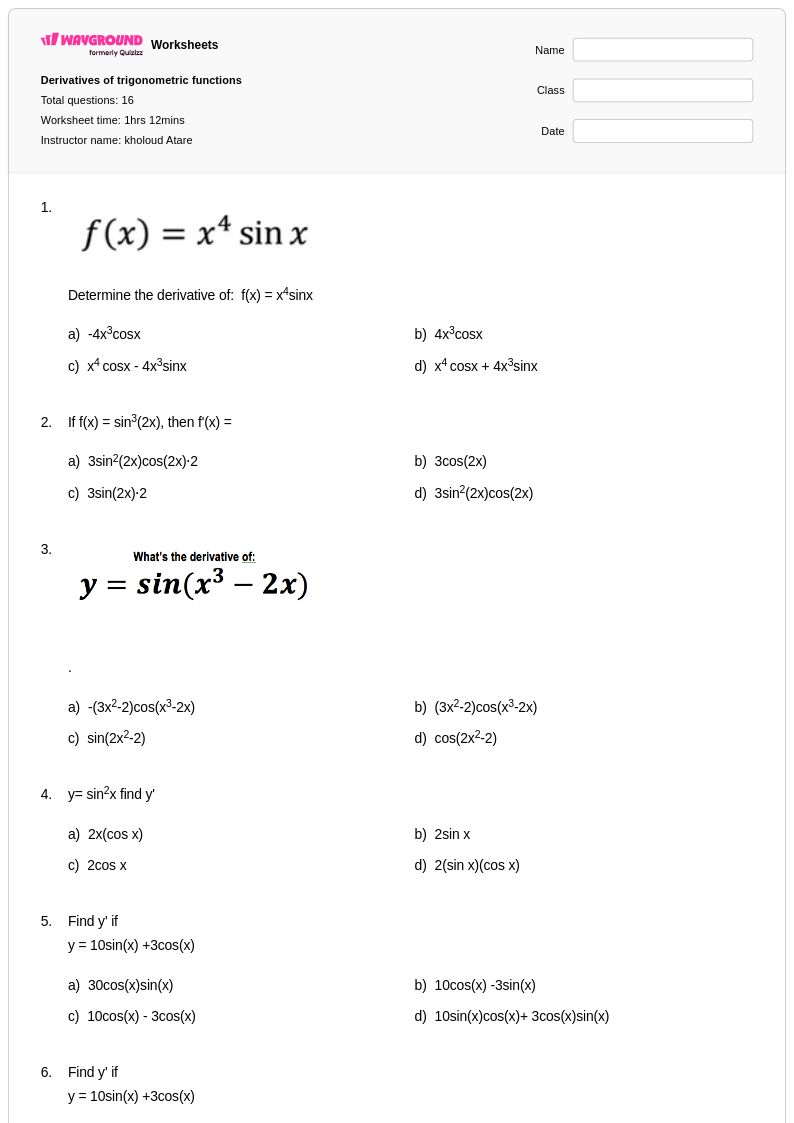
Free Printable Derivatives of Trigonometric Functions worksheets
Free printable worksheets and practice problems help students master derivatives of trigonometric functions through comprehensive PDF exercises with complete answer keys for effective calculus learning.
Explore printable Derivatives of Trigonometric Functions worksheets
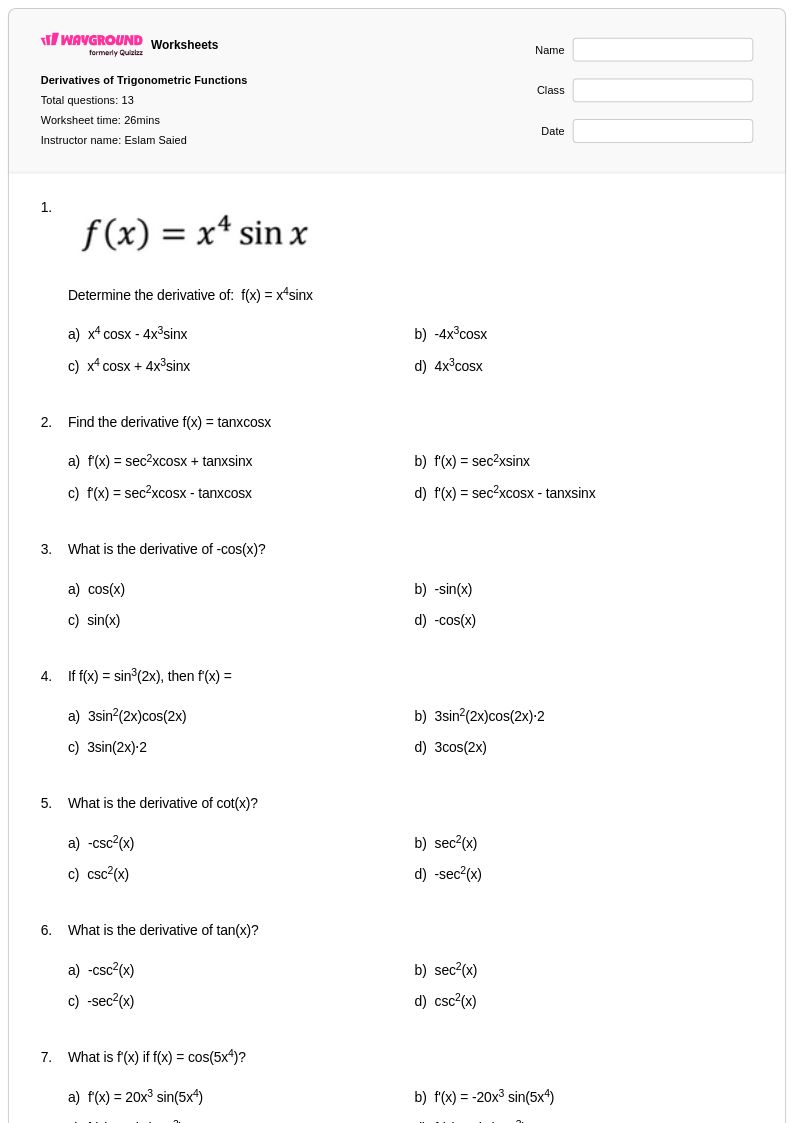
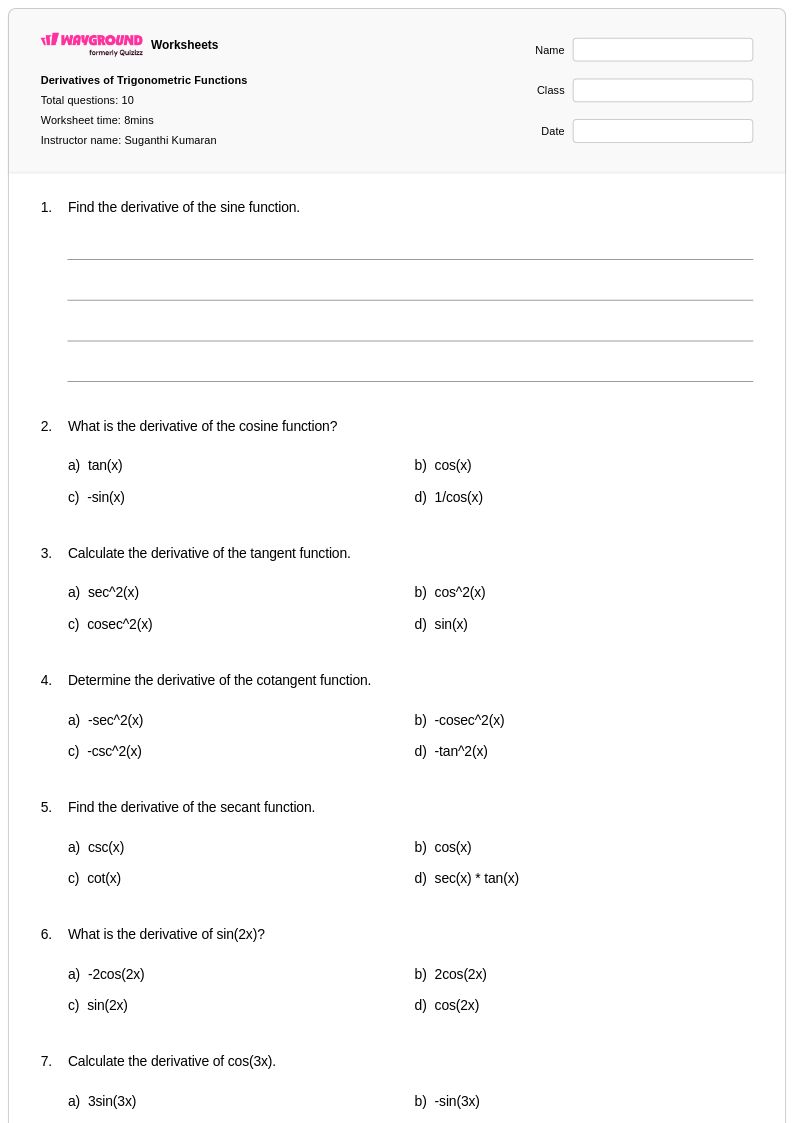
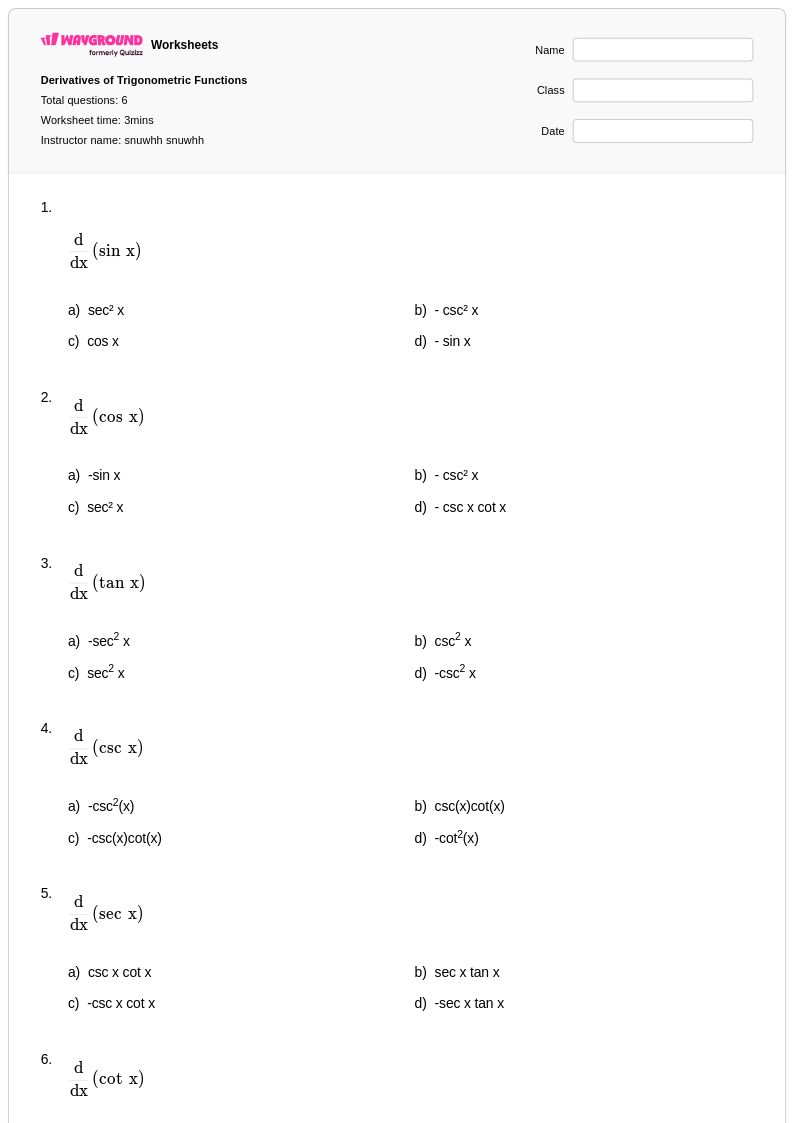
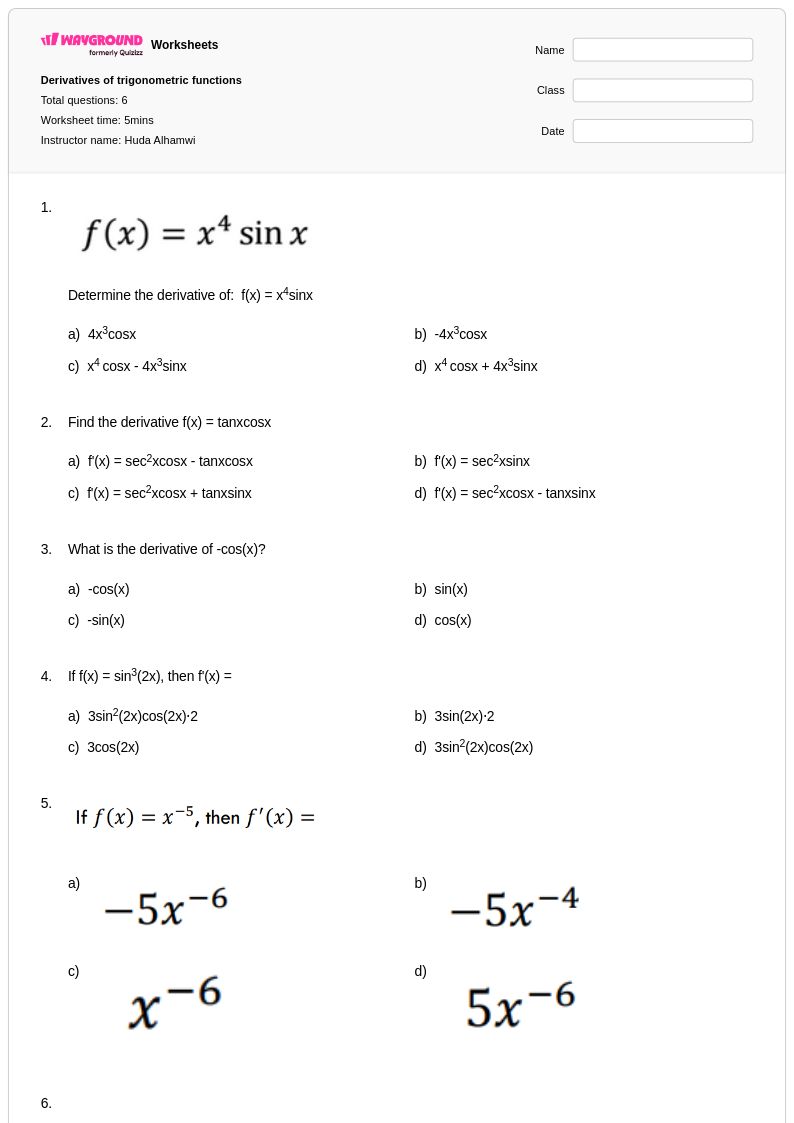
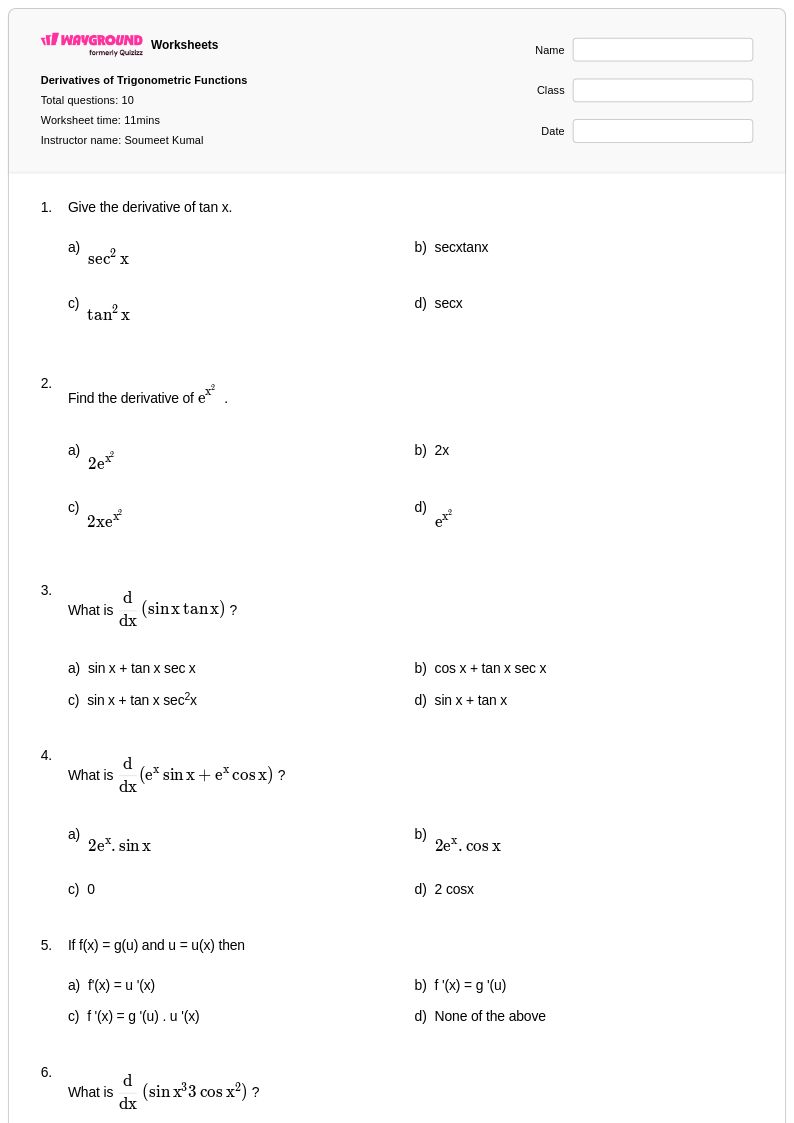
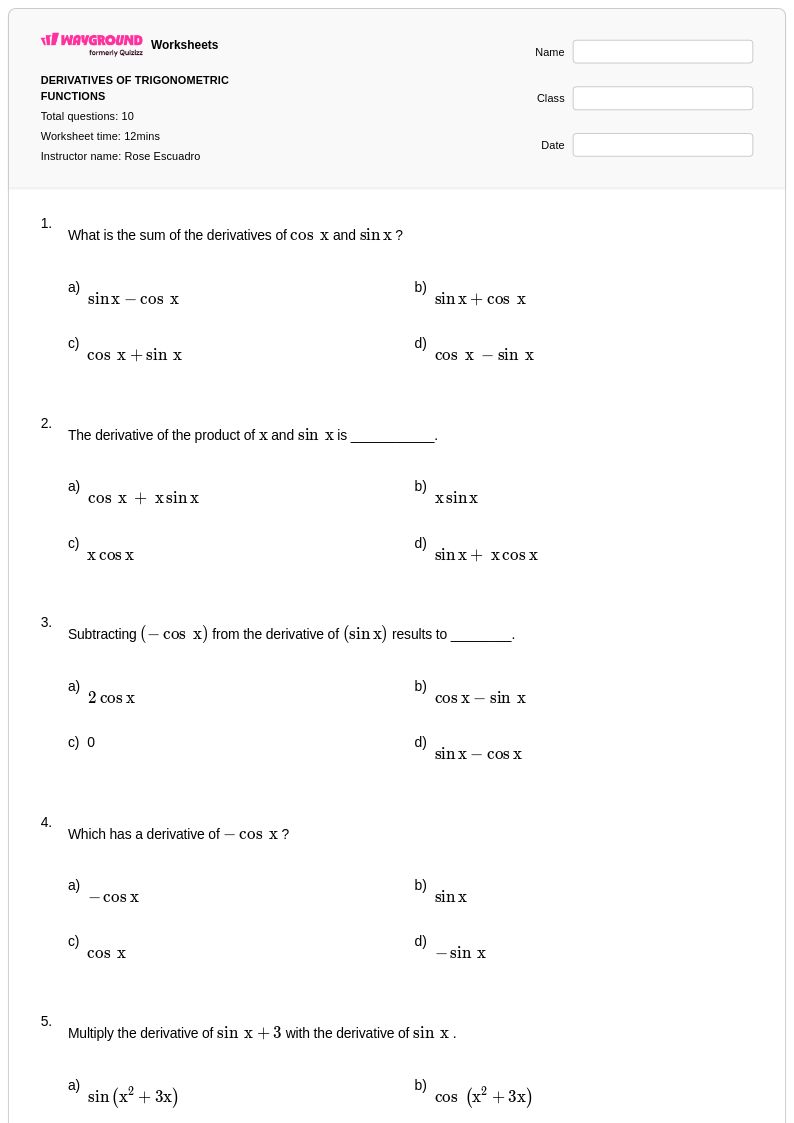
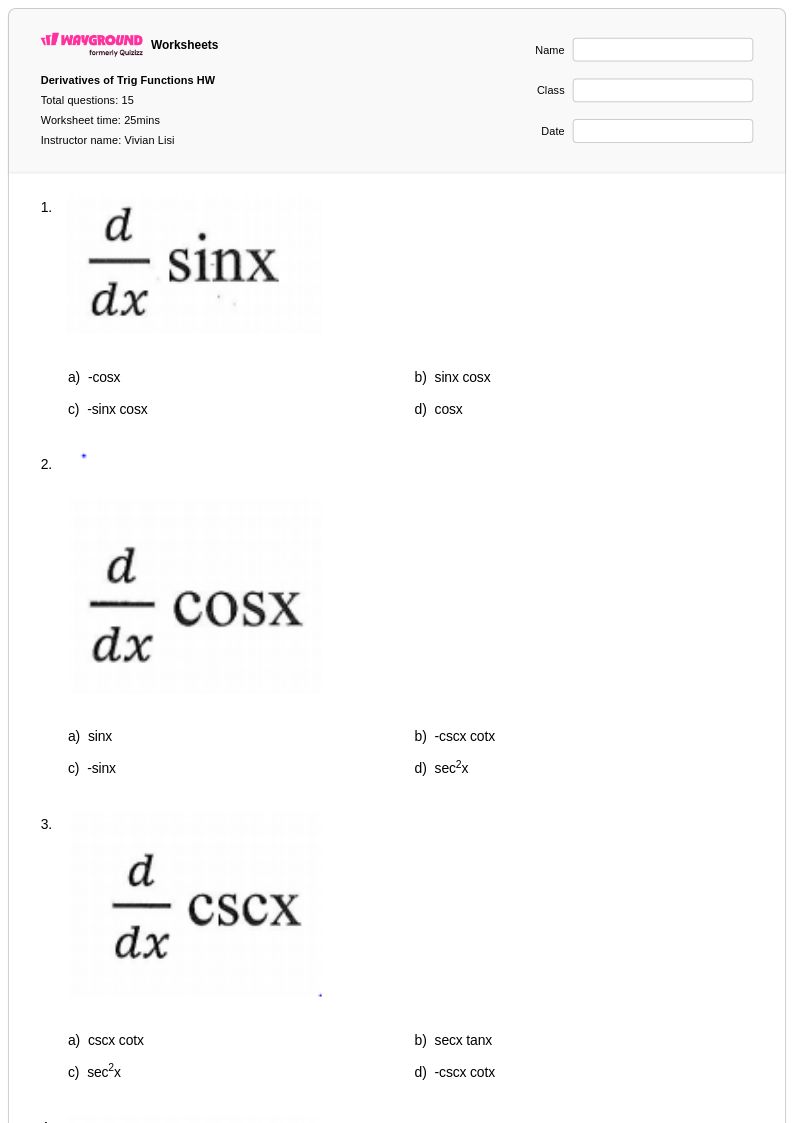
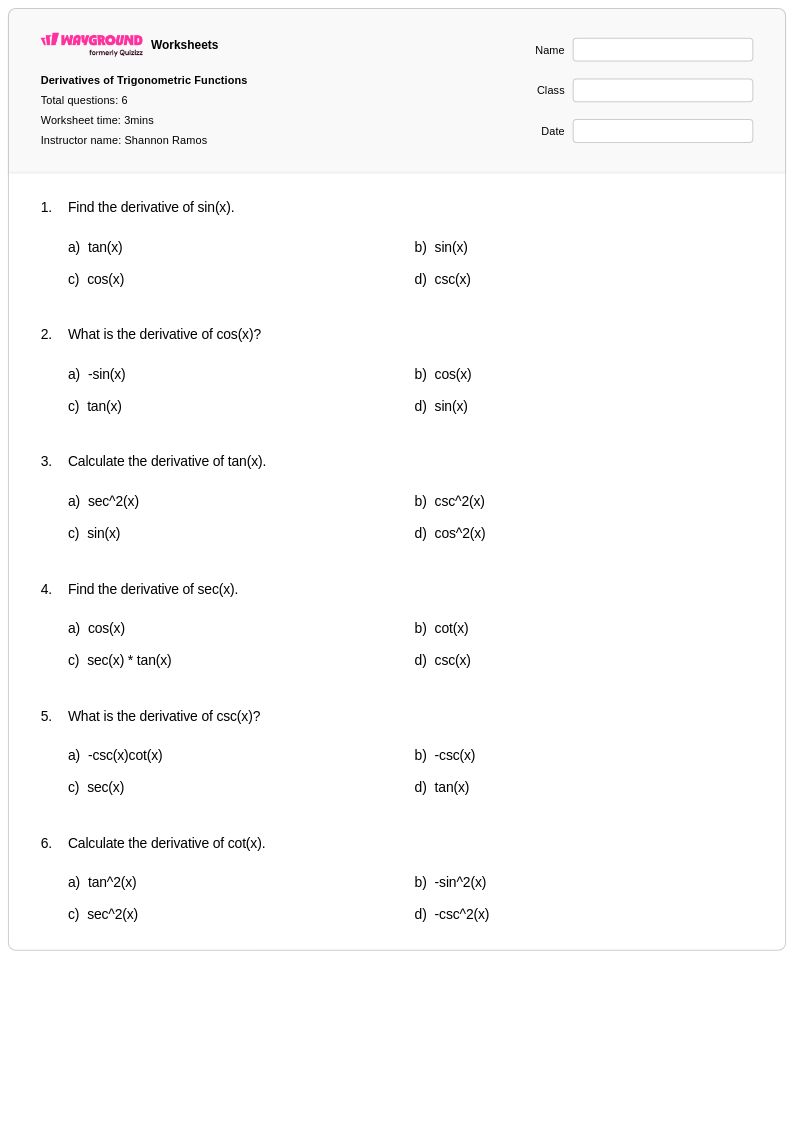
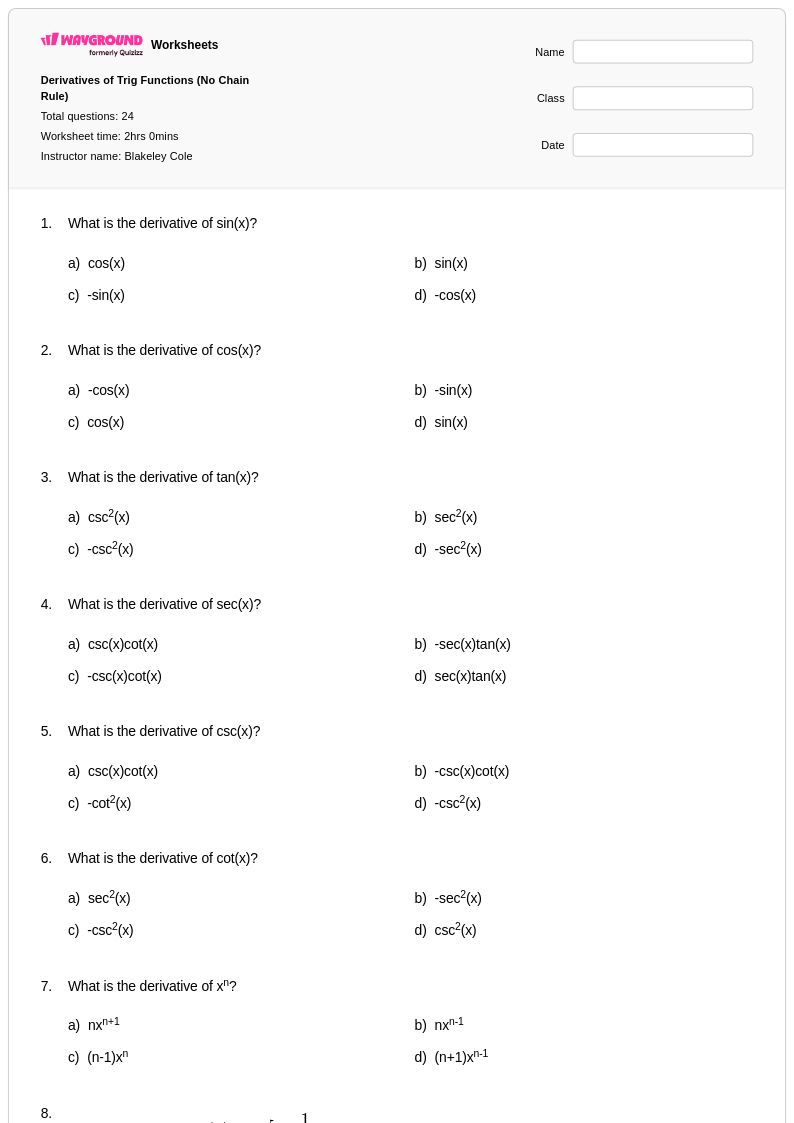
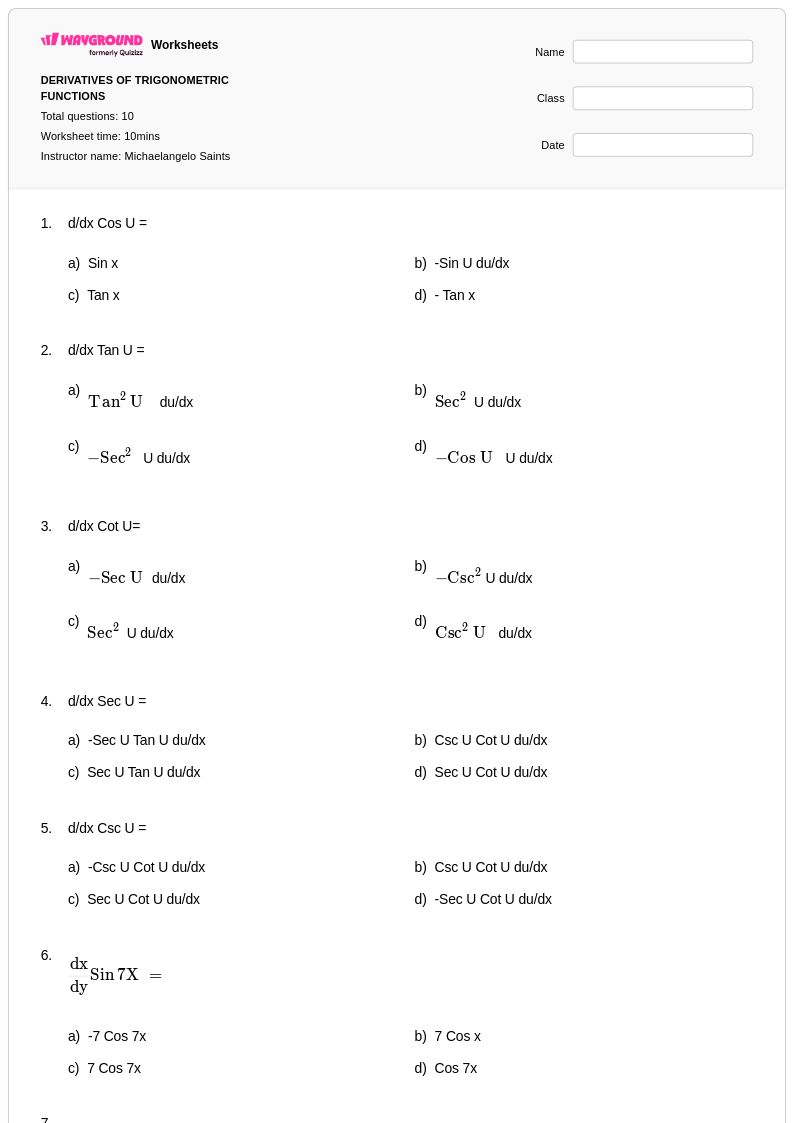
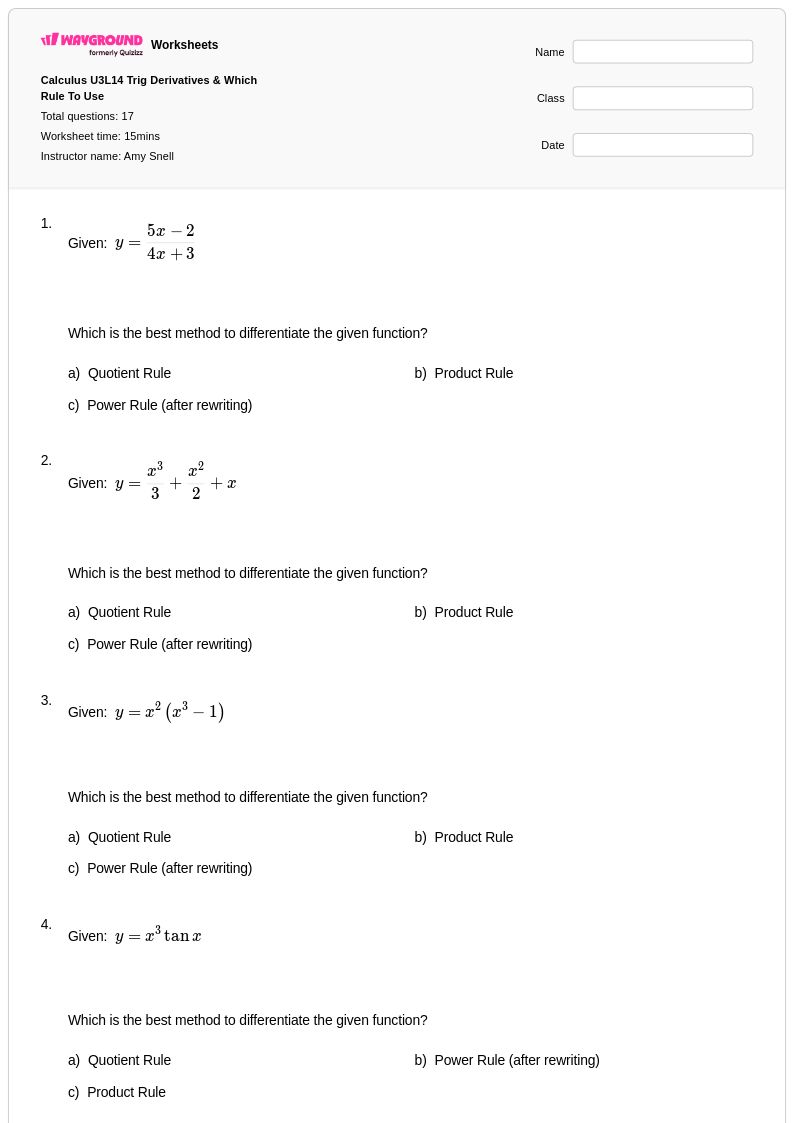
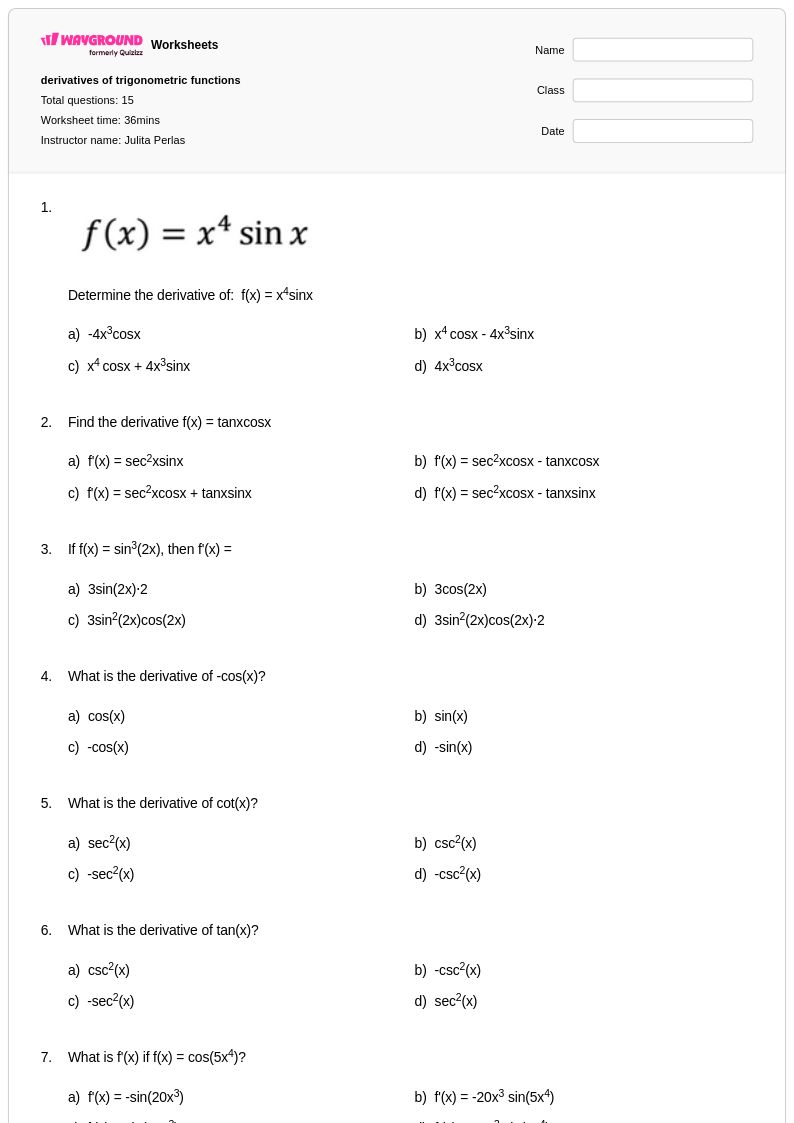
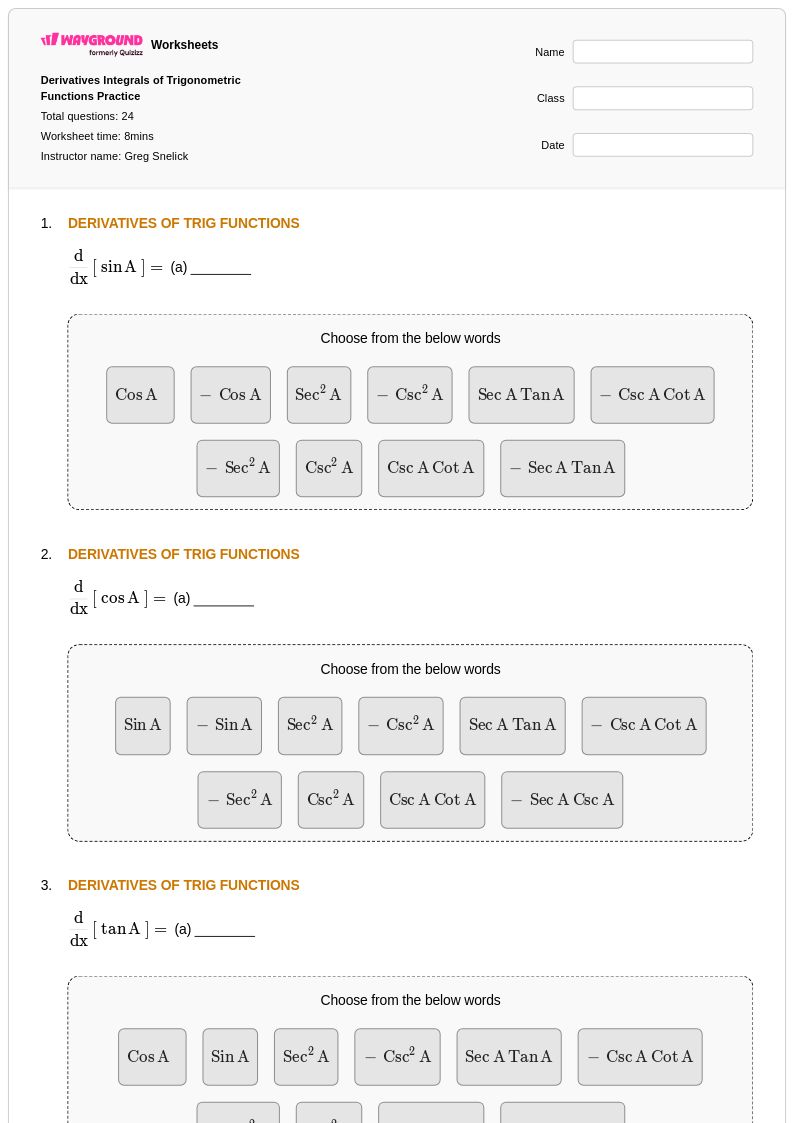
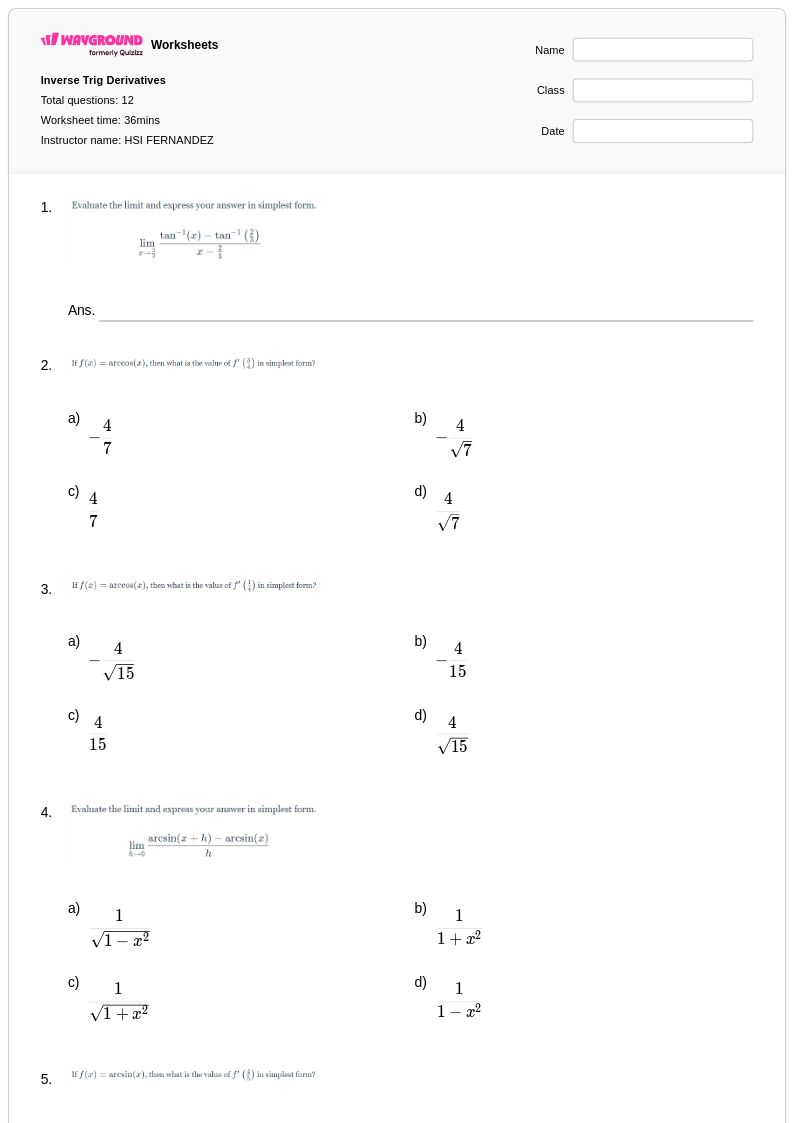
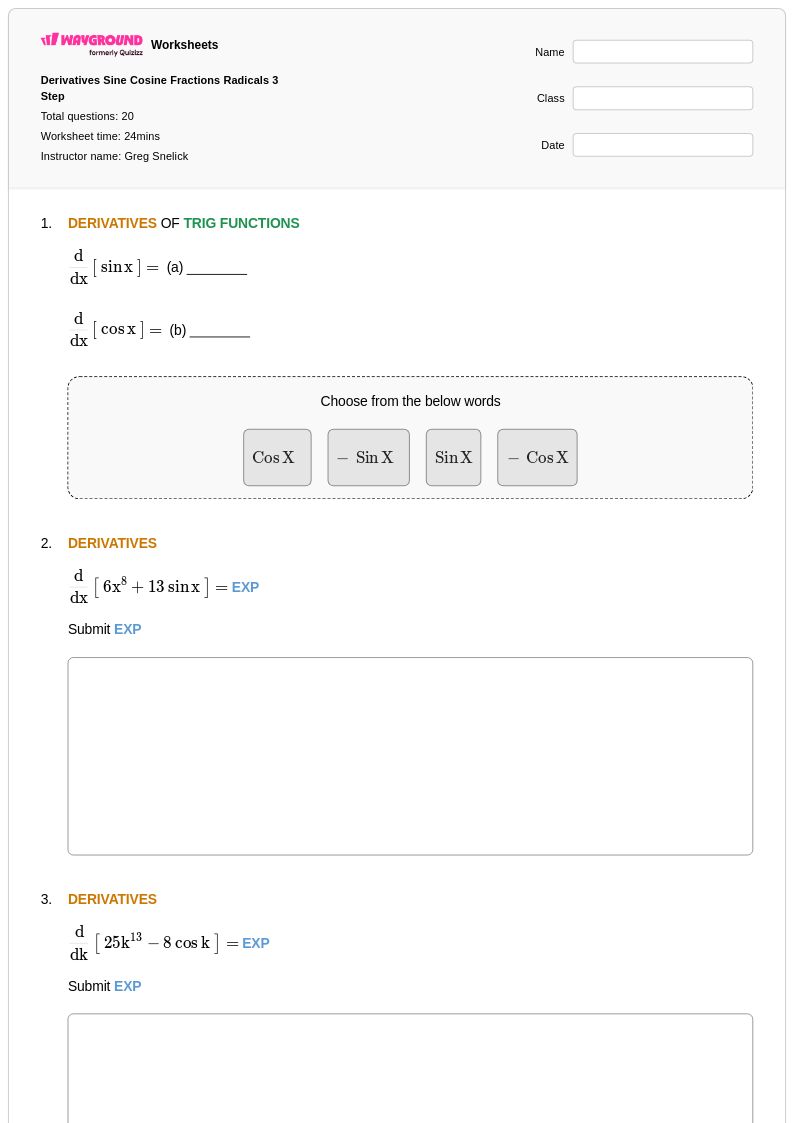
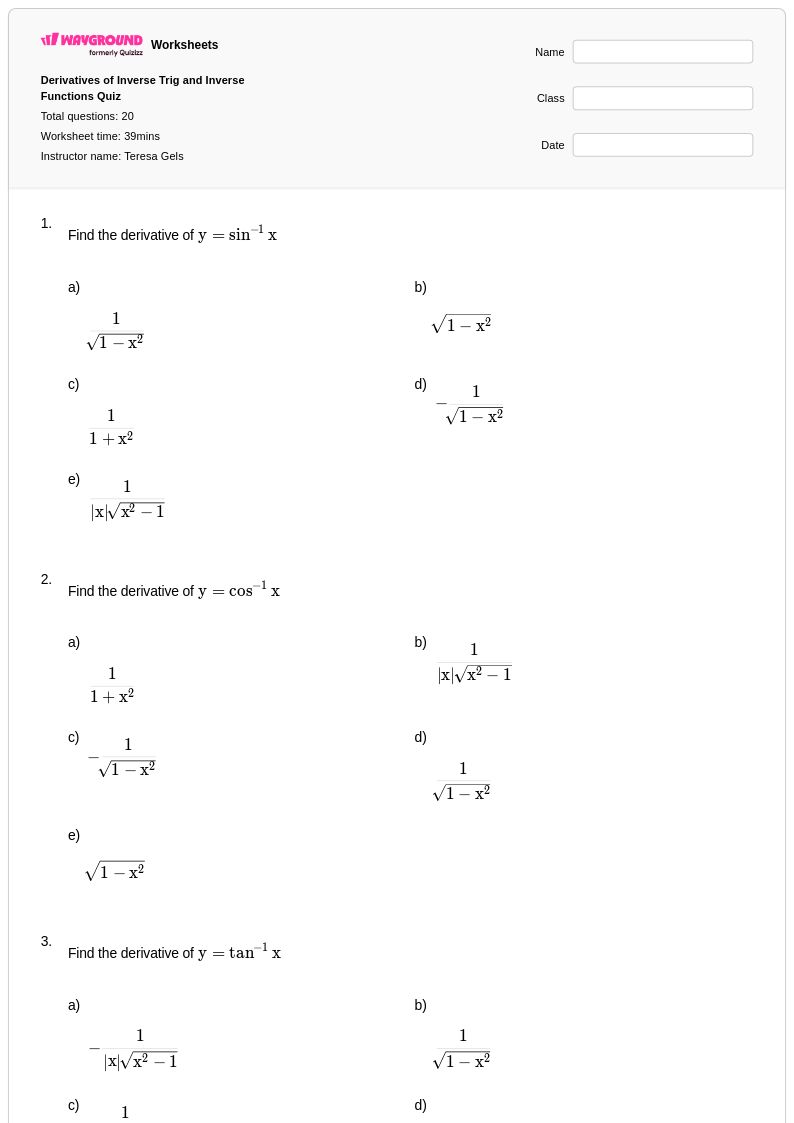
Derivatives of trigonometric functions worksheets available through Wayground (formerly Quizizz) provide comprehensive practice materials that help students master one of calculus's most essential skill sets. These expertly designed worksheets focus on developing proficiency with differentiating sine, cosine, tangent, and other trigonometric functions, including their inverse forms and composite applications. Students work through carefully scaffolded practice problems that progress from basic derivative rules for standard trig functions to more complex scenarios involving the chain rule, product rule, and quotient rule applications. Each worksheet collection includes detailed answer keys that guide students through step-by-step solutions, while the free printable pdf format ensures accessibility for both classroom instruction and independent study sessions.
Wayground (formerly Quizizz) empowers educators with millions of teacher-created resources specifically designed for derivatives of trigonometric functions instruction, featuring robust search and filtering capabilities that allow teachers to quickly locate materials aligned with their curriculum standards and student needs. The platform's sophisticated differentiation tools enable instructors to customize worksheet difficulty levels, modify problem sets for remediation or enrichment purposes, and adapt content to meet diverse learning requirements within their classrooms. Teachers can seamlessly transition between printable pdf formats for traditional paper-and-pencil work and digital versions for technology-integrated lessons, while the comprehensive customization options support flexible lesson planning approaches. These features collectively streamline the process of providing targeted skill practice, facilitating both immediate intervention for struggling students and advanced challenges for those ready to explore more sophisticated applications of trigonometric differentiation.
FAQs
How do I teach derivatives of trigonometric functions?
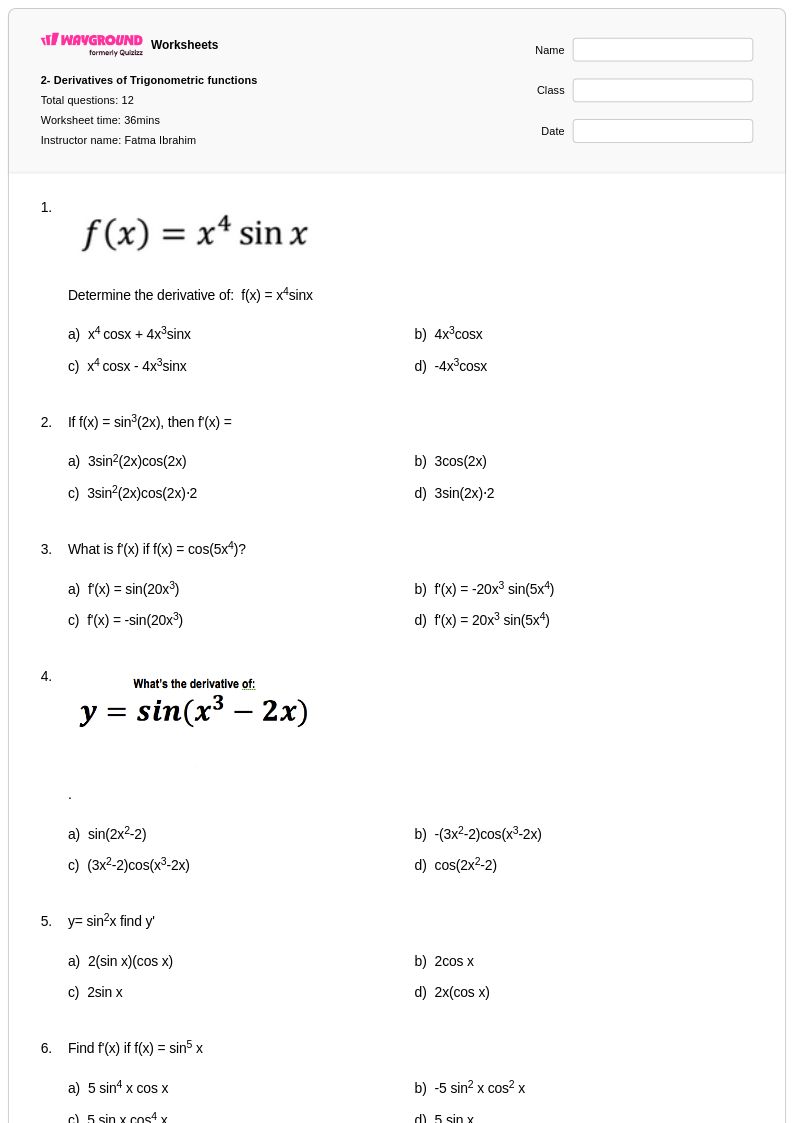
Start by making sure students have the six basic trig derivatives memorized, sin, cos, tan, csc, sec, cot, before layering on rules. A common and effective sequence: introduce the basic derivatives with pattern recognition, then apply the chain rule to composite trig expressions (e.g., sin(3x²)), then move to product and quotient rule problems that mix trig with polynomial or exponential terms. Connecting each derivative back to the unit circle or a graph of the original function helps students see why the rule works, not just how to apply it.
What exercises help students practice differentiating trig functions?
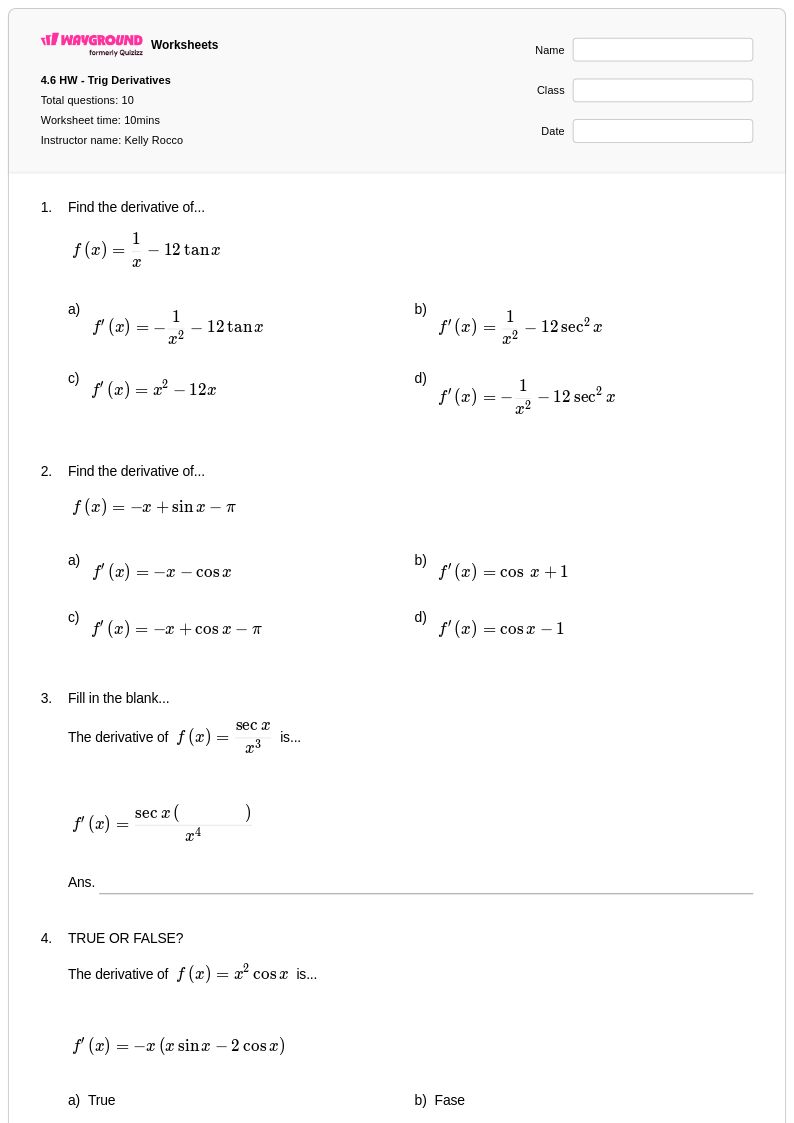
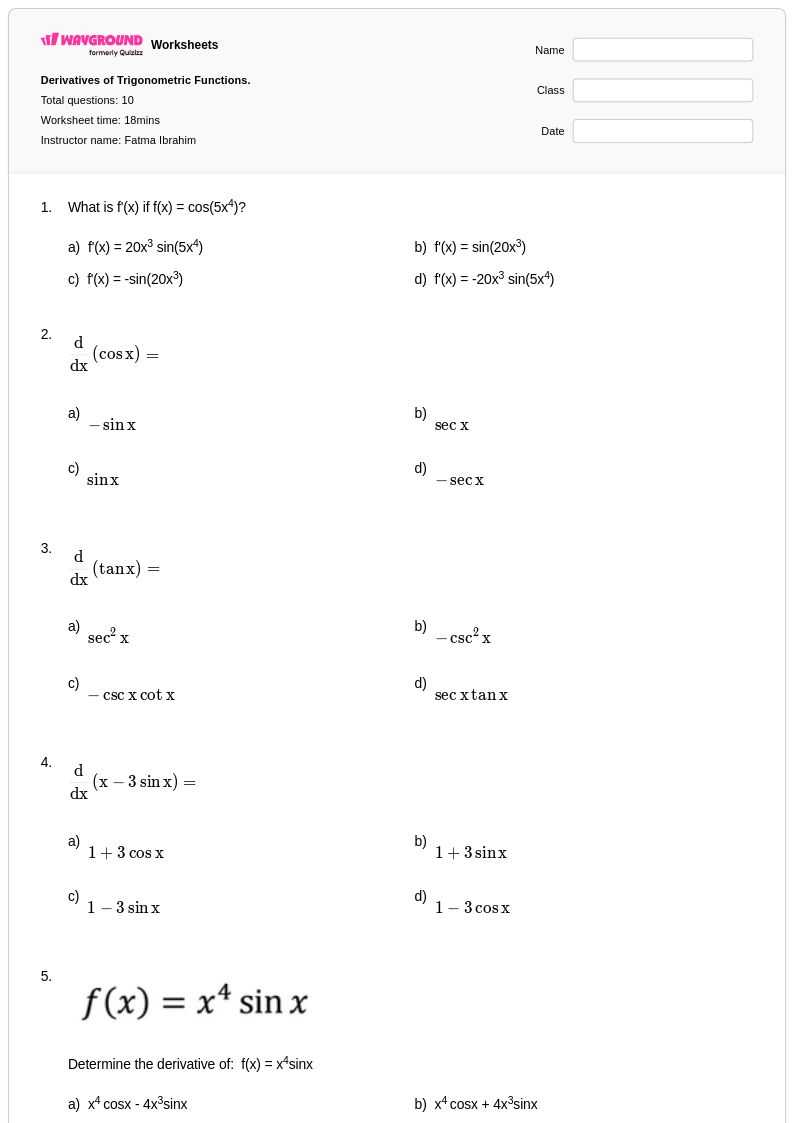
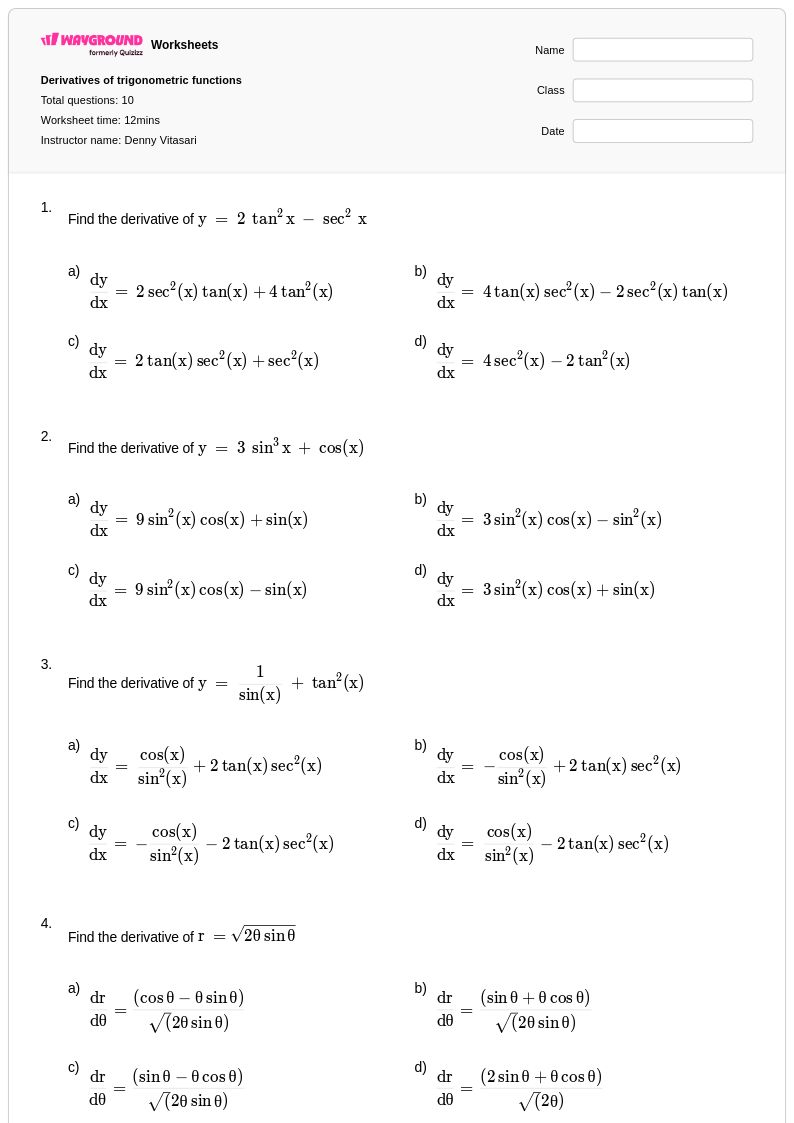
The most productive practice moves through three levels: straight differentiation of standard forms (d/dx[sin x], d/dx[tan x]), chain rule applications with composite trig expressions, and mixed problems requiring product or quotient rules alongside trig derivatives. Worksheets that scaffold in this order let students build confidence before hitting the harder combinations. Including a few problems that require simplifying the result using trig identities is also worth adding once students are past the basics.
What mistakes do students commonly make with trig derivatives?
Three errors come up constantly. First, sign errors on cosine and the co-functions, students frequently write d/dx[cos x] = sin x instead of −sin x. Second, forgetting the chain rule multiplier when differentiating a composite like sin(5x), writing cos(5x) instead of 5cos(5x). Third, confusing the derivatives of the reciprocal functions (sec, csc, cot) because they're less practiced and the patterns are less intuitive. Targeted drill on these specific cases, not just general mixed practice, is the fastest way to close those gaps.
How do I use Wayground's trig derivatives worksheets in my class?
Each worksheet comes with a complete answer key, so students can self-check after independent practice or you can use it to speed up grading. For in-class work, the printable PDF is straightforward to hand out; if you're grading paper submissions, the Wayground for Teachers app lets you scan or capture student work directly for faster turnaround. If your class is working digitally, you can host the same worksheet as an interactive quiz on Wayground and students get immediate feedback as they go.
Is derivatives of trig functions aligned to Common Core or AP Calculus standards?
Trig derivatives fall outside the K–12 Common Core Math standards, which cap at pre-calculus concepts. In practice, this topic is taught in AP Calculus AB and BC courses, where the College Board expects students to know the derivatives of all six trig functions and apply them fluently with the chain, product, and quotient rules. Mastery here is a prerequisite for later AP topics including related rates, optimization, and integration by substitution involving trig expressions.
How can I differentiate trig derivatives practice for mixed-ability students?
For students who are still shaky on the basic derivative rules, Wayground's reduced answer choices accommodation lowers the cognitive load so they can focus on the differentiation process rather than getting lost in answer selection. For students with reading difficulties or processing differences, the dyslexia-friendly font and adjustable font size options make dense notation easier to parse. Students who need more time working through multi-step chain rule problems can be assigned extended time individually without affecting the rest of the class.
What grade level covers derivatives of trigonometric functions?
This topic is typically taught in grades 11–12, within a pre-calculus or calculus course. Most students encounter basic trig derivatives in an introductory calculus class (often AP Calculus AB) in 11th or 12th grade, with inverse trig derivatives and more complex applications appearing in AP Calculus BC or a second-semester calculus course.