Master descriptive essay writing with Wayground's comprehensive collection of free worksheets and printables that help students develop vivid storytelling skills through structured practice problems and detailed answer keys.
Descriptive essay worksheets available through Wayground (formerly Quizizz) provide comprehensive resources designed to develop students' ability to create vivid, detailed written compositions that paint clear pictures with words. These carefully crafted materials focus on essential descriptive writing skills including sensory language integration, spatial organization techniques, figurative language application, and precise vocabulary selection. Students engage with practice problems that guide them through the process of transforming ordinary observations into compelling descriptive passages, while teachers benefit from included answer keys that facilitate efficient assessment and feedback. The collection encompasses both printable pdf formats and interactive digital versions, offering free access to systematic skill-building exercises that progress from basic sensory detail identification to complex multi-paragraph descriptive compositions.
Wayground's extensive platform supports educators with millions of teacher-created descriptive essay resources that streamline lesson planning and differentiated instruction. The robust search and filtering capabilities allow teachers to locate materials perfectly aligned with specific curriculum standards and student proficiency levels, while built-in customization tools enable seamless adaptation of worksheets to meet diverse classroom needs. These comprehensive collections support targeted remediation for struggling writers, enrichment opportunities for advanced students, and consistent skill practice across all ability levels. The platform's flexible delivery options, including both digital interactive formats and traditional printable worksheets, ensure teachers can effectively integrate descriptive writing instruction into any learning environment while maintaining focus on developing students' capacity to create engaging, sensory-rich written work.
FAQs
How do I teach descriptive essay writing to students who struggle to move beyond surface-level descriptions?
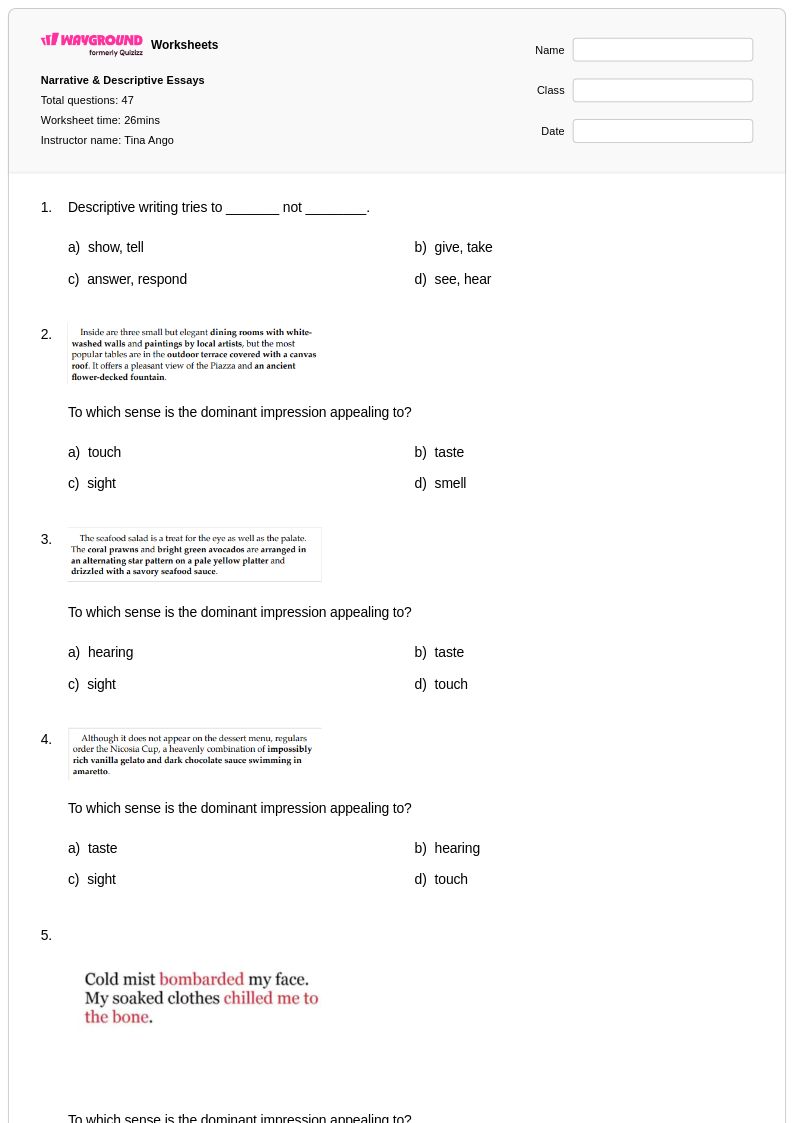
The most effective approach is to anchor instruction in the five senses. Ask students to describe a single object or scene using sight, sound, smell, taste, and touch before attempting a full essay. From there, introduce spatial organization so students learn to move through a scene logically rather than listing random details. Practice with mentor texts that model how professional writers transform ordinary observations into vivid passages helps students internalize the standard they are working toward.
What exercises help students practice descriptive writing skills?
Targeted exercises that isolate specific sub-skills are most effective for building descriptive writing ability. Sensory detail identification tasks train students to recognize and generate language tied to each of the five senses, while figurative language application exercises help them practice simile, metaphor, and personification in context. Vocabulary selection activities that ask students to replace vague words like 'nice' or 'big' with precise alternatives build the word-level precision that strong descriptive writing depends on. Structured practice problems that guide students from single-sentence observations to multi-paragraph compositions build these skills progressively.
What are the most common mistakes students make when writing descriptive essays?
The most frequent error is over-reliance on visual details at the expense of the other four senses, which produces flat, two-dimensional descriptions. Students also commonly use vague or generic adjectives instead of specific, precise vocabulary, writing 'the old house' rather than 'the sagging, paint-peeled Victorian with warped porch boards.' A third recurring issue is weak spatial organization, where details are listed randomly rather than guiding the reader through a scene in a coherent sequence. Addressing these three patterns explicitly in instruction and feedback produces measurable improvement.
How do I use descriptive essay worksheets effectively in my classroom?
Descriptive essay worksheets on Wayground are available as printable PDFs for traditional classroom use and in digital interactive formats for technology-integrated environments, making them flexible enough to assign as in-class practice, homework, or independent writing stations. Teachers can also host worksheets as a quiz directly on Wayground, which allows for streamlined collection and review of student responses. Using the included answer keys, teachers can provide specific, efficient feedback rather than spending time generating evaluation criteria from scratch. For classes with diverse learners, Wayground's accommodation tools, including read aloud and reduced answer choices, can be applied to individual students without disrupting the experience of the rest of the class.
How can I differentiate descriptive essay instruction for students at different writing levels?
For struggling writers, begin with structured exercises that isolate a single skill, such as identifying sensory language in a provided passage, before asking them to produce original writing. Advanced students benefit from enrichment tasks that require complex multi-paragraph compositions with sophisticated figurative language and intentional spatial structure. Wayground's platform supports this range directly, with search and filtering tools that help teachers locate materials matched to specific proficiency levels, and customization options that allow worksheets to be adapted for individual student needs without requiring separate lesson plans.
What is the difference between descriptive writing and narrative writing, and why does it matter for instruction?
Descriptive writing focuses on painting a detailed picture of a person, place, object, or experience using precise sensory and figurative language, while narrative writing centers on telling a story with plot, conflict, and resolution. The distinction matters because students who conflate the two often produce essays that summarize events rather than immerse the reader in a scene. Teaching descriptive writing as a distinct mode helps students understand that the goal is to make the reader see, hear, and feel the subject, not to explain what happened.