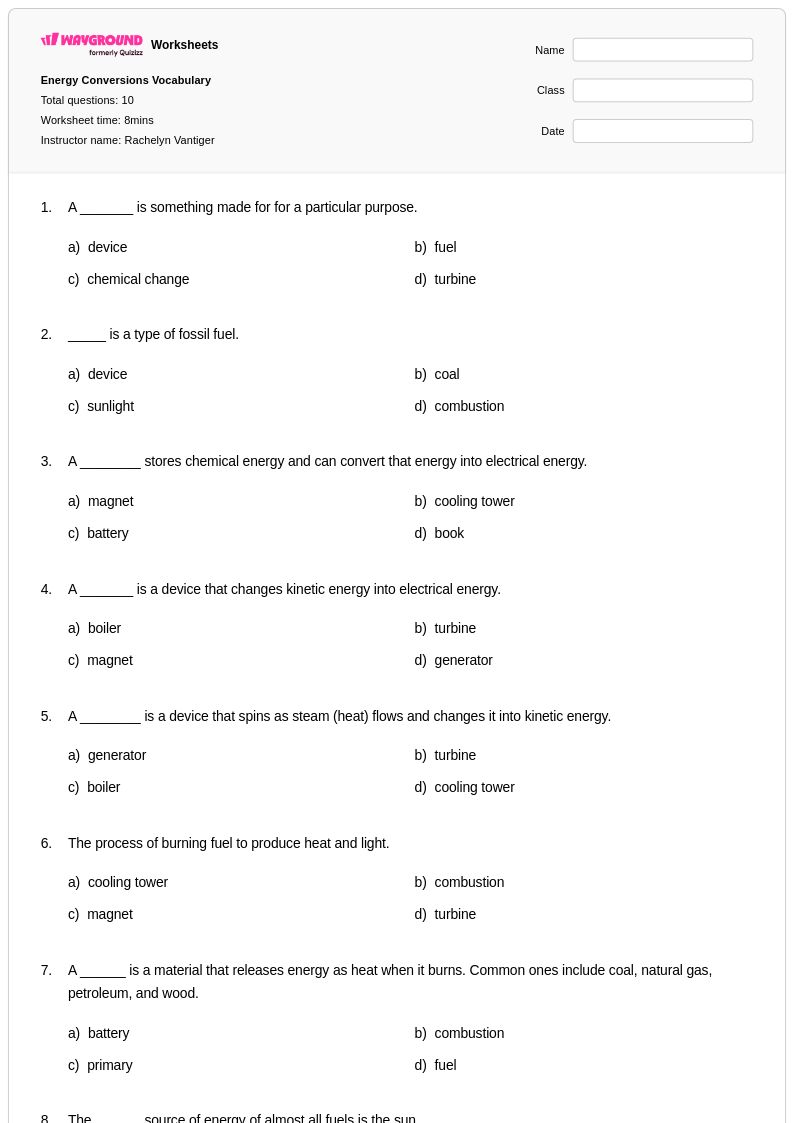
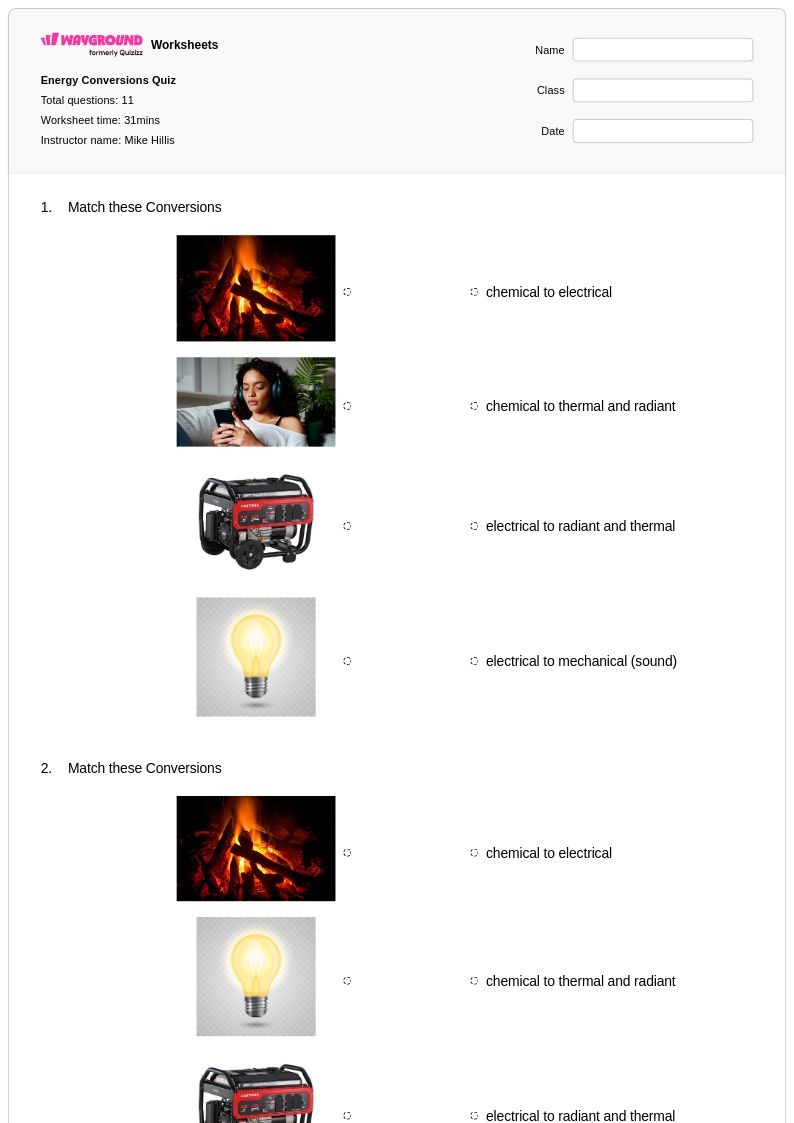
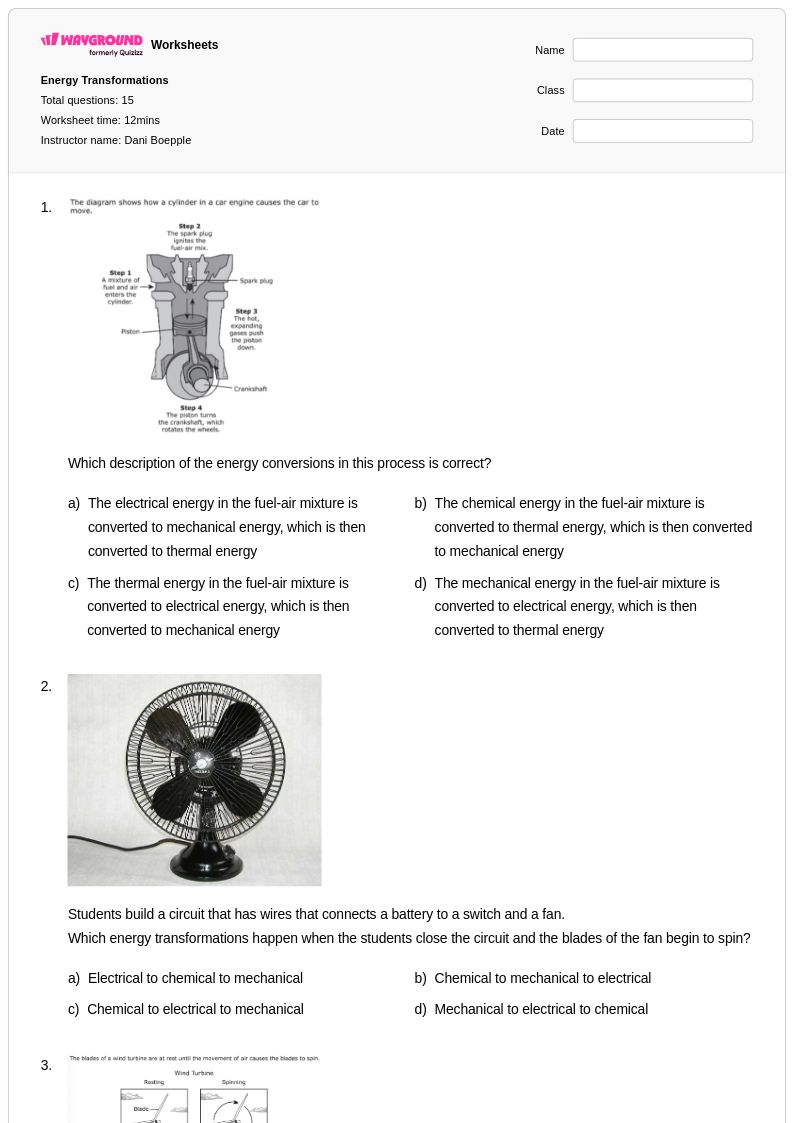
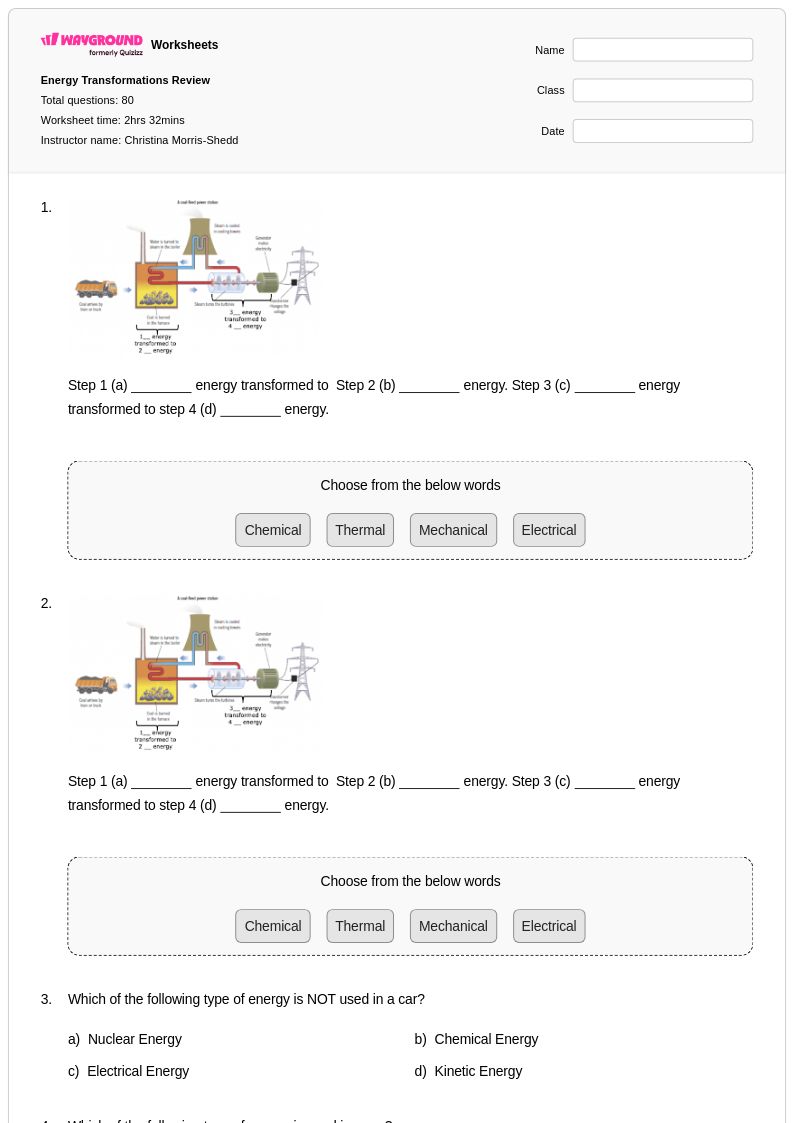
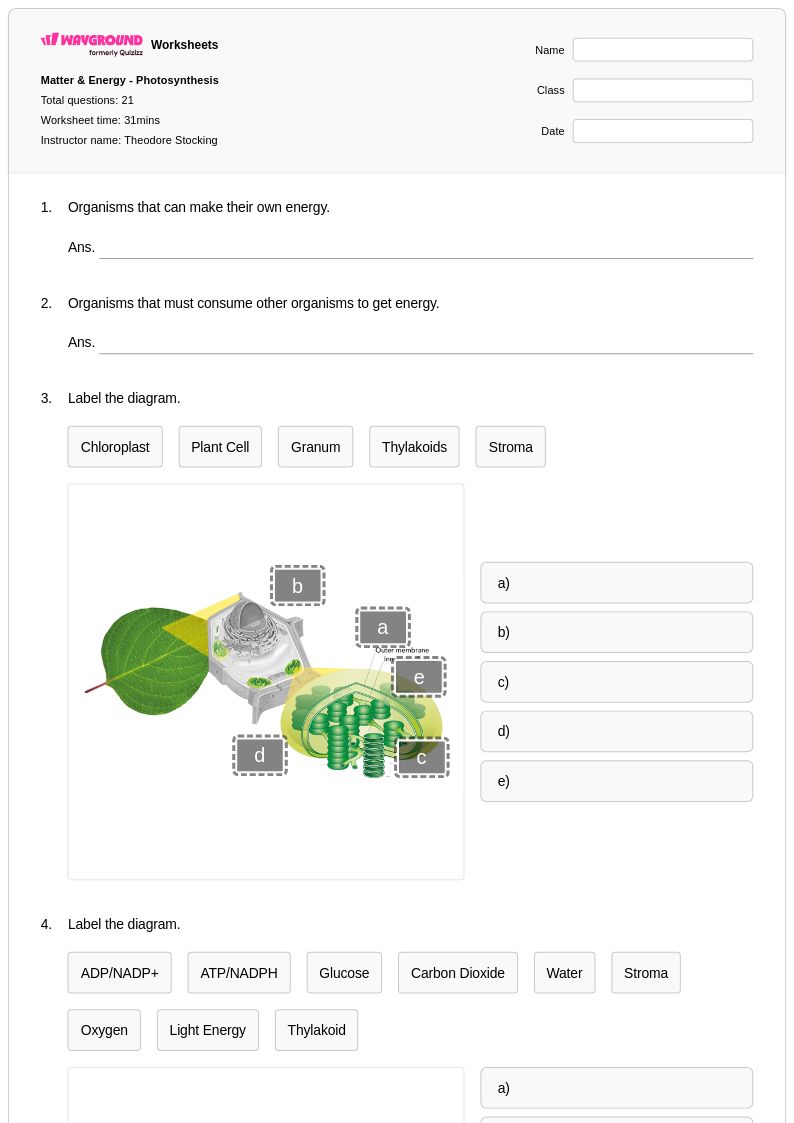
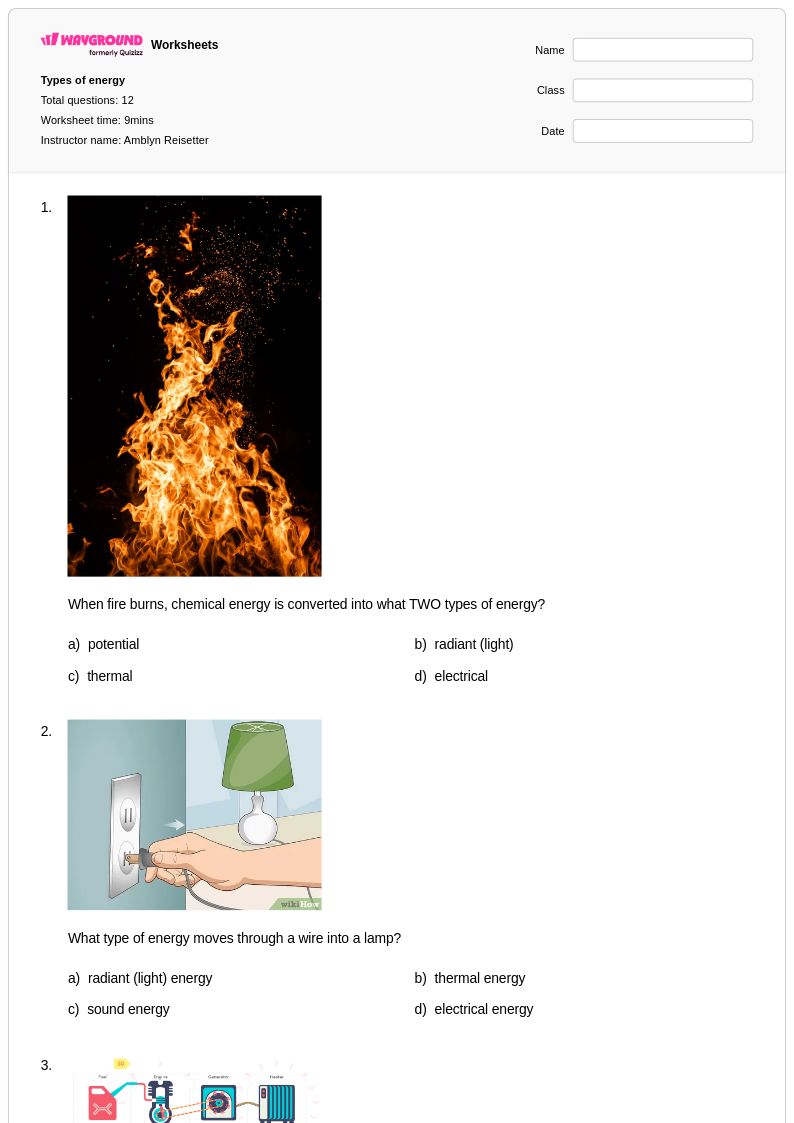
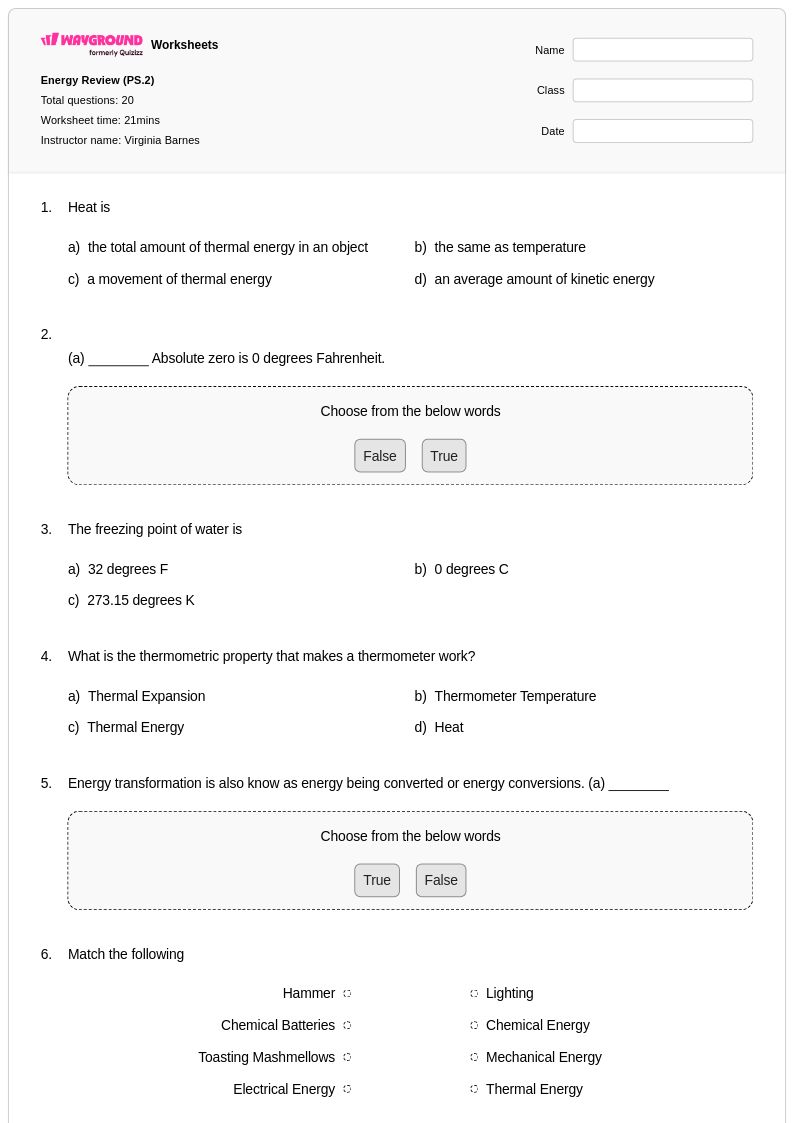
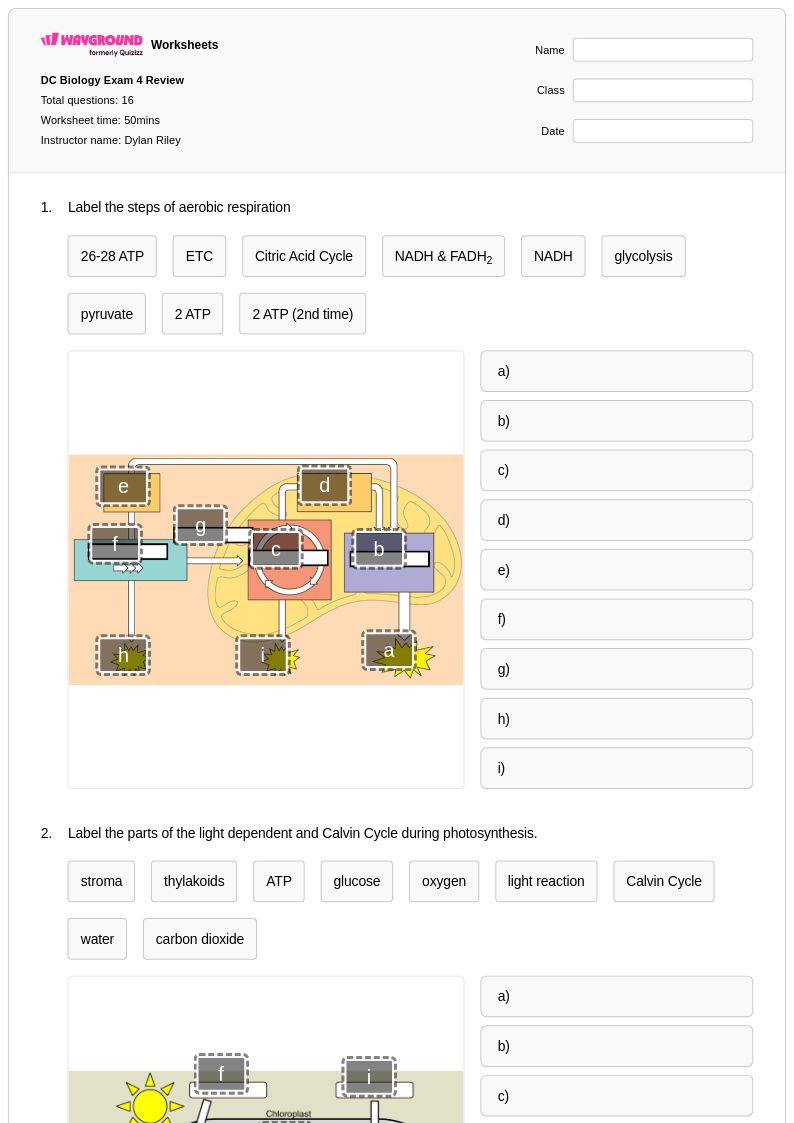
Explore Wayground's comprehensive collection of free energy conversions worksheets and printables that help students master the fundamental principles of how energy transforms between different forms through engaging practice problems and detailed answer keys.
Energy conversion worksheets available through Wayground (formerly Quizizz) provide comprehensive practice opportunities for students to master the fundamental principles of how energy transforms from one form to another. These expertly designed resources strengthen critical thinking skills as students analyze real-world scenarios involving kinetic and potential energy transformations, electrical energy conversion in circuits, chemical energy release in reactions, and thermal energy transfer processes. Each worksheet collection includes detailed answer keys that support both independent study and classroom instruction, with free printables covering everything from basic energy identification exercises to complex multi-step conversion problems that challenge students to trace energy pathways through interconnected systems.
Wayground (formerly Quizizz) empowers educators with millions of teacher-created energy conversion resources that streamline lesson planning and enhance student engagement through robust search and filtering capabilities. Teachers can easily locate worksheets aligned to specific science standards, customize content difficulty levels for differentiation, and access materials in both printable pdf format and interactive digital versions that adapt to diverse classroom needs. These comprehensive tools support targeted remediation for students struggling with energy concepts, provide enrichment opportunities for advanced learners ready to explore complex energy systems, and offer flexible skill practice options that help educators address varying proficiency levels while maintaining rigorous academic expectations across all energy conversion topics.
FAQs
How do I teach energy conversions to middle or high school students?
Start by grounding students in the idea that energy is never created or destroyed but changes form — this is the Law of Conservation of Energy. Use concrete, familiar examples like a roller coaster (potential to kinetic), a flashlight (chemical to electrical to light), or a campfire (chemical to thermal and light) before moving to more abstract systems. Building a visual energy pathway diagram for each scenario helps students trace transformations step by step rather than memorizing isolated facts.
What types of exercises help students practice energy conversions?
The most effective practice moves students from simple identification — naming the input and output energy forms in a given scenario — to multi-step tracing, where they follow energy through an interconnected system like a power plant or a biological process. Real-world scenario problems that require students to justify their reasoning, rather than just label diagrams, build the deeper conceptual understanding needed for assessments. Energy conversion worksheets that include both kinetic and potential energy transformations, electrical circuit conversions, and chemical energy reactions give students broad, standards-aligned exposure.
What mistakes do students commonly make when learning energy conversions?
The most frequent misconception is that energy is "used up" during a conversion rather than transformed into another form — students will often say a battery "runs out of energy" without understanding it has converted chemical energy into electrical energy. Another common error is failing to account for thermal energy as a byproduct in almost every real-world conversion, leading students to describe systems as more efficient than they actually are. Students also frequently confuse energy type with energy source, for example treating "electricity" as a primary energy form rather than recognizing it as a converted form of chemical, mechanical, or radiant energy.
How do I differentiate energy conversion instruction for students at different levels?
For struggling students, begin with single-step conversions using familiar household devices and provide sentence frames that scaffold the reasoning process. Advanced learners are ready to analyze multi-step energy pathways through complex systems — such as tracing solar energy through photosynthesis, cellular respiration, and muscular movement — and can be challenged to calculate efficiency losses at each stage. On Wayground, teachers can apply accommodations such as reduced answer choices or read-aloud support to individual students, allowing the same worksheet to serve differentiated needs without singling anyone out.
How can I use Wayground's energy conversion worksheets in my classroom?
Wayground's energy conversion worksheets are available as printable PDFs, making them easy to distribute for in-class practice, homework, or assessments in traditional classroom settings. They are also available in digital formats, which allows teachers to assign them for remote learning, flipped classroom instruction, or self-paced review — and teachers can host any worksheet as an interactive quiz directly on Wayground. Each worksheet includes a complete answer key, so they work equally well for independent student practice and for teacher-led instruction or immediate feedback sessions.
How do I align energy conversion worksheets to science standards?
Energy transformation is addressed directly in the Next Generation Science Standards (NGSS) under PS3: Energy, which covers the transfer and conservation of energy across physical, chemical, and biological systems. When selecting worksheets, look for resources that explicitly address energy input and output in real-world scenarios, since NGSS emphasizes applying concepts to phenomena rather than isolated definitions. Wayground's search and filtering tools allow teachers to locate worksheets aligned to specific science standards, which reduces planning time when building a standards-mapped unit on energy conversions.