Free Printable Forces and Interactions Worksheets for Grade 8
Grade 8 forces and interactions worksheets provide comprehensive printables and practice problems to help students master fundamental concepts about motion, gravity, and electromagnetic forces with included answer keys.
Explore printable Forces and Interactions worksheets for Grade 8
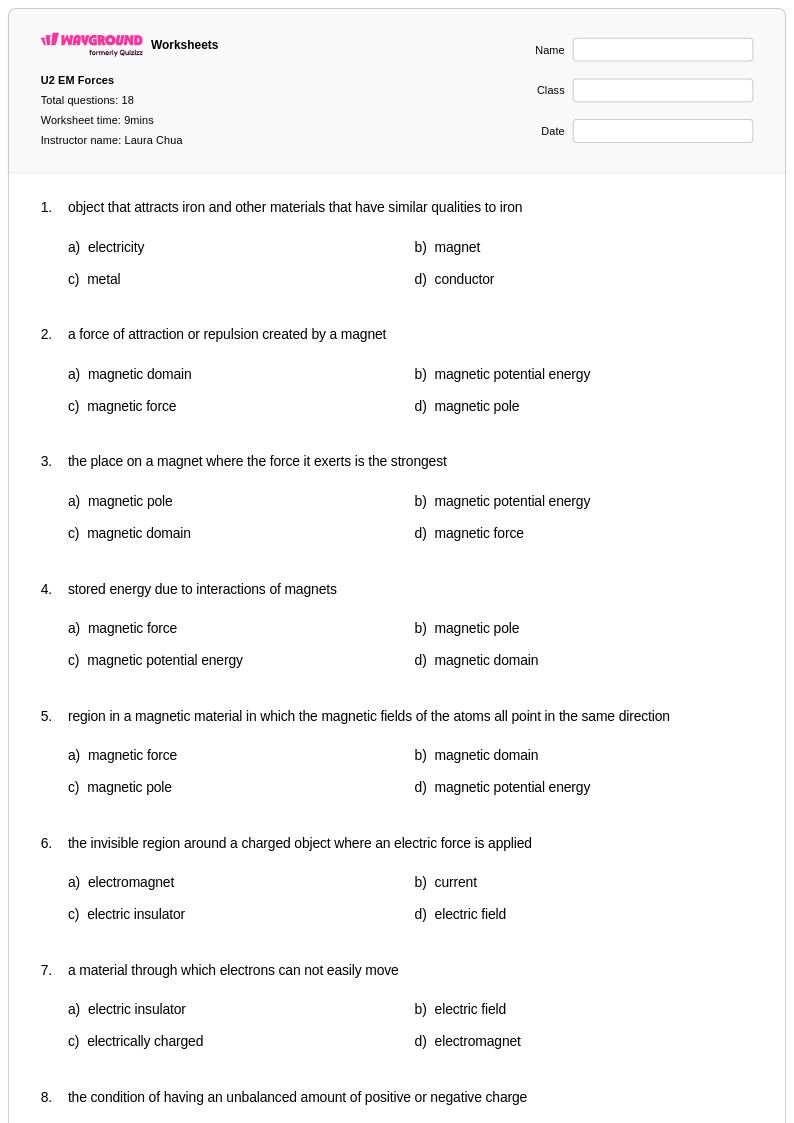
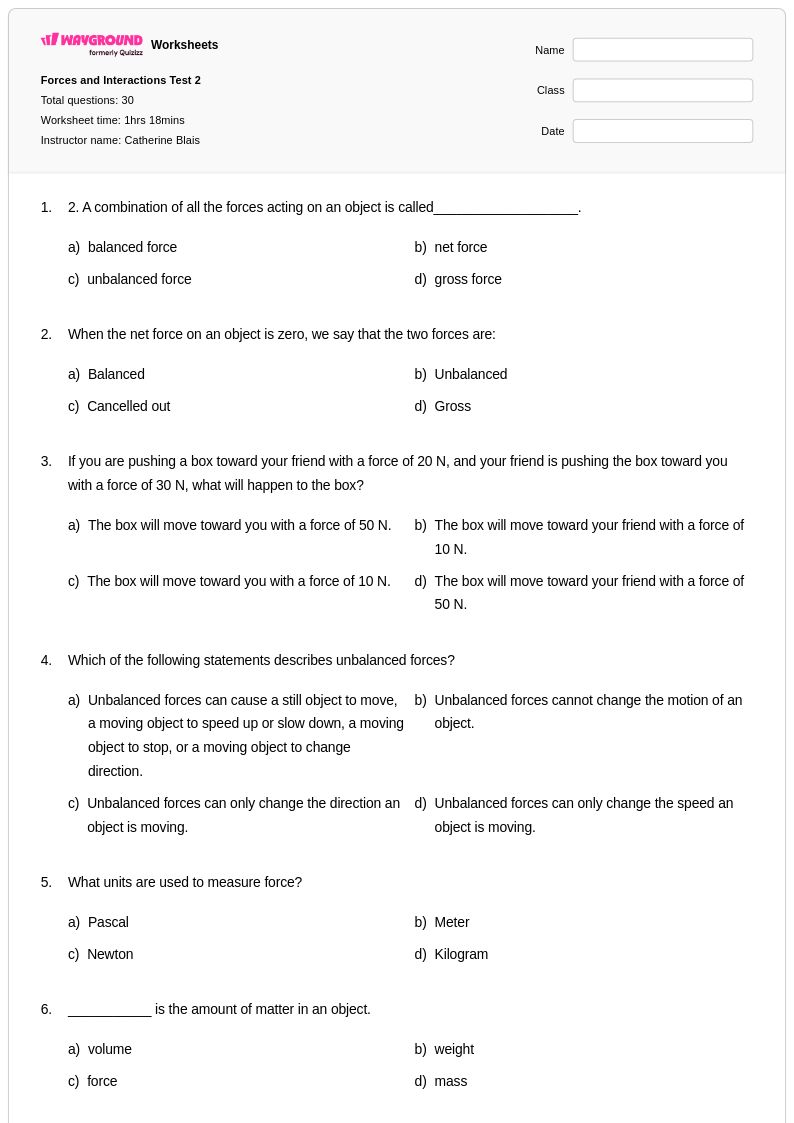
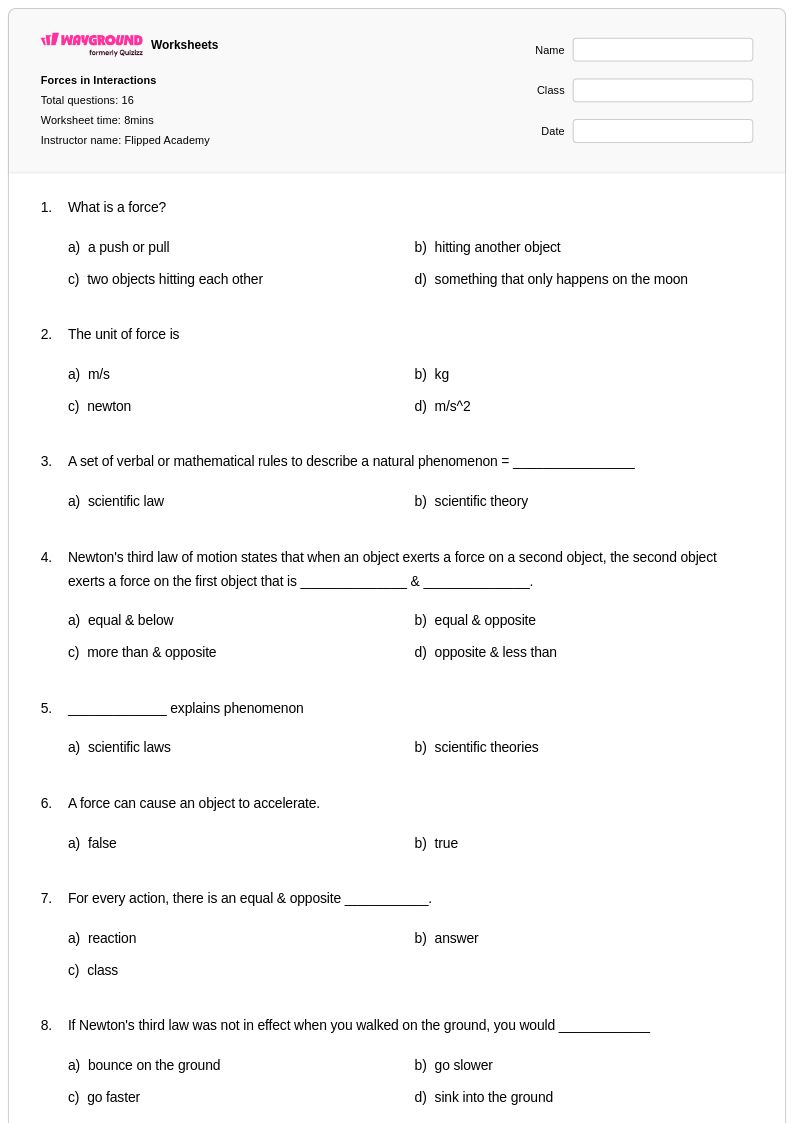
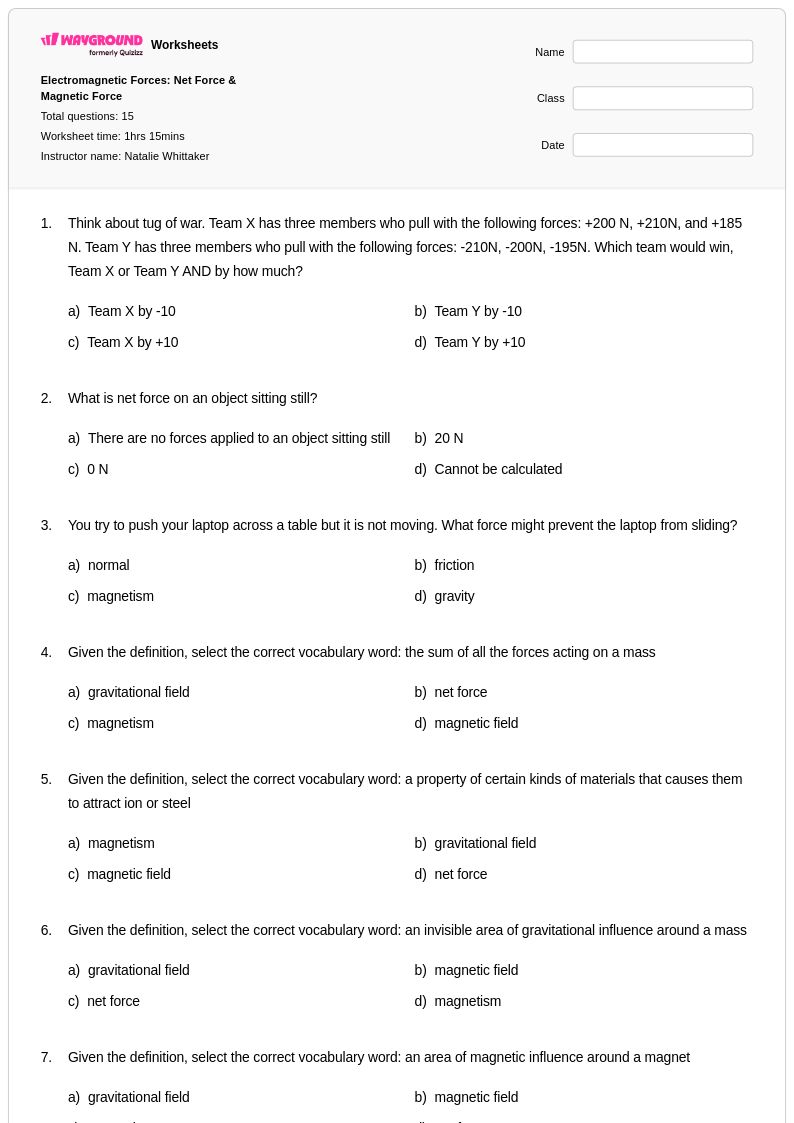
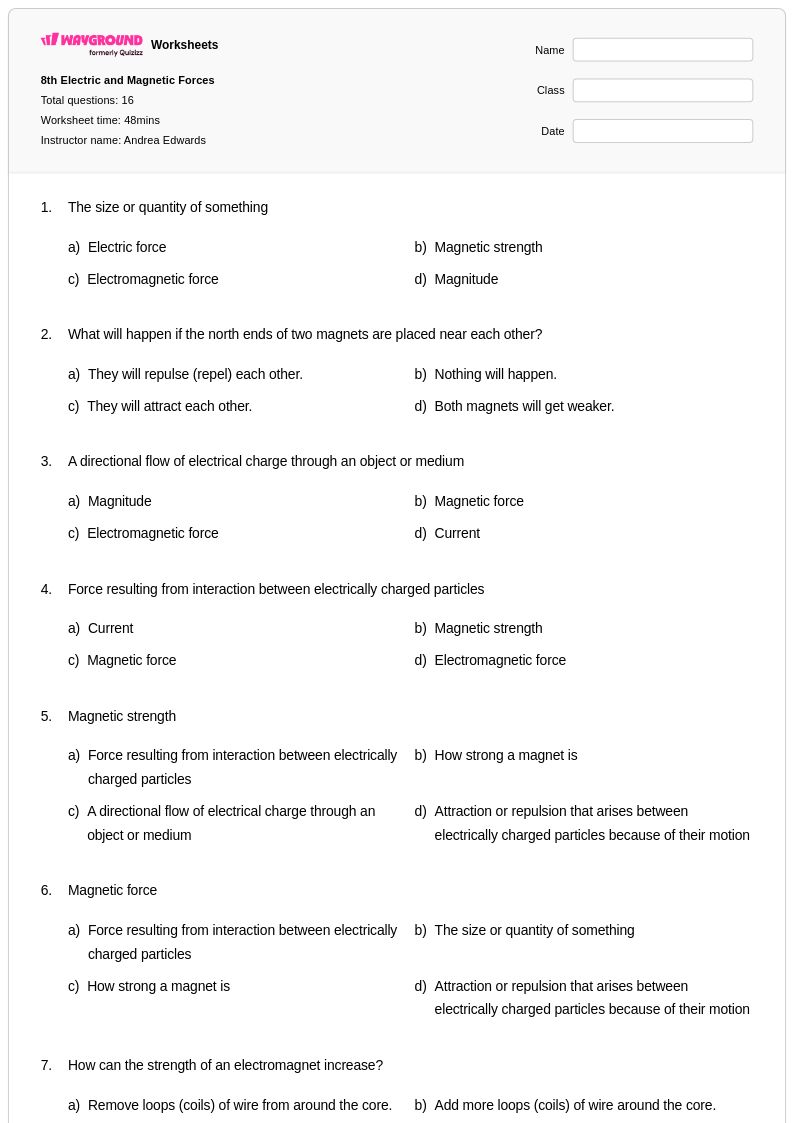
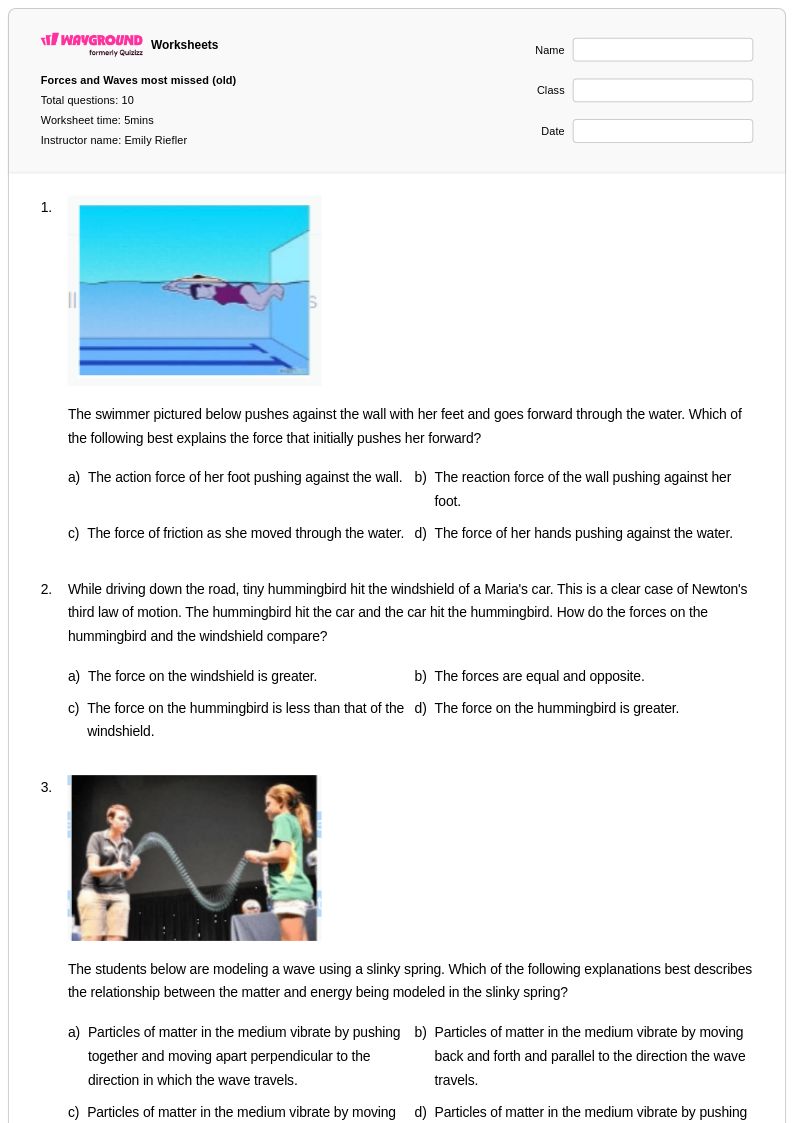
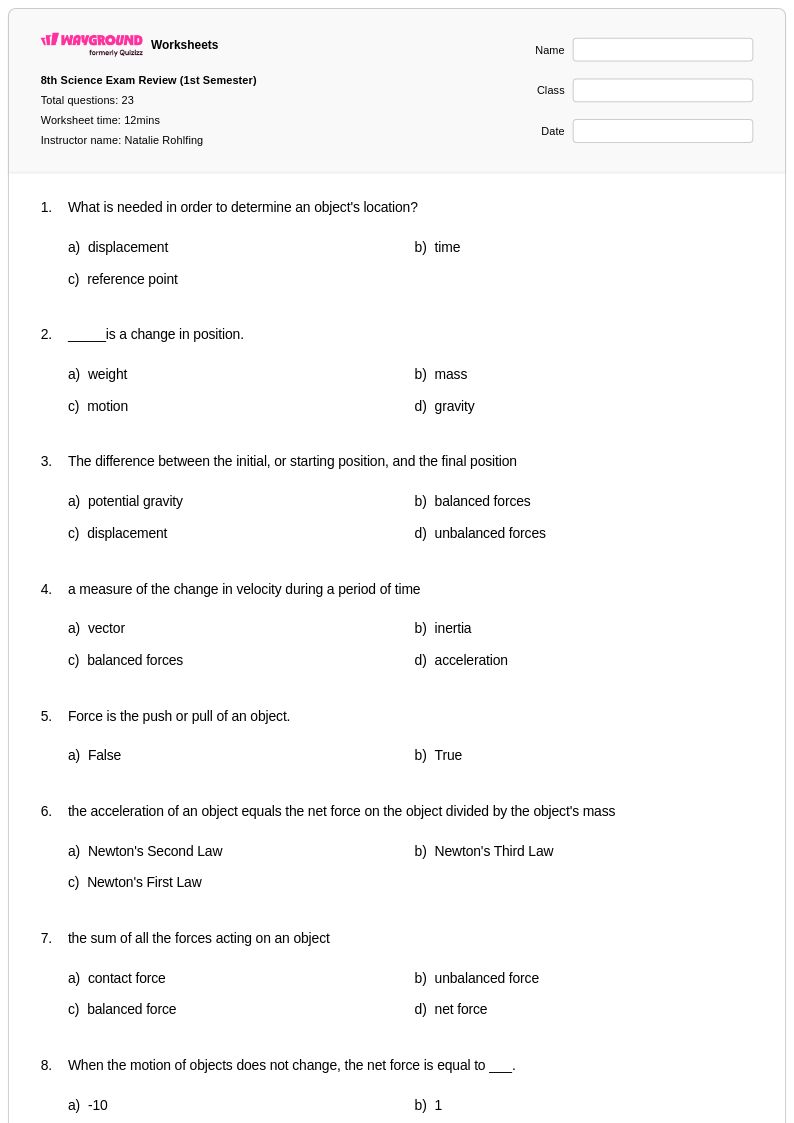
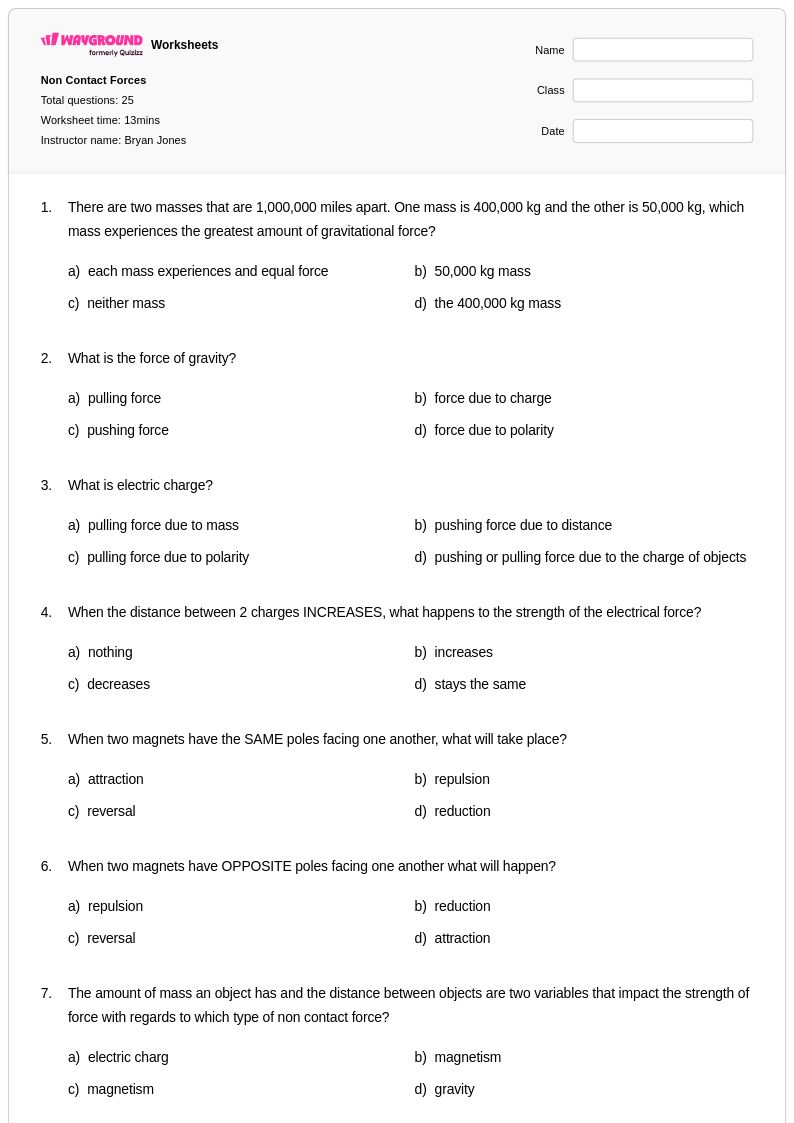
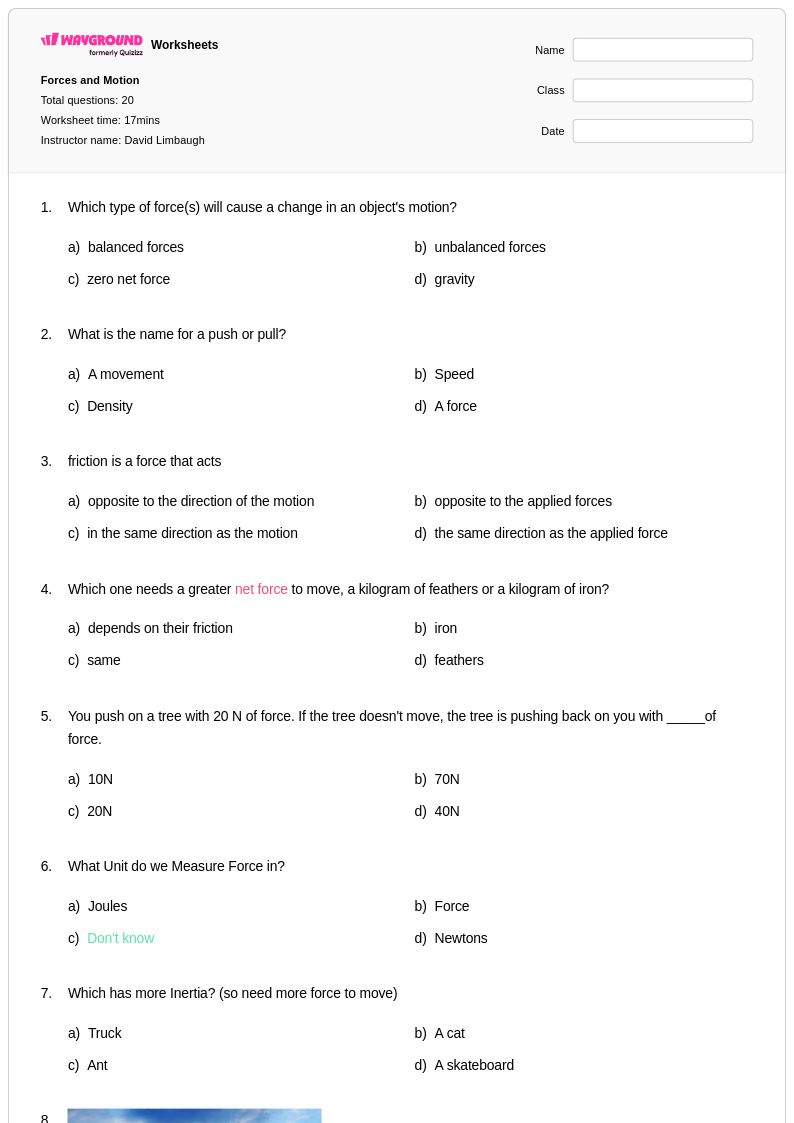
Forces and Interactions worksheets for Grade 8 students available through Wayground (formerly Quizizz) provide comprehensive coverage of fundamental physical science concepts that form the foundation of mechanical understanding. These educational resources focus on developing students' ability to identify, analyze, and predict the effects of various forces including gravitational, electromagnetic, and contact forces on objects in motion and at rest. The worksheets strengthen critical thinking skills through practice problems that require students to apply Newton's laws of motion, calculate net forces, and understand force interactions in real-world scenarios. Each worksheet collection includes detailed answer keys and is available as free printables in pdf format, making it easy for educators to implement immediate assessment and provide targeted feedback on student understanding of force vectors, balanced and unbalanced forces, and the relationship between force, mass, and acceleration.
Wayground (formerly Quizizz) empowers teachers with an extensive library of millions of teacher-created Forces and Interactions resources specifically designed to meet Grade 8 physical science standards and learning objectives. The platform's advanced search and filtering capabilities allow educators to quickly locate worksheets that align with specific curriculum standards, while built-in differentiation tools enable customization based on individual student needs and learning levels. Teachers can access these resources in both printable pdf formats for traditional classroom use and digital formats for interactive learning experiences, providing maximum flexibility for lesson planning and instruction delivery. This comprehensive worksheet collection supports effective remediation for struggling learners, enrichment opportunities for advanced students, and consistent skill practice that helps all Grade 8 students master the complex concepts of force interactions and their applications in physical systems.
FAQs
How do I teach forces and interactions to elementary and middle school students?
Start with concrete, qualitative experiences: have students push and pull objects to distinguish contact forces (friction, applied force, normal force) from non-contact forces (gravity, magnetism). Once students can identify and label forces in everyday scenarios, progress to drawing free-body diagrams and comparing balanced versus unbalanced forces before introducing quantitative work with Newton's Laws. Anchoring each new concept in a physical demonstration or real-world example builds the intuition students need before they encounter multi-step calculations.
What exercises help students practice calculating net force and applying Newton's Laws?
Effective practice sequences move from single-force identification to multi-force scenarios requiring students to sum vectors with direction in mind. Problems involving friction, air resistance, and gravity on inclined planes are particularly valuable because they require students to apply Newton's Second Law (F = ma) while managing multiple force components simultaneously. Free-body diagram exercises that pair visual representation with numerical calculation reinforce both conceptual understanding and procedural accuracy.
What misconceptions do students commonly have about forces and motion?
The most persistent misconception is that a moving object requires a continuous force to keep moving, which directly contradicts Newton's First Law. Students also frequently make sign errors when calculating net force, adding magnitudes without accounting for opposing directions, which leads to incorrect predictions about whether an object accelerates or remains in equilibrium. Targeted practice problems that isolate these scenarios, especially ones that show an object moving at constant velocity with no net force, are essential for correcting both errors.
How do I differentiate forces and interactions instruction for students at different skill levels?
For foundational learners, focus on qualitative identification of pushes and pulls and sorting forces as contact or non-contact before introducing any calculation. On-level students can work with balanced and unbalanced forces and single-variable Newton's Second Law problems, while advanced students tackle multi-step scenarios involving friction coefficients and systems of objects. Wayground's differentiation tools support managing remediation, on-level practice, and enrichment resources across the same class, and the platform's accommodation settings allow teachers to apply features like reduced answer choices or read-aloud support to individual students without disrupting the rest of the class.
How do I use Wayground's forces and interactions worksheets in my classroom?
Wayground's forces and interactions worksheets are available as printable PDFs for traditional classroom use and in digital formats for technology-integrated learning environments, including interactive quizzes hosted directly on the platform. Teachers can filter worksheets by curriculum standard using Wayground's advanced search tools, customize content for varied skill levels, and rely on complete answer keys for both grading and independent student practice. The digital format also allows teachers to assign accommodations such as extended time or read-aloud support to individual students, making the same worksheet accessible across a range of learners.
How do I help students correctly draw and interpret free-body diagrams?
Teach students to represent each force as an arrow originating from the object's center, labeled with both the force type and its direction before any numerical values are introduced. A common error is drawing arrows from the tips of other arrows rather than from the object itself, which obscures the vector relationships. Requiring students to list all forces acting on an object in a written inventory before drawing the diagram reduces omissions and helps them identify when forces are balanced or unbalanced.