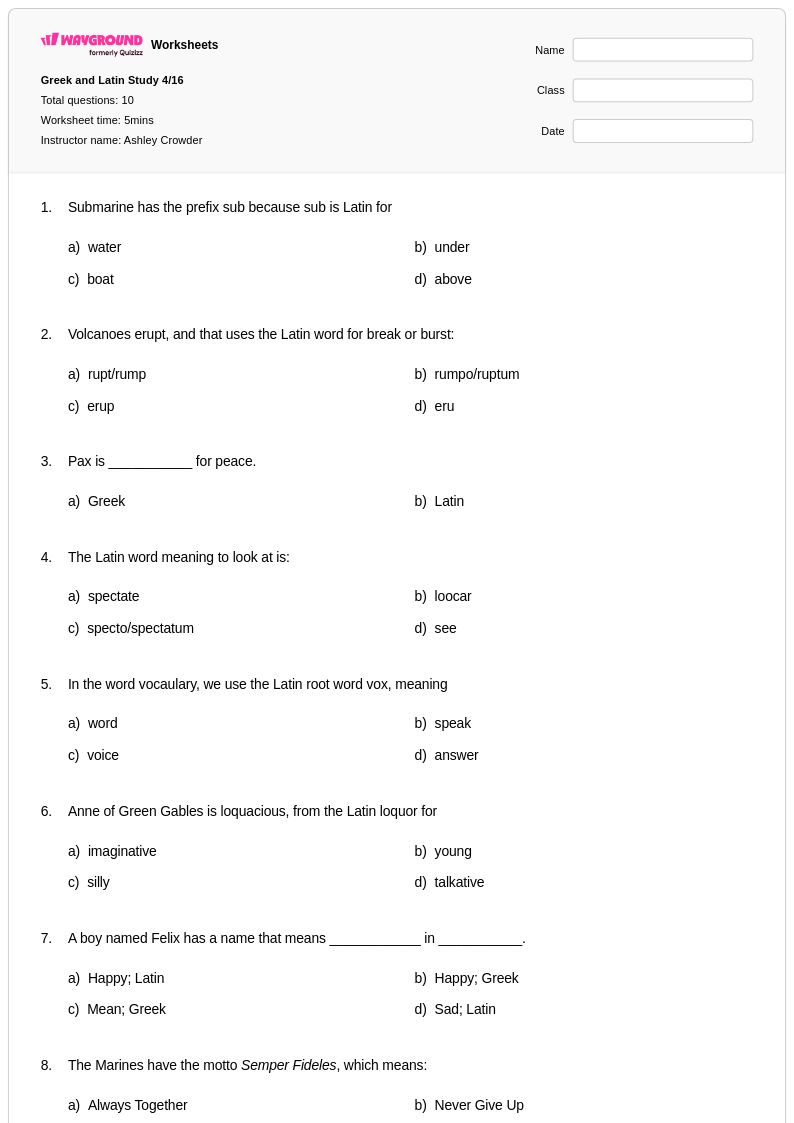
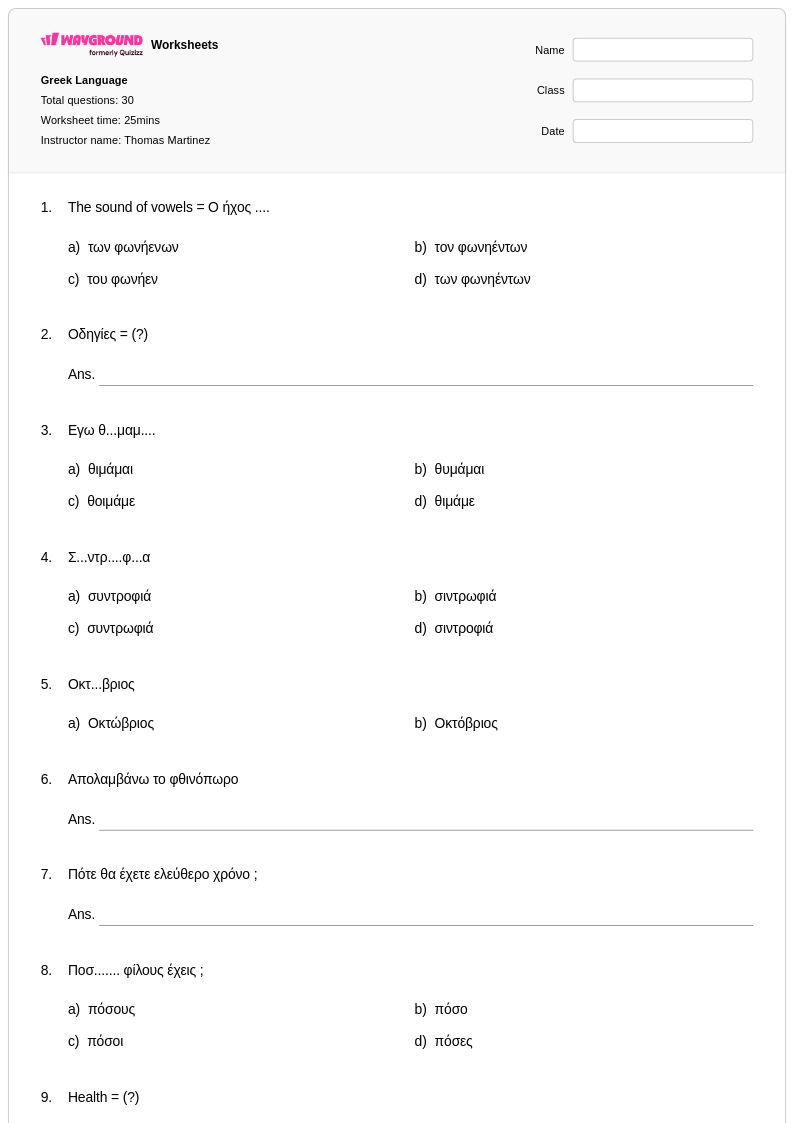
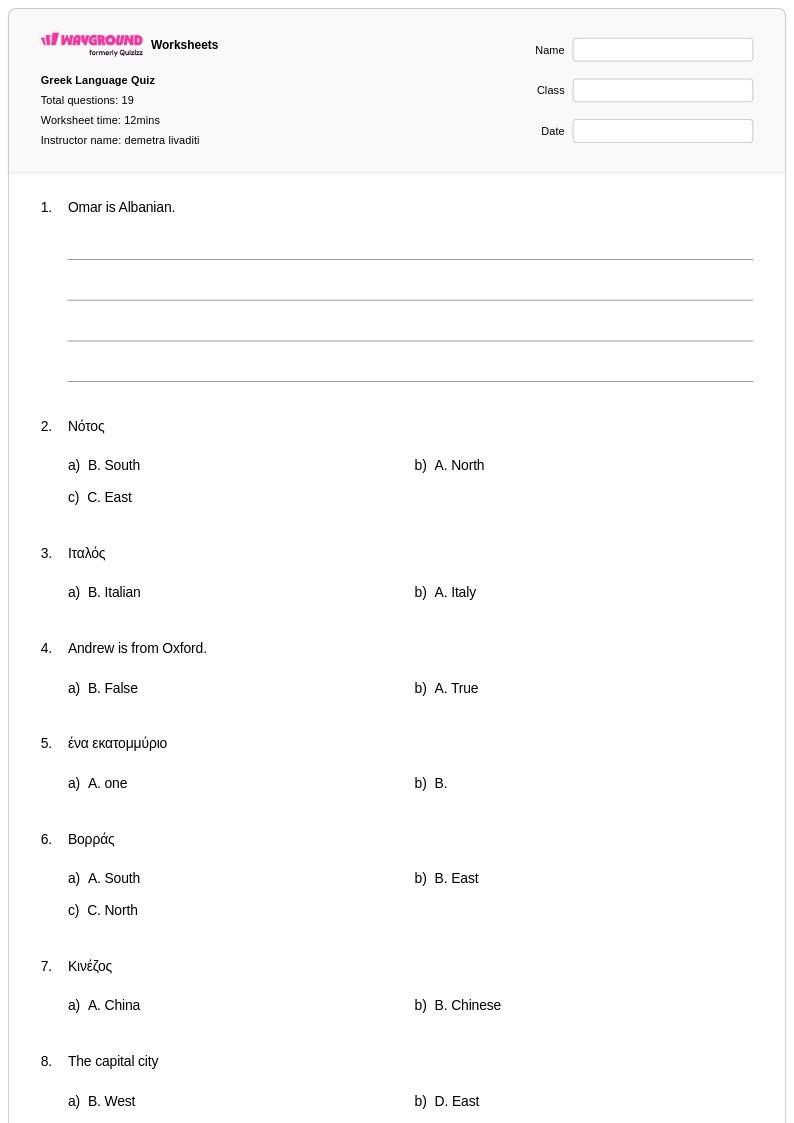
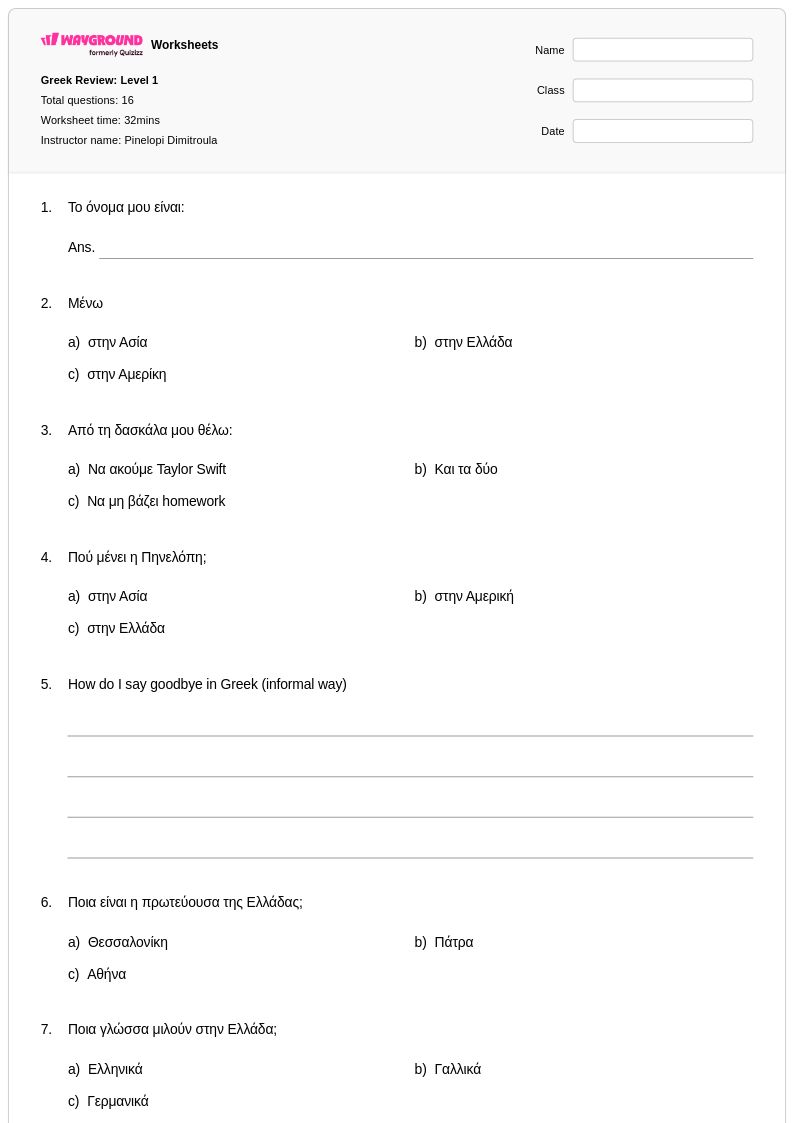
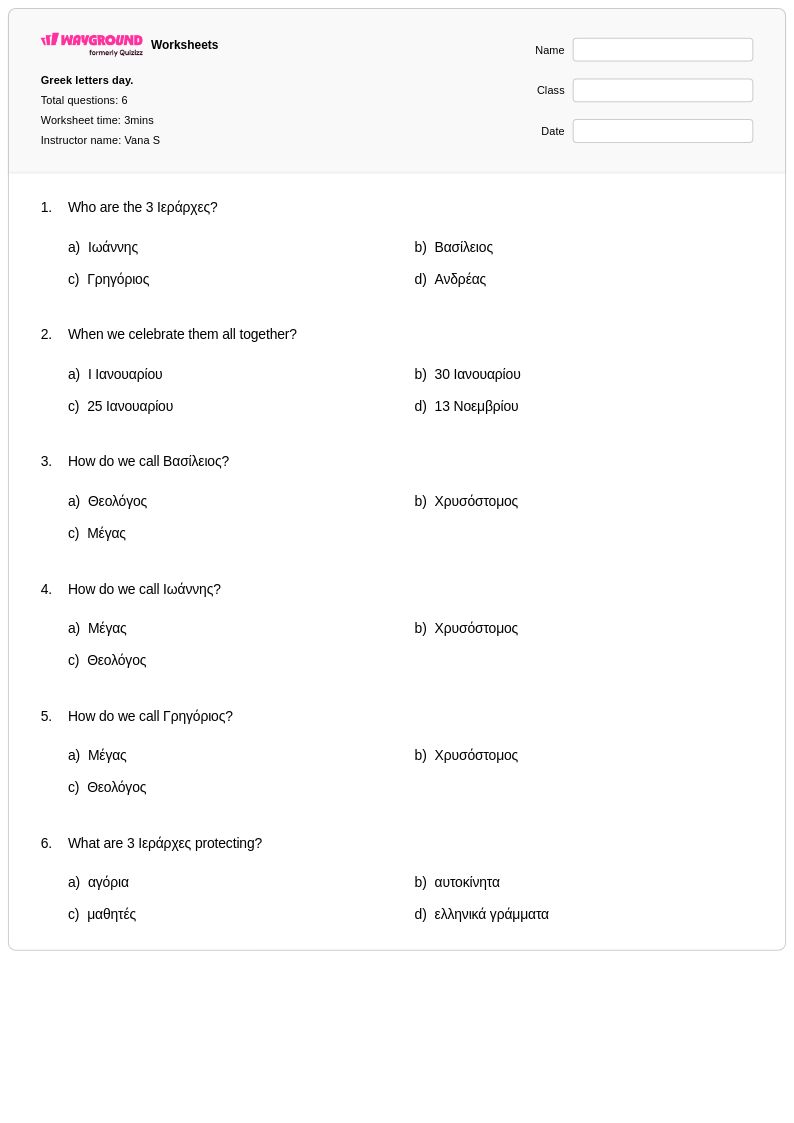
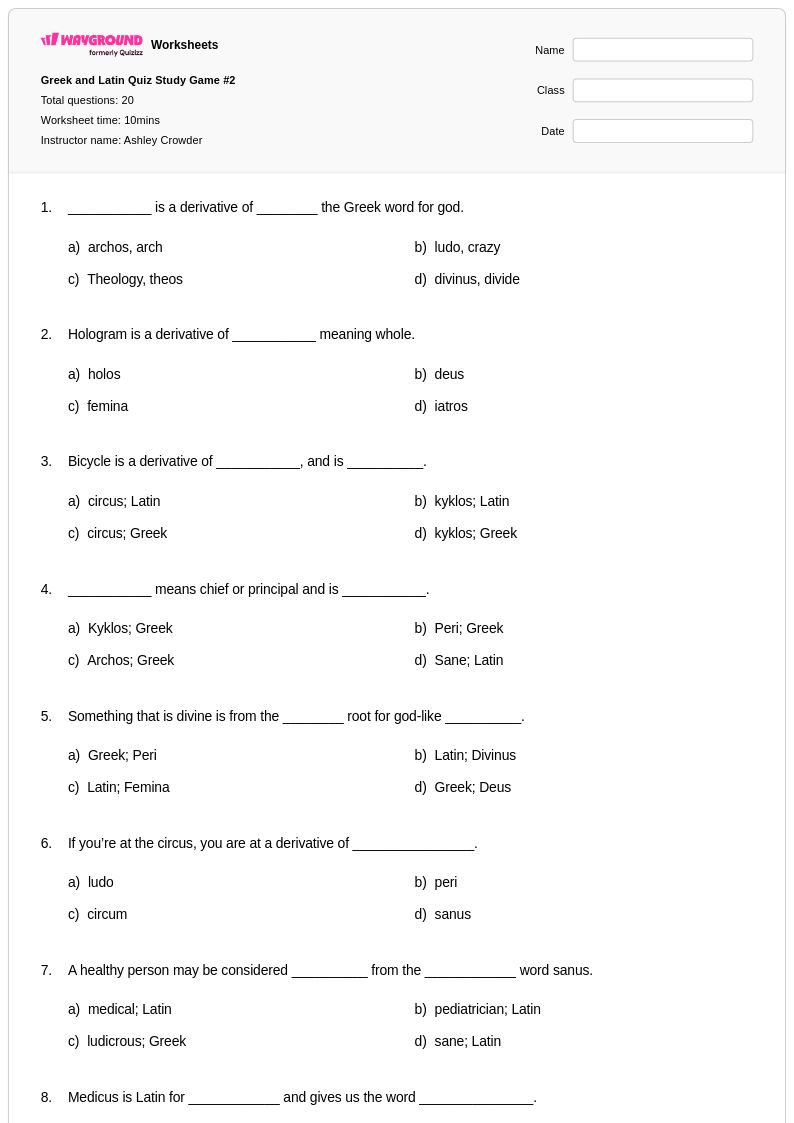
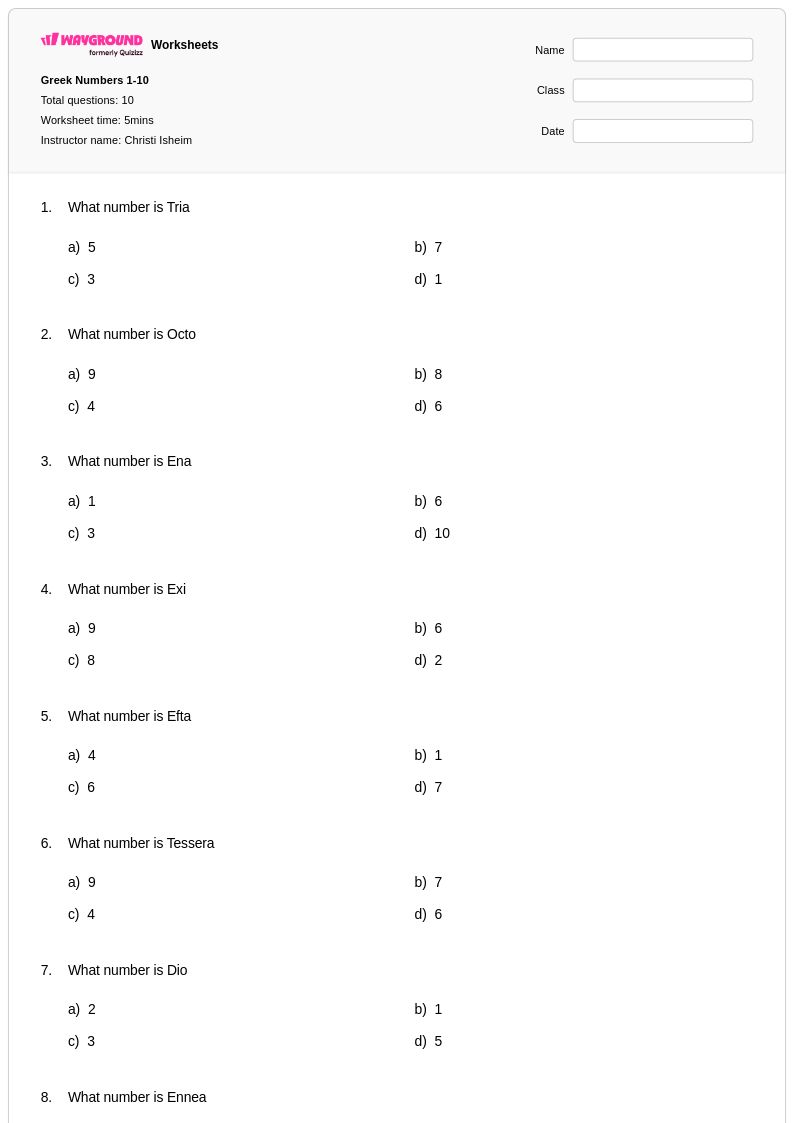
Discover free Grade 4 Greek language worksheets and printables from Wayground that help students practice essential vocabulary, basic grammar, and cultural concepts through engaging exercises with complete answer keys.
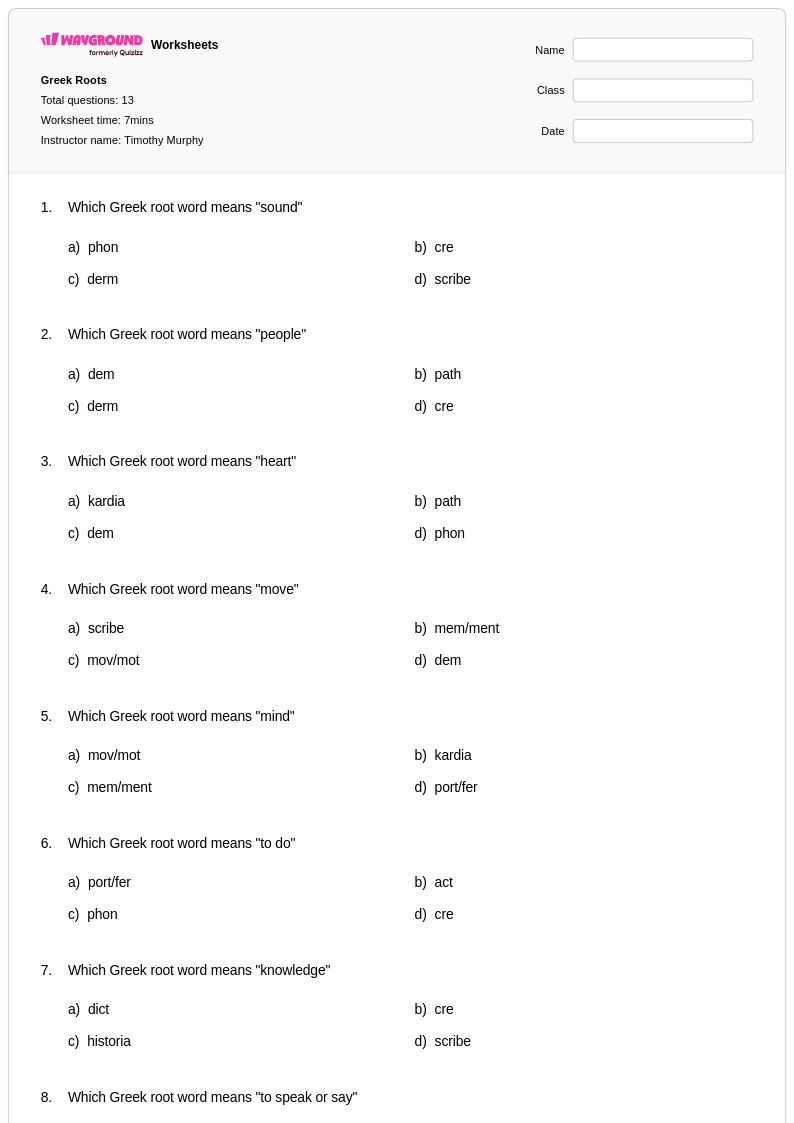
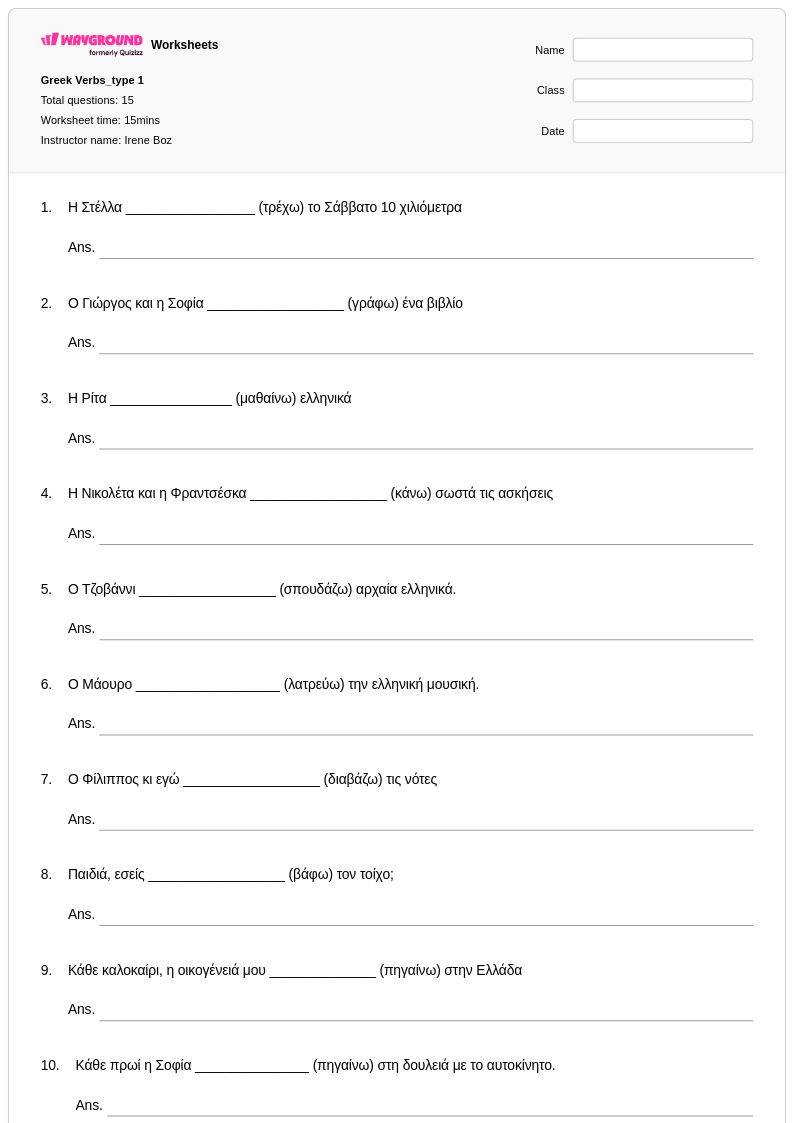
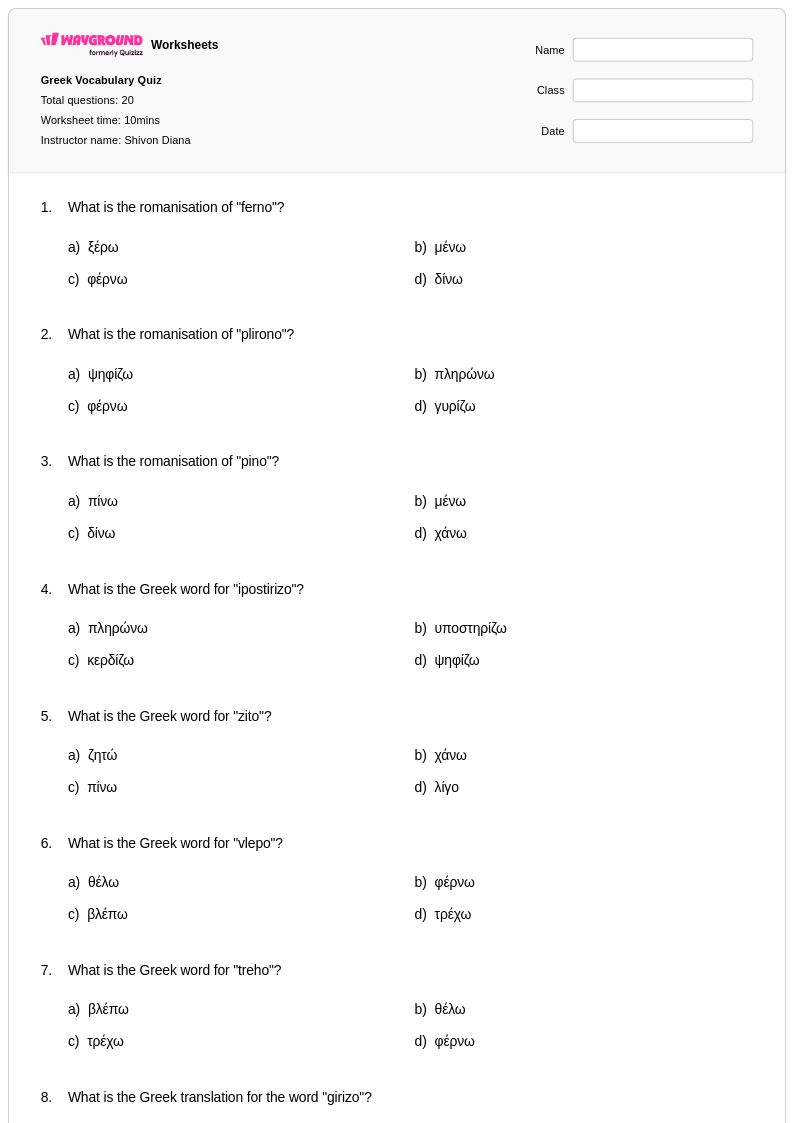
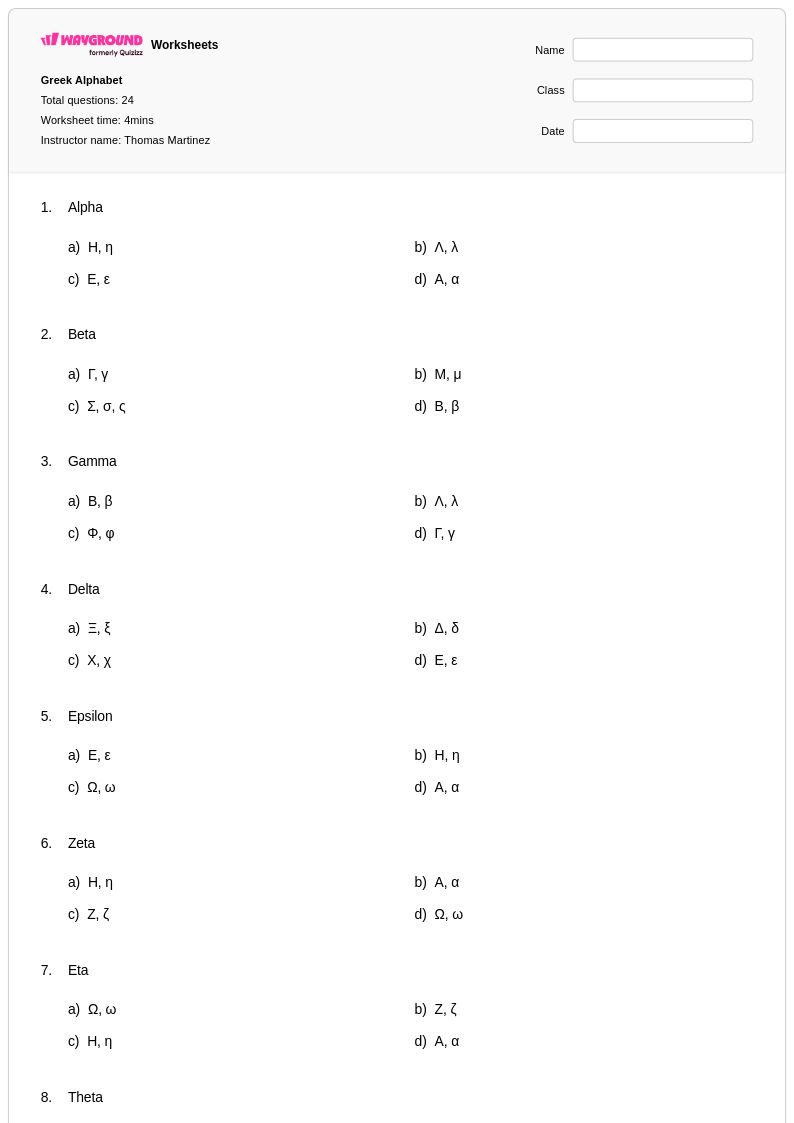
Greek language worksheets for Grade 4 students available through Wayground (formerly Quizizz) provide comprehensive introduction to this ancient and modern language, focusing on fundamental vocabulary, basic alphabet recognition, and essential cultural concepts. These educational resources strengthen students' understanding of Greek letters, common greetings, numbers, and simple phrases while building foundational skills in pronunciation and writing. The worksheet collection includes practice problems that guide fourth-grade learners through interactive exercises featuring Greek mythology characters, geographical terms, and everyday expressions, with accompanying answer keys that support both independent study and classroom instruction. Teachers can access these free printables in convenient pdf format, allowing for flexible implementation across diverse learning environments and varied instructional approaches.
Wayground's extensive platform supports educators with millions of teacher-created Greek language resources specifically designed for Grade 4 instruction, featuring robust search and filtering capabilities that enable quick identification of materials aligned with specific learning objectives and curriculum standards. The comprehensive worksheet collection offers built-in differentiation tools that accommodate varying skill levels within the classroom, from students requiring additional remediation in basic letter recognition to those ready for enrichment activities involving more complex vocabulary and cultural connections. Teachers benefit from flexible customization options that allow adaptation of existing materials to meet specific classroom needs, while the availability of both printable and digital pdf formats ensures seamless integration into traditional and technology-enhanced learning environments. These features collectively streamline lesson planning while providing targeted skill practice opportunities that support systematic progression through Greek language fundamentals.
FAQs
How do I teach the Greek alphabet to beginners?
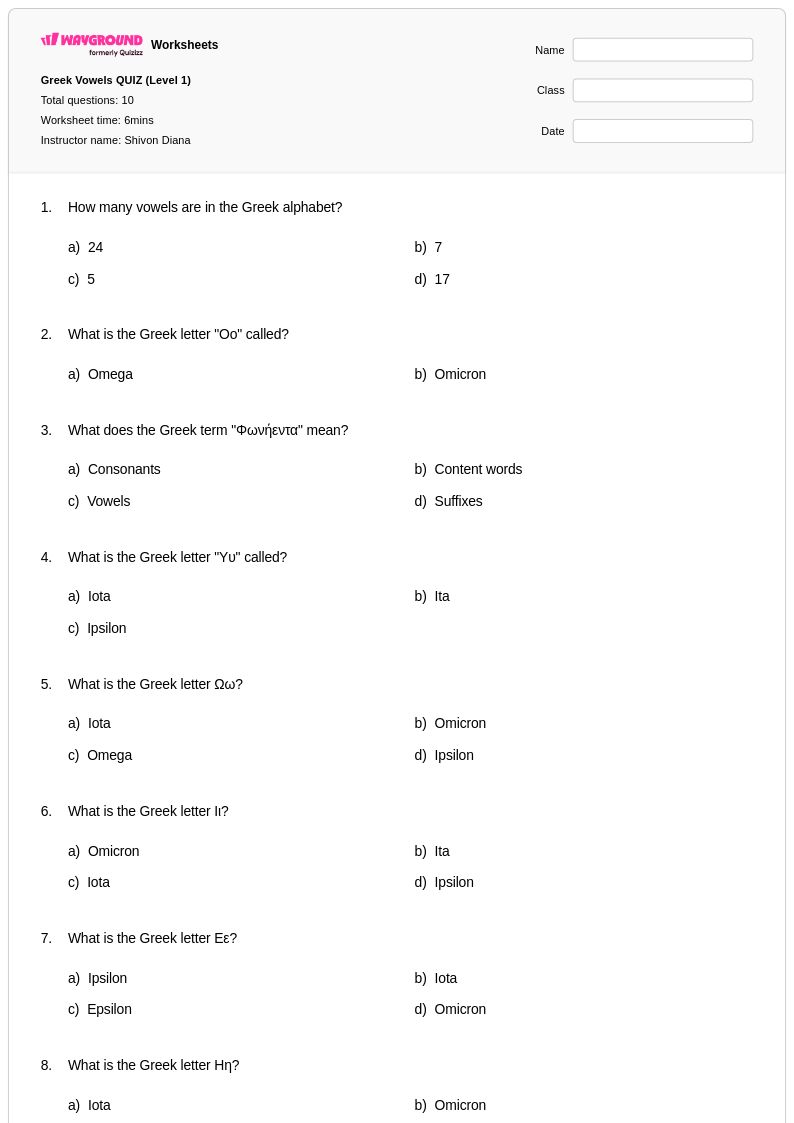
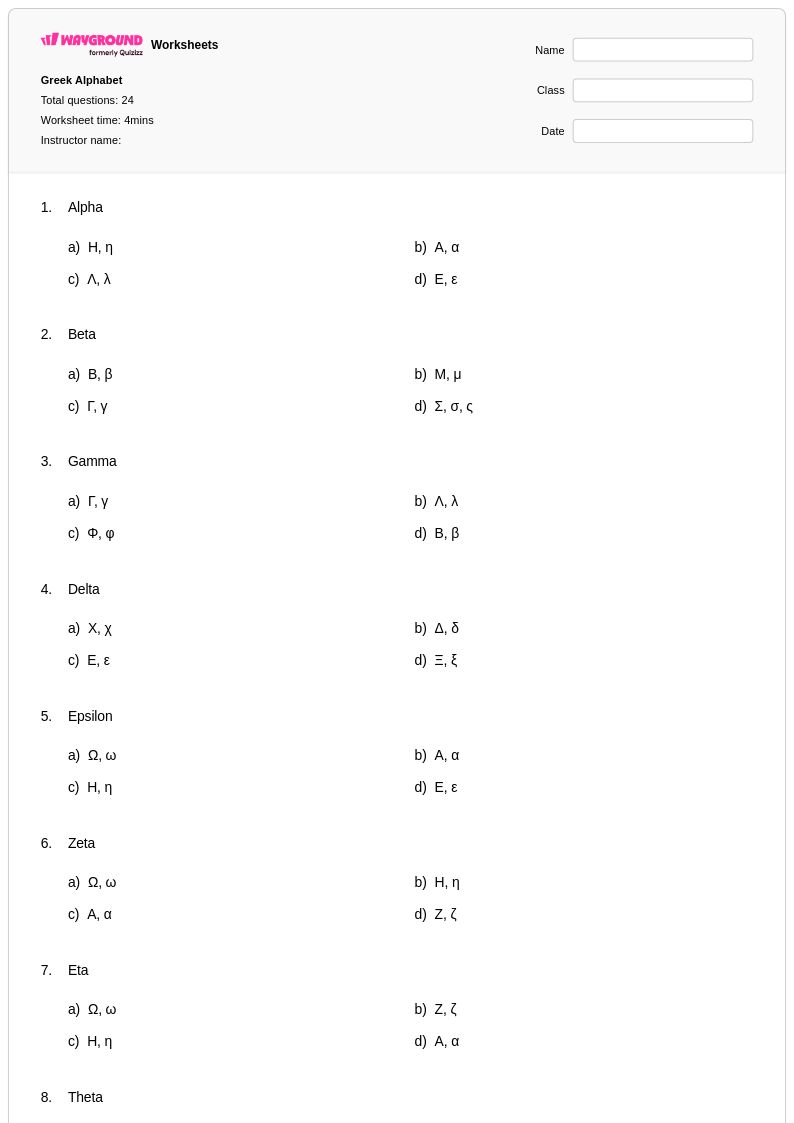
Start by introducing the Greek alphabet in small clusters, grouping letters by their visual similarity to Latin characters before moving to unfamiliar ones. Pair each letter with its phonetic sound and a familiar vocabulary word to anchor recognition. Repeated tracing, matching, and fill-in exercises help students internalize letter forms before moving on to pronunciation and basic vocabulary.
What are the most effective ways to help students practice Greek vocabulary?
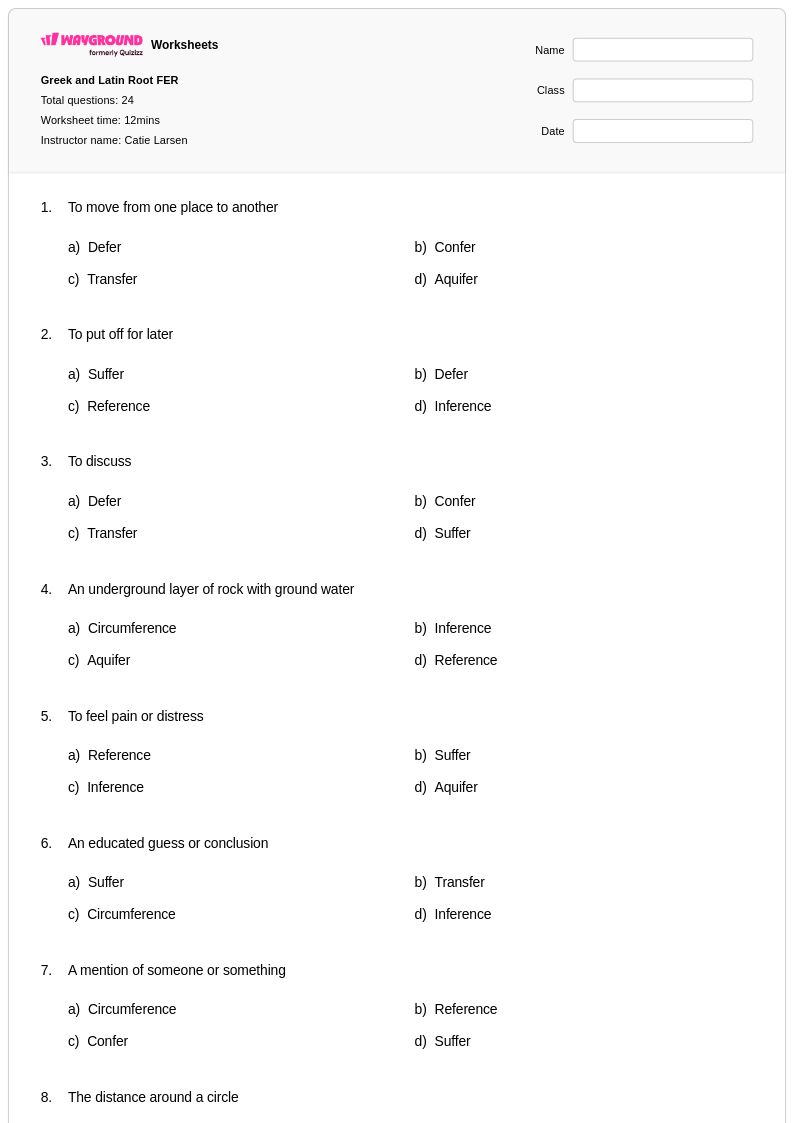
Structured vocabulary worksheets that pair Greek terms with English translations, visual cues, and contextual sentences give students multiple entry points for retention. Practice activities such as fill-in-the-blank, word-matching, and short translation exercises reinforce recognition and recall. Progressing from isolated word recognition to sentence-level usage builds the fluency students need for reading comprehension.
What common mistakes do students make when learning Greek grammar?
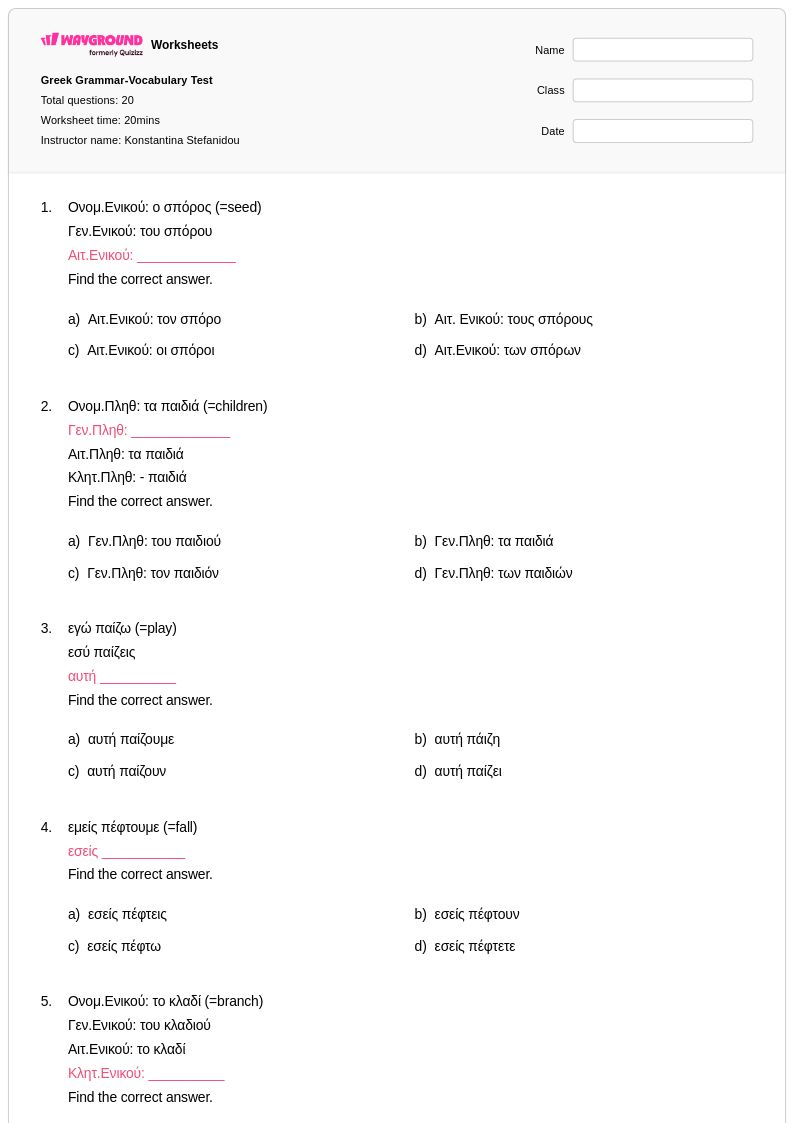
Students frequently confuse Greek noun cases, particularly the nominative and accusative, because English does not use a comparable case system. Verb conjugation errors are also common, as Greek verb endings encode person, number, and tense in ways that feel unfamiliar to English speakers. Targeted practice with structured conjugation tables and case-agreement exercises helps students identify and correct these patterns before they become habitual.
How can I differentiate Greek language instruction for students at different proficiency levels?
For beginners, focus on alphabet recognition, phonetics, and high-frequency vocabulary before introducing grammatical structures. More advanced students benefit from translation exercises, sentence construction tasks, and reading comprehension passages. On Wayground, teachers can apply accommodations such as reduced answer choices to lower cognitive load for struggling learners, or read-aloud support for students who need audio reinforcement of Greek pronunciation.
How do I use Wayground's Greek worksheets in my classroom?
Wayground's Greek worksheets are available as printable PDFs for traditional classroom use and in digital formats for technology-integrated environments, including the option to host them as an interactive quiz on the Wayground platform. Teachers can assign them as in-class practice, homework, or review sessions, and the included answer keys support both teacher-led correction and independent student self-assessment. The digital format also allows teachers to set individual accommodations, such as extended time or adjustable reading modes, directly from the session settings.
How do I help students with Greek pronunciation when I'm not a native speaker?
Pronunciation guides embedded in structured worksheets give non-specialist teachers a reliable scaffold for introducing Greek phonetics systematically. Focusing on the consistent sound-symbol correspondence of the Greek alphabet — which is more regular than English — helps both teachers and students build confidence quickly. Supplementing worksheet practice with audio resources and phonetic transcriptions reinforces correct pronunciation habits from the start.