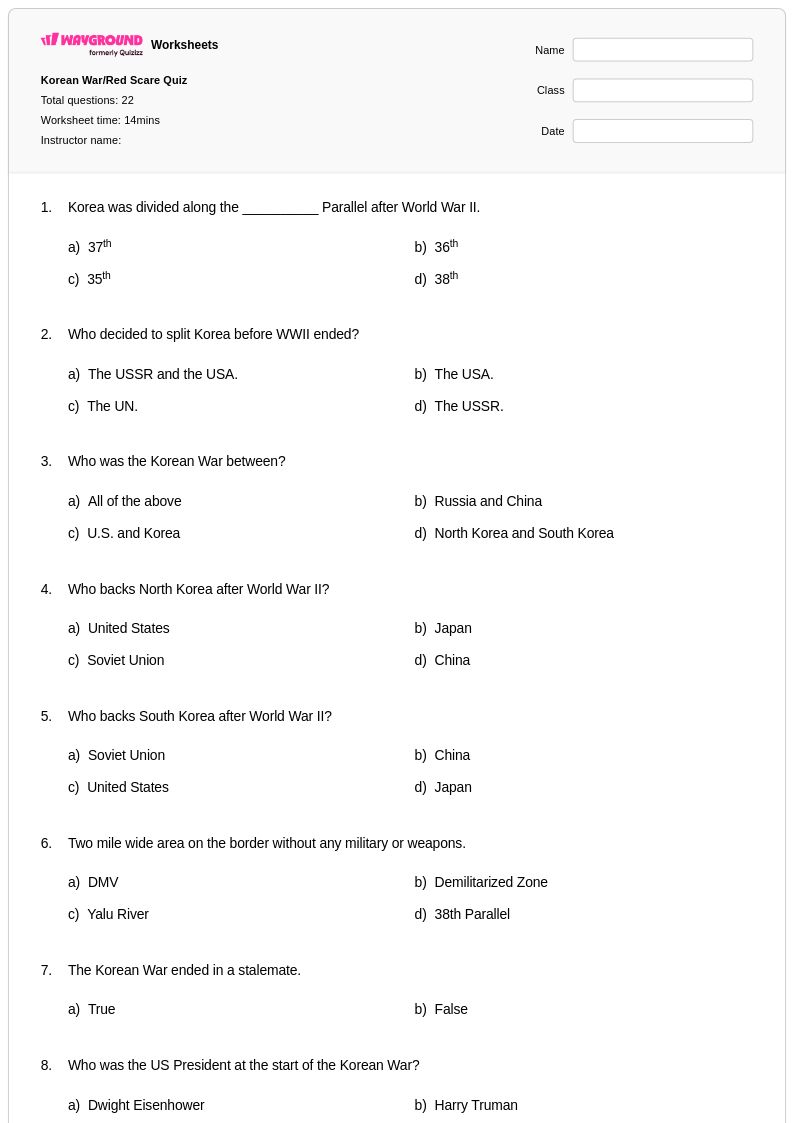
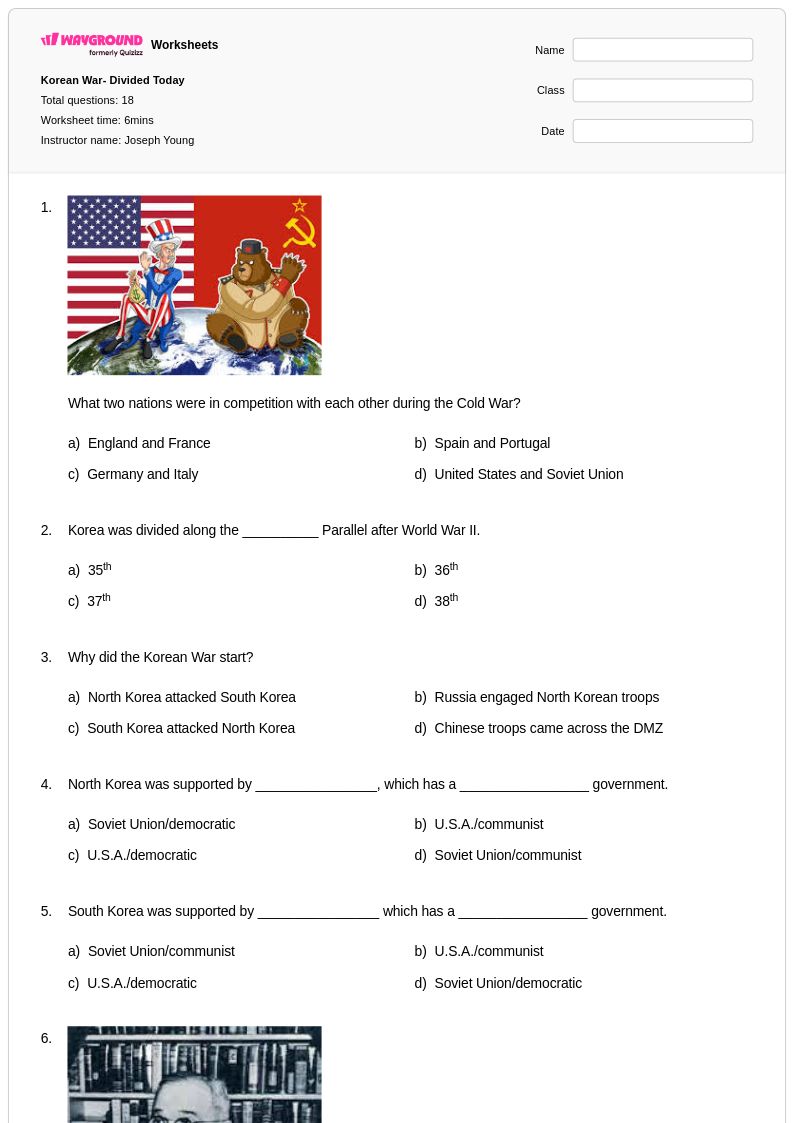
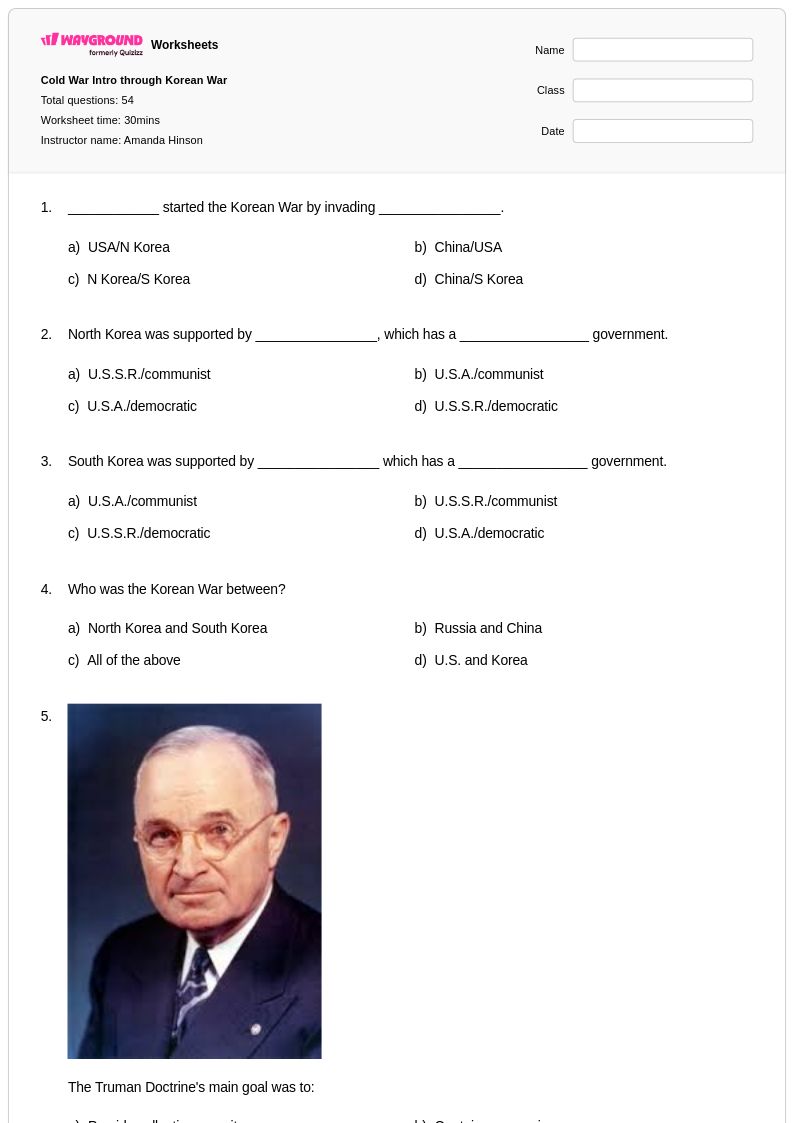
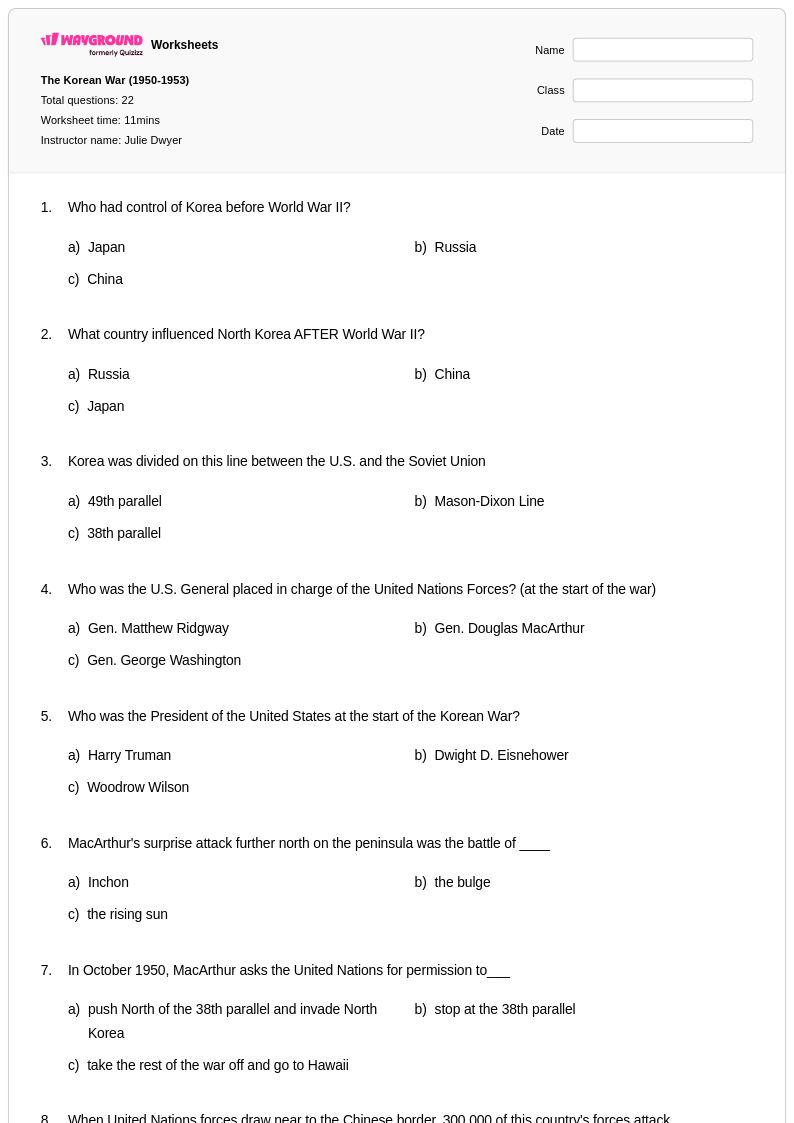
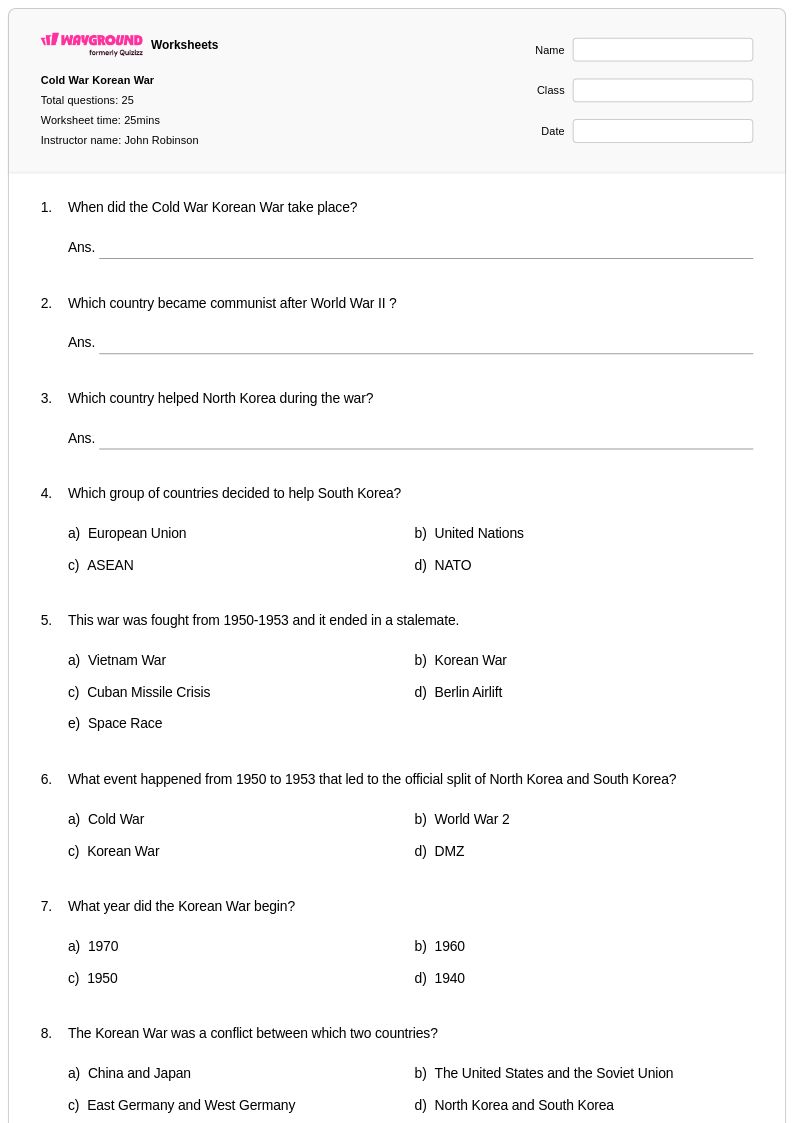
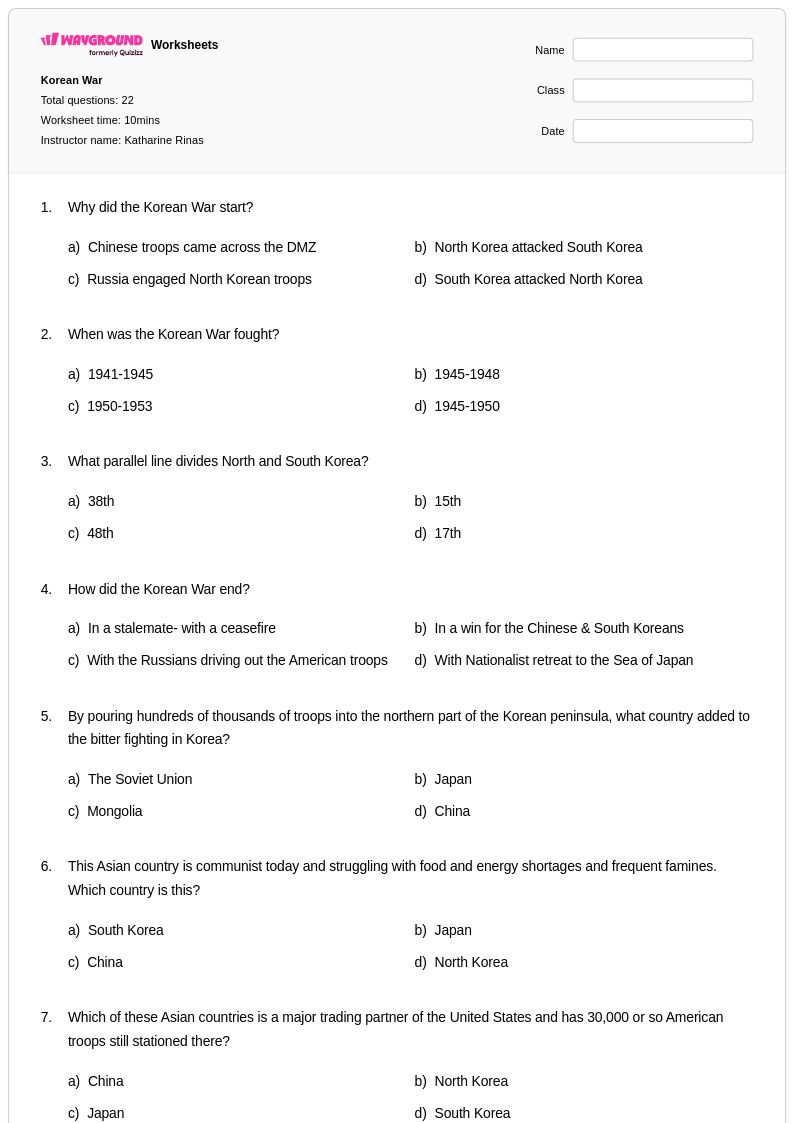
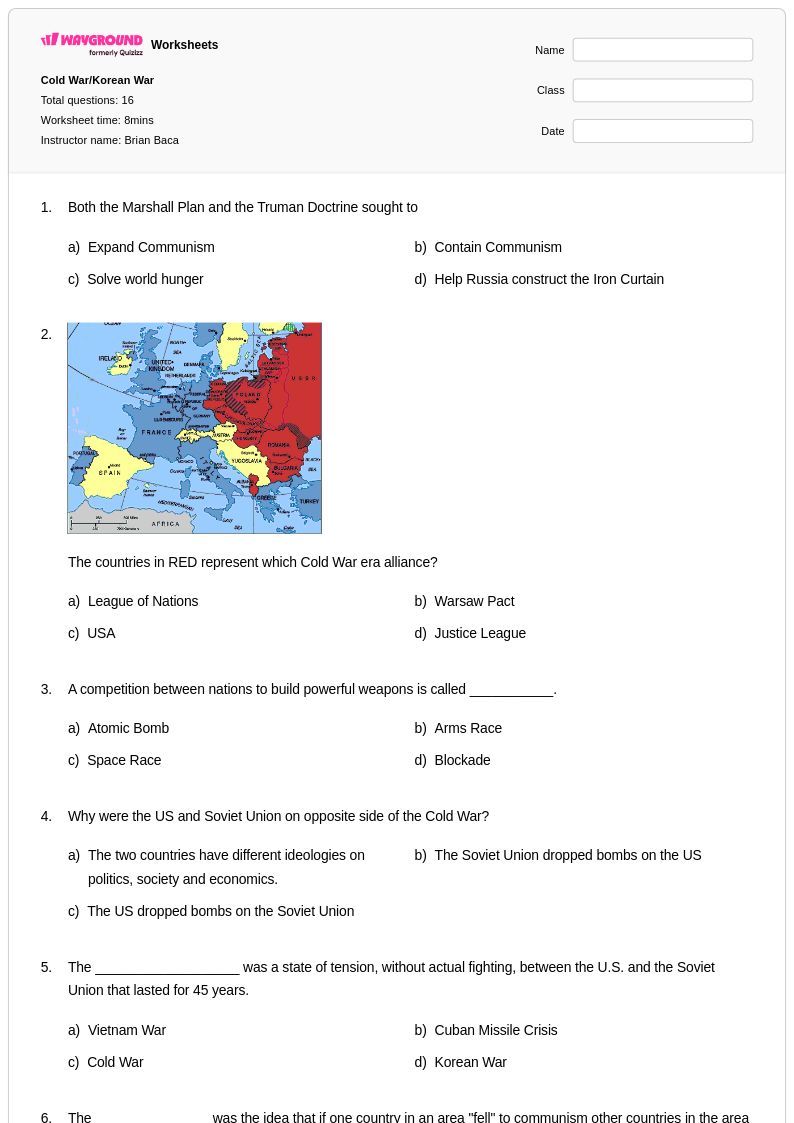
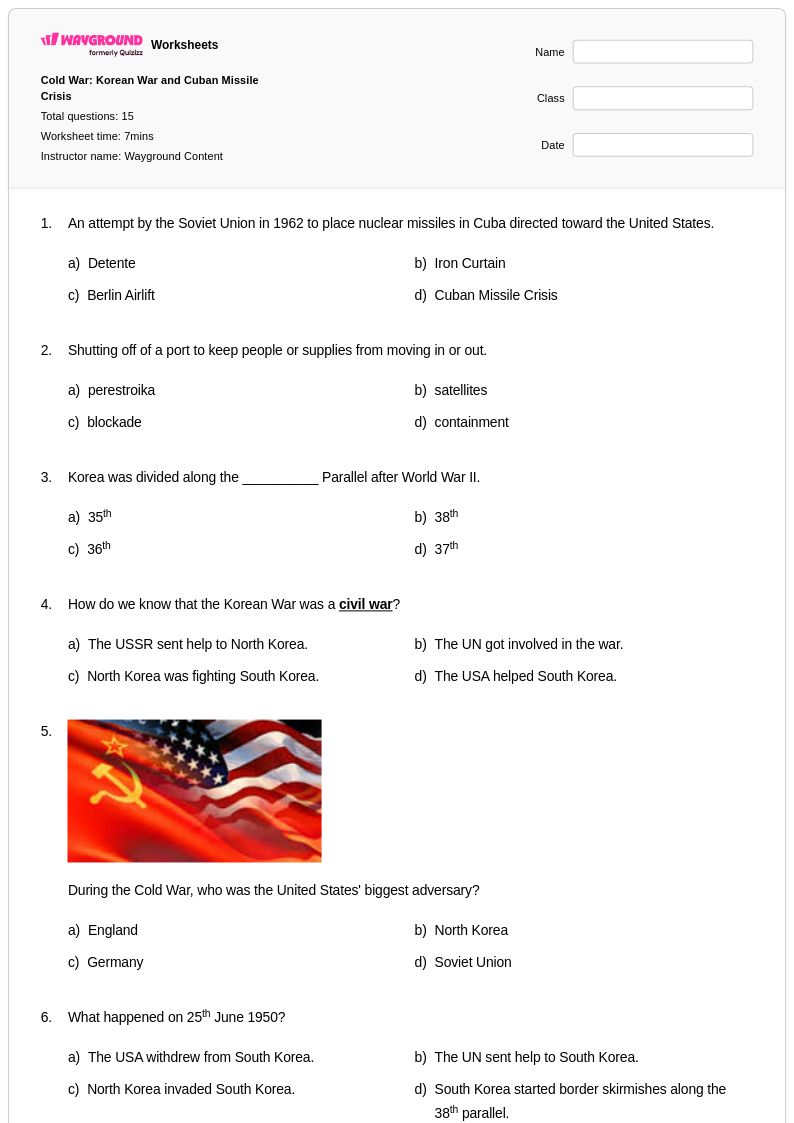
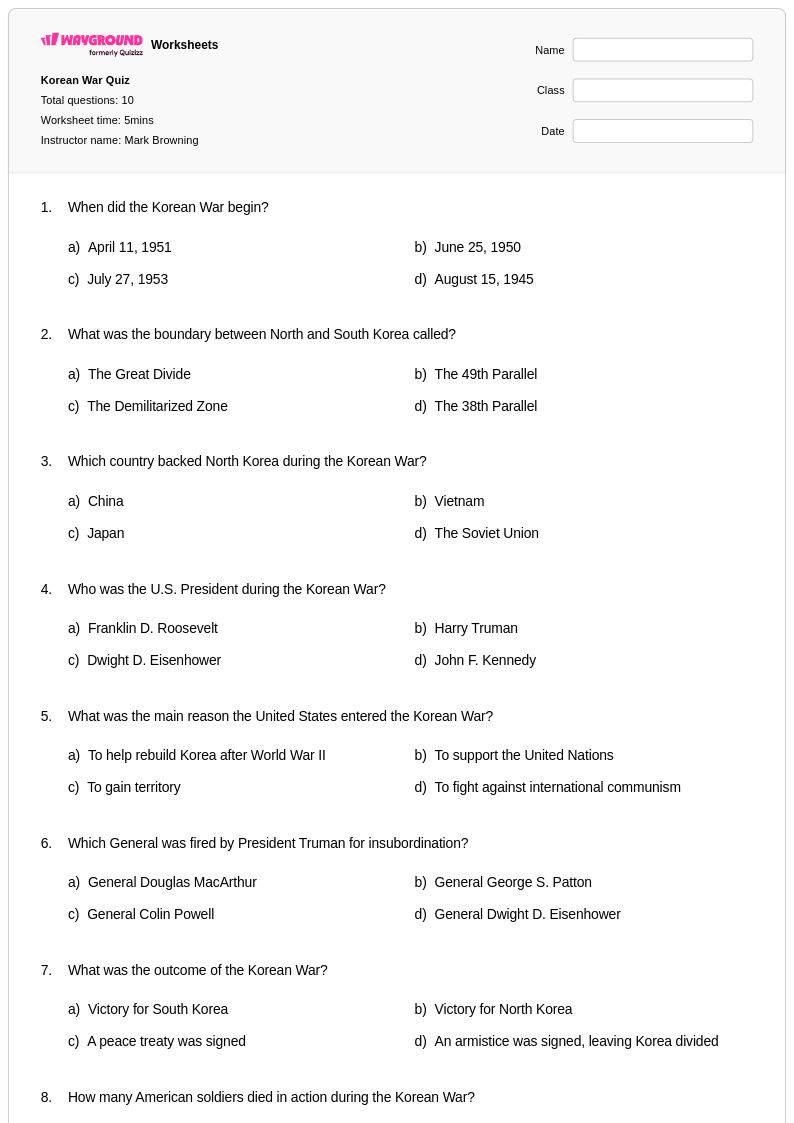
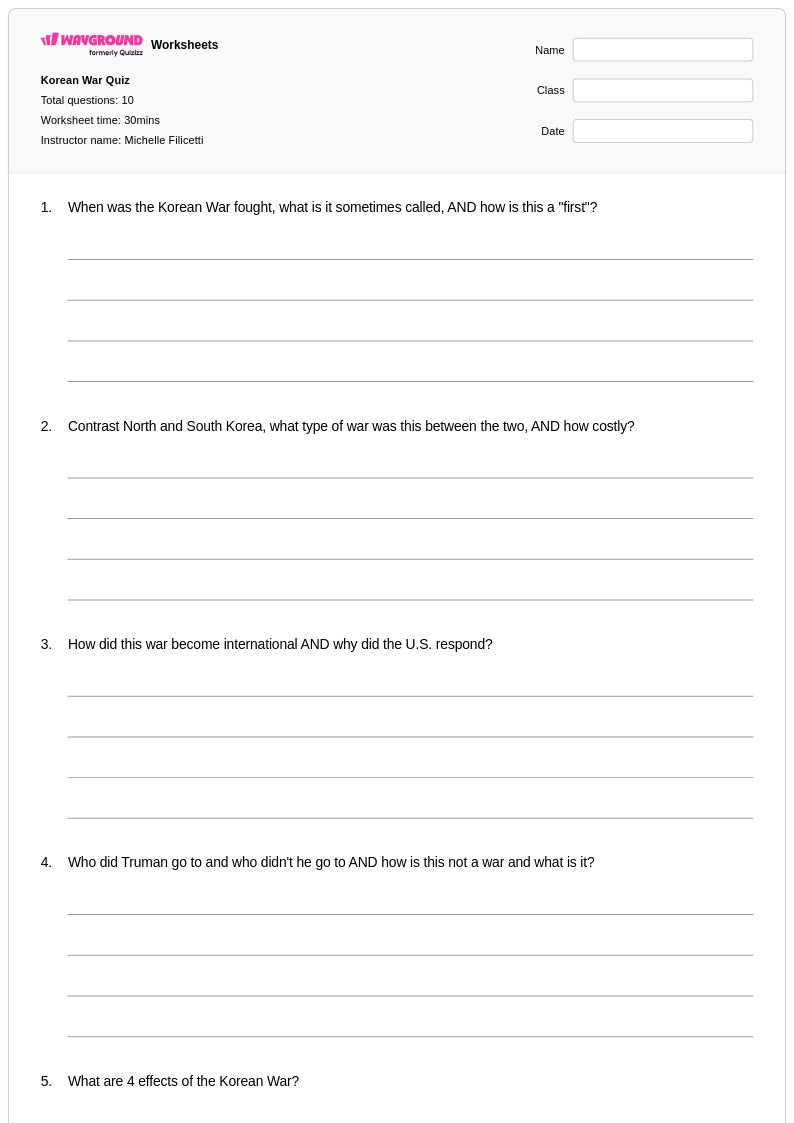
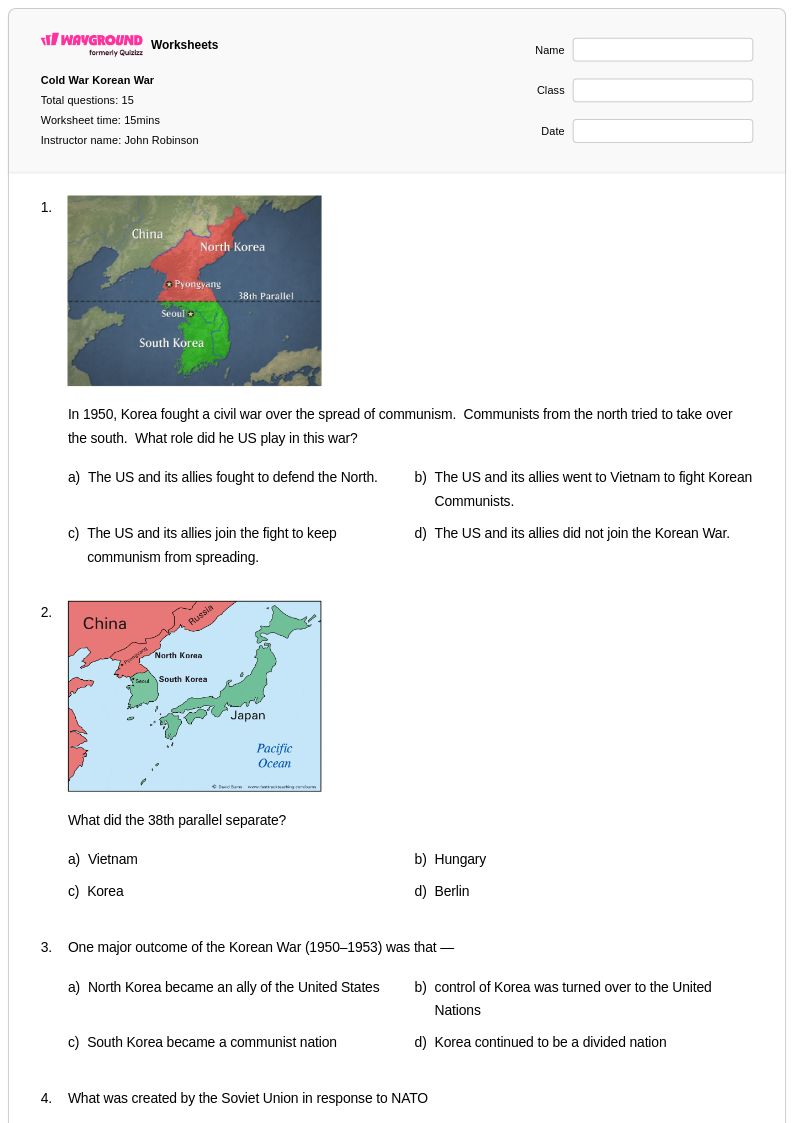
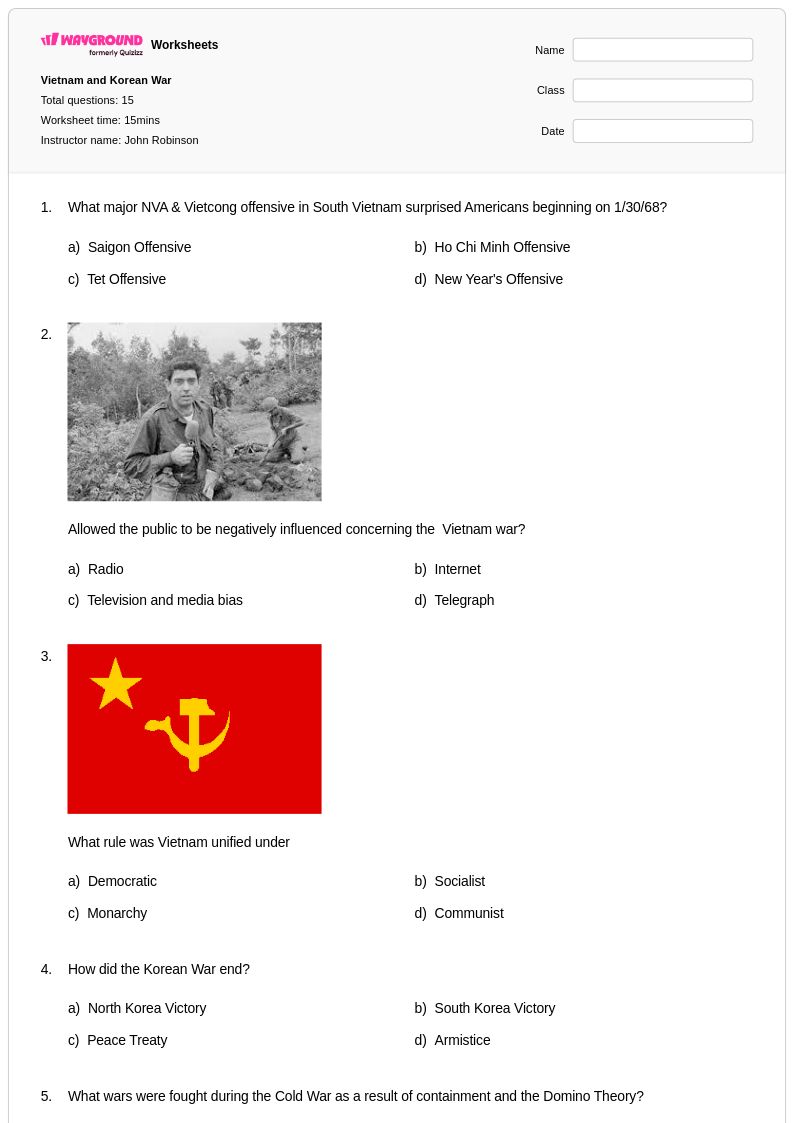
Grade 12 Korean War worksheets from Wayground help students analyze Cold War tensions, military strategies, and political consequences through engaging printables, practice problems, and comprehensive answer keys.
Explore printable Korean War worksheets for Grade 12
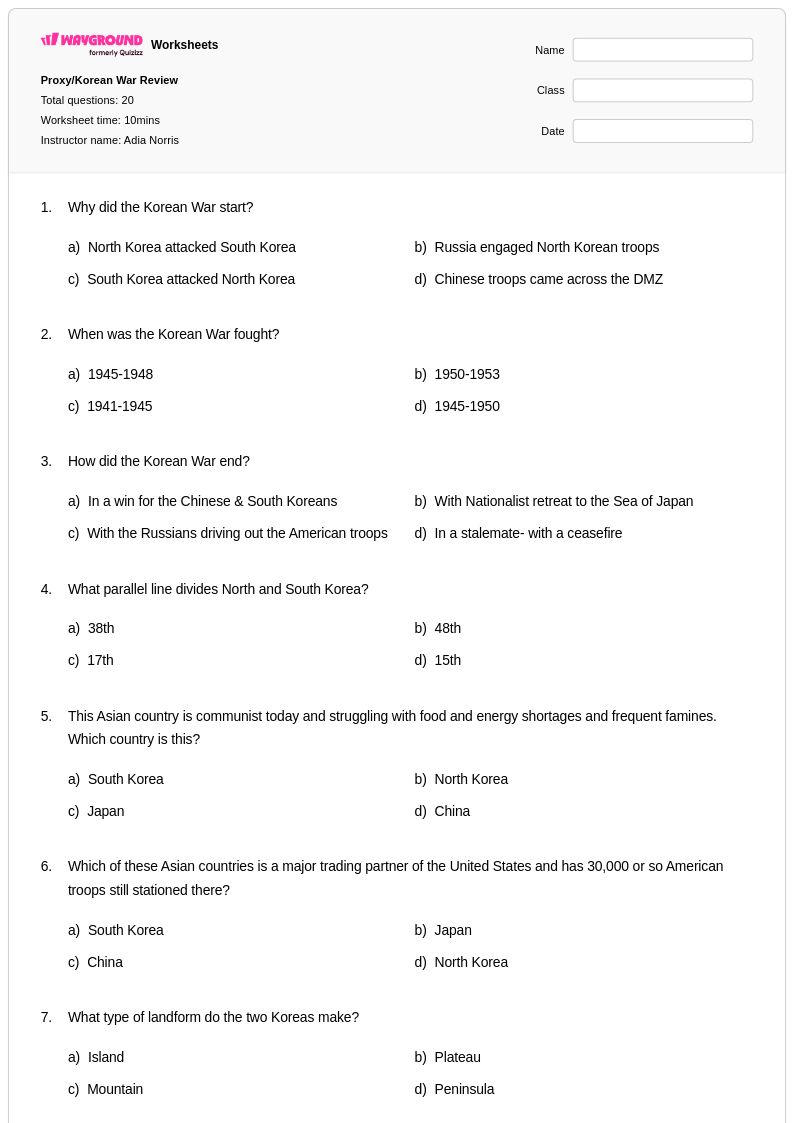
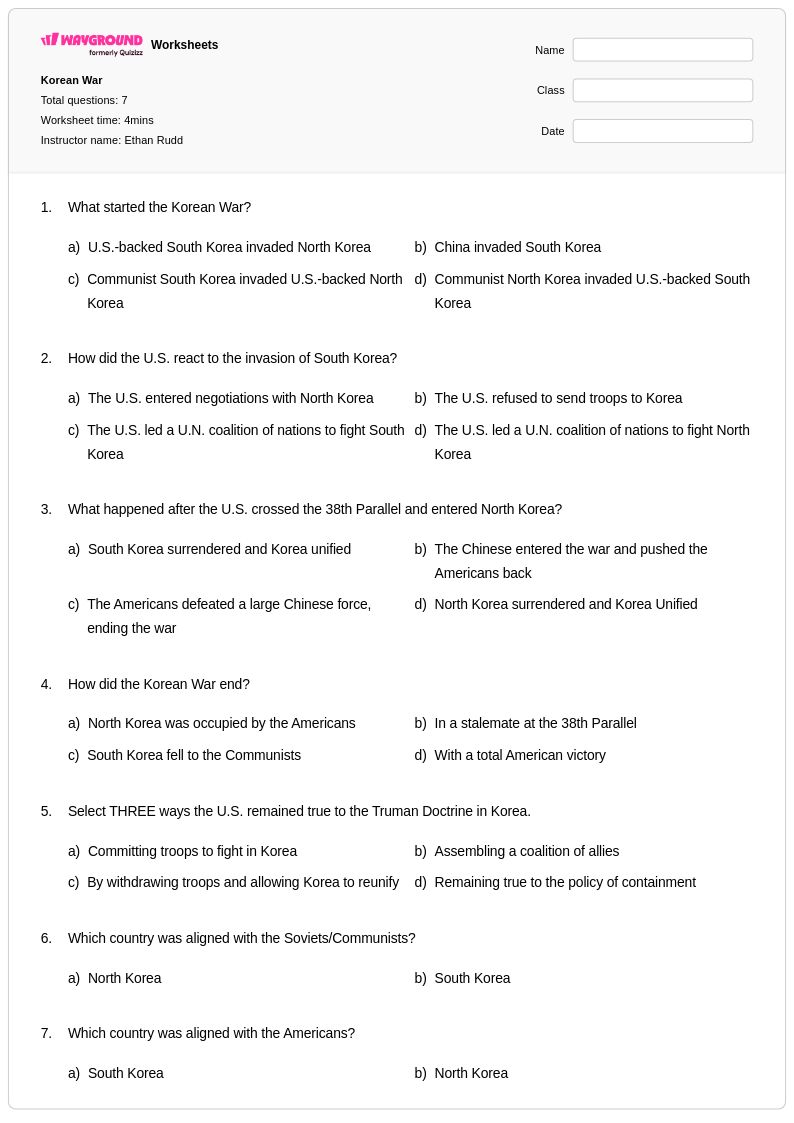
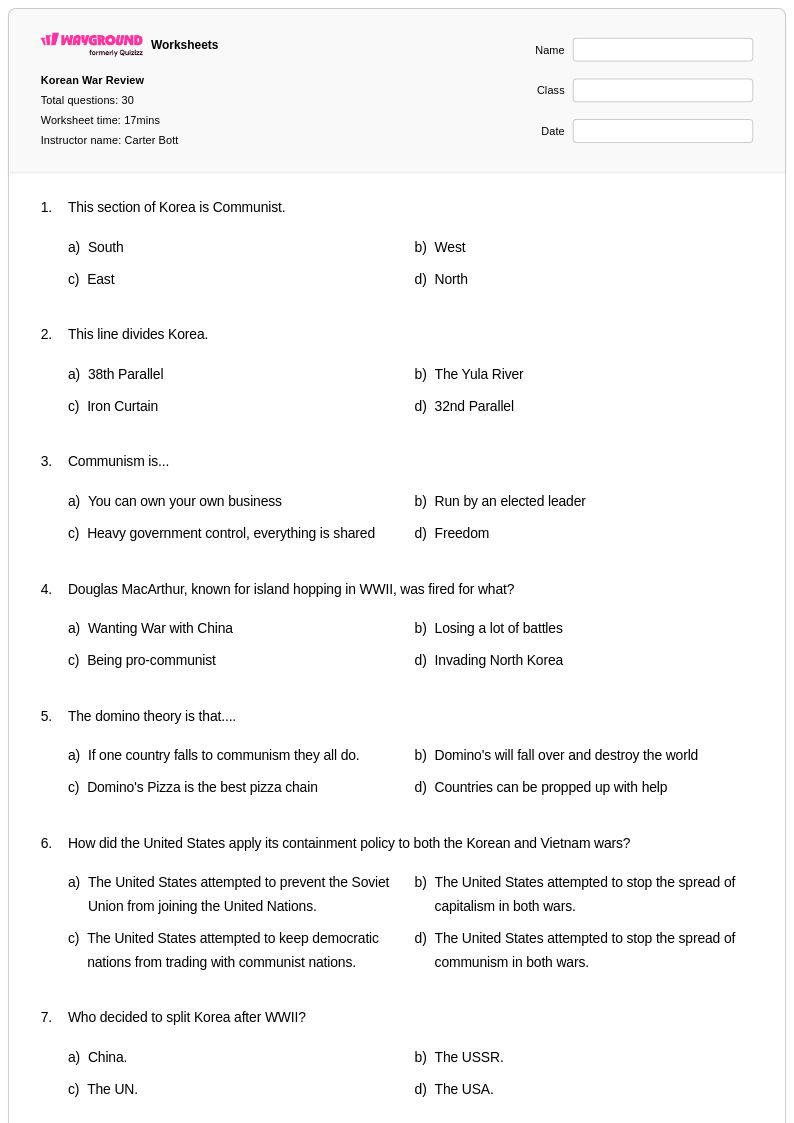
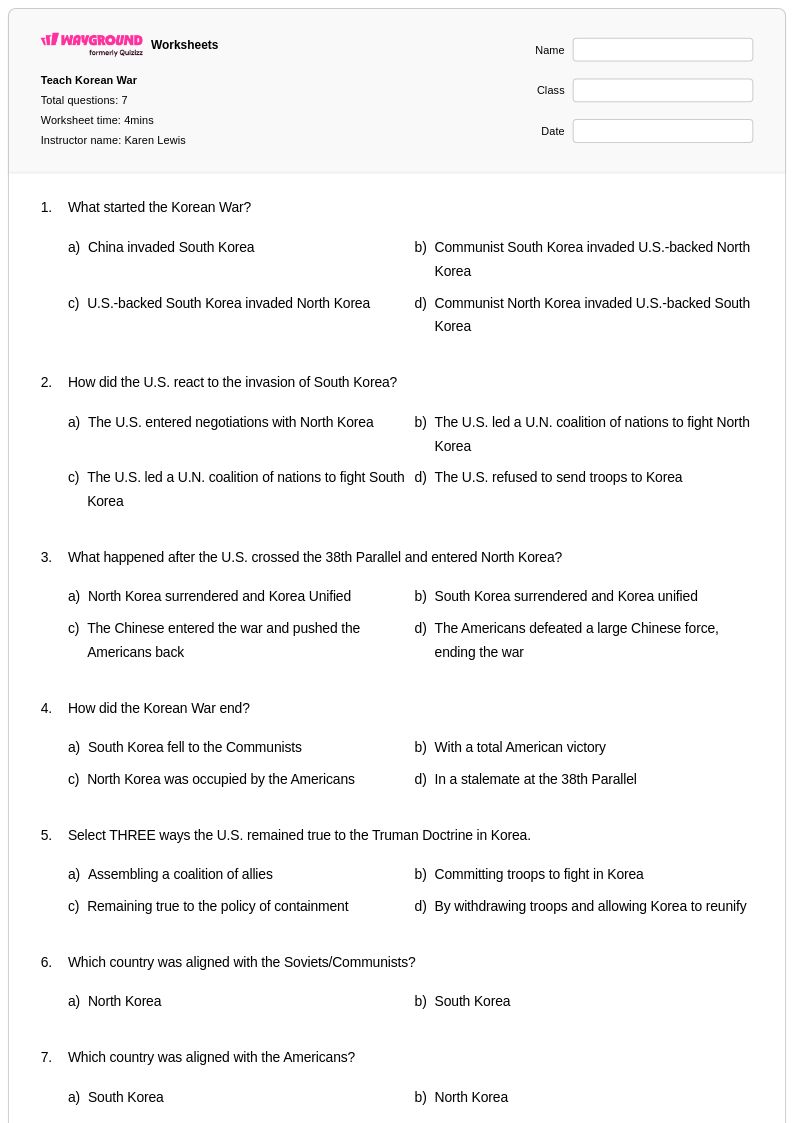
Korean War worksheets for Grade 12 students available through Wayground provide comprehensive coverage of this pivotal Cold War conflict that shaped modern geopolitics from 1950 to 1953. These expertly crafted resources strengthen critical thinking skills by examining the complex causes of the war, including the post-World War II division of Korea, the role of containment policy, and competing ideologies between communist and capitalist forces. Students engage with primary source documents, analyze military strategies and key battles such as Inchon and Chosin Reservoir, and evaluate the international dimensions involving United Nations forces, Chinese intervention, and Soviet support. The worksheets include detailed answer keys to support independent learning, comprehensive practice problems that reinforce understanding of concepts like the Truman Doctrine and MacArthur's dismissal, and are available as free printables in convenient pdf format for classroom use.
Wayground's extensive collection draws from millions of teacher-created resources specifically designed to support Grade 12 World History instruction on the Korean War. The platform's robust search and filtering capabilities enable educators to quickly locate materials aligned with state and national social studies standards, while differentiation tools allow teachers to customize worksheets for varying student ability levels and learning needs. These resources are seamlessly available in both printable and digital formats, including downloadable pdfs that facilitate flexible lesson planning and hybrid learning environments. Teachers utilize these comprehensive worksheet collections for targeted skill practice, remediation of challenging concepts like the armistice negotiations and DMZ establishment, and enrichment activities that connect Korean War themes to broader Cold War patterns, ensuring students develop deep historical understanding and analytical capabilities essential for advanced high school social studies success.
FAQs
How do I teach the Korean War to middle or high school students?
Teaching the Korean War effectively means grounding students in the Cold War context first — specifically the policy of containment and the post-WWII division of Korea at the 38th parallel. From there, build outward to the roles of the U.S., China, and Soviet Union, and use primary sources and key figures like General MacArthur and President Truman to make the conflict concrete. Framing the war as a 'forgotten war' and asking students why it has been historically overlooked can spark strong analytical discussion.
What exercises help students practice analyzing the causes of the Korean War?
Cause-and-effect mapping is one of the most effective exercises for this topic — students can chart how the division of Korea, the spread of communism, and U.S. containment policy each contributed to the outbreak of war. Primary source analysis, such as examining Truman's justification for intervention or UN Security Council resolutions, pushes students beyond memorization into historical reasoning. Worksheets that ask students to rank causes by significance and defend their reasoning build the kind of argumentation skills central to social studies standards.
What are common misconceptions students have about the Korean War?
One of the most common misconceptions is that the Korean War ended with a clear victory — students often conflate an armistice with a peace treaty, not realizing the conflict technically never officially ended. Many students also underestimate China's role, focusing almost entirely on the U.S. and North Korea. Another frequent error is confusion about geography: students sometimes misplace the 38th parallel or misunderstand why it became the defining boundary of the conflict.
How does studying the Korean War help students understand the Cold War more broadly?
The Korean War is one of the clearest examples of Cold War proxy conflict in action — it shows how the ideological struggle between the U.S. and Soviet Union played out through military intervention in a third country. Studying it helps students understand containment policy as a practical strategy, not just a theoretical doctrine, and illustrates how the United Nations functioned as a tool of collective security during this period. The war also foreshadowed the dynamics that would define later Cold War conflicts, including Vietnam.
How can I use Korean War worksheets in my classroom?
Korean War worksheets on Wayground are available as printable PDFs for traditional classroom use and in digital formats for technology-integrated or hybrid learning environments, including the option to host them as a quiz on Wayground. Printable versions work well for close reading and annotation activities, while digital formats allow for self-paced or remote assignment. For students who need accommodations, Wayground supports features like read aloud, extended time, and reduced answer choices, which can be assigned individually without disrupting the rest of the class.
How do I assess whether students understand the Korean War's lasting consequences?
Strong assessment tasks for this topic ask students to connect wartime decisions to long-term outcomes — for example, explaining how the armistice line became a permanent border or analyzing how the war influenced U.S. military policy during the Cold War. Look for whether students can distinguish between short-term consequences (casualties, displacement, destruction) and long-term geopolitical impacts (the continued division of North and South Korea, shifts in U.S.-China relations). Common gaps include students treating the war as a closed historical event rather than understanding its ongoing relevance to modern Korean society and international relations.