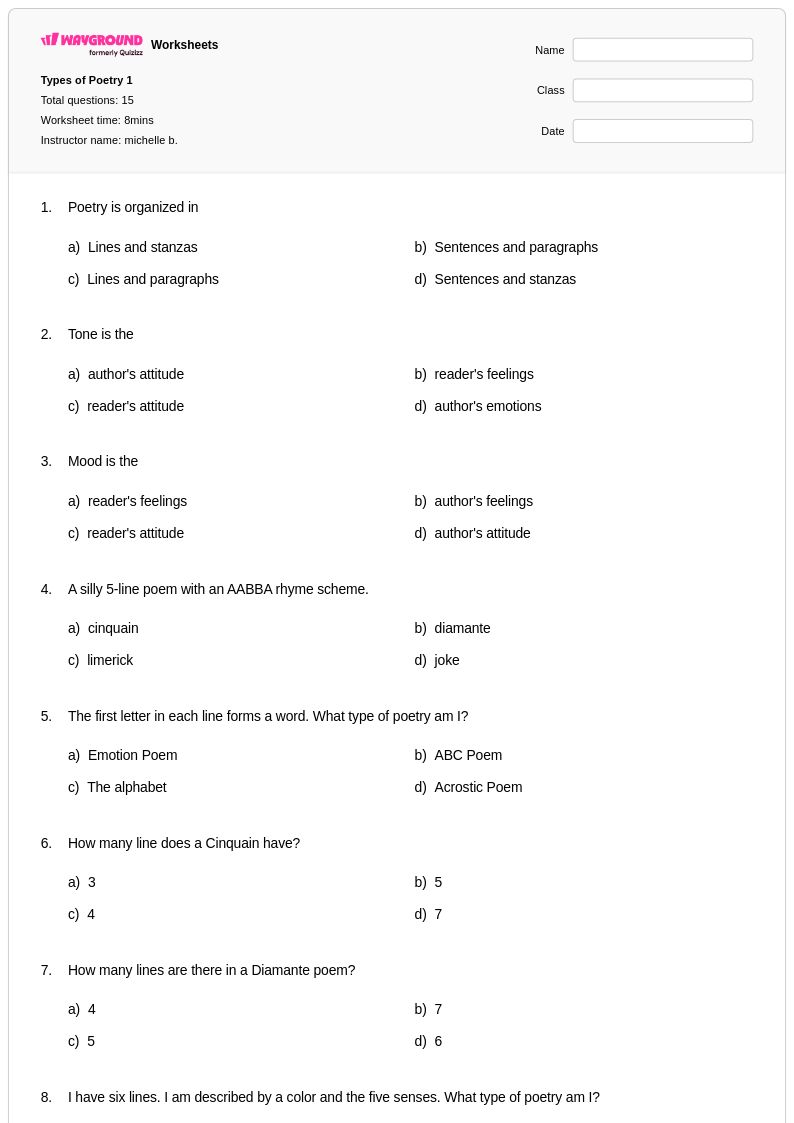
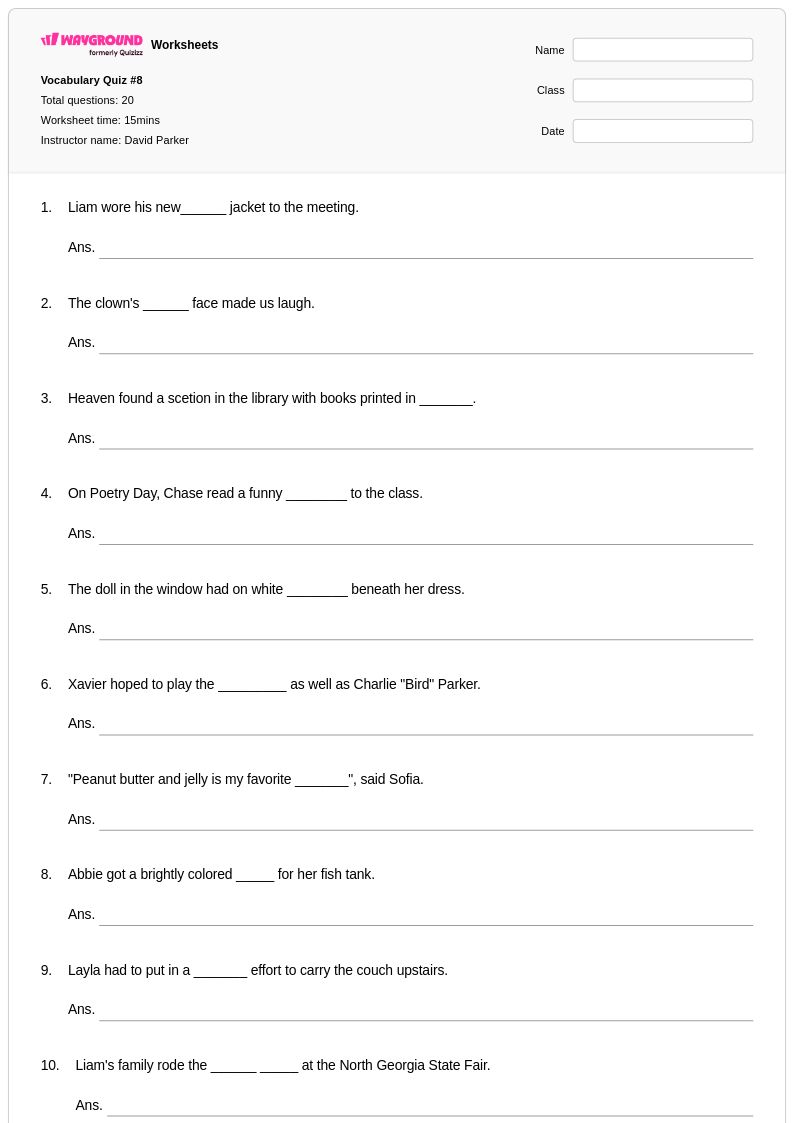
Discover free Grade 4 limerick worksheets and printables from Wayground that help students master this playful poetry form through engaging practice problems, creative writing exercises, and comprehensive answer keys.
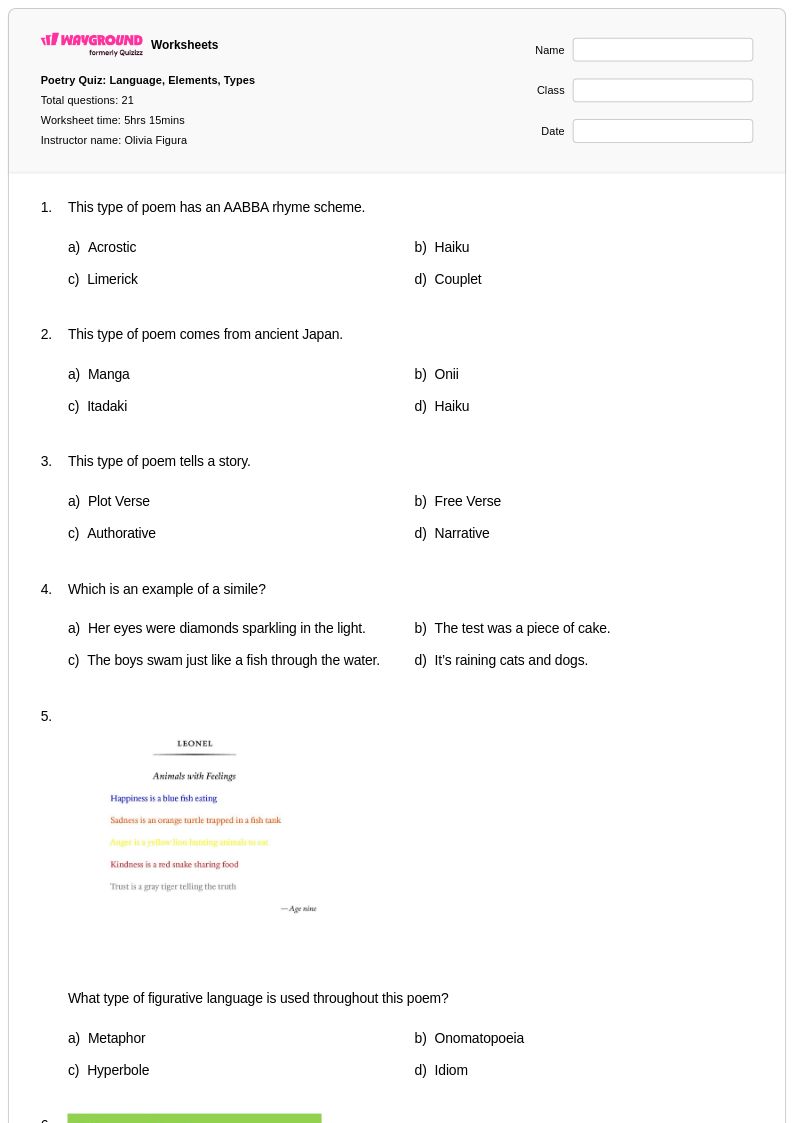
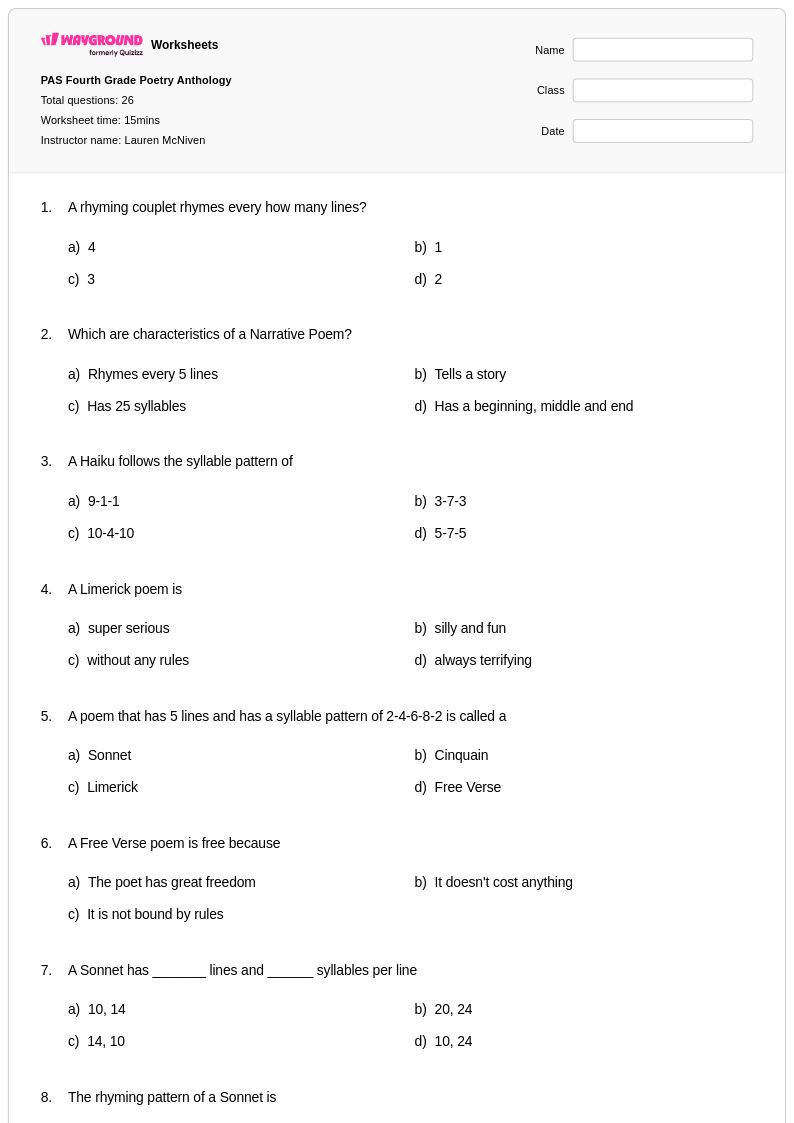
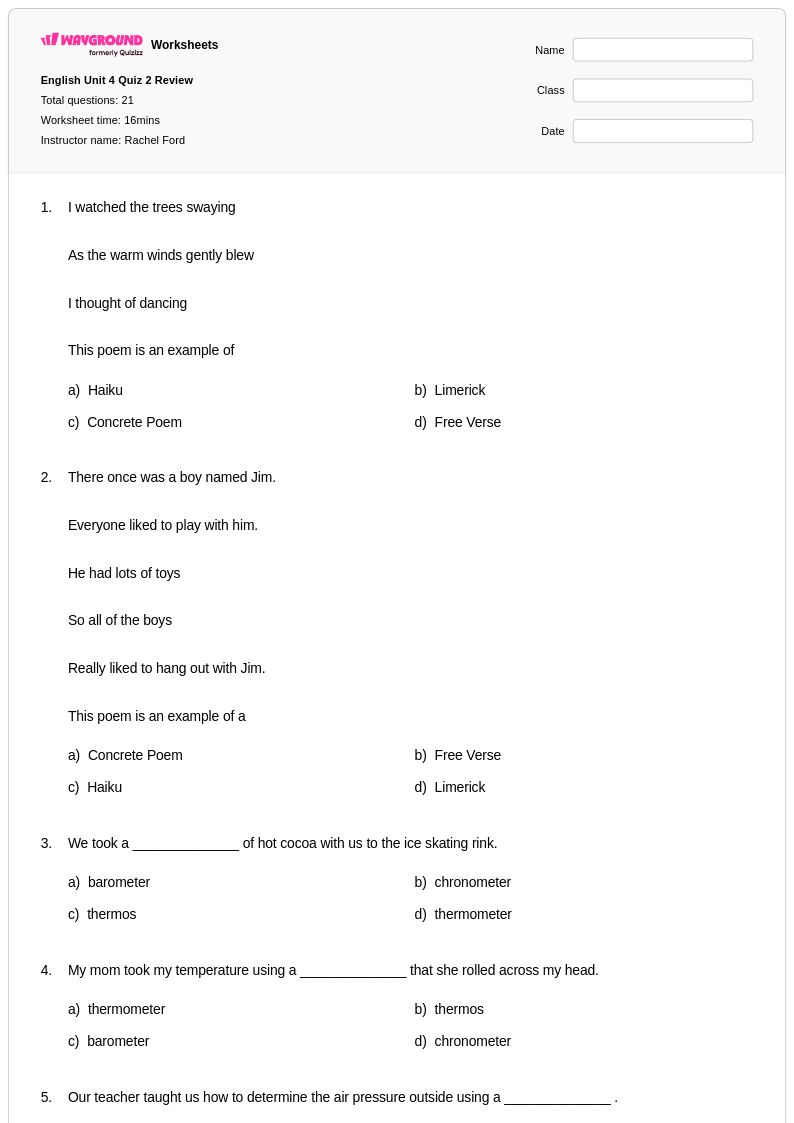
Limerick worksheets for Grade 4 students available through Wayground (formerly Quizizz) provide comprehensive practice in understanding and creating this distinctive form of poetry. These educational resources strengthen essential literary skills including rhythm recognition, rhyme scheme identification, and creative writing techniques specific to the AABBA pattern that defines limericks. Students engage with practice problems that guide them through analyzing famous limericks, identifying their characteristic meter and humorous elements, and composing original five-line poems that follow traditional limerick structure. The collection includes printable materials with complete answer keys, offering teachers flexibility to distribute free pdf worksheets for independent study, homework assignments, or collaborative classroom activities that make poetry both accessible and enjoyable for fourth-grade learners.
Wayground (formerly Quizizz) supports educators with an extensive collection of teacher-created limerick resources designed specifically for Grade 4 instruction, drawing from millions of professionally developed materials that undergo rigorous quality standards. The platform's advanced search and filtering capabilities allow teachers to locate worksheets aligned with specific learning objectives and literacy standards, while built-in differentiation tools enable customization for diverse learning needs within the classroom. These limerick worksheets are available in both printable pdf formats and interactive digital versions, facilitating seamless integration into lesson planning whether teachers need materials for remediation support, enrichment activities, or regular skill practice sessions. The comprehensive nature of these resources empowers educators to provide targeted instruction in poetry analysis and creative writing while maintaining student engagement through the naturally playful and rhythmic qualities inherent in limerick composition.
FAQs
How do I teach limericks to my students?
Start by reading several well-known limericks aloud so students can hear the rhythm and rhyme before analyzing structure. Introduce the AABBA rhyme scheme explicitly, then break down the meter by clapping or tapping syllables in lines 1, 2, and 5 (longer) versus lines 3 and 4 (shorter). Guided completion activities, where students fill in missing lines, are an effective bridge between analysis and original composition.
What exercises help students practice writing limericks?
Effective practice moves from structured to open-ended: begin with completing partial limericks, then provide a first line and have students write the rest, and finally assign fully original limerick composition. Syllable counting exercises help students internalize the anapestic meter, while rhyme-scheme labeling reinforces the AABBA pattern before students attempt to replicate it independently.
What mistakes do students commonly make when writing limericks?
The most frequent errors are forcing rhymes at the expense of natural language, miscounting syllables in lines 3 and 4, and failing to maintain consistent meter across all five lines. Students often treat limericks as simply rhyming without attending to the rhythmic bounce of the anapestic foot, resulting in lines that look correct on paper but sound off when read aloud. Reading drafts aloud is the single most effective self-correction strategy.
How do I explain the AABBA rhyme scheme to students?
Label each end word with a letter as you read the poem together: lines 1, 2, and 5 share the same rhyme (A), while lines 3 and 4 share a different rhyme (B). Use a color-coding system on the board to make the pattern visually distinct before asking students to apply the labels independently to new limericks. Connecting this to other familiar rhyme schemes, such as ABAB in ballads, helps students see it as one option within a broader poetic system.
How can I use limerick worksheets in my classroom?
Limerick worksheets on Wayground are available as printable PDFs for traditional classroom use and in digital formats for technology-integrated or remote learning environments, and can also be hosted as a live quiz on Wayground. Use rhythm recognition and rhyme scheme labeling exercises as warm-ups or independent practice, and assign original composition tasks as formative assessments or creative homework. For students who need additional support, Wayground's Read Aloud feature can audio-read questions, and reduced answer choices can lower cognitive load during identification tasks.
How do limericks connect to broader poetry and literary history?
Limericks belong to the tradition of nonsense verse, a form popularized in the nineteenth century by Edward Lear in his Book of Nonsense. Teaching limericks gives students an accessible entry point into poetic devices including meter, rhyme scheme, and syllabic structure, while the humor and wordplay inherent in the form sustain engagement across grade levels. This makes limericks a practical bridge to more complex poetry study.