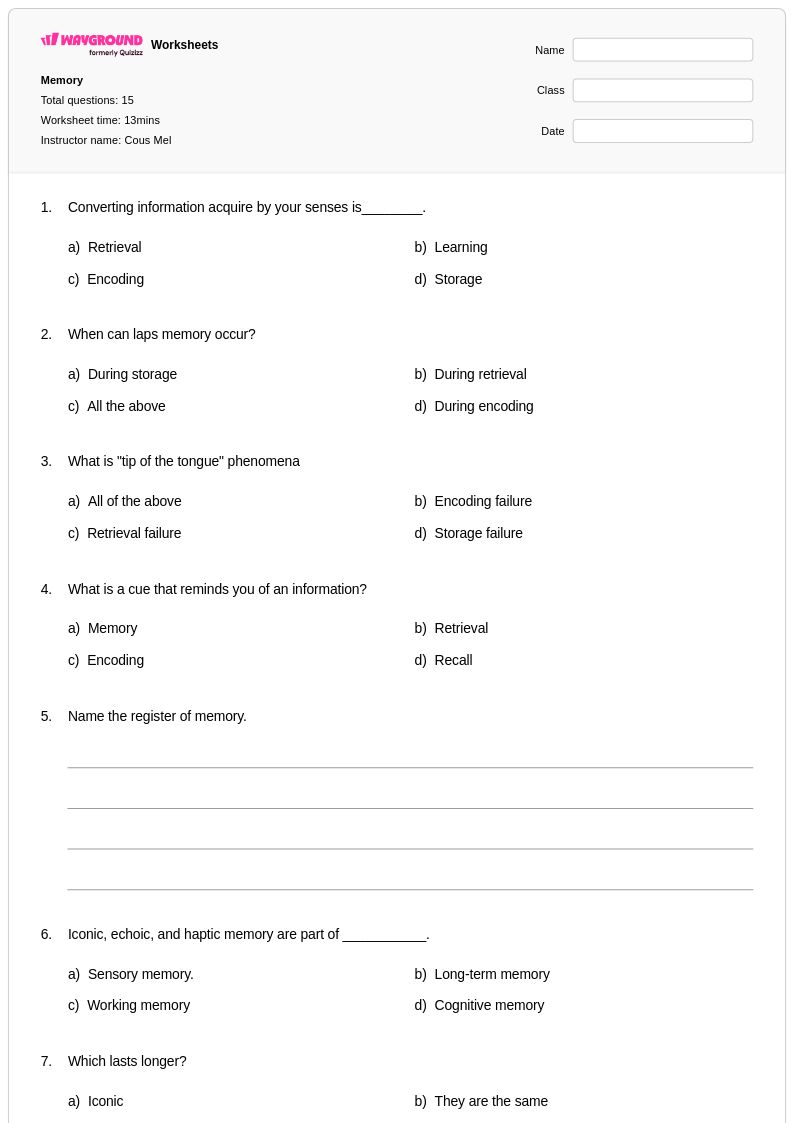
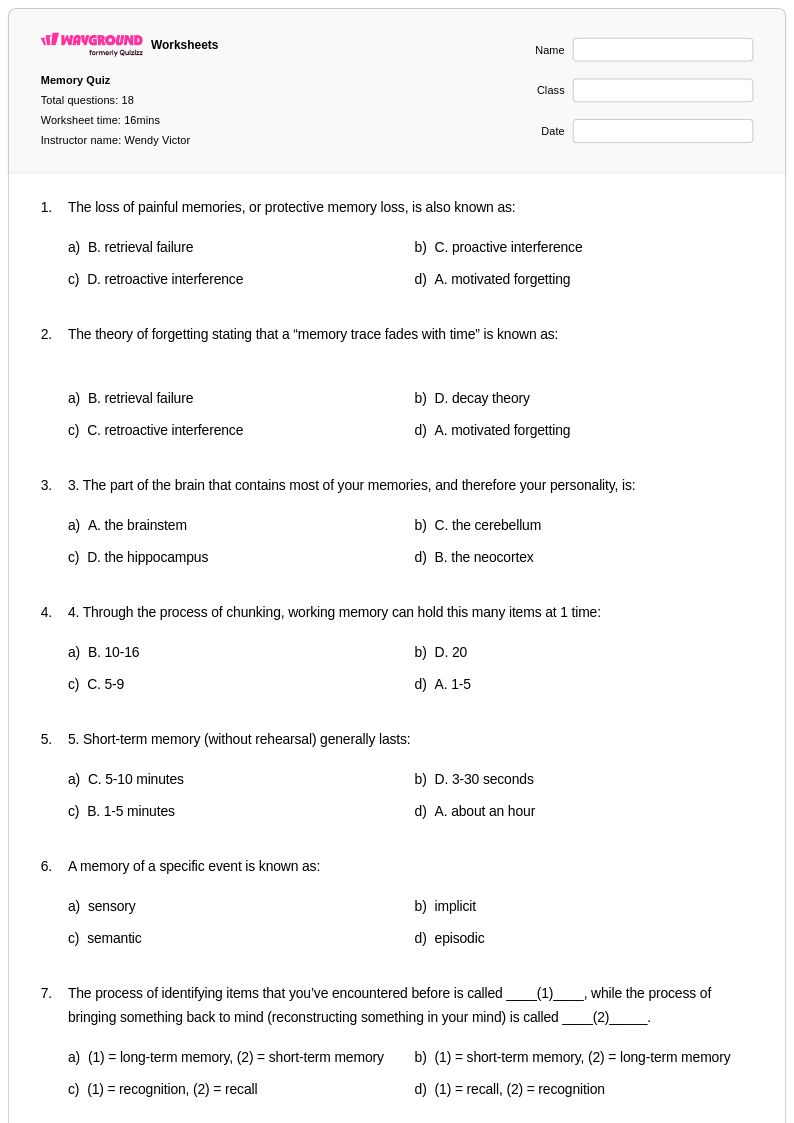
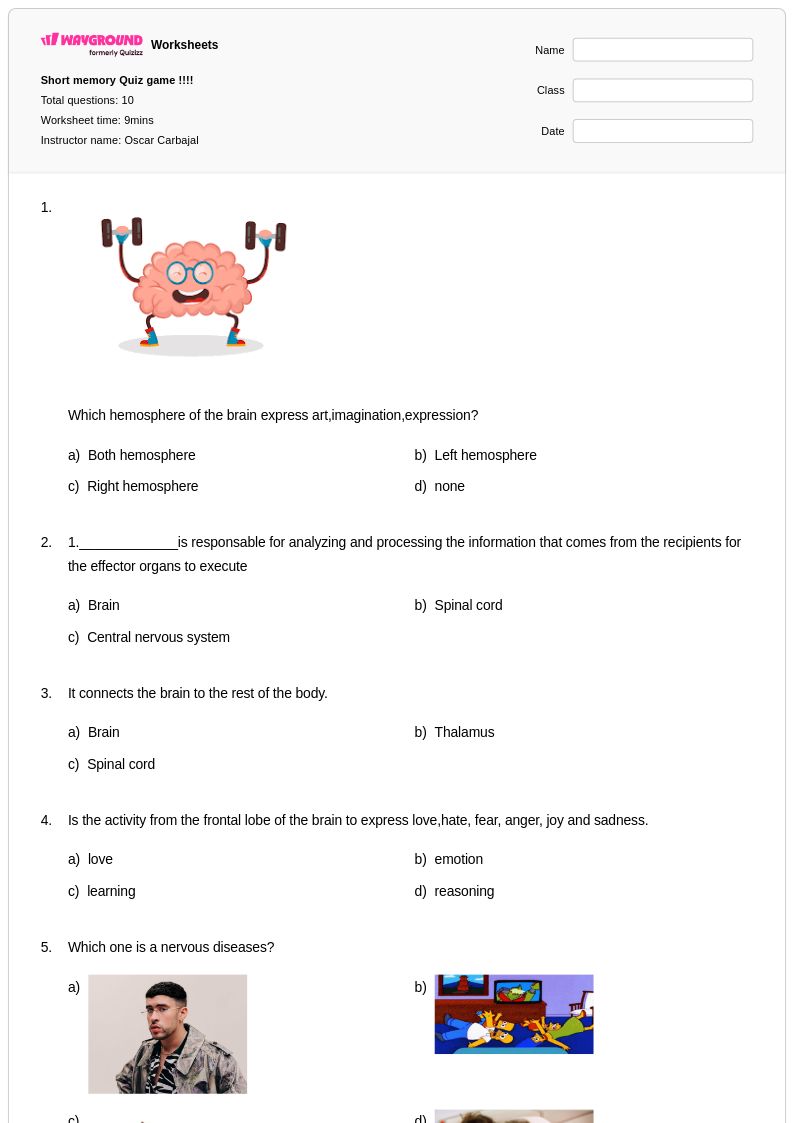
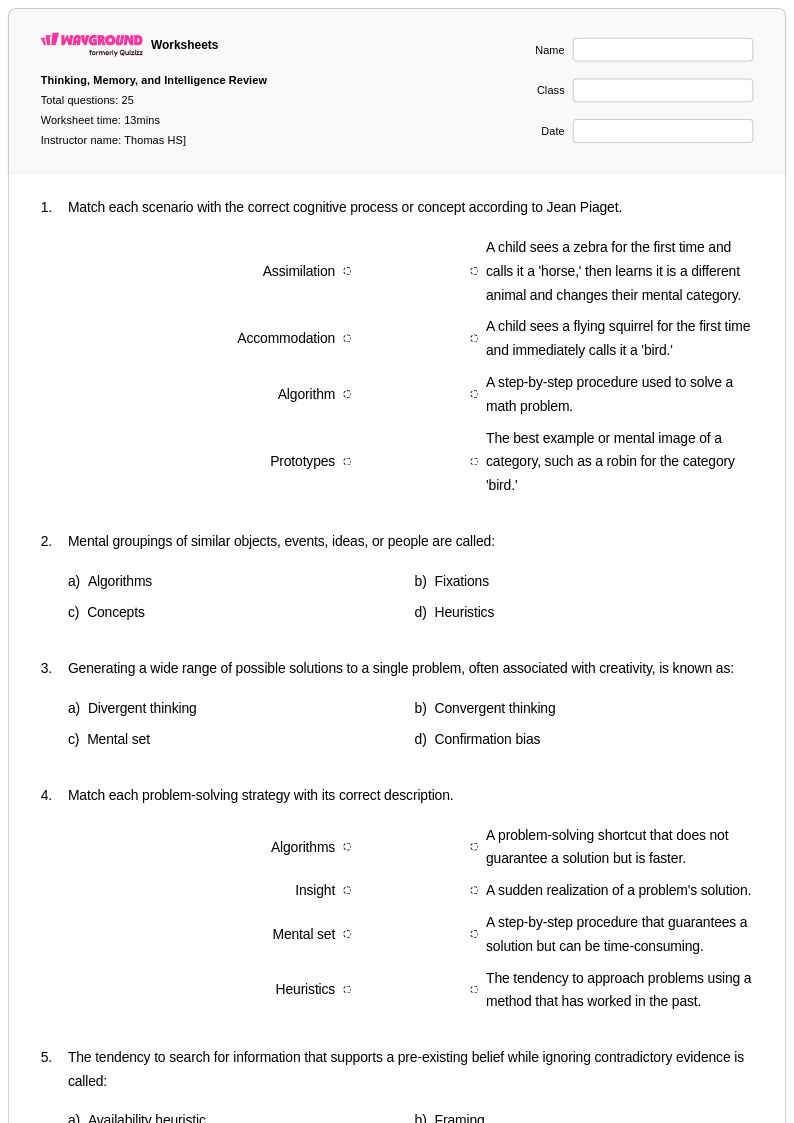
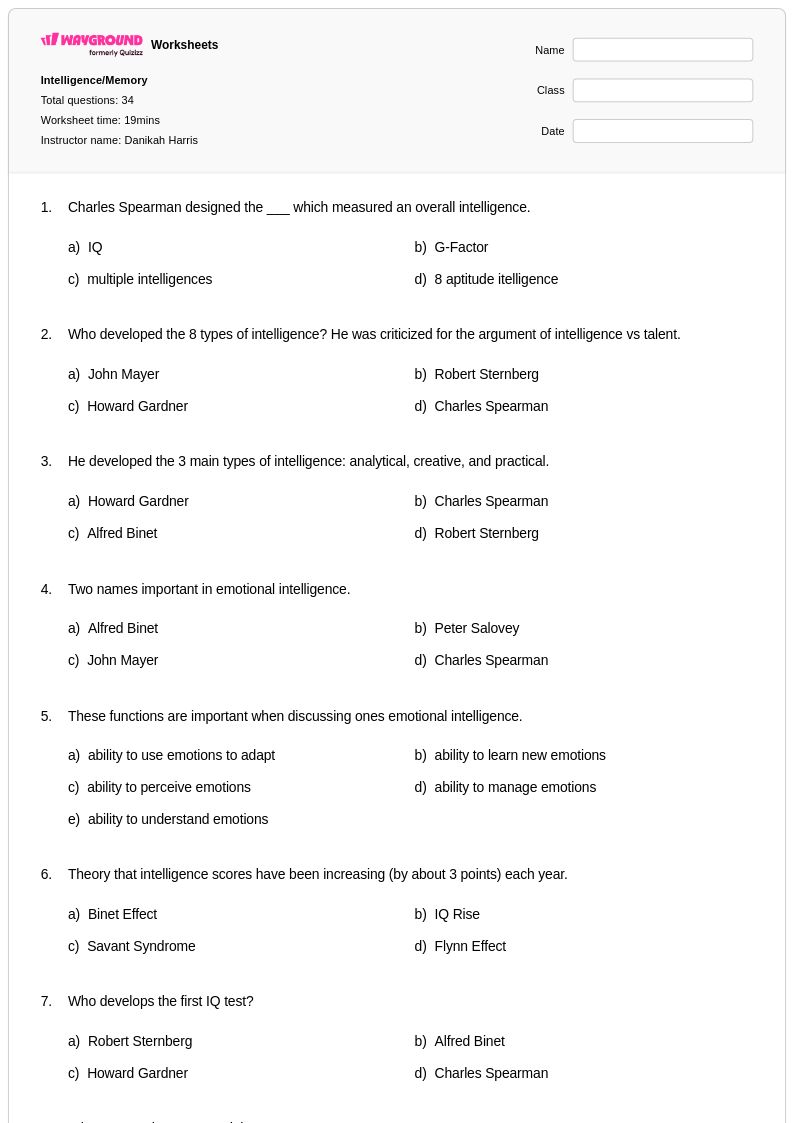
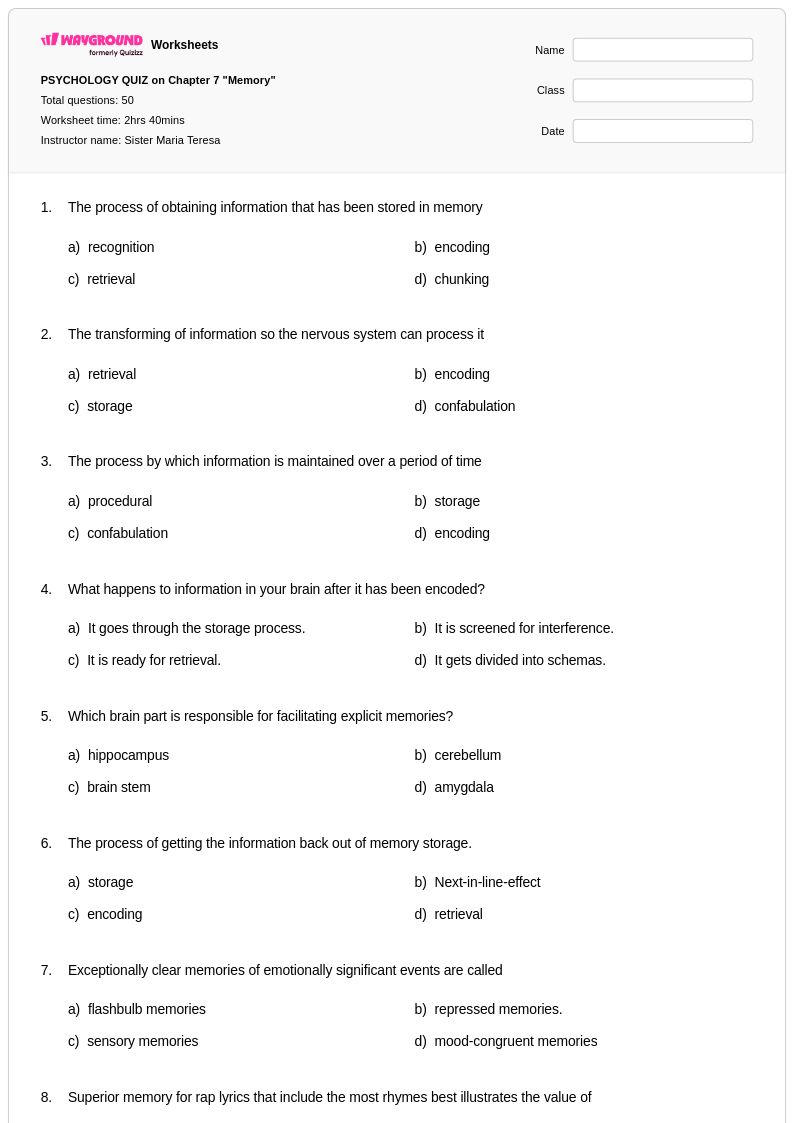
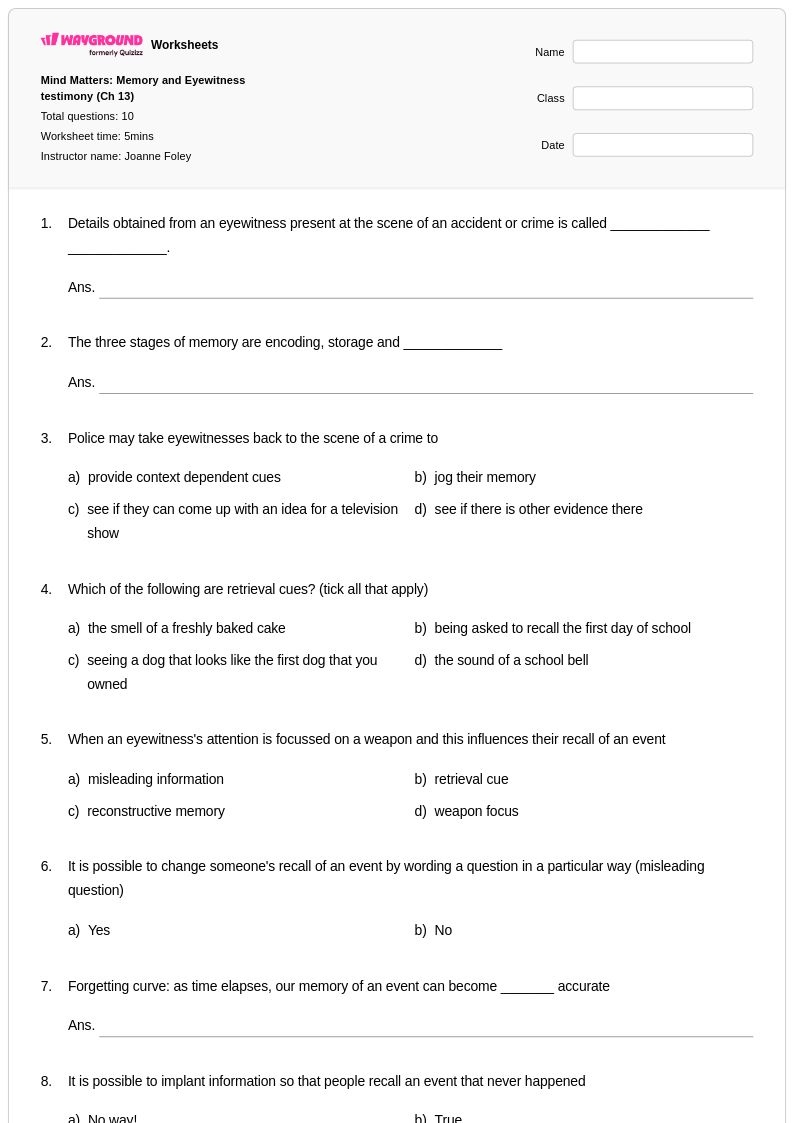
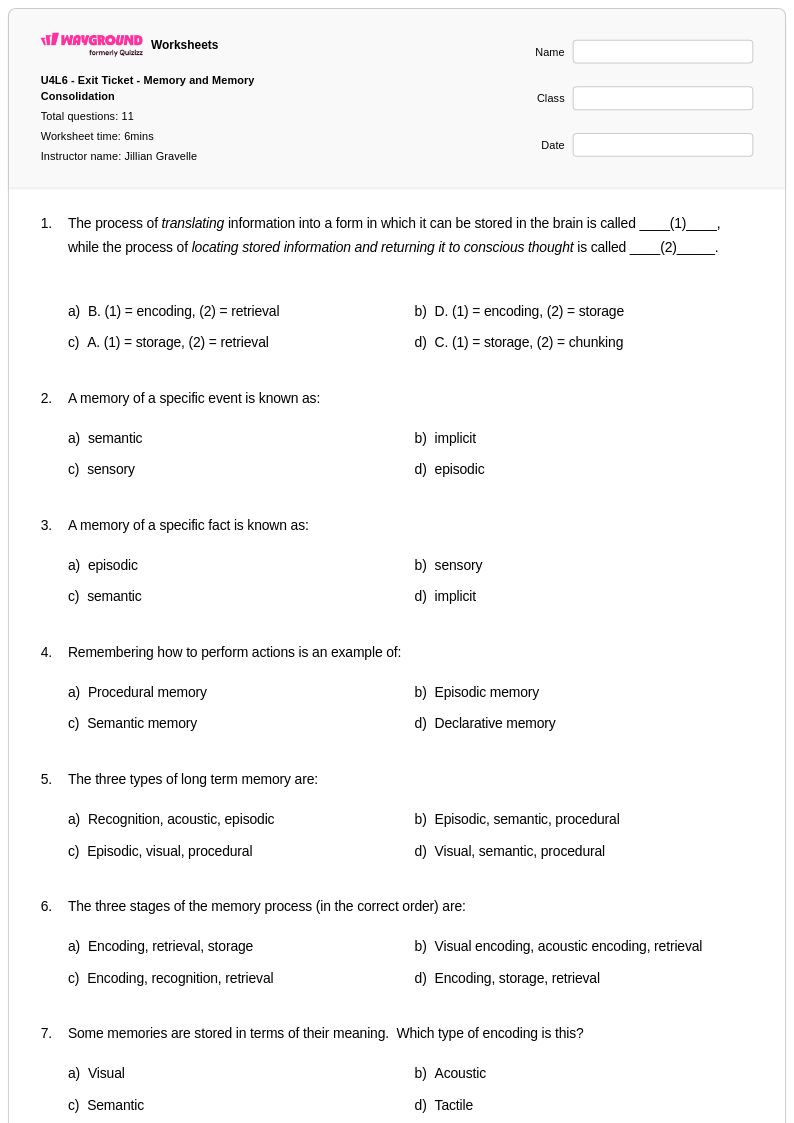
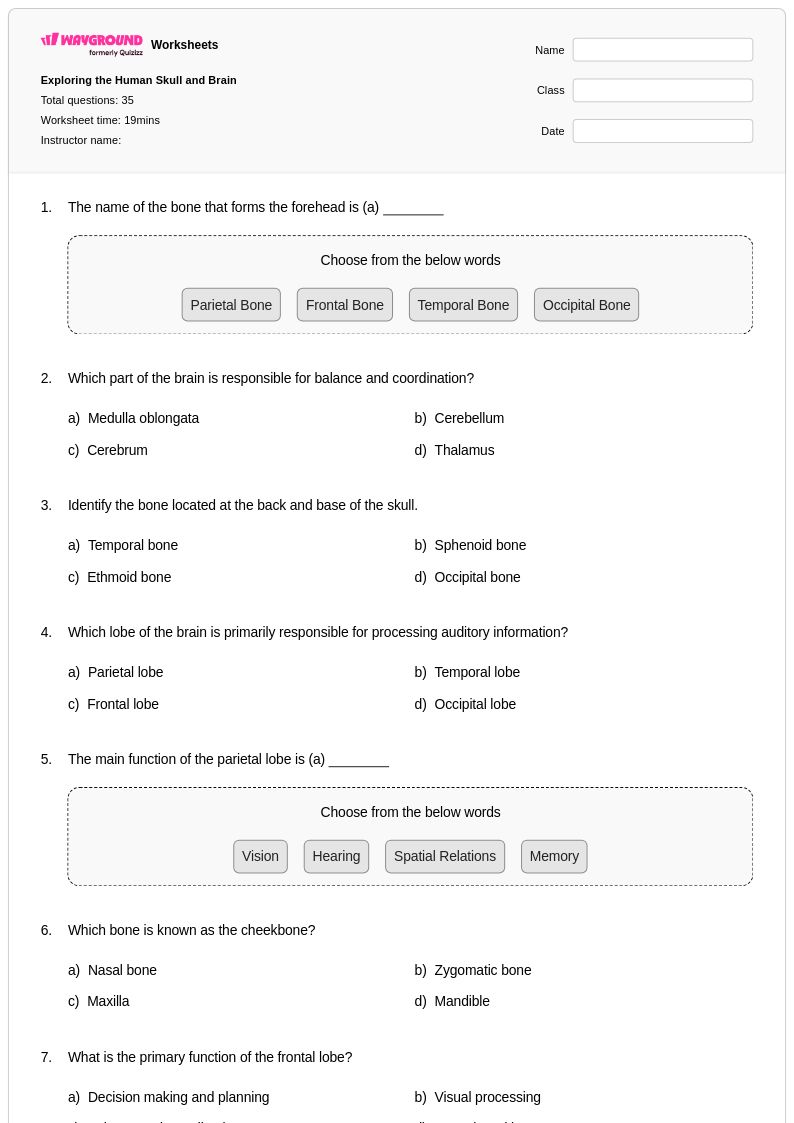
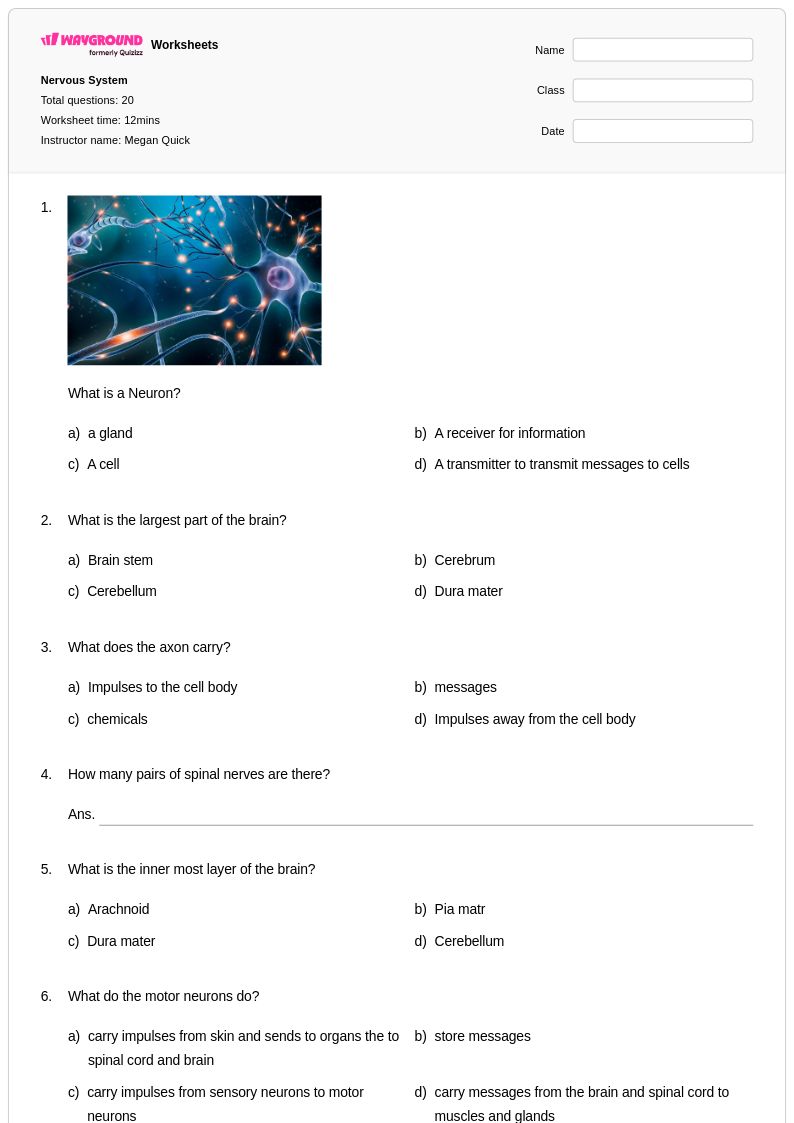
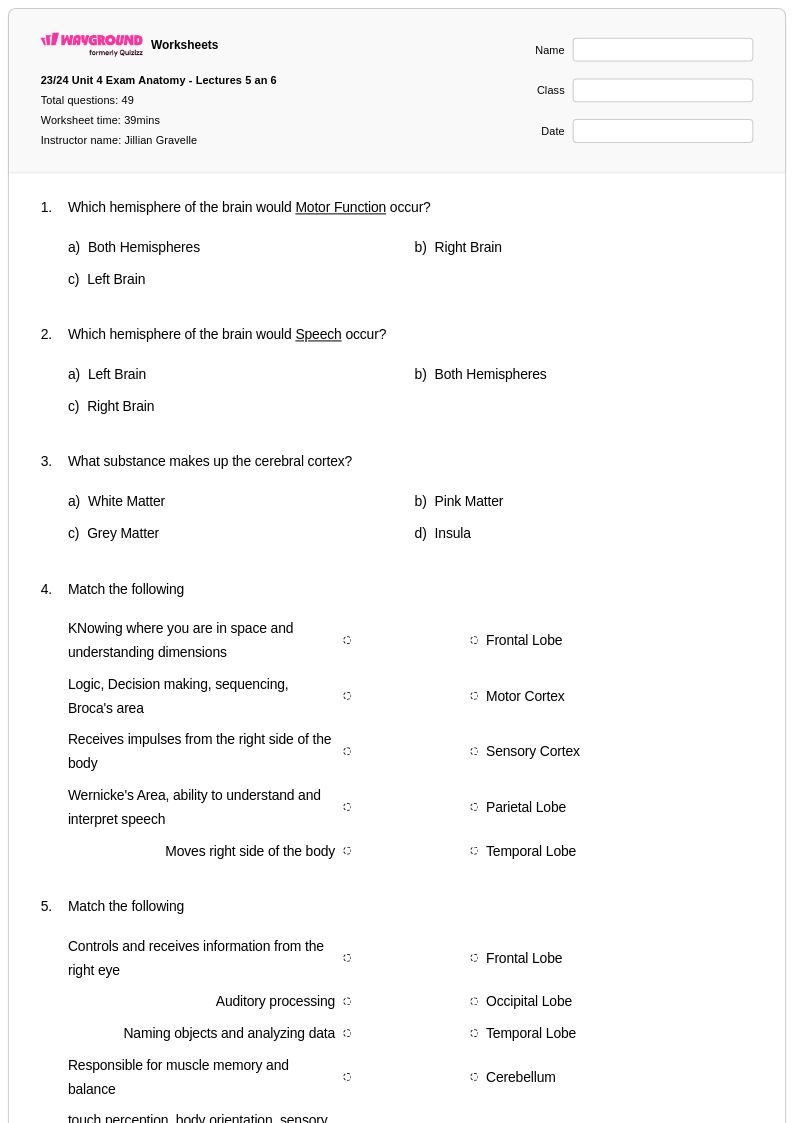
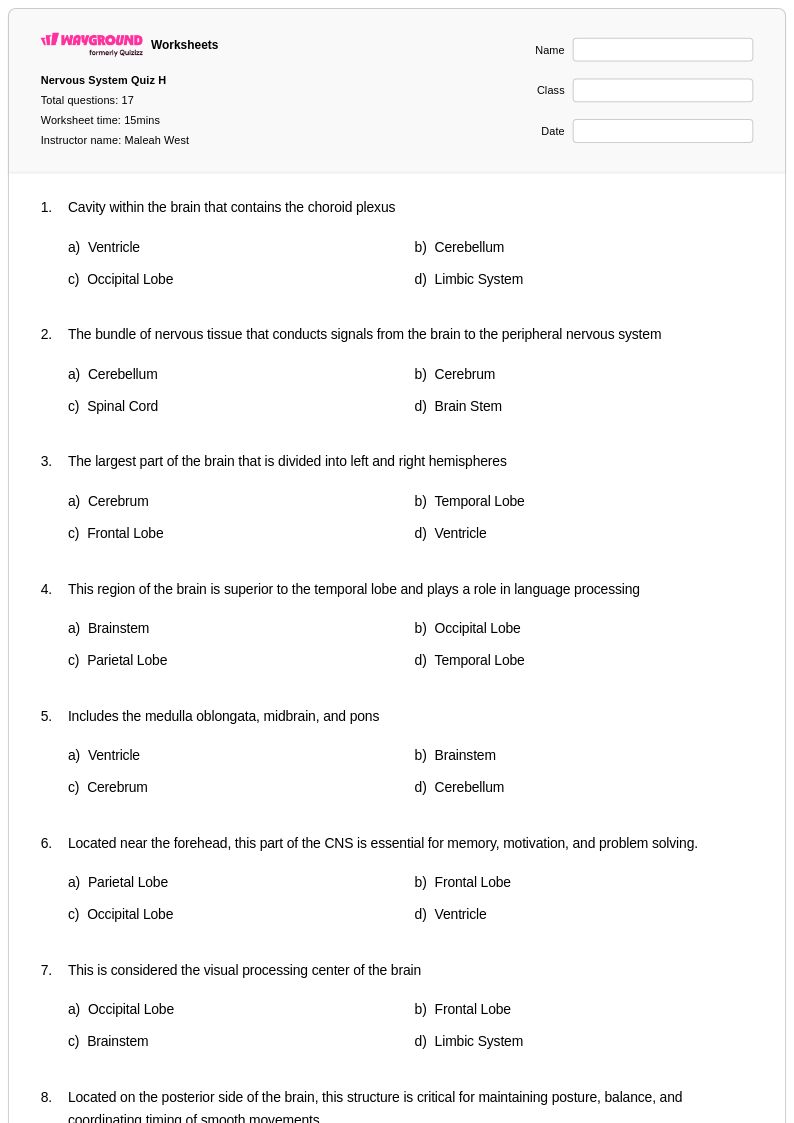
Explore Grade 9 memory worksheets and printables that help students understand how the brain stores, processes, and retrieves information through engaging practice problems with comprehensive answer keys.
Memory worksheets for Grade 9 psychology students available through Wayground (formerly Quizizz) provide comprehensive exploration of how the human brain encodes, stores, and retrieves information. These expertly designed resources strengthen students' understanding of memory processes including sensory memory, short-term memory, and long-term memory systems, while examining factors that influence memory formation such as attention, rehearsal, and interference. The collection features practice problems that challenge students to analyze memory experiments, identify different types of memory disorders, and apply memory improvement strategies to real-world scenarios. Each worksheet includes detailed answer keys that support independent learning, and the materials are available as free printables in convenient PDF format, making them accessible for both classroom instruction and home study.
Wayground's extensive library of teacher-created memory psychology worksheets draws from millions of educational resources, offering Grade 9 instructors powerful search and filtering capabilities to locate materials perfectly aligned with their curriculum standards and learning objectives. The platform's differentiation tools enable educators to customize worksheets for varying skill levels within their classrooms, supporting both remediation for struggling students and enrichment opportunities for advanced learners. These flexible resources are available in both printable PDF format and interactive digital versions, allowing teachers to seamlessly integrate memory psychology practice into their lesson planning whether conducting in-person or remote instruction. The comprehensive collection supports targeted skill practice in cognitive psychology concepts while providing educators with reliable assessment tools to measure student progress in understanding complex memory processes and psychological research methodologies.
FAQs
How do I teach memory concepts in a psychology class?
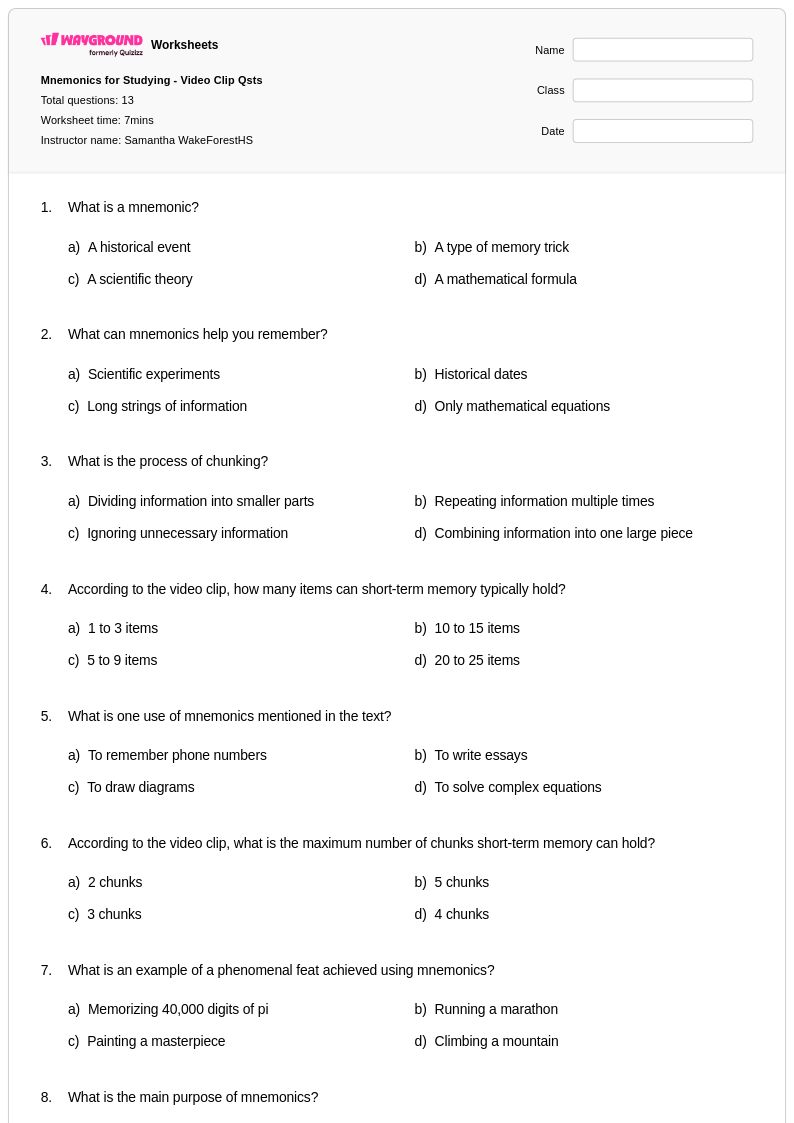
Teaching memory effectively starts with grounding students in the three core processes: encoding, storage, and retrieval. From there, introduce memory systems in sequence, beginning with sensory memory, then short-term memory, and finally long-term memory, so students can see how information moves through the cognitive pipeline. Using real-world examples, such as why students forget information after cramming or how mnemonics improve recall, helps connect abstract models to lived experience. Pairing direct instruction with structured practice problems reinforces the conceptual framework before students are assessed.
What exercises help students practice memory concepts?
Effective practice for memory topics includes labeling diagrams of memory models, explaining the stages of the Atkinson-Shiffrin model, and answering scenario-based questions that ask students to identify which memory system is being engaged. Forgetting curve exercises, where students analyze why information decays over time, build critical thinking alongside content knowledge. Worksheets that require students to apply concepts like elaborative encoding or interference theory to realistic situations tend to produce stronger retention than definition-only recall tasks.
What mistakes do students commonly make when learning about memory?
One of the most common misconceptions is conflating short-term memory with working memory, treating them as identical when they are distinct constructs in cognitive psychology. Students also frequently confuse encoding failure with retrieval failure, assuming they have 'forgotten' information when it was never properly stored to begin with. Another persistent error is assuming that long-term memory is permanent and perfectly accurate, when in reality memory is reconstructive and susceptible to distortion. Targeted practice problems that force students to distinguish between these concepts can correct these errors before they become entrenched.
How do I use memory worksheets in my classroom?
Memory worksheets on Wayground are available as printable PDFs for traditional classroom use and in digital formats for technology-integrated environments, giving teachers flexibility in how they deploy the material. Teachers can print and distribute them as independent practice, assign them digitally for homework, or host them as a quiz directly on Wayground to collect student responses. Built-in answer keys make grading efficient and allow students to self-check their work during guided practice sessions.
How can I differentiate memory worksheets for students with different learning needs?
On Wayground, teachers can apply individual accommodations to specific students without affecting the rest of the class. For students who need additional support, options include Read Aloud to have questions read to them, reduced answer choices to lower cognitive load, and extended time per question. Reading mode allows font size and display themes to be adjusted for accessibility. These settings are saved per student and carry over to future sessions, so differentiation requires minimal setup each time.
What memory models and systems should students know for a psychology course?
Students in an introductory psychology course should be familiar with the Atkinson-Shiffrin multi-store model, which outlines sensory, short-term, and long-term memory as distinct stages. They should also understand Baddeley's working memory model, which replaces the simple short-term store with a more complex system involving a central executive, phonological loop, and visuospatial sketchpad. Key phenomena to cover include encoding specificity, the serial position effect, and interference theory, all of which explain why memory succeeds or fails under different conditions.