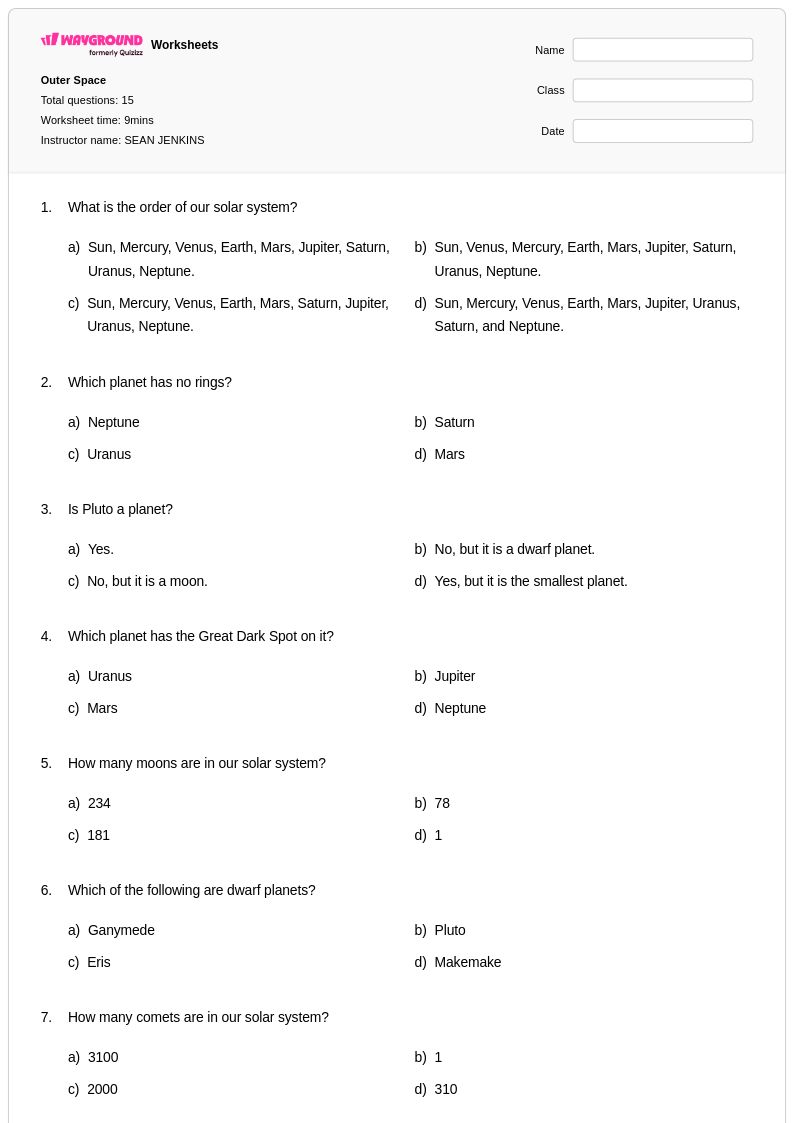
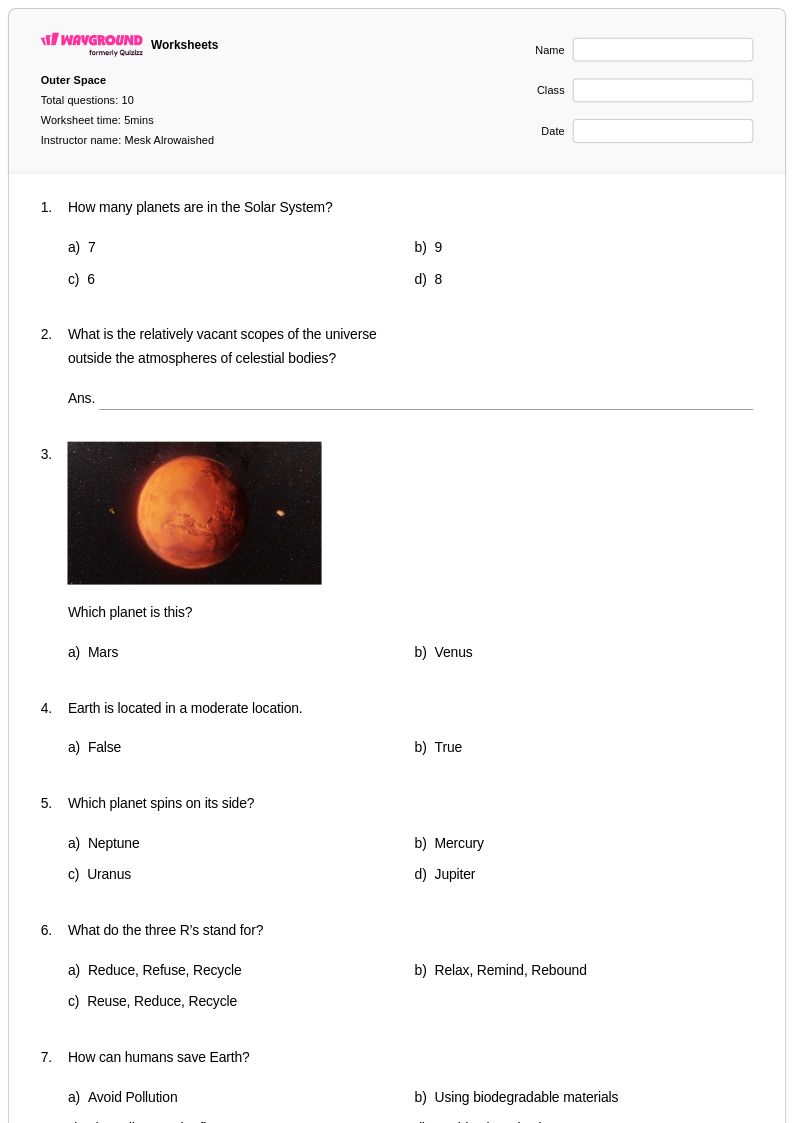
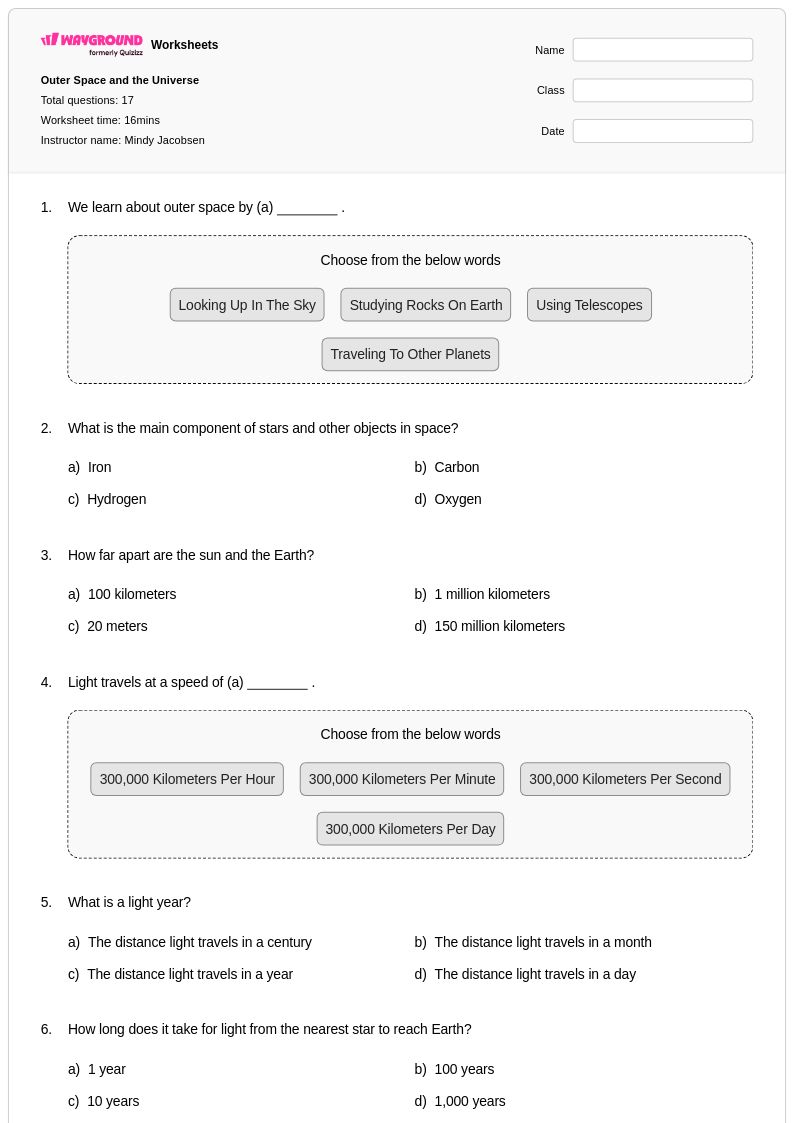
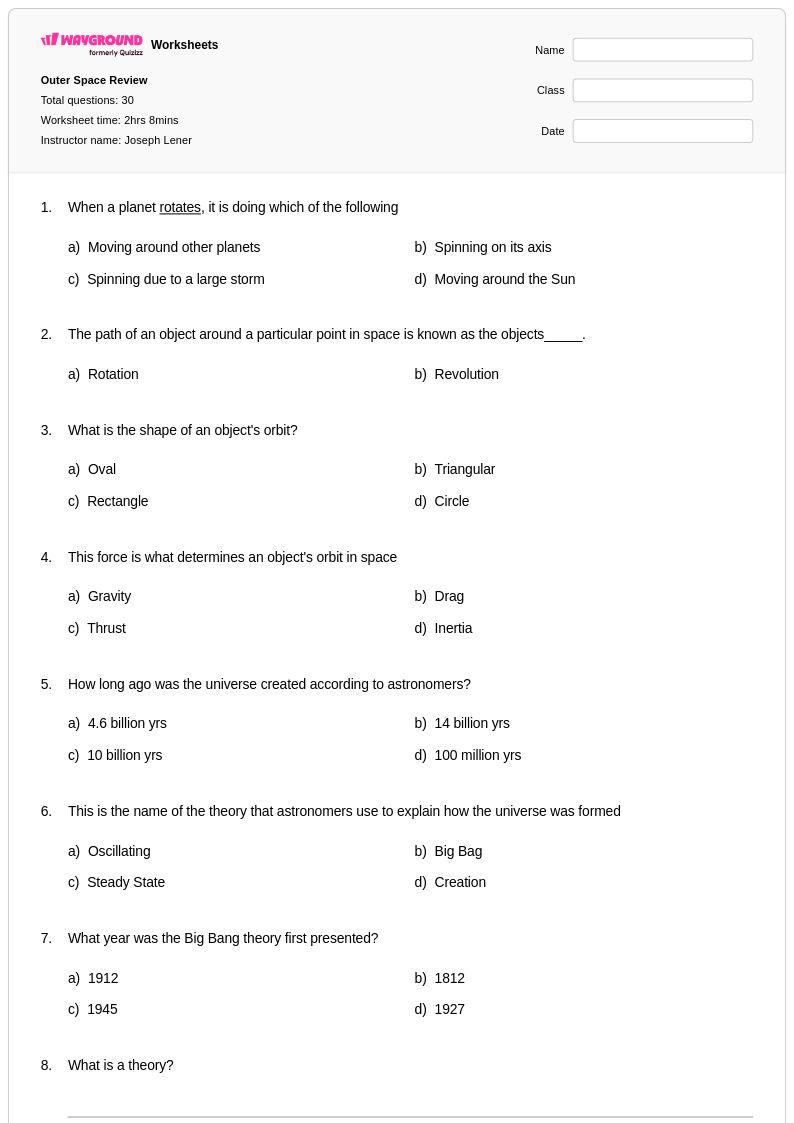
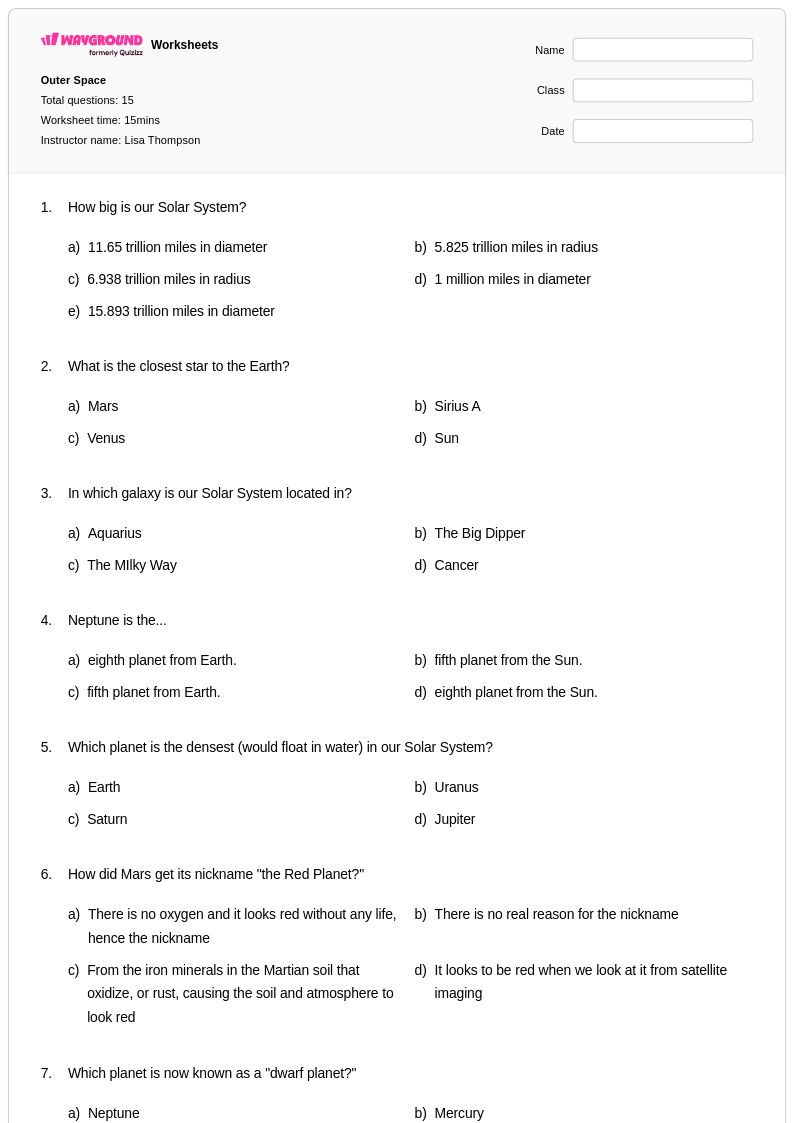
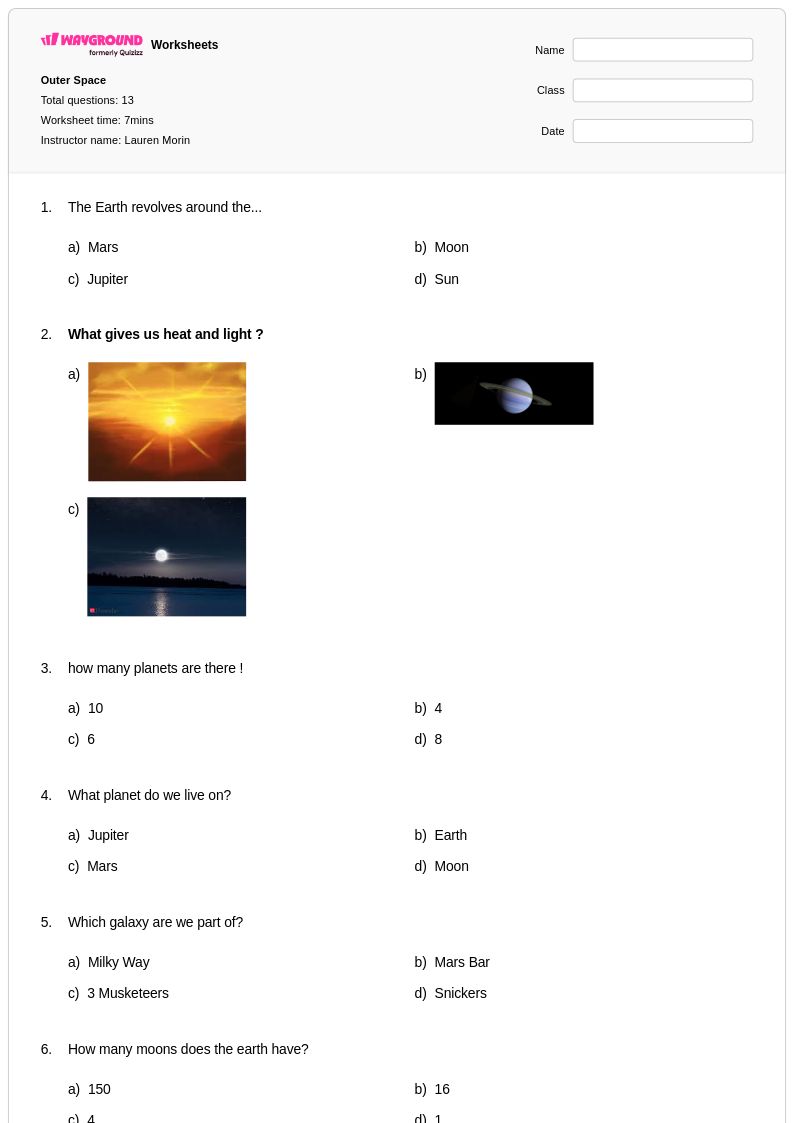
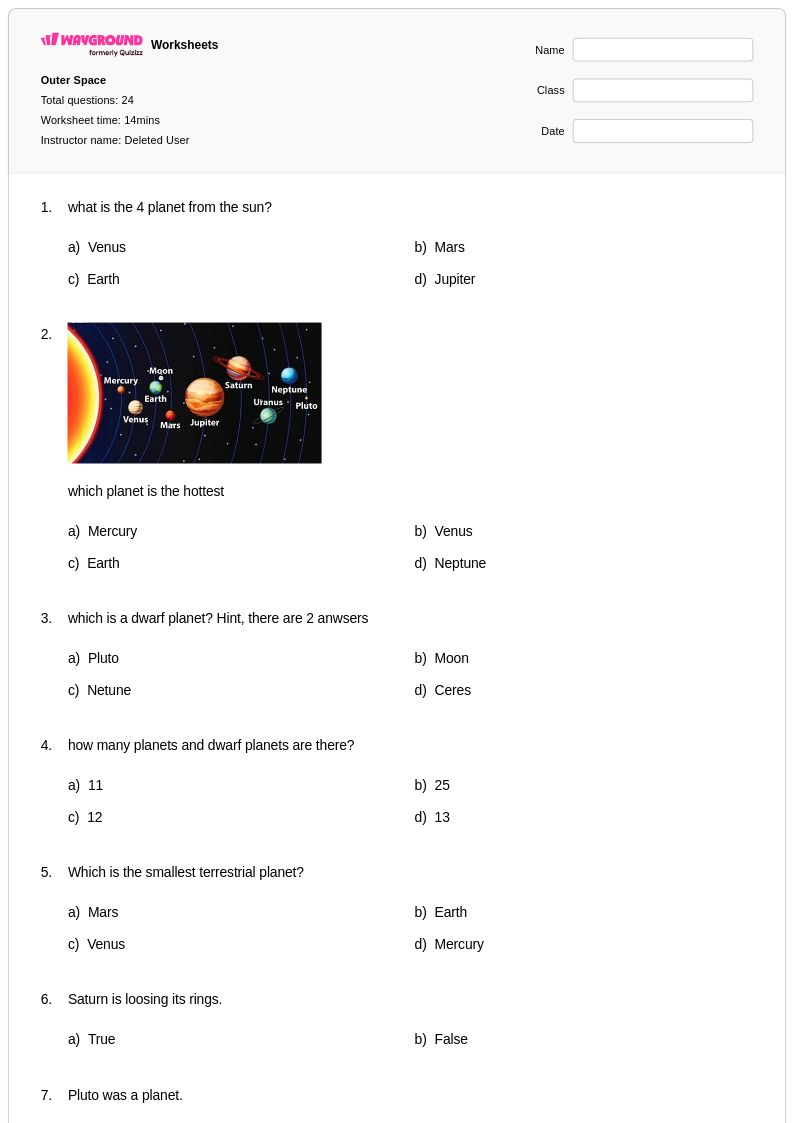
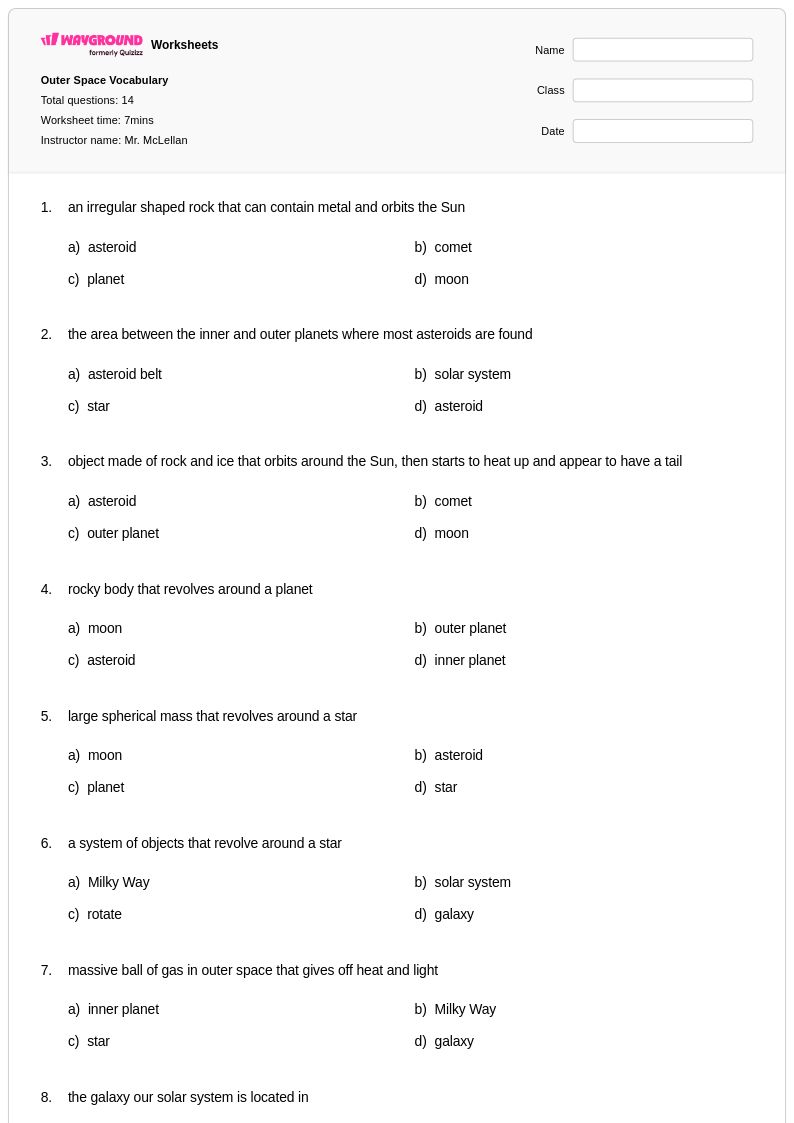
Explore free outer space worksheets and printables from Wayground that help students discover planets, stars, galaxies, and cosmic phenomena through engaging practice problems with comprehensive answer keys.
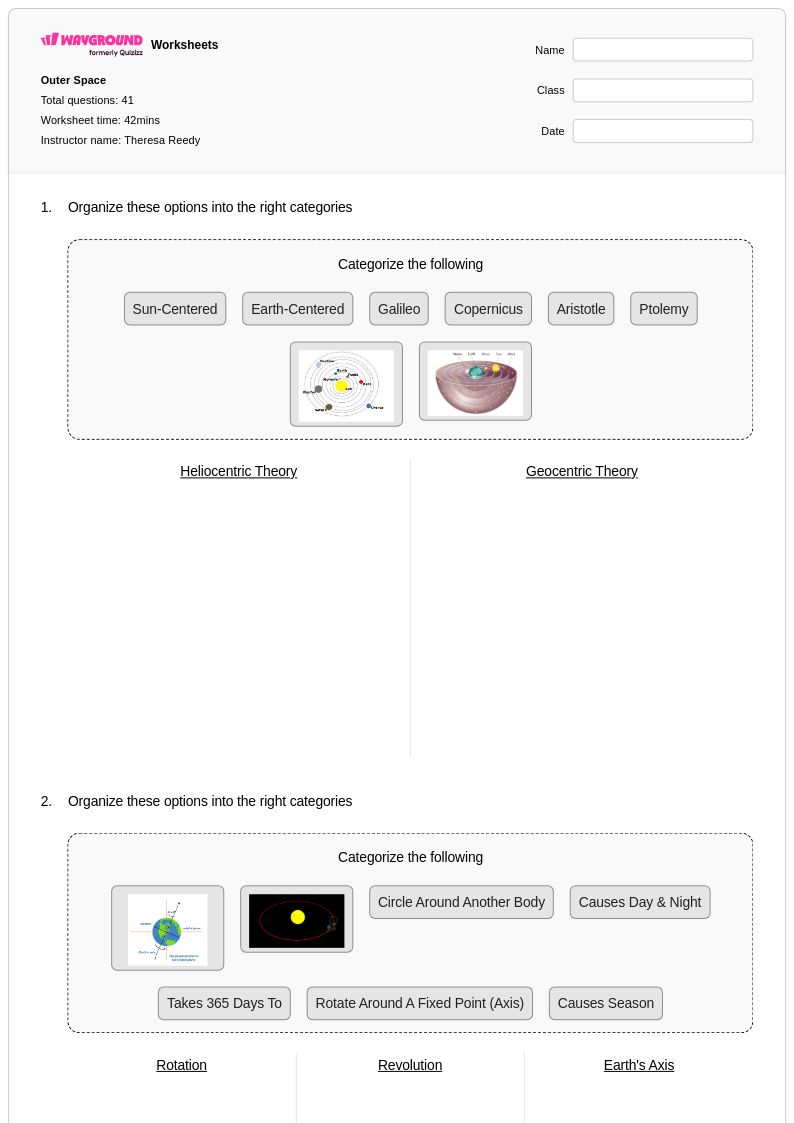
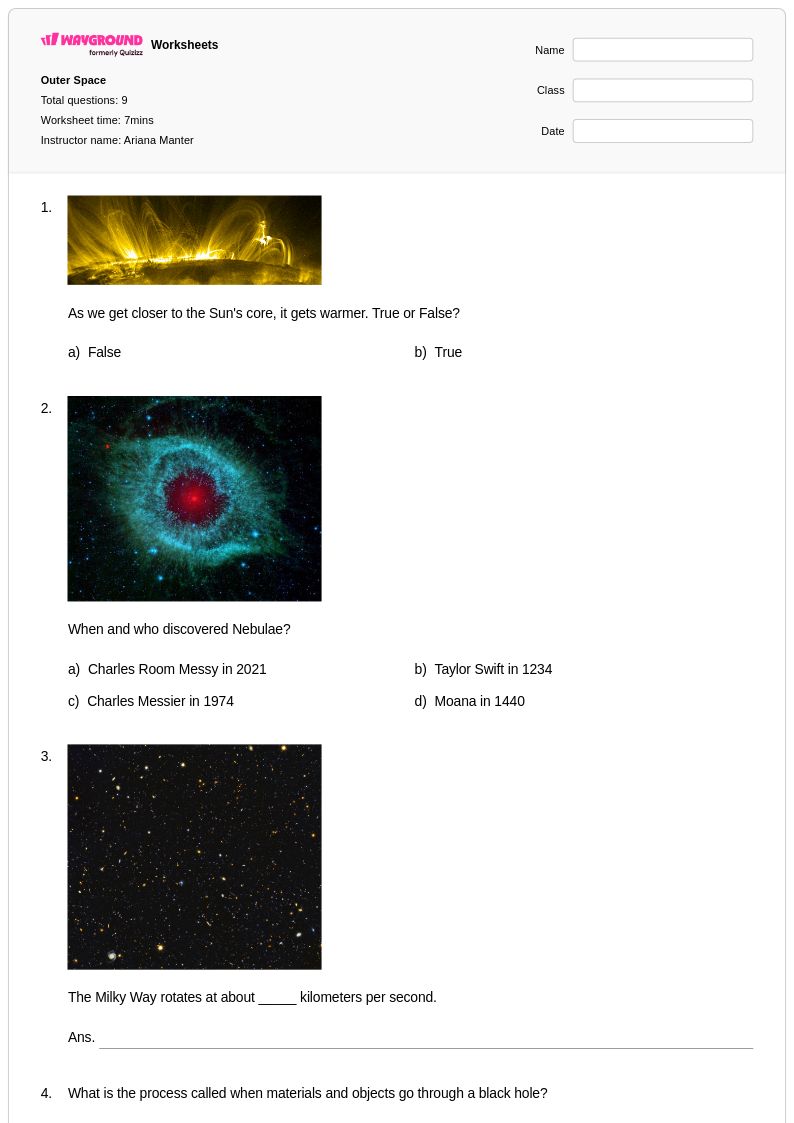
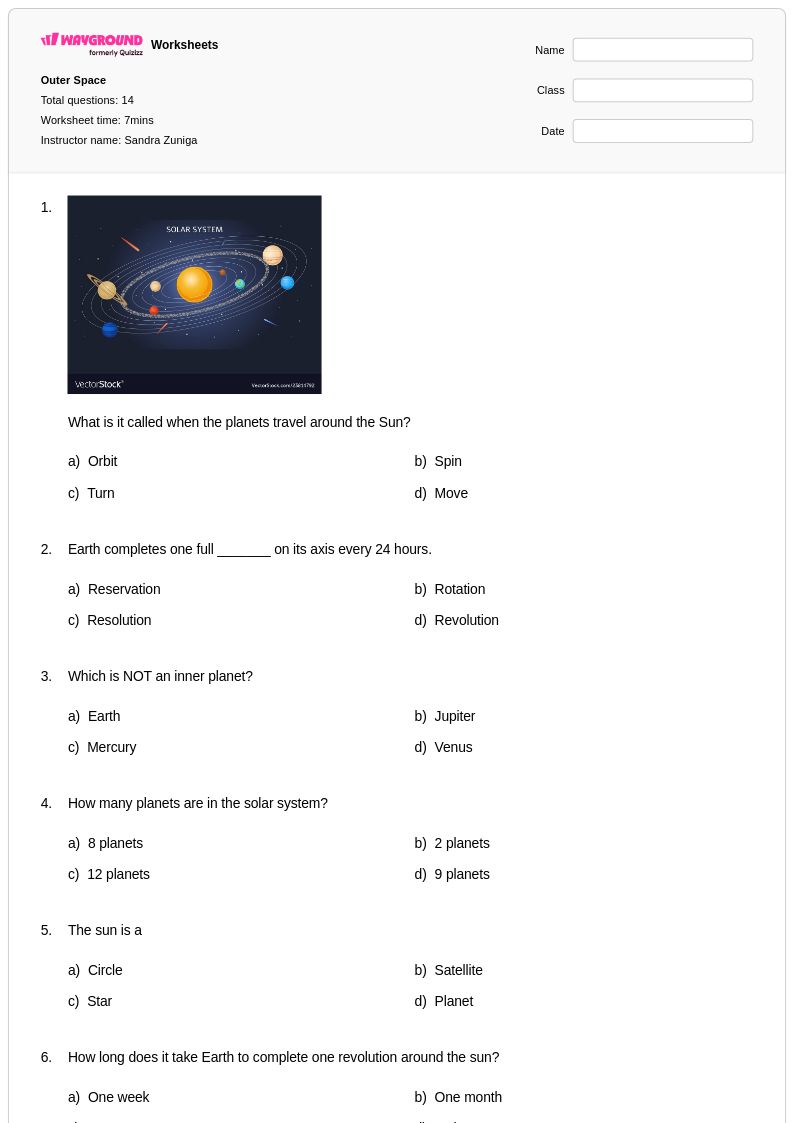
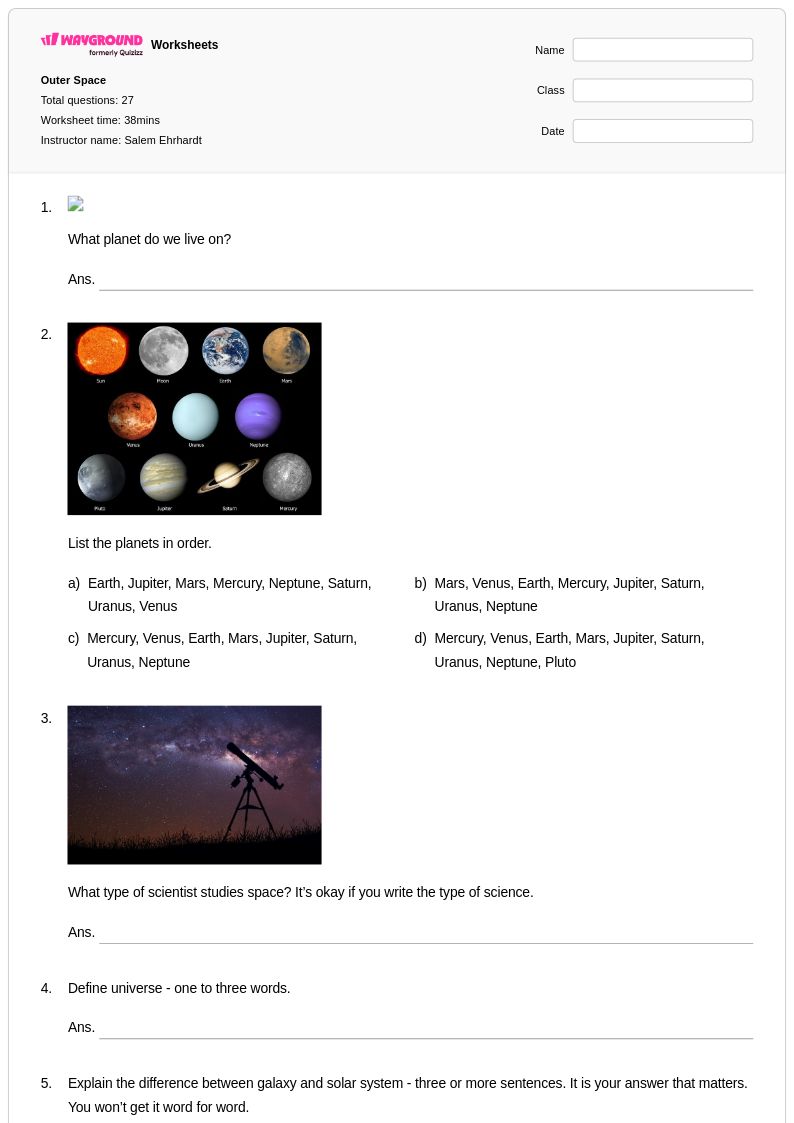
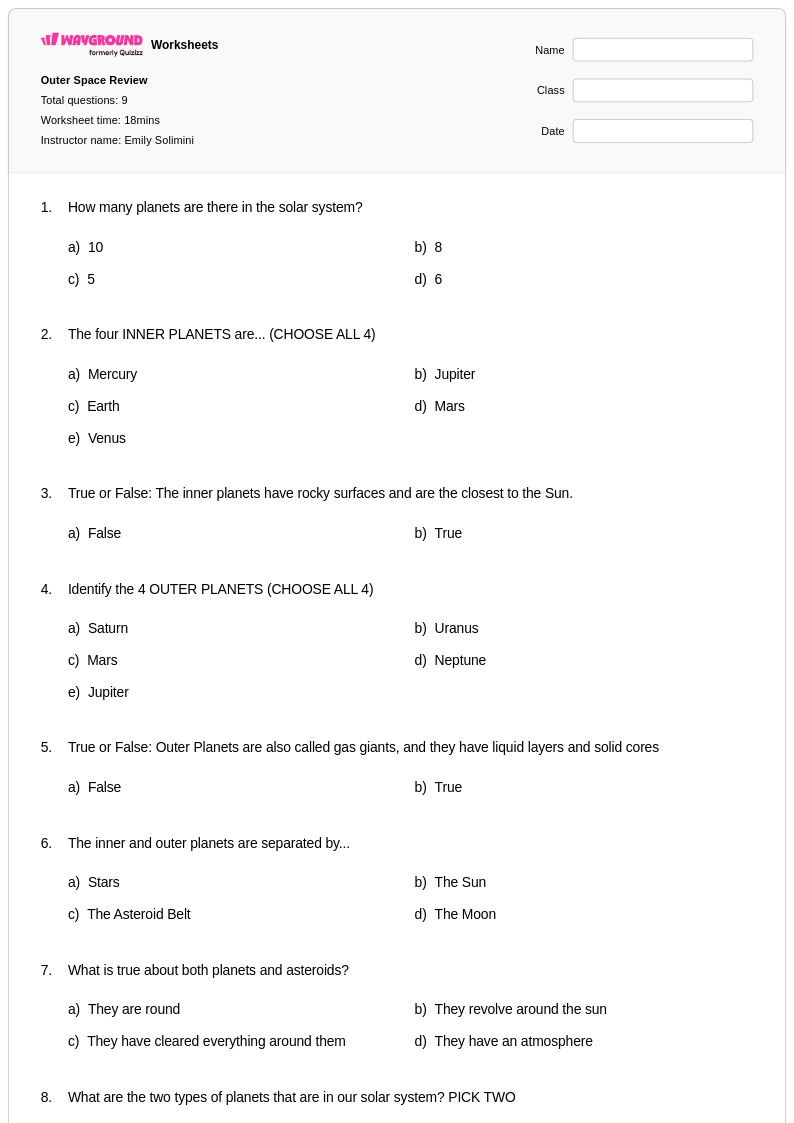
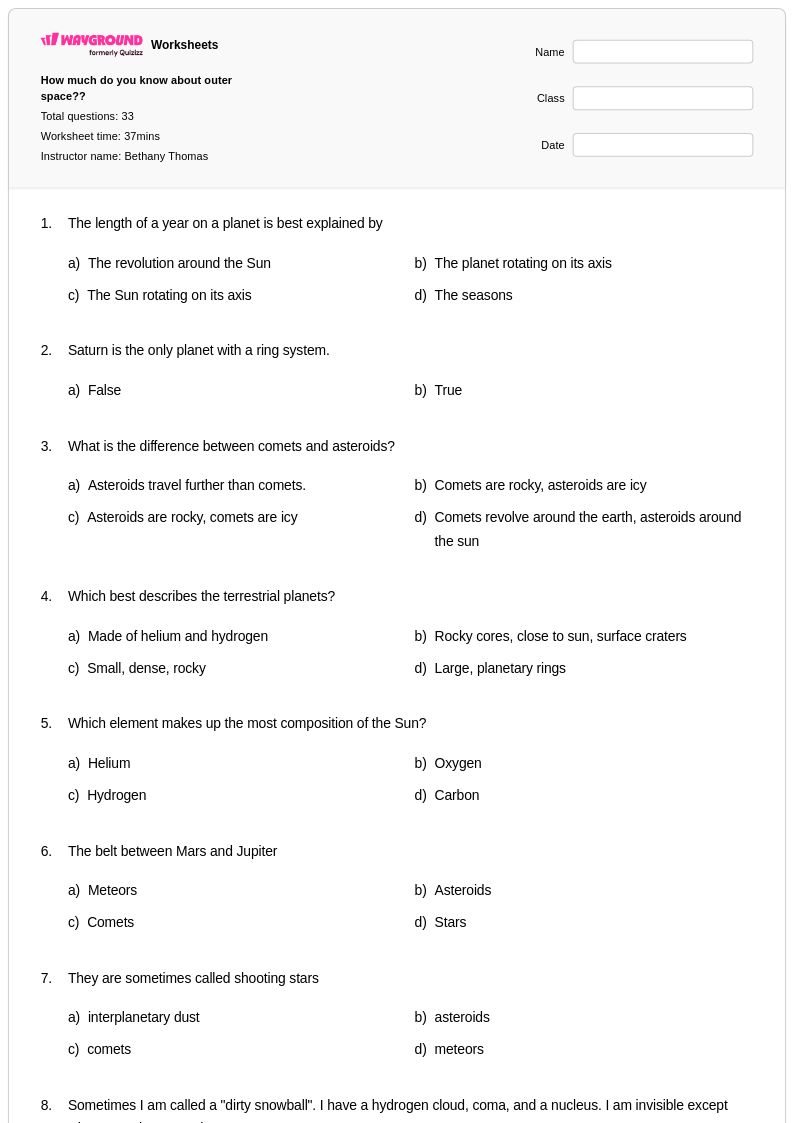
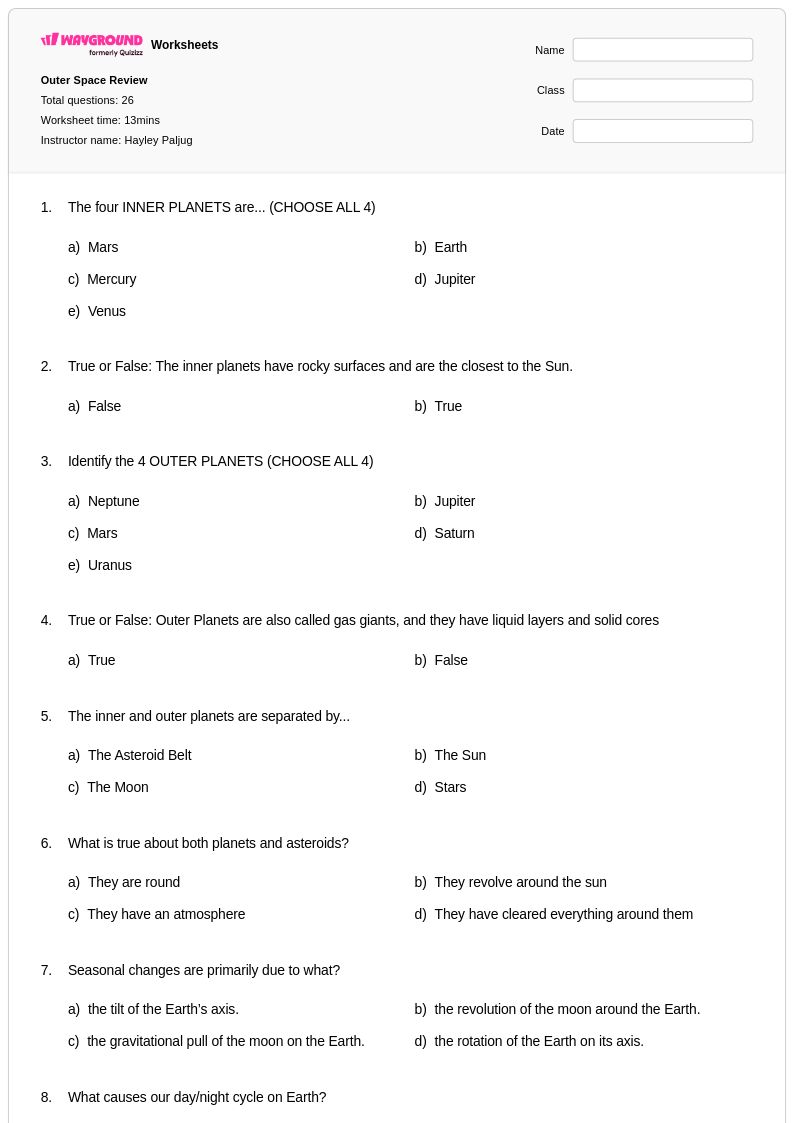
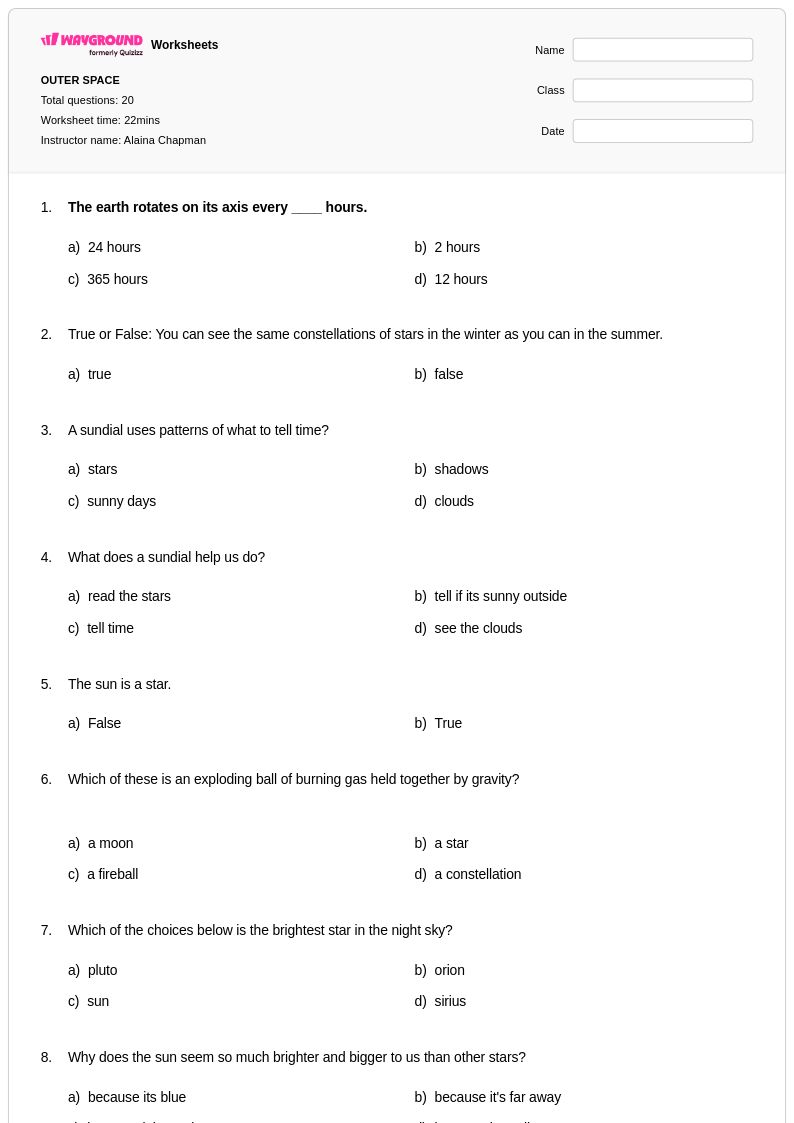
Outer space is the vast expanse beyond Earth's atmosphere containing planets, stars, galaxies, and other celestial objects whose motions and properties are governed by gravitational and electromagnetic forces. Outer space worksheets develop student understanding of the solar system's structure, planetary characteristics, Moon phases, eclipses, stellar lifecycles, and galaxy formation through diagram interpretation, data comparison, and cause-and-effect analysis. Effective practice sequences move from identifying and ordering planets to explaining why we observe phenomena such as seasons, lunar phases, and eclipses based on the spatial relationships between the Earth, Moon, and Sun. Teachers should watch for the persistent misconception that seasons result from Earth's changing distance from the Sun rather than axial tilt, and for students who confuse rotation with revolution or believe the Moon generates its own light. These worksheets are available as printable PDFs for traditional classroom use and in digital formats for technology-integrated learning environments, including interactive quizzes hosted on Wayground. Wayground offers standards-aligned outer space worksheets with customizable content for remediation through enrichment levels, detailed answer keys, and searchable resources filtered by grade, concept, and science standard. The platform includes a teacher-created resource library and organizational tools for managing practice, assessment, and intervention materials across units. These worksheets are best suited for teachers in grades 2 through 12 building Earth and Space Science literacy from introductory planet identification through advanced astrophysics concepts.
FAQs
How do I teach outer space to elementary students?
Start with observable phenomena students already notice -- the Sun's movement, the Moon's changing shape, and visible stars -- before introducing the solar system as a structured model. Use worksheets that ask students to label planets in order from the Sun and compare basic characteristics like size and distance, building spatial reasoning through diagrams rather than abstract numbers. By grade 4-5, students are ready to connect these observations to concepts like Earth's rotation causing day and night and the Moon's orbit producing lunar phases.
What exercises help students practice solar system and space science concepts?
Effective practice pairs visual identification tasks with factual recall and analytical reasoning. Worksheets that require students to match planets to their characteristics, sequence the stages of a star's lifecycle, or label the components of a lunar eclipse build both vocabulary and conceptual understanding. For older students, problems that involve comparing distances using scale models or interpreting data about planetary atmospheres develop the quantitative reasoning that space science demands.
What common mistakes do students make when learning about outer space?
The most persistent misconception is that the seasons are caused by Earth's distance from the Sun rather than the tilt of Earth's axis. Students also frequently believe that the Moon produces its own light instead of reflecting sunlight, and they struggle with the difference between rotation and revolution, often confusing which motion causes day/night versus the yearly cycle. Scale is another major challenge -- students consistently underestimate the vast distances between planets and between stars.
How do I assess student understanding of planets, stars, and space phenomena?
Use worksheets that require students to explain cause-and-effect relationships rather than simply recall facts -- for example, asking why we see different Moon phases rather than asking students to name the phases. Questions that present a diagram of the Earth-Sun-Moon system and ask students to predict eclipse types or season changes at specific positions test whether students understand spatial relationships. Including items where students must identify errors in a description of a space phenomenon reveals misconceptions that multiple-choice questions often miss.
How do I use outer space worksheets in my classroom?
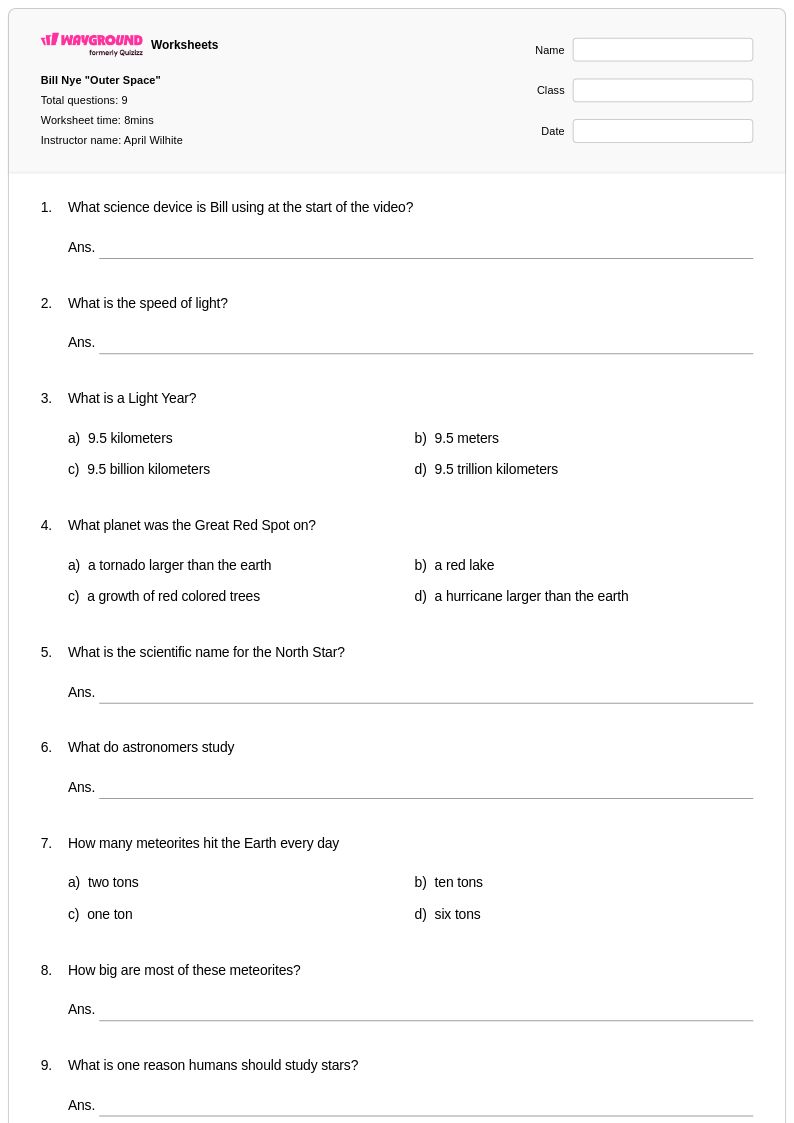
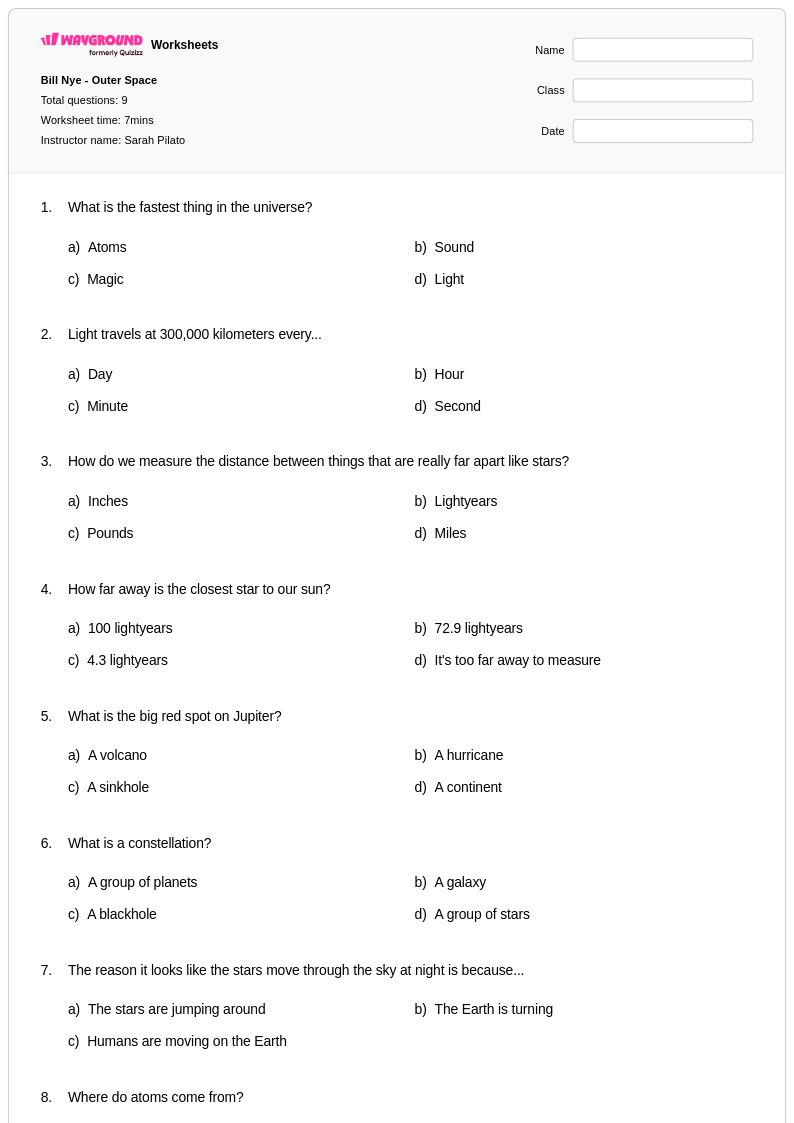
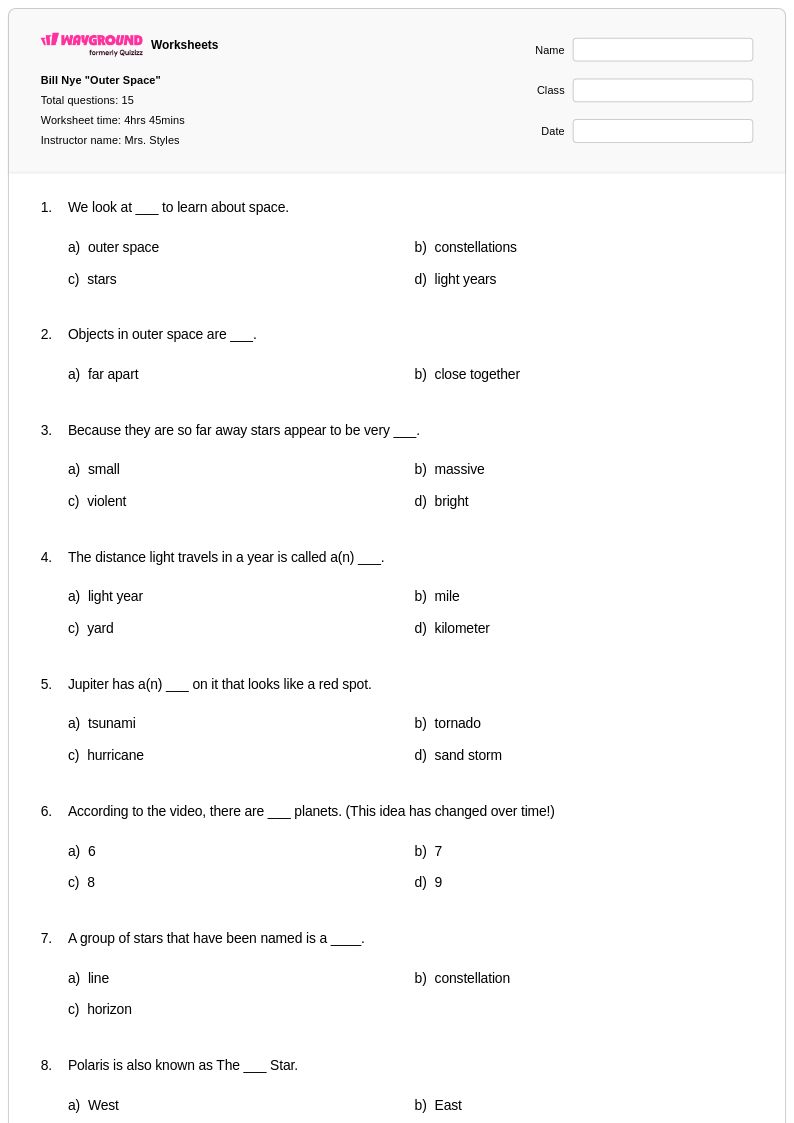
These worksheets are available as printable PDFs for traditional classroom use and in digital formats for technology-integrated learning environments. Use planet identification and vocabulary sheets as introductory activities when opening a new unit, and assign analytical worksheets on topics like stellar lifecycles or gravitational forces as independent practice after direct instruction. Bill Nye episode companion worksheets pair directly with video segments, providing structured note-taking and comprehension checks during or immediately after viewing.
How do I differentiate outer space instruction for different grade levels?
For grades 2-3, focus on worksheets that use sorting, labeling, and matching to build foundational vocabulary about planets, the Moon, and the Sun. Grades 4-6 benefit from diagram-based worksheets where students interpret Moon phase cycles, identify eclipse types, and compare planetary characteristics using data tables. For grades 7-12, assign worksheets that require applying physics concepts such as gravitational force, electromagnetic radiation, and stellar evolution to explain observable phenomena.
What grade levels are outer space worksheets appropriate for?
Outer space worksheets span grades 2 through 12, with content complexity scaled at each level. Grades 2-3 cover planet names and order, basic Moon observations, and day/night concepts. Grades 4-6 address Moon phases, eclipses, Earth's place in the solar system, and introductory galaxy concepts. Grades 7-12 cover stellar lifecycles, electromagnetic spectrum analysis, gravitational physics, and space exploration missions, aligned to Next Generation Science Standards for Earth and Space Science.