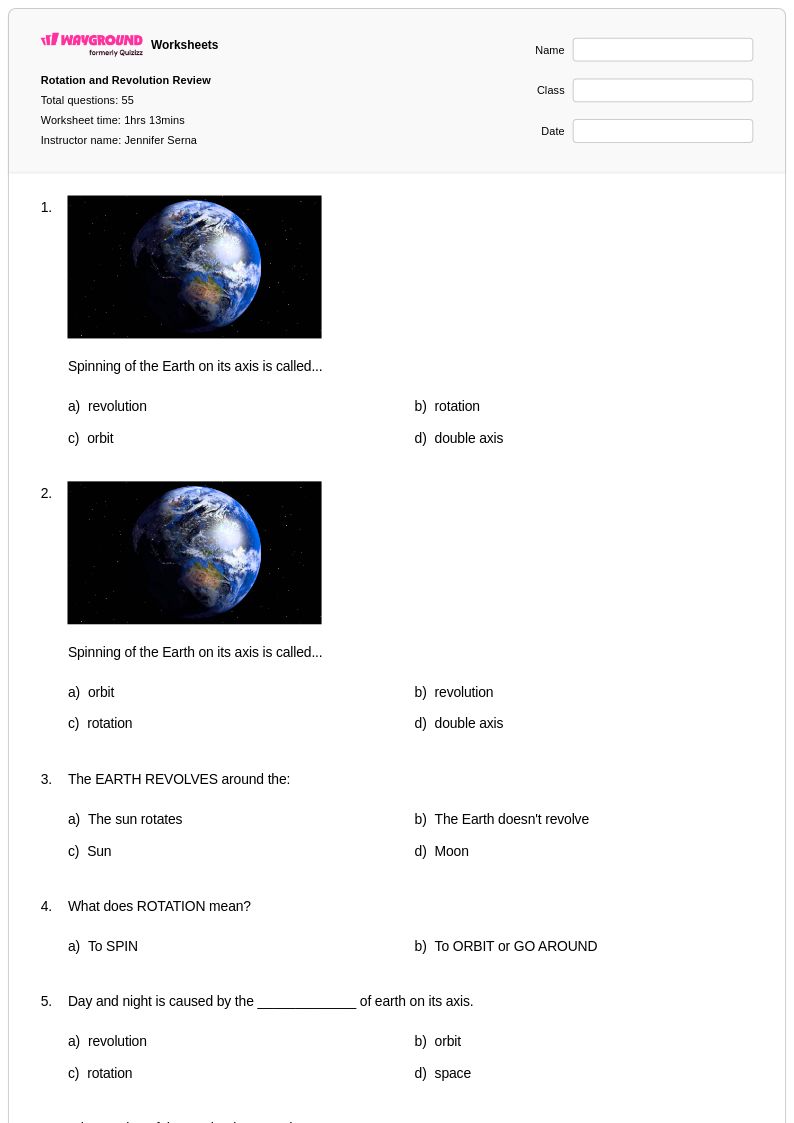
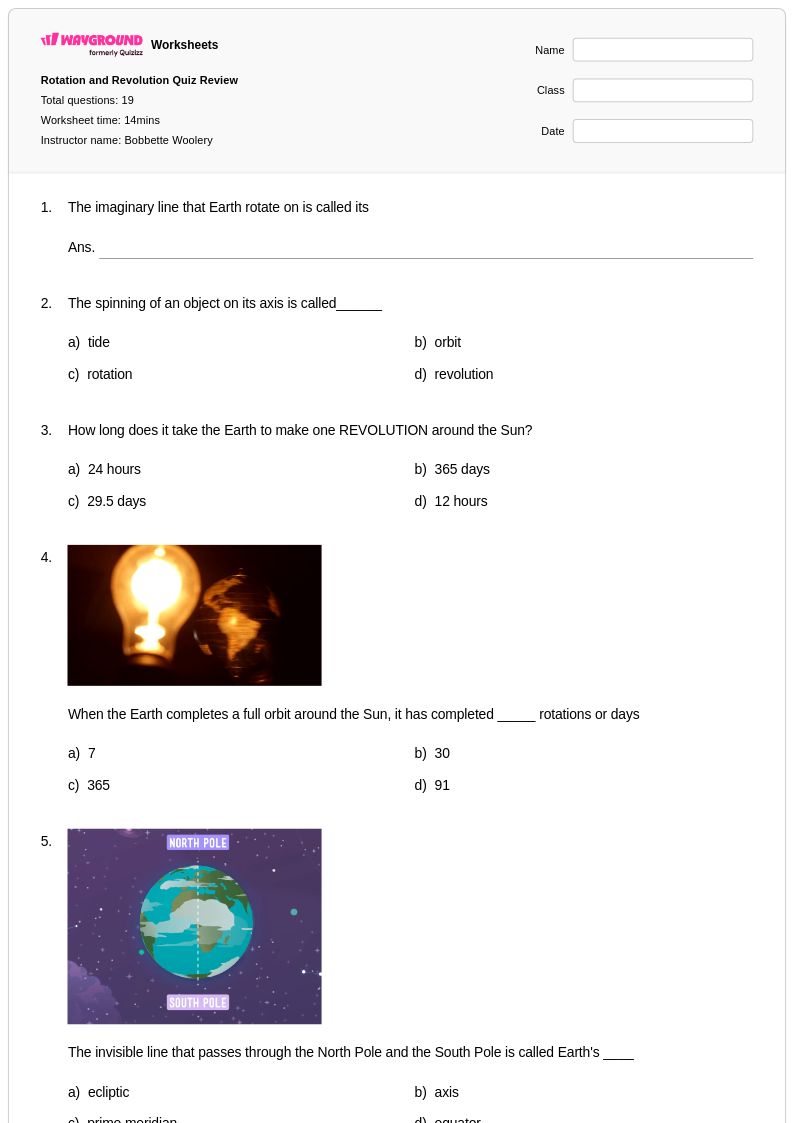
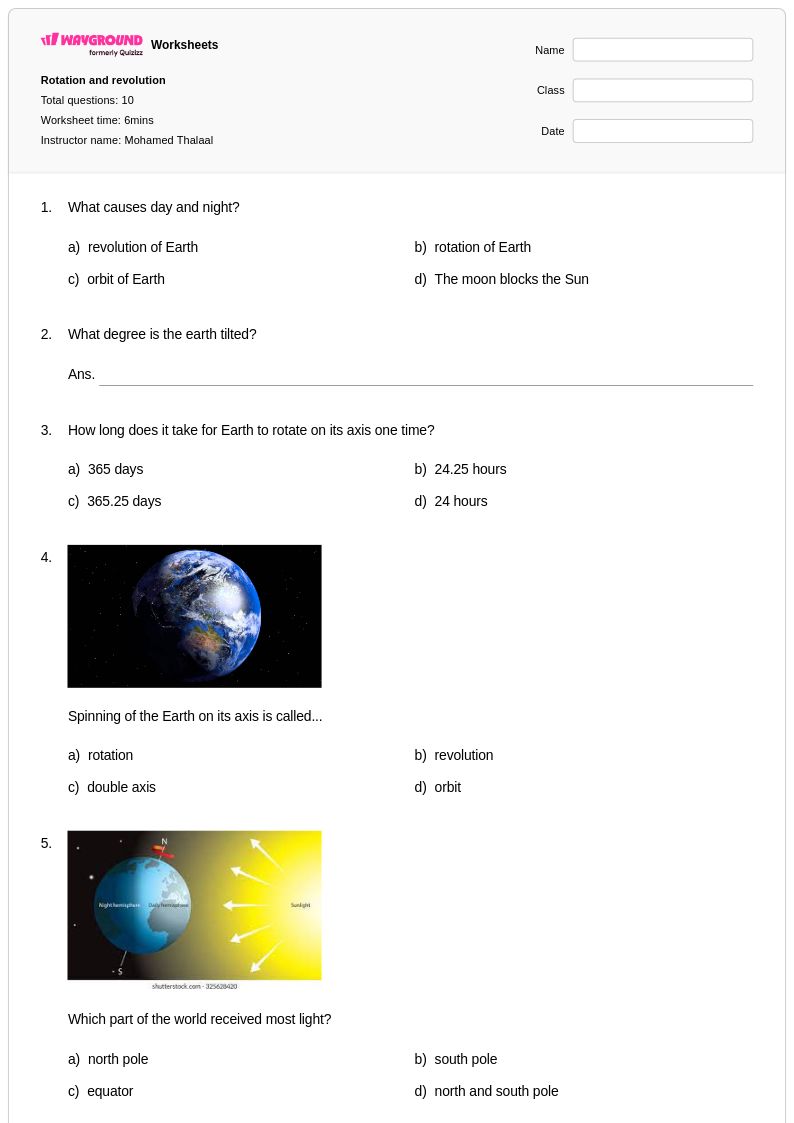
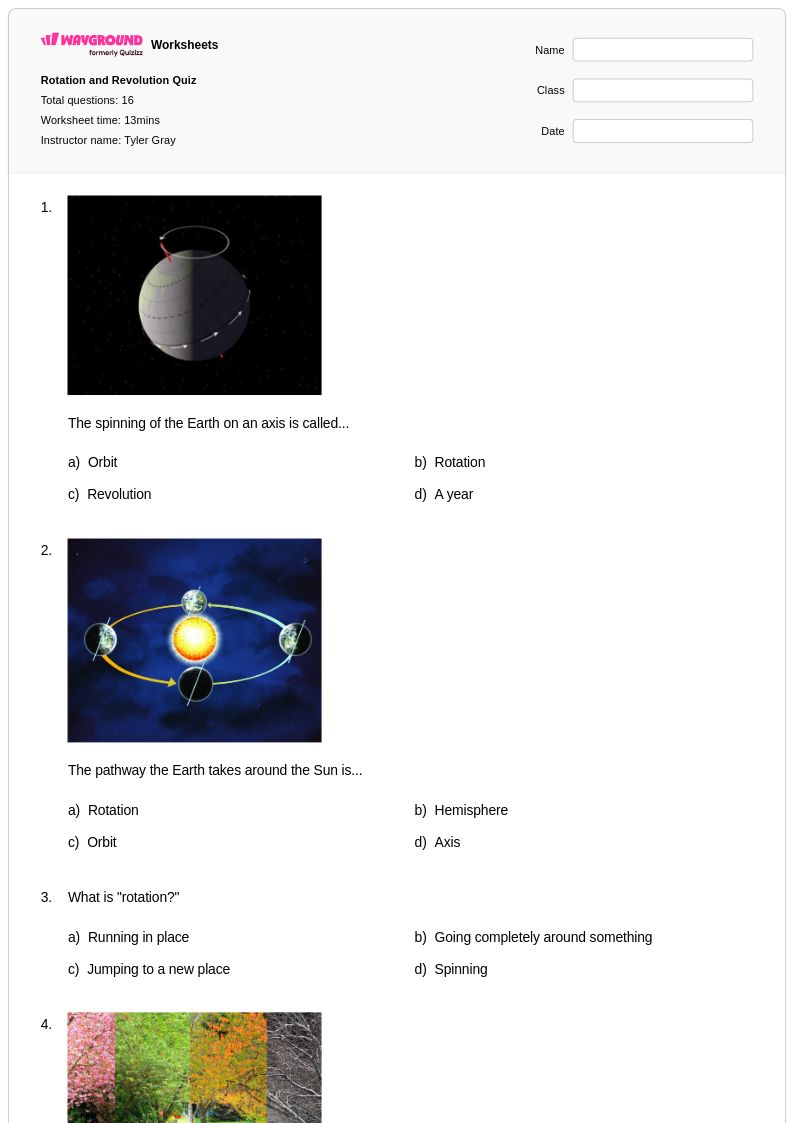
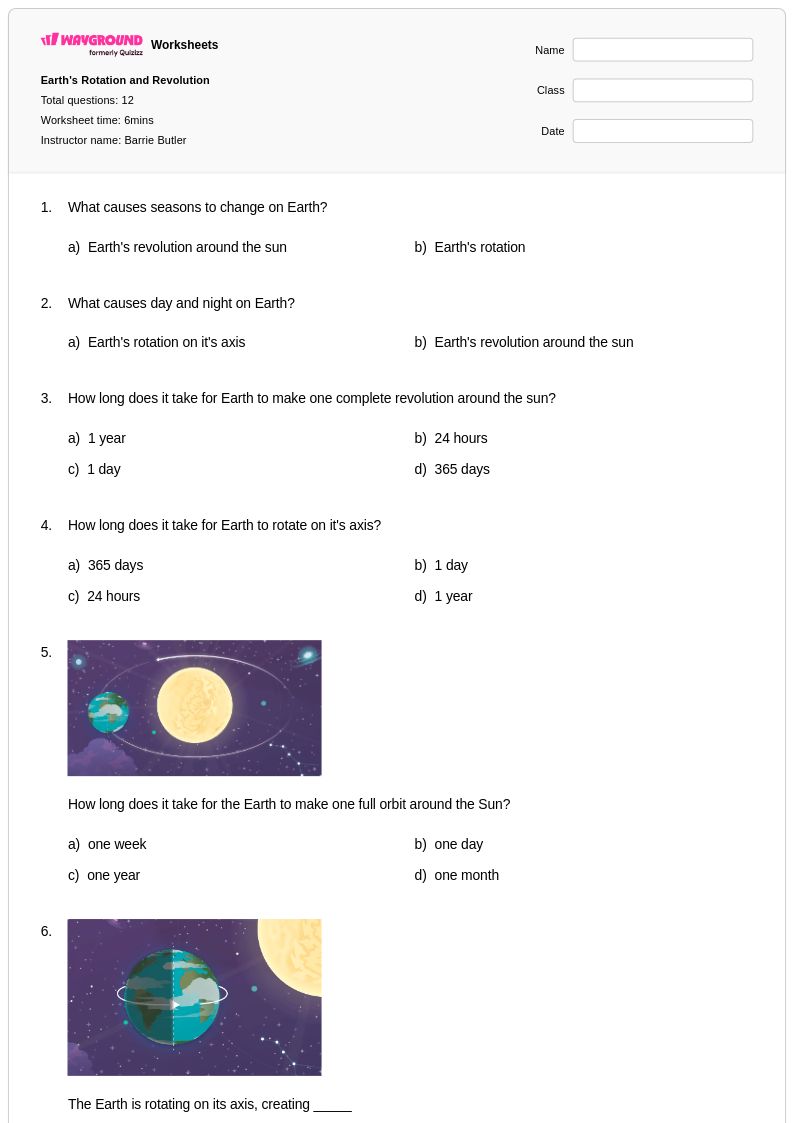
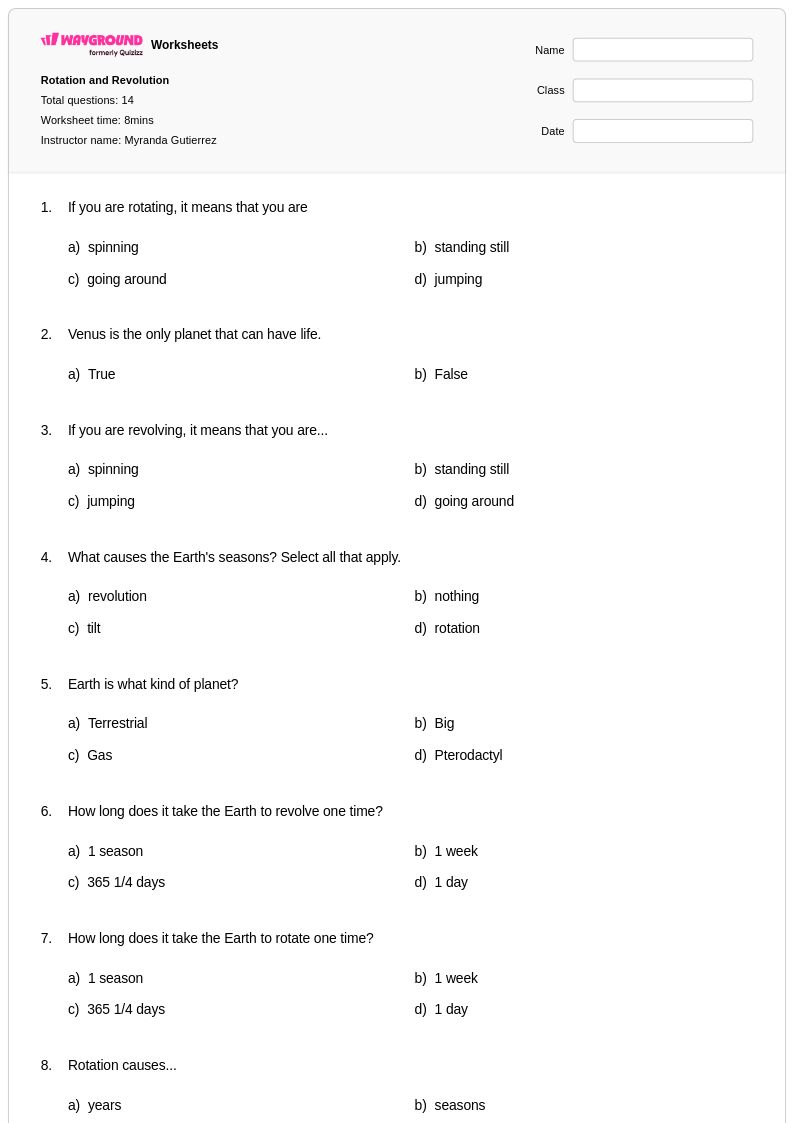
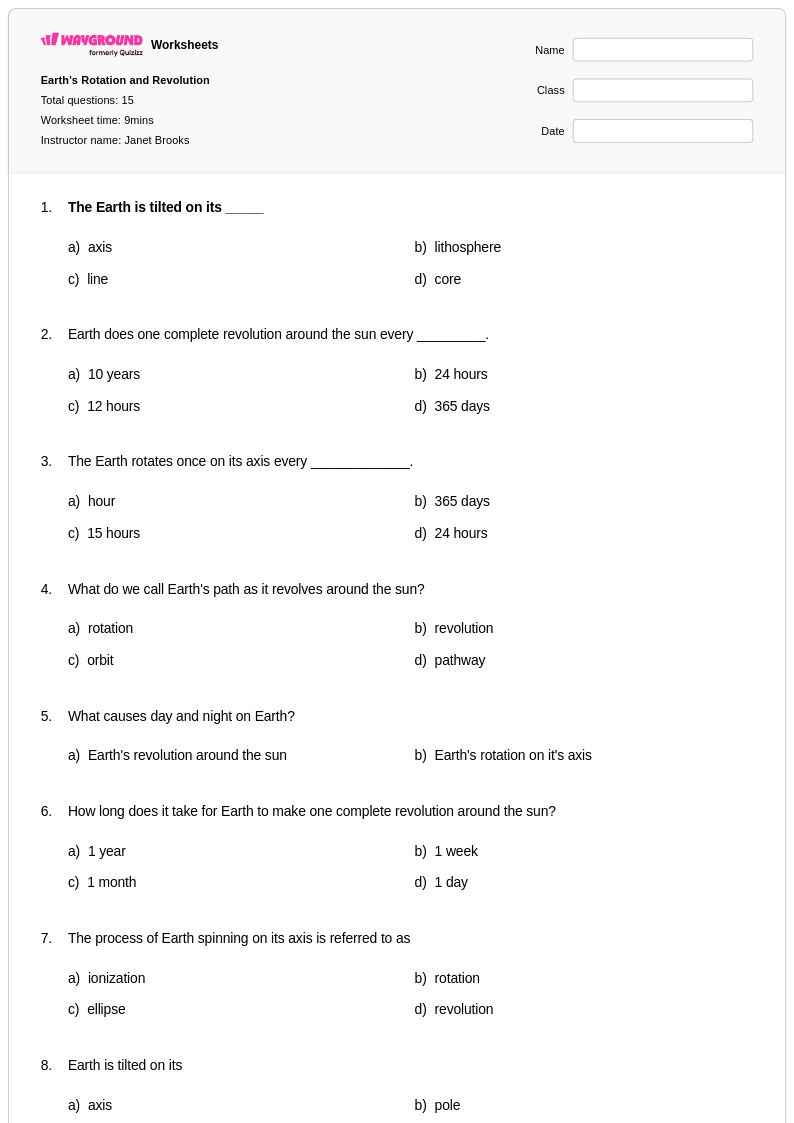
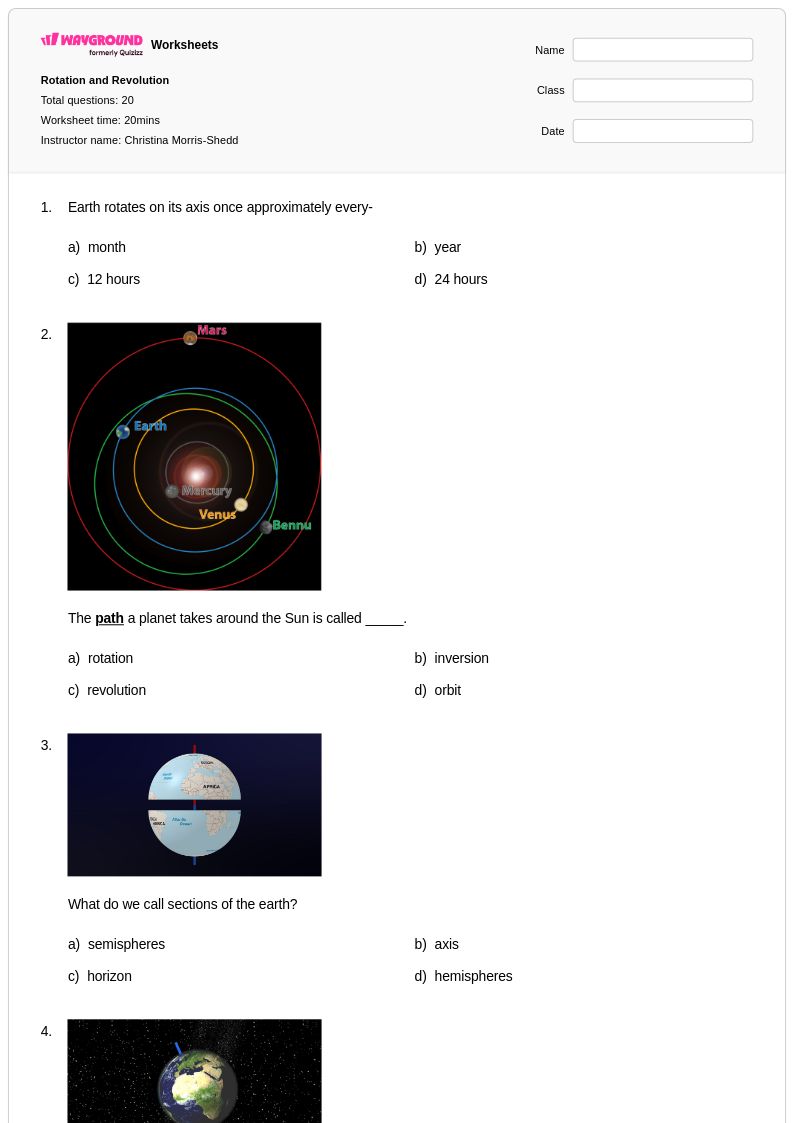
Explore free printable worksheets and practice problems on Earth's rotation and revolution that help students master planetary motion concepts through engaging PDF activities with comprehensive answer keys.
Explore printable Rotation and Revolution worksheets
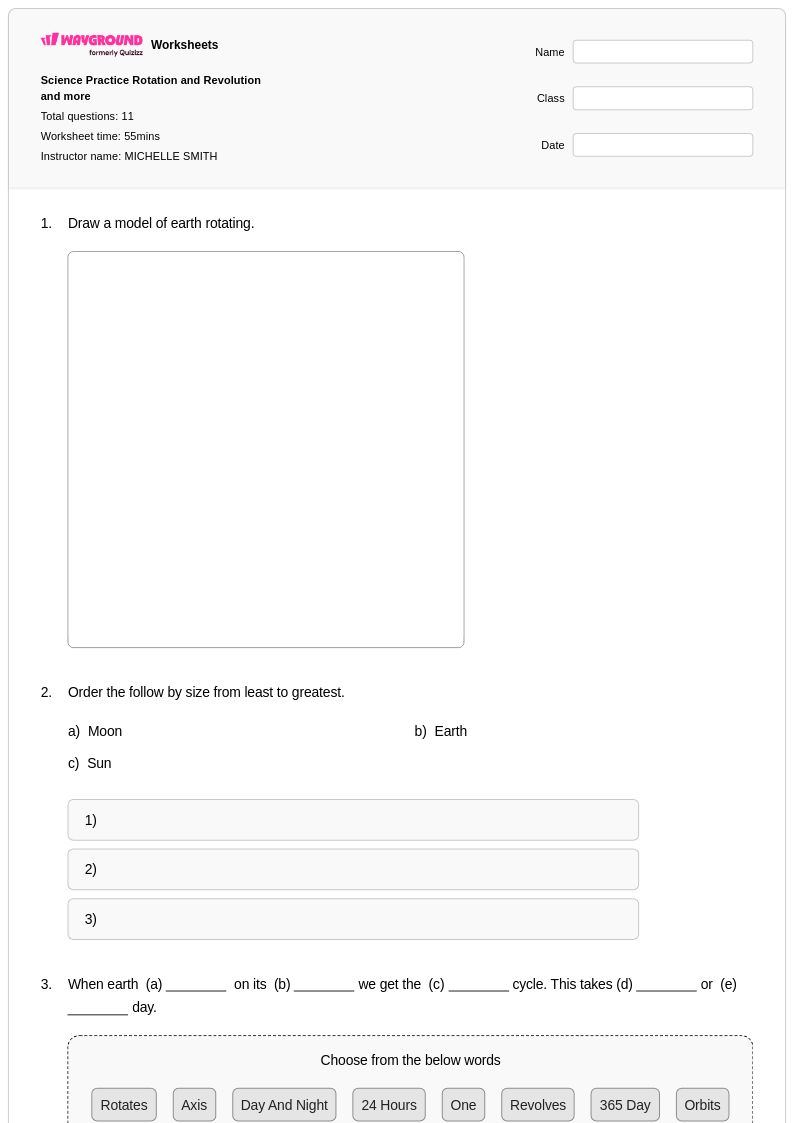
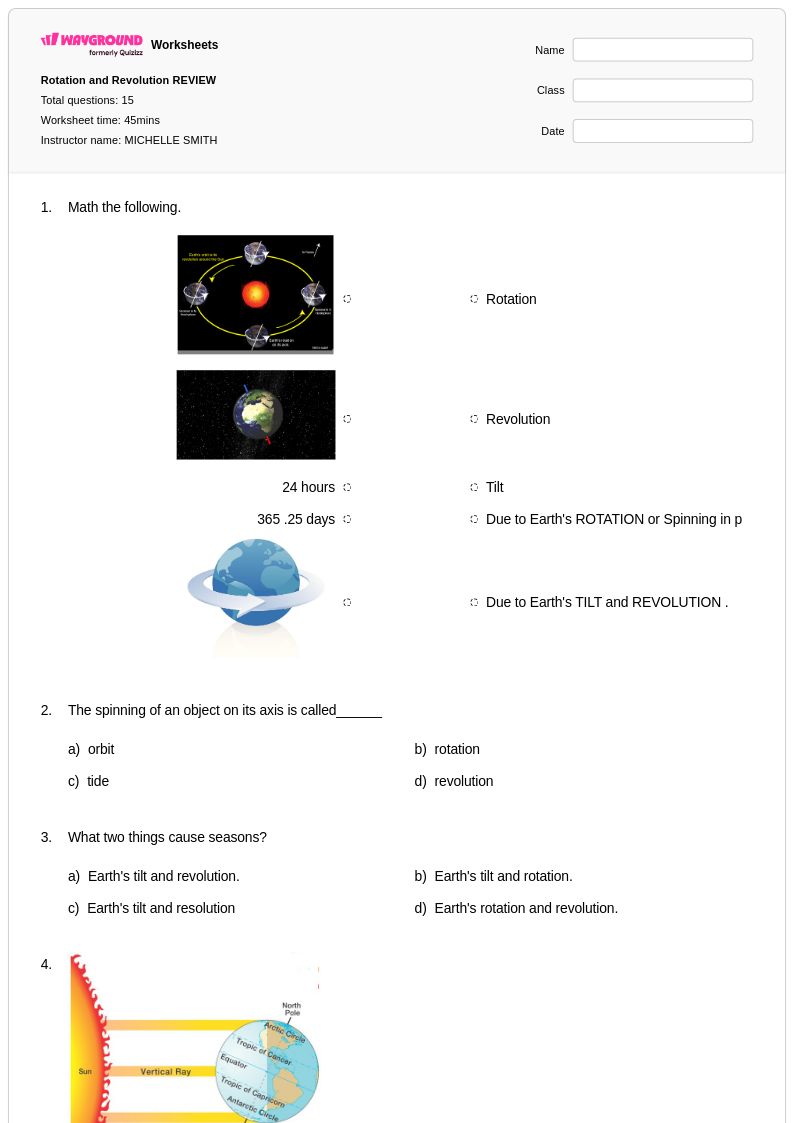
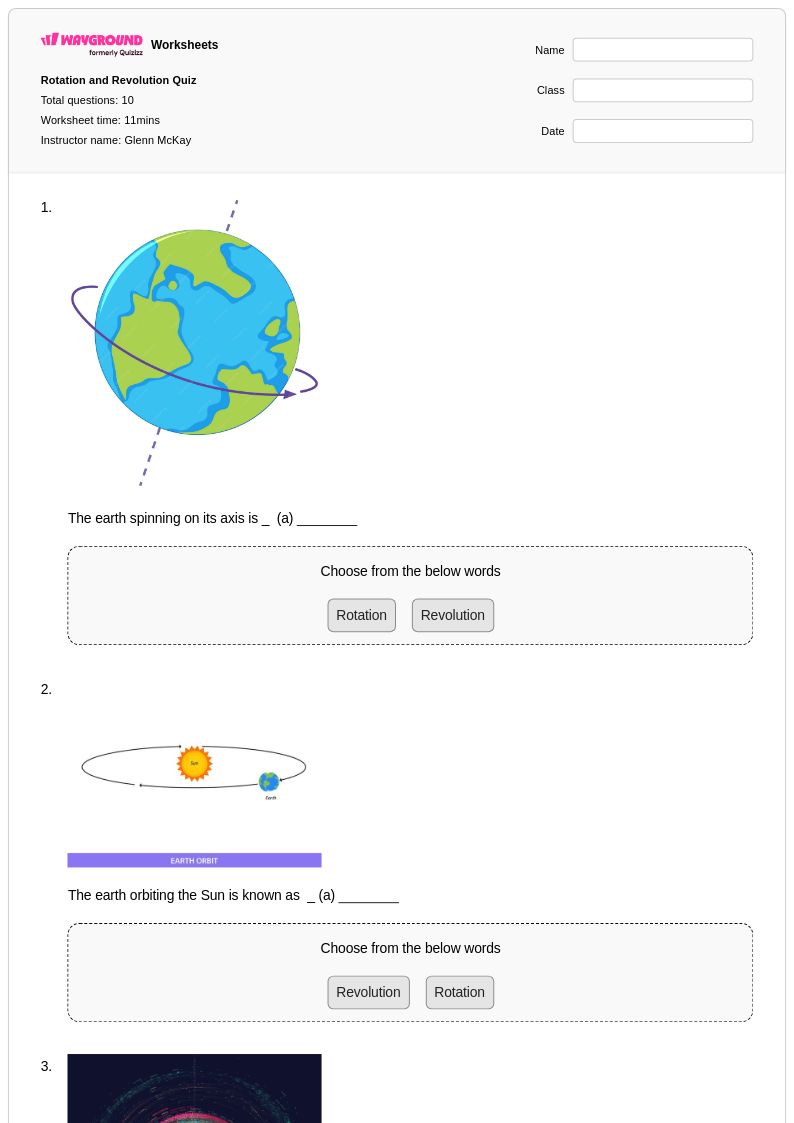
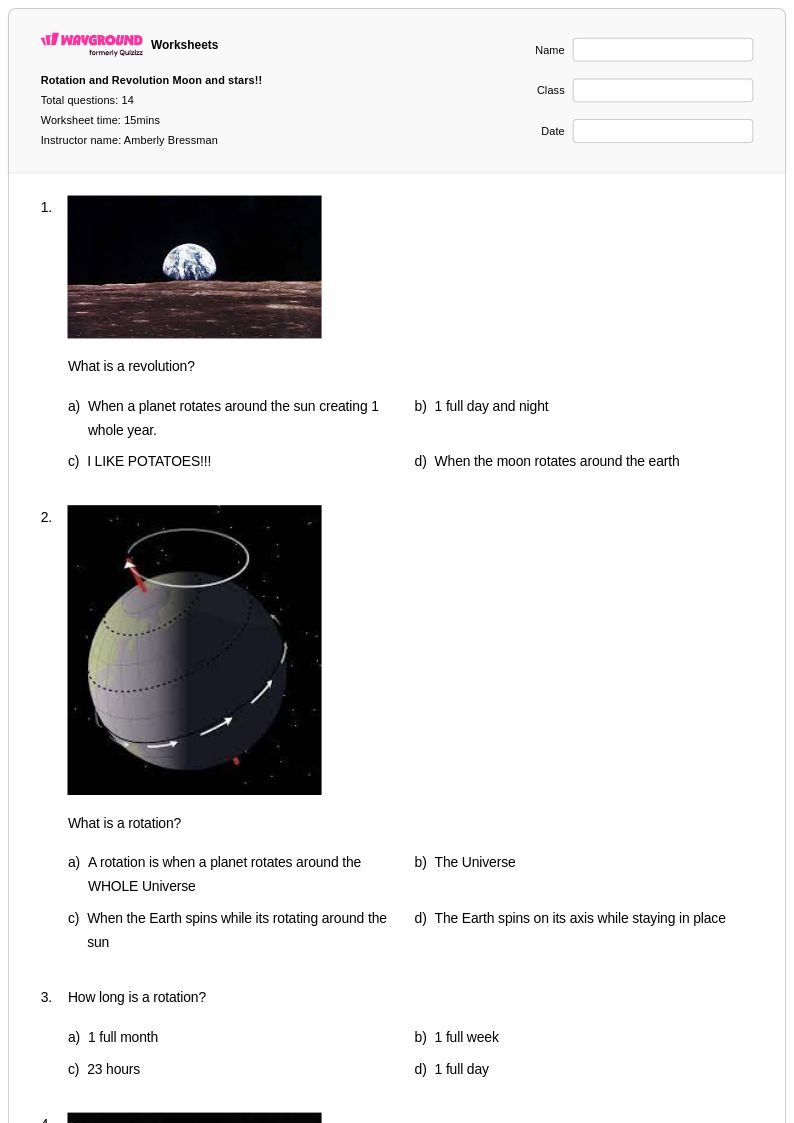
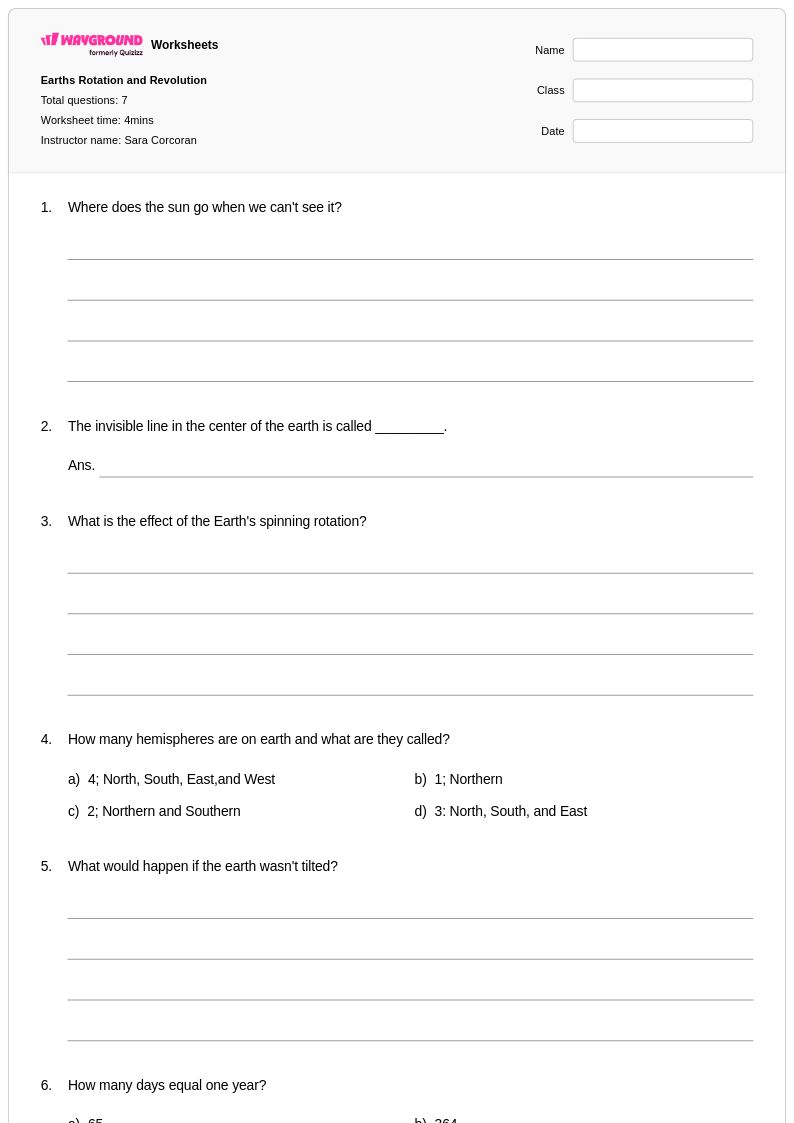
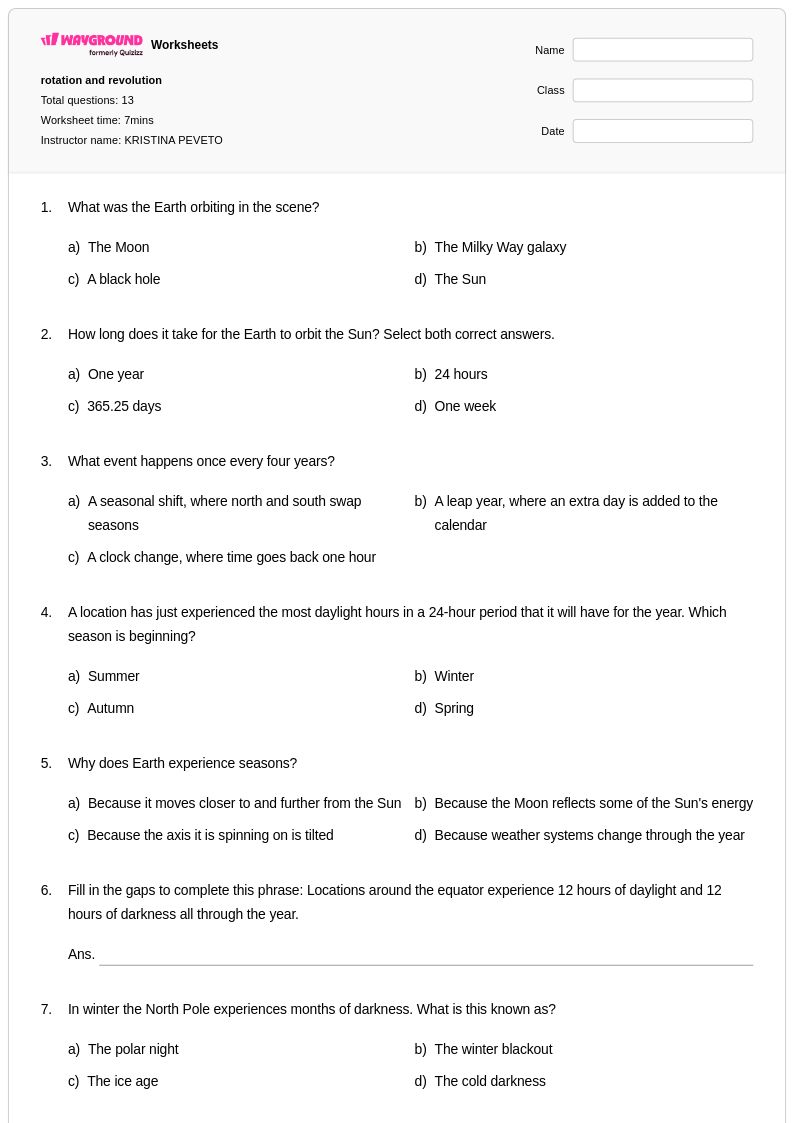
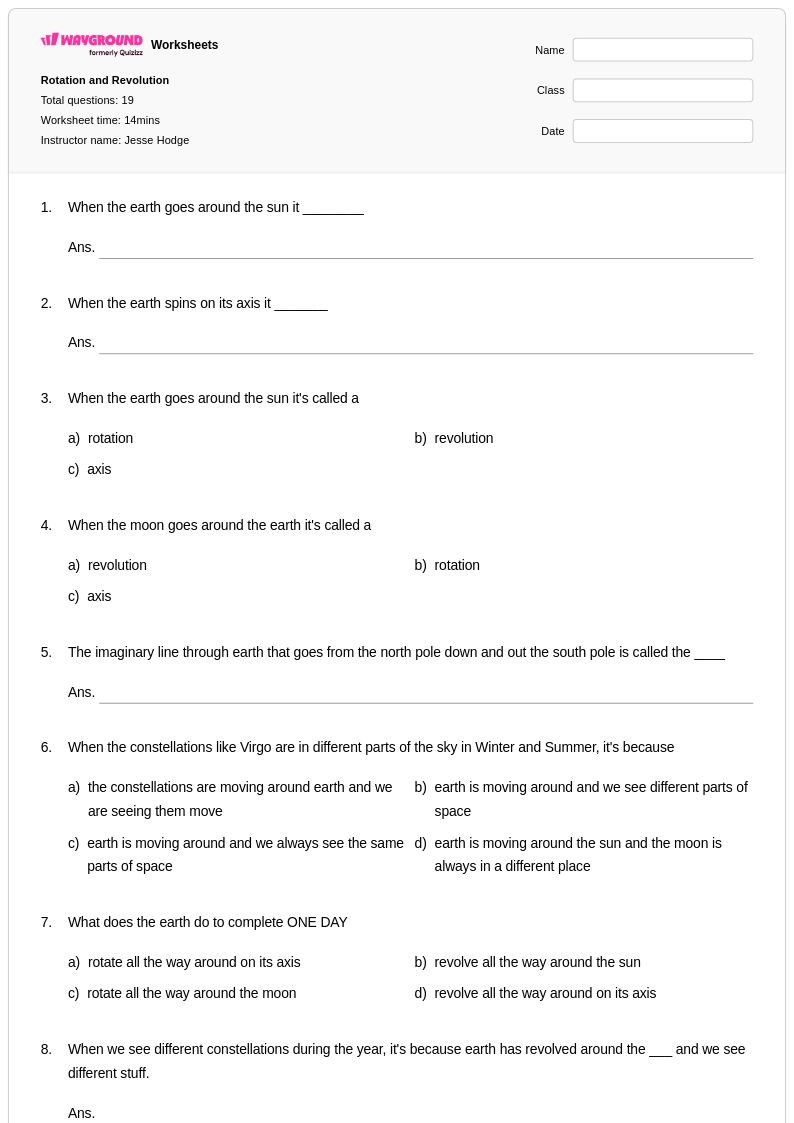
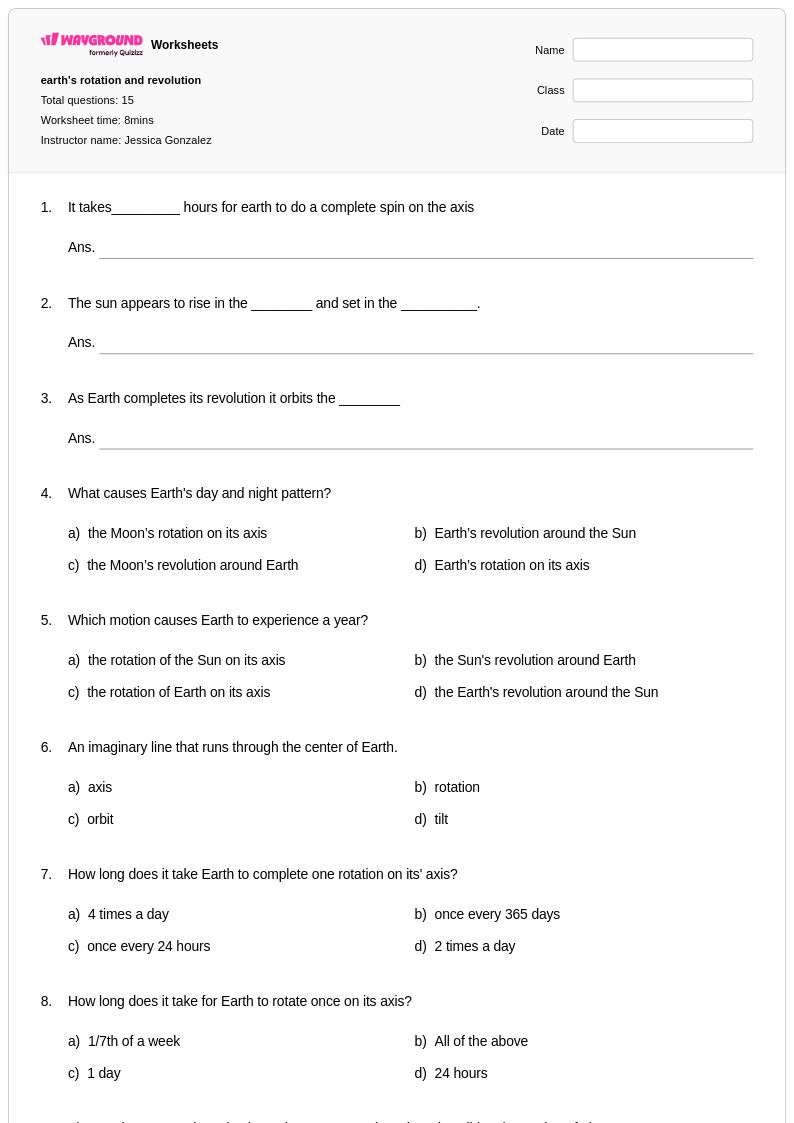
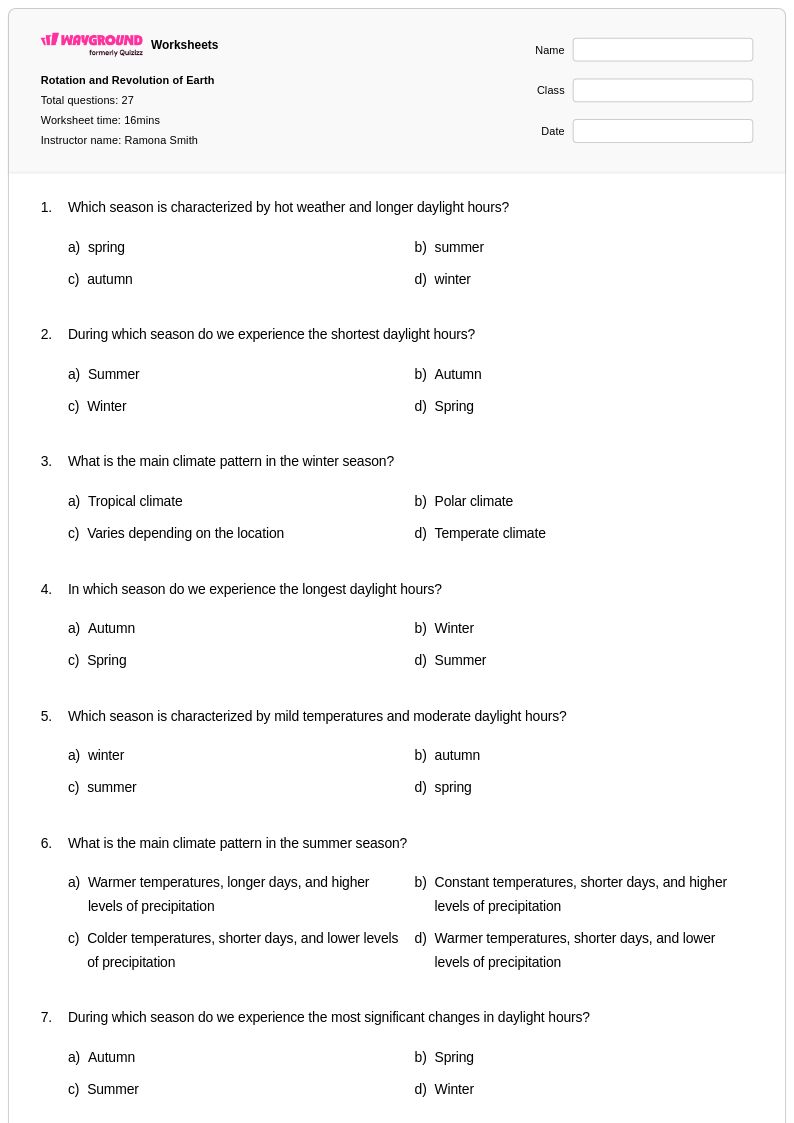
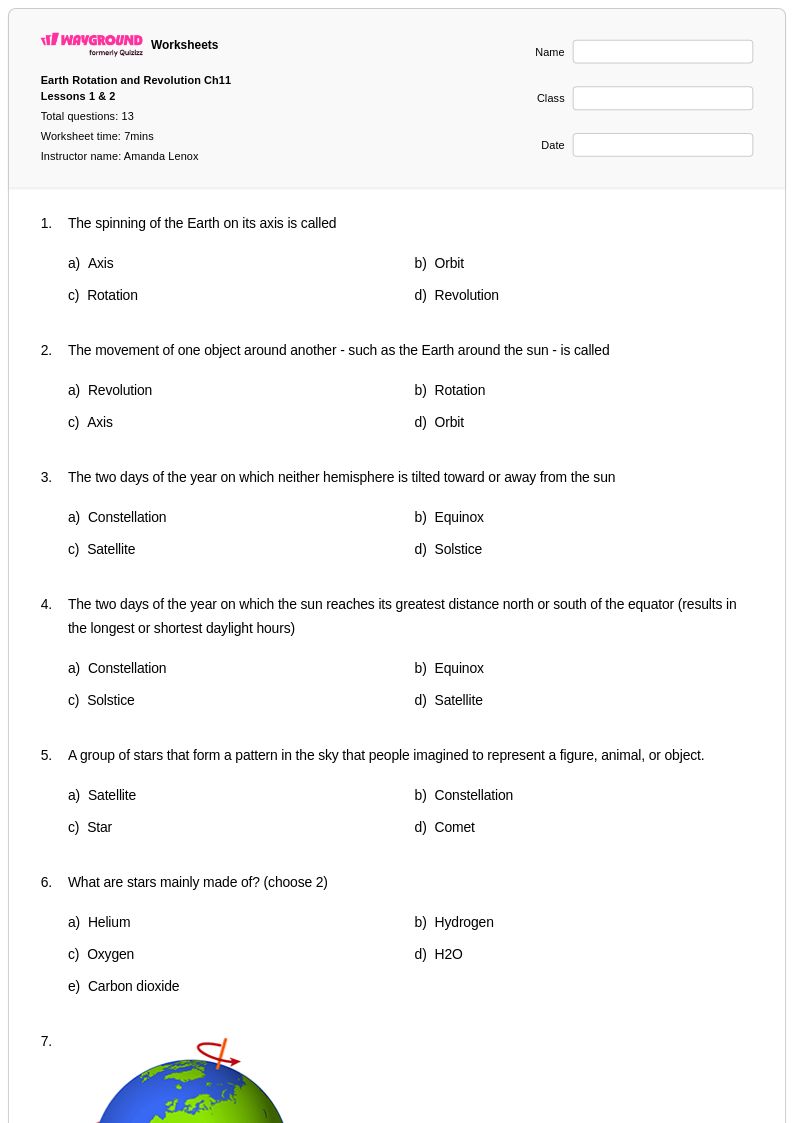
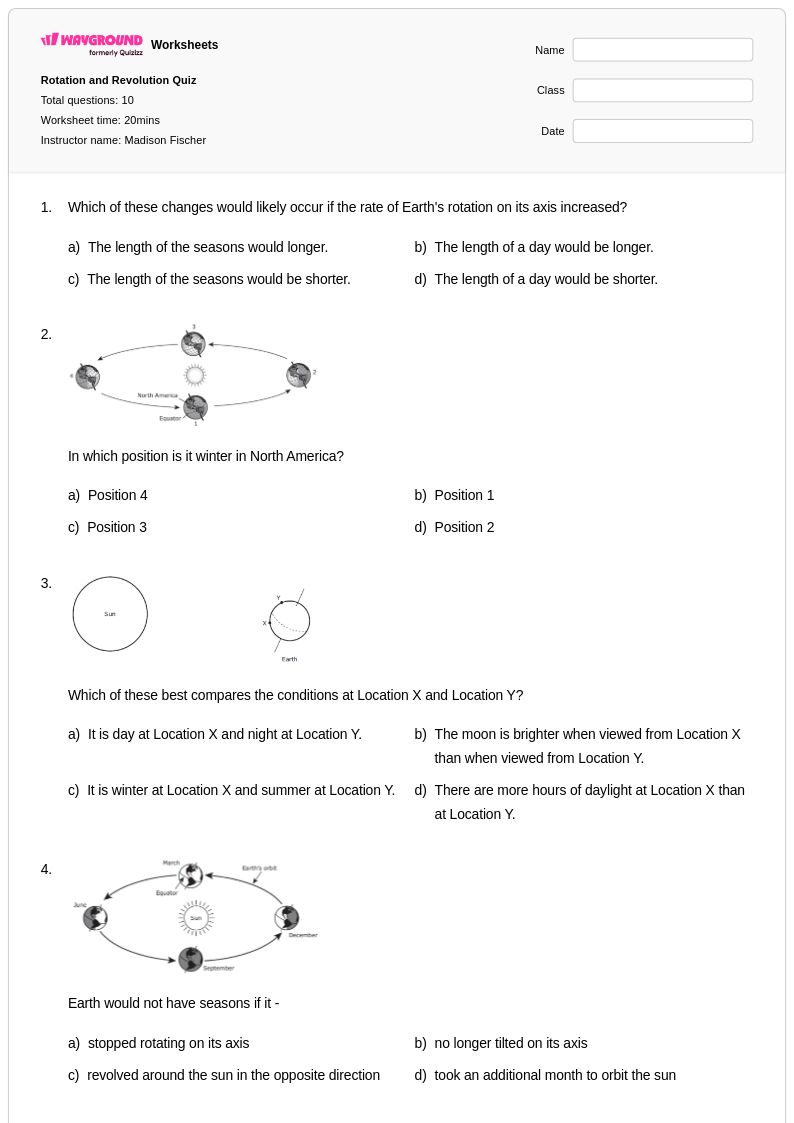
Rotation and Revolution worksheets available through Wayground (formerly Quizizz) provide comprehensive coverage of Earth's fundamental motions and their effects on our planet's physical and environmental systems. These carefully designed educational resources help students master the distinction between Earth's rotation on its axis and its revolution around the Sun, while developing critical thinking skills about how these movements influence day and night cycles, seasonal changes, and climate patterns. The collection includes practice problems that challenge learners to calculate rotational periods, analyze orbital mechanics, and connect celestial movements to observable phenomena on Earth. Each worksheet comes with detailed answer keys and is available as free printable pdf resources, enabling students to work through complex astronomical concepts at their own pace while reinforcing essential Earth and Space Science principles.
Wayground (formerly Quizizz) supports educators with an extensive library of millions of teacher-created Rotation and Revolution worksheets that can be easily searched, filtered, and customized to meet diverse classroom needs. The platform's robust standards alignment ensures that these resources directly support curriculum objectives while providing differentiation tools that accommodate varying skill levels and learning styles. Teachers can seamlessly transition between printable pdf formats for traditional classroom use and digital formats for technology-integrated instruction, making these worksheets versatile tools for lesson planning, targeted remediation, and enrichment activities. The comprehensive collection enables educators to provide systematic skill practice that builds student understanding of planetary motion concepts, from basic rotational mechanics to advanced applications involving astronomical calculations and real-world connections to Earth's dynamic systems.
FAQs
How do I teach the difference between rotation and revolution to students?
Start by grounding each term in a physical demonstration: rotation is Earth spinning on its own axis, causing day and night cycles, while revolution is Earth's orbit around the Sun, driving the cycle of seasons. Having students act out both motions simultaneously helps cement the distinction. Once students can physically distinguish the two, connect each motion to observable phenomena, such as why we have 24-hour days versus 365-day years, before moving into calculations or diagrams.
What exercises help students practice rotation and revolution concepts?
Effective practice exercises include labeling diagrams of Earth's axial tilt and orbital path, calculating the length of a rotational period versus a revolutionary period, and matching observable phenomena like solstices, equinoxes, and time zones to their causative motion. Practice problems that ask students to connect celestial mechanics to real-world events, such as explaining why the Northern Hemisphere experiences summer while the Southern Hemisphere experiences winter, are especially useful for deepening conceptual understanding.
What mistakes do students commonly make when learning about rotation and revolution?
The most common misconception is confusing rotation with revolution, often using the terms interchangeably. Students also frequently believe that Earth's distance from the Sun causes the seasons, rather than the axial tilt and angle of sunlight. Another persistent error is assuming Earth's orbit is a perfect circle rather than an ellipse, which can lead to misunderstandings about orbital mechanics. Targeted practice that explicitly contrasts these concepts, with immediate feedback, helps address these errors before they become entrenched.
How can I use rotation and revolution worksheets in my classroom?
Rotation and revolution worksheets on Wayground are available as printable PDFs for traditional classroom use and in digital formats for technology-integrated environments, giving teachers flexibility across in-person, hybrid, and remote settings. You can also host them as a quiz directly on Wayground, enabling real-time student responses and instant scoring. Each worksheet includes a complete answer key, making them practical for independent practice, small-group review, or homework assignments.
How do I differentiate rotation and revolution instruction for students at different skill levels?
For students still building foundational understanding, focus on the conceptual distinction between the two motions using visual diagrams and physical modeling before introducing calculations. More advanced students can be challenged with orbital mechanics problems, axial tilt analysis, and astronomical calculations connecting Earth's motions to climate patterns. On Wayground, teachers can apply individual accommodations such as reduced answer choices to lower cognitive load for struggling learners, or extended time for students who need additional processing support, without affecting the experience of other students in the class.
How does Earth's rotation relate to time zones?
Earth completes one full rotation on its axis approximately every 24 hours, and because the planet is divided into 360 degrees of longitude, each 15-degree segment corresponds to roughly one hour of time difference. This is why the world is divided into 24 standard time zones. Understanding rotation as the mechanism behind time zones helps students connect abstract celestial motion to concrete, real-world geography and daily life, which reinforces the broader lesson that planetary motion has measurable effects on Earth's systems.