Free Printable Rock Climbing Worksheets for Grade 10
Explore Wayground's comprehensive Grade 10 rock climbing worksheets and printables that help students master essential outdoor adventure skills through engaging practice problems, free PDF resources, and detailed answer keys.
Explore printable Rock Climbing worksheets for Grade 10
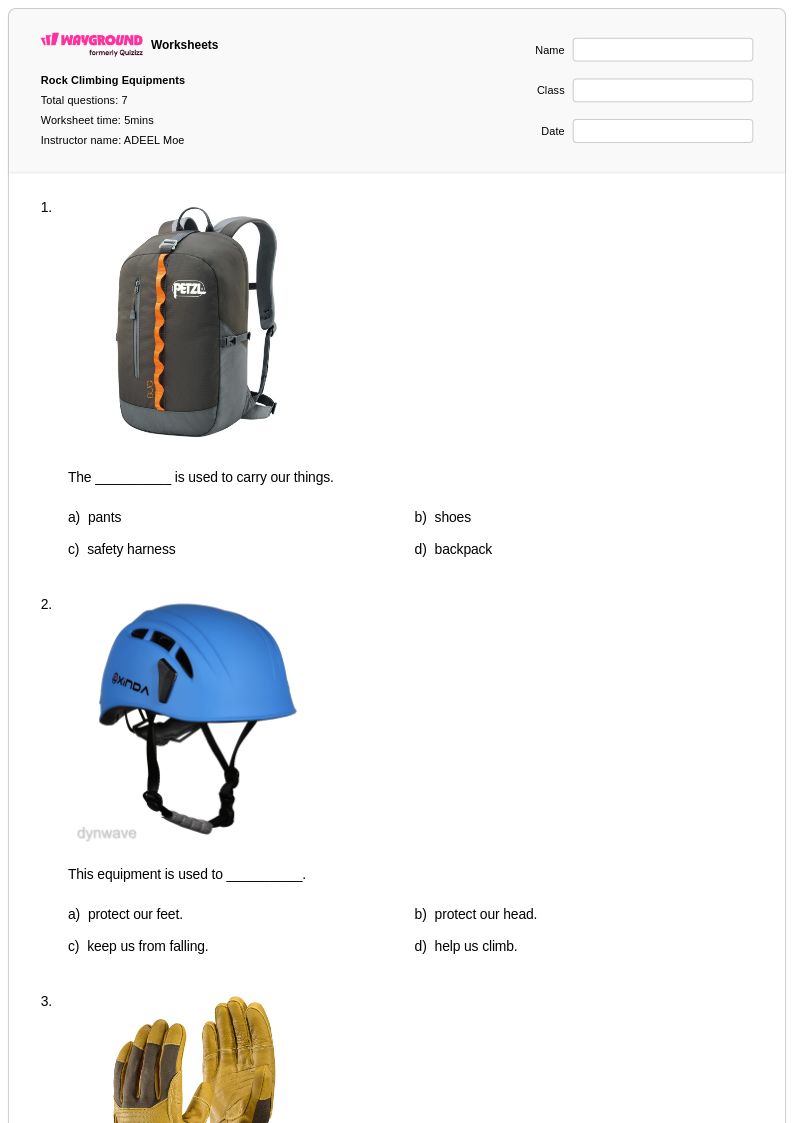
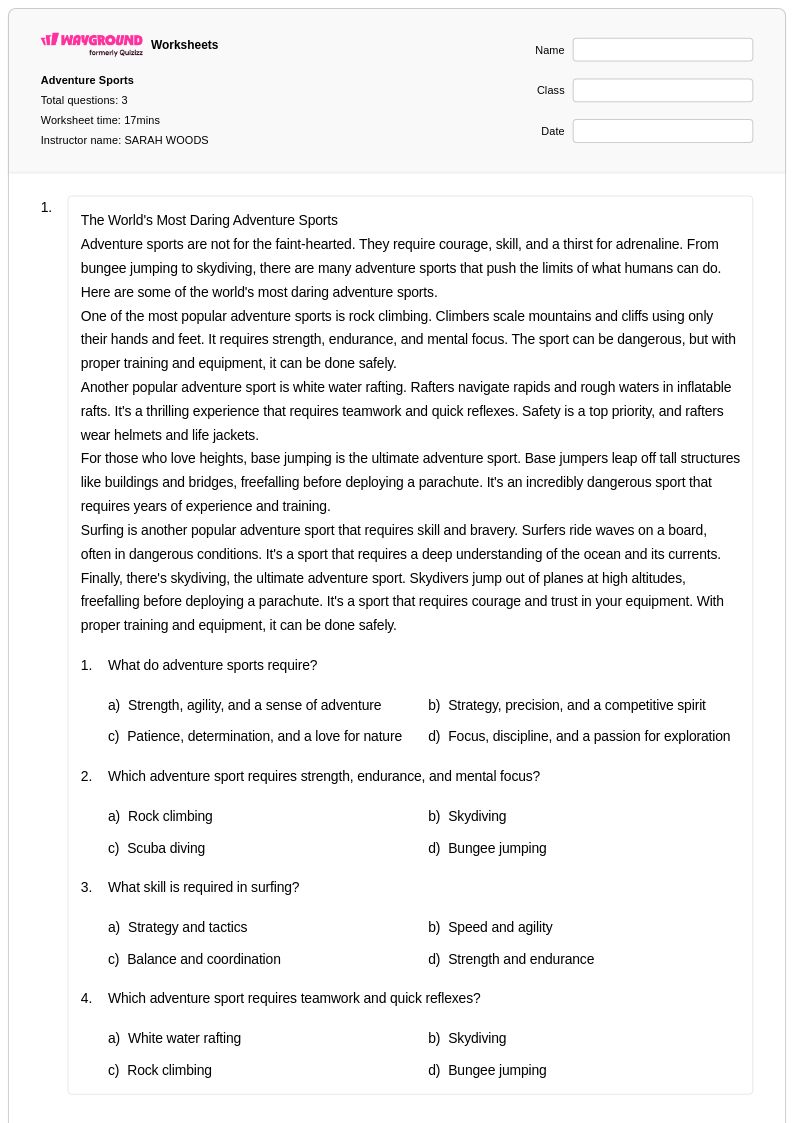
Rock climbing worksheets for Grade 10 students available through Wayground (formerly Quizizz) provide comprehensive educational resources that bridge theoretical knowledge with practical outdoor adventure skills. These expertly designed materials focus on essential rock climbing concepts including safety protocols, equipment identification, route planning, risk assessment, and climbing techniques specific to various rock formations and difficulty levels. The worksheets strengthen critical thinking abilities as students analyze climbing scenarios, evaluate safety measures, and develop problem-solving strategies essential for successful outdoor adventures. Each resource includes detailed answer keys that facilitate self-assessment and instructor evaluation, while the free printable format ensures accessibility for diverse learning environments. Practice problems challenge students to apply their understanding of climbing physics, weather considerations, and emergency procedures, building the foundational knowledge necessary for safe participation in rock climbing activities.
Wayground (formerly Quizizz) empowers physical education teachers with an extensive collection of millions of teacher-created rock climbing and outdoor adventure resources that streamline lesson planning and enhance student engagement. The platform's robust search and filtering capabilities enable educators to quickly locate Grade 10 appropriate materials that align with curriculum standards and specific learning objectives. Teachers can customize worksheets to accommodate different skill levels, supporting both remediation for struggling students and enrichment opportunities for advanced learners. The flexible digital and printable pdf formats allow seamless integration into various instructional settings, whether conducting classroom-based theory sessions or preparing students for actual climbing experiences. These differentiation tools and comprehensive resource libraries significantly reduce preparation time while ensuring that rock climbing education maintains the highest standards of safety awareness and technical competency development.
FAQs
How do I teach rock climbing safety in a PE class without a climbing wall?
You can teach rock climbing safety concepts entirely in a classroom setting by focusing on equipment identification, knot-tying sequences, belaying procedures, and scenario-based risk assessment. Worksheets that present real climbing situations and ask students to evaluate hazards or choose correct responses are especially effective for building safety judgment before students ever touch a wall. This approach ensures students arrive at a climbing facility with foundational knowledge already in place.
What topics should rock climbing worksheets cover for a physical education unit?
A well-rounded rock climbing unit should cover safety protocols, equipment identification (harnesses, carabiners, belay devices, helmets), climbing techniques, knot-tying sequences, route reading, risk assessment, and environmental stewardship. Practice problems that walk students through belaying procedures and scenario-based safety evaluations help reinforce both procedural knowledge and critical thinking. Covering environmental stewardship is also important for programs that include outdoor or natural climbing environments.
What mistakes do students commonly make when learning rock climbing concepts?
Students frequently confuse the steps of belaying procedures, misidentify equipment functions, and underestimate the importance of pre-climb safety checks. A common error in written assessments is treating knot-tying as a memorization task rather than understanding why each knot is used in a specific context. Scenario-based questions that require students to spot unsafe practices are particularly effective at surfacing these gaps before they become real-world risks.
How can I differentiate rock climbing worksheets for students at different skill levels?
For beginners, focus on foundational vocabulary, basic equipment identification, and step-by-step safety checklists. More experienced climbers can engage with advanced technique analysis, route-reading challenges, and complex risk-assessment scenarios. On Wayground, teachers can apply accommodations such as reduced answer choices for students who need additional support, or enable Read Aloud so questions are read to students who benefit from audio delivery, ensuring every learner can access the material.
How do I use Wayground's rock climbing worksheets in my class?
Wayground's rock climbing worksheets are available as printable PDFs for traditional classroom or theory-session use, and in digital formats for technology-integrated PE programs. Teachers can also host worksheets as a live quiz directly on Wayground, making them suitable for both individual practice and whole-class review. All worksheets include comprehensive answer keys, supporting both independent student study and instructor-guided instruction.
What exercises help students practice route reading and climbing decision-making?
Scenario-based worksheet problems are among the most effective tools for building route-reading and decision-making skills, presenting students with climbing situations where they must identify the safest path, evaluate risks, or choose the correct technique. Diagram-based questions that show a climbing route and ask students to annotate anchor points, rest positions, or hazard zones add a visual dimension to practice. These exercises translate directly into better on-wall judgment because they train deliberate thinking under structured conditions.