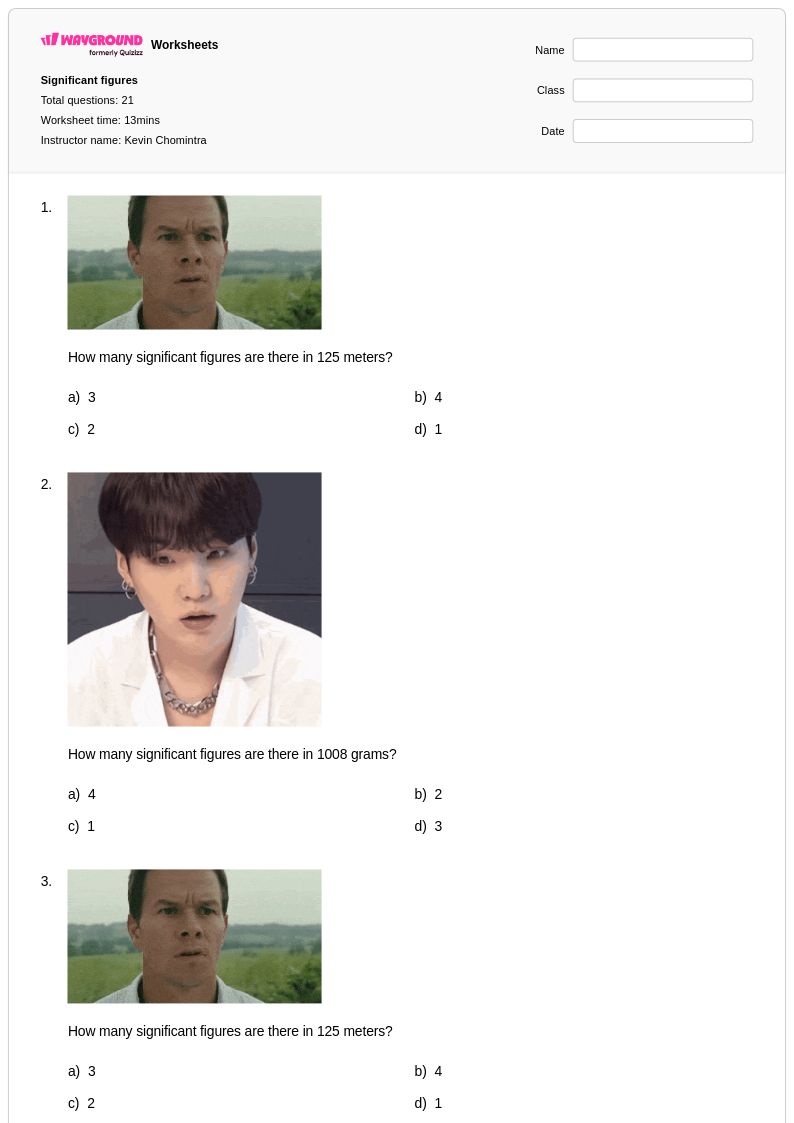
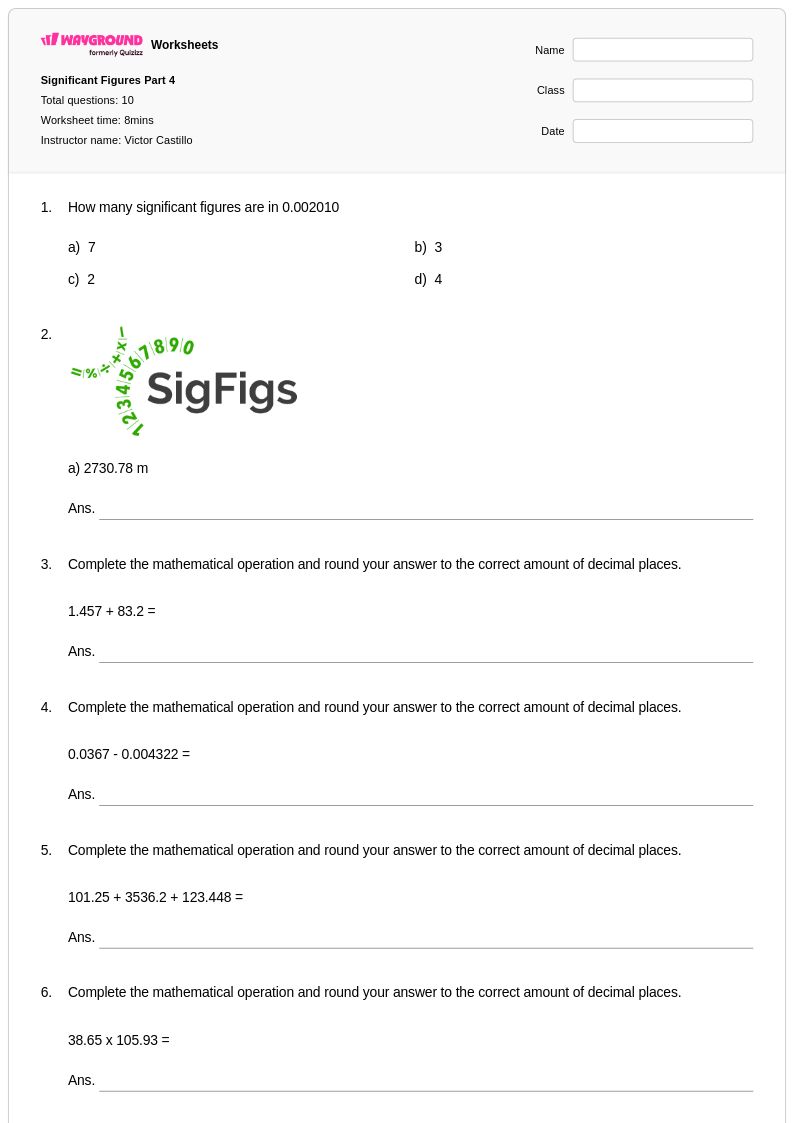
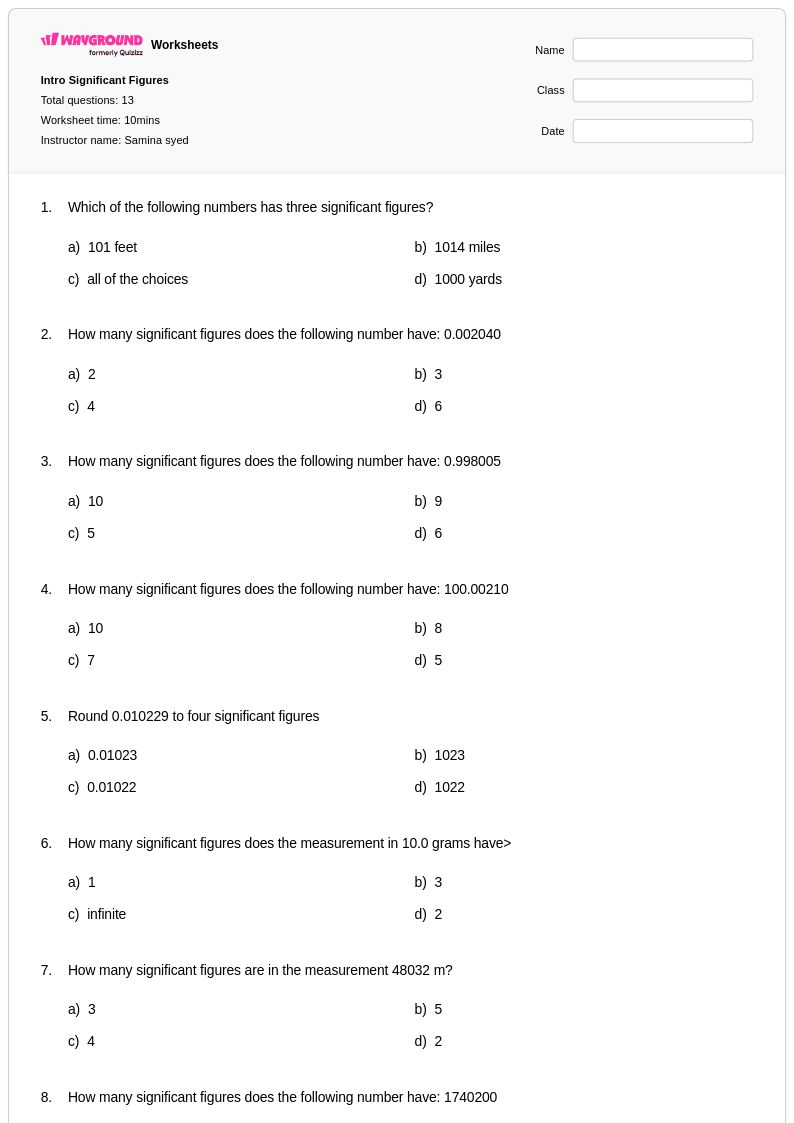
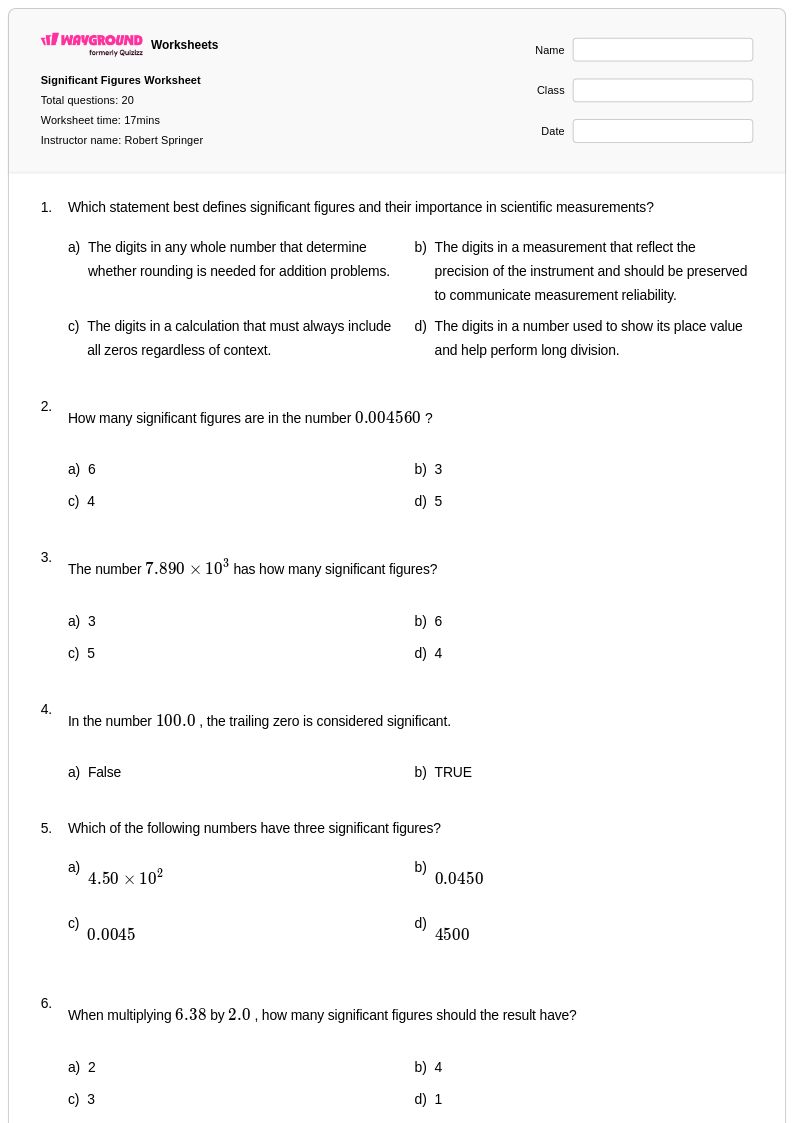
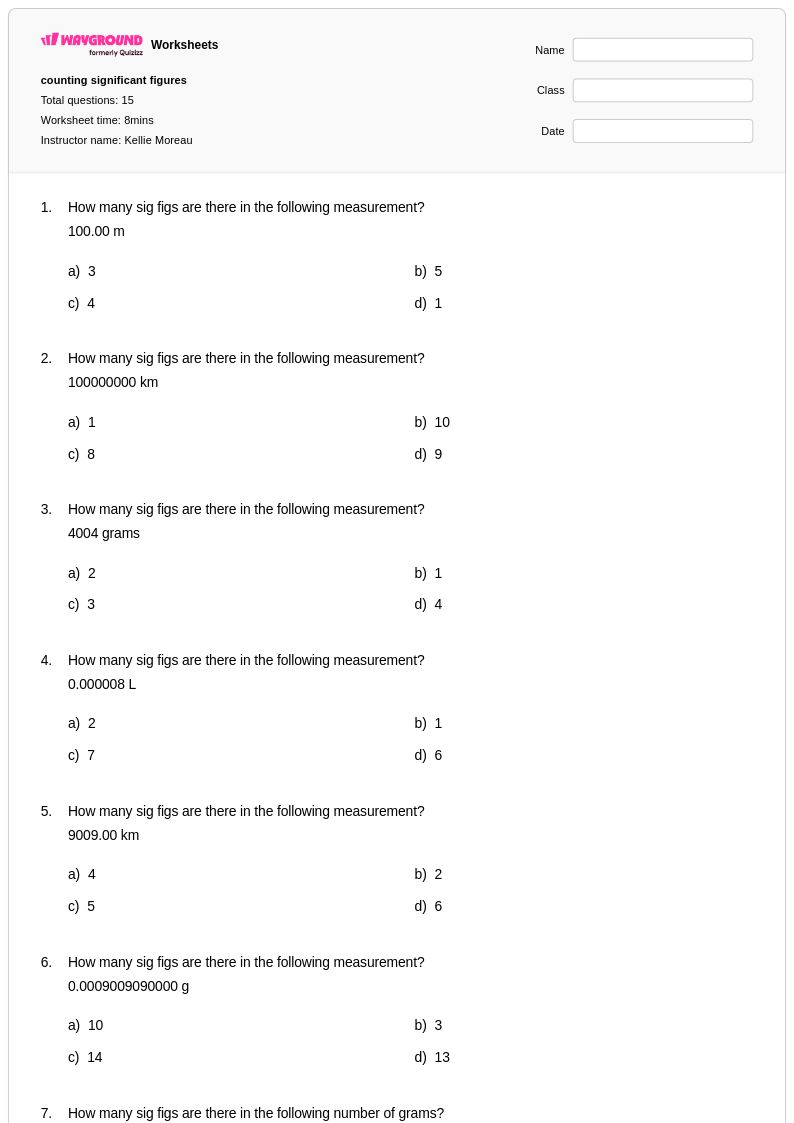
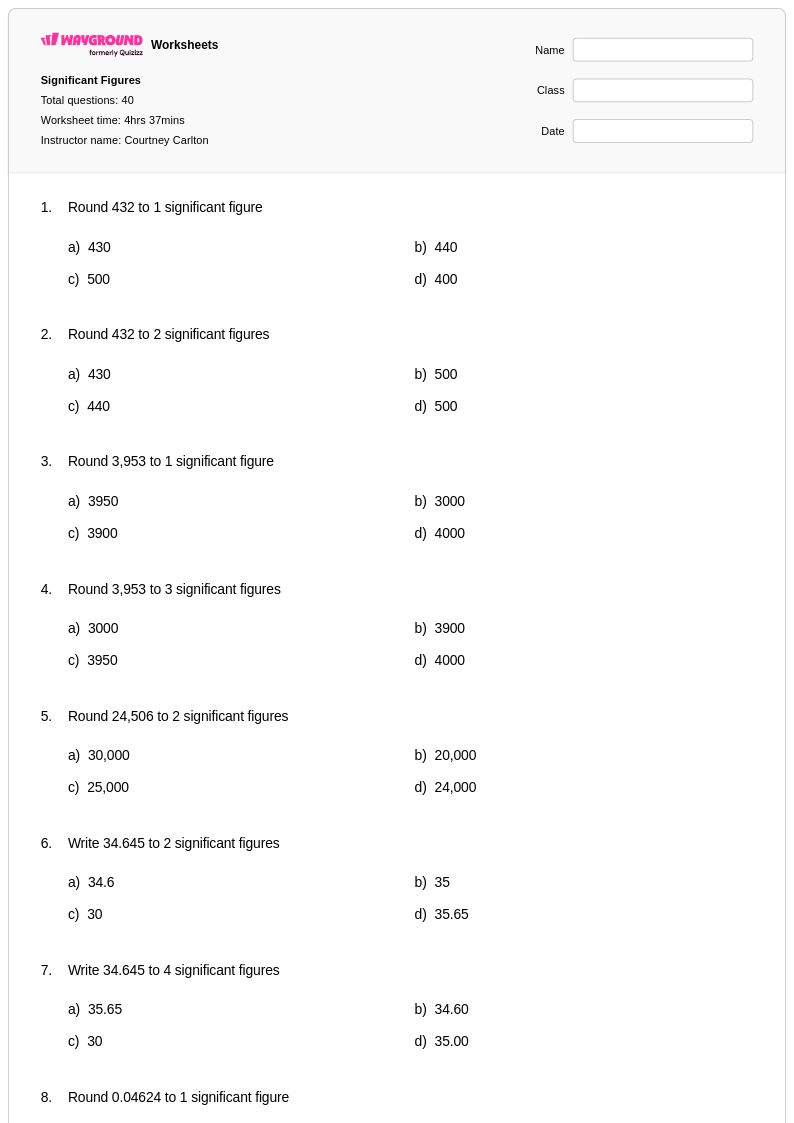
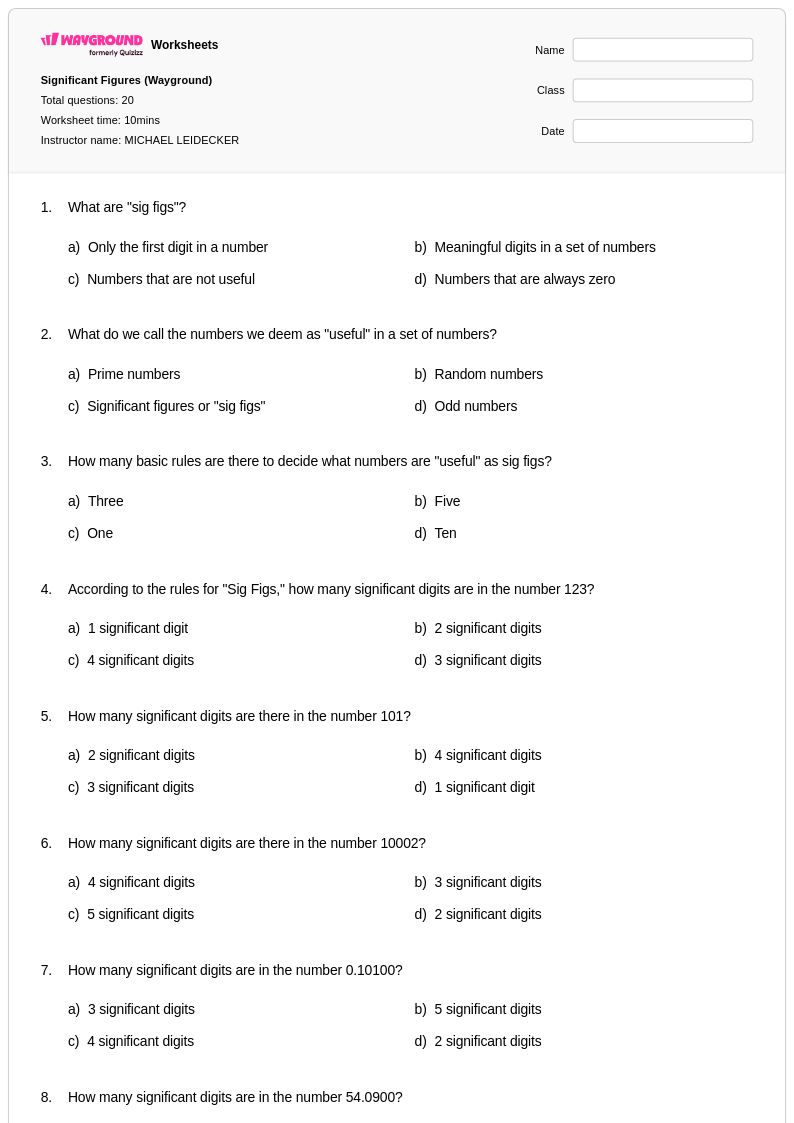
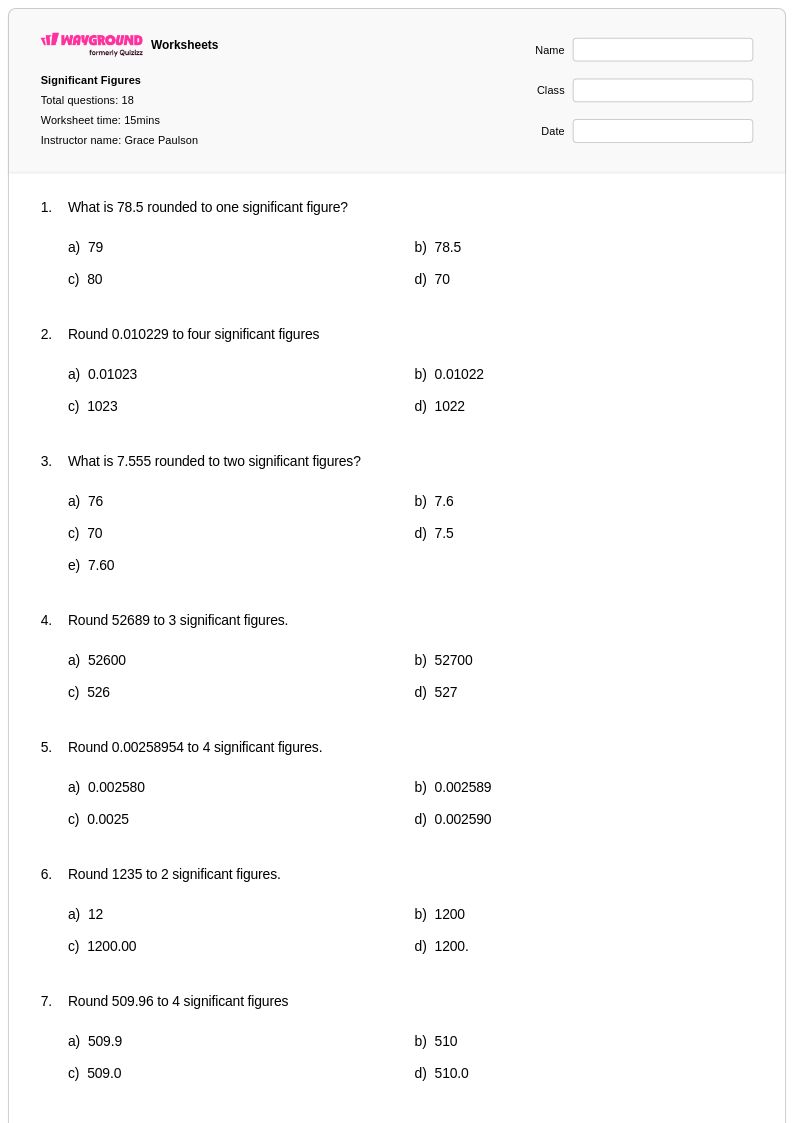
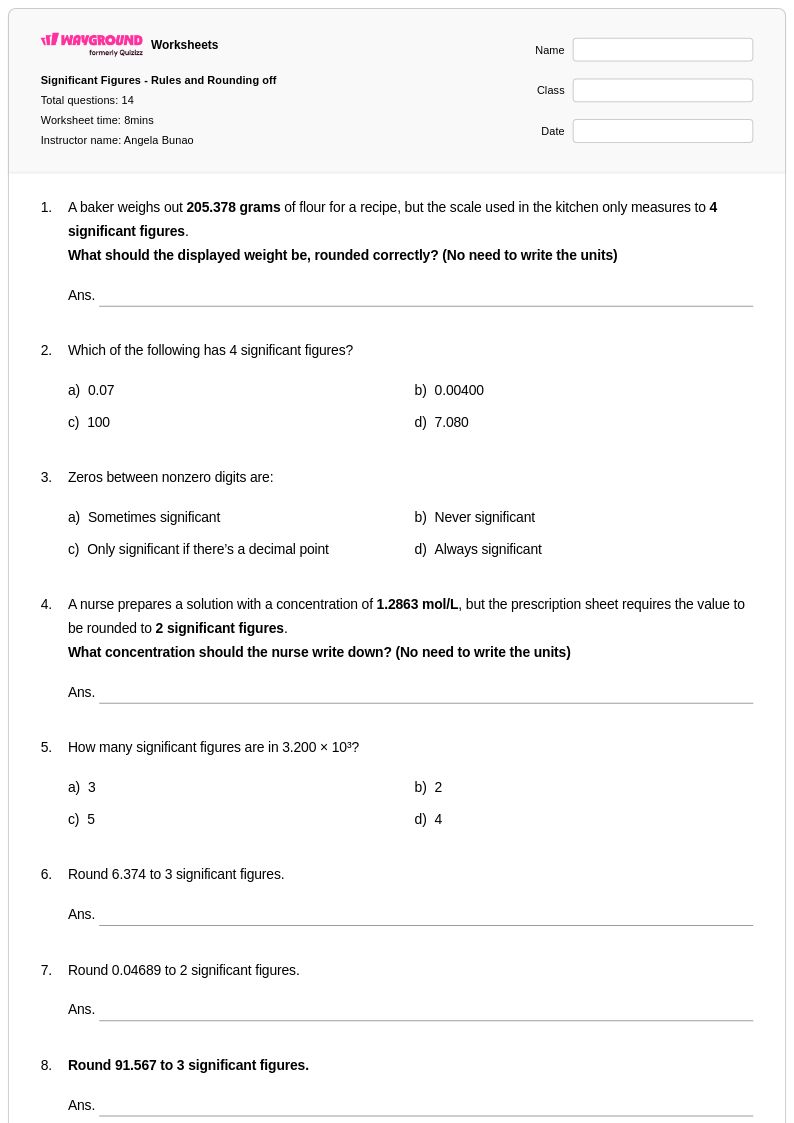
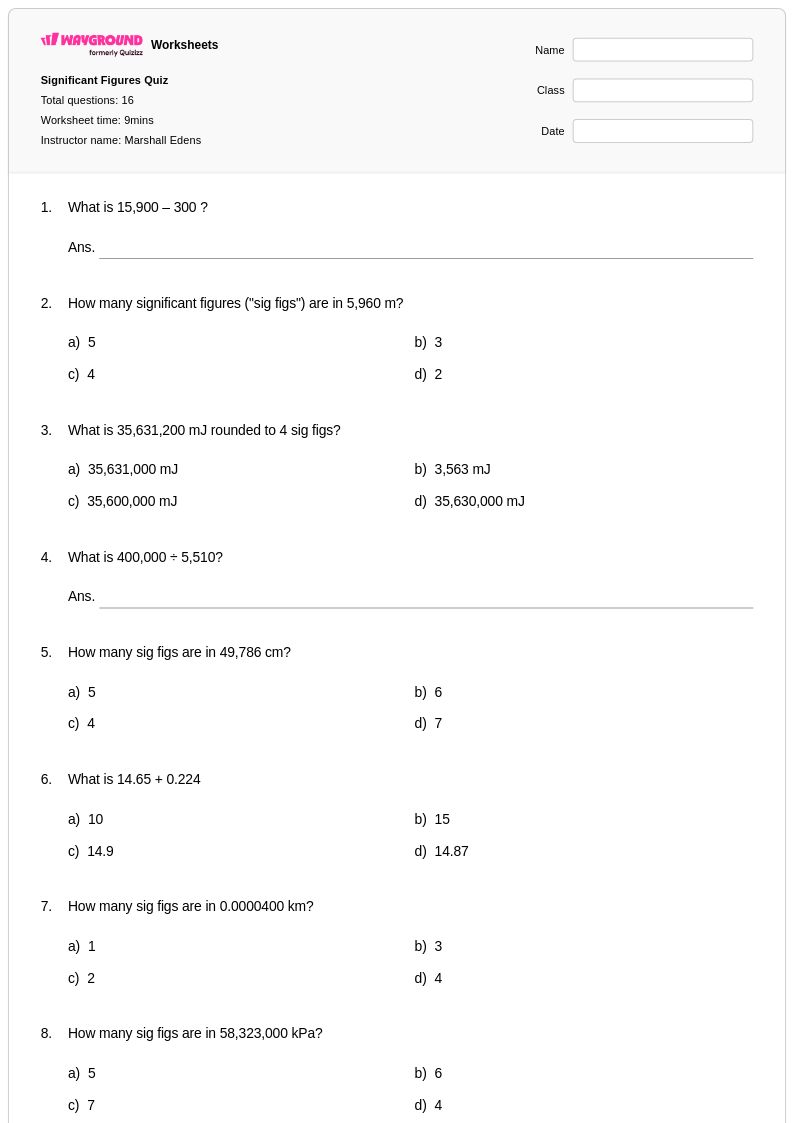
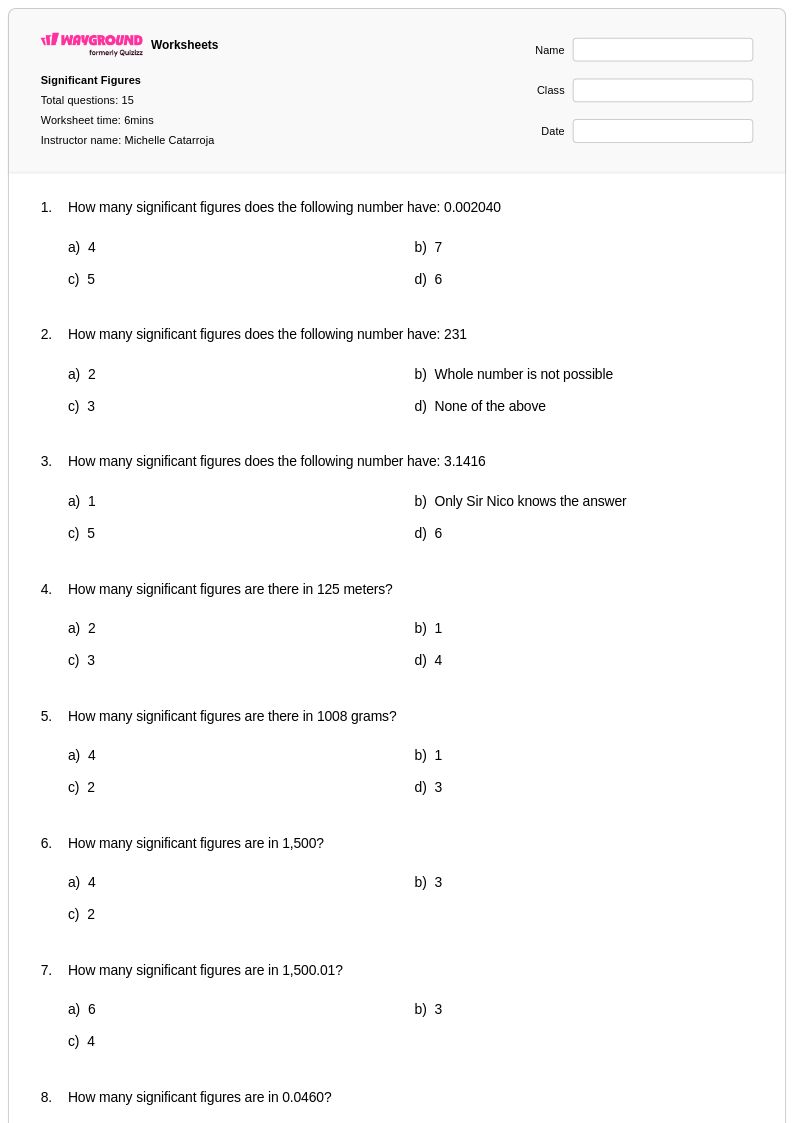
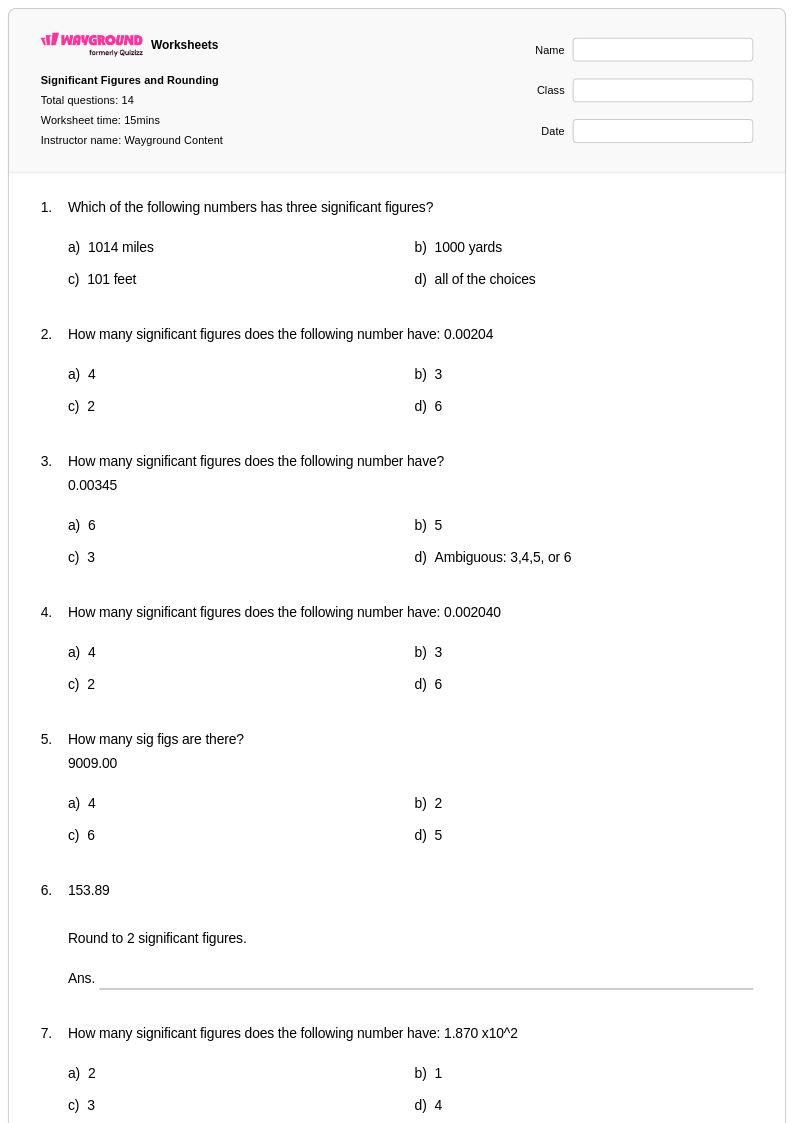
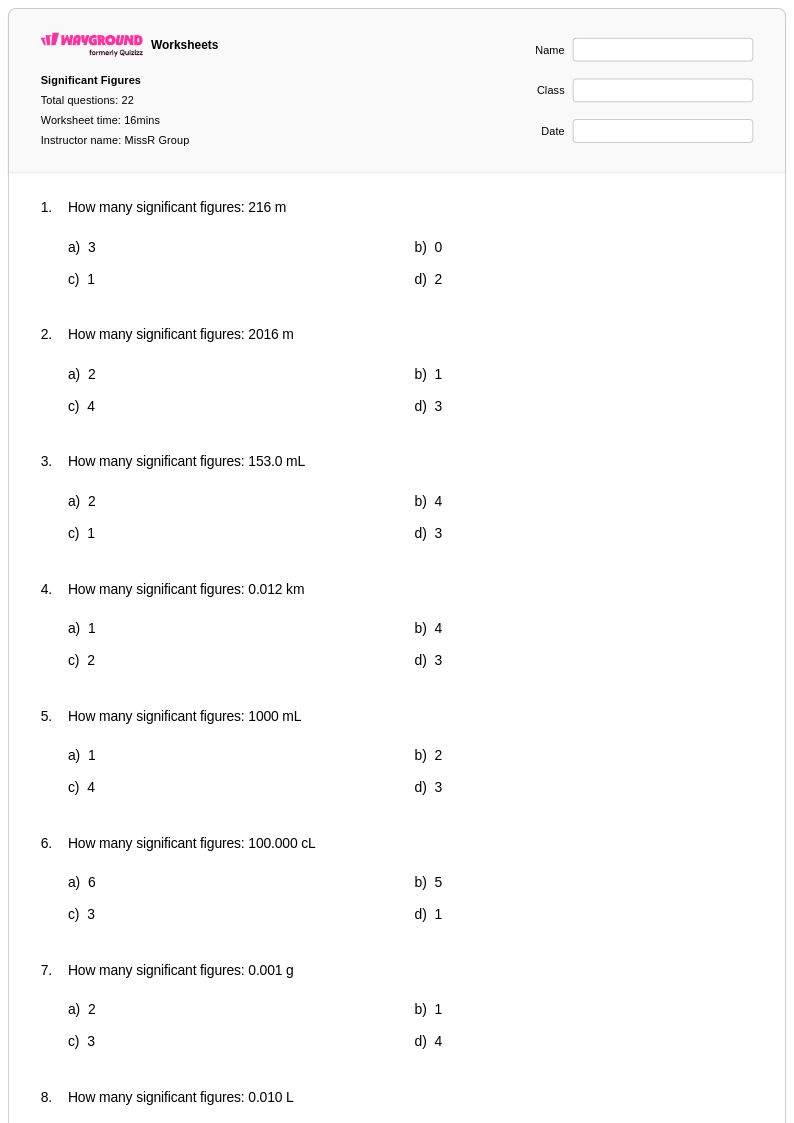
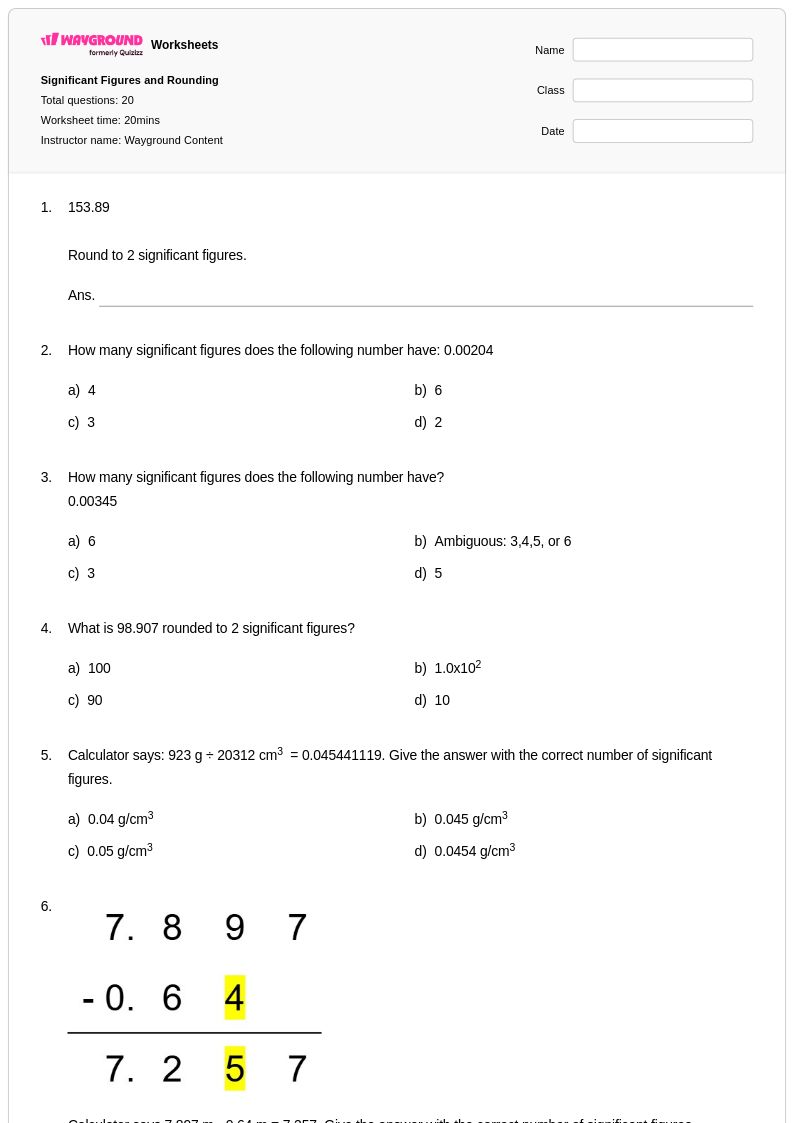
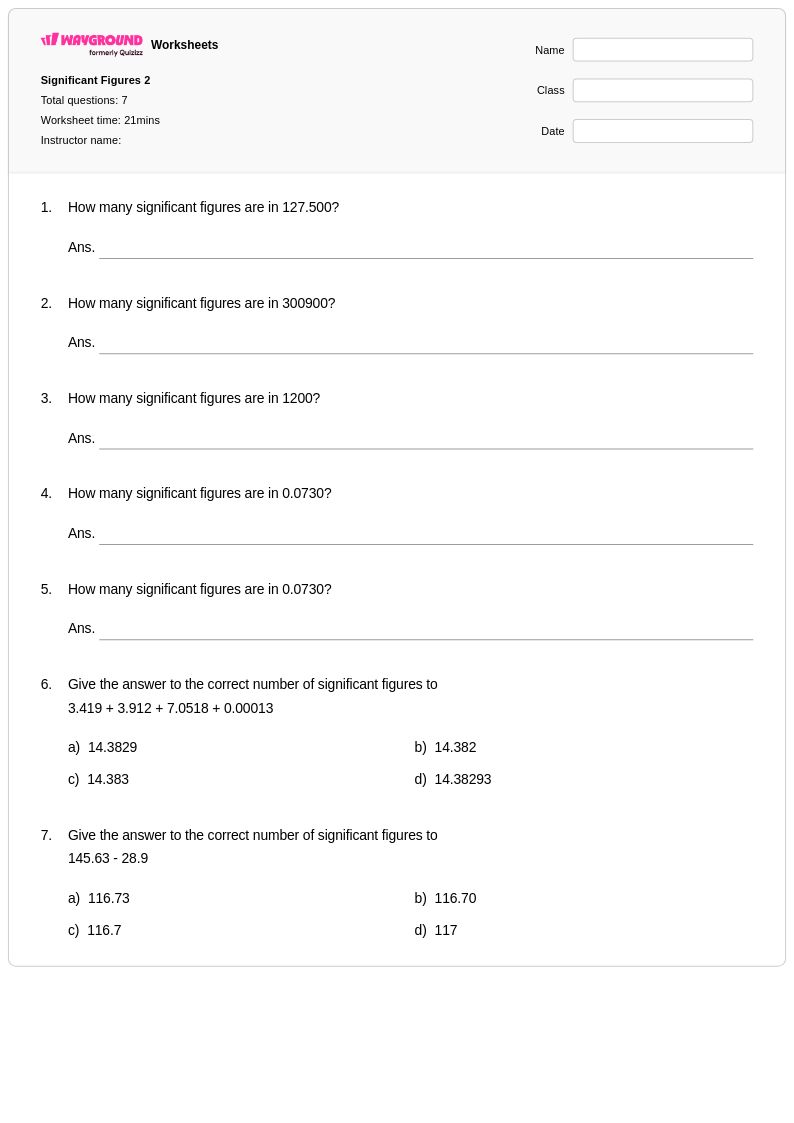
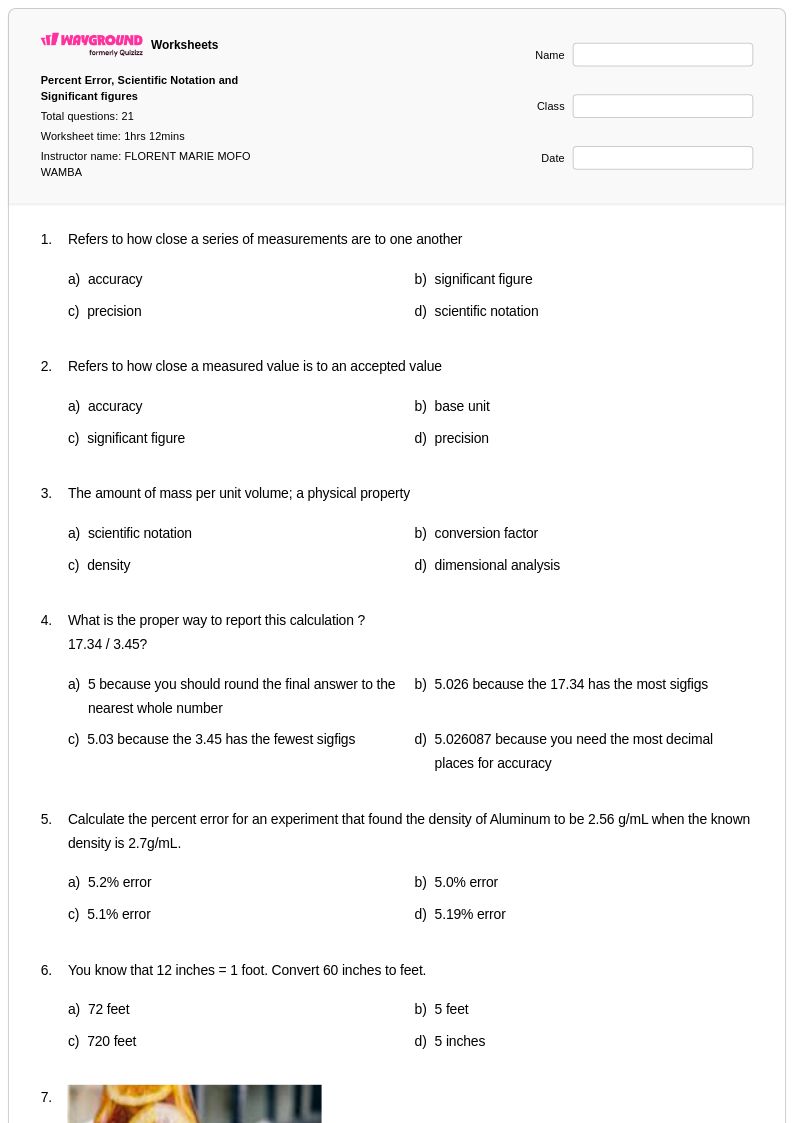
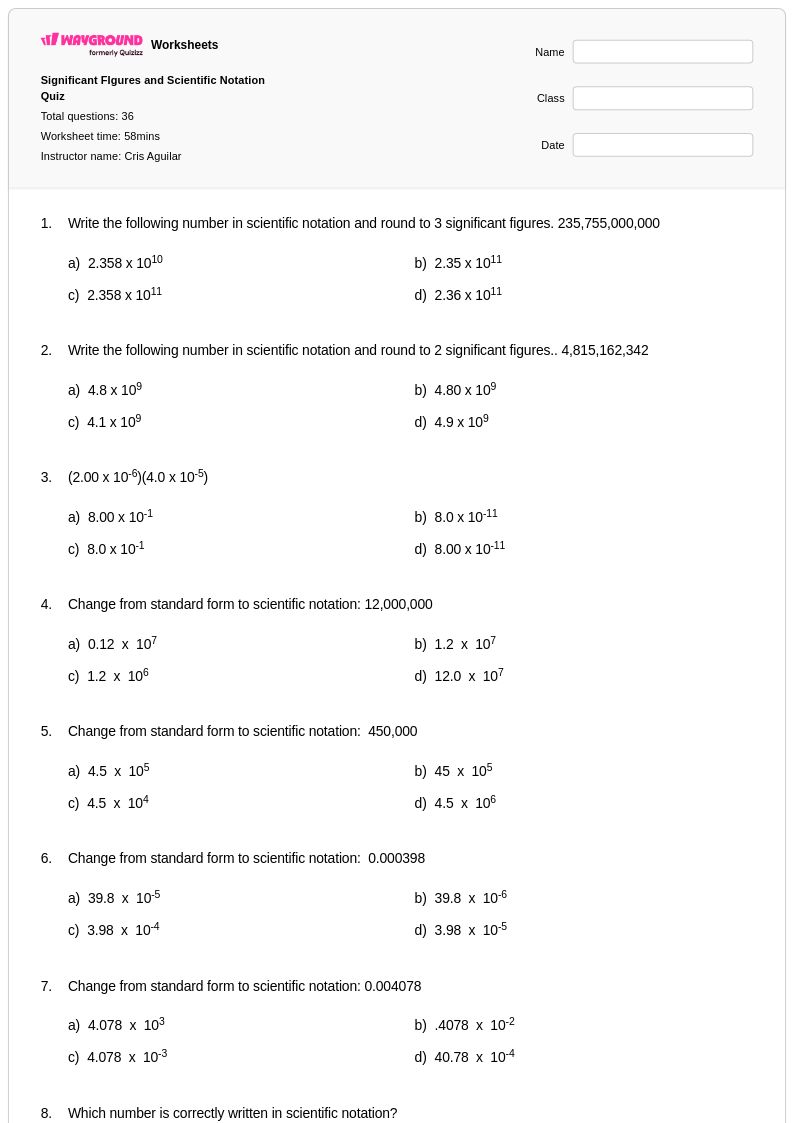
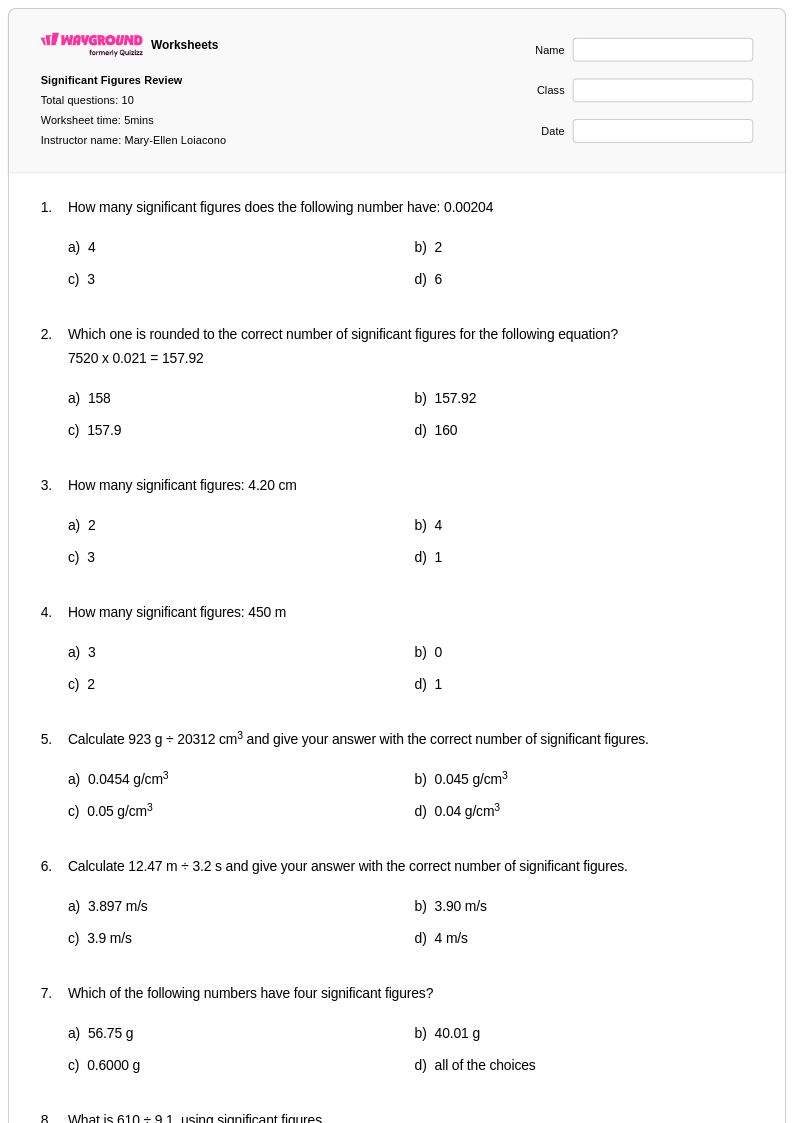
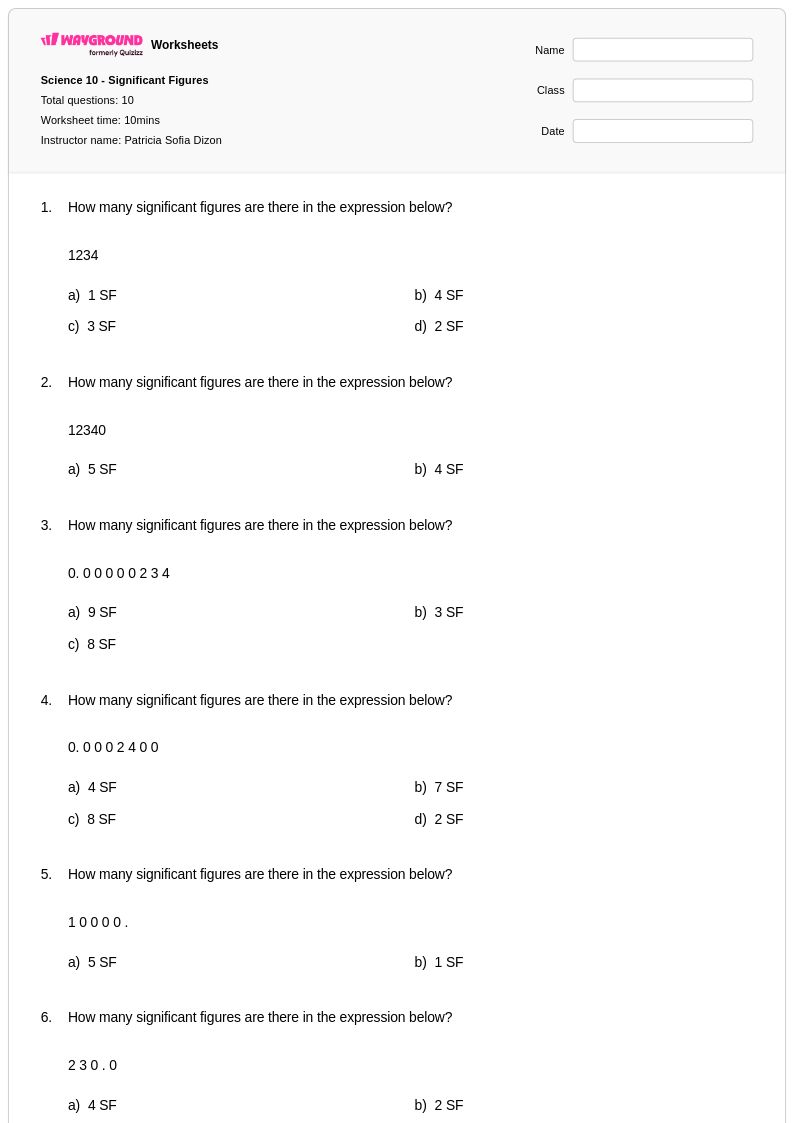
Strengthen understanding of significant figures with Wayground's comprehensive collection of free worksheets and printables, featuring practice problems and answer keys to help students master precise measurement and scientific notation skills.
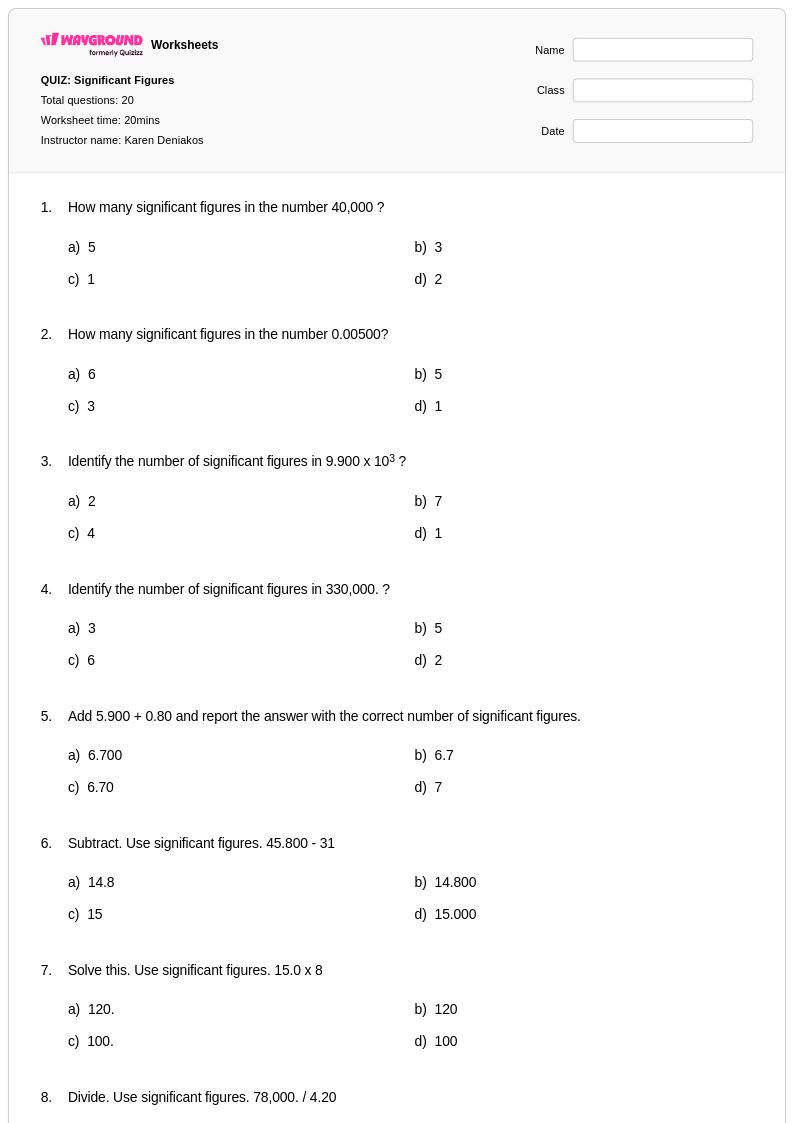
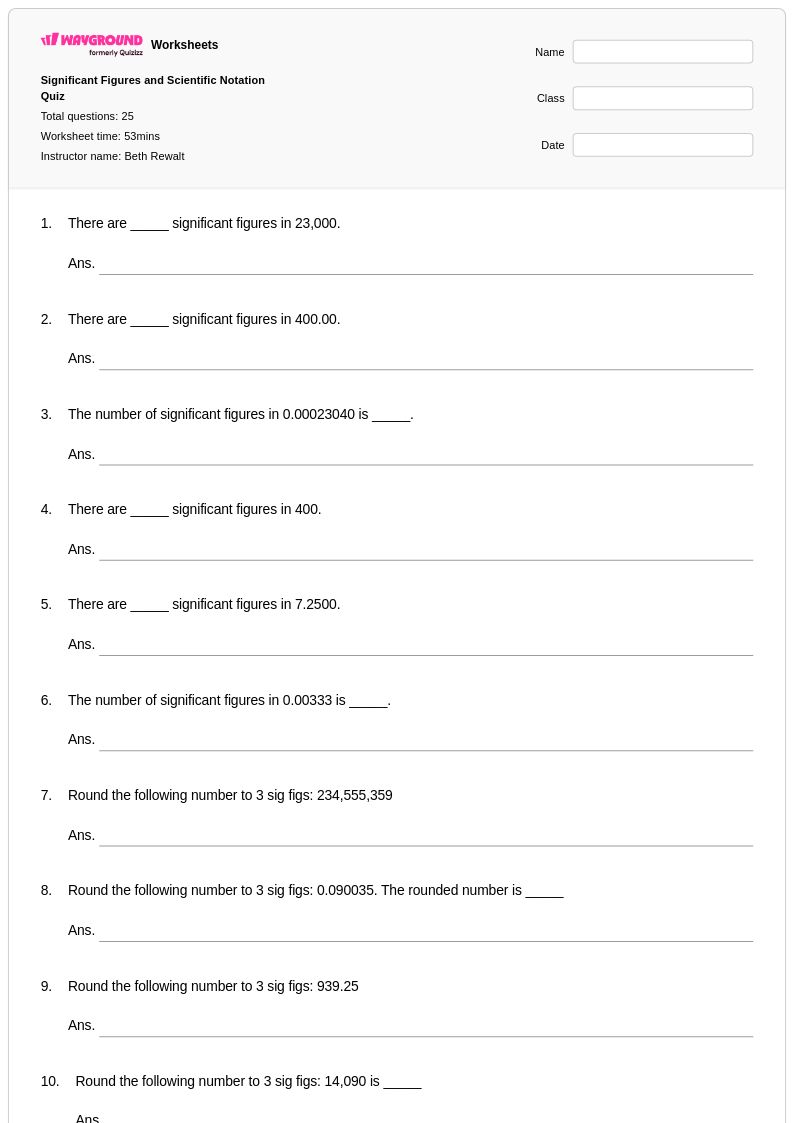
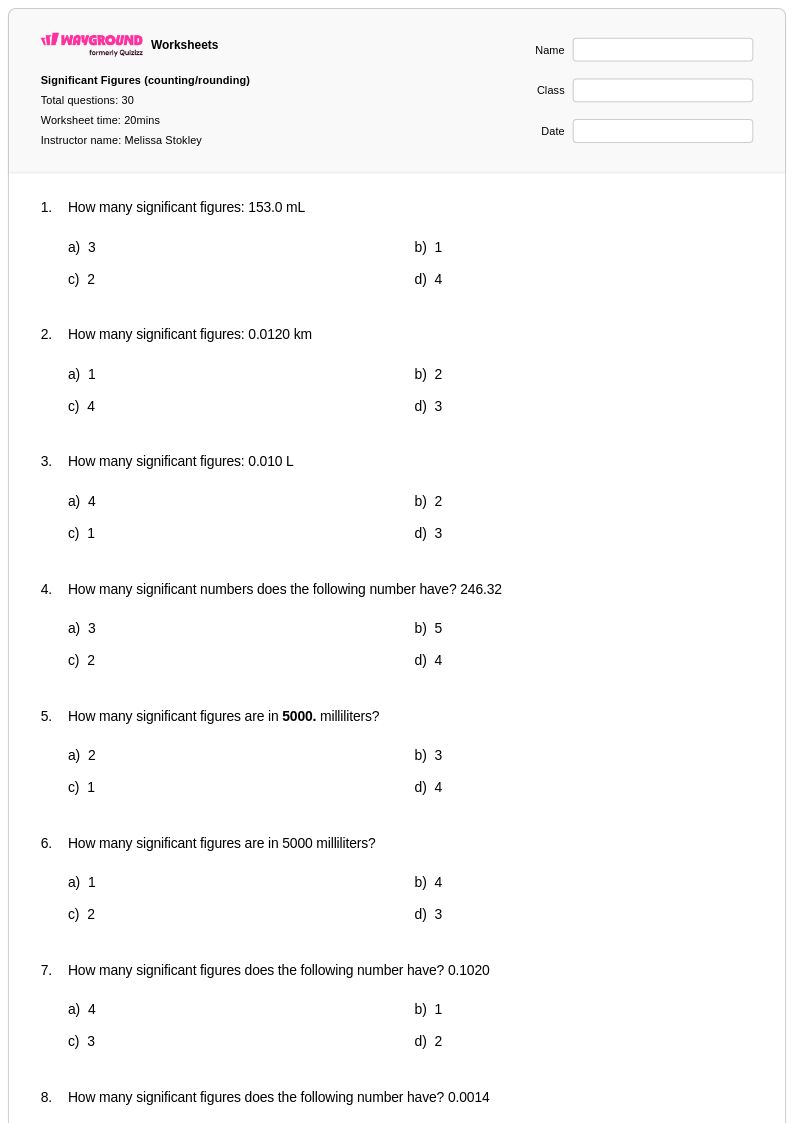
Significant figures worksheets available through Wayground (formerly Quizizz) provide comprehensive practice opportunities for students to master this fundamental measurement concept in science. These expertly designed resources help students develop critical skills in identifying, counting, and applying significant figures in calculations, measurements, and scientific notation. The worksheet collection includes structured practice problems that progress from basic identification exercises to complex multi-step calculations requiring proper significant figure rules. Each worksheet comes with a detailed answer key that explains the reasoning behind correct responses, making these free printables valuable for both independent study and classroom instruction. Students work through realistic scenarios involving laboratory measurements, data analysis, and mathematical operations while learning to distinguish between precise and uncertain digits in numerical values.
Wayground (formerly Quizizz) empowers educators with access to millions of teacher-created significant figures resources that can be easily searched, filtered, and customized to meet diverse classroom needs. The platform's robust collection includes worksheets aligned with science standards that address various aspects of significant figures, from basic counting rules to advanced applications in scientific calculations. Teachers can differentiate instruction by selecting materials appropriate for different skill levels, modify existing worksheets to target specific learning objectives, and access both printable pdf formats for traditional paper-based activities and digital versions for online learning environments. These flexible tools support comprehensive lesson planning while providing targeted resources for remediation, enrichment, and ongoing skill practice, ensuring students develop the precision and accuracy essential for scientific measurement and calculation.
FAQs
How do I teach significant figures to students who are new to the concept?
Start by grounding significant figures in the real-world context of measurement precision — why a ruler and a micrometer don't carry the same certainty. Introduce the counting rules one at a time: non-zero digits, zeros between non-zero digits, trailing zeros with decimals, and leading zeros. Use physical lab measurements early so students connect the concept to authentic scientific practice before moving into calculations.
What exercises best help students practice identifying and applying significant figures?
Effective practice begins with identification drills where students count significant figures in a list of values, then progresses to rounding answers from addition, subtraction, multiplication, and division to the correct number of significant figures. Multi-step calculation problems that mirror lab data analysis are especially useful because they force students to apply the rules in sequence rather than in isolation. Worksheets that include scientific notation alongside standard form help students see how significant figures behave across different representations.
What are the most common mistakes students make with significant figures?
The most frequent error is misreading zeros — students routinely count leading zeros as significant or overlook trailing zeros that follow a decimal point. A second persistent mistake is applying multiplication/division rounding rules to addition/subtraction problems (and vice versa), which are governed by different logic. Students also tend to round intermediate steps in multi-step calculations, compounding error before they reach the final answer.
How do I differentiate significant figures instruction for students at different skill levels?
For students still building foundational skills, focus on single-rule identification before introducing mixed practice sets. More advanced students benefit from multi-step problems involving unit conversions, scientific notation, and lab-style data tables. On Wayground, teachers can select or modify worksheets to target specific rules and can apply accommodations such as reduced answer choices or read-aloud support for individual students who need additional scaffolding.
How can I use Wayground's significant figures worksheets in my classroom?
Wayground's significant figures worksheets are available as printable PDFs for traditional paper-based practice and in digital formats for technology-integrated classrooms. Teachers can assign them as independent work, guided practice, or homework, and can also host them as a quiz directly on Wayground for instant auto-grading. Each worksheet includes a complete answer key, making it straightforward to use for self-checking, peer review, or teacher-led correction sessions.
How do significant figures relate to scientific notation, and should I teach them together?
Scientific notation and significant figures are closely linked because expressing a number in scientific notation makes its significant figures immediately visible — ambiguous trailing zeros disappear once a value is written as a coefficient times a power of ten. Teaching them together, or in close sequence, reinforces both concepts and helps students understand why scientists use this notation for clarity and precision. Worksheet problems that require students to convert between standard form and scientific notation while preserving the correct number of significant figures are a practical way to reinforce both skills simultaneously.