Free Printable Six Thinking Hats Worksheets for Grade 8
Grade 8 Six Thinking Hats worksheets and printables from Wayground help students master critical thinking through structured perspective-taking exercises, featuring free PDF practice problems with comprehensive answer keys.
Explore printable Six Thinking Hats worksheets for Grade 8
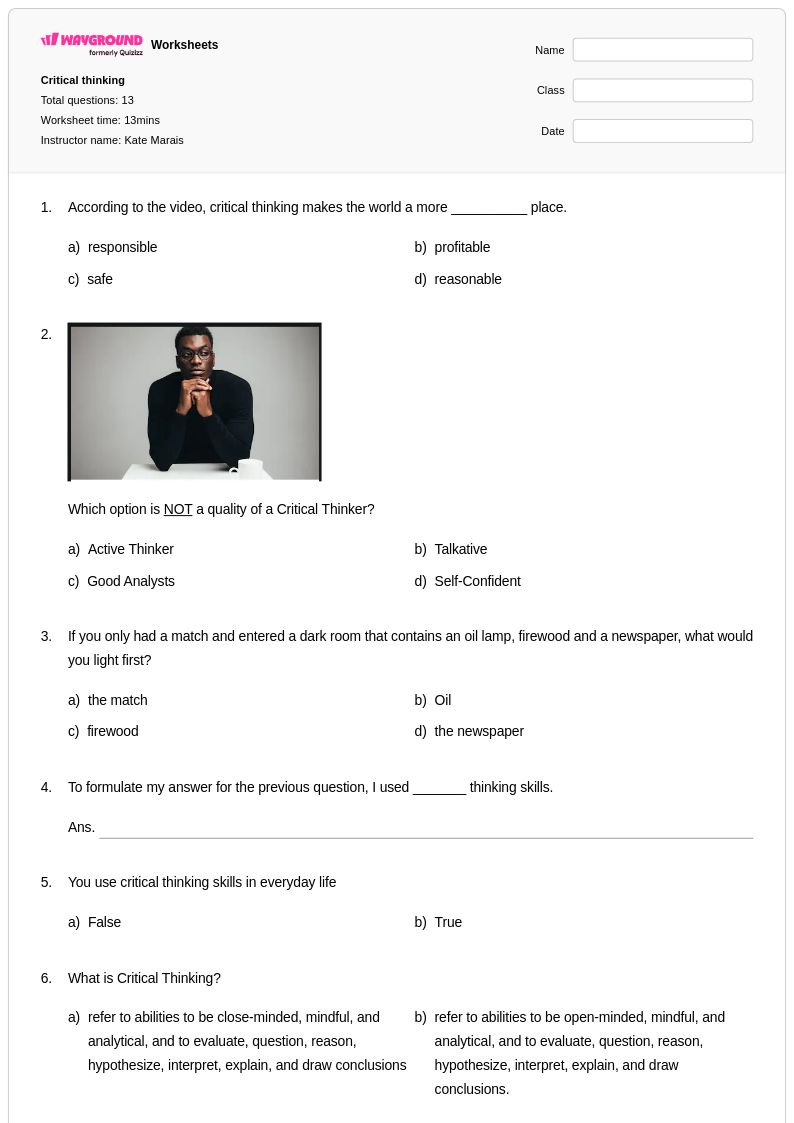
Six Thinking Hats worksheets for Grade 8 students available through Wayground provide comprehensive practice with Edward de Bono's powerful critical thinking framework, helping students develop systematic approaches to analyzing complex problems and situations. These carefully designed worksheets guide eighth-grade learners through each of the six distinct thinking modes—white hat factual thinking, red hat emotional responses, black hat cautious analysis, yellow hat optimistic evaluation, green hat creative alternatives, and blue hat process management—enabling them to examine topics from multiple perspectives with greater depth and objectivity. Each printable resource includes structured activities that strengthen analytical reasoning, perspective-taking abilities, and collaborative problem-solving skills, with answer keys provided to support both independent practice and guided instruction in developing more sophisticated critical thinking capabilities.
Wayground's extensive collection of teacher-created Six Thinking Hats resources offers educators millions of high-quality materials specifically designed to support Grade 8 critical thinking instruction across diverse learning environments and student needs. The platform's advanced search and filtering capabilities allow teachers to quickly locate worksheets aligned with specific curriculum standards and learning objectives, while built-in differentiation tools enable seamless customization of content difficulty and complexity to accommodate varying skill levels within the classroom. These flexible resources are available in both digital and printable PDF formats, providing educators with versatile options for lesson planning, targeted skill remediation, academic enrichment opportunities, and ongoing practice that helps students master this essential analytical thinking methodology through repeated application and reflection.
FAQs
How do I teach the Six Thinking Hats framework to students?
Introduce the Six Thinking Hats by explaining each hat's role one at a time before asking students to apply them together. Use a familiar, low-stakes scenario — such as a school decision or a story from class — so students can focus on the thinking process rather than the content. Once students understand each hat individually, move to parallel thinking exercises where the whole class wears the same hat at the same time, which is the core mechanic of de Bono's methodology. Structured worksheets that walk through each hat sequentially are especially effective for building this habit early.
What kinds of practice activities help students get better at using the Six Thinking Hats?
Students improve most when they repeatedly apply all six hats to a range of real-world scenarios — ethical dilemmas, school decisions, current events, or problem-solving tasks. Worksheets that prompt students to write responses under each hat heading help make abstract thinking concrete and visible. Rotating through different types of problems prevents students from memorizing responses and forces genuine perspective-taking. Practice that includes self-reflection prompts, such as which hat was hardest to apply and why, deepens metacognitive awareness alongside the framework itself.
What mistakes do students commonly make when using the Six Thinking Hats?
The most common error is confusing the Black Hat with negativity or pessimism — students need to understand that Black Hat thinking is cautious and logical, not emotional. Students also frequently blend hat roles, mixing Red Hat feelings into White Hat fact-finding sections. Another common issue is treating Yellow Hat thinking as surface-level positivity rather than grounded, evidence-based optimism. Worksheets that require students to label and justify each response by hat type help surface and correct these misapplications before they become entrenched habits.
How do I use Six Thinking Hats worksheets in my classroom?
Six Thinking Hats worksheets on Wayground are available as printable PDFs for traditional classroom use and in digital formats for technology-integrated environments, including the option to host them as a quiz directly on Wayground. For print use, students can complete worksheets individually or in small groups, with each hat section providing a structured prompt to guide thinking. In digital mode, the format supports self-paced practice and allows teachers to monitor responses in real time. Answer keys are included, making it easy to facilitate class discussion or provide immediate feedback after students complete the activity.
How can I differentiate Six Thinking Hats instruction for students who are struggling?
For students who find the framework abstract, simplify by focusing on just two or three hats at a time before introducing the full six. Wayground supports individual accommodations such as Read Aloud, which can help students who struggle with reading-heavy prompts access the thinking task without the text being a barrier. Reducing answer choices in digital formats lowers cognitive load for students who feel overwhelmed by open-ended responses. These settings are saved per student so teachers can apply them consistently across future sessions without reconfiguring each time.
Is the Six Thinking Hats framework appropriate for all grade levels?
The Six Thinking Hats framework can be adapted across a wide range of grades, but it is most effective when introduced once students can engage in structured written reflection, typically around grades 4 and up. Younger students may benefit from a simplified version using visual hat icons and shorter, guided prompts, while older students can handle more nuanced scenarios involving ethics, policy, or complex texts. The framework is widely used in middle school, high school, and professional development contexts because its structure makes higher-order thinking visible and teachable regardless of subject area.