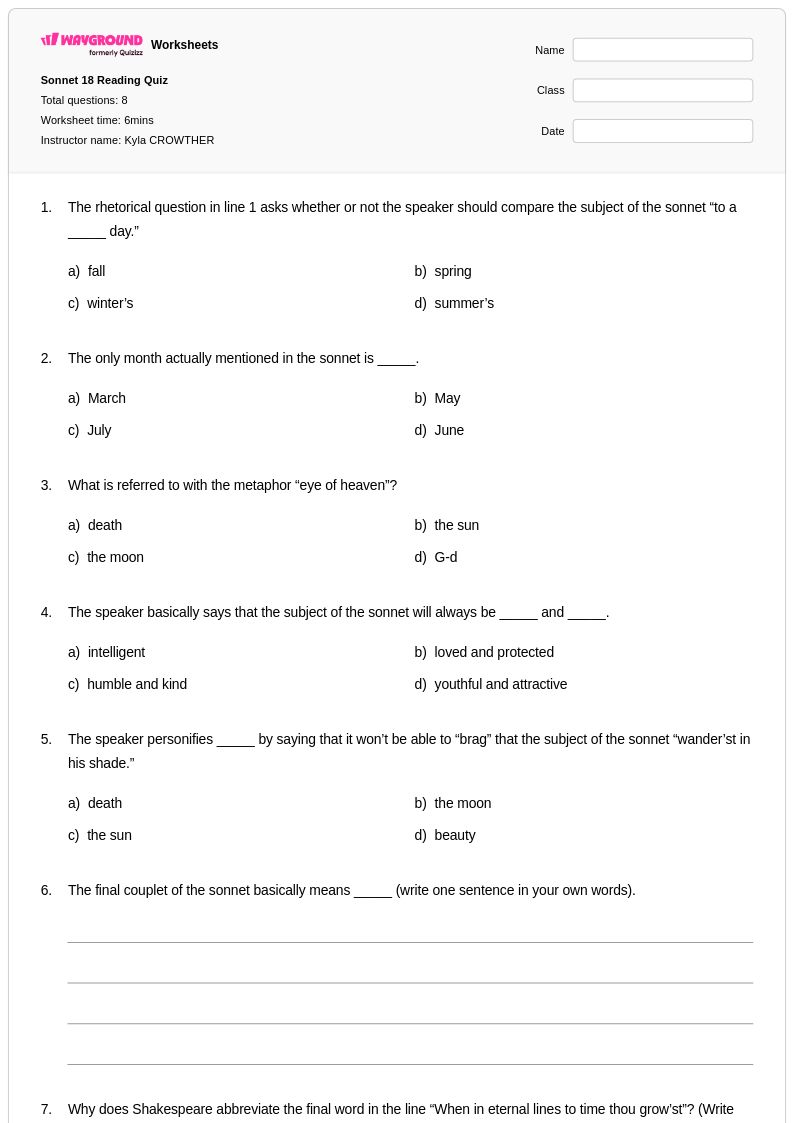
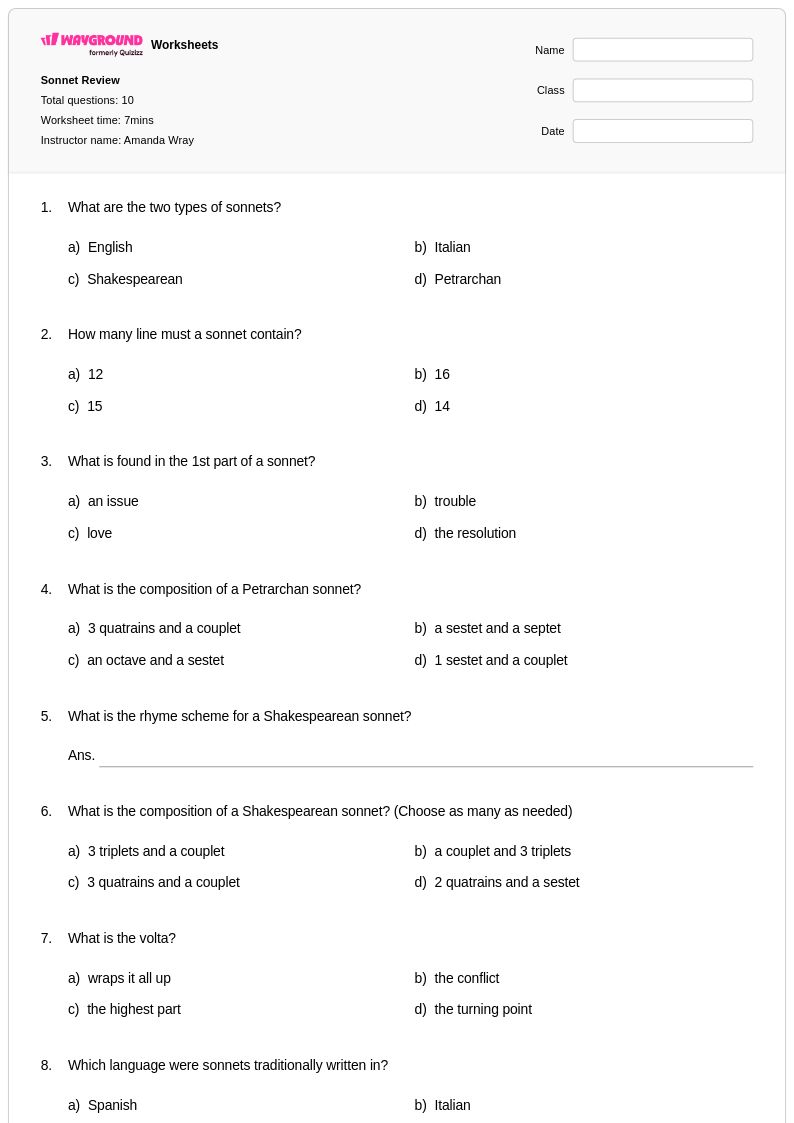
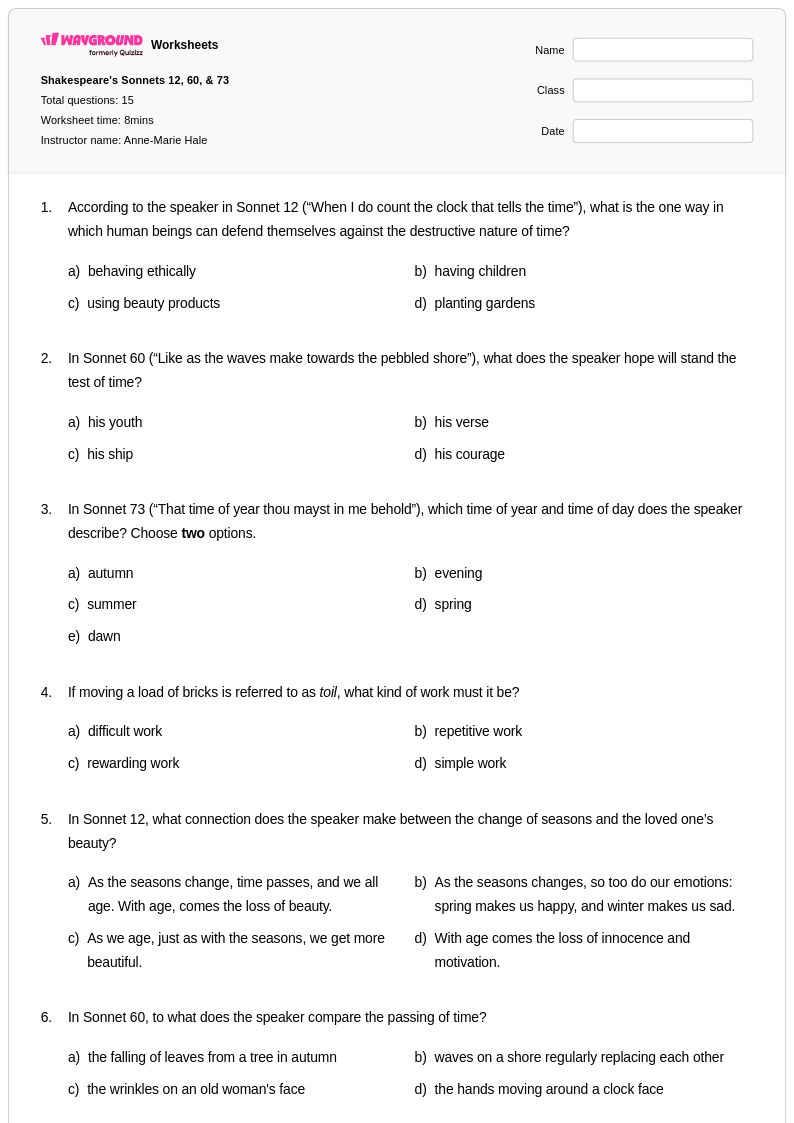
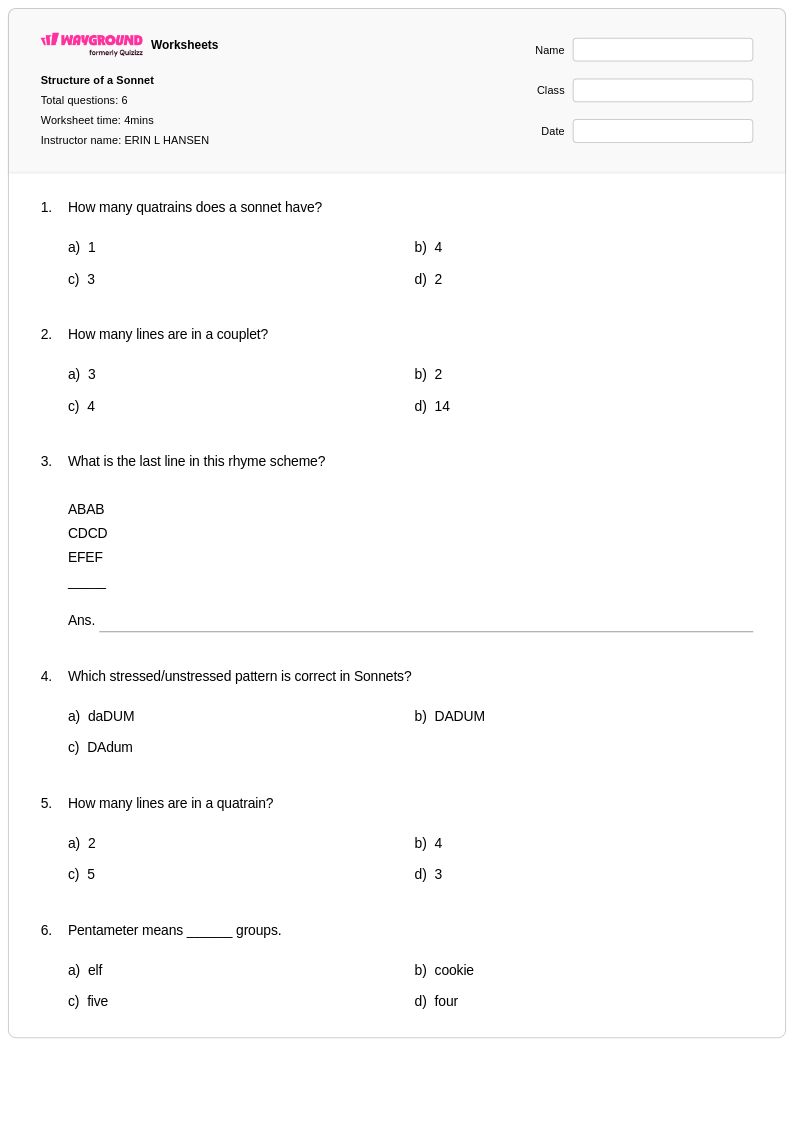
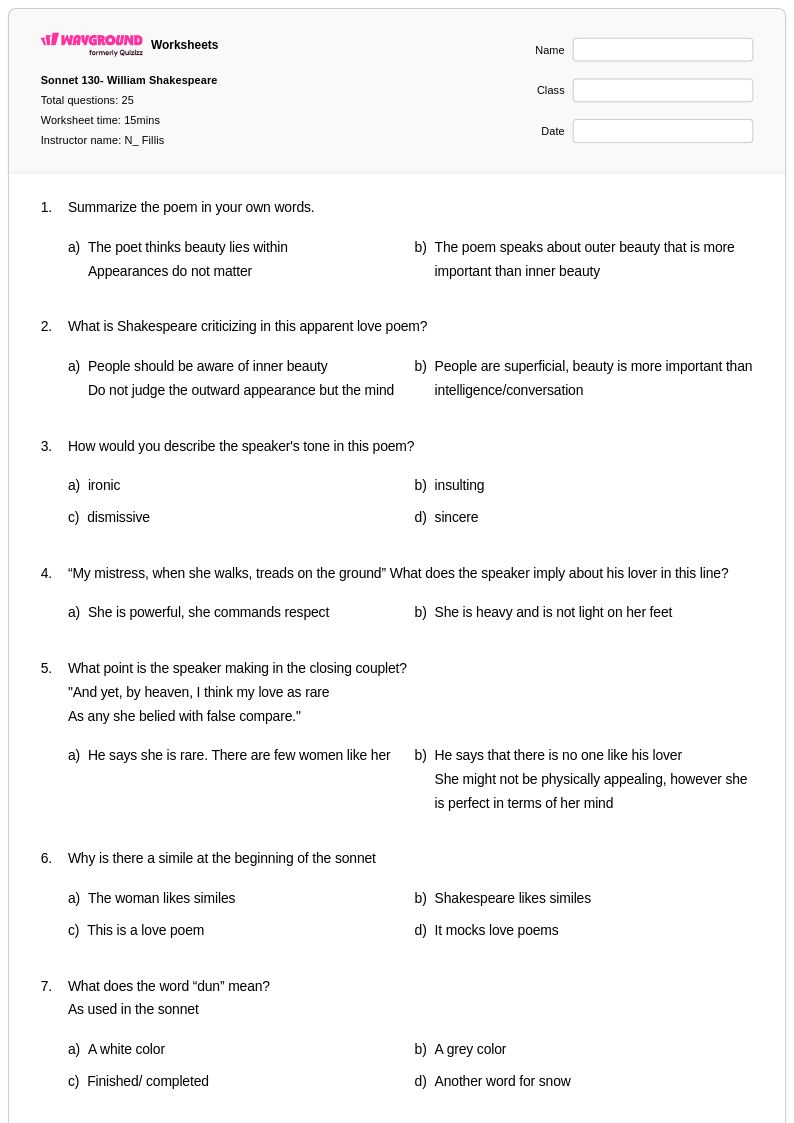
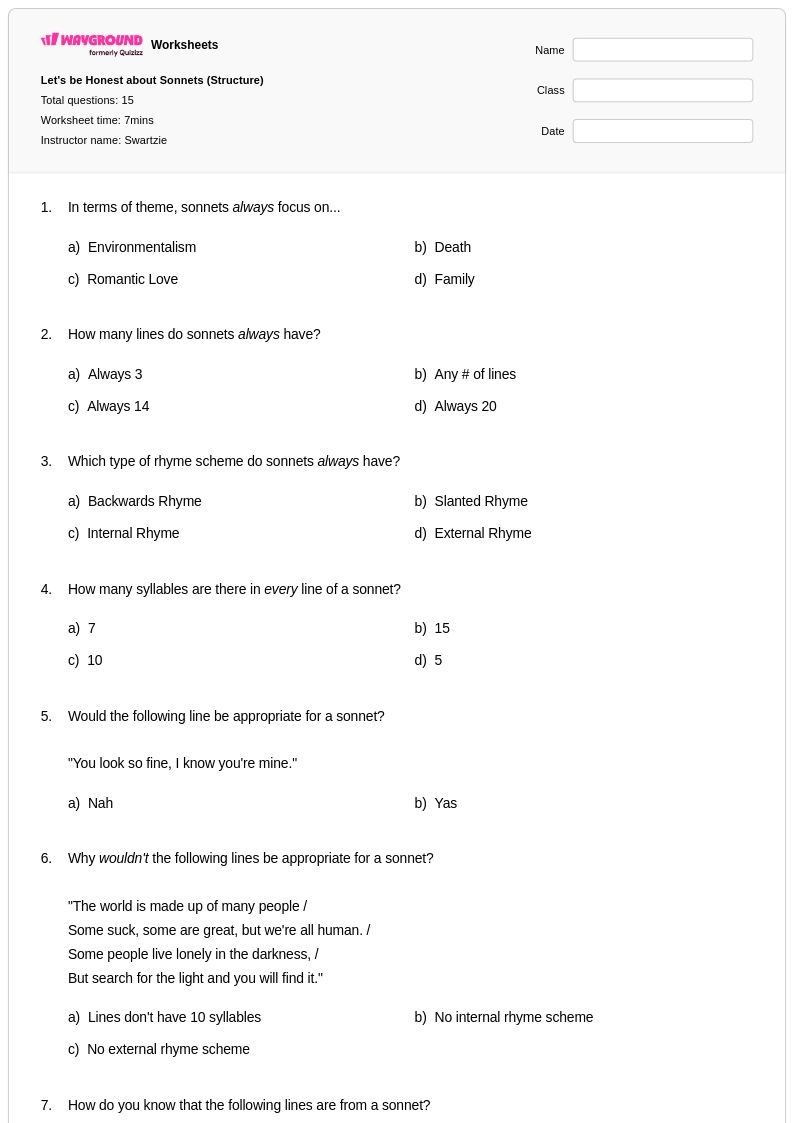
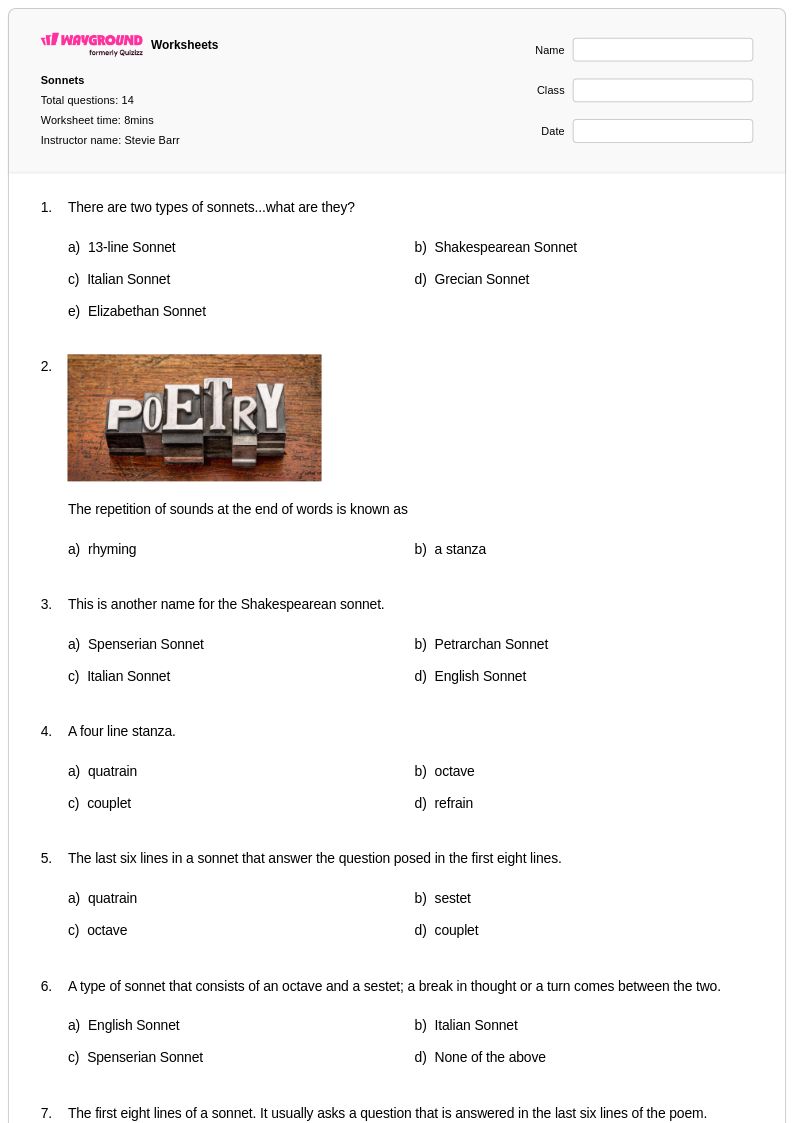
Discover free sonnet worksheets and printables from Wayground that help students master this classic poetic form through engaging practice problems, comprehensive PDF resources, and detailed answer keys for effective learning.
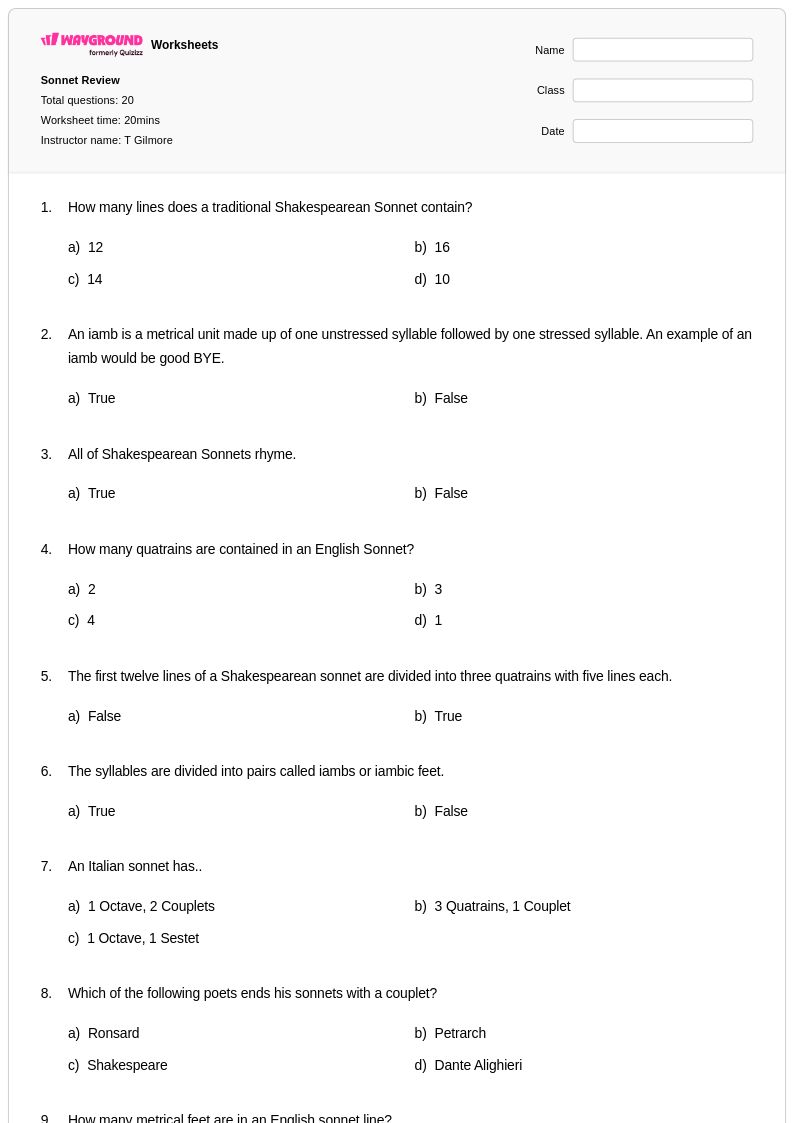
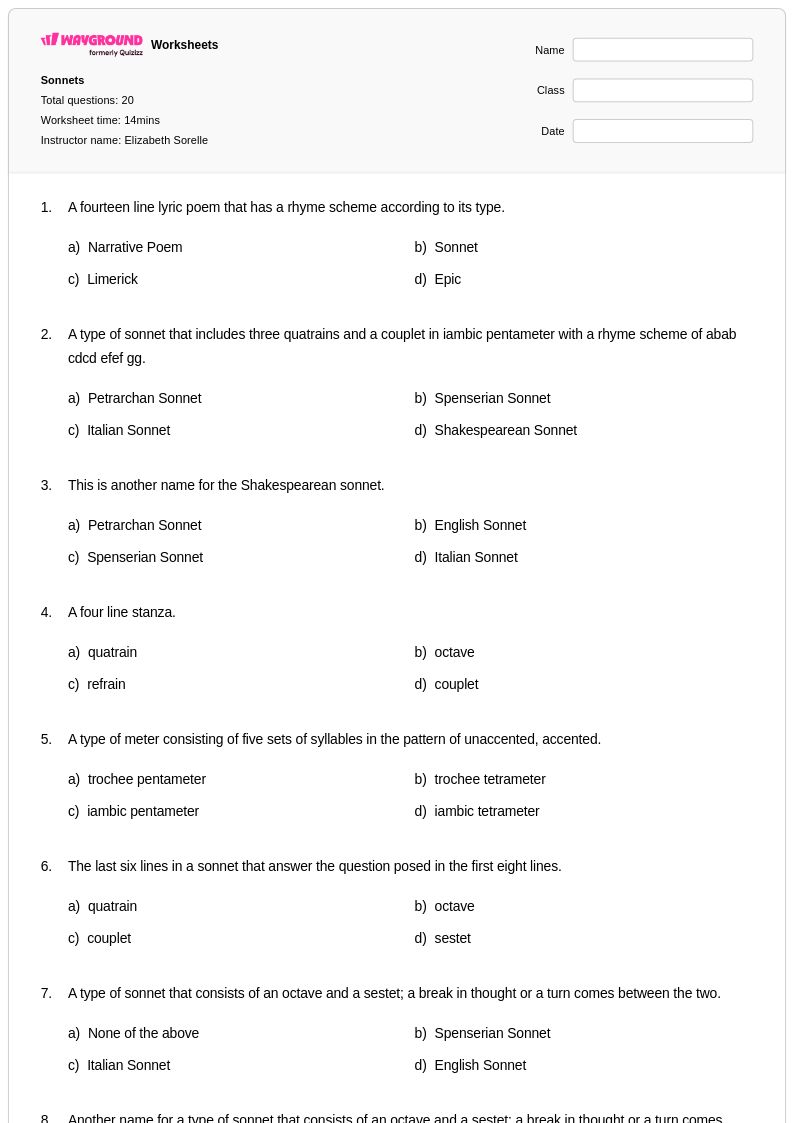
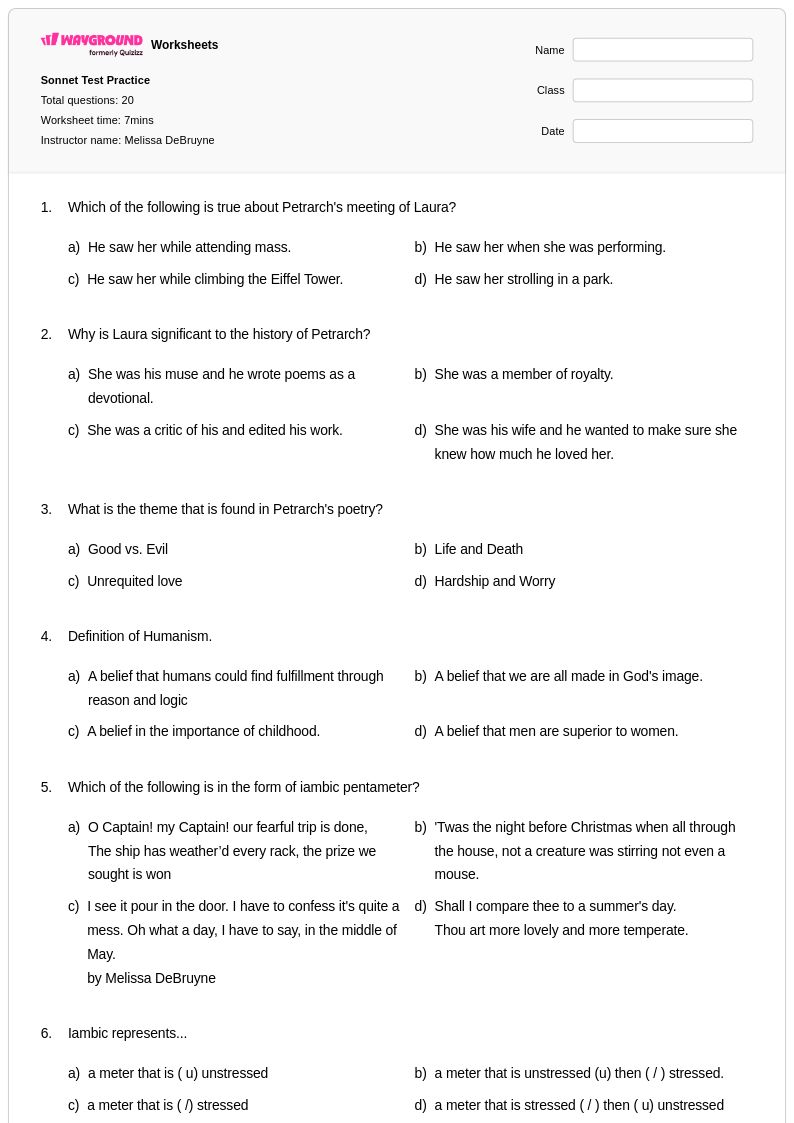
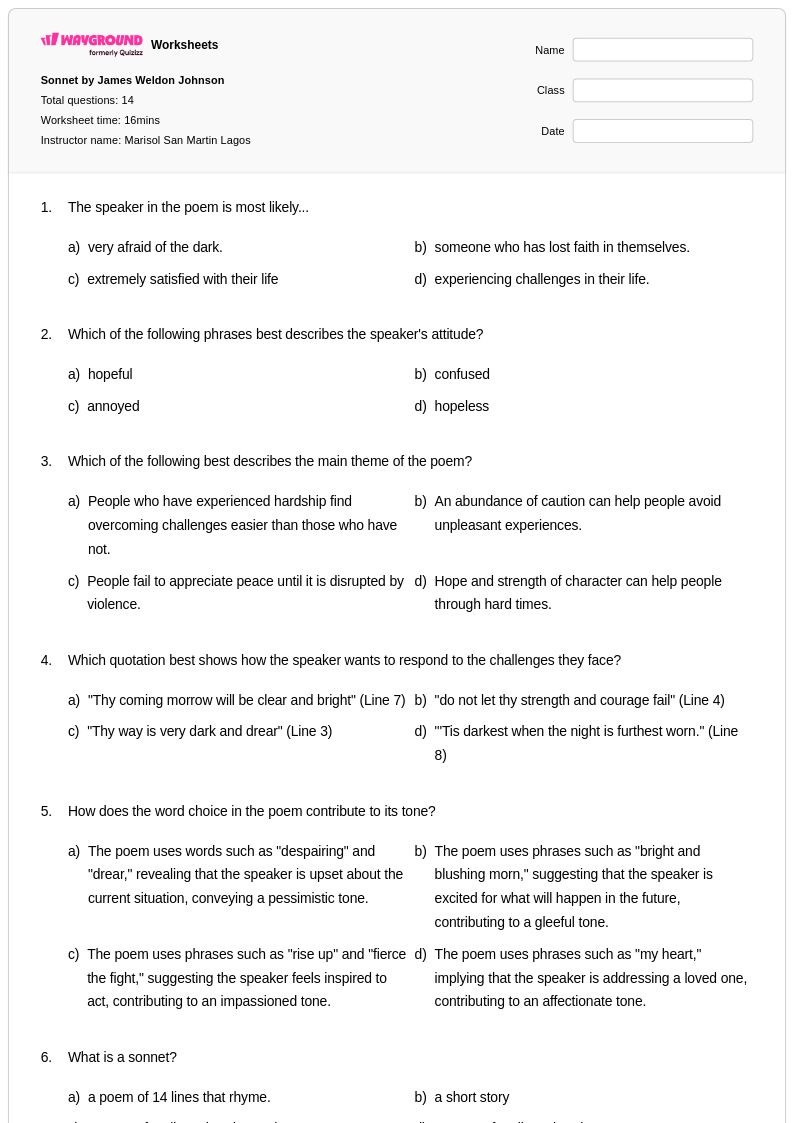
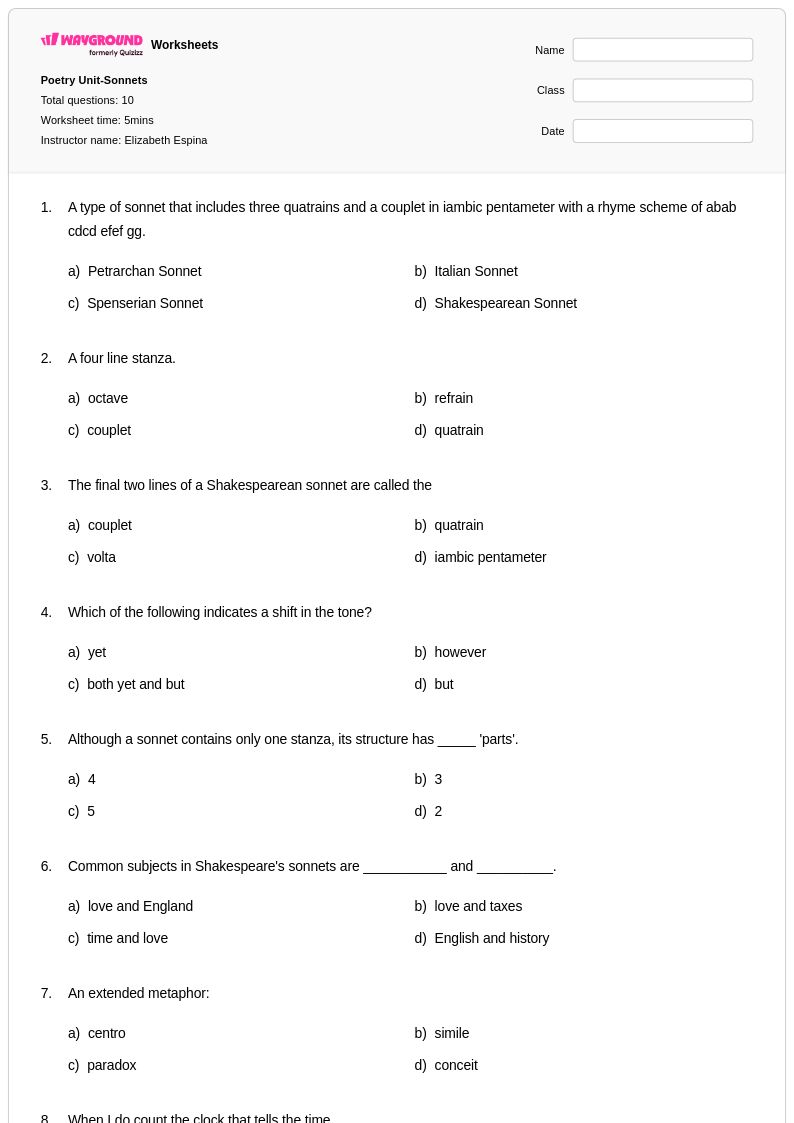
Sonnet worksheets available through Wayground (formerly Quizizz) provide comprehensive resources for students to master this fundamental poetic form that has captivated writers for centuries. These carefully designed materials guide learners through the intricate structure of sonnets, including the traditional fourteen-line format, specific rhyme schemes like ABAB CDCD EFEF GG for Shakespearean sonnets, and the characteristic volta or turn that shifts the poem's perspective. Students engage with practice problems that strengthen their ability to identify iambic pentameter, analyze thematic development, and recognize the distinction between different sonnet types including Petrarchan, Shakespearean, and Spenserian variations. Each worksheet comes complete with answer keys and is available as free printables in pdf format, ensuring educators have immediate access to reliable assessment tools that build critical poetry analysis skills.
Wayground's extensive collection of sonnet worksheets draws from millions of teacher-created resources, offering educators unparalleled flexibility in designing instruction that meets diverse classroom needs. The platform's robust search and filtering capabilities allow teachers to locate materials aligned with specific standards while accessing differentiation tools that support both struggling readers and advanced students exploring complex poetic devices. These customizable resources are available in both printable and digital pdf formats, enabling seamless integration into various learning environments and instructional approaches. Whether used for initial skill introduction, targeted remediation, or enrichment activities, these sonnet worksheets provide the structured practice necessary for students to develop sophisticated understanding of poetic form, meter, and literary analysis while supporting teachers in creating engaging, standards-aligned lesson plans.
FAQs
How do I teach sonnets to middle or high school students?
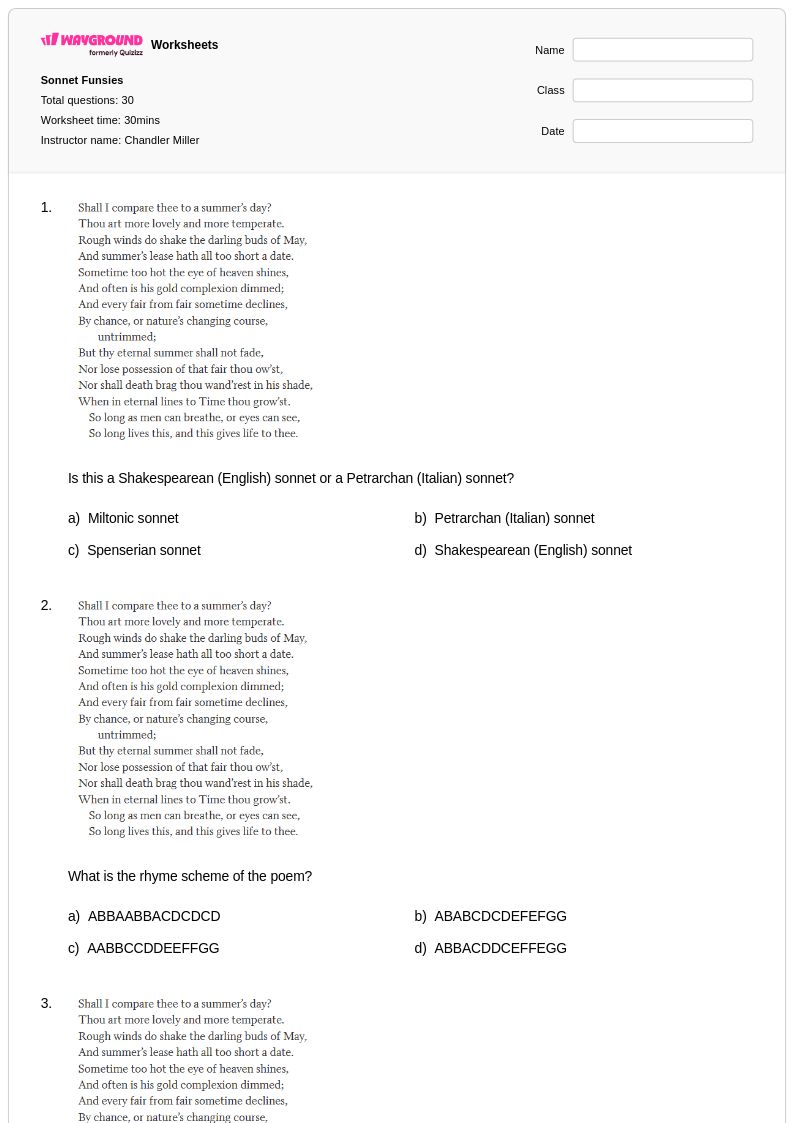
Start by grounding students in the structural rules before introducing analysis: the fourteen-line format, the rhyme scheme, and the volta. Use a Shakespearean sonnet like 'Shall I Compare Thee' to walk students through each quatrain's argument before showing how the couplet resolves it. Once students can map the structure on paper, move into identifying iambic pentameter by clapping syllables and marking stressed beats. Building familiarity with form before theme prevents students from getting lost in figurative language before they understand what holds the poem together.
What exercises help students practice identifying sonnet structure?
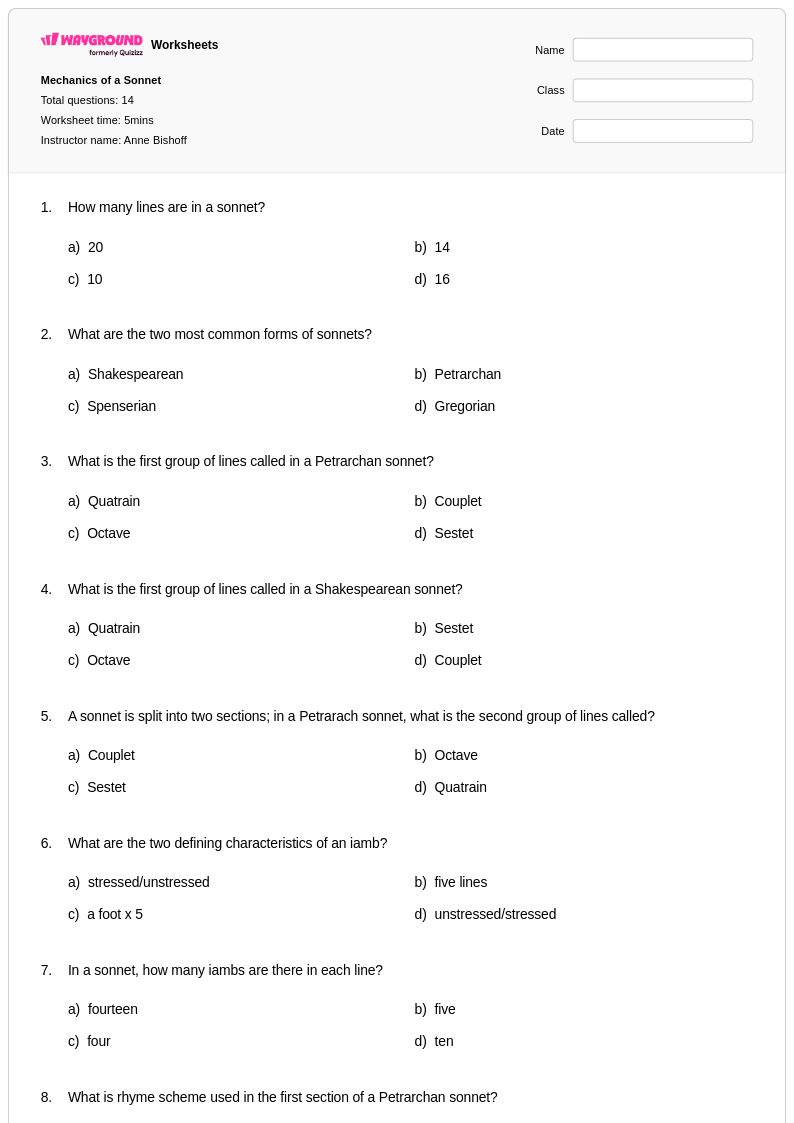
Labeling exercises are the most effective starting point: give students an unlabeled sonnet and ask them to mark the rhyme scheme, identify the volta, and count syllables in one or two lines to confirm iambic pentameter. Comparison exercises that place a Shakespearean and a Petrarchan sonnet side by side help students internalize the structural differences between types. Practice problems that ask students to distinguish the octave from the sestet in a Petrarchan sonnet, or identify the three quatrains and closing couplet in a Shakespearean one, build the close-reading habits necessary for deeper literary analysis.
What are the most common mistakes students make when analyzing sonnets?
The most frequent error is treating the entire sonnet as one continuous statement rather than recognizing how the volta shifts the poem's argument or tone. Students also commonly confuse rhyme scheme labeling, particularly when consecutive lines share end sounds across quatrain boundaries. Misidentifying iambic pentameter is another persistent issue because students count syllables rather than stresses, leading them to label lines with ten syllables as pentameter even when the stress pattern is irregular. Addressing these three patterns early prevents compounding errors in longer analysis tasks.
How do I help students tell the difference between Shakespearean, Petrarchan, and Spenserian sonnets?
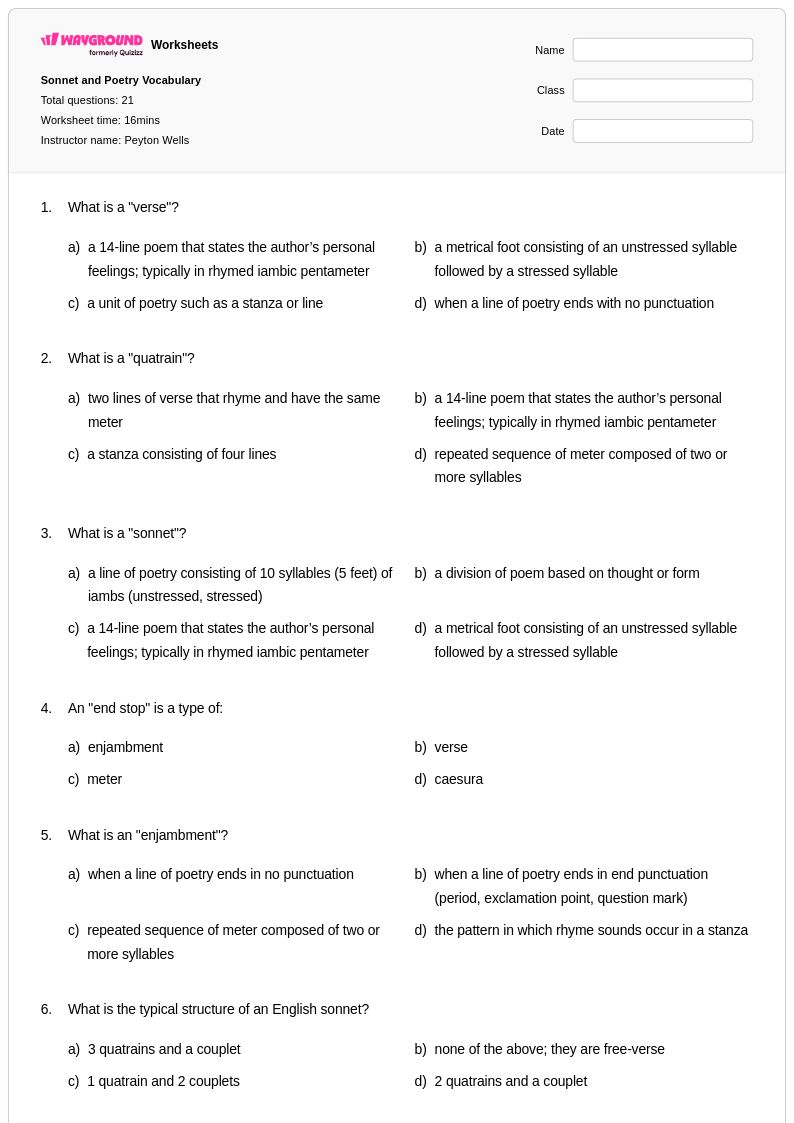
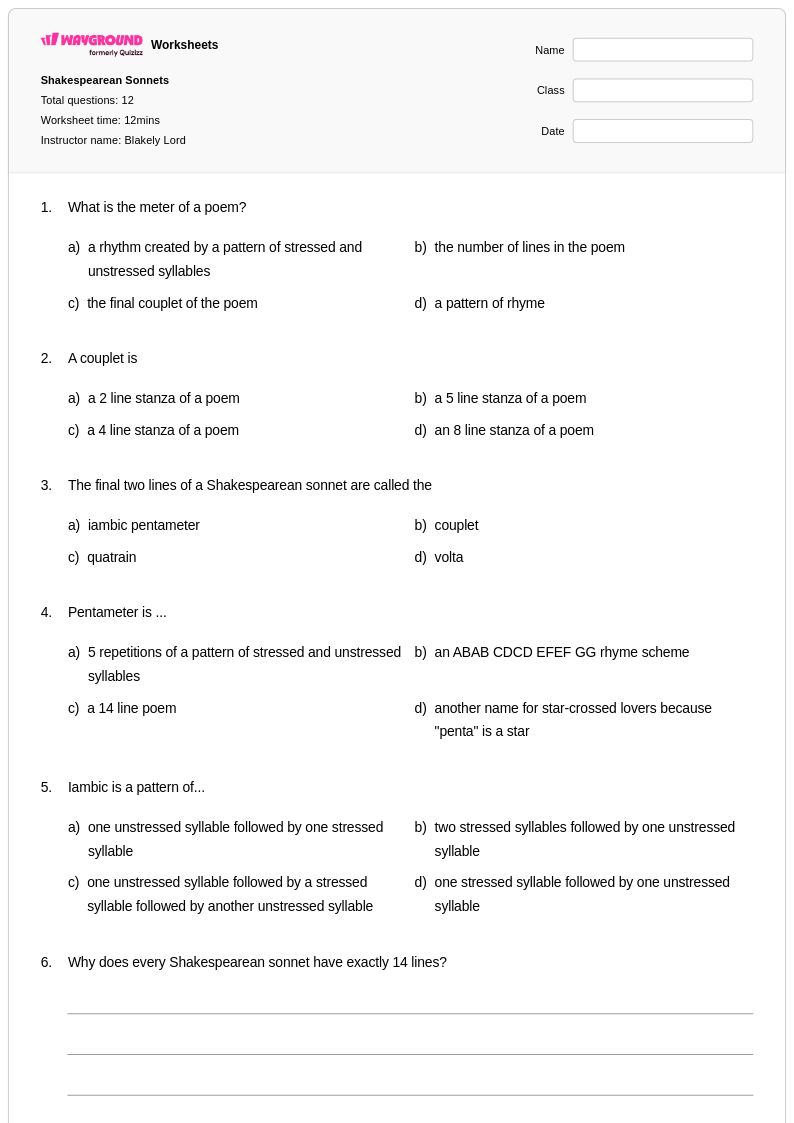
The clearest entry point is the rhyme scheme: ABAB CDCD EFEF GG for Shakespearean, ABBAABBA CDECDE for Petrarchan, and ABAB BCBC CDCD EE for Spenserian. Beyond the scheme, the structural division matters: Petrarchan sonnets split into an octave and sestet, while Shakespearean sonnets use three quatrains and a couplet. Teaching students to locate the volta and notice where the poem pivots helps them connect form to meaning rather than memorizing labels in isolation.
How can I use Wayground's sonnet worksheets in my classroom?
Wayground's sonnet worksheets are available as free printable PDFs for traditional classroom use and in digital formats for technology-integrated instruction, making them flexible enough for in-person, hybrid, or remote settings. Teachers can also host these worksheets as a live or assigned quiz directly on Wayground, giving students immediate feedback and giving teachers real-time data on where the class is struggling. Each worksheet includes a complete answer key, so they work equally well for guided practice, independent work, or assessment without additional prep.
How do I support struggling readers when teaching sonnets?
Sonnets present a dual challenge for struggling readers: archaic syntax and compressed meaning compound the difficulty of poetic form. On Wayground, teachers can enable the Read Aloud accommodation so students hear the text read to them, which helps with both pronunciation and phrasing. Reducing answer choices on analysis questions lowers cognitive load while students build familiarity with structural terms. These accommodations can be assigned to individual students without alerting the rest of the class, so differentiated support happens invisibly within a shared assignment.