

Wayground
author's purpose and point of view - Printable ELA Worksheets grade 6 - Wayground

author's purpose and point of view

Jessica Canan

Created by Jessica Canan

17 questions

6th Grade

ELA

Updated Sep 2026

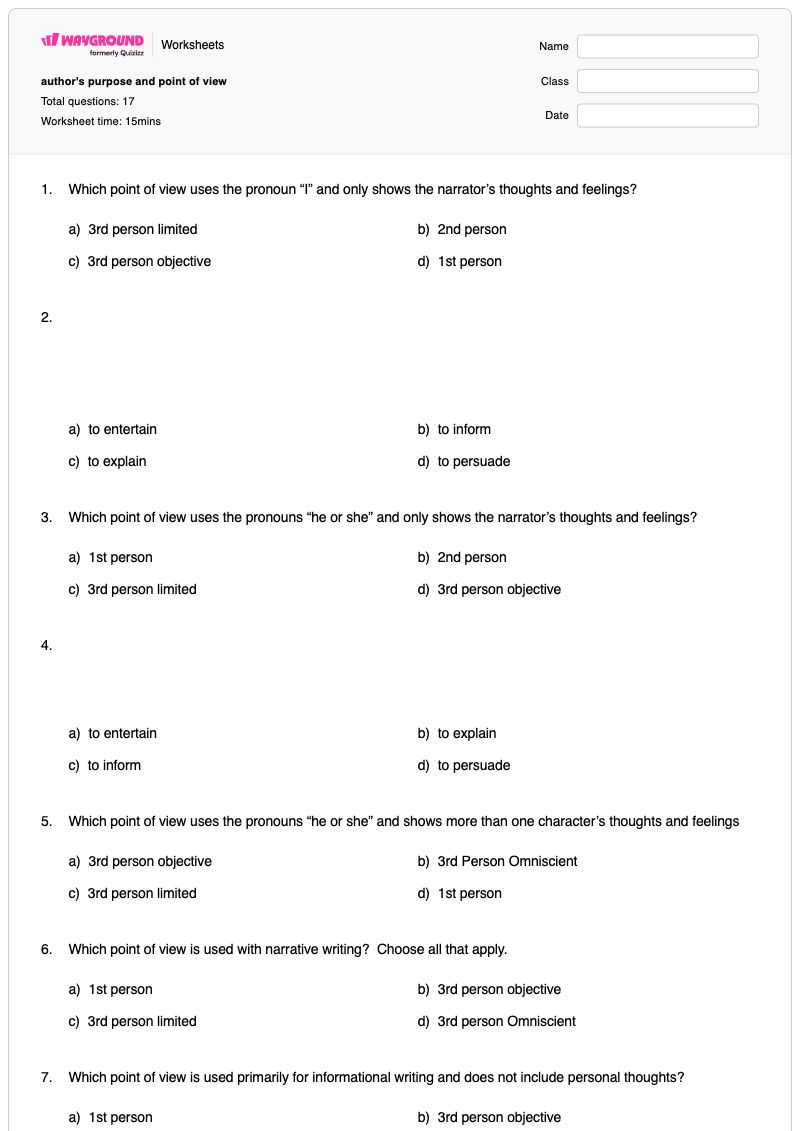
This Grade 6 English worksheet builds students’ ability to identify an author’s purpose and a narrator’s point of view. Through 16 multiple-choice questions and one multiple-select question, students distinguish among writing intended to inform, explain, entertain, or persuade, using both definitions and short examples such as library notices, meeting announcements, recipes, and arguments for a dog park. Students also identify first-person, third-person limited, third-person omniscient, and third-person objective points of view by analyzing pronouns, access to characters’ thoughts, and the type of writing in which each perspective is used. The questions connect point of view to diary entries, narrative writing, and informational writing, helping students apply terminology rather than memorize labels. This free printable worksheet includes a complete answer key for efficient review, independent practice, or assessment.

Worksheet settings

Font size

S
M
L
XL
WaygroundWorksheets

author's purpose and point of view

Total questions: 17

Name
Class
Date
1.

Which point of view uses the pronoun “I” and only shows the narrator’s thoughts and feelings?

a)

3rd person limited

b)

2nd person

c)

3rd person objective

d)

1st person

2.

What is the author’s purpose?

Lee County Library hours have been changed.  The library will now be open an hour longer during the week, (8 a.m. – 9 p.m.), but an hour shorter on Saturdays, (9 a.m. – 11 a.m.)  If you have any questions, call the reference desk at (555) 239-1200.

a)

to entertain

b)

to inform

c)

to explain

d)

to persuade

3.

Which point of view uses the pronouns “he or she” and only shows the narrator’s thoughts and feelings?

a)

1st person

b)

2nd person

c)

3rd person limited

d)

3rd person objective

4.

Which is the author’s purpose?

In order to make chewy brownies, two eggs need to be added to the recipe instead of just one.  

“Why do I always have to do everything around here?” Tina wondered as she read the directions.

a)

to entertain

b)

to explain

c)

to inform

d)

to persuade

5.

Which point of view uses the pronouns “he or she” and shows more than one character’s thoughts and feelings

a)

3rd person objective

b)

3rd Person Omniscient

c)

3rd person limited

d)

1st person

6.

Which point of view is used with narrative writing?  Choose all that apply.

a)

1st person

b)

3rd person objective

c)

3rd person limited

d)

3rd person Omniscient

7.

Which point of view is used primarily for informational writing and does not include personal thoughts?

a)

1st person

b)

3rd person objective

c)

3rd person limited

d)

3rd person Omniscient 

8.

n narrative writing, the author’s purpose is – 

a)

to inform

b)

to persuade

c)

to entertain

d)

to explain

9.

When writing to convince others of a particular point of view, the author’s purpose is –

a)

to inform

b)

to entertain

c)

to explain

d)

to persuade

10.

When writing to enhance the general knowledge of the reader about something new the author’s purpose is –

a)

to inform

b)

to explain

c)

to entertain

d)

to persuade

11.

What is the author’s purpose?

The board will meet again on Tuesday night at 7:00 p.m. to discuss the proposed budget.  A vote will be taken at the conclusion of the meeting.  All interested parties should attend.

a)

to entertain

b)

to inform

c)

to persuade

d)

to explain

12.

Which point of view would you use for a diary entry? 

a)

1st person

b)

2nd person

c)

3rd person limited

d)

3rd person objective

13.

What is the author’s purpose?

First of all, the empty lot on Main Street is the perfect location for a dog park because it has plenty of trees.  Maples, oaks and birch trees fill the area with beauty and shade.

a)

to explain

b)

to entetain

c)

to inform

d)

to persuade

14.

What is the author’s purpose?

When diagramming a sentence, a vertical line is drawn between the subject and the verb.  Adjectives and adverbs are placed below the horizontal line.

a)

to inform

b)

to explain

c)

to entertain

d)

to persuade

15.

Which point of view is this?

The door slammed shut.  I wonder what Angela is going to do next?  She is so hard to understand these days.

a)

3rd person limited

b)

3rd person objective

c)

2nd person

d)

1st person

16.

When writing to describe how to do something the author’s purpose is –

a)

to explain

b)

to entertain

c)

to inform

d)

to persuade

17.

Which point of view is great for character development because the reader hears the thoughts and feelings of more than one character?

a)

third person objective

b)

third person limited

c)

third person  Omniscient 

d)

1st person

WaygroundAnswer Key

author's purpose and point of view

Total questions: 17

1.
d)

1st person

2.
b)

to inform

3.
c)

3rd person limited

4.
a)

to entertain

5.
b)

3rd Person Omniscient

6.
a)

1st person

, c)

3rd person limited

, d)

3rd person Omniscient

7.
b)

3rd person objective

8.
c)

to entertain

9.
d)

to persuade

10.
a)

to inform

11.
b)

to inform

12.
a)

1st person

13.
d)

to persuade

14.
b)

to explain

15.
d)

1st person

16.
a)

to explain

17.
c)

third person  Omniscient 

FAQs

What does this worksheet cover, and how does it help students identify author’s purpose and point of view?

This Grade 6 English worksheet uses 16 multiple-choice questions and one multiple-select question to practice identifying four author’s purposes: to inform, explain, entertain, and persuade. Students also classify first-person, third-person limited, third-person omniscient, and third-person objective points of view by examining pronouns, access to characters’ thoughts, and examples of narrative or informational writing.

How can I use this worksheet to teach author’s purpose and point of view?

Introduce the four purposes and the four point-of-view types with a simple anchor chart, then model how clues in a short passage reveal the answer. Have students explain why a library notice is meant to inform, why a dog-park argument is meant to persuade, and how a diary entry signals first person before they complete the worksheet independently. Use the multiple-select item as a class discussion about which perspectives commonly appear in narrative writing.

What mistakes should I watch for when students complete this author’s purpose and point-of-view worksheet?

Students may confuse to inform with to explain, especially when a passage gives factual details or describes a process, and they may choose entertain simply because a passage is written as a story. They may also confuse third-person limited with third-person omniscient by overlooking whether the narrator reveals one character’s thoughts or several characters’ thoughts. On the multiple-select question, remind students to evaluate every option because more than one point of view can be used in narrative writing.

How do I assign and grade this author’s purpose and point-of-view worksheet?

The worksheet is available as a printable PDF and as a digital quiz on Wayground, and it includes a complete answer key for checking the 16 multiple-choice and one multiple-select responses. For printable submissions, scan student work with the Wayground for Teachers app to support grading and review.

How can I differentiate this worksheet for my students?

Use the worksheet’s Advanced Settings to adjust font spacing and font size so the author’s-purpose examples and point-of-view questions are easier to read. You can also enable a dyslexia-friendly font or translate the worksheet into another language while students work with the same multiple-choice and multiple-select format.

Where can I find more free worksheets like this on Wayground?

Wayground offers a broad collection of free printable worksheets and practice problems across subjects, with downloadable PDFs and answer keys to support essential skills and concepts. Browse more resources at https://wayground.com/en-us/worksheets.