
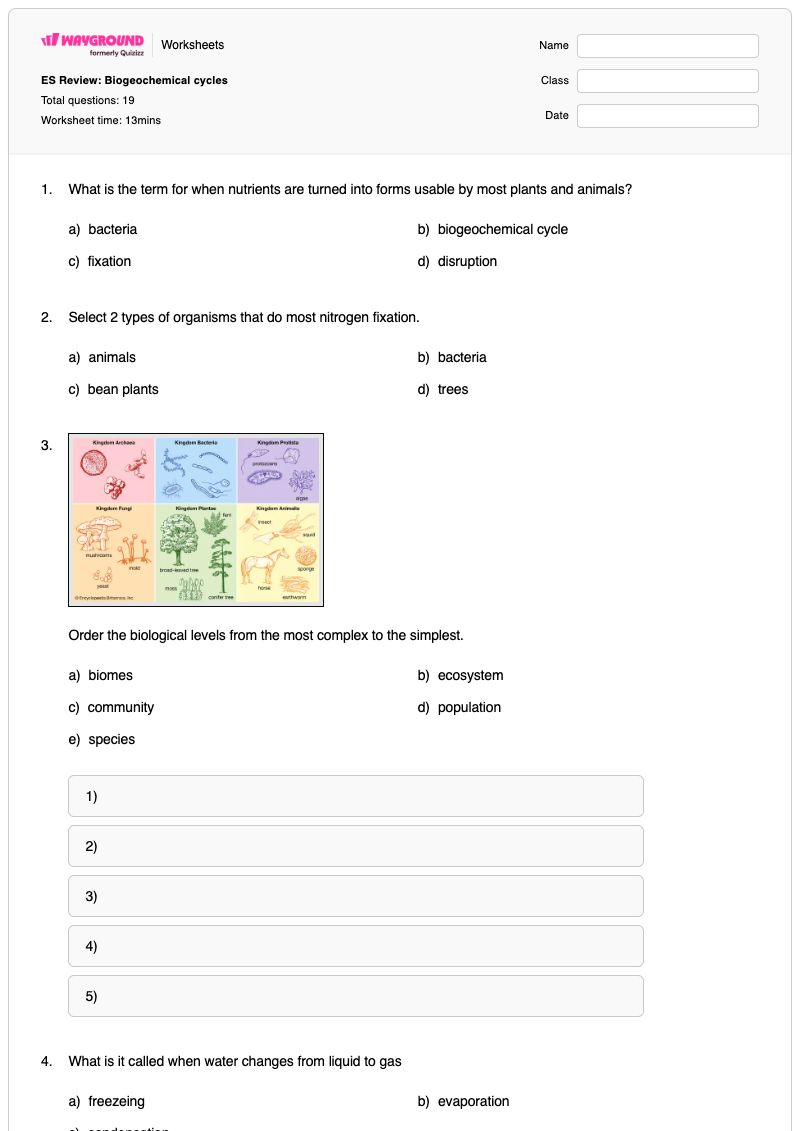

ES Review: Biogeochemical Cycles is a free printable science worksheet for students in Grades 9–12. It reviews how matter moves through the nitrogen, water, carbon, and phosphorus cycles, along with the biological levels of organization from species through biomes. Students answer 16 multiple-choice questions, select multiple correct responses in 2 multiple-select questions, and arrange biological levels in 1 ordering task.
The questions ask students to distinguish processes such as fixation, evaporation, precipitation, and transpiration; identify the roles and locations of nitrogen-fixing and denitrifying bacteria; connect fossil fuels to the carbon cycle; and identify pictured biogeochemical cycles. This worksheet supports review, formative assessment, or end-of-unit practice by requiring students to recall terminology, select accurate scientific relationships, interpret cycle visuals, and organize levels of biological complexity. A complete answer key is included for efficient checking.
Worksheet settings
Font size
S
M
L
XL
Worksheets
ES Review: Biogeochemical cycles
Total questions: 19
Name
Class
Date
1.
What is the term for when nutrients are turned into forms usable by most plants and animals?
a)
bacteria
b)
biogeochemical cycle
c)
fixation
d)
disruption
2.
Select 2 types of organisms that do most nitrogen fixation.
a)
animals
b)
bacteria
c)
bean plants
d)
trees
3.
Order the biological levels from the most complex to the simplest.
a)
biomes
b)
ecosystem
c)
community
d)
population
e)
species
1)
2)
3)
4)
5)
4.
What is it called when water changes from liquid to gas
a)
freezeing
b)
evaporation
c)
condensation
5.
How is water returned to earth?
a)
evaporation
b)
transpiration
c)
precipitation
d)
percolation
6.
What do plants do with carbon dioxide (CO2)
a)
Plants use CO2 to make carbohydrates.
b)
Plants use CO2 to produce extra sunshne.
c)
Don't pick this answer.
7.
What are two by products released by plants?
a)
water
b)
oxygen
c)
carbon
d)
sugar
8.
Which is NOT a process of the water cycle?
a)
precipitation
b)
freezing
c)
transpiration
d)
evaporation
9.
The process of plants losing water through their leaves is called ____.
a)
condensation
b)
evaporation
c)
transpiration
d)
exhaling
10.
What is the most abundant gas in the atmosphere?
a)
hydrogen
b)
oxygen
c)
helium
d)
nitrogen
11.
Where are denitrifying bacteria found?
a)
In the soil
b)
Root nodules
c)
In dead things
d)
In the atmosphere
12.
Where are nitrogen-fixing bacteria found?
a)
In the soil
b)
Root nodules
c)
In dead things
d)
In the atmosphere
13.
Which cycle are fossil fuels (oil, coal, natural gas) part of?
a)
carbon
b)
water
c)
nitrogen
d)
phosphorus
14.
Identify the cycle pictured.
a)
The Water cycle
b)
The Carbon cycle
c)
The Nitrogen cycle
d)
The Phosphorus cycle.
15.
Identify the cycle pictured.
a)
The Water cycle
b)
The Carbon cycle
c)
The Nitrogen cycle
d)
The Phosphorus cycle
16.
Identify the cycle pictured.
a)
The Water cycle
b)
The Carbon cycle
c)
The Nitrogen cycle
d)
The Phosphorus cycle.
17.
Identify the cycle pictured.
a)
The Water cycle
b)
The Carbon cycle
c)
The Nitrogen cycle
d)
The Phosphorus cycle.
18.
Too much phosphorus in waterways (rivers, lakes) can lead to___________.
a)
eutrophication
b)
Nothing
c)
Death
d)
diseases
19.
This is released by the weathering of rocks.
a)
Carbon
b)
Oxygen
c)
Phosphorus
d)
Nitrogen
Answer Key
ES Review: Biogeochemical cycles
Total questions: 19
1.
c)
fixation
2.
b)
bacteria
, c)
bean plants
3.
a, b, c, d, e
4.
b)
evaporation
5.
c)
precipitation
6.
a)
Plants use CO2 to make carbohydrates.
7.
a)
water
, b)
oxygen
8.
b) freezing
9.
c) transpiration
10.
d) nitrogen
11.
a) In the soil
12.
b) Root nodules
13.
a)
carbon
14.
d) The Phosphorus cycle.
15.
c) The Nitrogen cycle
16.
b)
The Carbon cycle
17.
a)
The Water cycle
18.
a)
eutrophication
19.
c) Phosphorus
140 %
Browse by subjects
Browse by grades
Browse by format
FAQs
What does this biogeochemical cycles worksheet cover?
This Grade 9–12 science worksheet reviews the water, nitrogen, carbon, and phosphorus cycles through 16 multiple-choice questions, 2 multiple-select questions, and 1 ordering task. Students identify processes such as fixation, evaporation, precipitation, and transpiration; connect organisms and locations to nitrogen fixation and denitrification; identify pictured cycles; and arrange biological levels from most complex to simplest.
How can I use this worksheet to teach biogeochemical cycles?
Use the worksheet after introducing cycle diagrams and key vocabulary, asking students to explain each selected answer rather than recall terms in isolation. Pause at the nitrogen items to discuss why bacteria and bean plants are associated with fixation, then use the water- and carbon-cycle questions to trace processes such as precipitation, transpiration, and plant use of carbon dioxide. Finish with the ordering item to connect ecosystem processes to biological levels of organization.
What mistakes should I watch for when students complete this biogeochemical cycles review?
Watch for students confusing evaporation with transpiration, or selecting freezing as a water-cycle process when the worksheet asks which option is not included. In the nitrogen questions, students may mix up nitrogen-fixing bacteria in root nodules with denitrifying bacteria in soil, and in the multiple-select items they may choose only one correct response. Students may also confuse the carbon, nitrogen, and phosphorus cycle images or treat carbon dioxide as something plants use to produce sunlight rather than carbohydrates.
How do I assign and grade this biogeochemical cycles worksheet?
You can assign this worksheet as a printable PDF or use it as a digital quiz on Wayground. It includes a complete answer key for the multiple-choice, multiple-select, and ordering items, and printable submissions can be graded by scanning student work with the Wayground for Teachers app. The printable format can also support schools that are reducing screen time.
How can I differentiate this biogeochemical cycles worksheet for my students?
In the worksheet’s Advanced Settings, adjust font spacing or choose a larger font size to make the cycle terminology and multiple-choice options easier to read. You can also apply a dyslexia-friendly font or translate the worksheet into another language, helping students access the nitrogen, water, carbon, and phosphorus cycle questions without changing the task format.
Where can I find more worksheets like this on Wayground?
Wayground offers a comprehensive collection of free printable worksheets and practice problems across subjects, with downloadable PDFs and answer keys to help students master essential skills and concepts. Browse more resources at https://wayground.com/en-us/worksheets.