
Wayground
Columbian Exchange - Printable Social Studies Worksheets grade 7 - Wayground

Columbian Exchange

20 questions

7th - 7th Grade

Social Studies

This Grade 7 social studies worksheet builds understanding of the Columbian Exchange through 20 questions: 17 multiple-choice items and 3 multiple-select items. Students identify the exchange by name, connect it to Christopher Columbus and the Age of Exploration, distinguish the Old World from the New World, and classify specific plants and animals such as potatoes, corn, tomatoes, horses, sugar, and pigs by their origins. The worksheet also checks students’ understanding of disease transmission, European immunity, and the population growth associated with new crops in Europe, Africa, and Asia. It is a free printable worksheet with an answer key for social studies instruction, review, or assessment. Teachers can use the varied question types to check both factual recall and students’ ability to select all correct continents or descriptions of the exchange.

Worksheet settings

Font size

S
M
L
XL
Worksheets

Columbian Exchange

Total questions: 20

Name
Class
Date
1.

The global trading of plants, animals, diseases, and ideas begun after Columbus's first voyage is known as __________________.

a)

The Great Exchange

b)

The Columbian Exchange

c)

The New World Exchange

d)

The American Exchange

2.

Europeans were not as affected by the diseases they brought to the Americas because they had _________________ .

a)

mercantilism

b)

epidemiology

c)

immunity

d)

colonization

3.

The introduction of new crops from the Americas caused populations to _____________ in the Europe, Africa, and Asia.

a)

increase

b)

decrease

c)

the stay the same

d)

none of the above

4.

What disease(s) did Europeans bring to the New World

a)

Small Pox

b)

Measles

c)

Diphtheria

d)

All of the above

5.

Where did horses come from?

a)

New World

b)

Old World

6.

Where did potatoes come from?

a)

New World

b)

Old World

7.

Where did sugar come from?

a)

New World

b)

Old World

8.

Where did corn come from?

a)

New World

b)

Old World

9.

Where did tomatoes come from?

a)

New World

b)

Old World

10.

Where did pigs come from

a)

New World

b)

Old World

11.

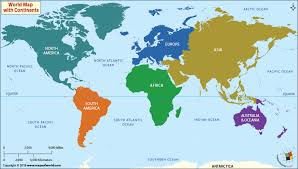
What continents are in the New World?

a)

North America

b)

South America

c)

Europe

d)

Asia

e)

Africa

12.

What continents are in the Old World?

a)

North America

b)

South America

c)

Europe

d)

Asia

e)

Africa

13.

the Columbian Exchange was the exchange of plants, animals and diseases between.... (read all options)

a)

the Americas and Europe

b)

Asia and Europe

c)

the Old World and the New World

d)

North and South America

14.

The Columbian Exchange was started due to the "discovery" of the Americas by ______________?

a)

Henry Hudson

b)

Leif Erikson

c)

John Cabot

d)

Christopher Columbus

15.

What was the MAIN reason for the Age of Exploration to start?

a)

To find better routes to Asia to buy spices and luxury goods

b)

To find new crops to feed starving Europeans

c)

To ease overpopulation in Europe

d)

To find places where they could freely practice their religion

16.

What killed a large percentage of the indigenous population?

a)

Wild cattle

b)

Diseases

c)

War

17.
During the Columbian Exchange, which way did plants, animals, diseases, and people flow? 
a)
From west to east only 
b)
From east to west only 
c)
From both east to west and west to east 
d)
From both north to south and south to north
18.
Even today, the exchange between cultures continues to affect people around the world
a)
True
b)
False
19.

Native Americans, or indigenous people, did not have horses until horses were brought to the new world by Spanish and European explorers.

a)

True

b)

False

20.

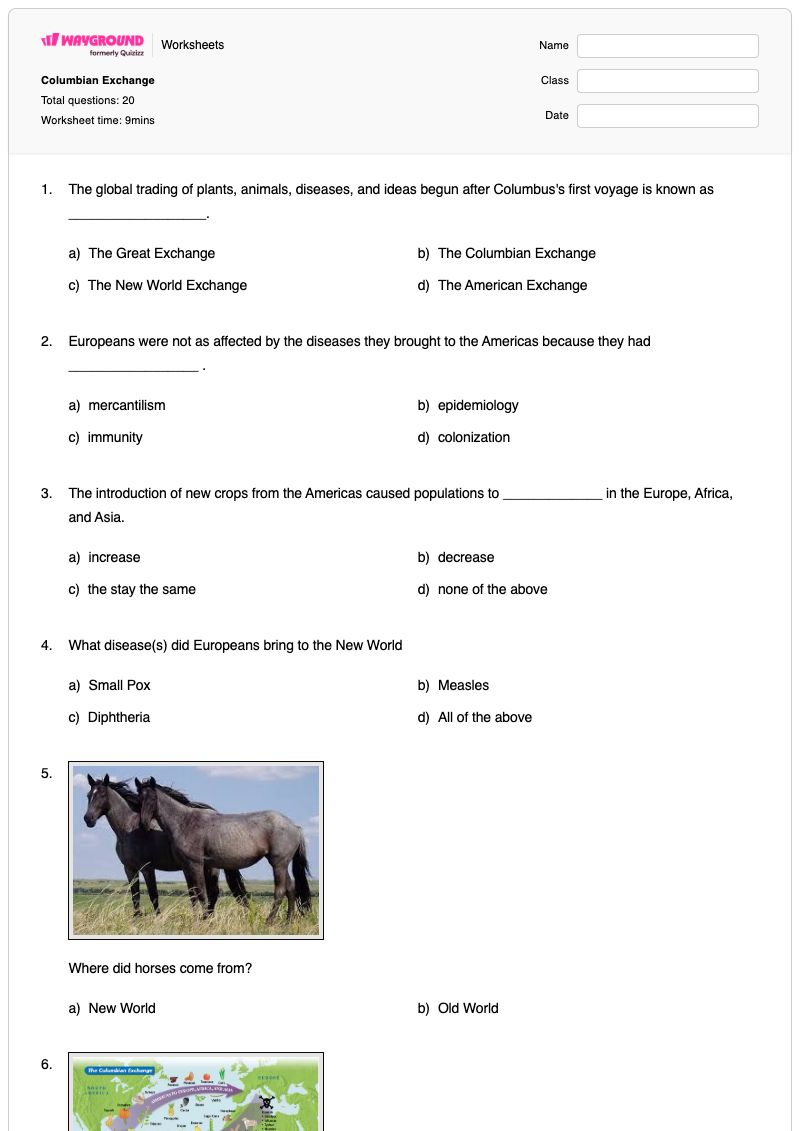
Which is true about the map?

a)

Europeans introduced livestock to the Americas.

b)

Native Americans brought diseases to Europe.

c)

Europeans taught Native Americans how to grow potatoes and squash.

Answer Key

Columbian Exchange

Total questions: 20

1.
b)

The Columbian Exchange

2.
c)

immunity

3.
a)

increase

4.
d)

All of the above

5.
b)

Old World

6.
a)

New World

7.
b)

Old World

8.
a)

New World

9.
a)

New World

10.
b)

Old World

11.
b)

South America

, a)

North America

12.
c)

Europe

, d)

Asia

, e)

Africa

13.
a)

the Americas and Europe

, c)

the Old World and the New World

14.
d)

Christopher Columbus

15.
a)

To find better routes to Asia to buy spices and luxury goods

16.
b)

Diseases

17.
c) From both east to west and west to east 
18.
a) True
19.
a)

True

20.
a)

Europeans introduced livestock to the Americas.

FAQs

What does this Columbian Exchange worksheet help Grade 7 students learn?

This worksheet helps students identify the Columbian Exchange and understand its connections to Christopher Columbus, the Age of Exploration, disease transmission, population growth, and the movement of plants and animals. Its 17 multiple-choice and 3 multiple-select questions require students to classify items such as potatoes, corn, tomatoes, horses, sugar, and pigs as originating in the Old World or New World, while also selecting the correct continents and descriptions.

How can I use this worksheet to teach the Columbian Exchange?

Introduce the lesson by defining the Old World and New World, then use the crop, animal, and disease questions to discuss what moved between the two regions. Before students complete the multiple-select items, ask them to explain why North and South America belong to the New World and why Europe, Asia, and Africa belong to the Old World. Use the final questions to connect the exchange to Columbus’s voyage and the search for Asian trade routes.

What mistakes should I watch for when students complete this Columbian Exchange worksheet?

Watch for students reversing the origins of familiar items, especially identifying potatoes, corn, and tomatoes as Old World or horses, pigs, and sugar as New World. Students may also select only one answer on the multiple-select questions, omit Africa or Asia from the Old World, or confuse European immunity with terms such as epidemiology. Review the distinction between the immediate start of the exchange and the broader economic motivation of finding routes to Asia.

How do I assign and grade this Columbian Exchange worksheet?

The worksheet is available as a printable PDF and as a digital quiz on Wayground, and it includes a complete answer key for all 20 questions. Printable submissions can be graded by scanning student work with the Wayground for Teachers app, while the digital quiz supports online completion and grading.

How can I differentiate this Columbian Exchange worksheet for my students?

In the worksheet’s Advanced Settings, adjust font spacing or choose a larger font size to make the Old World/New World classification items and multiple-select directions easier to read. You can also enable a dyslexia-friendly font or translate the worksheet into another language so students can access the questions about crops, animals, diseases, and continents more independently.

Where can I find more free worksheets like this on Wayground?

Wayground offers a comprehensive collection of free printable worksheets and practice problems across all subjects, with downloadable PDFs and answer keys to help students master essential skills and concepts. Browse more worksheets at https://wayground.com/en-us/worksheets.