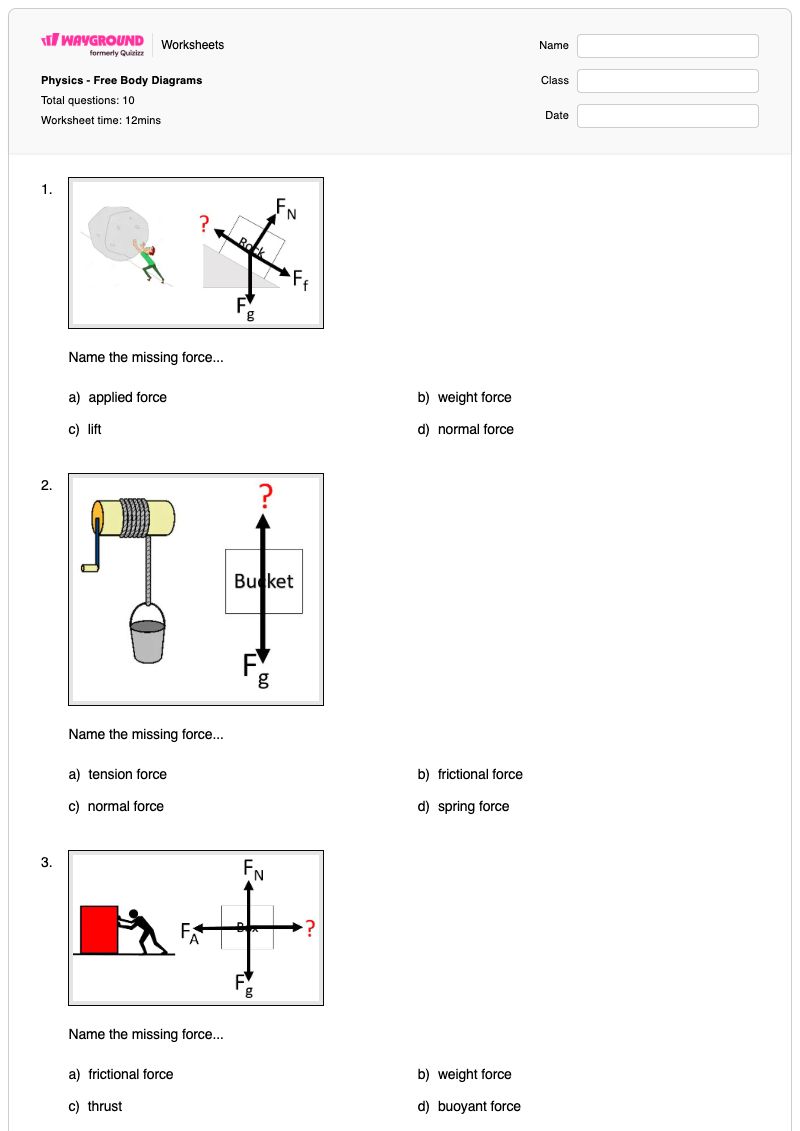
This free printable Grade 10 science worksheet helps students interpret free-body diagrams and identify the forces represented by arrows, including applied, tension, frictional, normal, and weight forces. It contains 10 multiple-choice questions that move from naming missing forces to analyzing force direction, balanced and unbalanced forces, and motion in familiar situations such as pushing a dresser or box.
Students also use force relationships to describe constant-velocity motion in horizontal and vertical directions and identify the frictional force that keeps an object stationary on an inclined plane. The worksheet supports practice with connecting diagram evidence to Newtonian force concepts, rather than simply memorizing force names. A complete answer key is included, making this free printable worksheet useful for independent practice, review, or a Grade 10 science assessment.
Worksheet settings
Font size
S
M
L
XL
Worksheets
Physics - Free Body Diagrams
Total questions: 10
Name
Class
Date
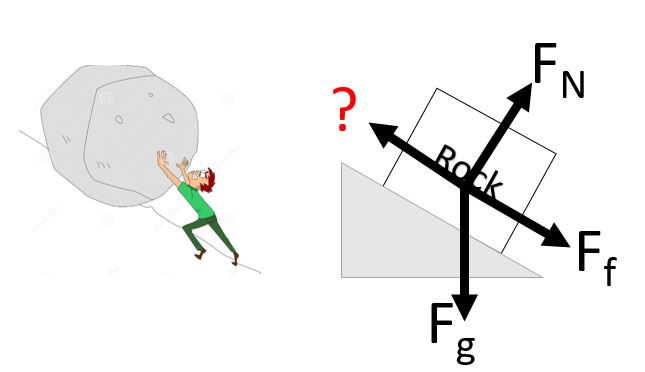
1.
Name the missing force...
a)
applied force
b)
weight force
c)
lift
d)
normal force
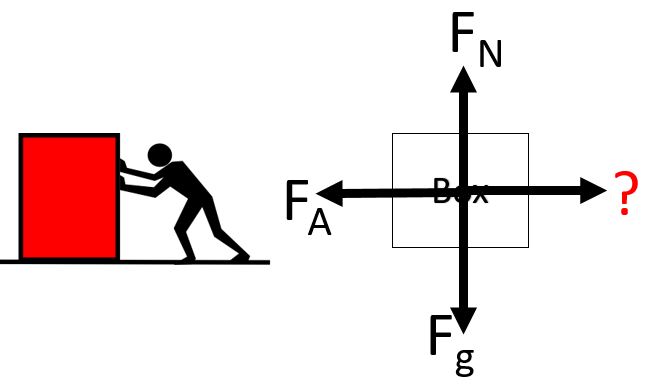
2.
Name the missing force...
a)
tension force
b)
frictional force
c)
normal force
d)
spring force
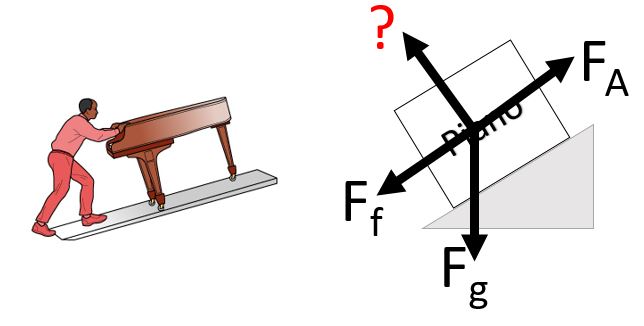
3.
Name the missing force...
a)
frictional force
b)
weight force
c)
thrust
d)
buoyant force
4.
Name the missing force...
a)
normal force
b)
applied force
c)
frictional force
d)
tension force
5.
A rightward force is applied to a dresser to accelerate it to the right across the bedroom floor.
a)
b)
c)
d)
6.
If this object were moving to the right, the left-arrow in this diagram would most likely represent:
a)
gravity
b)
normal
c)
a push or pull
d)
friction
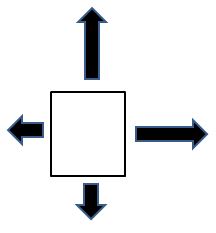
7.
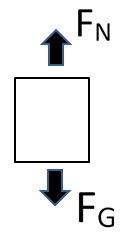
Which of the following is true about this free-body diagram?
a)
the forces are are balanced
b)
the object is free-falling
c)
the object is moving upward
d)
the forces are unbalanced
8.
A man pushes a box across the floor at a constant velocity. Which formula describes the horizontal forces on the box?
a)
FP−Ff=0
b)
Fp+Fg−Ff=0
c)
FP−10Fg=0
d)
Fp×Ff=0
9.
A man pushes a box across the floor at a constant velocity. Which formula describes the vertical forces on the box?
a)
FP−Fg=0
b)
Fp+Fg−Ff=0
c)
Fn−10Fg=0
d)
Fn−mg=0
10.
What force is responsible for keeping an object stationary on an inclined plane?
a)
frictional force
b)
tension force
c)
gravitational force
d)
normal force
Answer Key
Physics - Free Body Diagrams
Total questions: 10
1.
a) applied force
2.
a) tension force
3.
a) frictional force
4.
a) normal force
5.
d)
6.
d)
friction
7.
a)
the forces are are balanced
8.
a)
FP−Ff=0
9.
d)
Fn−mg=0
10.
a)
frictional force
140 %
Browse by subjects
Browse by grades
Browse by format
FAQs
What does this free-body diagram worksheet help Grade 10 students learn?
This worksheet helps students identify forces shown in free-body diagrams and connect arrow direction to applied, tension, frictional, normal, and weight forces. Its 10 multiple-choice questions also ask students to determine whether forces are balanced, describe horizontal and vertical forces during constant-velocity motion, and identify friction on an inclined plane.
How can I use this worksheet to teach students to interpret free-body diagrams?
Introduce the worksheet by having students name familiar forces from an arrow’s direction and the object’s situation, such as a push across a floor or a box on an incline. Then ask students to justify each multiple-choice selection by explaining whether the arrow represents contact, friction, tension, gravity, or an applied force. Use the balanced-force and constant-velocity questions to connect diagram interpretation with net force.
What mistakes should I watch for when students complete this free-body diagram worksheet?
Students may confuse an applied push or pull with friction when an object moves across a floor, or confuse the normal force with weight because both can appear as vertical arrows. They may also select unbalanced forces simply because an object is moving, even though the worksheet’s constant-velocity questions test for balanced horizontal and vertical forces. On the inclined-plane item, check that students recognize friction as the force keeping the object stationary.
How do I assign and grade this free-body diagrams worksheet?
The worksheet is available as a printable PDF and as a digital quiz on Wayground, and it includes a complete answer key for all 10 multiple-choice questions. For printed submissions, scan student work with the Wayground for Teachers app to support grading and review.
How can I differentiate this free-body diagram worksheet for my students?
Use the worksheet’s Advanced Settings to adjust font spacing and font size so the force diagrams, answer choices, and force-relationship questions are easier to read. You can also enable a dyslexia-friendly font or translate the worksheet into another language while preserving its multiple-choice free-body diagram practice.
Where can I find more worksheets like this on Wayground?
Wayground offers a comprehensive collection of free printable worksheets and practice problems across subjects, with downloadable PDFs and answer keys to help students master essential skills and concepts. Browse more resources at https://wayground.com/en-us/worksheets.

 Worksheets