Free Printable Free Body Diagrams Worksheets for Grade 10
Grade 10 free body diagrams worksheets and printables help students master physics concepts through practice problems analyzing forces, with downloadable PDFs and answer keys available from Wayground's comprehensive collection.
Explore printable Free Body Diagrams worksheets for Grade 10
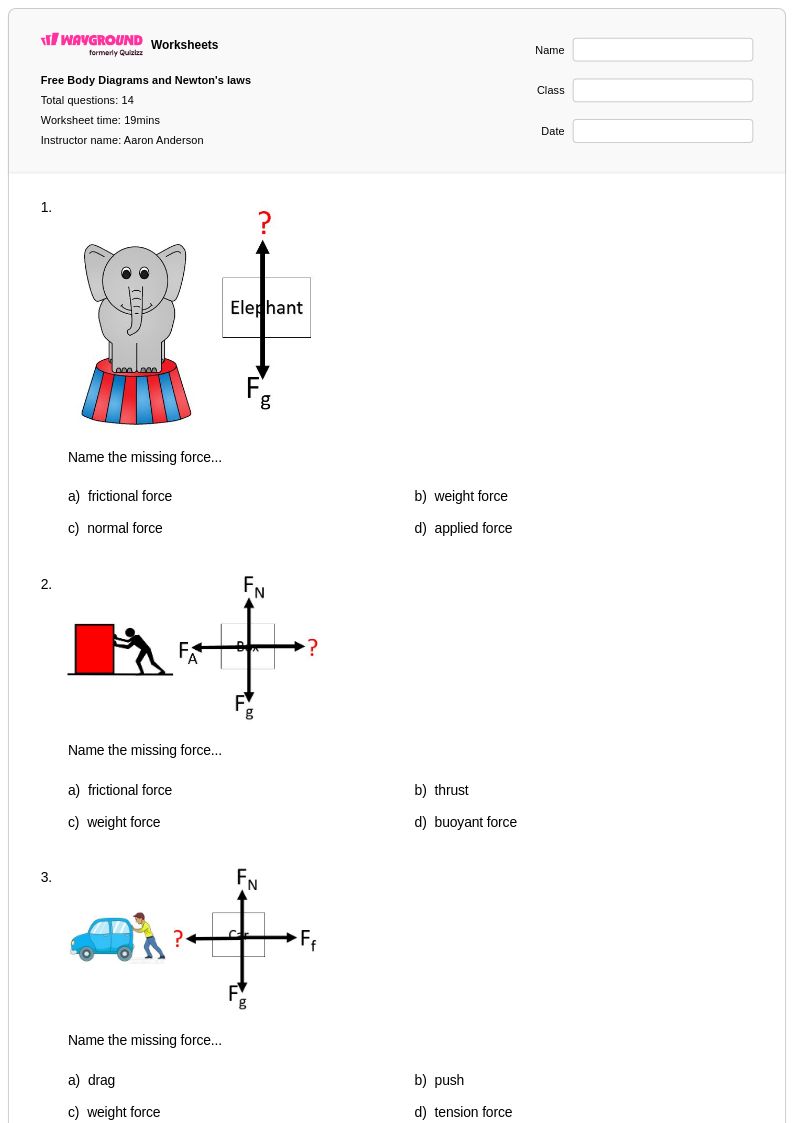
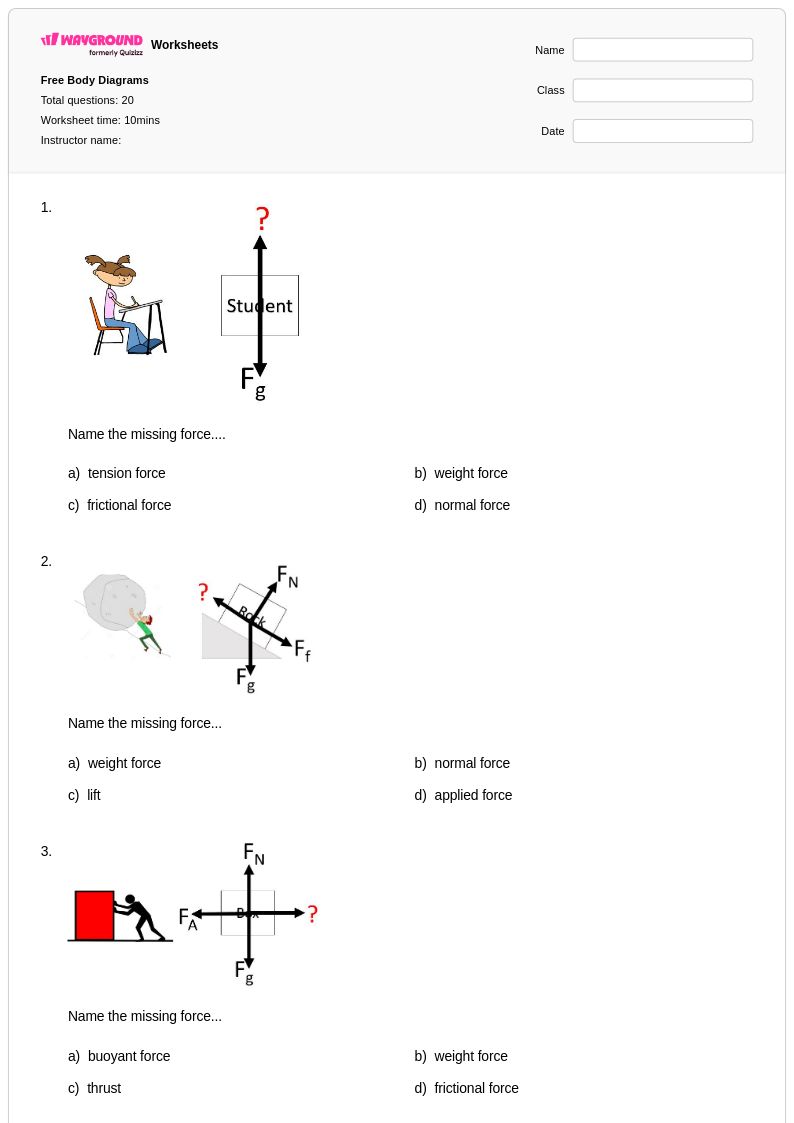
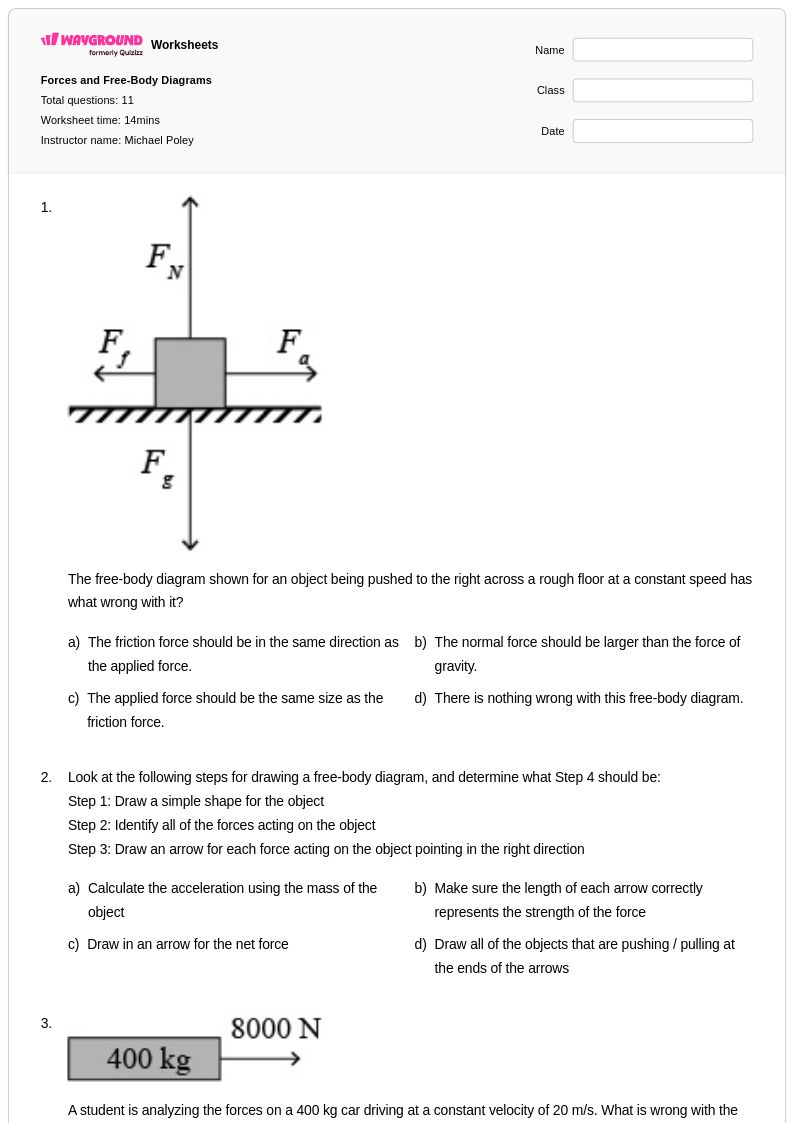
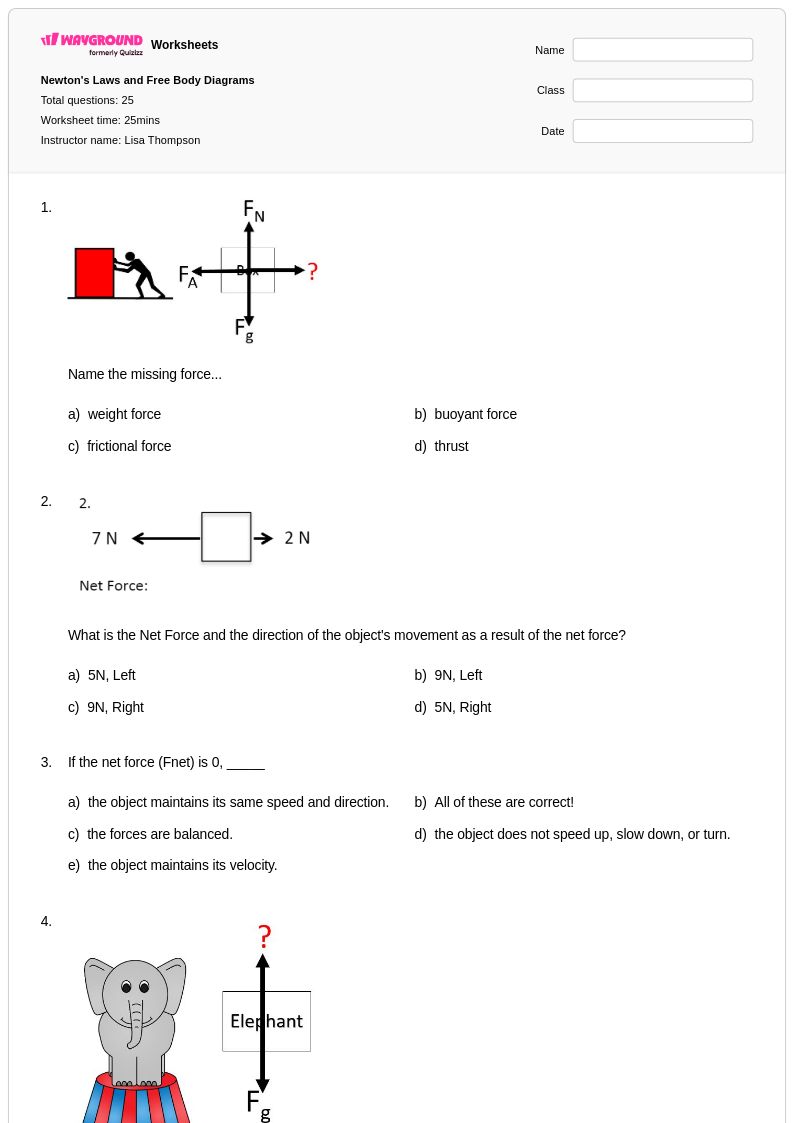
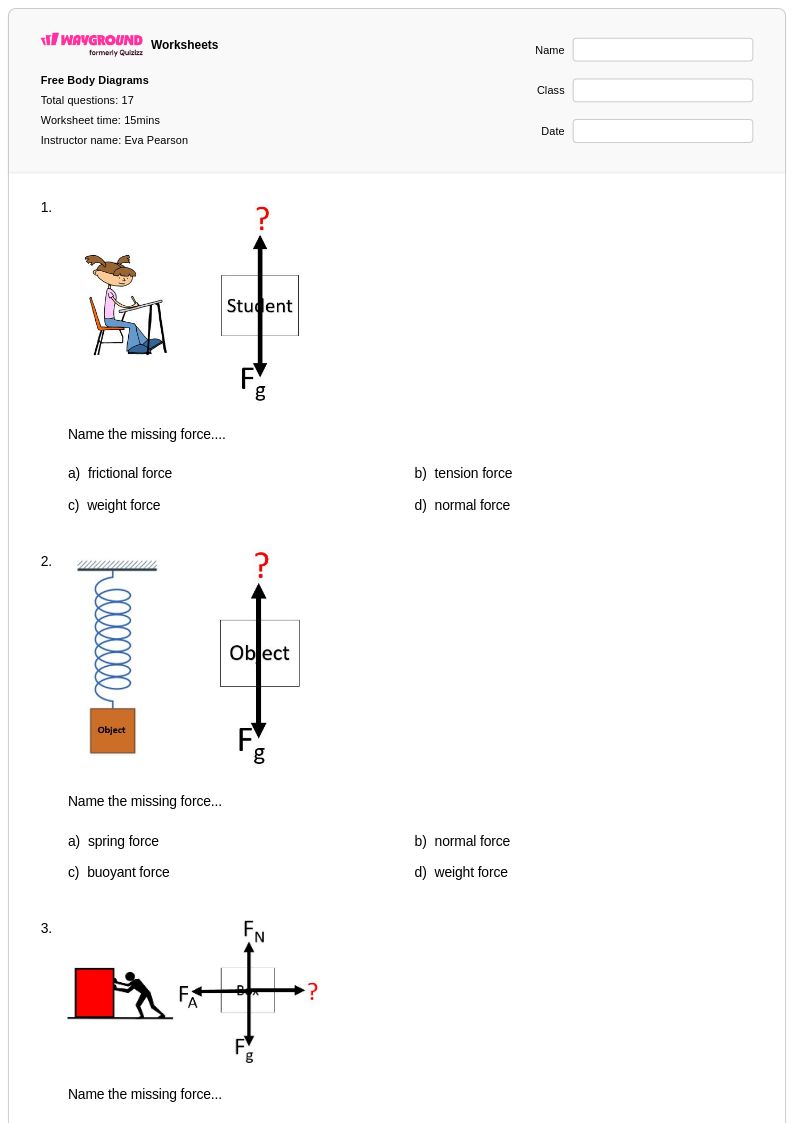
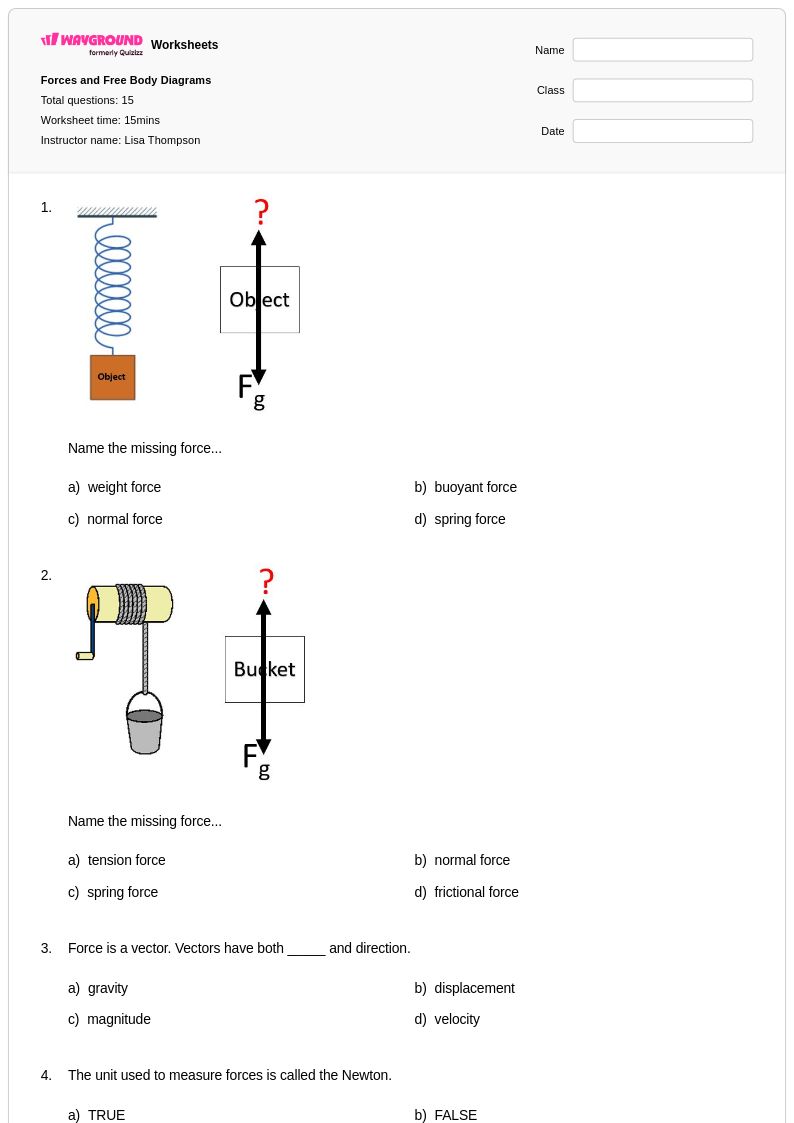
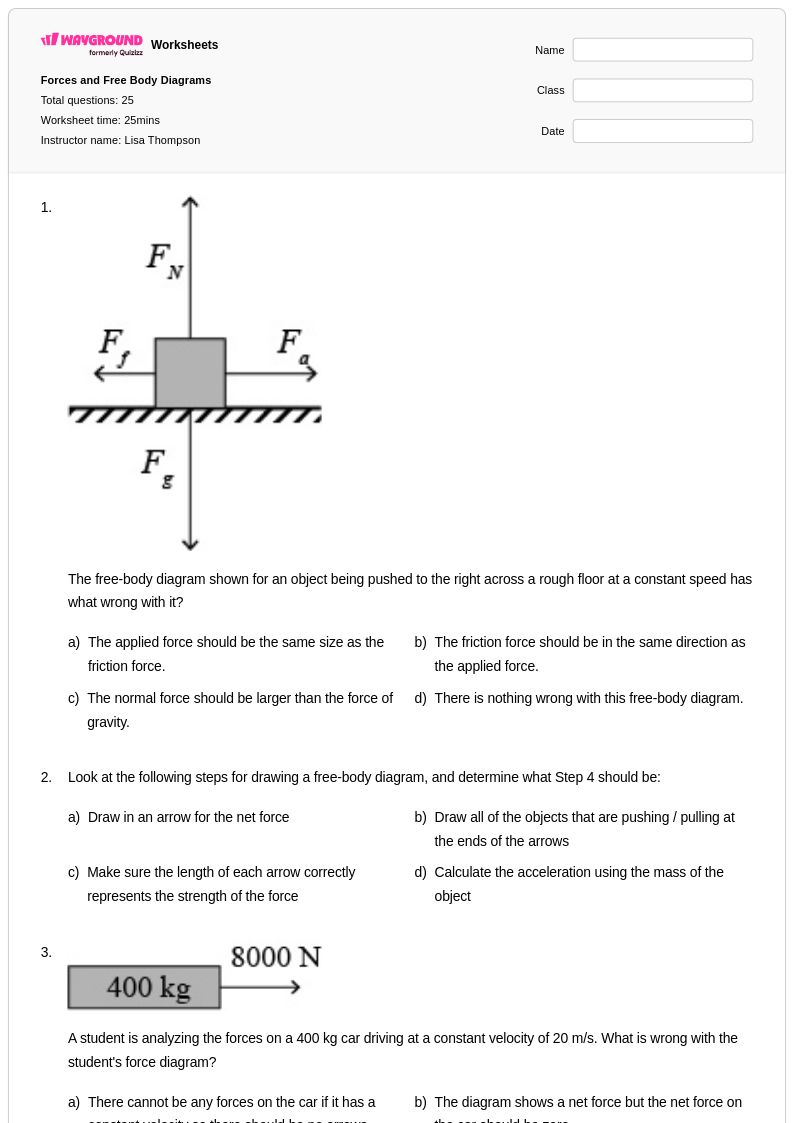
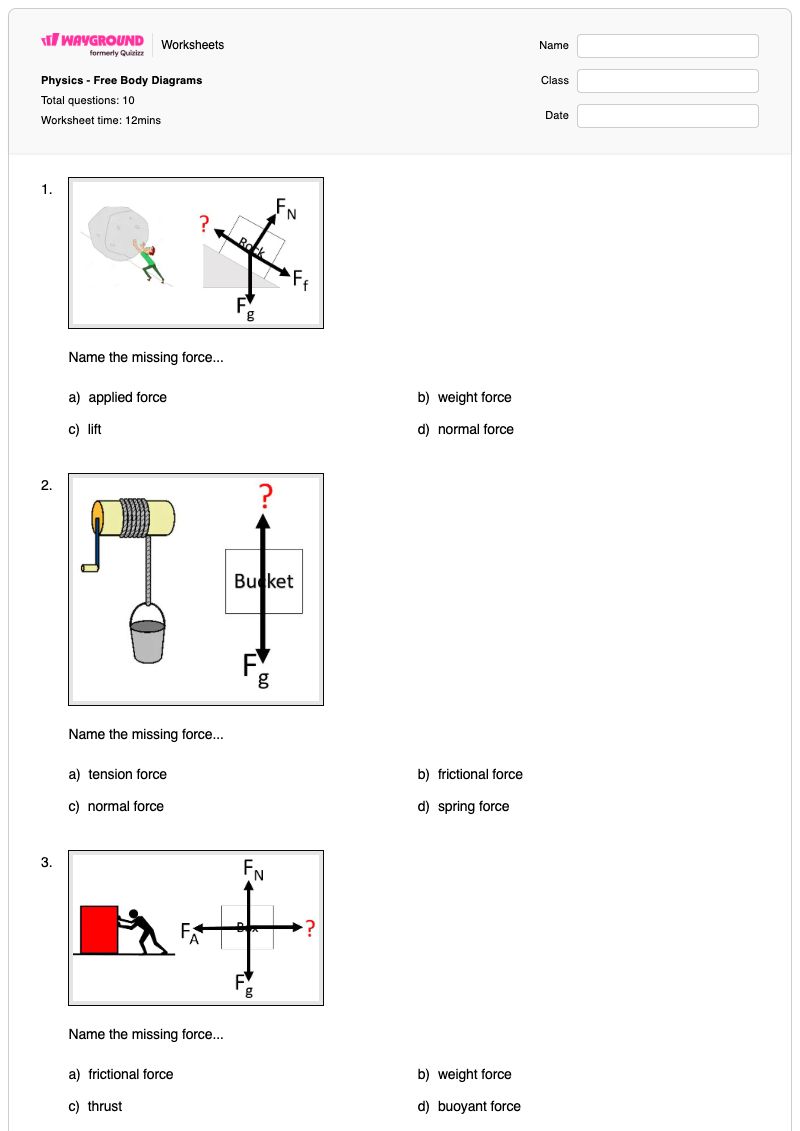
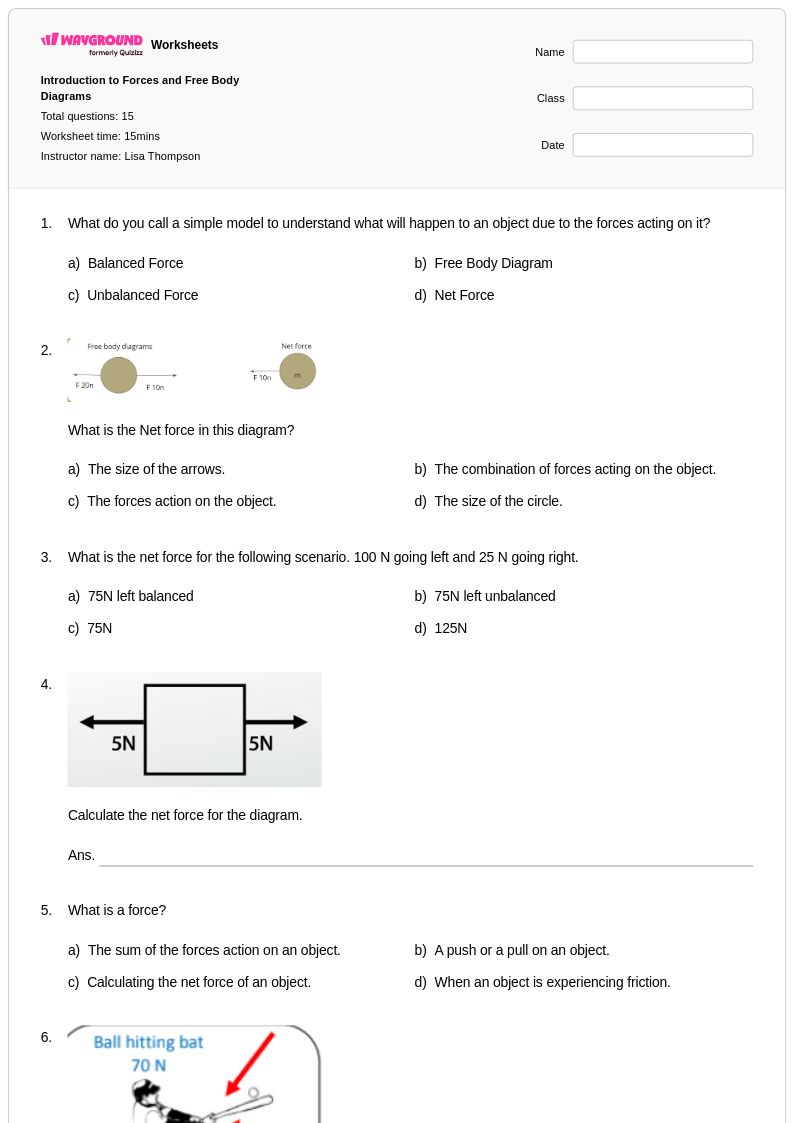
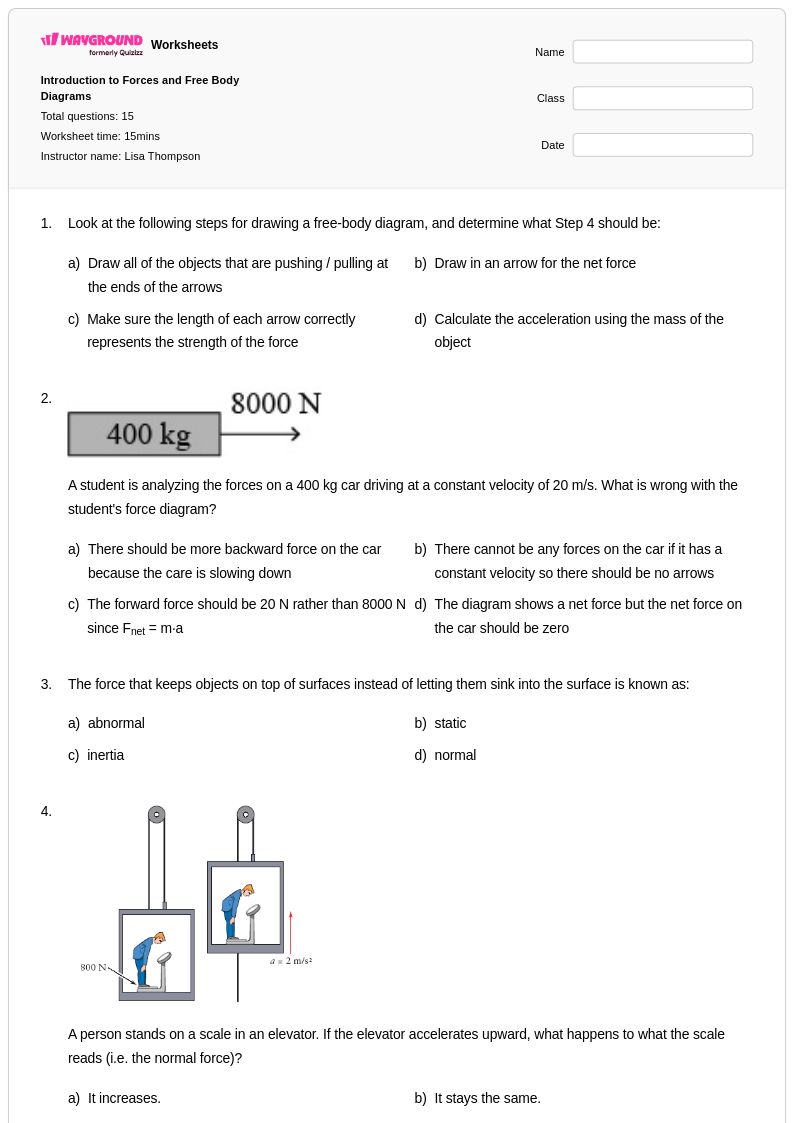
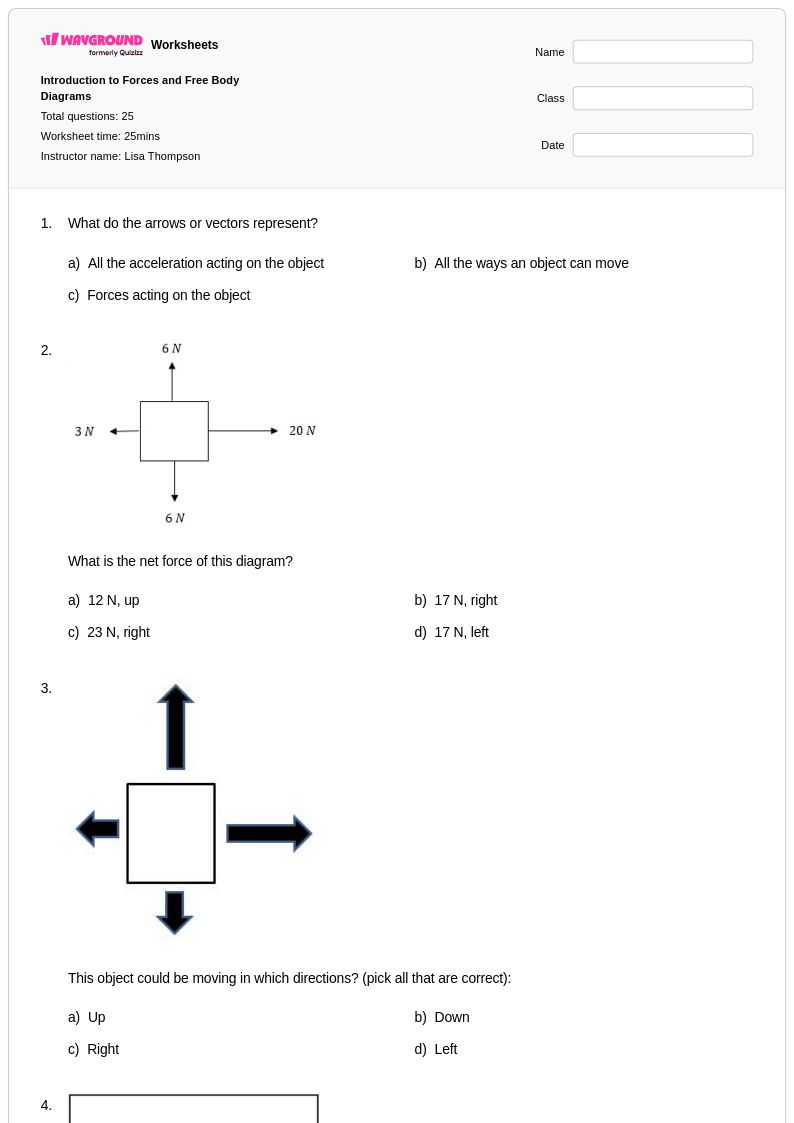
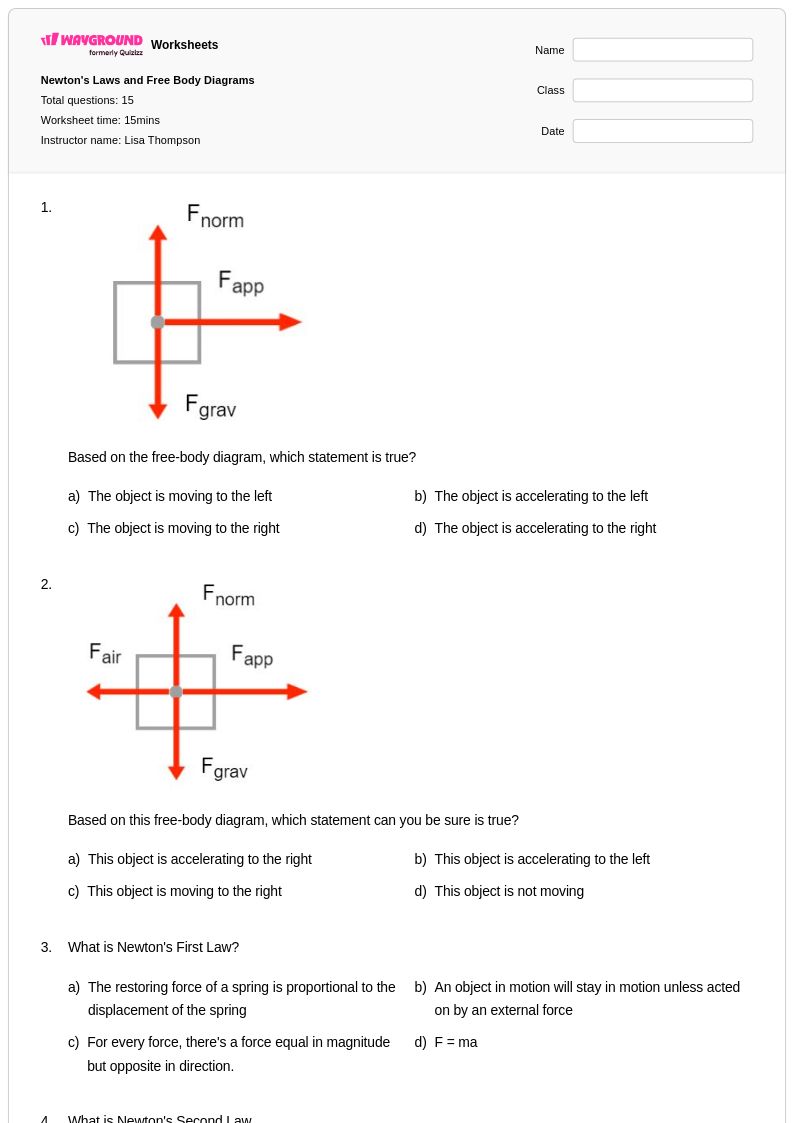
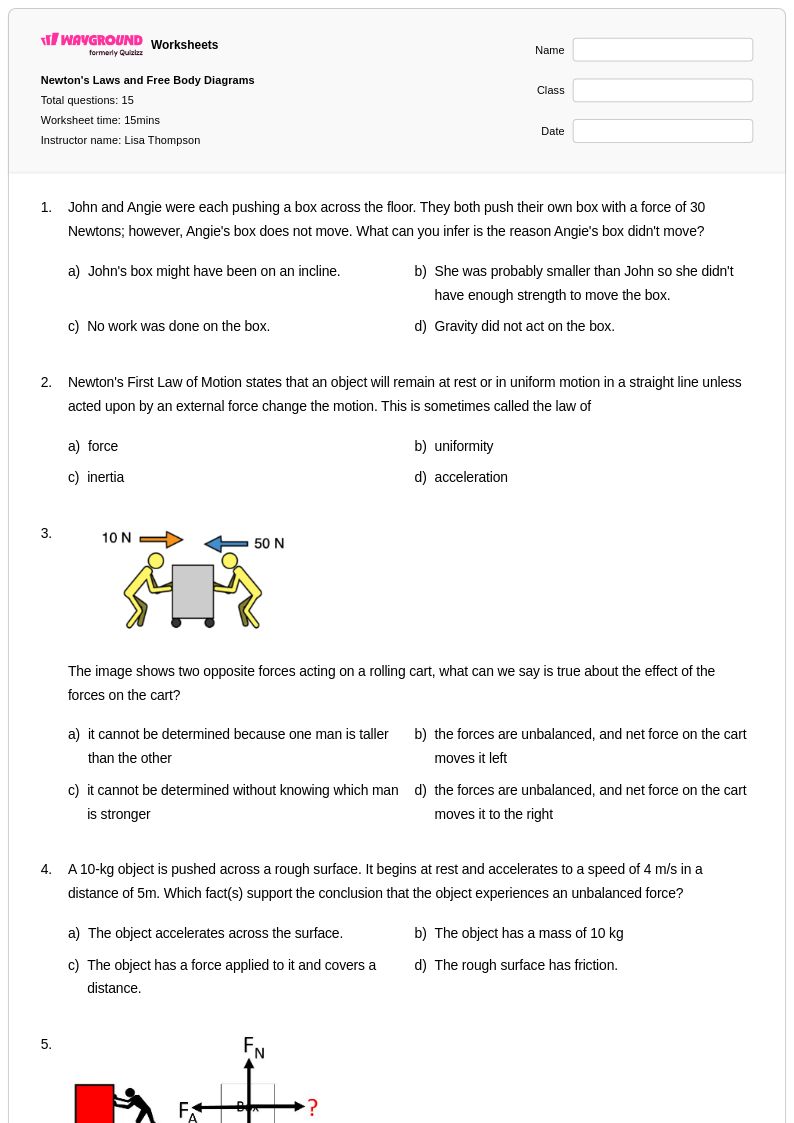
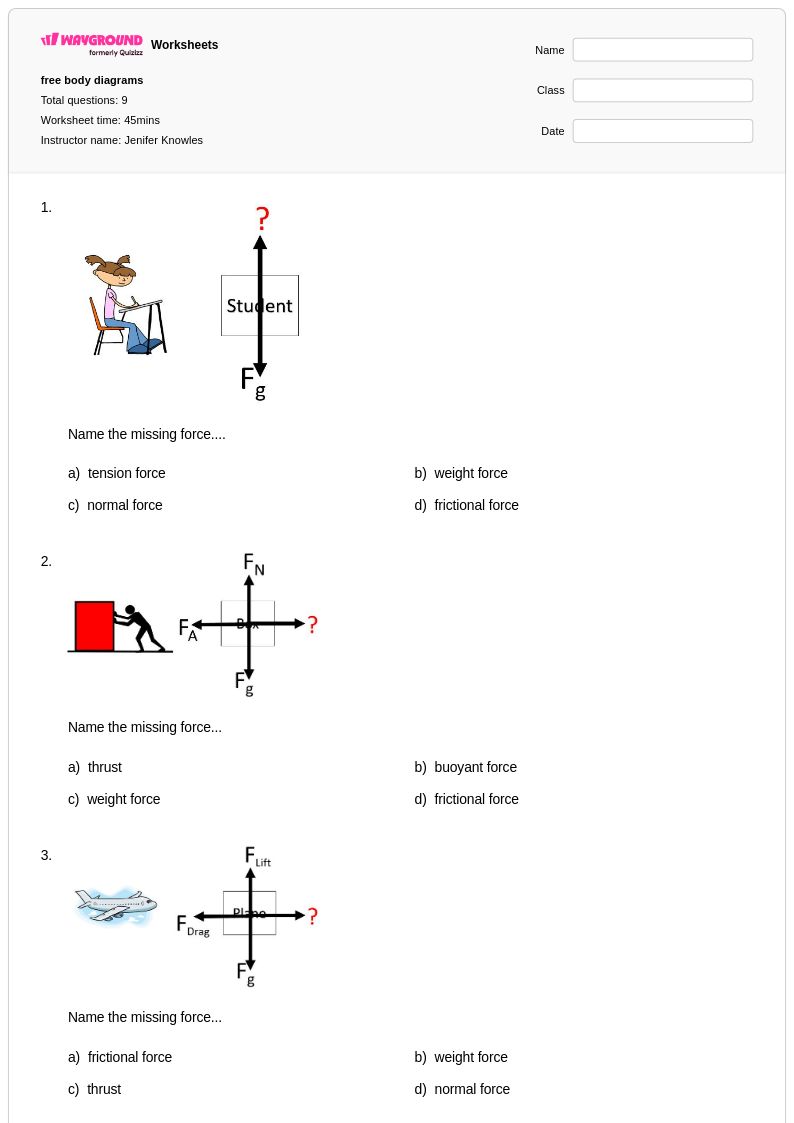
Free body diagrams represent a fundamental concept in Grade 10 physics that enables students to visualize and analyze the forces acting upon objects in various scenarios. Wayground's comprehensive collection of free body diagram worksheets provides students with extensive practice in identifying, drawing, and interpreting force vectors, including gravitational forces, normal forces, friction, tension, and applied forces. These carefully crafted worksheets strengthen critical analytical skills by guiding students through systematic approaches to problem-solving, from simple static equilibrium situations to more complex scenarios involving inclined planes, pulleys, and multiple connected objects. Each worksheet includes detailed answer keys and step-by-step solutions that help students understand the reasoning behind proper diagram construction and force analysis, while the free printable pdf format ensures accessibility for both classroom instruction and independent study sessions.
Wayground's extensive library of millions of teacher-created resources makes it effortless for educators to locate high-quality free body diagram materials that align with physics curriculum standards and accommodate diverse learning needs. The platform's robust search and filtering capabilities allow teachers to quickly identify worksheets targeting specific force concepts, difficulty levels, or real-world applications, while built-in differentiation tools enable seamless customization for remediation or enrichment activities. Whether delivered as printable pdf handouts for traditional pencil-and-paper practice or implemented through digital formats for interactive learning experiences, these resources support comprehensive lesson planning and provide flexible options for skill reinforcement. Teachers can efficiently address varying student proficiency levels by selecting from foundational practice problems that build conceptual understanding to advanced scenarios that challenge students to apply free body diagram principles in complex physics situations.
FAQs
How do I teach free body diagrams to physics students?
Start by teaching students to isolate the object of interest before identifying every force acting on it, including gravity, normal force, friction, tension, and applied forces. Emphasize that each force is represented by an arrow pointing in the direction the force acts, with length roughly proportional to magnitude. A common scaffolding approach is to move from static single-object scenarios to dynamic multi-body problems progressively, reinforcing Newton's laws at each stage. Having students verbally narrate their force identification before drawing helps catch omissions early.
What exercises help students practice drawing free body diagrams?
Effective practice exercises include labeling forces on objects at rest on inclined planes, identifying tension and weight in pulley systems, and analyzing friction in sliding-block problems. Worksheets that progress from simple static scenarios to dynamic situations build procedural fluency while reinforcing conceptual understanding. Having students cross-reference their diagrams with Newton's second law equations strengthens the connection between diagram construction and quantitative problem-solving.
What mistakes do students commonly make when drawing free body diagrams?
The most frequent error is including forces the object exerts on other objects rather than forces acting on the object itself, which violates the isolation principle of a free body diagram. Students also commonly omit the normal force in contact scenarios, mislabel friction direction, or draw net force as if it were an additional acting force. Another persistent misconception is equating constant velocity with no forces present, rather than recognizing that balanced forces produce zero net force. Targeted practice with answer keys helps students self-correct these patterns before they become entrenched.
How do I use free body diagram worksheets in my physics class?
Free body diagram worksheets on Wayground are available as printable PDFs for traditional classroom use and in digital formats for technology-integrated learning environments, including the option to host them as a quiz directly on Wayground. Printable versions work well for in-class practice, lab extensions, or homework assignments, while digital formats allow for immediate feedback in blended or online settings. The included answer keys support both independent student review and efficient teacher grading, making them adaptable for formative assessment or guided practice.
How do I differentiate free body diagram instruction for students at different skill levels?
For struggling students, begin with pre-drawn diagrams where they only need to label force arrows, then progress to blank diagrams with written scenario descriptions. Advanced learners benefit from multi-body or pulley system problems that require resolving forces into components. On Wayground, teachers can customize worksheets to create differentiated versions and apply student-level accommodations such as read aloud for written problem prompts or reduced answer choices to lower cognitive load for students who need additional support.
How do free body diagrams connect to Newton's laws of motion?
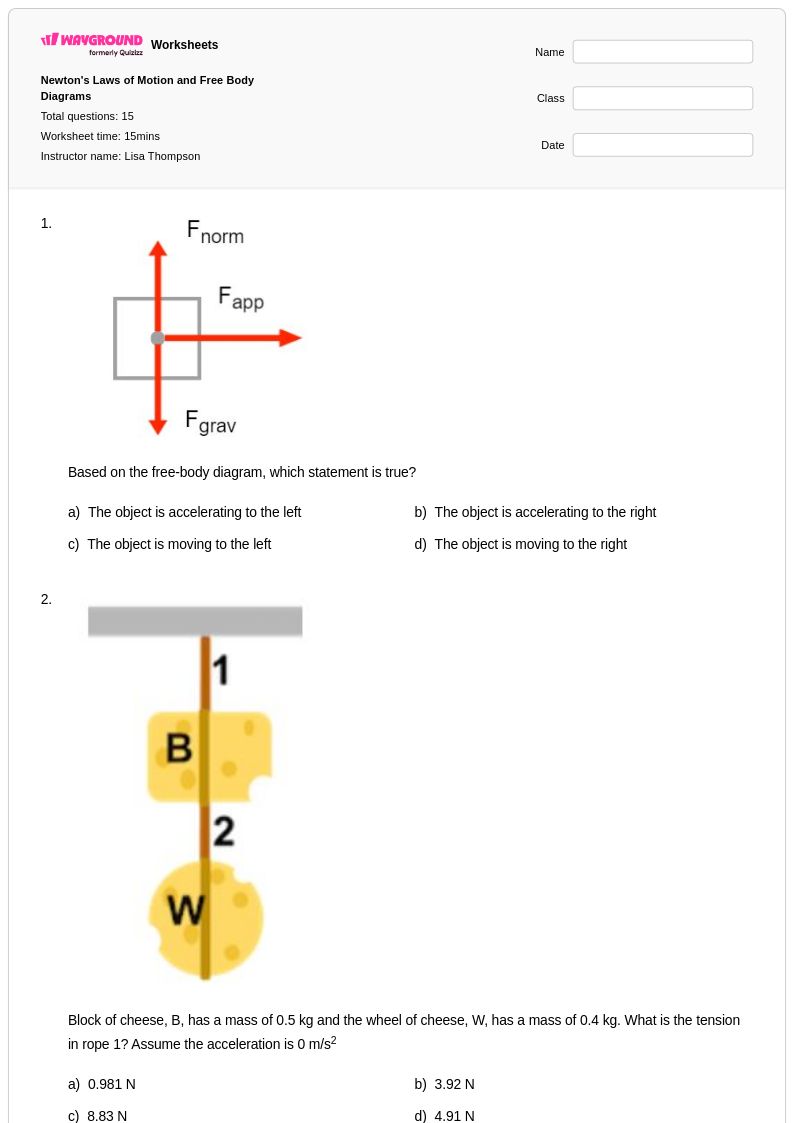
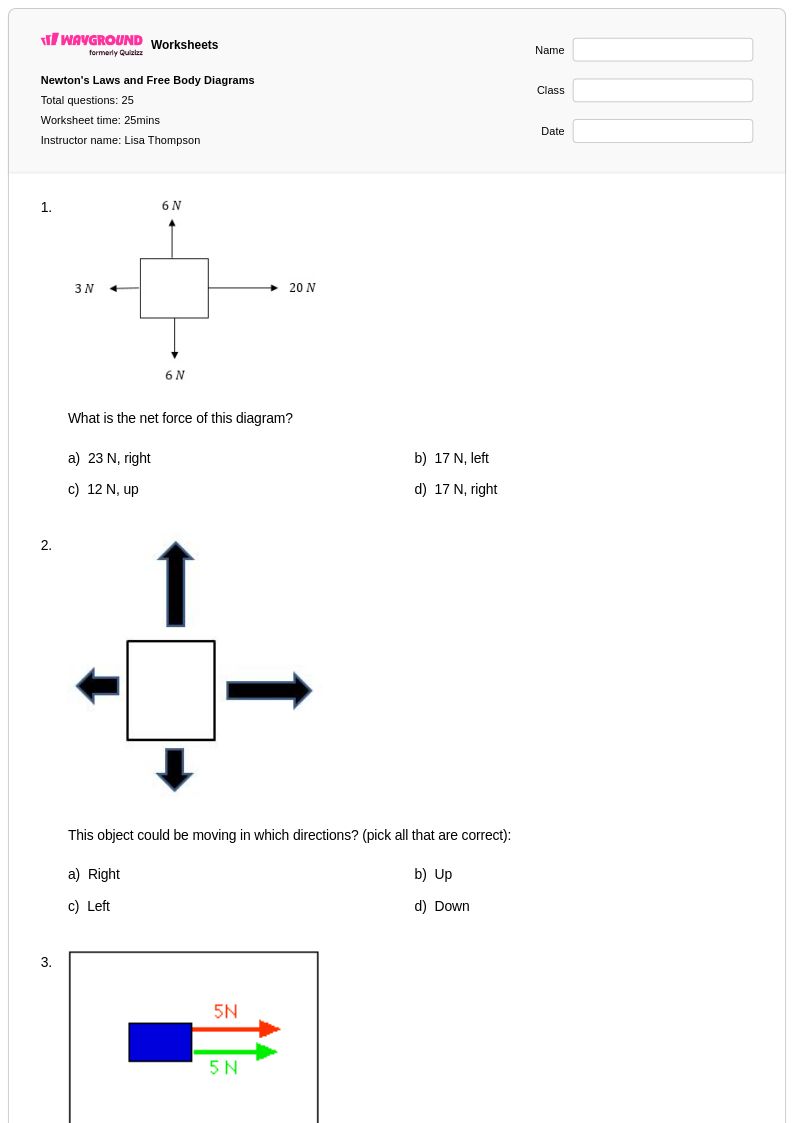
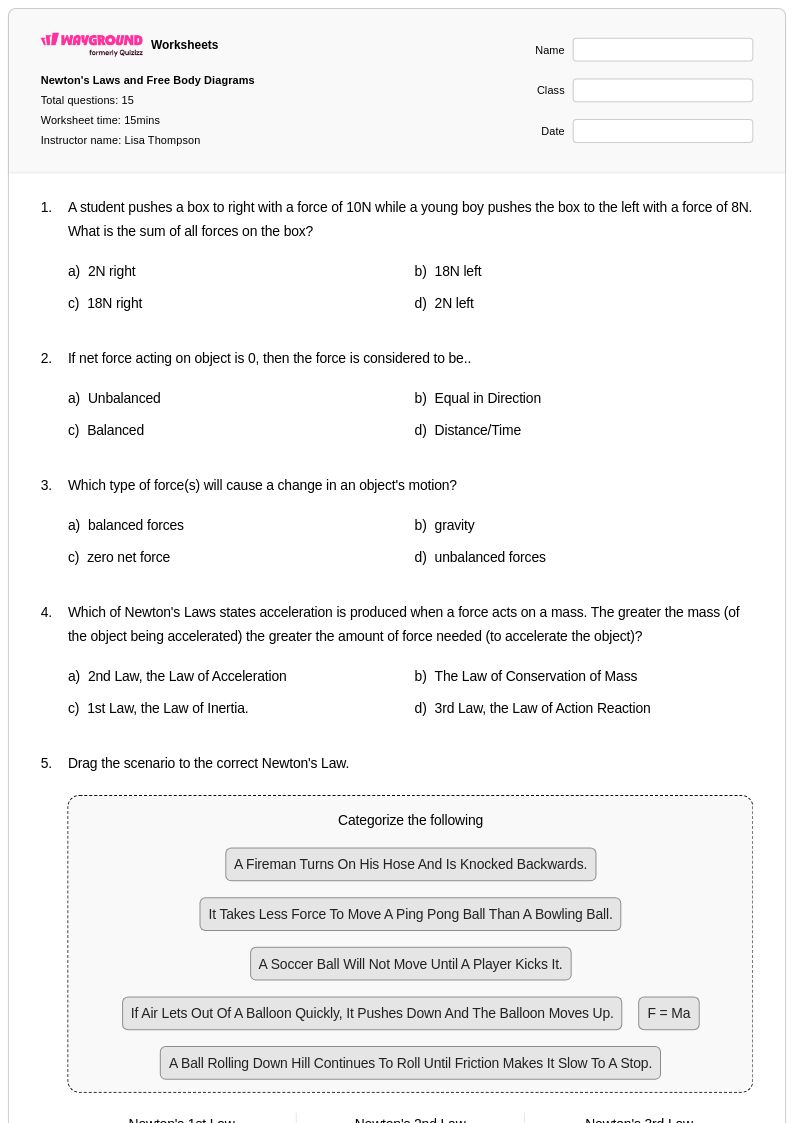
Free body diagrams are the visual foundation for applying all three of Newton's laws, but they are most directly linked to the second law, which states that the net force on an object equals its mass times acceleration. By representing all acting forces as vectors, students can sum forces in each direction and set up the equations needed to solve for unknown quantities such as acceleration, tension, or friction. Without an accurate free body diagram, students are prone to setting up incorrect equations because they have not properly accounted for all forces or their directions.