Free Printable Electrostatics Worksheets for Grade 10
Enhance Grade 10 students' understanding of electrostatics with Wayground's comprehensive collection of free worksheets, printable PDFs, and practice problems featuring detailed answer keys for mastering electric charges and fields.
Explore printable Electrostatics worksheets for Grade 10
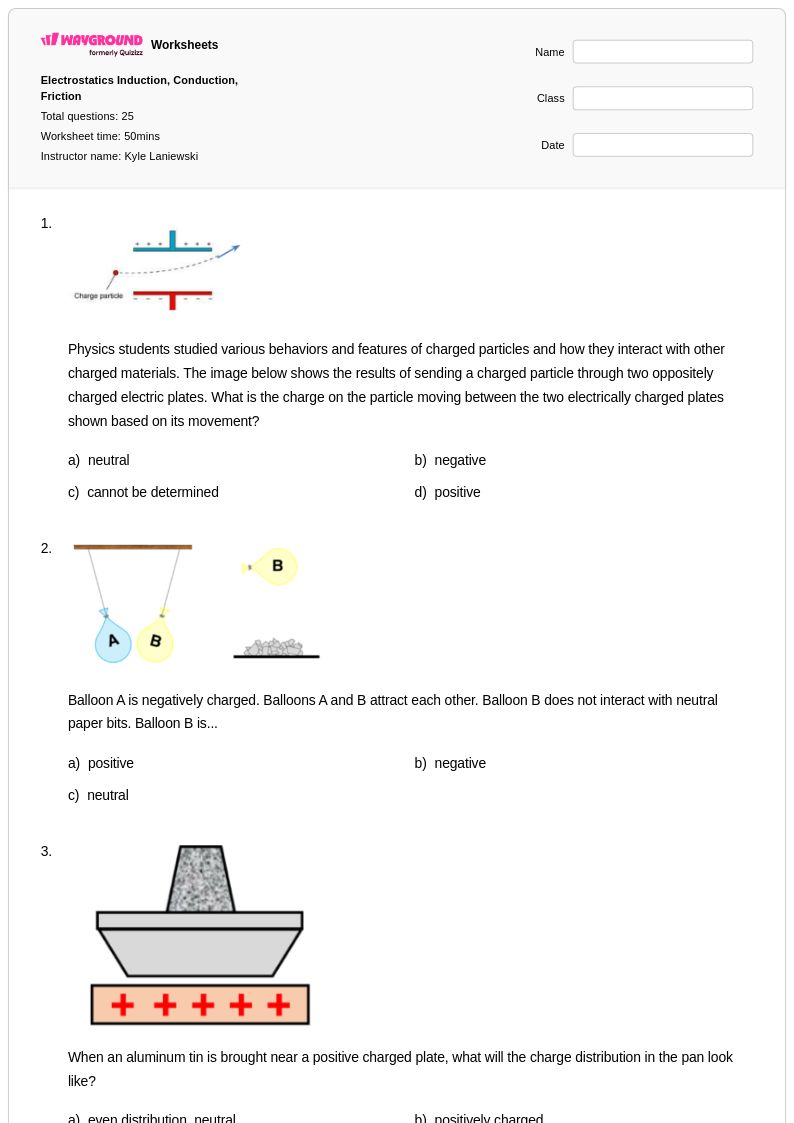
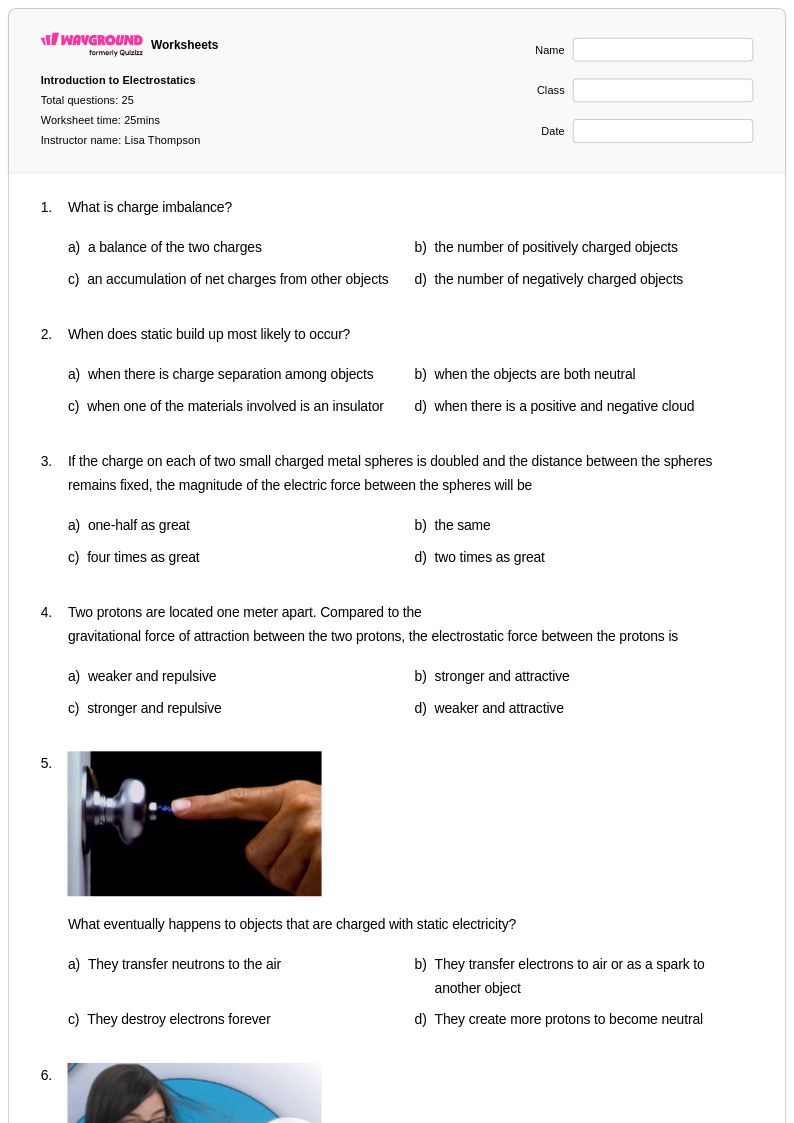
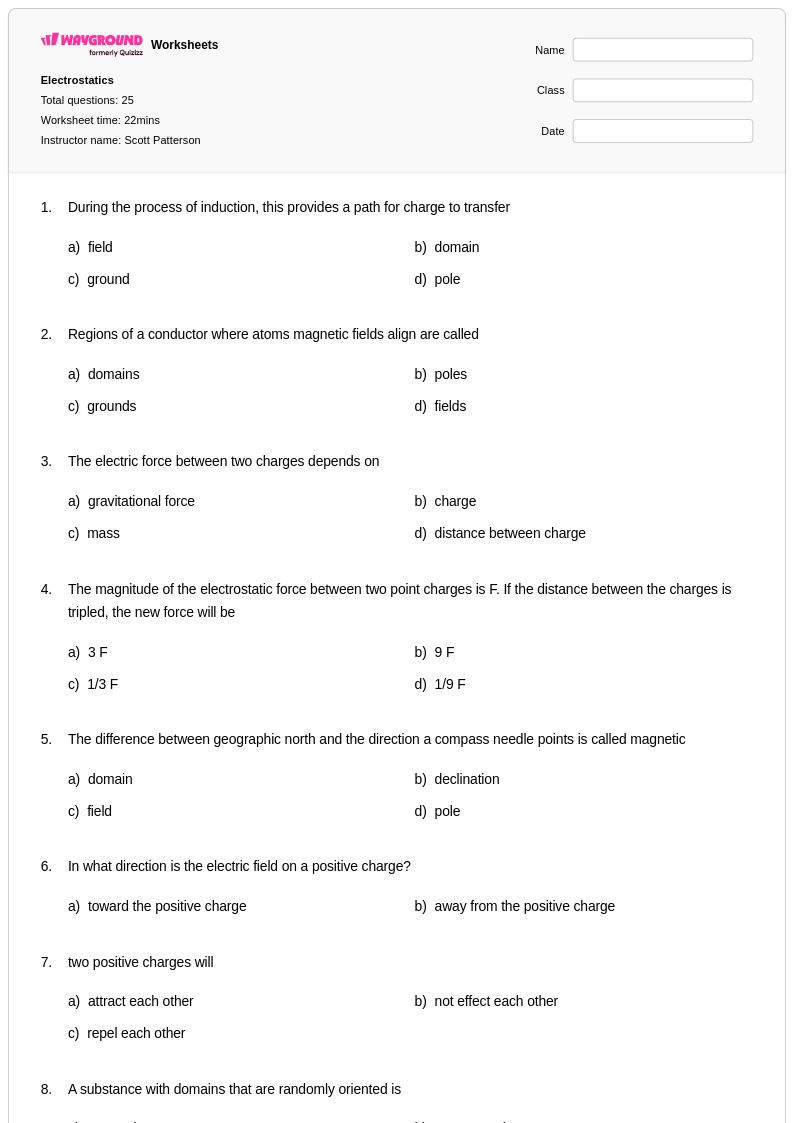
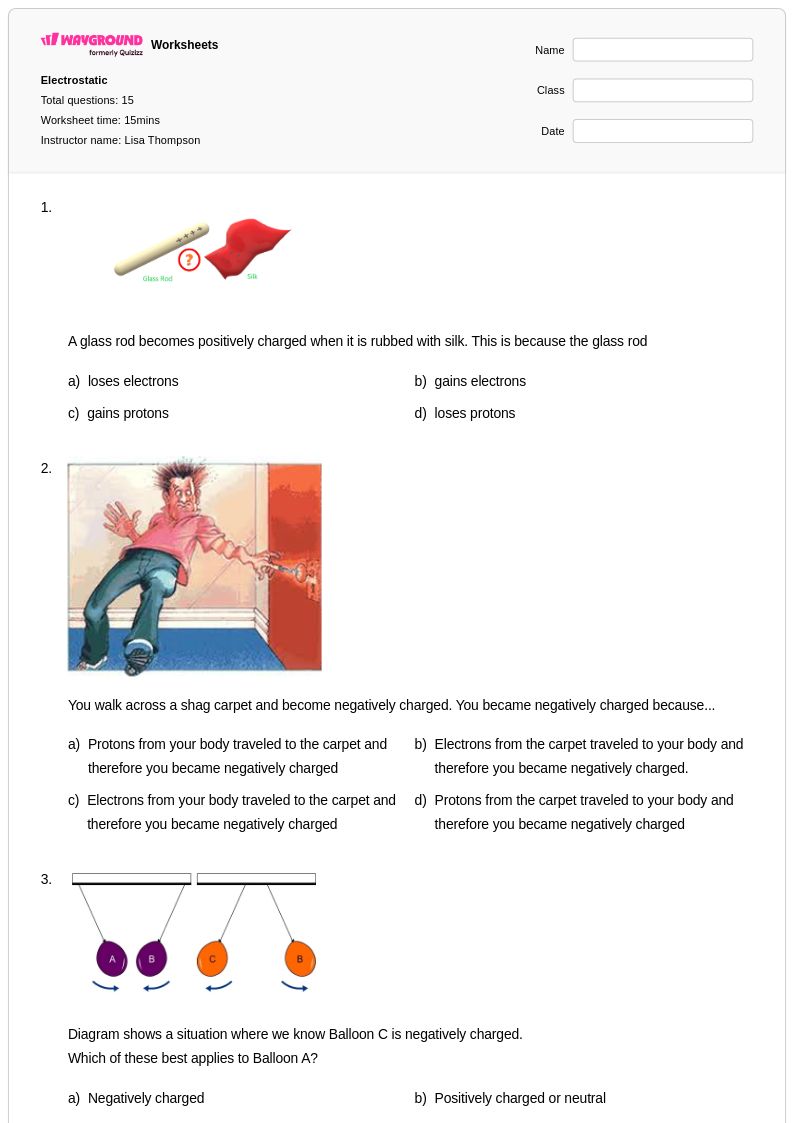
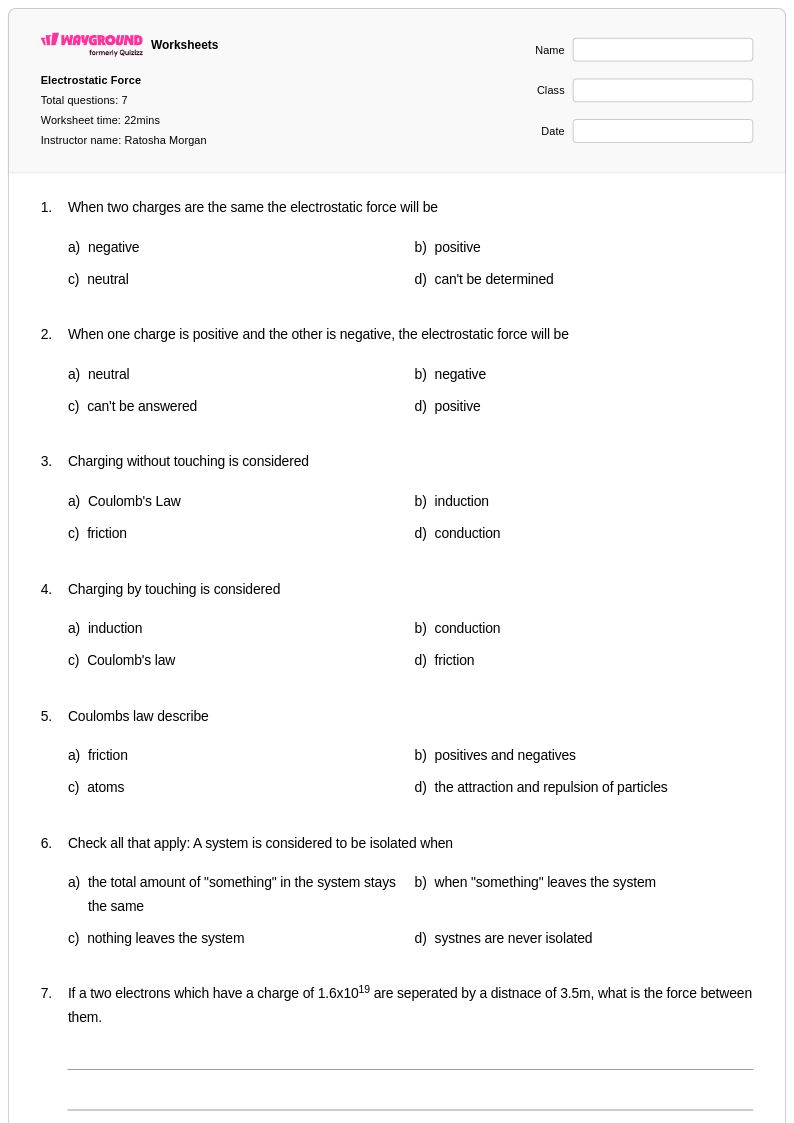
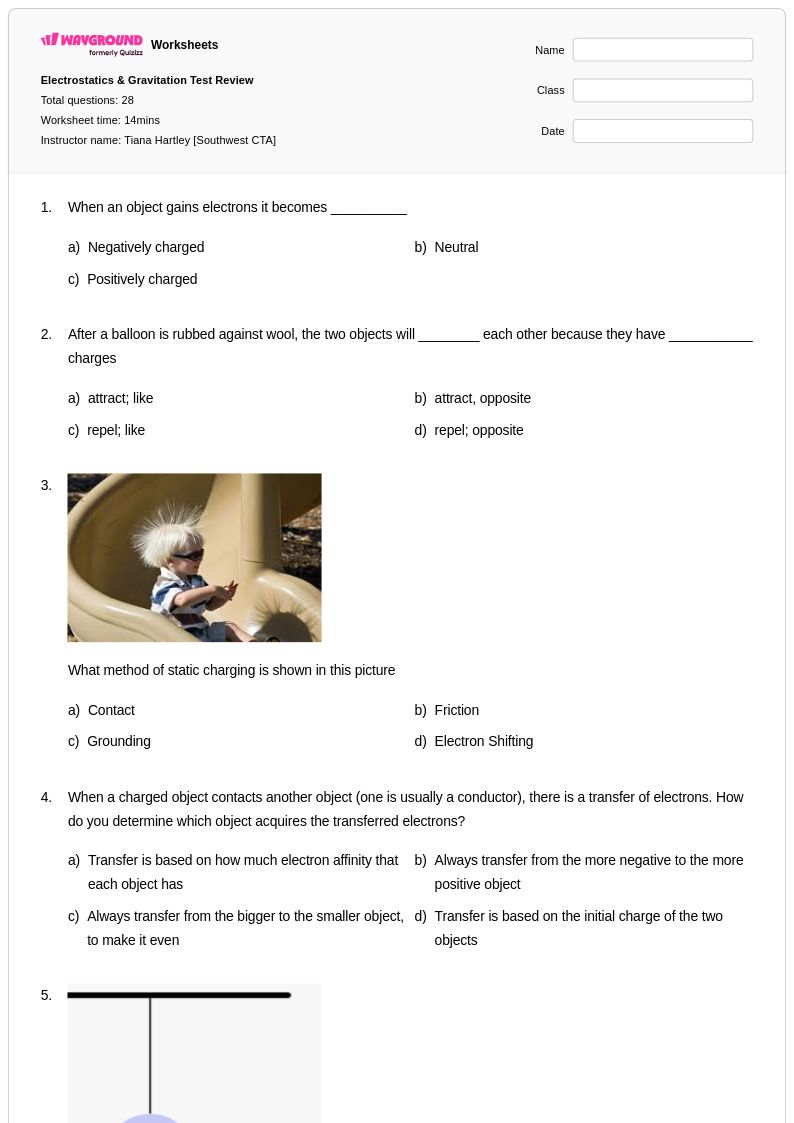
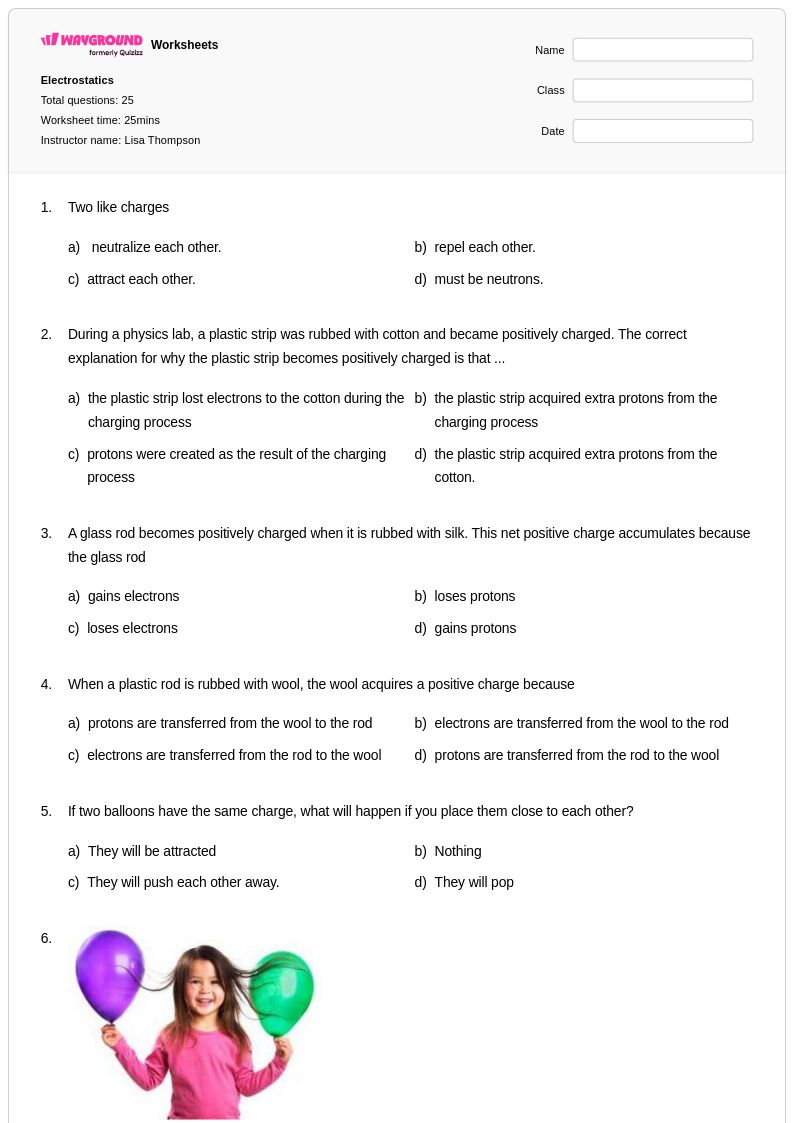
Electrostatics worksheets for Grade 10 students available through Wayground (formerly Quizizz) provide comprehensive coverage of fundamental electrical phenomena, including electric charge, electric fields, Coulomb's law, and electric potential. These carefully designed practice problems strengthen students' understanding of how charged objects interact, the principles governing electric field strength and direction, and the mathematical relationships that describe electrostatic forces. Each worksheet collection includes detailed answer keys that guide students through complex problem-solving processes, while printable pdf formats ensure easy classroom distribution and independent study sessions. The free educational resources emphasize both conceptual understanding and quantitative analysis, helping tenth-grade physics students master the mathematical foundations of electrostatics while developing critical thinking skills essential for advanced physics coursework.
Wayground (formerly Quizizz) empowers educators with access to millions of teacher-created electrostatics worksheets specifically aligned with Grade 10 physics standards and curriculum requirements. The platform's robust search and filtering capabilities enable teachers to quickly locate resources targeting specific electrostatic concepts, from basic charge interactions to complex electric field calculations, while differentiation tools allow seamless customization for diverse learning needs and ability levels. These comprehensive worksheet collections are available in both printable and digital formats, including downloadable pdf versions, supporting flexible lesson planning whether for in-person instruction, remote learning, or hybrid classroom environments. Teachers utilize these resources for targeted skill practice, remediation of challenging electrostatic concepts, and enrichment activities that challenge advanced students to explore real-world applications of electric field theory and charge distribution principles.
FAQs
How do I teach electrostatics to high school physics students?
Start with the concept of electric charge and the principle that like charges repel while opposite charges attract, using physical demonstrations like rubbing a balloon to build intuition before introducing formulas. From there, progress to Coulomb's law, electric field lines, and electric potential in sequence, since each concept depends on the previous one. Grounding abstract ideas in visible phenomena before moving to calculations significantly reduces early misconceptions.
What are the most common mistakes students make when solving electrostatics problems?
The most frequent error is treating Coulomb's law as a scalar equation and ignoring the vector nature of electric force, which causes sign errors when multiple charges are involved. Students also commonly confuse electric field strength with electric potential, treating them as interchangeable when they are fundamentally different quantities. A third persistent mistake is failing to convert units consistently, particularly microcoulombs to coulombs, before substituting values into equations.
What practice problems help students get better at electrostatics calculations?
Effective practice starts with single-charge Coulomb's law problems before progressing to multi-charge superposition problems that require vector addition of forces. Students benefit from problems that ask them to calculate both the magnitude and direction of electric fields at a point due to multiple source charges, as this reinforces the vector treatment of fields. Including problems that connect electric potential energy to work done by or against electric forces builds the conceptual bridge between mechanics and electrostatics.
How can I differentiate electrostatics instruction for students at different skill levels?
For students who are still building foundational skills, reduce problem complexity by working with one or two charges before introducing superposition scenarios, and use diagrams heavily to make field directions visible. Advanced students benefit from open-ended problems involving continuous charge distributions or problems that require deriving expressions rather than plugging in numbers. On Wayground, teachers can apply accommodations such as reduced answer choices or read-aloud support to individual students without disrupting the experience of the rest of the class.
How do I use Wayground's electrostatics worksheets in my classroom?
Wayground's electrostatics worksheets are available as printable PDFs for traditional classroom use and in digital formats for technology-integrated environments, so they work equally well as in-class practice, homework, or test prep. Teachers can also host these worksheets as a live or self-paced quiz directly on Wayground, giving students immediate feedback on their responses. Each worksheet includes a complete answer key, which supports independent review and makes grading more efficient for teachers.
How do I help students who struggle to understand electric field lines?
Electric field lines are a common stumbling block because students tend to interpret them as paths that charges travel rather than as representations of force direction at each point in space. Using guided drawing exercises where students sketch field lines around single charges, then dipoles, then parallel plates helps build spatial understanding progressively. Pairing drawing tasks with quantitative problems reinforces that field line density corresponds to field strength, not just direction.