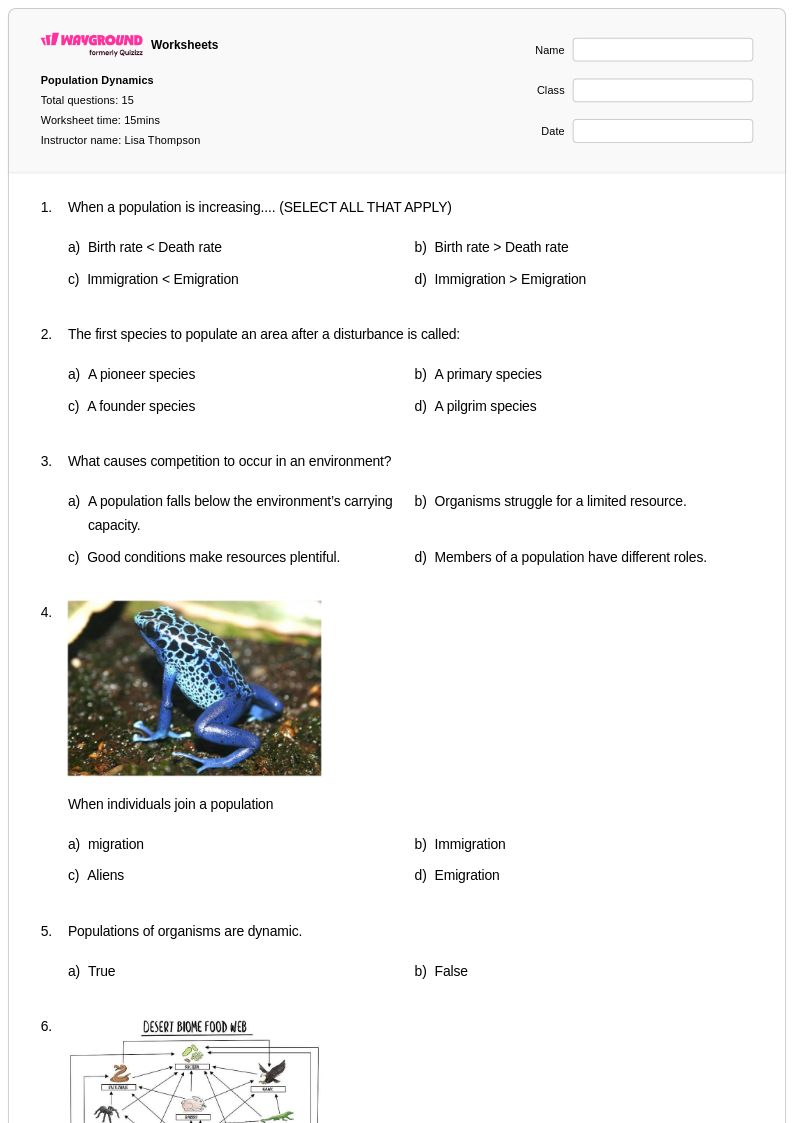
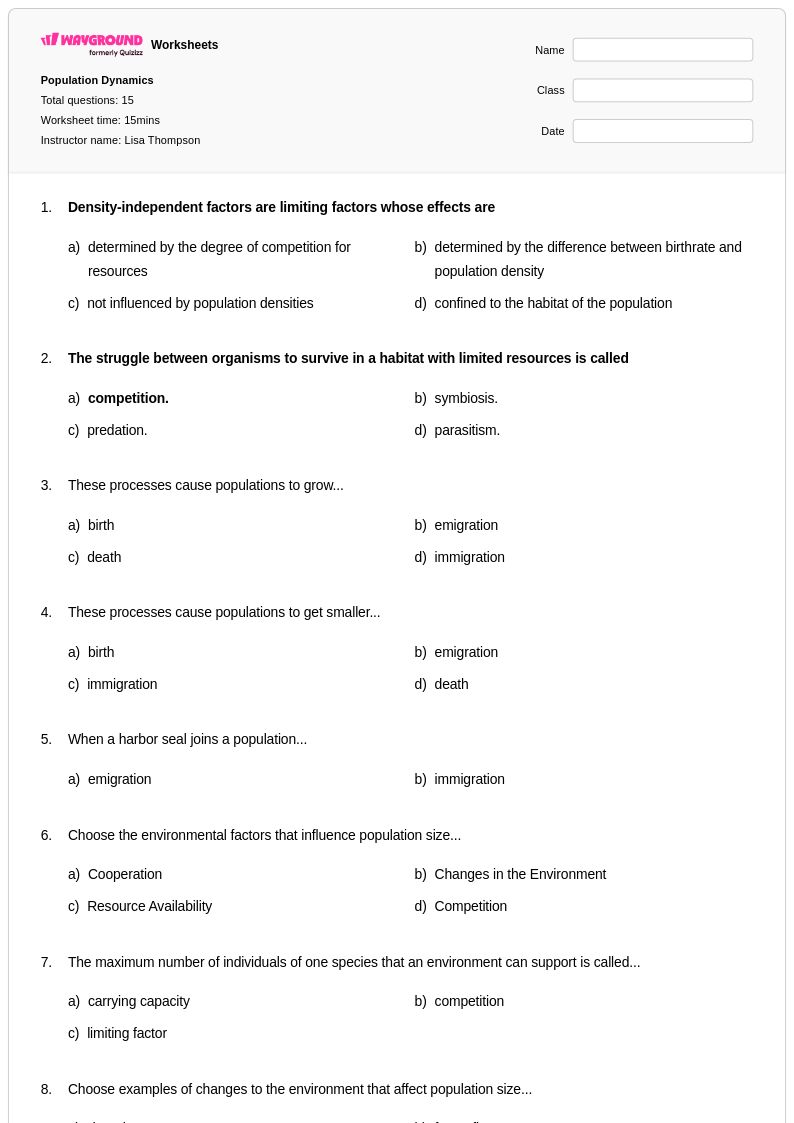
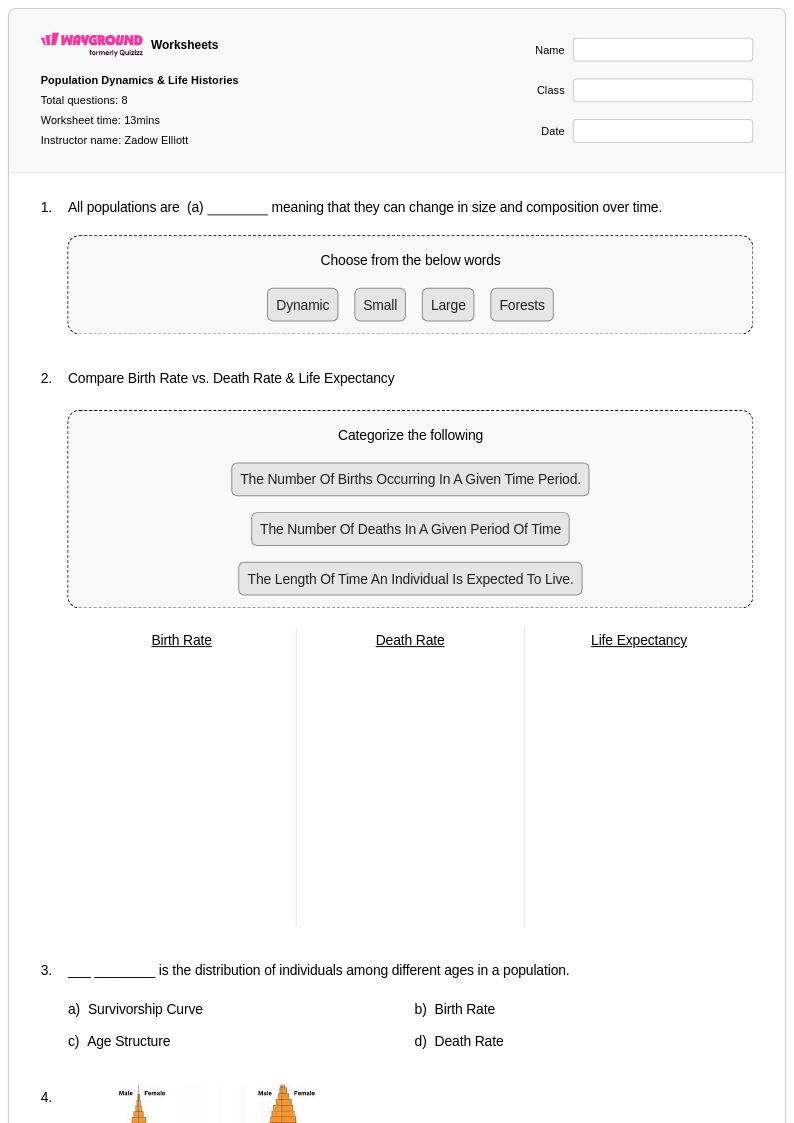
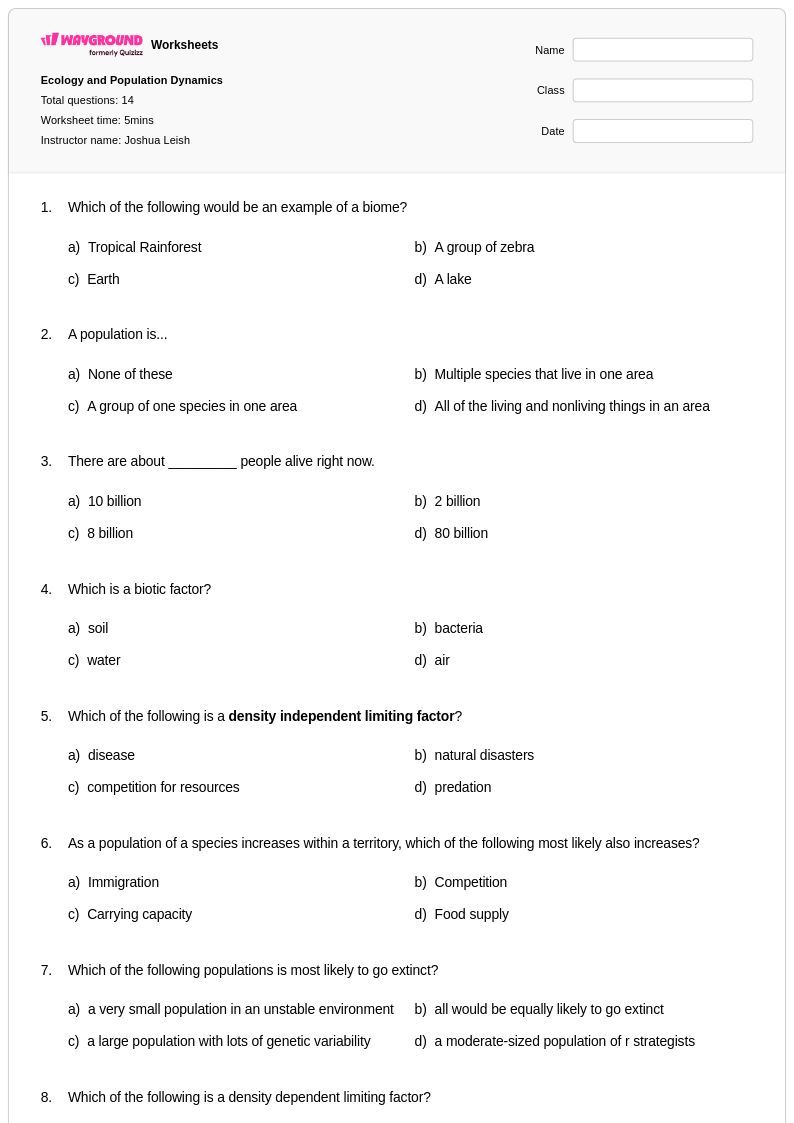
Grade 10 dynamics worksheets from Wayground help students master force, motion, and Newton's laws through comprehensive printables, practice problems, and answer keys designed to strengthen physics fundamentals.
Explore printable Dynamics worksheets for Grade 10
Grade 10 dynamics worksheets available through Wayground (formerly Quizizz) provide comprehensive coverage of motion principles, force analysis, and Newton's laws of motion that form the foundation of classical mechanics. These expertly designed practice problems strengthen students' ability to analyze complex motion scenarios, calculate net forces, apply Newton's three laws to real-world situations, and solve problems involving friction, tension, and gravitational forces. The collection includes detailed answer key materials and free printable resources that guide students through step-by-step problem-solving processes, from basic force diagrams to advanced applications of dynamics principles in inclined planes, pulley systems, and circular motion contexts.
Wayground (formerly Quizizz) empowers educators with millions of teacher-created dynamics resources that streamline lesson planning and enhance student understanding of fundamental physics concepts. The platform's robust search and filtering capabilities allow teachers to quickly locate materials aligned with specific learning standards, while differentiation tools enable customization for varying skill levels within Grade 10 classrooms. These comprehensive worksheet collections are available in both printable pdf formats and interactive digital versions, providing flexibility for in-class instruction, homework assignments, and assessment preparation. Teachers can effectively use these resources for targeted skill practice, remediation of challenging concepts like acceleration analysis, and enrichment activities that extend learning beyond basic force calculations to more sophisticated dynamics applications.
FAQs
How do I teach dynamics in a physics class?
Teach dynamics by building from Newton's three laws before introducing net force calculations, free body diagrams, and kinematic equations. Start with single-object systems in one dimension, then progress to multi-body systems, circular motion, and momentum conservation. Connecting each concept to real-world scenarios — such as car crashes for impulse-momentum or roller coasters for energy transformation — helps students see why the math matters before they practice it formally.
What are the best practice problems for students learning Newton's laws?
Effective Newton's laws practice should begin with free body diagram construction, move into net force and acceleration calculations, and then tackle multi-step problems involving friction, tension, and inclined planes. Problems that require students to identify all forces acting on a system before writing equations are especially valuable because they build the analytical habit of isolating variables. Progressing from single-force scenarios to multi-body systems with connected objects ensures students develop both conceptual and procedural fluency.
What mistakes do students commonly make when solving dynamics problems?
The most common error in dynamics is treating force and acceleration as interchangeable rather than understanding that net force causes acceleration. Students also frequently forget to include all forces in a free body diagram — especially normal force and friction — or fail to apply Newton's third law correctly in multi-body problems. A related mistake is sign confusion when working with vector quantities, particularly when components of forces act along inclined planes or in opposing directions.
How do I help struggling students keep up with dynamics problem-solving?
For students who struggle with dynamics, breaking problems into structured steps — identify the system, draw a free body diagram, write the net force equation, then solve — reduces cognitive overload significantly. On Wayground, teachers can enable accommodations such as read aloud for students who need question content read to them, reduced answer choices to lower the number of options displayed, and extended time per question for students who need additional processing time. These settings can be applied to individual students without notifying the rest of the class, so differentiated support can happen seamlessly during a shared assignment.
How can I use Wayground's dynamics worksheets in my classroom?
Wayground's dynamics worksheets are available as printable PDFs for traditional classroom use and in digital formats for technology-integrated environments, making them flexible for both in-person and remote instruction. Teachers can assign digital worksheets and host them as a quiz directly on Wayground, enabling real-time tracking of student responses. All worksheets include complete answer keys, which allows students to self-check their work or enables teachers to provide immediate feedback during guided practice sessions.
How do I assess whether students truly understand dynamics concepts versus just memorizing formulas?
To distinguish conceptual understanding from formula memorization, use problems that require students to explain why a net force produces a given acceleration or to predict the outcome of a scenario before calculating it. Tasks like analyzing a flawed free body diagram, identifying the error, and correcting it reveal whether students understand force relationships or are simply substituting numbers into equations. Multi-step problems involving momentum conservation or energy transformation — where the correct formula cannot be identified without first understanding the physical situation — are particularly effective assessment tools.