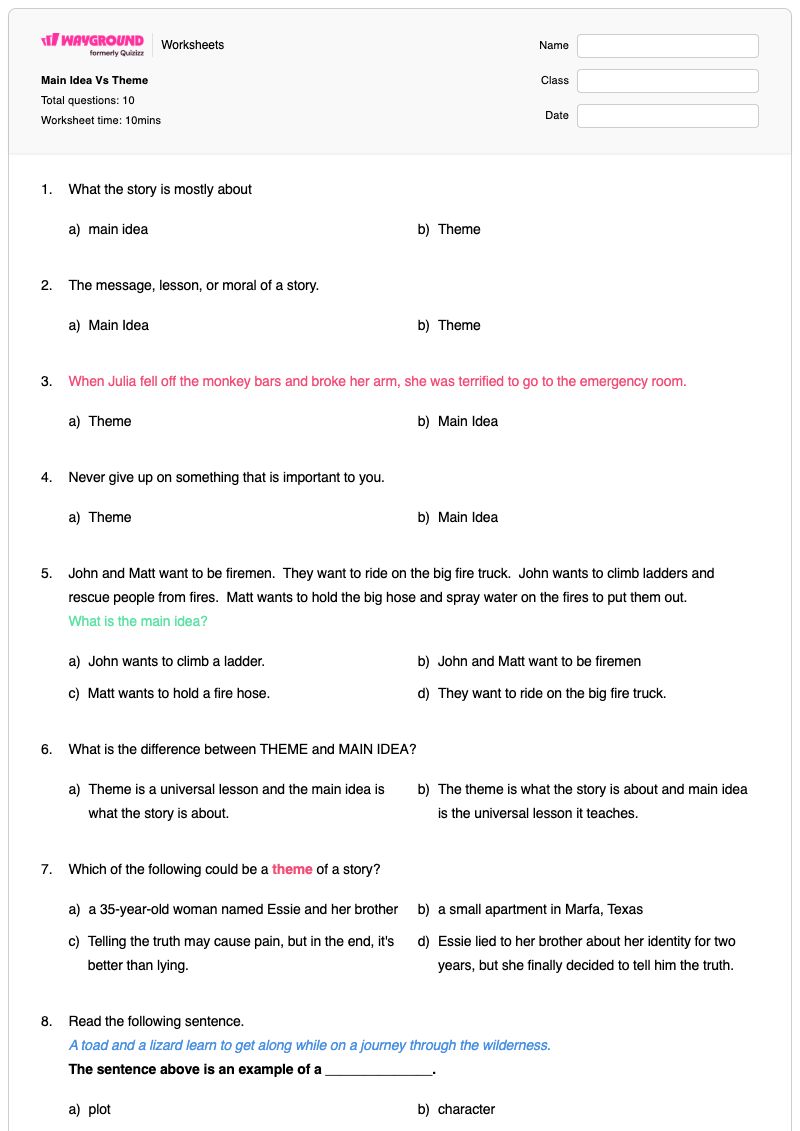
Main Idea Vs Theme is a 10-question multiple-choice English worksheet for students in Grades 3–6. It teaches learners to distinguish a story’s main idea—what the text is mostly about—from its theme—the universal message, lesson, or moral. Students classify short statements, identify the main idea of a brief scenario about two aspiring firefighters, and decide whether examples express a plot, character, main idea, or theme.
This free printable worksheet with an answer key helps students apply the distinction across definitions, story situations, and concise literary examples. It is useful for introducing or reviewing literary comprehension vocabulary, checking whether students can separate a text’s subject from its broader lesson, and identifying errors before students analyze longer passages. Teachers can use the multiple-choice format for independent practice, warm-up review, or a quick formative assessment in English classes for Grades 3–6.
Worksheet settings
Font size
S
M
L
XL
Worksheets
Main Idea Vs Theme
Total questions: 10
Name
Class
Date
1.
What the story is mostly about
a)
main idea
b)
Theme
2.
The message, lesson, or moral of a story.
a)
Main Idea
b)
Theme
3.
When Julia fell off the monkey bars and broke her arm, she was terrified to go to the emergency room.
a)
Theme
b)
Main Idea
4.
Never give up on something that is important to you.
a)
Theme
b)
Main Idea
5.
John and Matt want to be firemen. They want to ride on the big fire truck. John wants to climb ladders and rescue people from fires. Matt wants to hold the big hose and spray water on the fires to put them out. What is the main idea?
a)
John wants to climb a ladder.
b)
John and Matt want to be firemen
c)
Matt wants to hold a fire hose.
d)
They want to ride on the big fire truck.
6.
What is the difference between THEME and MAIN IDEA?
a)
Theme is a universal lesson and the main idea is what the story is about.
b)
The theme is what the story is about and main idea is the universal lesson it teaches.
7.
Which of the following could be a theme of a story?
a)
a 35-year-old woman named Essie and her brother
b)
a small apartment in Marfa, Texas
c)
Telling the truth may cause pain, but in the end, it's better than lying.
d)
Essie lied to her brother about her identity for two years, but she finally decided to tell him the truth.
8.
Read the following sentence.
A toad and a lizard learn to get along while on a journey through the wilderness.
The sentence above is an example of a ______________.
a)
plot
b)
character
c)
main idea
d)
theme
9.
Read the following sentence.
Friendship helps people get through hard times.
The sentence above is an example of a _________________.
a)
plot
b)
character
c)
main idea
d)
theme
10.
Read the following sentence.
A woman risks her life to spy for the Union during the Civil War.
The sentence above is an example of a __________________.
a)
plot
b)
character
c)
main idea
d)
theme
Answer Key
Main Idea Vs Theme
Total questions: 10
1.
a)
main idea
2.
b)
Theme
3.
b) Main Idea
4.
a) Theme
5.
b) John and Matt want to be firemen
6.
a) Theme is a universal lesson and the main idea is what the story is about.
7.
c)
Telling the truth may cause pain, but in the end, it's better than lying.
8.
c)
main idea
9.
d)
theme
10.
c)
main idea
140 %
Browse by subjects
Browse by grades
Browse by format
FAQs
What does the Main Idea Vs Theme worksheet help students learn?
This 10-question multiple-choice worksheet helps students distinguish the main idea—what a story or sentence is mostly about—from the theme—the universal lesson or moral it communicates. Students apply the distinction to direct definitions, the firefighter scenario, and examples that ask them to identify a plot, character, main idea, or theme.
How can I use this worksheet to teach the difference between main idea and theme?
Begin by modeling the worksheet’s core distinction: a main idea describes the story’s subject or central focus, while a theme states a broader lesson such as “Never give up on something important.” Then have students explain why the firefighter example gives the main idea that John and Matt want to be firemen, while the truth-and-lying example expresses a theme. Use the remaining multiple-choice items for guided practice before assigning the worksheet independently.
What mistakes should I watch for when students complete this main idea and theme worksheet?
Students may choose a specific detail, character, setting, or plot event instead of the broader main idea, as in the firefighter question where individual actions are details rather than the central focus. They may also confuse a theme with a plot summary: a statement such as “Friendship helps people get through hard times” expresses a lesson, whereas a sentence describing what characters do gives the main idea. Watch for students who reverse these definitions or select a named character or place as the theme.
How do I assign and grade this Main Idea Vs Theme worksheet?
You can assign it as a printable PDF or use it as a digital quiz on Wayground. The worksheet includes a complete answer key for all 10 multiple-choice questions, and printable submissions can be graded by scanning student work with the Wayground for Teachers app. The printable format also gives schools an option for reducing screen time.
How can I differentiate this Main Idea Vs Theme worksheet for my students?
In the worksheet’s Advanced Settings, adjust font spacing or choose a larger font size to make the definitions and answer choices easier to track. You can also enable a dyslexia-friendly font or translate the worksheet into another language while keeping the same multiple-choice practice on main idea, theme, plot, and character.
Where can I find more free worksheets like this from Wayground?
Wayground offers a broad collection of free printable worksheets and practice problems across subjects, with downloadable PDFs and answer keys to support essential skills and concepts. Browse more resources at https://wayground.com/en-us/worksheets.


 Worksheets