
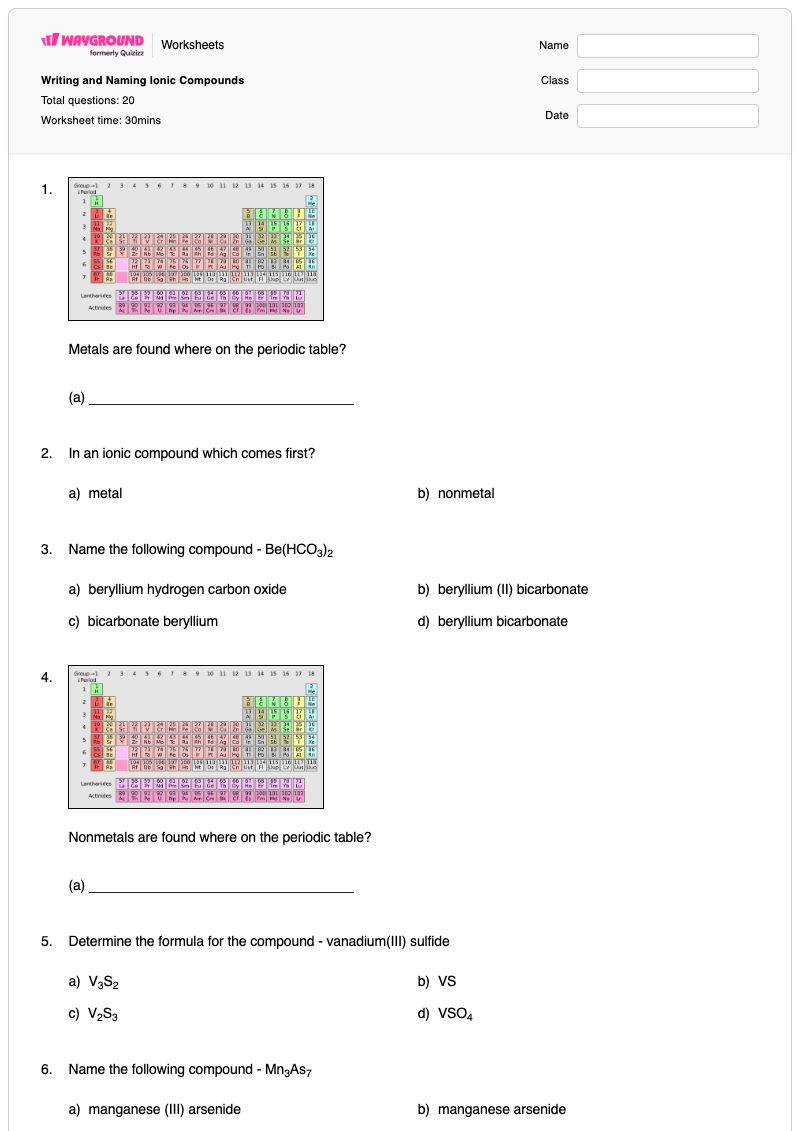

This Grade 11 science worksheet builds practical skills for writing and naming ionic compounds. Students identify where metals and nonmetals appear on the periodic table, determine which ion is written first, apply the -ide ending to nonmetal names, recognize common polyatomic ions, and decide when parentheses are needed. They also name ionic compounds from formulas and write formulas from compound names, including compounds with variable-charge metals and polyatomic ions.
The 20-question format combines 3 fill-in-the-blank items with 17 multiple-choice questions, giving students practice with both recall and application. Examples include naming beryllium bicarbonate, sodium hydride, and potassium hydroxide, as well as writing formulas for vanadium(III) sulfide, cobalt(III) chromate, and iron(III) phosphate. This free printable worksheet is designed for Grade 11 chemistry review, independent practice, or assessment and includes a complete answer key.
Worksheet settings
Font size
S
M
L
XL
Worksheets
Writing and Naming Ionic Compounds
Total questions: 20
Name
Class
Date
1.
Metals are found where on the periodic table?
(a)
2.
In an ionic compound which comes first?
a)
metal
b)
nonmetal
3.
Name the following compound - Be(HCO3)2
a)
beryllium hydrogen carbon oxide
b)
beryllium (II) bicarbonate
c)
bicarbonate beryllium
d)
beryllium bicarbonate
4.
Nonmetals are found where on the periodic table?
(a)
5.
Determine the formula for the compound - vanadium(III) sulfide
a)
V3S2
b)
VS
c)
V2S3
d)
VSO4
6.
Name the following compound - Mn3As7
a)
manganese (III) arsenide
b)
manganese arsenide
c)
manganese (VII) arsenide
d)
manganese (I) arsenide
7.
What ending is added to the end of the nonmetal name?
a)
-ing
b)
no ending is added
c)
-ide
d)
-ade
8.
Name the following compound - Sr(C2H3O2)2
a)
strontium acid
b)
strontium acetate
c)
scandium acetate
d)
strontium (II) acetate
9.
When should polyatomic ions be placed in parenthesis?
a)
charge is greater than 2
b)
charge is greater than 1
c)
polyatomic ions are never placed in parenthesis
d)
charge is less than 1
10.
Name the following compound - NaH
a)
sodium hydride
b)
sodium hydrogen
c)
sodium (I) hyride
d)
sodium hydroxide
11.
Name the following compound - GaCl3
a)
gallium carbon iodide
b)
gallium chlorine
c)
gallium (III) chloride
d)
gallium chloride
12.
Determine the formula for the compound - cobalt (III) chromate
a)
Ca2(CrO4)3
b)
Co2Cr2O7
c)
Co2Cr
d)
Co2(CrO4)3
13.
Name the following compound - (NH4)2SO4
a)
ammonium (I)
sulfate
b)
ammonium (II)
sulfate
c)
ammonium sulfate
d)
hydronium sulfate
14.
Determine the formula for the compound - iron (III) phosphate
a)
FeP
b)
FePO4
c)
FePO3
15.
Name the following compound - KOH
a)
potassium hydrogen
b)
potassium hydroxide
c)
potassium hydride
16.
Name the following compound - PtS
a)
platinum sulfur
b)
platinum (I) sulfide
c)
platinum sulfide
d)
platinum (II) sulfide
17.
An ionic bonds forms between a ____________?
a)
metal and nonmetal
b)
2 metals
c)
nonmetal and metalloid
d)
2 nonmetals
18.
Determine the formula for the compound - nickel (III) sulfide
a)
Ni3S2
b)
NiS
c)
Ni2S3
d)
Ni2(SO4)3
19.
Determine the formula for the compound - lithium sulfite
a)
LiS
b)
Li2SO2
c)
Li2SO3
d)
LiS2
20.
Transition metals should include what in their names?
(a)
Answer Key
Writing and Naming Ionic Compounds
Total questions: 20
1.
left, left of the periodic table
2.
a)
metal
3.
d)
beryllium bicarbonate
4.
right, right side of the periodic table
5.
c)
V2S3
6.
c)
manganese (VII) arsenide
7.
c)
-ide
8.
b)
strontium acetate
9.
b)
charge is greater than 1
10.
a)
sodium hydride
11.
d)
gallium chloride
12.
d)
Co2(CrO4)3
13.
c)
ammonium sulfate
14.
b)
FePO4
15.
b)
potassium hydroxide
16.
d)
platinum (II) sulfide
17.
a)
metal and nonmetal
18.
c)
Ni2S3
19.
c)
Li2SO3
20.
roman numeral
140 %
Browse by subjects
Browse by grades
Browse by format
FAQs
What does the Writing and Naming Ionic Compounds worksheet cover?
This Grade 11 worksheet practices naming ionic compounds from chemical formulas and writing formulas from compound names. Its 20 items combine fill-in-the-blank questions about metals, nonmetals, and naming rules with multiple-choice problems involving -ide endings, variable-charge metals, polyatomic ions, and parentheses.
How can I use this worksheet to teach students to write and name ionic compounds?
Introduce the worksheet by reviewing how to identify metals and nonmetals on the periodic table, then model one naming example and one formula-writing example. Have students explain how they identify the cation, select the anion name or charge, and balance charges before completing the items on compounds such as vanadium(III) sulfide, cobalt(III) chromate, and iron(III) phosphate.
What mistakes should I watch for when students complete this ionic compounds worksheet?
Watch for students reversing the metal and nonmetal, using the element name instead of an -ide ending, or adding Roman numerals to compounds whose names do not require them. Students may also omit parentheses around repeated polyatomic ions or choose an incorrect subscript when balancing charges, especially in formula-writing items such as cobalt(III) chromate.
How do I assign and grade this ionic compounds worksheet?
The worksheet is available as a printable PDF and as a digital quiz on Wayground, and it includes a complete answer key for the 3 fill-in-the-blank and 17 multiple-choice questions. For printable submissions, scan student work with the **Wayground for Teachers** app to help grade responses efficiently.
How can I differentiate this ionic compounds worksheet for my students?
In the worksheet’s Advanced Settings, adjust font spacing or font size to make the chemical formulas, subscripts, and answer choices easier to read. You can also apply a dyslexia-friendly font or translate the worksheet into another language while keeping its naming and formula-writing format.
Where can I find more worksheets like this on Wayground?
Wayground offers a broad collection of free printable worksheets and practice problems across subjects, with downloadable PDFs and answer keys to support essential skills and concepts. Browse more resources at https://wayground.com/en-us/worksheets.