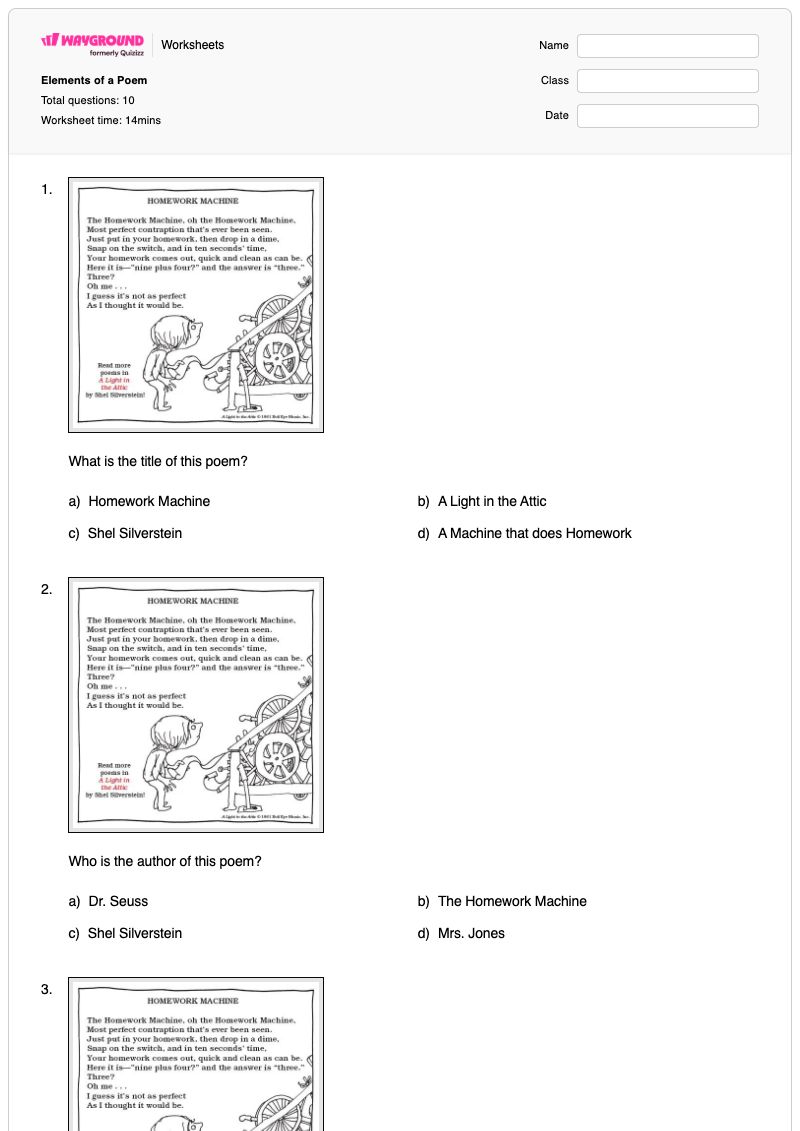
This free printable Grade 3 English worksheet uses Shel Silverstein’s poem “Homework Machine” to build foundational poetry-reading skills. Students answer 8 multiple-choice questions, complete 1 fill-in-the-blank math item, and respond to 1 open-ended writing prompt. The questions ask students to identify the poem’s title and author, count its 10 lines and 1 stanza, recognize rhyming words, and recall details about what the homework machine does, the problem it has, and its cost. The worksheet includes a complete answer key.
Students also apply what they learn by solving the poem’s 9 + 4 problem and writing an original poem with a title, at least 3 lines, 1 stanza, and 2 rhyming words. This combination of recognition, text-based recall, a short fill-in response, and creative composition helps Grade 3 learners connect poetry terminology and features to their own writing. Use it for independent practice, a poetry lesson check, or a follow-up activity after reading the poem.
Worksheet settings
Font size
S
M
L
XL
Worksheets
Elements of a Poem
Total questions: 10
Name
Class
Date
1.
What is the title of this poem?
a)
Homework Machine
b)
A Light in the Attic
c)
Shel Silverstein
d)
A Machine that does Homework
2.
Who is the author of this poem?
a)
Dr. Seuss
b)
The Homework Machine
c)
Shel Silverstein
d)
Mrs. Jones
3.
How many lines are in this poem?
a)
1
b)
5
c)
100
d)
10
4.
What is the homework machine supposed to do?
a)
Solve your homework problems for you
b)
Make candy
c)
Cancel school
d)
Teach you Spanish
5.
How many stanzas are there in this poem?
a)
5
b)
3
c)
1
d)
2
6.
Pick the words that rhyme in the poem.
a)
Machine, Seen
b)
Dime, Time
c)
Be, Three
d)
All of the above
7.
What is the problem with the homework machine?
a)
It falls apart
b)
It gets the homework answers wrong
c)
It looks ugly
d)
It is too perfect
8.
What is the correct answer to the problem the homework machine tries to solve? 9 + 4 = ?
(a)
9.
How much does it cost for the homework machine to solve a problem for you?
a)
A dollar
b)
A dime
c)
30 cents
d)
50 cents
10.
Get creative! Write your own poem that has a title, at least 3 lines, at least one stanza and at least 2 words that rhyme!
4 lines
Answer Key
Elements of a Poem
Total questions: 10
1.
a)
Homework Machine
2.
c)
Shel Silverstein
3.
d)
10
4.
a)
Solve your homework problems for you
5.
c)
1
6.
d)
All of the above
7.
b)
It gets the homework answers wrong
8.
13
9.
b)
A dime
10.
n/a
140 %
Browse by subjects
Browse by grades
Browse by format
FAQs
What does the Elements of a Poem worksheet cover?
This Grade 3 English worksheet uses “Homework Machine” to practice identifying a poem’s title, author, number of lines, stanza count, and rhyming words. Its 8 multiple-choice questions, 1 fill-in-the-blank item, and 1 open-ended prompt move students from recognizing features in the poem to writing their own poem with a title, at least 3 lines, 1 stanza, and 2 rhyming words.
How can I use this worksheet to teach the elements of a poem?
Read “Homework Machine” with students first, then model how to locate the title, author, lines, stanza, and rhyming words in the text before assigning the multiple-choice items. Review the 9 + 4 fill-in response and discuss how the poem’s problem and details support comprehension, then use the final prompt as a guided opportunity for students to apply those elements in an original poem.
What mistakes should I watch for when students complete this poem elements worksheet?
Students may confuse the poem’s title, “Homework Machine,” with its author, Shel Silverstein, or miscount the 10 lines and 1 stanza. Watch for students selecting only one rhyme pair instead of recognizing that all listed pairs rhyme, overlooking that the machine gives incorrect answers, or leaving out required features in their original poem, such as a title, 3 lines, 1 stanza, or 2 rhyming words.
How do I assign and grade the Elements of a Poem worksheet?
Assign it as a printable PDF or as a digital quiz on Wayground, and use the complete answer key to check the objective questions and the 9 + 4 response. For printable submissions, you can scan student work with the Wayground for Teachers app; review the open-ended poem for the required title, line count, stanza, and rhyming words.
How can I differentiate this Elements of a Poem worksheet for my students?
In the worksheet’s Advanced Settings, adjust font spacing or choose a larger font size to make the multiple-choice items, fill-in response, and creative writing prompt easier to read and complete. You can also enable a dyslexia-friendly font or translate the worksheet into another language when those options better support access to the poem-elements questions.
Where can I find more worksheets like this on Wayground?
Wayground offers a comprehensive collection of free printable worksheets and practice problems across subjects, with downloadable PDFs and answer keys to help students master essential skills and concepts. Browse more resources at https://wayground.com/en-us/worksheets.


 Worksheets


