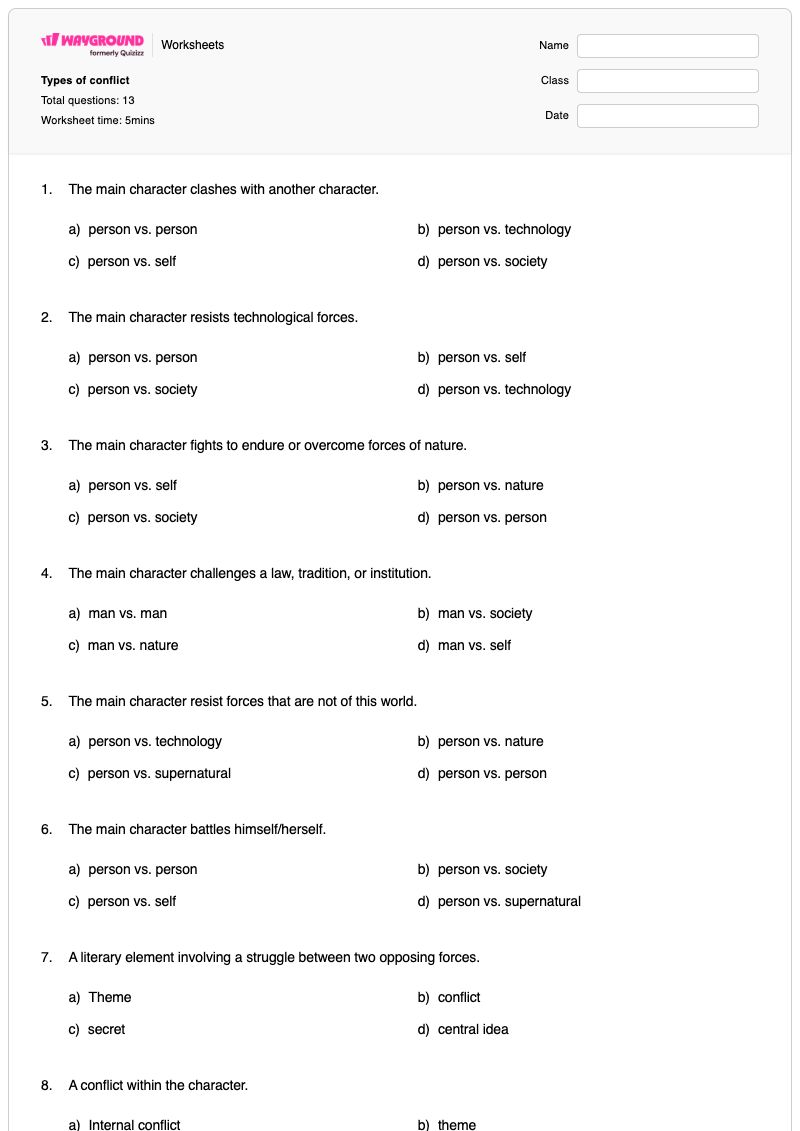
Types of Conflict is a Grade 6 English worksheet that helps students identify how opposing forces shape a literary plot. Through 13 multiple-choice questions, students distinguish person vs. person, technology, nature, society, supernatural, and self conflicts; classify conflicts as internal or external; and identify the protagonist and antagonist.
This free printable worksheet gives students repeated practice connecting short descriptions to the correct conflict type and distinguishing related literary terms such as conflict, internal conflict, and external conflict. It is useful for introducing or reviewing characterization and plot elements before students analyze conflicts in complete stories. The worksheet includes a complete answer key for efficient checking and feedback.
Worksheet settings
Font size
S
M
L
XL
Worksheets
Types of conflict
Total questions: 13
Name
Class
Date
1.
The main character clashes with another character.
a)
person vs. person
b)
person vs. technology
c)
person vs. self
d)
person vs. society
2.
The main character resists technological forces.
a)
person vs. person
b)
person vs. self
c)
person vs. society
d)
person vs. technology
3.
The main character fights to endure or overcome forces of nature.
a)
person vs. self
b)
person vs. nature
c)
person vs. society
d)
person vs. person
4.
The main character challenges a law, tradition, or institution.
a)
man vs. man
b)
man vs. society
c)
man vs. nature
d)
man vs. self
5.
The main character resist forces that are not of this world.
a)
person vs. technology
b)
person vs. nature
c)
person vs. supernatural
d)
person vs. person
6.
The main character battles himself/herself.
a)
person vs. person
b)
person vs. society
c)
person vs. self
d)
person vs. supernatural
7.
A literary element involving a struggle between two opposing forces.
a)
Theme
b)
conflict
c)
secret
d)
central idea
8.
A conflict within the character.
a)
Internal conflict
b)
theme
c)
central idea
d)
external conflict
9.
A conflict between a character and someone or something in the outside world.
a)
External conflict
b)
Internal conflict
c)
central idea
d)
theme
10.
Which of the following are examples of Internal Conflict?
a)
man vs. self
b)
man vs. nature
c)
man vs. society
d)
man vs. technology
11.
Which of the following is an example of external conflict?
a)
man vs. man
b)
man vs. self
c)
man vs. technology
d)
man vs. society
12.
The opposing force against the main character.
a)
antagonist
b)
protagonist
c)
central idea
d)
main idea
13.
The central character who faces opposing forces.
a)
theme
b)
central idea
c)
protagonist
d)
antagonist
Answer Key
Types of conflict
Total questions: 13
1.
a)
person vs. person
2.
d)
person vs. technology
3.
b)
person vs. nature
4.
b)
man vs. society
5.
c)
person vs. supernatural
6.
c)
person vs. self
7.
b)
conflict
8.
a)
Internal conflict
9.
a)
External conflict
10.
a)
man vs. self
11.
d)
man vs. society
12.
a)
antagonist
13.
c)
protagonist
140 %
Browse by subjects
Browse by grades
Browse by format
FAQs
What does the Types of Conflict worksheet cover?
This Grade 6 English worksheet uses 13 multiple-choice questions to assess whether students can classify literary conflicts as person vs. person, technology, nature, society, supernatural, or self. It also asks students to distinguish internal from external conflict and identify the protagonist and antagonist. Selecting answers from short conflict descriptions helps students connect literary definitions with the opposing forces and character roles they represent.
How can I use this worksheet to teach the different types of conflict?
Introduce conflict as a struggle between opposing forces, then model how a character's opponent or obstacle determines the conflict type. Have students sort the worksheet's examples into internal conflict, such as person vs. self, and external conflict, such as person vs. society or person vs. technology, before completing the multiple-choice questions. Discuss why each option fits or does not fit, and connect the final protagonist and antagonist questions to the conflict in a familiar story.
What mistakes should I watch for when students complete this conflict worksheet?
Students may confuse internal conflict with external conflict, especially by choosing person vs. self for any difficult situation rather than a struggle occurring within the character. They may also mix up person vs. society, technology, nature, and supernatural forces because all are external conflicts. Watch for reversals between protagonist and antagonist, and for selecting the general term conflict when a question asks specifically for internal or external conflict.
How do I assign and grade the Types of Conflict worksheet?
Wayground provides this Types of Conflict worksheet as a printable PDF and as a digital quiz, with a complete answer key for all 13 multiple-choice questions. You can assign the digital version through Wayground or print copies for students, then grade printable submissions by scanning student work with the Wayground for Teachers app. The printable option also supports schools that are reducing screen time.
How can I differentiate this worksheet for my students?
For the multiple-choice definitions and conflict-type descriptions in this worksheet, use Advanced Settings to adjust font spacing and font size for easier reading. You can also apply a dyslexia-friendly font or translate the worksheet into another language when those options better support access to the literary terms. These changes preserve the worksheet's focus on classifying internal, external, and specific character-versus-force conflicts.
Where can I find more worksheets like this on Wayground?
Wayground offers a comprehensive collection of free printable worksheets and practice problems across all subjects, with downloadable PDFs and answer keys to help students master essential skills and concepts. Browse more resources at https://wayground.com/en-us/worksheets.

 Worksheets