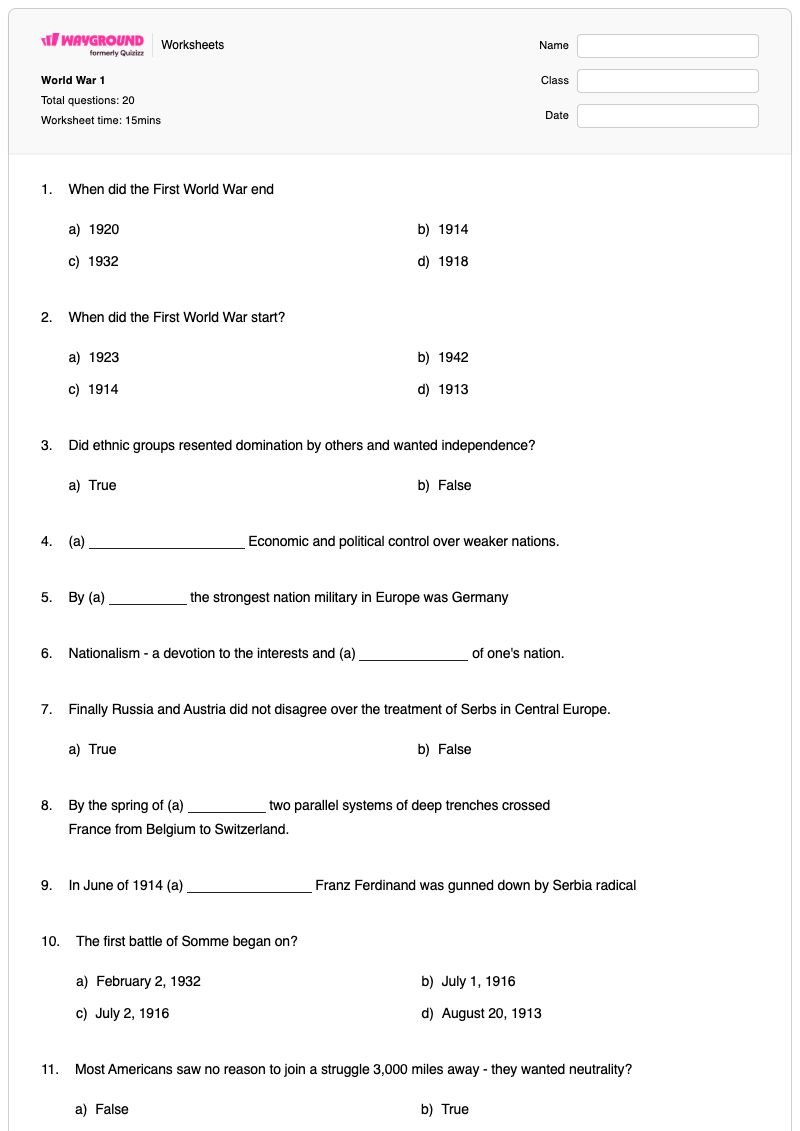
This Grade 7 social studies worksheet builds foundational knowledge of World War I through 20 questions: 10 multiple-choice items, 8 fill-in-the-blank prompts, and 2 multiple-select questions. Students identify the war’s 1914 start and 1918 end, define imperialism and nationalism, recall the 1890 growth of German military strength, and connect the assassination of Archduke Franz Ferdinand to the conflict.
The worksheet also checks students’ understanding of trench warfare, the First Battle of the Somme, British casualties, German U-boat attacks, American neutrality and wartime supplies, and the Allied powers of France, Britain, and Russia. It is useful for introducing or reviewing key World War I dates, vocabulary, participants, and developments while requiring students to distinguish correct and incorrect historical statements. This is a free printable worksheet with a complete answer key.
Worksheet settings
Font size
S
M
L
XL
Worksheets
World War 1
Total questions: 20
Name
Class
Date
1.
When did the First World War end
a)
1920
b)
1914
c)
1932
d)
1918
2.
When did the First World War start?
a)
1923
b)
1942
c)
1914
d)
1913
3.
Did ethnic groups resented domination by others and wanted independence?
a)
True
b)
False
4.
(a) Economic and political control over weaker nations.
5.
By (a) the strongest nation military in Europe was Germany
6.
Nationalism - a devotion to the interests and (a) of one's nation.
7.
Finally Russia and Austria did not disagree over the treatment of Serbs in Central Europe.
a)
True
b)
False
8.
By the spring of (a) two parallel systems of deep trenches crossed
France from Belgium to Switzerland.
9.
In June of 1914 (a) Franz Ferdinand was gunned down by Serbia radical
10.
The first battle of Somme began on?
a)
February 2, 1932
b)
July 1, 1916
c)
July 2, 1916
d)
August 20, 1913
11.
Most Americans saw no reason to join a struggle 3,000 miles away - they wanted neutrality?
a)
False
b)
True
12.
The British suffered an enormous number of casualties (a) on the first day.
13.
During the first two years of the war America was providing (selling) the allied forces ?
a)
Airplanes
b)
Cannon Powder
c)
Copper Wire
d)
Tubing
14.
A German (a) sank the British passenger liner on May 7th 1915
15.
Allies consisted of
a)
France
b)
Canada
c)
Britain
d)
Russia
16.
What was Lusitania?
a)
City
b)
A Plane
c)
Country in Europe
d)
A ship
17.
How many people died on the Lusitania?
a)
1,198
b)
1,197
c)
1,234
d)
0
18.
How many Americans died on the Lusitania
a)
150
b)
19
c)
128
d)
1,000
19.
Americans were outraged and public opinion turned against (a) and the Central Powers
20.
When did Germany invade Belgium?
a)
August 3, 1914
b)
August 7, 1915
c)
June 11, 1942
d)
September 12, 1915
Answer Key
World War 1
Total questions: 20
1.
d)
1918
2.
c)
1914
3.
a)
True
4.
Imperialism
5.
1890
6.
Culture
7.
b)
False
8.
1915
9.
Archduke
10.
b)
July 1, 1916
11.
b)
True
12.
60,000
13.
b)
Cannon Powder
, c)
Copper Wire
, d)
Tubing
14.
U-boat
15.
a)
France
, c)
Britain
, d)
Russia
16.
d)
A ship
17.
a)
1,198
18.
c)
128
19.
Germany
20.
a)
August 3, 1914
140 %
Browse by subjects
Browse by grades
Browse by format
FAQs
What does this World War I worksheet cover?
This Grade 7 worksheet reviews World War I chronology, key vocabulary, causes, alliances, and wartime developments through 10 multiple-choice questions, 8 fill-in-the-blank prompts, and 2 multiple-select items. Students work with dates such as 1914, 1915, 1916, and 1918; identify terms such as imperialism and U-boat; and recall details about the Allies, trench warfare, American neutrality, and wartime supplies.
How can I use this worksheet to teach World War I?
Introduce the worksheet by building a class timeline with the dates it tests, including the war’s start and end, the assassination of Archduke Franz Ferdinand, trench construction, and the First Battle of the Somme. Then preteach imperialism, nationalism, neutrality, Allies, and U-boat before students complete the fill-in-the-blank items. Use the multiple-select questions to discuss why France, Britain, and Russia were identified as Allies and what America supplied during the war.
What mistakes should I watch for when students complete this World War I worksheet?
Students may reverse the 1914 start date and 1918 end date, confuse the 1915 trench date with the 1916 Somme date, or overlook the false wording in the statement about Russia and Austria disagreeing over the treatment of Serbs. In the fill-in-the-blank items, check that they distinguish terms such as imperialism, Archduke, and U-boat from surrounding historical details. For the multiple-select questions, remind students that more than one answer may be correct, especially for American wartime supplies and the Allied powers.
How do I assign and grade this World War I worksheet?
The worksheet is available as a printable PDF and as a digital quiz on Wayground, with a complete answer key for all 20 questions. Assign the digital version for online responses, or print the PDF and grade student work by scanning it with the Wayground for Teachers app. The printable option can also support schools that are reducing screen time.
How can I differentiate this World War I worksheet for my students?
Use the worksheet’s Advanced Settings to adjust font spacing or increase the font size so the mixed multiple-choice, fill-in-the-blank, and multiple-select items are easier to read. You can also apply a dyslexia-friendly font or translate the worksheet into another language while preserving its World War I questions and answer choices.
Where can I find more worksheets like this on Wayground?
Wayground offers a broad collection of free printable worksheets and practice problems across subjects, with downloadable PDFs and answer keys to help students master essential skills and concepts. Browse more resources at https://wayground.com/en-us/worksheets.

 Worksheets