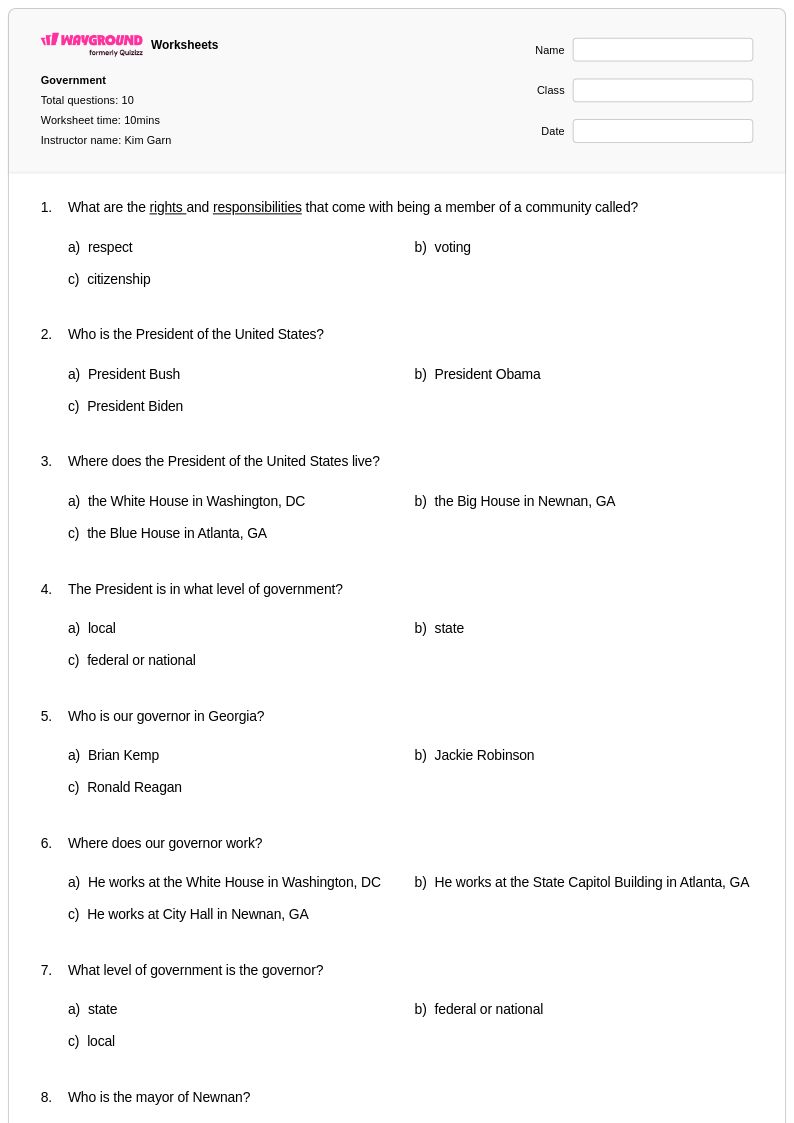
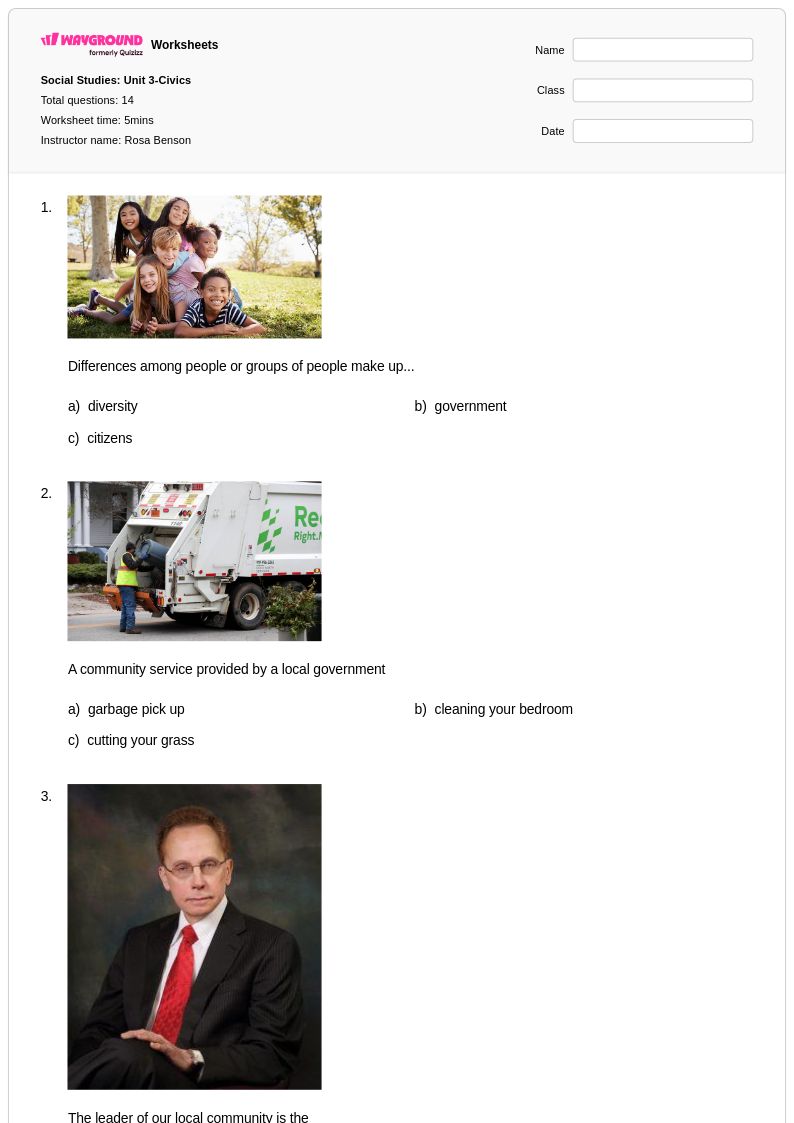
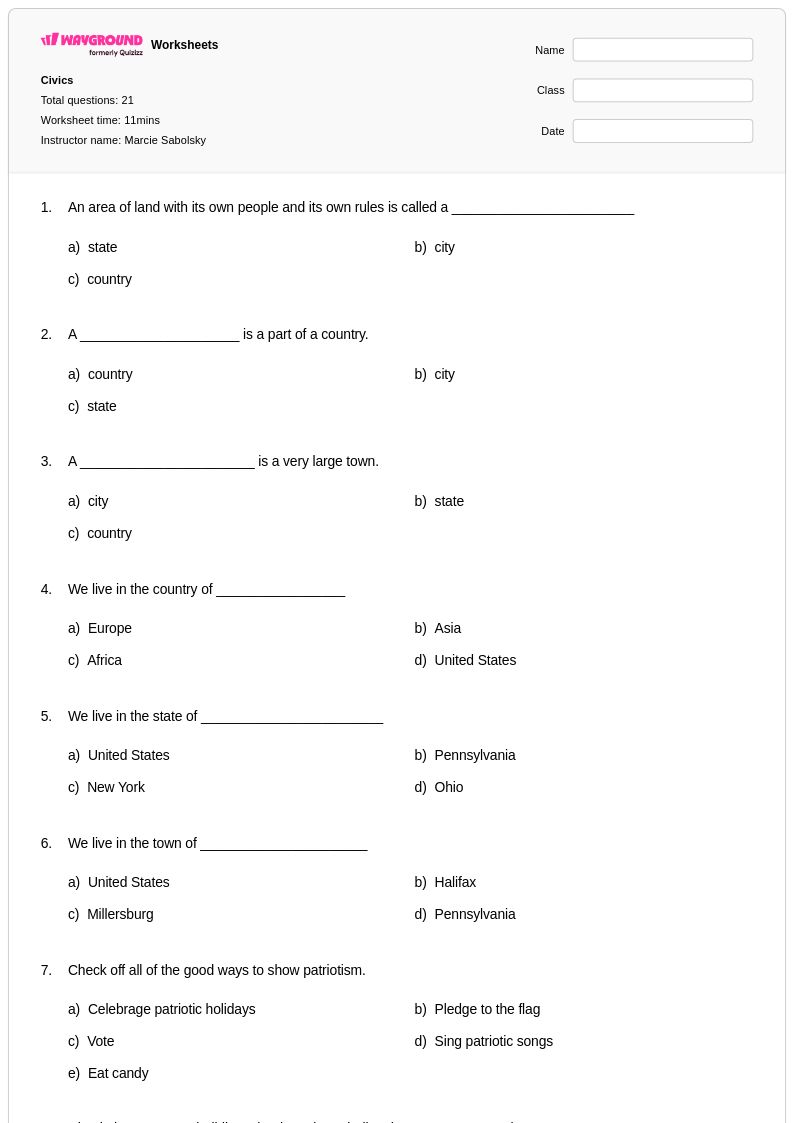
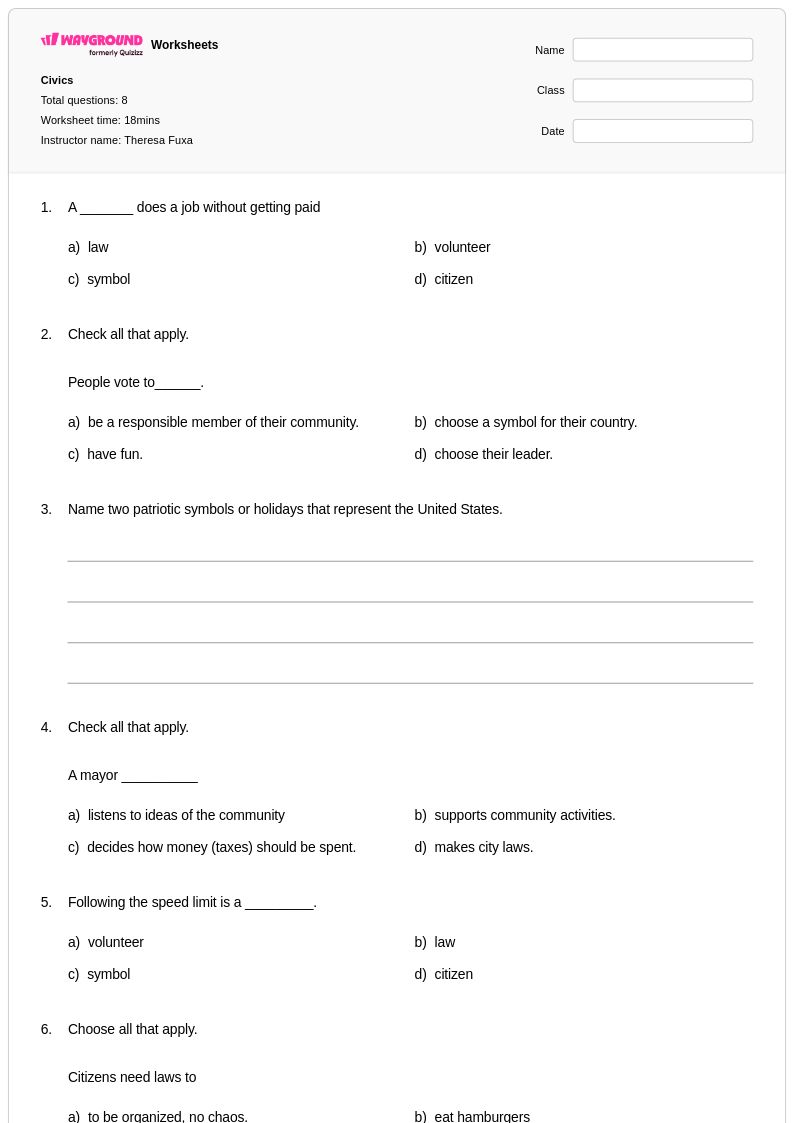
Free Printable Civics & Government Worksheets for Class 2
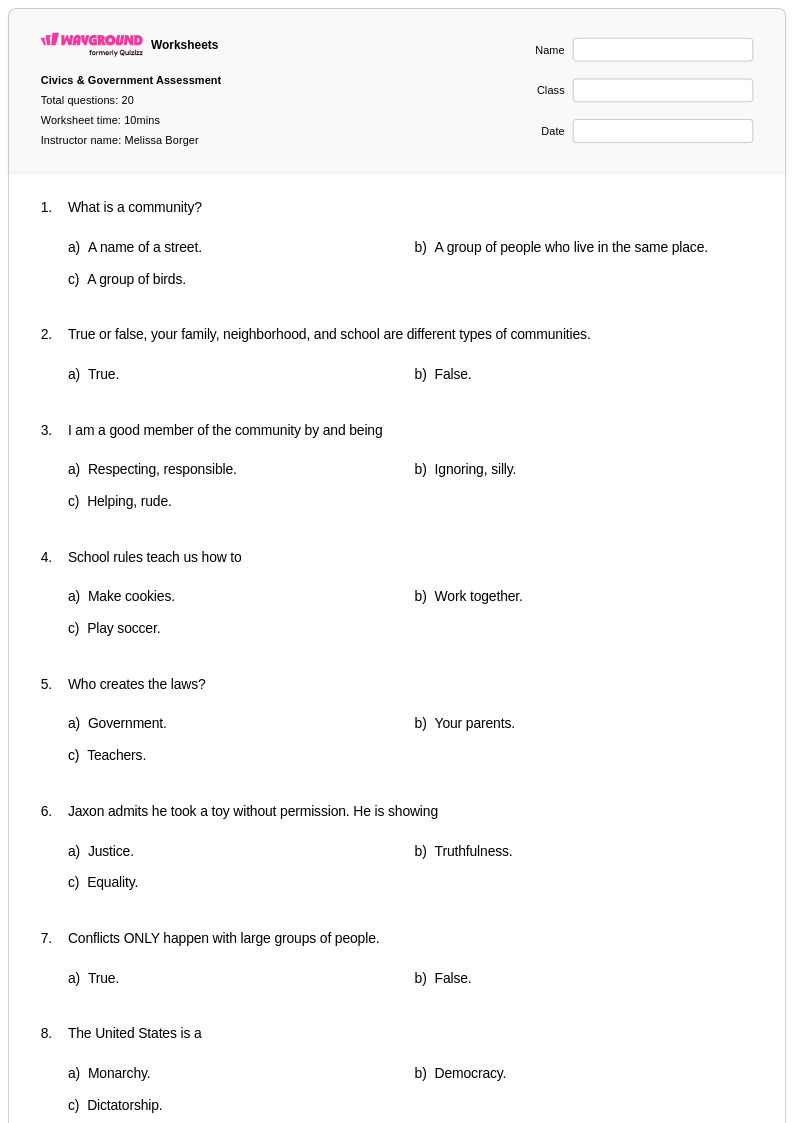
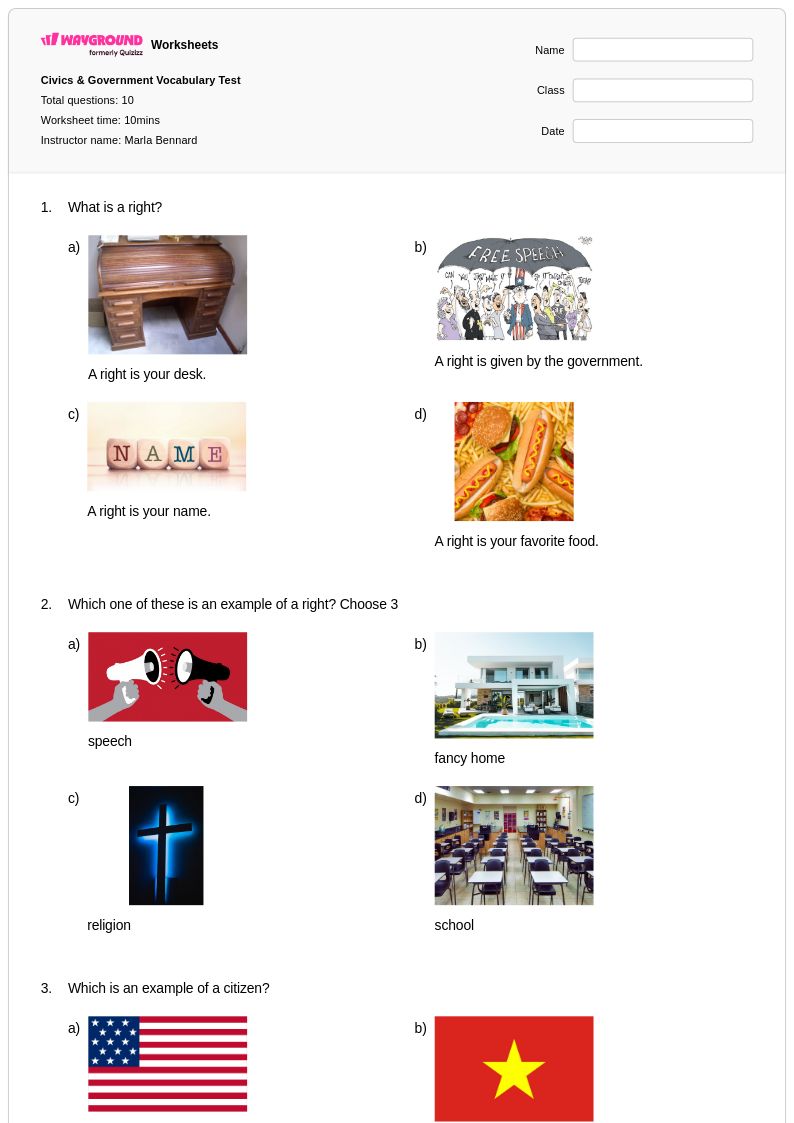
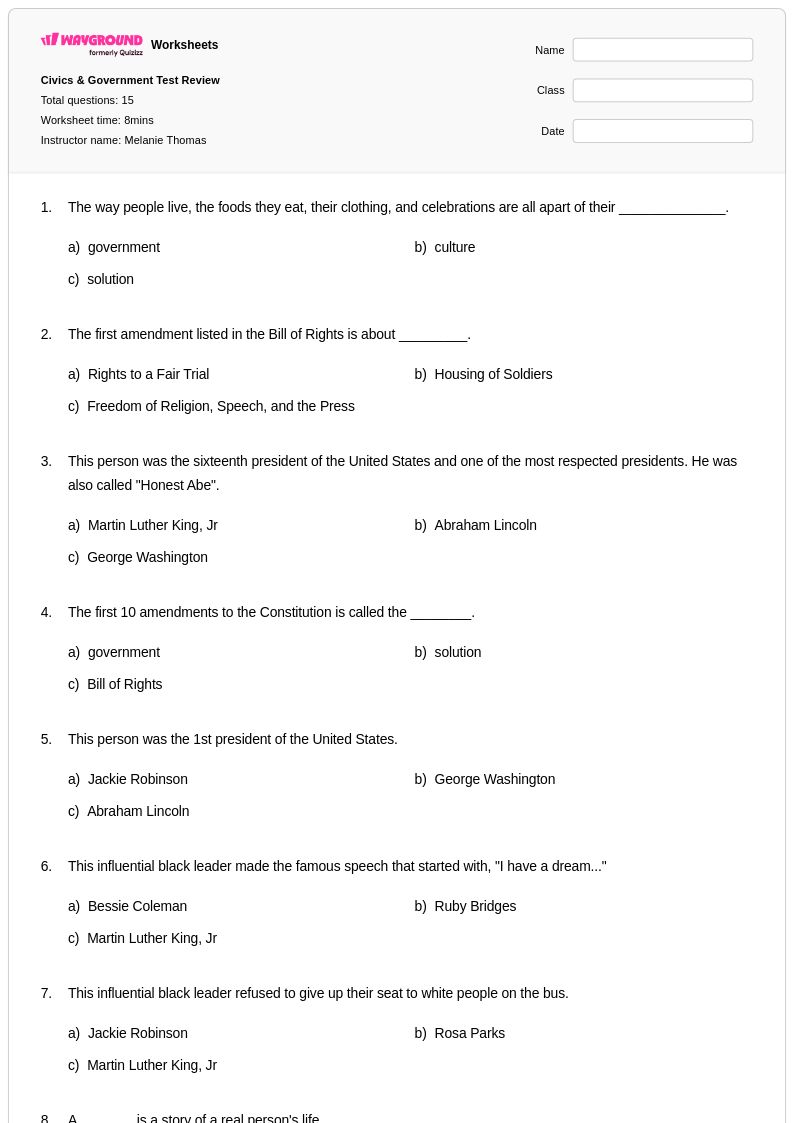
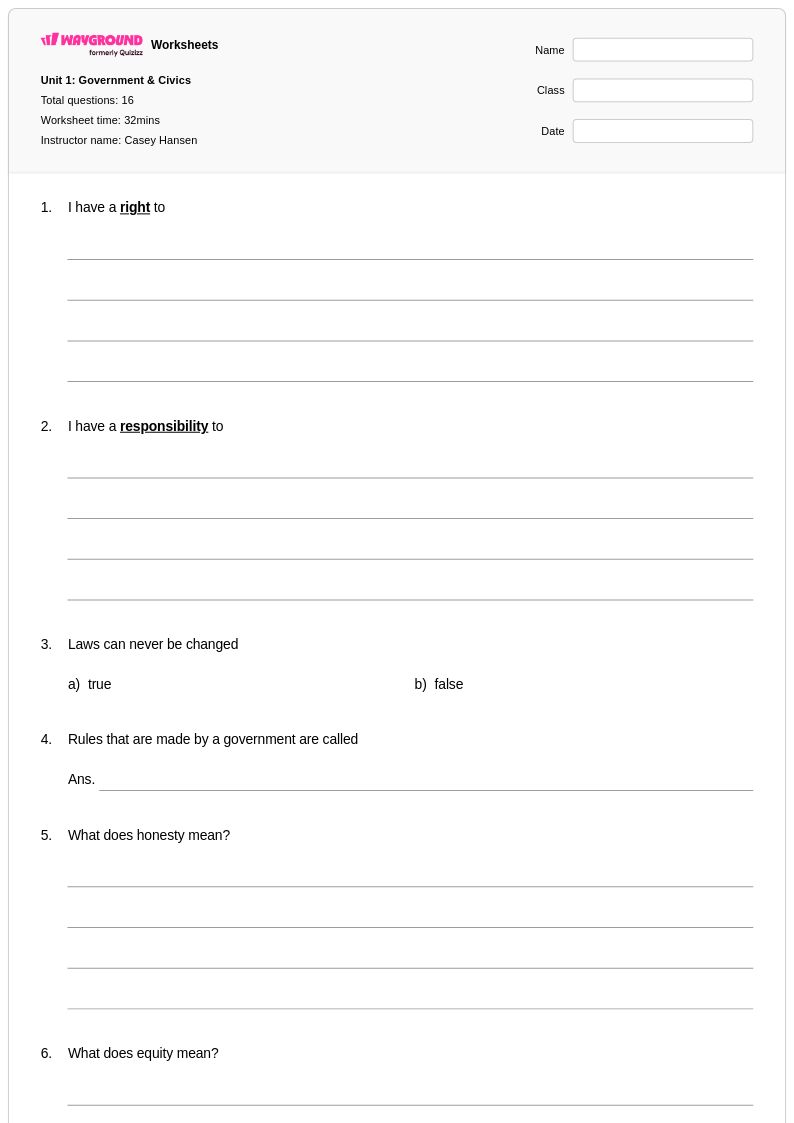
Class 2 civics and government free worksheets and printables help students learn fundamental concepts about community roles, rules, and citizenship through engaging practice problems with answer keys.
Explore printable Civics & Government worksheets for Class 2
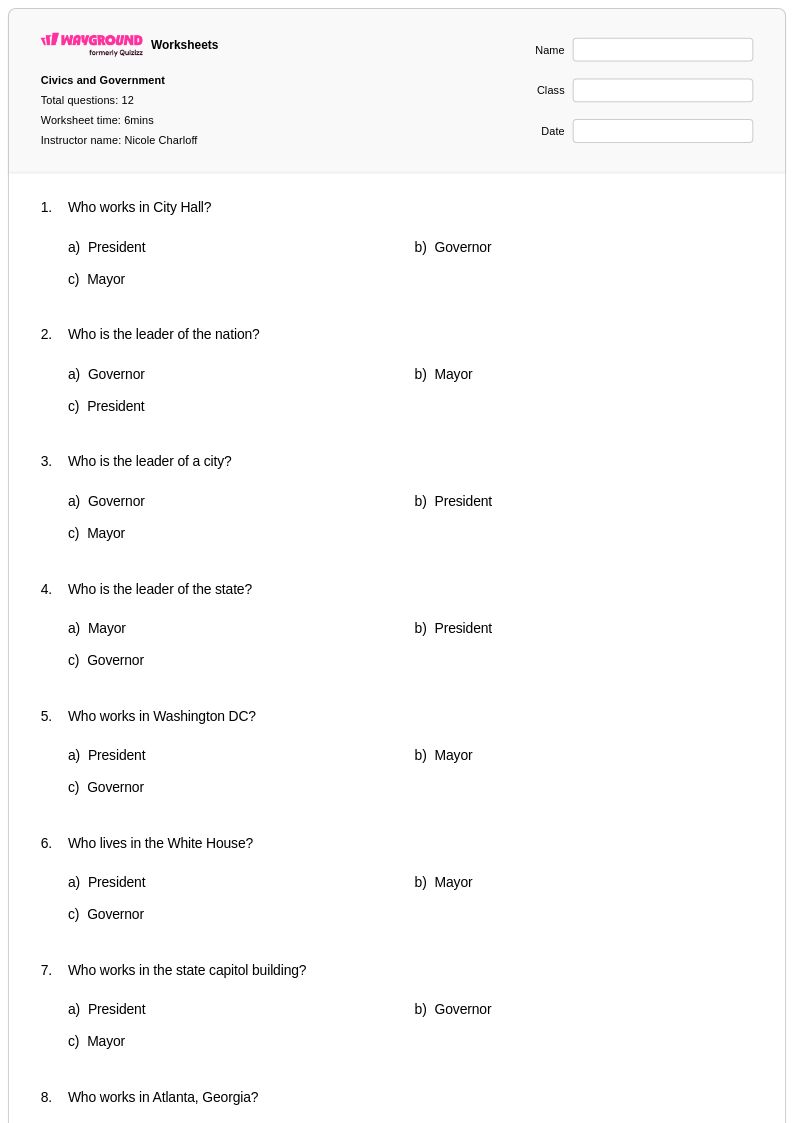
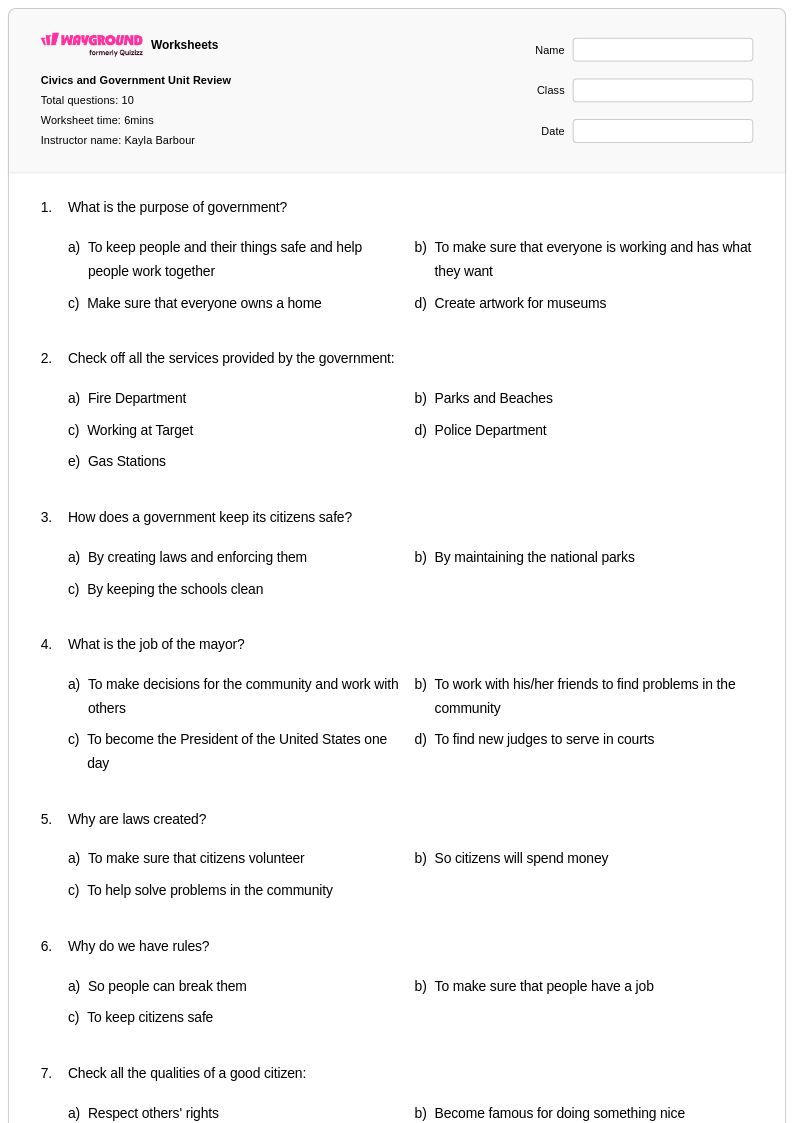
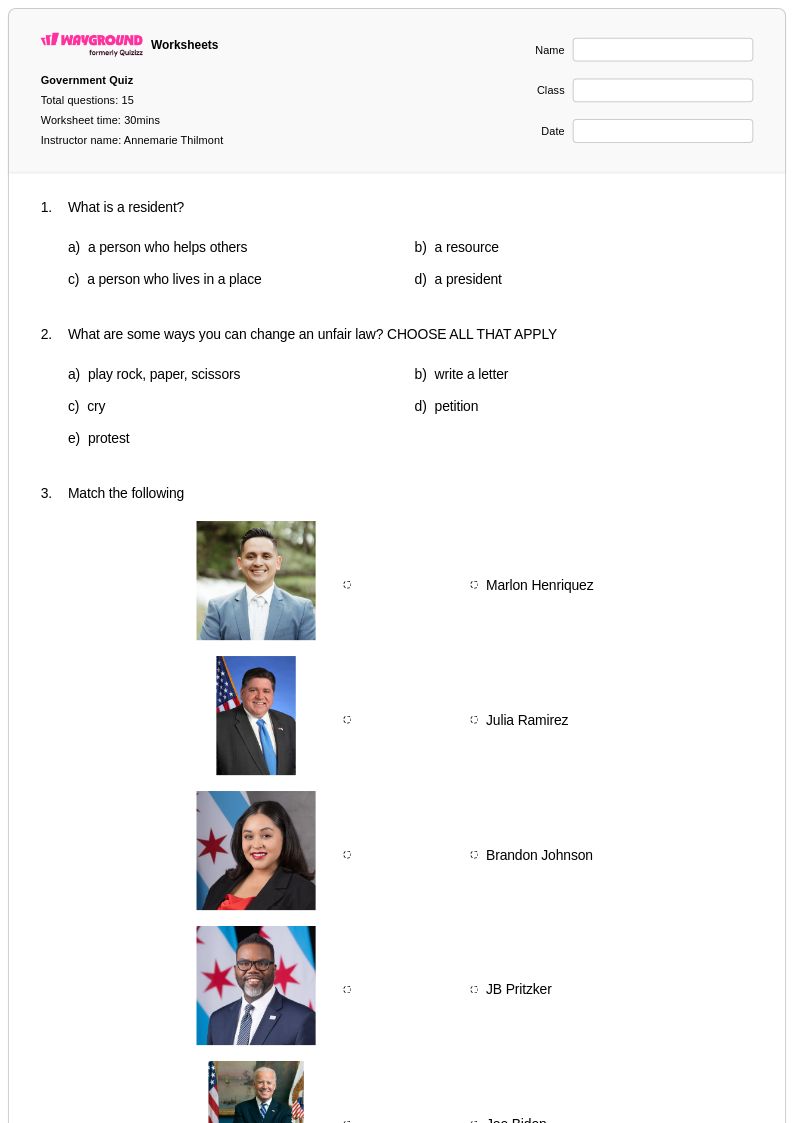
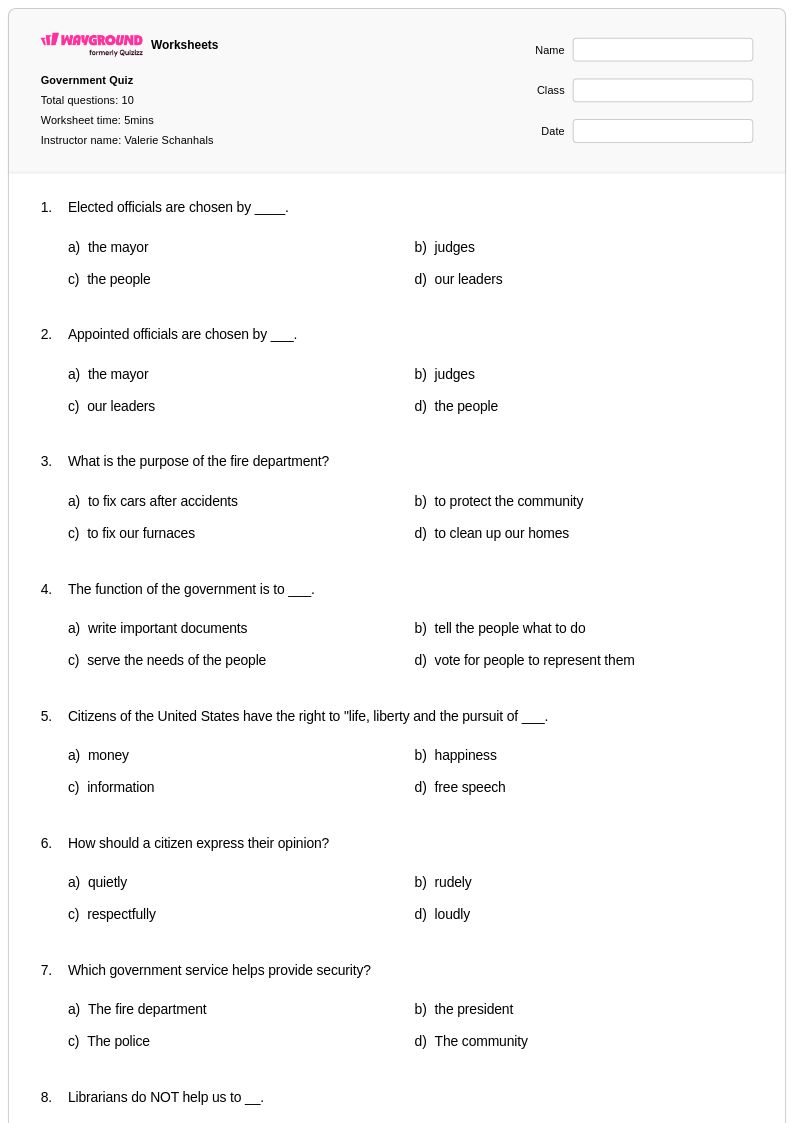
Class 2 Civics & Government worksheets available through Wayground (formerly Quizizz) introduce young learners to fundamental concepts about community helpers, rules, laws, and basic governmental structures that shape their daily lives. These carefully designed educational materials help second-grade students develop essential civic understanding by exploring topics such as community leadership roles, the importance of following rules at home and school, voting processes, and how local government services like fire departments and libraries serve their neighborhoods. Each worksheet collection includes comprehensive practice problems that reinforce key learning objectives, complete answer keys for efficient grading, and free printable pdf formats that make classroom implementation seamless and accessible for all educators.
Wayground (formerly Quizizz) empowers teachers with millions of educator-created civics and government resources specifically calibrated for Class 2 learning standards, featuring robust search and filtering capabilities that allow quick identification of materials aligned to specific curriculum requirements. The platform's differentiation tools enable teachers to customize worksheet difficulty levels and content focus areas, supporting both remediation for struggling learners and enrichment opportunities for advanced students ready to explore more complex civic concepts. Available in both printable and digital formats including downloadable pdfs, these comprehensive worksheet collections streamline lesson planning while providing flexible options for in-class activities, homework assignments, and targeted skill practice that builds foundational knowledge about citizenship, community responsibility, and democratic participation appropriate for second-grade developmental levels.
FAQs
How do I teach the three branches of government to middle school students?
Start by grounding students in the principle of separation of powers before introducing each branch individually. Use concrete examples — such as a recent Supreme Court ruling, an active bill in Congress, or a presidential executive order — to show each branch operating in real time. Once students understand each branch in isolation, introduce checks and balances to show how the branches interact and constrain one another. Role-play activities where students simulate a bill becoming a law or a presidential veto can make the structure tangible and memorable.
What are the most common misconceptions students have about the Electoral College?
A frequent misconception is that the Electoral College is a place or institution rather than a process. Students also commonly believe that the popular vote winner automatically becomes president, not understanding that electoral votes are allocated by state. Another error is assuming all states award electoral votes proportionally — most use a winner-take-all system. Addressing these misconceptions directly with map-based activities and historical election comparisons (such as 2000 or 2016) helps students understand how outcomes can diverge from the national popular vote.
What exercises help students practice understanding checks and balances?
Scenario-based exercises are especially effective — present students with a situation where one branch oversteps its authority and ask them to identify which branch would respond and how. Matching activities that pair constitutional powers with the correct branch build foundational vocabulary, while case study analysis of landmark Supreme Court decisions (such as Marbury v. Madison) demonstrates judicial review in action. Civics and government worksheets that require students to classify actions by branch and identify the checking mechanism reinforce both comprehension and application.
How can I help students understand the Bill of Rights in practical terms?
Connect each amendment to a real-world scenario students can relate to — for example, linking the Fourth Amendment to phone searches or the First Amendment to school dress codes and social media speech. This context-first approach helps students see constitutional protections as living rules rather than historical text. Follow up with case study worksheets on landmark Supreme Court decisions that interpreted specific amendments, so students understand how rights are defined and limited in practice. Asking students to argue both sides of a constitutional debate sharpens their ability to reason from the text.
How do I use Wayground's civics and government worksheets in my classroom?
Wayground's civics and government worksheets are available as printable PDFs for traditional classroom use and in digital formats for technology-integrated environments, making them flexible across instructional settings. Teachers can assign worksheets covering specific topics — such as federalism, voting rights, or the legislative process — to match exactly where students are in the curriculum. In digital mode, you can host worksheets as a quiz directly on Wayground, which supports real-time tracking of student responses. Wayground also offers built-in accommodation settings, including extended time, read-aloud support, and reduced answer choices, so teachers can differentiate for individual students without disrupting the rest of the class.
What's the best way to teach students about the role of political parties and interest groups?
Begin by distinguishing between political parties, which seek to win elections and control government, and interest groups, which seek to influence policy without running candidates. Use current examples of lobbying activity or recent legislation shaped by organized interest groups to make the distinction concrete. Comparative chart activities that map party platforms on key issues help students understand ideological positioning, while case studies on landmark Citizens United or campaign finance rulings show how legal frameworks shape political participation. Discussion prompts that ask students to evaluate the influence of money in politics build higher-order civic reasoning skills.
How do I assess whether students truly understand federalism versus just memorizing definitions?
Surface-level memorization breaks down quickly when students are asked to apply federalism to unfamiliar scenarios. Strong assessment tasks ask students to classify a policy issue — such as education standards, marijuana legalization, or immigration enforcement — as a federal, state, or shared responsibility and justify their reasoning using constitutional principles. Common errors include assuming the federal government controls all major policy areas or conflating the Supremacy Clause with total federal authority. Worksheets that include short-answer or case-based questions, rather than only multiple choice, reveal whether students can reason with the concept rather than just recall it.