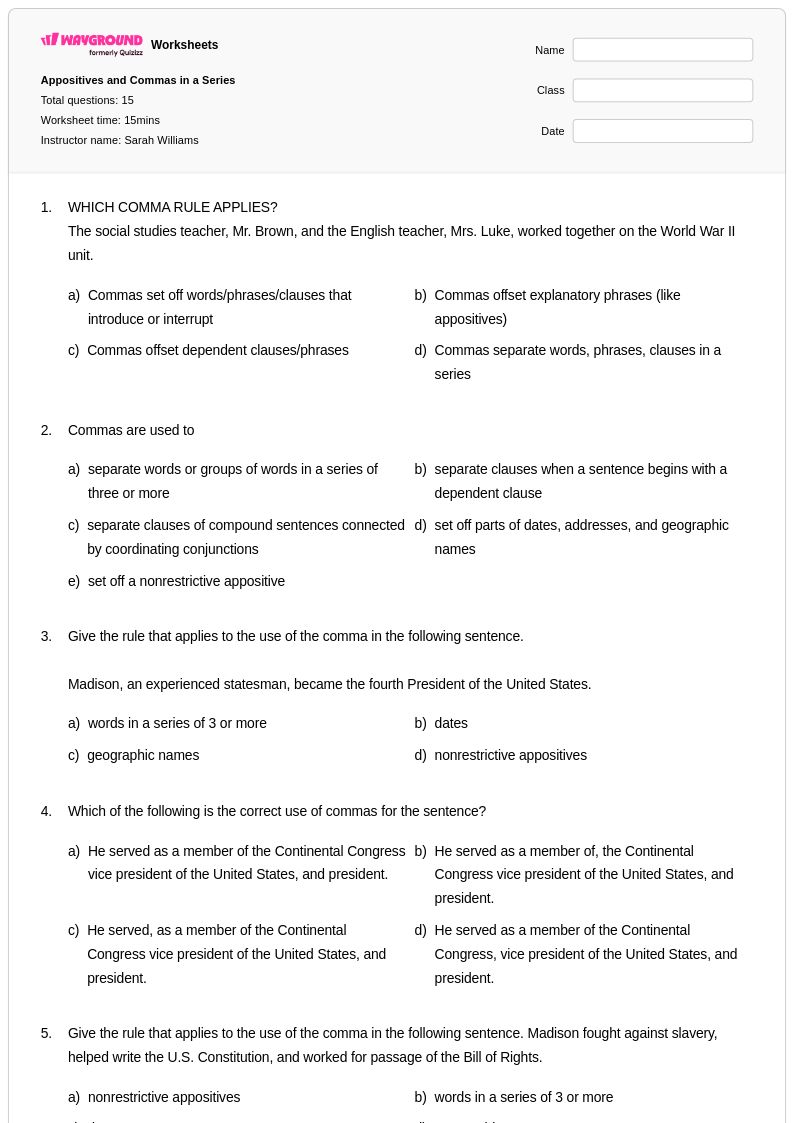
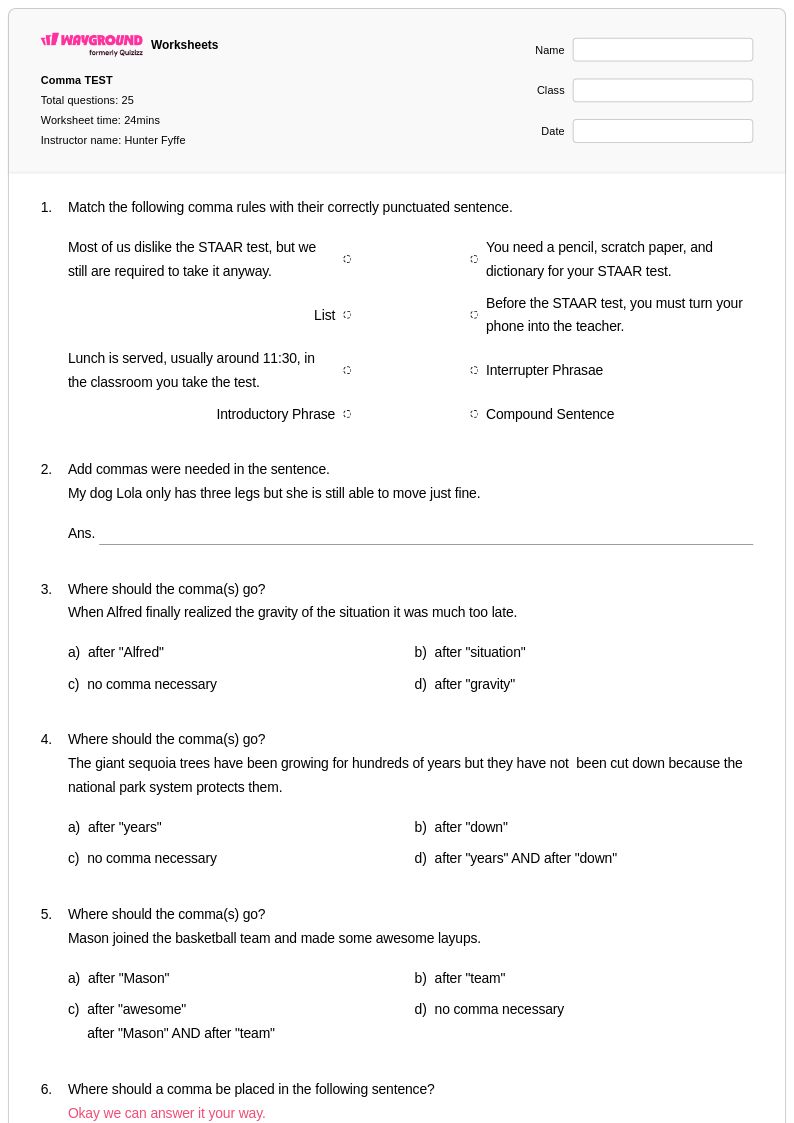
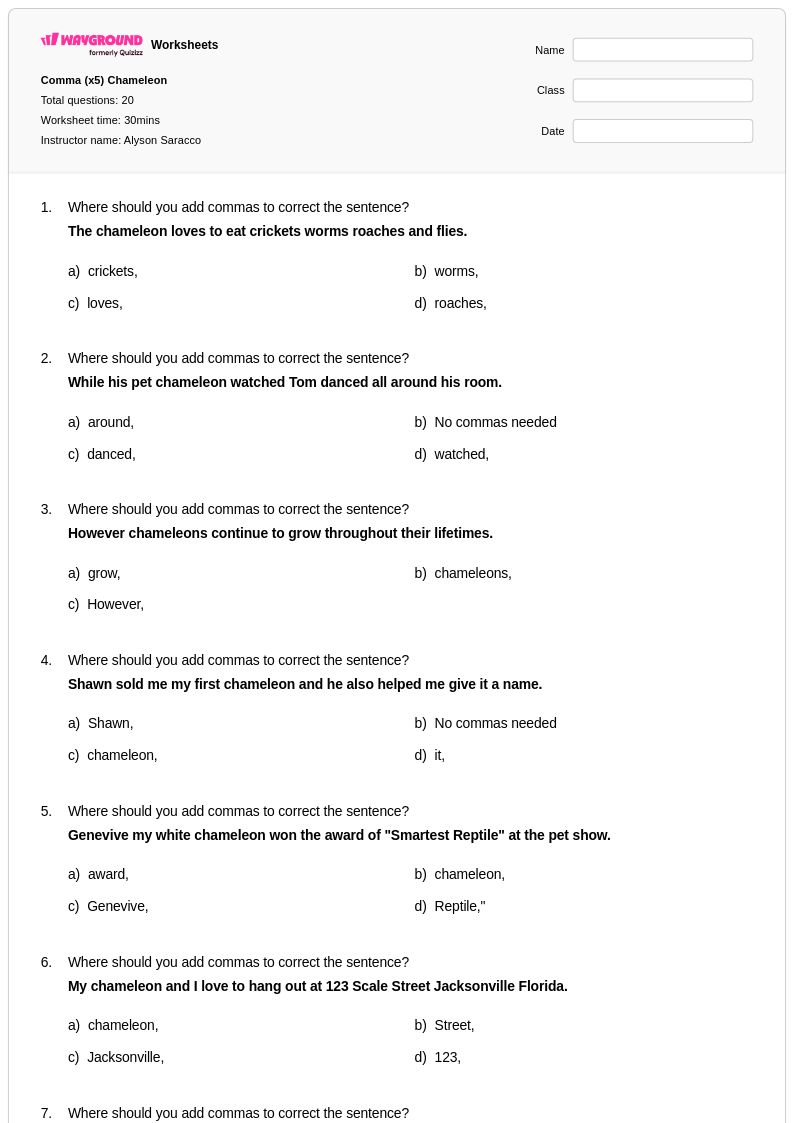
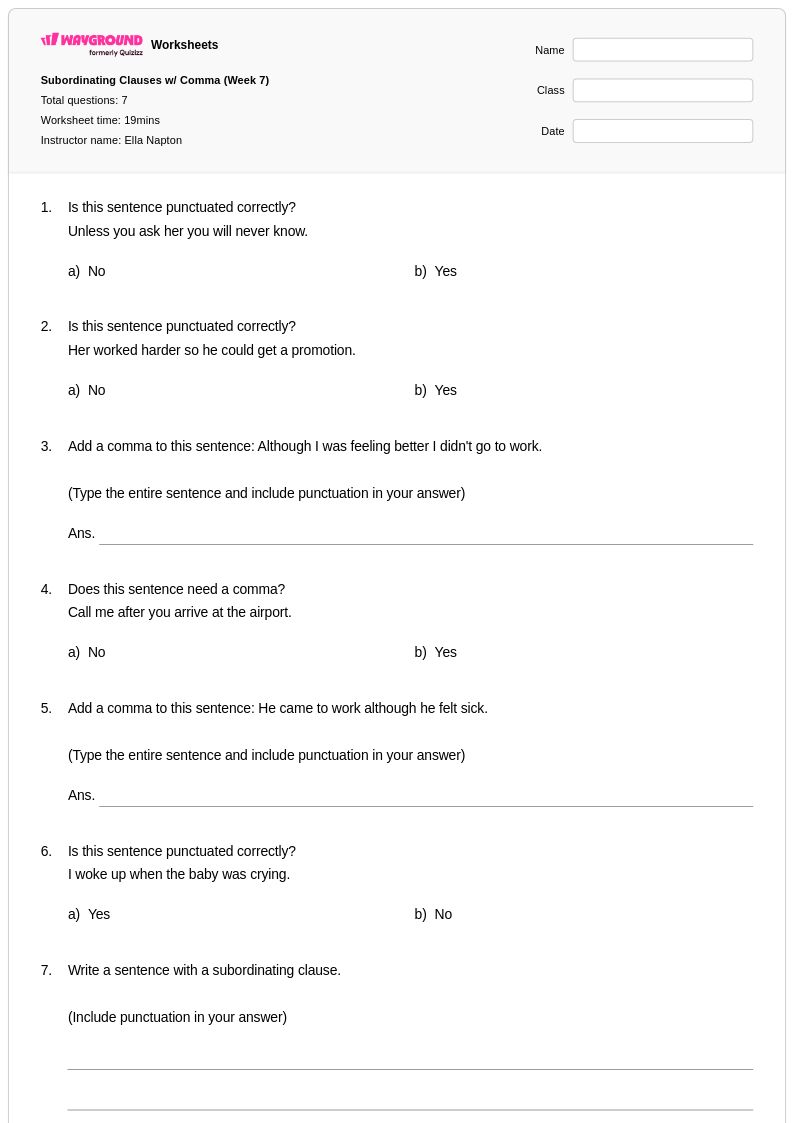
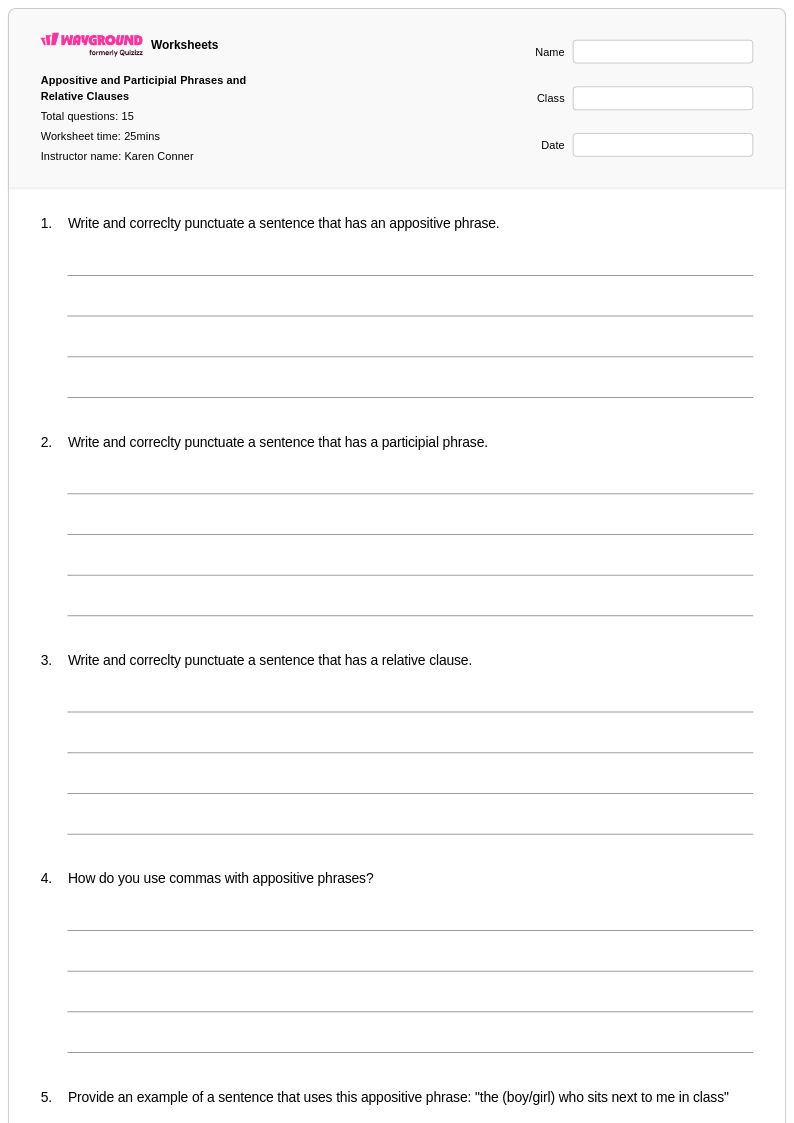
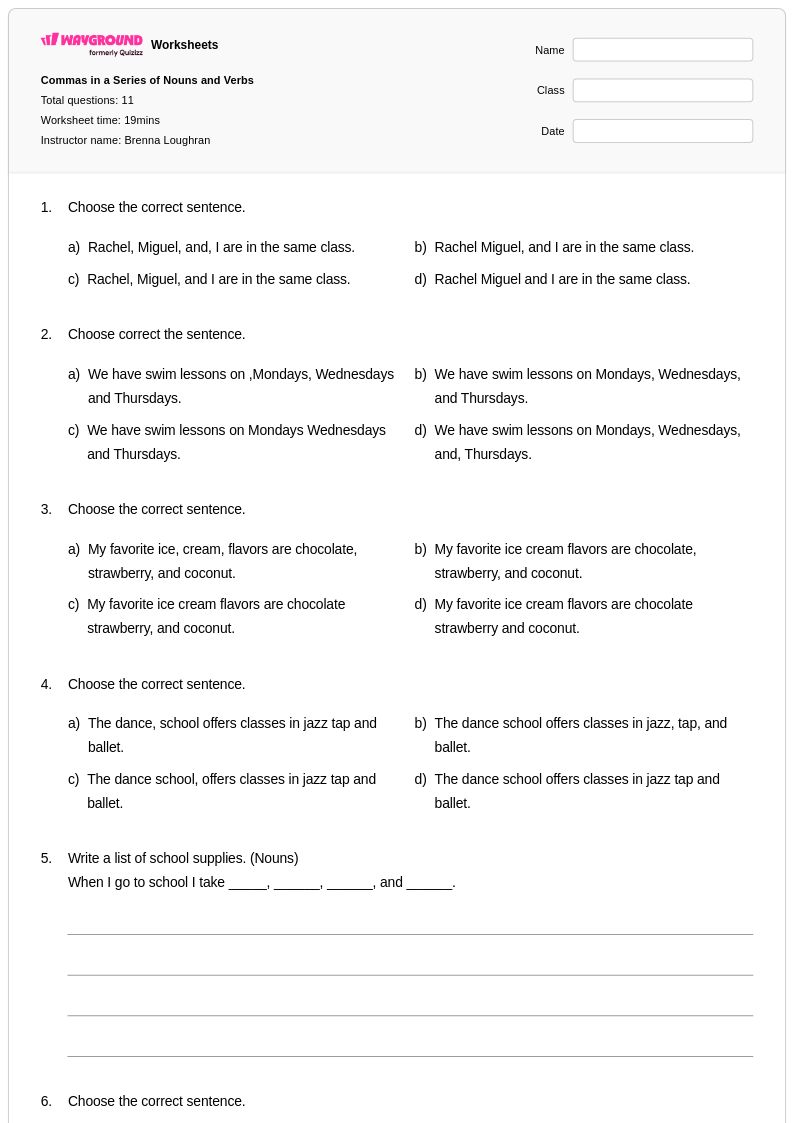
Free Printable Commas with Nonrestrictive Elements Worksheets for Class 11
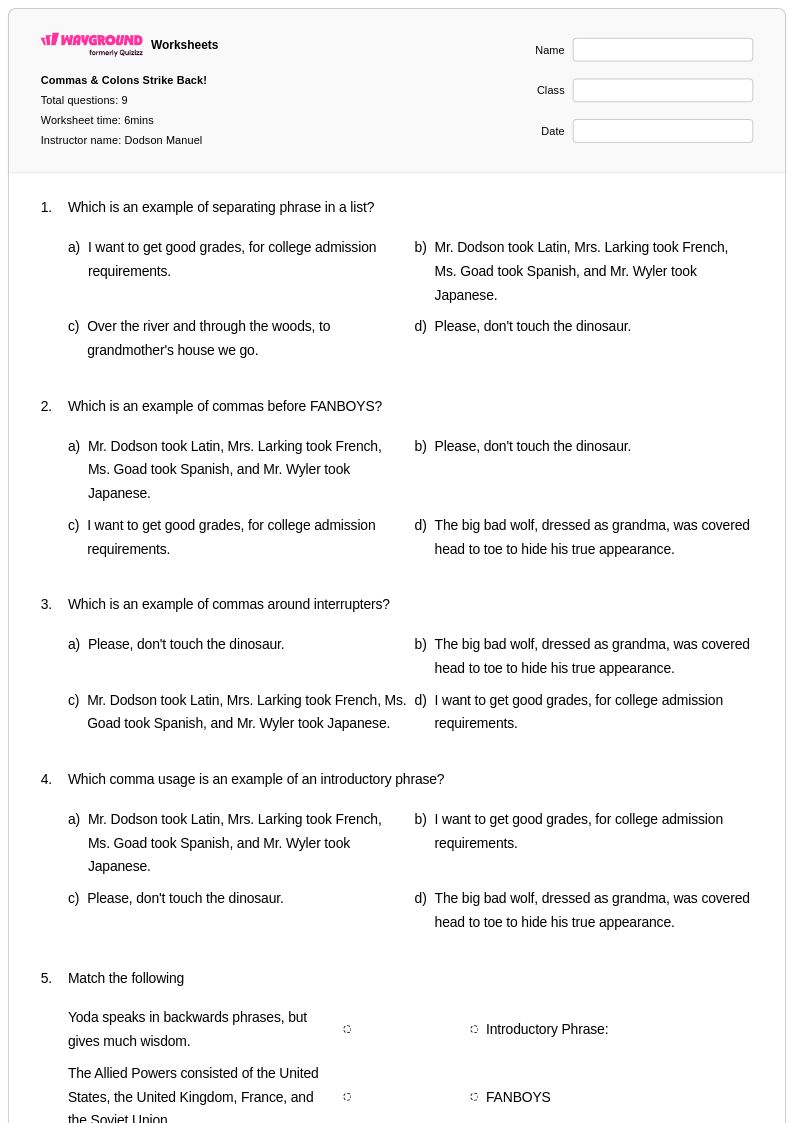
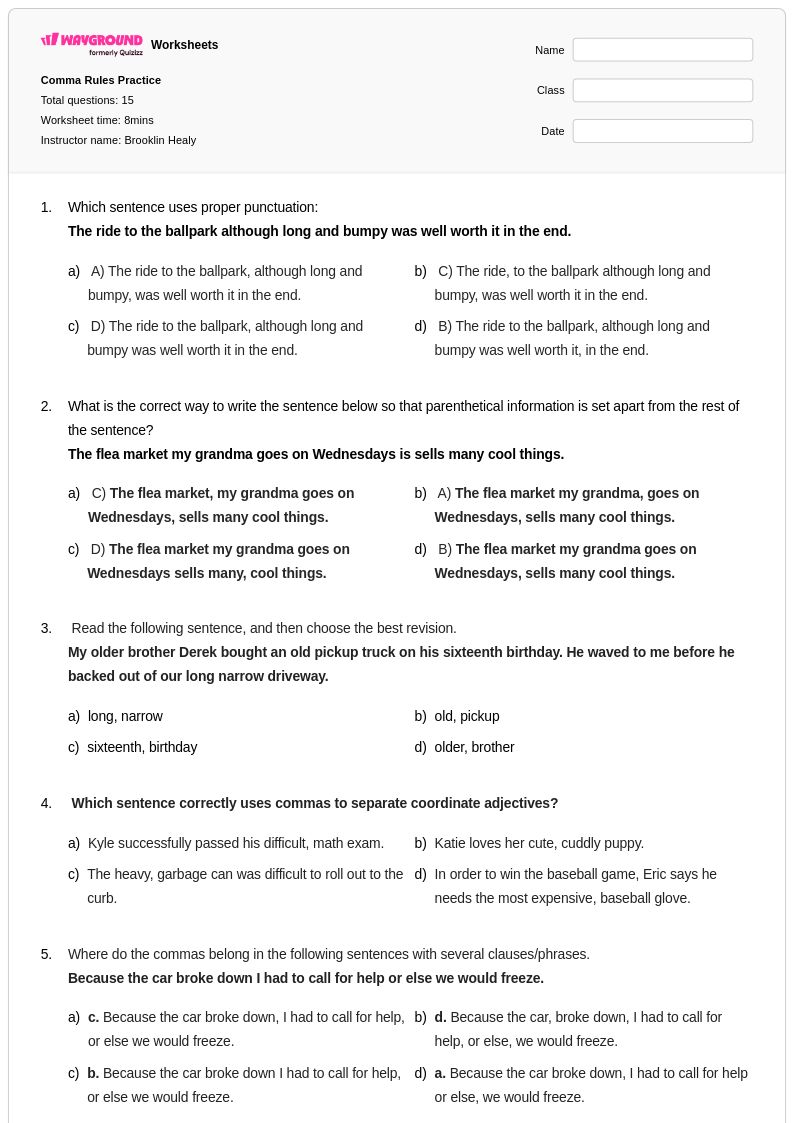
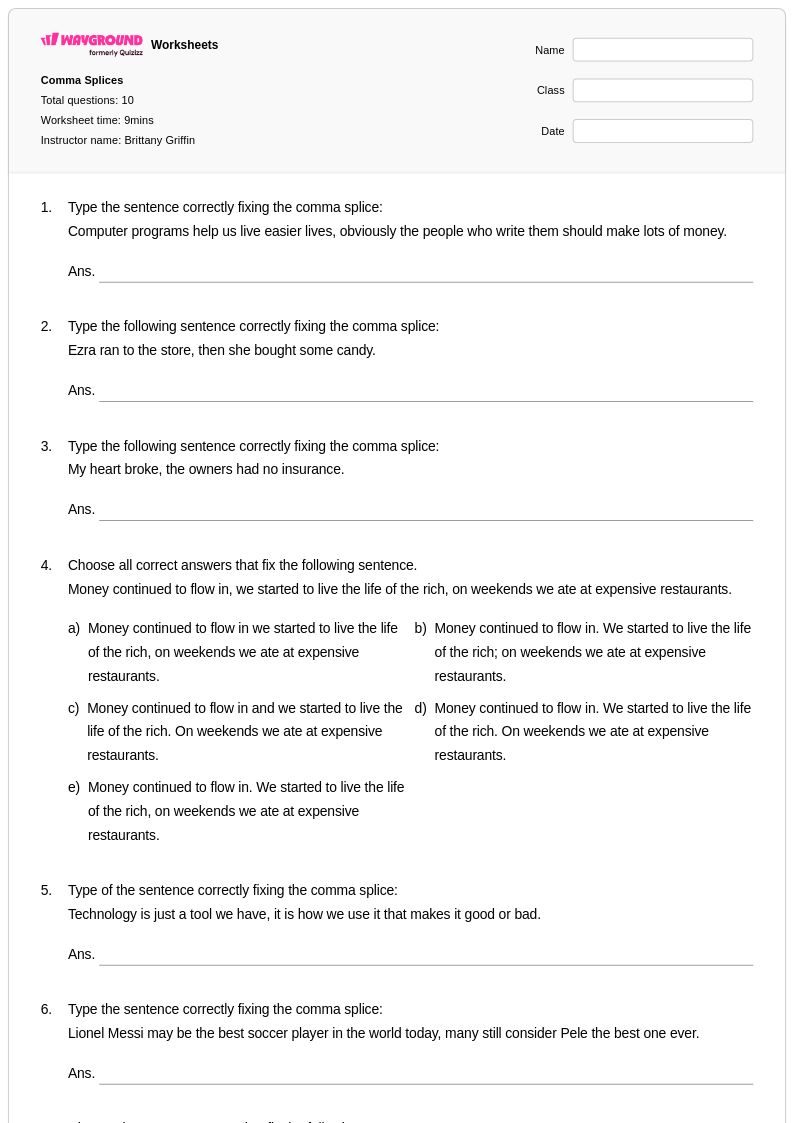
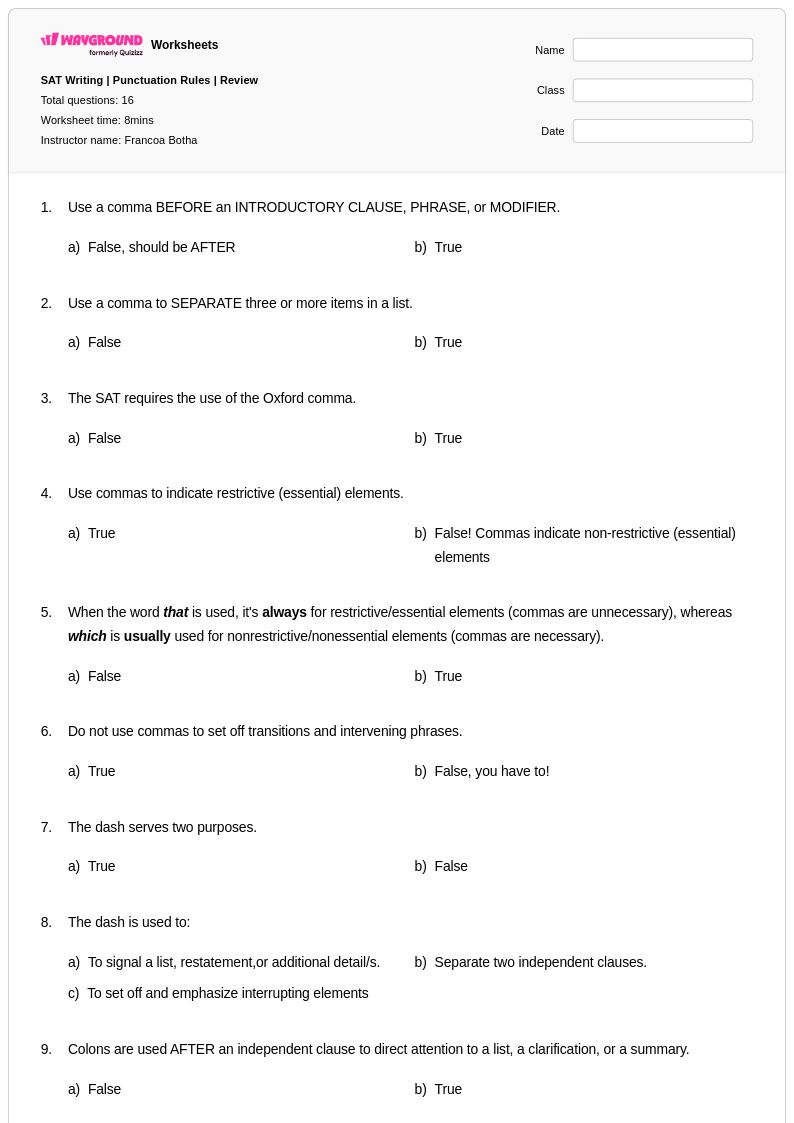
Class 11 students can master commas with nonrestrictive elements through Wayground's comprehensive collection of free worksheets, featuring targeted practice problems, printable PDFs, and detailed answer keys to strengthen punctuation skills.
Explore printable Commas with Nonrestrictive Elements worksheets for Class 11
Commas with nonrestrictive elements present one of the most nuanced punctuation challenges for Class 11 students, requiring them to distinguish between essential and non-essential information within sentences. Wayground's comprehensive collection of worksheets addresses this sophisticated grammatical concept by providing targeted practice problems that help students identify clauses, phrases, and appositives that add extra information without restricting the meaning of the main sentence. These expertly designed resources strengthen students' ability to recognize when commas are necessary to set off nonrestrictive elements, building their confidence in advanced punctuation usage through systematic practice. Each worksheet includes detailed answer keys and clear explanations, making these free printables invaluable tools for both independent study and classroom instruction as students prepare for college-level writing expectations.
Wayground's extensive library, featuring millions of teacher-created resources, empowers educators to effectively teach this complex punctuation concept through carefully curated worksheet collections that align with language arts standards. Teachers can utilize the platform's robust search and filtering capabilities to locate materials specifically targeting nonrestrictive elements, while differentiation tools allow for seamless customization based on individual student needs and proficiency levels. The availability of both printable pdf formats and digital versions provides instructional flexibility, enabling teachers to incorporate these resources into various learning environments for targeted skill practice, remediation support, and enrichment activities. This comprehensive approach ensures that educators have access to high-quality materials that facilitate thorough understanding of comma usage with nonrestrictive elements, supporting students' development of sophisticated writing mechanics essential for academic success.
FAQs
How do I teach commas with nonrestrictive elements?
Start by ensuring students can distinguish between information that restricts meaning and information that simply adds detail. Use paired sentence examples — one with a restrictive clause and one with a nonrestrictive clause — to show how removing the element changes (or doesn't change) the sentence's core meaning. Once students grasp that nonrestrictive elements are 'removable' without altering the main idea, comma placement becomes a logical consequence of that distinction rather than an arbitrary rule.
What exercises help students practice identifying nonrestrictive elements?
Effective practice exercises ask students to insert or remove commas and then evaluate whether the meaning of the sentence shifts. Sentence-editing tasks, comma-insertion drills, and rewrite exercises using appositives and nonrestrictive clauses all reinforce the concept. Worksheets that pair practice problems with immediate answer key feedback are especially useful for building accuracy before students apply the skill in their own writing.
What is the difference between a restrictive and a nonrestrictive clause?
A restrictive clause limits or defines the noun it modifies and is essential to the sentence's meaning — it does not take commas. A nonrestrictive clause provides supplementary information about a noun already clearly identified, and because it can be removed without changing the core meaning, it is set off with commas. For example, 'The student who studied hardest passed' is restrictive, while 'Maria, who studied all week, passed' is nonrestrictive.
What mistakes do students commonly make with commas and nonrestrictive elements?
The most common error is treating all relative clauses as interchangeable, leading students to either omit commas around nonrestrictive clauses or incorrectly add commas around restrictive ones. Students also frequently mishandle appositives, punctuating them inconsistently depending on whether they are specific or general. Another persistent mistake is placing only one comma around a mid-sentence nonrestrictive element instead of the required pair — both an opening and a closing comma are needed to properly 'bracket' the supplementary information.
How can I use Wayground's commas with nonrestrictive elements worksheets in my classroom?
Wayground's worksheets are available as printable PDFs for traditional classroom use and in digital formats for technology-integrated environments, giving you flexibility for independent practice, small-group instruction, or homework assignments. You can also host them as a quiz directly on Wayground for interactive student engagement. Each worksheet includes complete answer keys, so students can self-check during independent practice or you can use them for quick formative assessment.
How do I support struggling students when teaching nonrestrictive elements?
For students who find the restrictive/nonrestrictive distinction difficult, reduce the initial cognitive load by focusing exclusively on appositive phrases before introducing relative clauses. On Wayground, you can apply accommodations such as reduced answer choices and read-aloud support to individual students, making the same worksheet accessible at different levels without singling anyone out. Pairing these supports with targeted remediation worksheets allows struggling learners to build confidence on simpler structures before tackling complex sentences.