Free Printable Distance, Rate, and Time Worksheets for Class 8
Class 8 distance, rate, and time printable worksheets from Wayground help students master motion calculations through comprehensive practice problems, free PDF downloads, and complete answer keys.
Explore printable Distance, Rate, and Time worksheets for Class 8
Distance, rate, and time worksheets for Class 8 students available through Wayground (formerly Quizizz) provide comprehensive practice with one of the most fundamental measurement concepts in mathematics. These carefully designed resources help students master the essential relationship between distance, rate, and time through the formula d = rt and its variations, strengthening their ability to solve real-world problems involving speed calculations, travel scenarios, and motion analysis. The practice problems progress systematically from basic applications to more complex multi-step word problems, ensuring students develop fluency with unit conversions, algebraic manipulation, and problem-solving strategies. Each worksheet includes a complete answer key and is available as a free printable pdf, making it easy for educators to incorporate these materials into their lesson plans and provide students with additional skill reinforcement.
Wayground (formerly Quizizz) supports mathematics educators with an extensive collection of teacher-created distance, rate, and time resources that streamline instructional planning and enhance student learning outcomes. The platform's robust search and filtering capabilities allow teachers to quickly locate worksheets that align with specific curriculum standards and match their students' skill levels, while built-in differentiation tools enable customization for diverse learning needs. These materials are available in both printable pdf format and interactive digital versions, providing flexibility for classroom instruction, homework assignments, remediation sessions, and enrichment activities. With millions of high-quality resources at their fingertips, teachers can efficiently create targeted practice opportunities that help Class 8 students build confidence with measurement concepts and develop the mathematical reasoning skills essential for success in algebra and advanced mathematics courses.
FAQs
How do I teach distance, rate, and time in 8th grade?
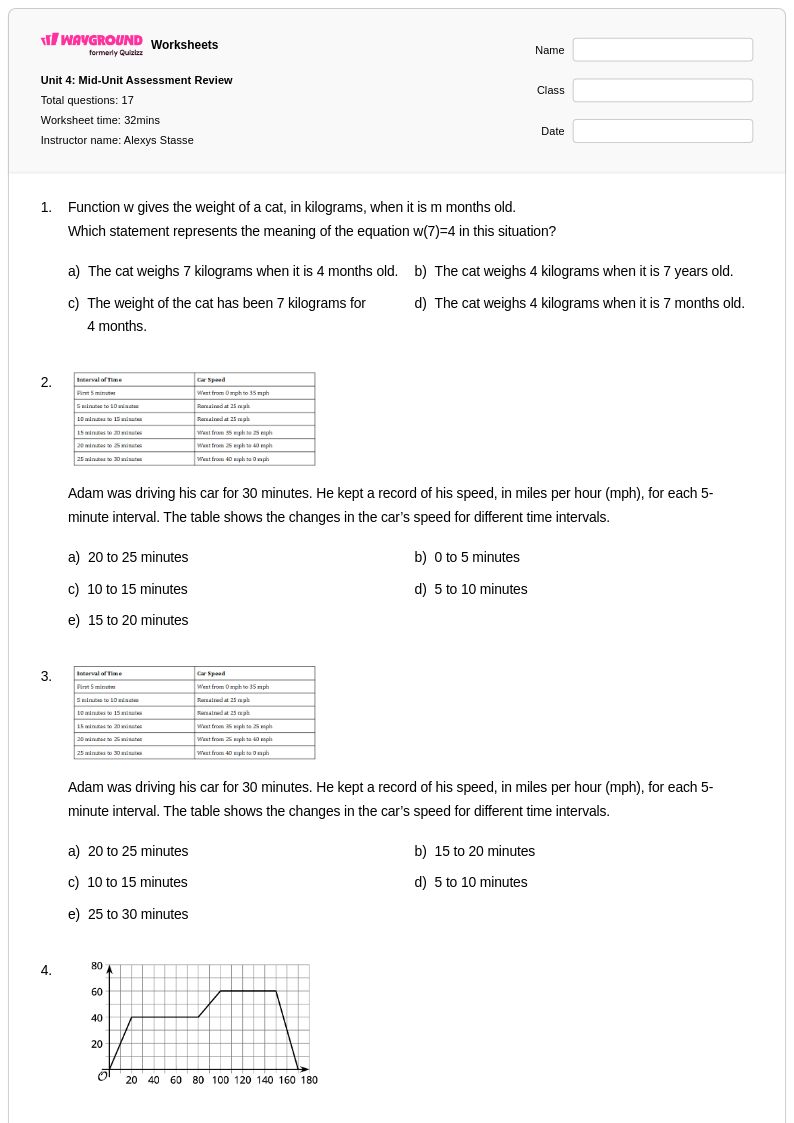
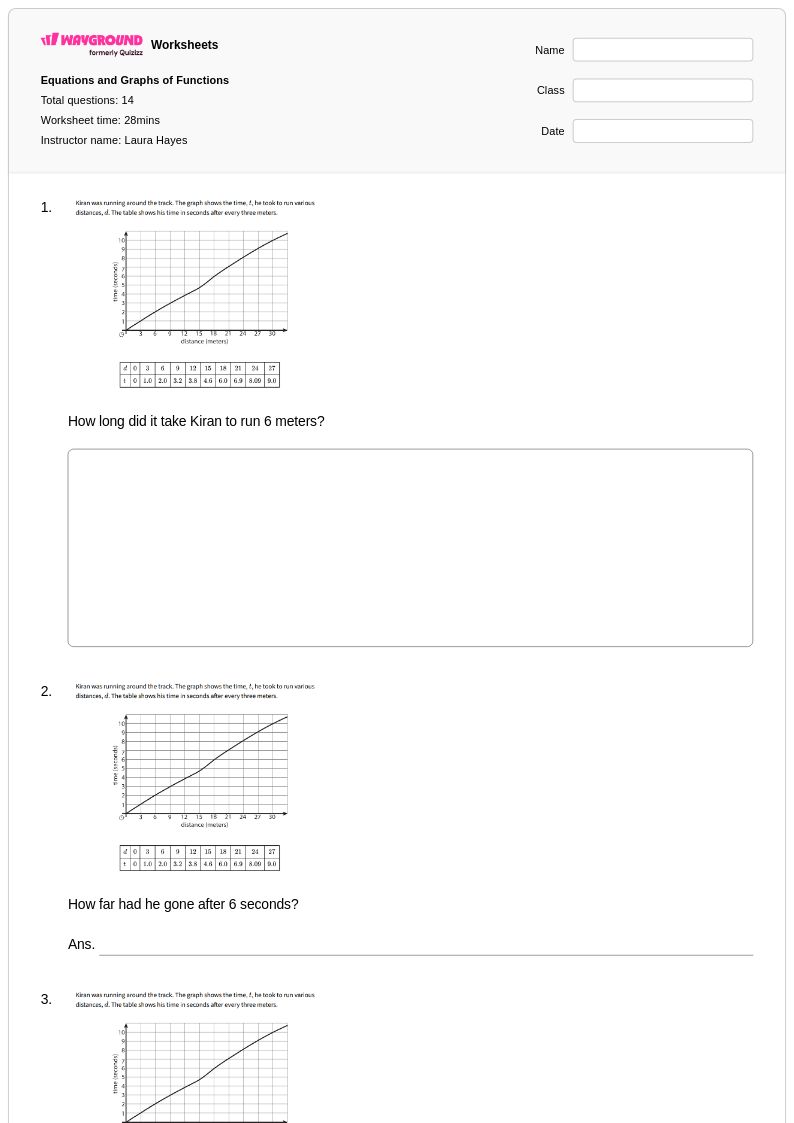
At eighth grade, d = rt should connect explicitly to linear functions. Constant speed is slope: a car traveling at 60 mph traces a straight line on a distance-time graph with slope 60. Teaching it this way does two things at once — it deepens students' understanding of rate as a proportional relationship and gives them a concrete anchor for the abstract idea of slope. Problems that ask students to graph a trip, interpret the slope, and then solve for an unknown variable bridge the two topics naturally.
What kinds of distance, rate, and time problems should 8th graders be working on?
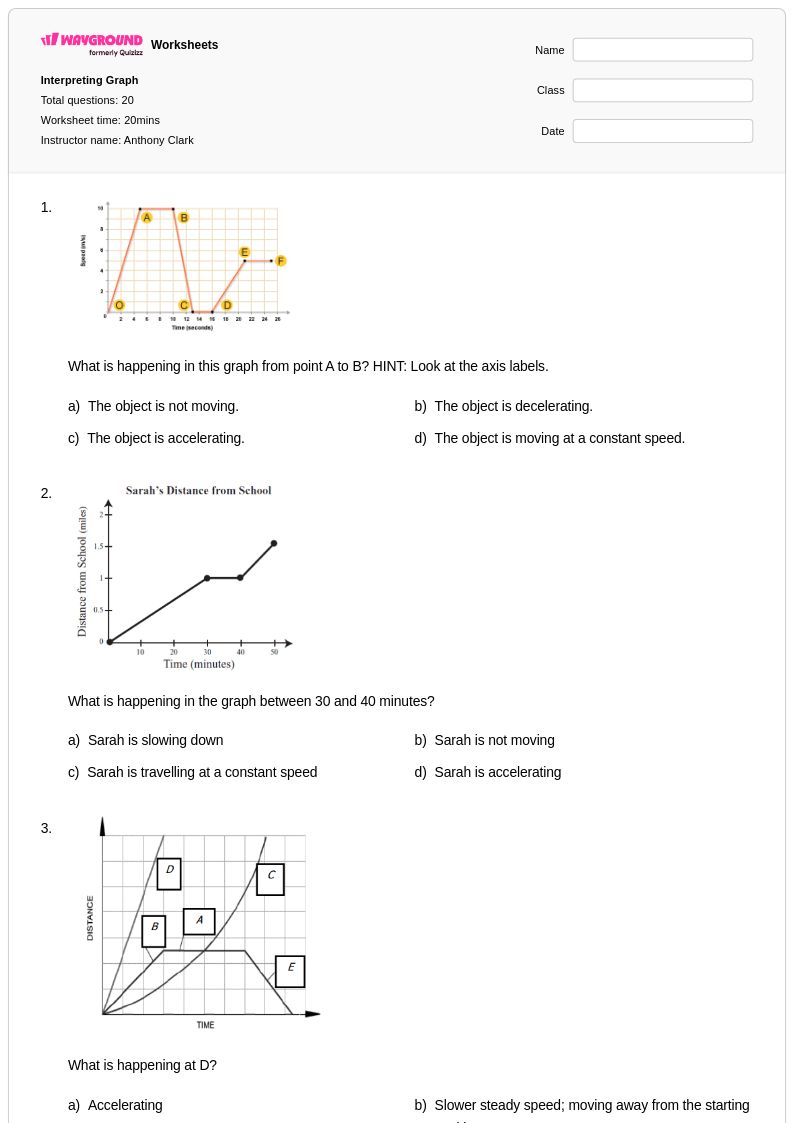
Eighth graders should be handling problems that require algebraic manipulation, not just arithmetic. That means setting up and solving equations where the unknown is embedded (e.g., two objects leave at different times and you need to find when they meet), working with unit conversions as part of the setup, and interpreting distance-time graphs. Problems that connect to systems of equations — two objects, two equations — are appropriate here and preview work students will do formally in algebra.
What mistakes do 8th graders still make with distance, rate, and time?
Even at this level, unit inconsistency causes errors — students who are otherwise algebraically capable still mix hours and minutes without noticing. In meeting-point problems, a frequent mistake is writing one equation for the total distance instead of separate expressions for each object and then setting them equal. Students also sometimes confuse average speed with the average of two speeds, which gives a wrong answer whenever the two legs of a trip take different amounts of time.
How do I use Wayground's Grade 8 distance, rate, and time worksheets?
Each worksheet comes with a complete answer key and is available as a printable PDF or a digital quiz on Wayground. The digital format is useful for immediate feedback during independent practice; the printable version works well for assessments or for classes where you want students working off-screen. If you collect paper submissions, the Wayground for Teachers app lets you scan student work for grading rather than scoring each page by hand.
How does distance, rate, and time connect to 8th grade Common Core math?
In Common Core, eighth grade is where proportional relationships formalize into linear functions, and distance, rate, and time sits at that intersection. A constant rate of travel is a proportional relationship with a unit rate equal to speed — which is also the slope of the corresponding distance-time graph. Students who understand d = rt deeply are better positioned to interpret slope as a rate of change across any linear context, not just motion problems. This makes it one of the more useful bridge topics between middle school ratio work and high school algebra.
How can I differentiate distance, rate, and time practice for 8th graders with different skill levels?
For students who are still building confidence with the formula itself, Wayground lets you create an alternate version of the worksheet with wider spacing and larger font, reducing visual clutter on problems that already have a lot of numerical information. For students who need more time on multi-step algebraic setups, extended time can be set per student without signaling anything to the rest of the class. Advanced students who have mastered the standard problems can be directed to the more complex multi-step and graph-interpretation problems in the collection.
How do distance, rate, and time problems prepare 8th graders for algebra?
These problems are applied algebra before students call it that. Setting up a meeting-point problem requires writing two expressions, setting them equal, and solving for an unknown — the same process as solving a linear equation or a simple system. Students who work through these problems fluently arrive in algebra already comfortable with translating a word problem into an equation, which is consistently one of the hardest skills to build from scratch in a formal algebra course.