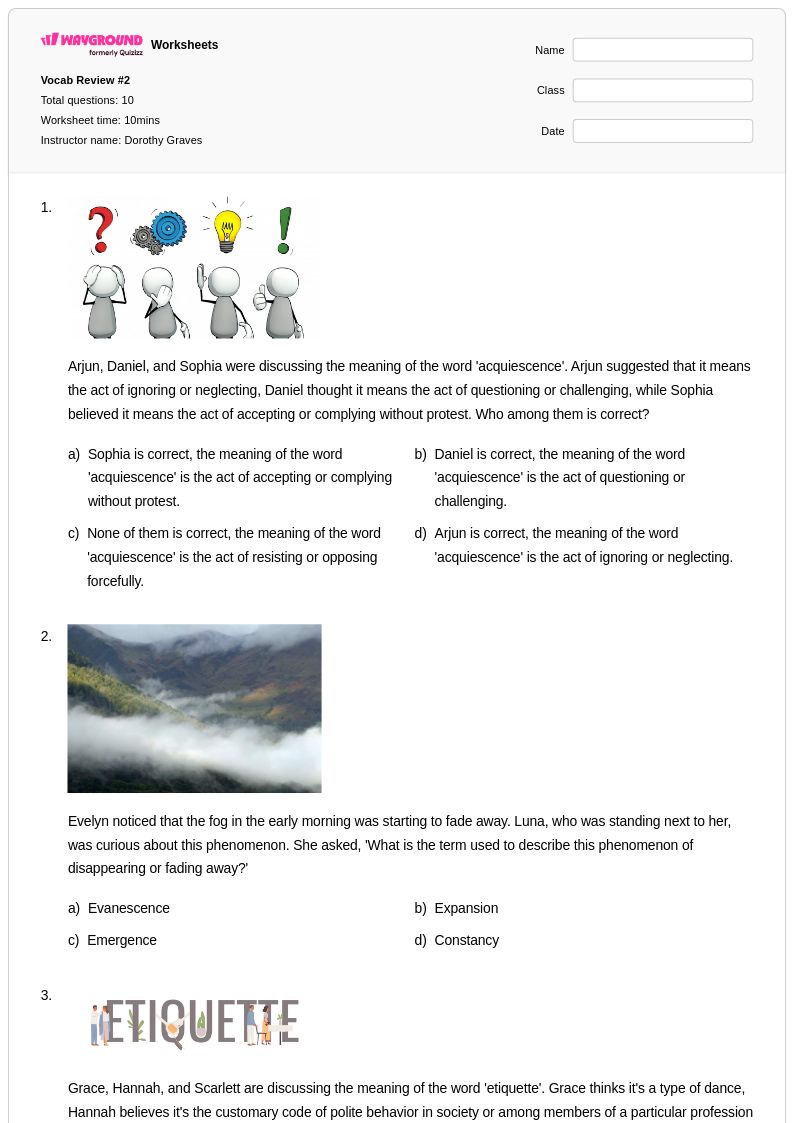
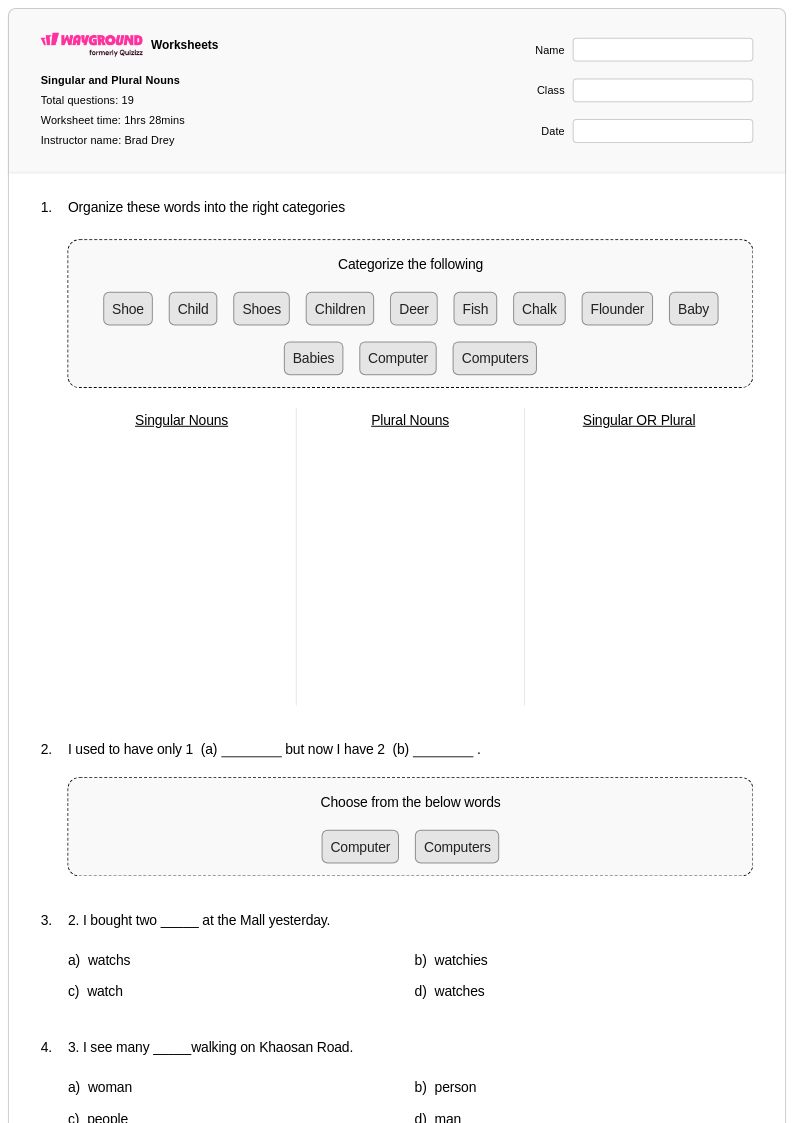
Develop visual processing skills with Wayground's free form constancy worksheets and printables that help students recognize letters and shapes regardless of size, orientation, or style through engaging practice problems with answer keys.
Form constancy worksheets available through Wayground (formerly Quizizz) provide essential foundational practice for developing students' ability to recognize letters, numbers, and shapes regardless of their orientation, size, or style variations. These carefully designed worksheets strengthen critical pre-reading and mathematical skills by challenging learners to identify familiar symbols when they appear rotated, inverted, or presented in different fonts and formats. Each printable resource includes comprehensive answer keys and offers free access to systematically structured practice problems that build visual processing abilities essential for reading success. The pdf format ensures easy classroom distribution while maintaining high-quality graphics that clearly demonstrate the subtle differences students must learn to distinguish.
Wayground (formerly Quizizz) empowers educators with millions of teacher-created form constancy resources that feature robust search and filtering capabilities, enabling quick identification of materials perfectly suited to individual student needs. The platform's sophisticated differentiation tools allow teachers to customize worksheet difficulty levels, font sizes, and visual complexity to support diverse learning requirements within a single classroom. Standards alignment ensures that practice activities directly support curriculum objectives, while the availability of both printable and digital formats, including downloadable pdf versions, provides maximum flexibility for lesson planning and implementation. These comprehensive features streamline the process of creating targeted remediation activities, enrichment challenges, and regular skill practice sessions that systematically develop students' form constancy abilities across multiple learning contexts.
FAQs
What is form constancy and why does it matter for early learners?
Form constancy is a visual perceptual skill that allows a person to recognize that a shape, letter, or number remains the same even when it changes in size, orientation, font, or position. It is foundational to reading and math because students must recognize that the letter 'b' in print is the same as a handwritten 'b', or that a triangle is still a triangle when rotated. Without this skill, students often struggle with letter recognition, letter reversals, and basic geometry. Developing form constancy early reduces confusion and builds the visual processing confidence needed for reading fluency.
How do I teach form constancy in the classroom?
Effective form constancy instruction involves presenting students with the same letter, number, or shape in multiple formats and asking them to identify what stays the same. Use activities that show letters in different fonts, sizes, and orientations alongside their standard form so students learn to abstract the core features of a symbol from its surface appearance. Sorting tasks, matching exercises, and guided observation of rotated or resized shapes are particularly effective. Consistent, structured practice with clear visual examples helps students internalize the concept rather than memorize specific appearances.
What kinds of exercises help students practice form constancy?
The most effective form constancy exercises require students to identify a target shape or letter among distractors that differ in size, rotation, or style. Matching tasks where students connect a standard letter to its rotated or font-varied counterpart build direct recognition skills. Find-the-shape activities embedded in more complex visual fields add challenge as skills develop. Worksheets that systematically increase visual complexity, moving from simple geometric shapes to letters and then numbers, provide a logical progression that supports skill building over time.
What mistakes do students commonly make when developing form constancy?
The most common error is treating orientation as a defining feature of a symbol, which leads students to identify a rotated 'b' as a different letter than an upright 'b'. Students also frequently over-rely on size, concluding that a large triangle and a small triangle are different shapes. Another common pattern is confusing visually similar letters such as 'b', 'd', 'p', and 'q' because they cannot yet abstract the core form from its directional orientation. These errors signal that the student is processing surface-level visual detail rather than the invariant structure of the symbol.
How can I use Wayground's form constancy worksheets in my classroom?
Wayground's form constancy worksheets are available as printable PDFs for traditional classroom distribution and in digital formats for technology-integrated learning environments, giving teachers flexibility depending on their setup. Teachers can assign digital versions as quizzes directly on Wayground, allowing for streamlined practice and review in one-to-one or shared-device settings. Each worksheet includes an answer key, making it easy to use for independent practice, small group instruction, or homework. For students who need additional support, Wayground's accommodation tools, including read aloud and reduced answer choices, can be applied individually without disrupting the rest of the class.
How does form constancy relate to letter reversal problems in early readers?
Letter reversal errors, such as writing or reading 'b' as 'd' or 'p' as 'q', are directly linked to underdeveloped form constancy. When a student's visual system has not yet learned to treat orientation as irrelevant to identity, mirrored letters appear interchangeable. This is developmentally normal in early learners but becomes a reading barrier if the skill does not mature. Targeted form constancy practice that specifically addresses directional discrimination, using exercises that require students to identify and sort letters based on their orientation, can help close this gap effectively.

![Constancy under negation & The projection problem [Presupposition - Entailment] - Printable Form-constancy Worksheets - Wayground](https://quizizz-static.s3.amazonaws.com/_media/worksheets-new/616c3e0fe84add001e90919e-constancy-under-negation-the-projection-problem-presupposition-entailment)