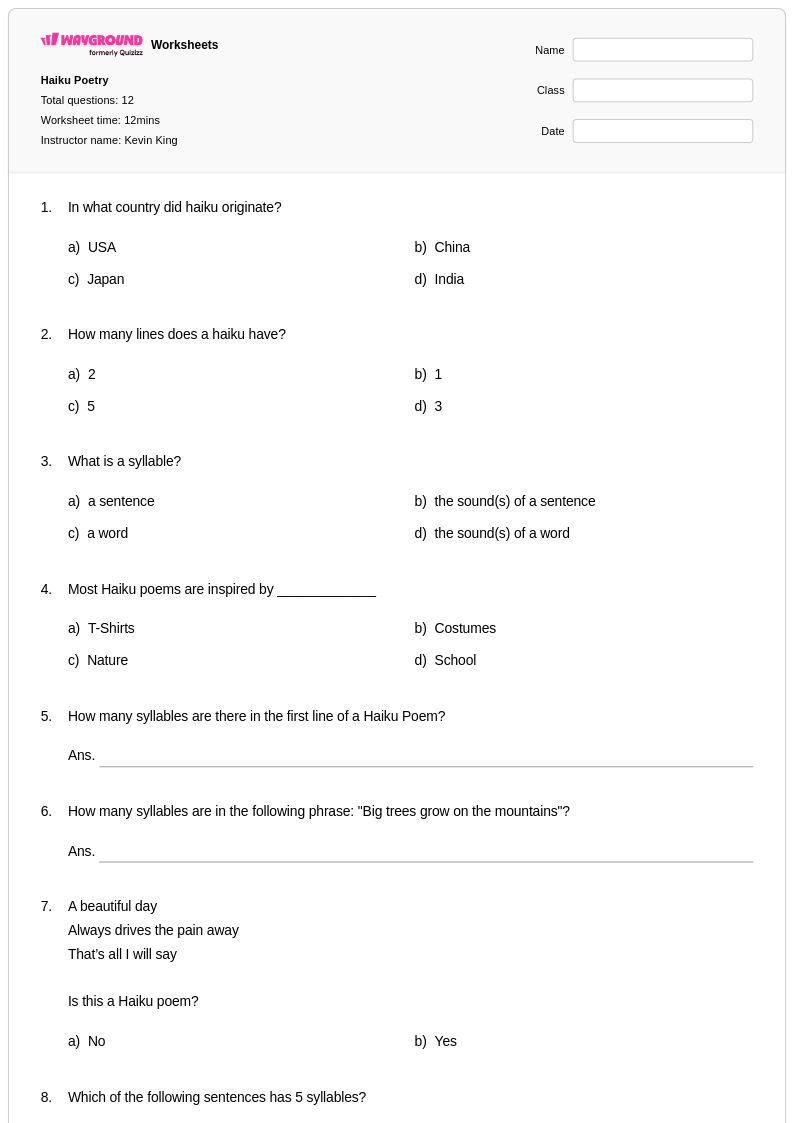
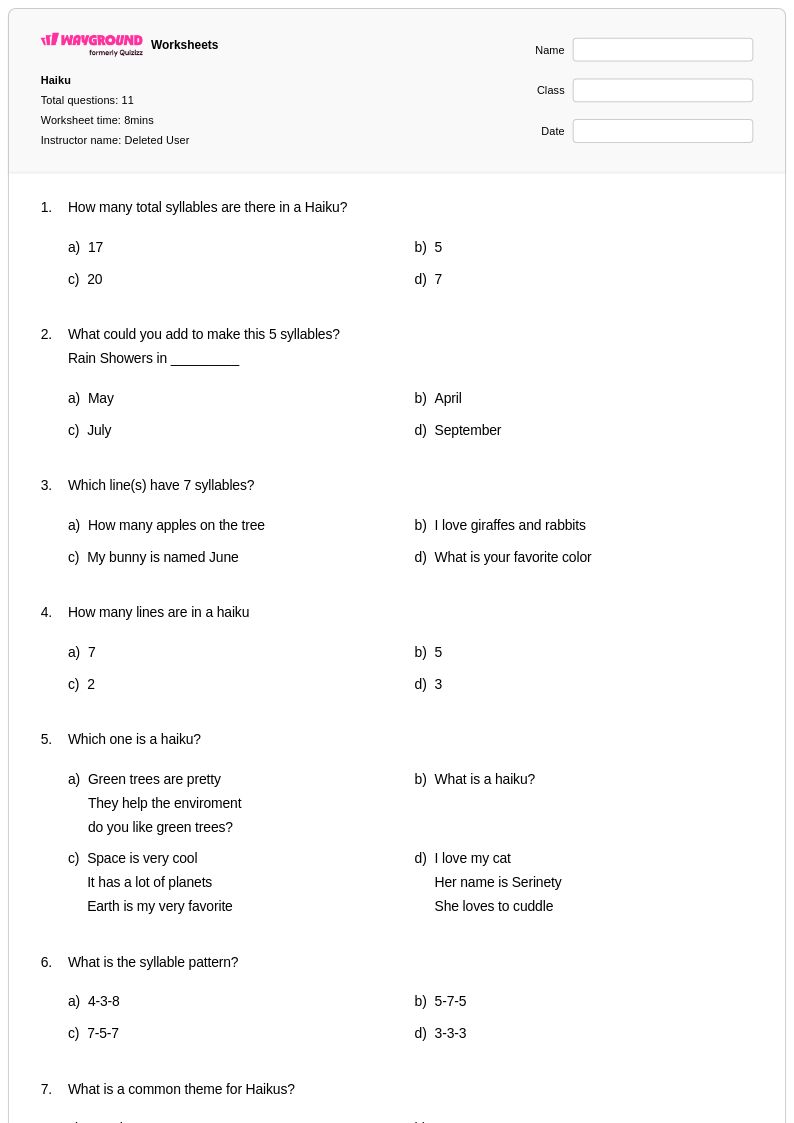
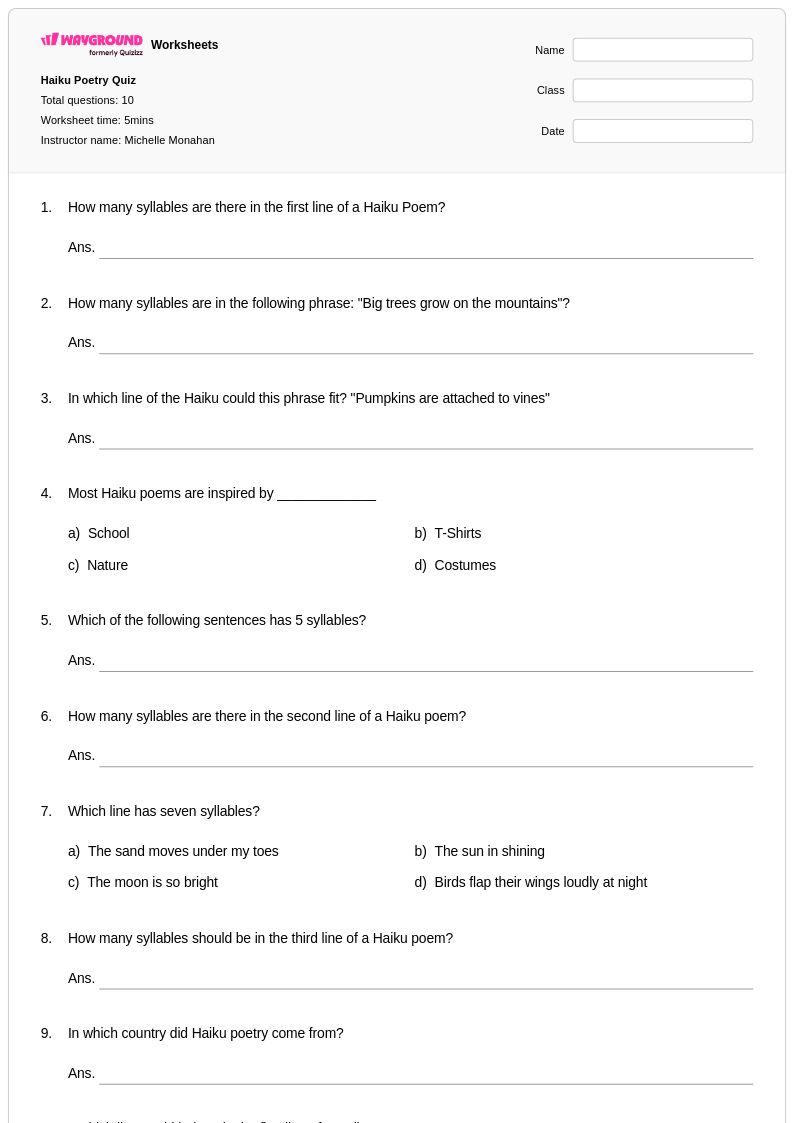
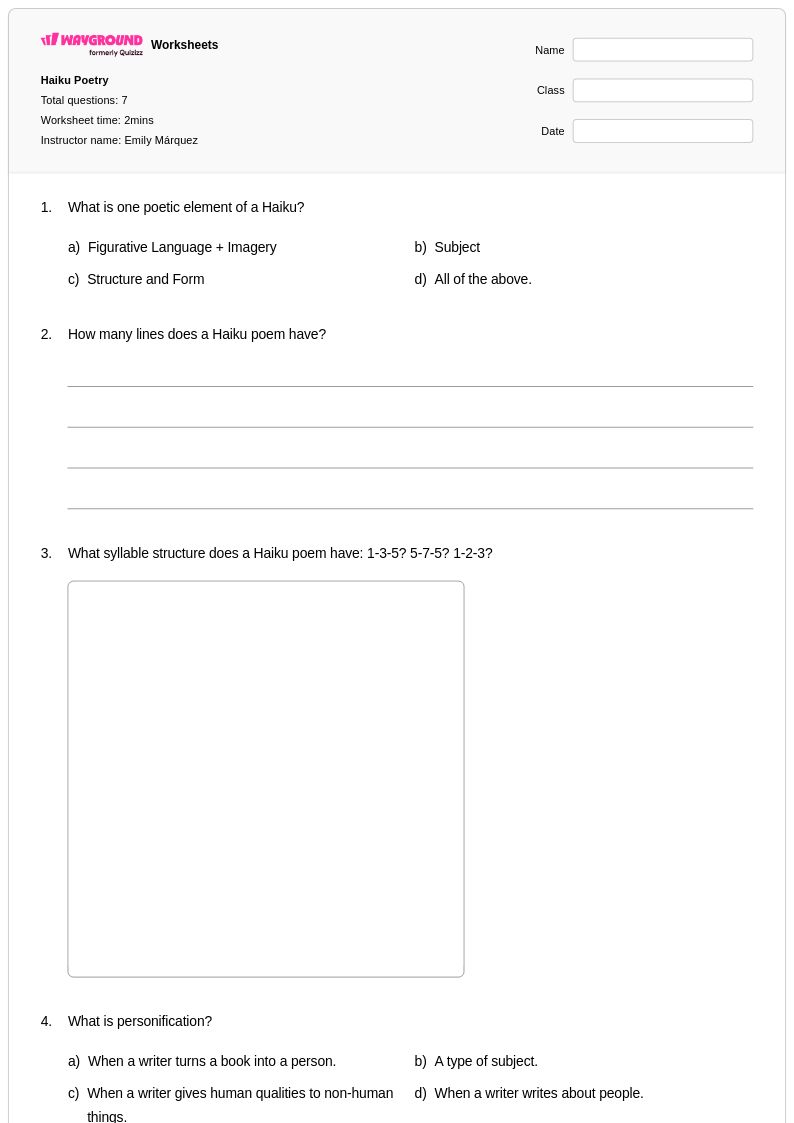
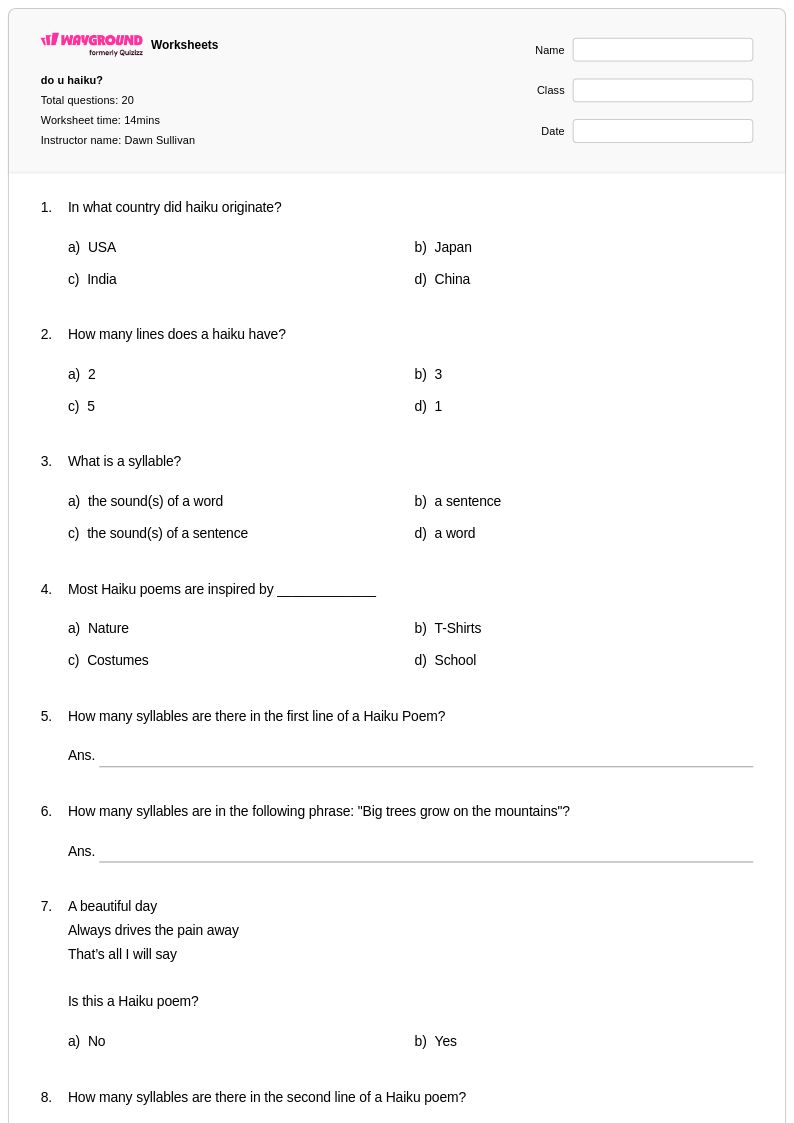
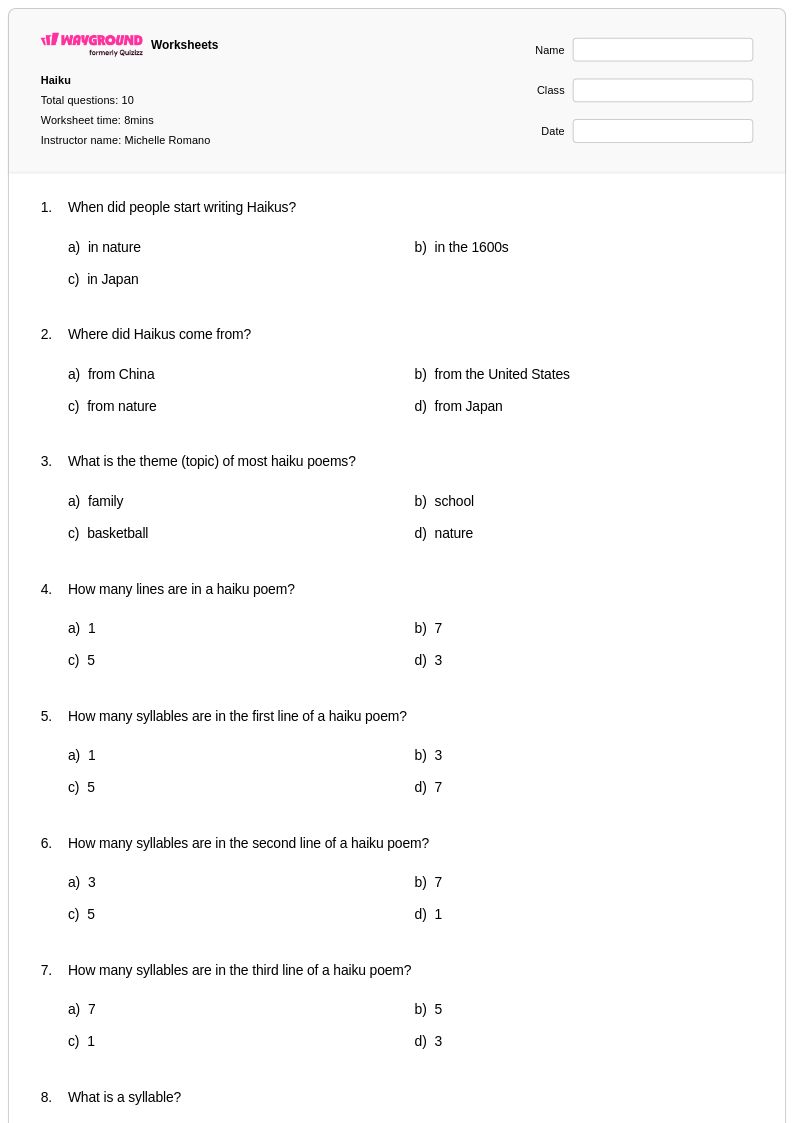
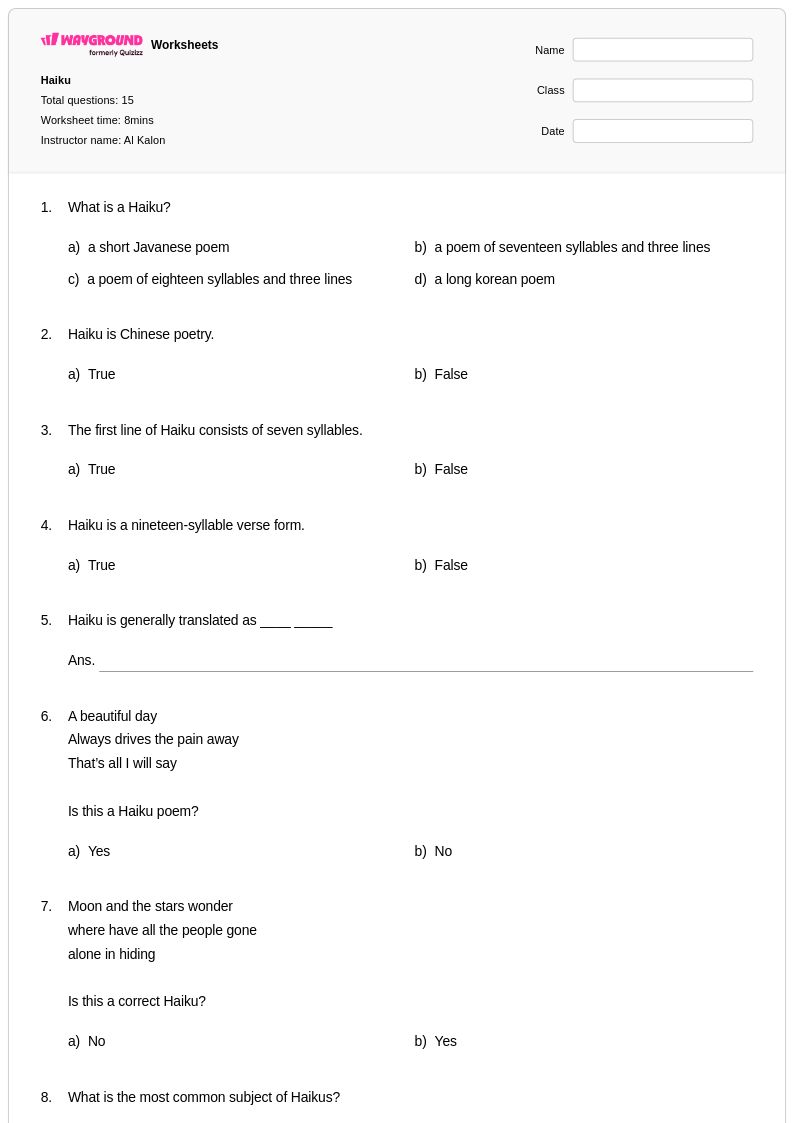
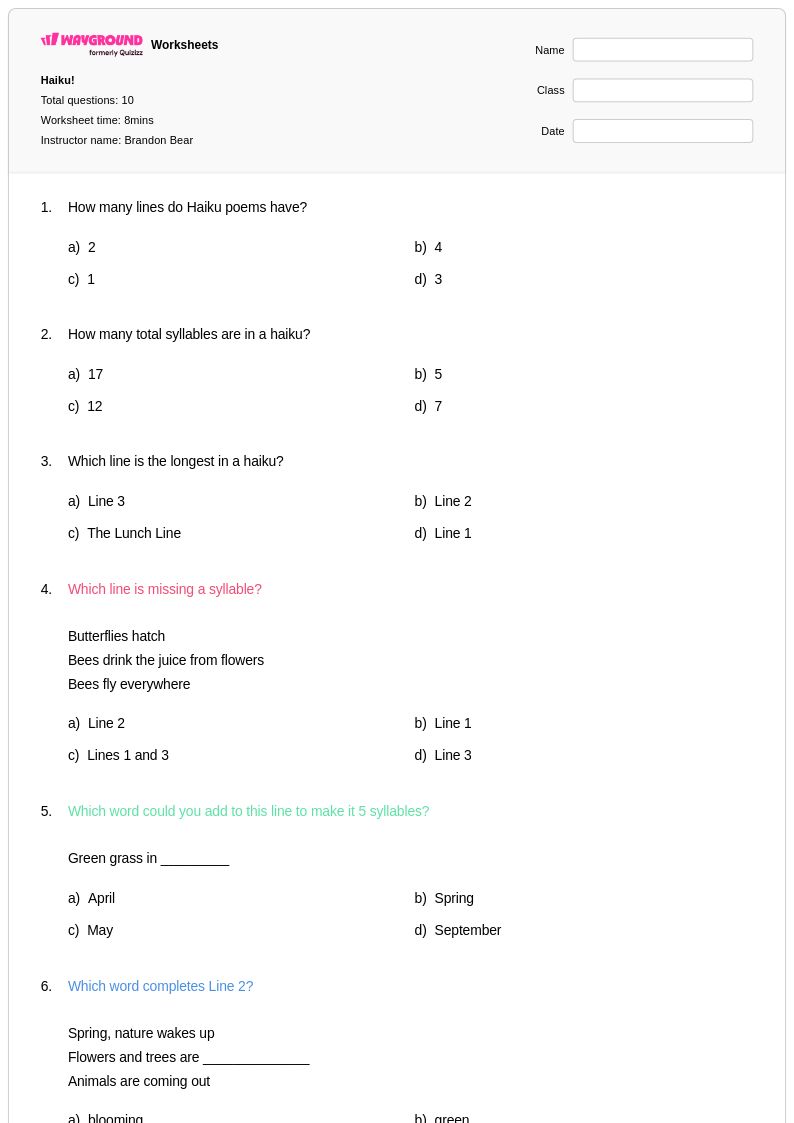
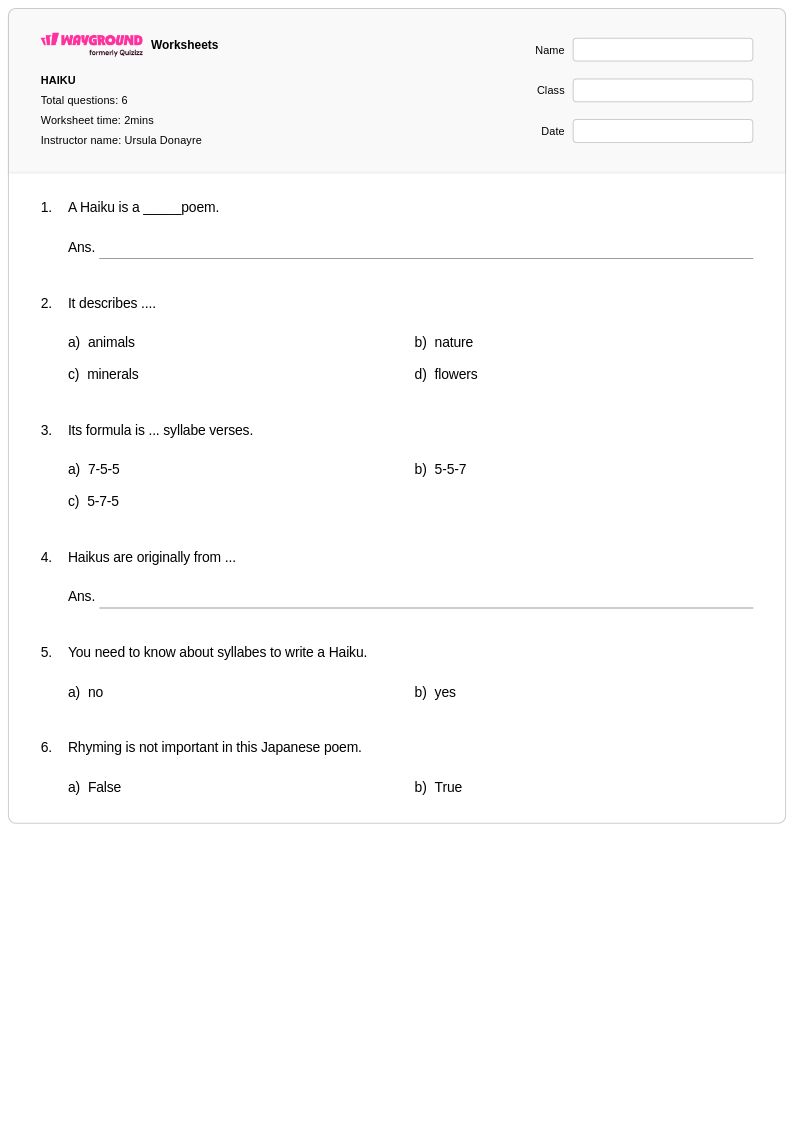
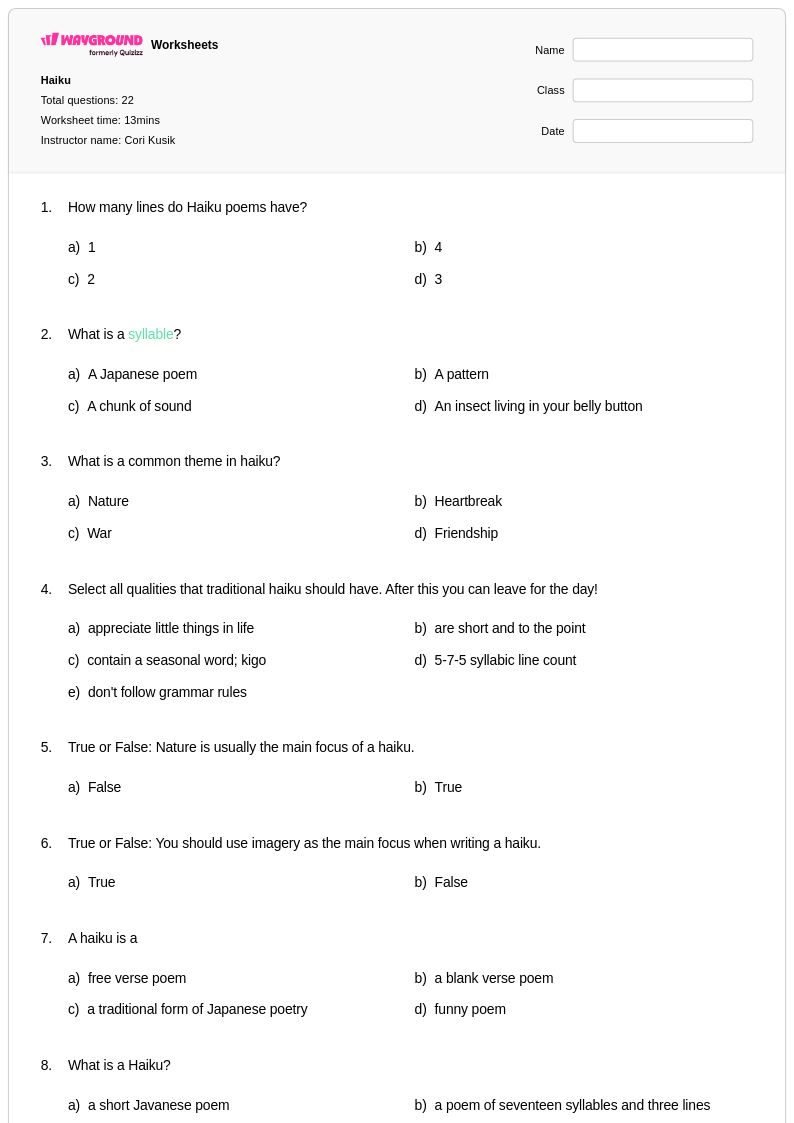
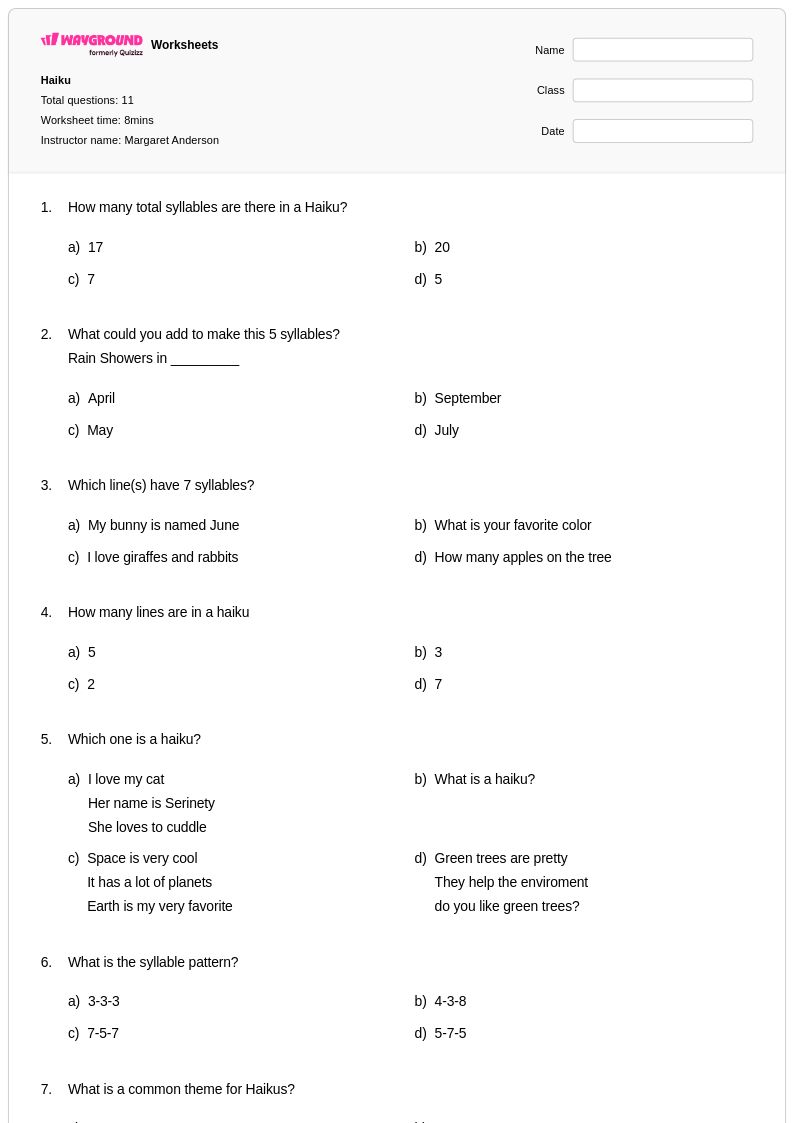
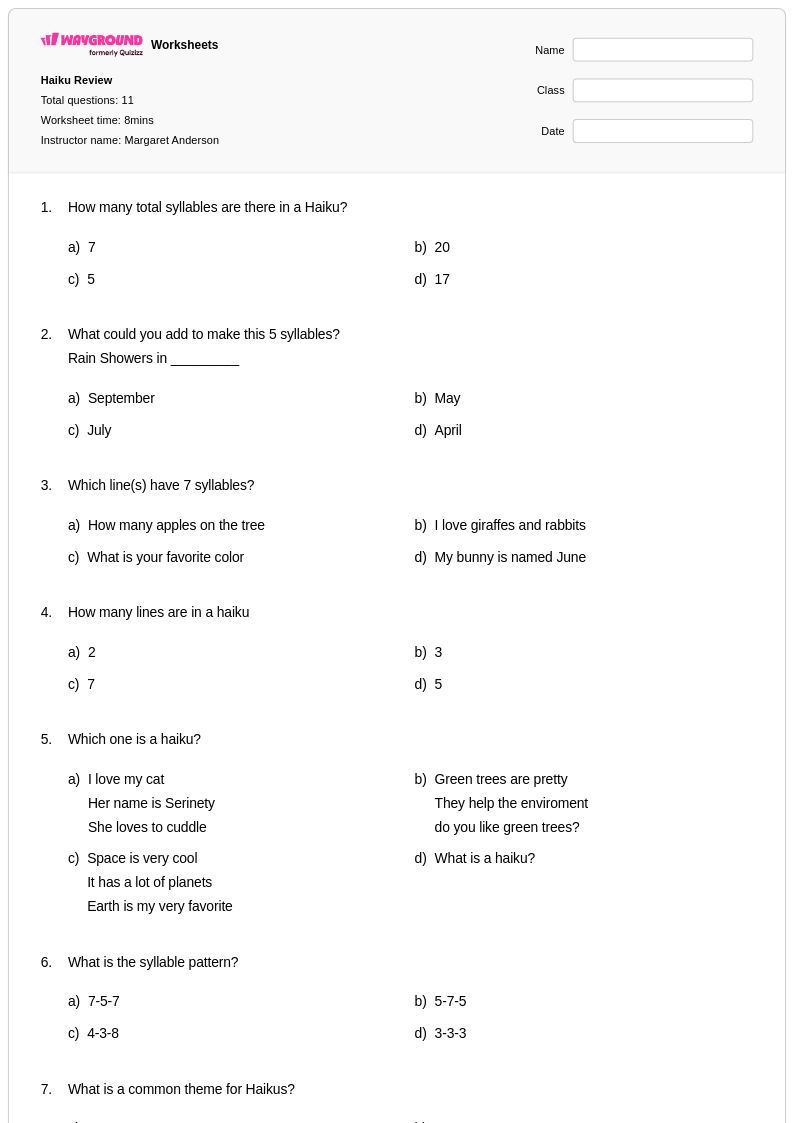
Explore Wayground's free haiku worksheets and printables that help students master this traditional Japanese poetry form through structured practice problems, creative writing exercises, and comprehensive answer keys.
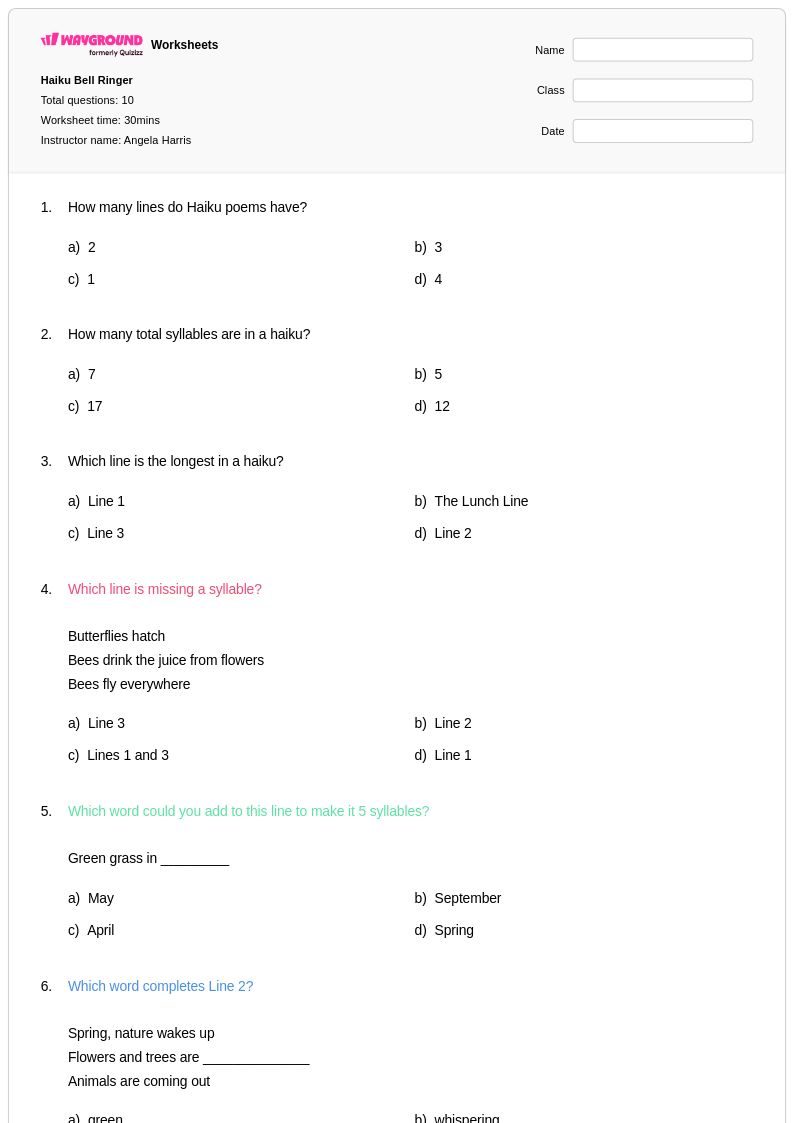
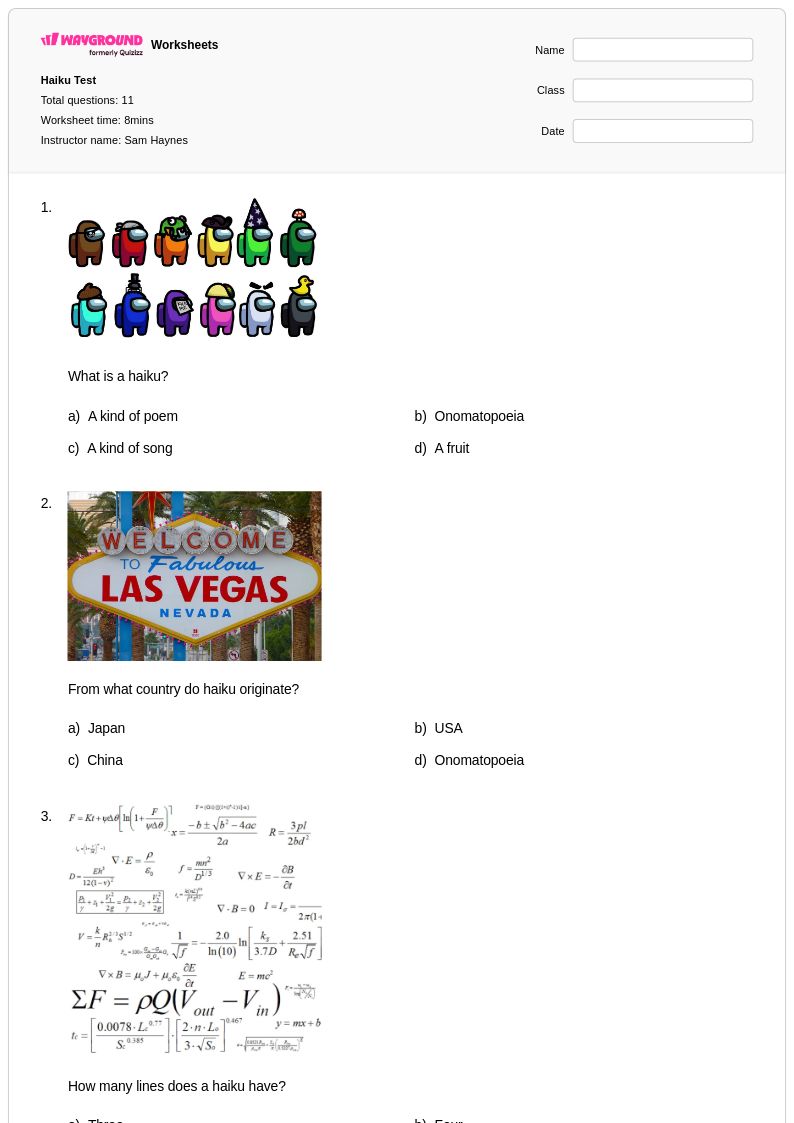
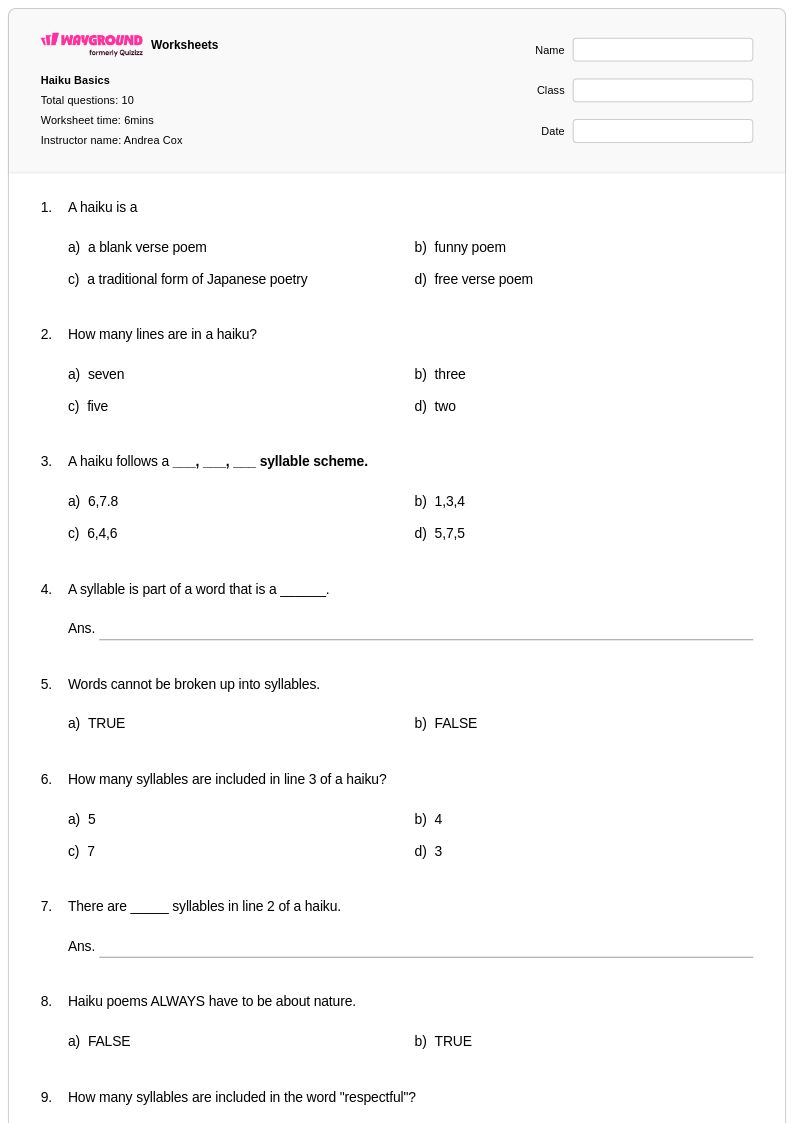
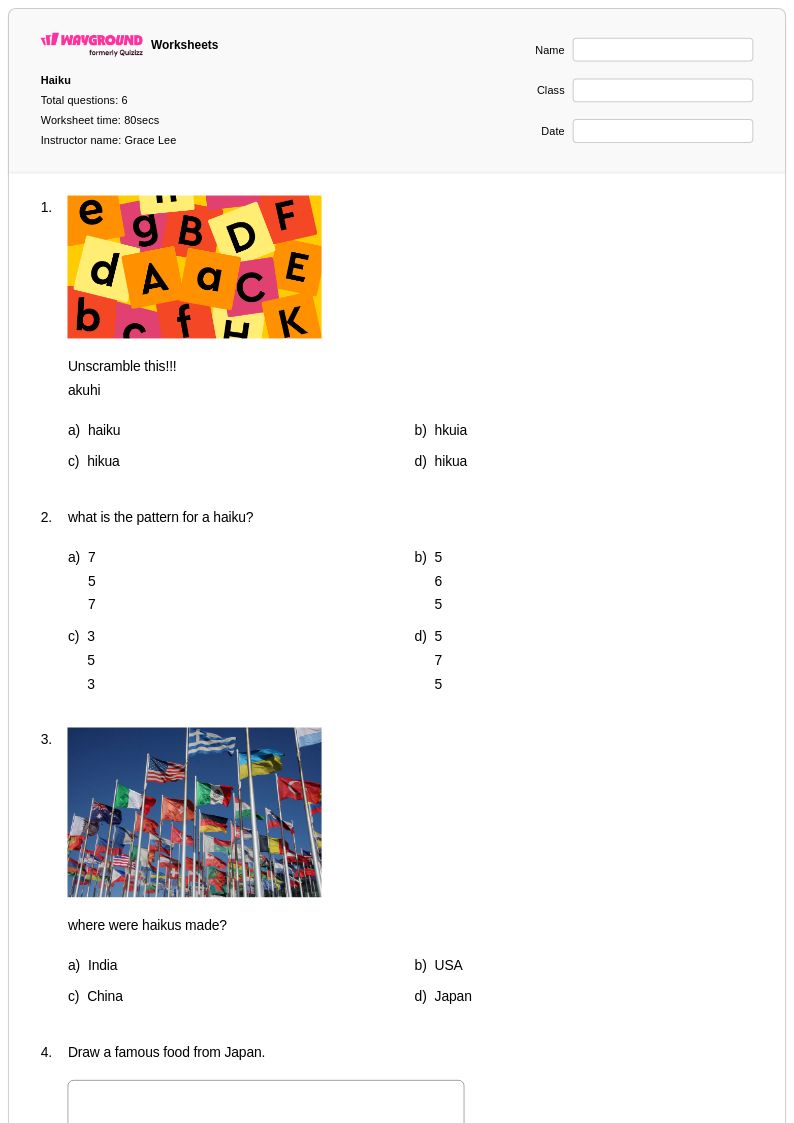
Haiku worksheets available through Wayground (formerly Quizizz) provide comprehensive resources for developing students' understanding of this traditional Japanese poetic form. These carefully crafted materials guide learners through the fundamental structure of haiku poetry, emphasizing the classic 5-7-5 syllable pattern while exploring themes of nature, seasons, and momentary observations. The worksheets strengthen essential skills including syllable counting, imagery creation, and concise expression, helping students master the art of capturing profound moments in just seventeen syllables. Each resource includes detailed answer keys and practice problems that reinforce proper haiku construction, with free printable options that make these materials accessible for immediate classroom use or independent study.
Wayground (formerly Quizizz) empowers educators with millions of teacher-created haiku resources that streamline lesson planning and enhance student engagement with this elegant poetic form. The platform's robust search and filtering capabilities allow teachers to quickly locate materials aligned with specific learning standards and grade-level expectations, while differentiation tools enable customization for diverse learning needs and abilities. These haiku worksheets are available in both printable pdf format and interactive digital versions, providing flexibility for traditional classroom instruction, remote learning, or hybrid educational environments. Teachers can seamlessly integrate these resources into their poetry units for initial instruction, targeted remediation, enrichment activities, or ongoing skill practice, ensuring that every student develops confidence in both analyzing and composing haiku poetry.
FAQs
How do I teach haiku poetry to students who have never written poetry before?
Start by introducing the 5-7-5 syllable structure with simple, familiar words before asking students to write original poems. Model the process by counting syllables aloud together using nature-themed words, then work through guided examples as a class. Once students understand the structure, provide a theme or image prompt to help them focus on a single moment or observation rather than trying to tell a complete story.
What exercises help students practice writing haiku?
Syllable-counting practice is the essential first step — have students clap out syllables in everyday words before applying that skill to full lines. From there, structured exercises that ask students to complete a partially written haiku reinforce proper line construction without the pressure of starting from scratch. Creative writing prompts focused on seasons, weather, or a single sensory detail are also highly effective for building original composition skills within the 5-7-5 framework.
What mistakes do students commonly make when writing haiku?
The most frequent error is miscounting syllables, especially with multi-syllable words or words students pronounce informally (e.g., "every" counted as two syllables instead of three). Students also tend to write narrative or explanatory haiku rather than capturing a single, vivid moment, which misses the core purpose of the form. Additionally, beginners often overlook the importance of imagery and try to make haiku rhyme, which is not a feature of traditional Japanese haiku.
How do I use Wayground's haiku worksheets in my classroom?
Wayground's haiku worksheets are available as printable PDFs for traditional classroom use and in digital formats for technology-integrated or remote learning environments, and can also be hosted as a quiz directly on the Wayground platform. Each worksheet includes complete answer keys, making them practical for independent practice, small-group instruction, or homework assignments. Teachers can use them at the start of a poetry unit to introduce haiku structure or return to them for targeted remediation when students struggle with syllable counting or imagery.
How can I differentiate haiku instruction for students with different skill levels?
For students who struggle with syllable counting, Wayground's Read Aloud feature can help by reading questions and content aloud, reinforcing phonemic awareness as they work through exercises. Reduced answer choices can lower the cognitive load for students who find open-ended poetry intimidating, giving them a scaffolded entry point. More advanced students can be challenged to move beyond the structural mechanics and focus on crafting haiku with strong seasonal imagery (kigo) and a moment of contrast or surprise.
What grade level is haiku poetry typically taught at?
Haiku is commonly introduced in grades 3 through 5, where syllable awareness and poetry fundamentals are part of the language arts curriculum. However, it remains a relevant form through middle and high school, where students can engage more deeply with the philosophical and imagistic traditions behind Japanese haiku. The accessibility of the 5-7-5 structure makes it teachable across a wide range of grade levels, with expectations scaled to match student skill and maturity.