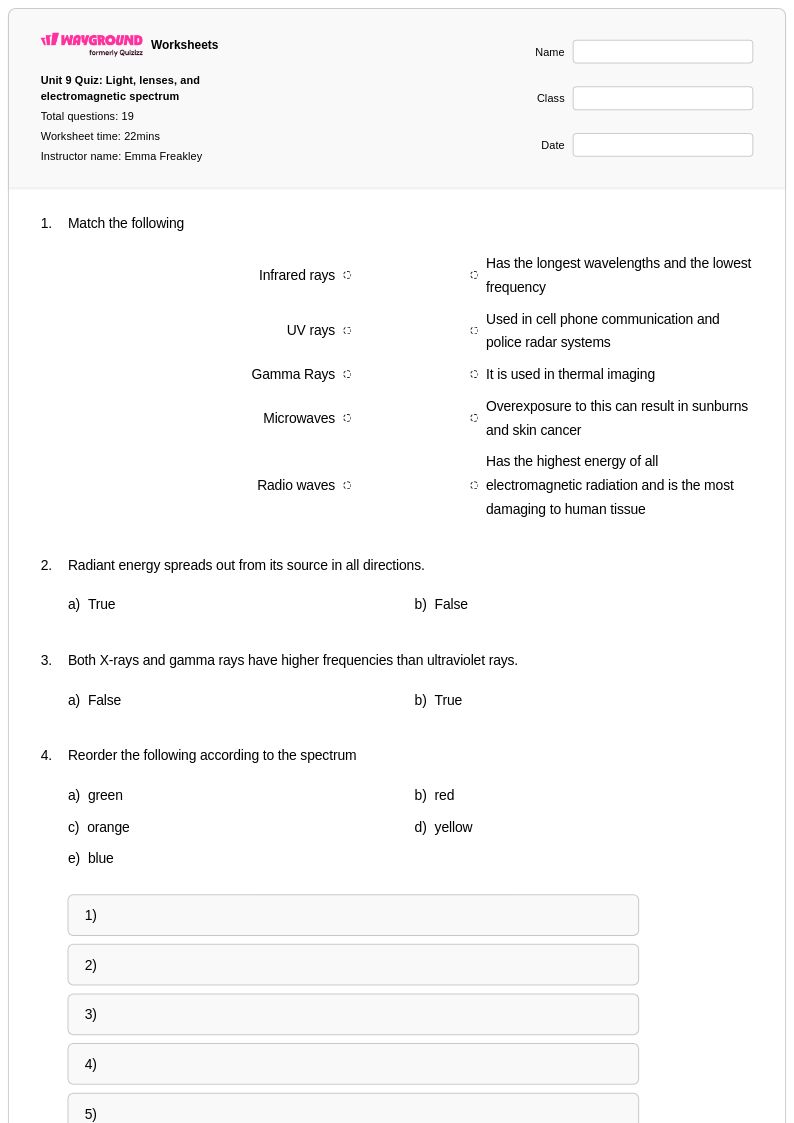
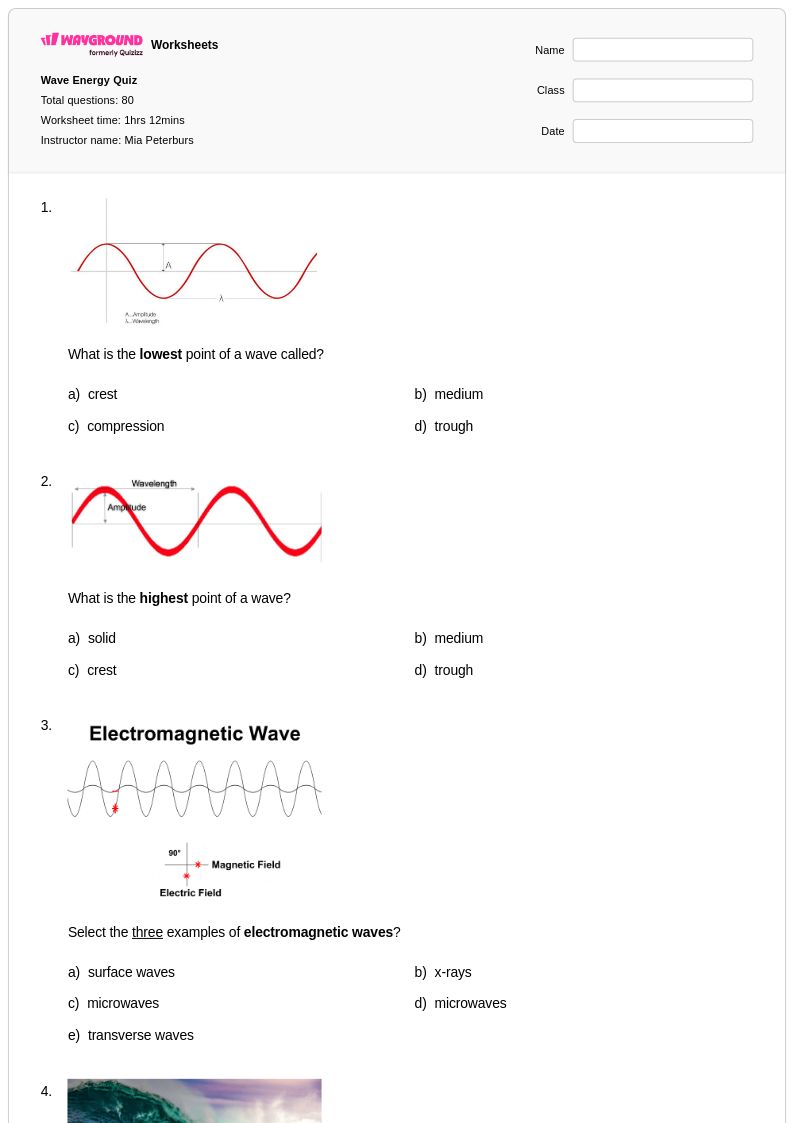
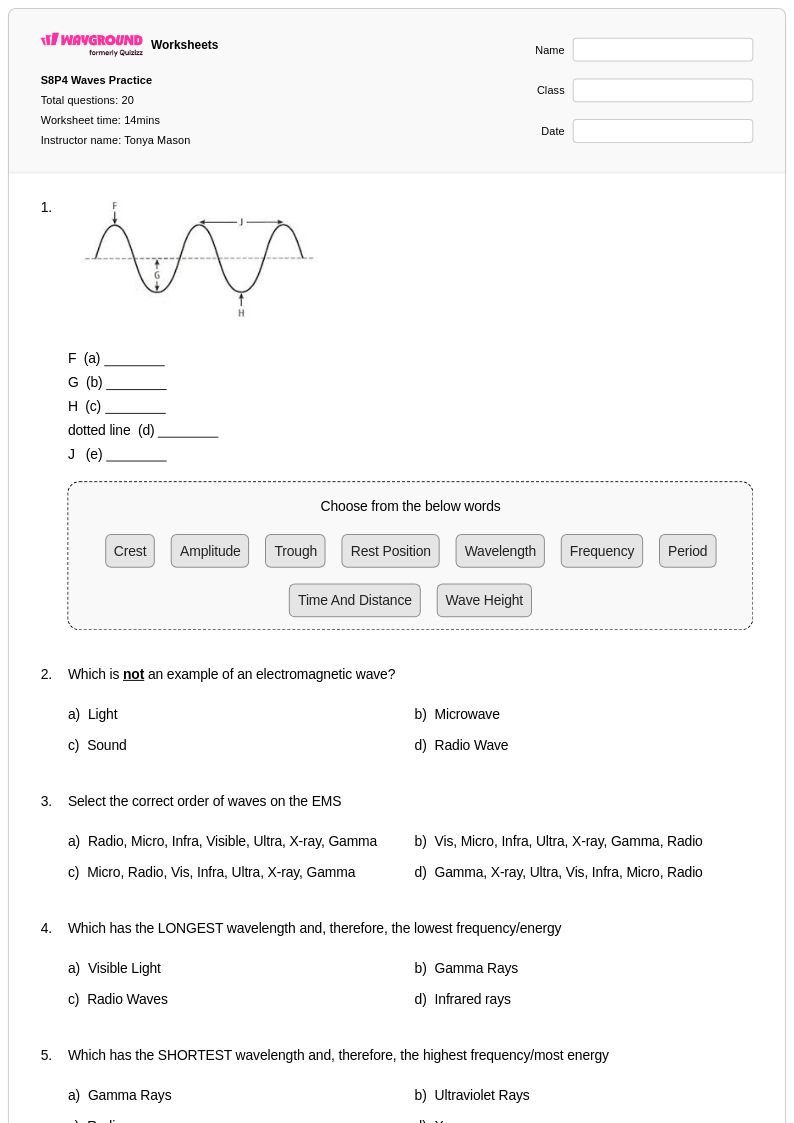
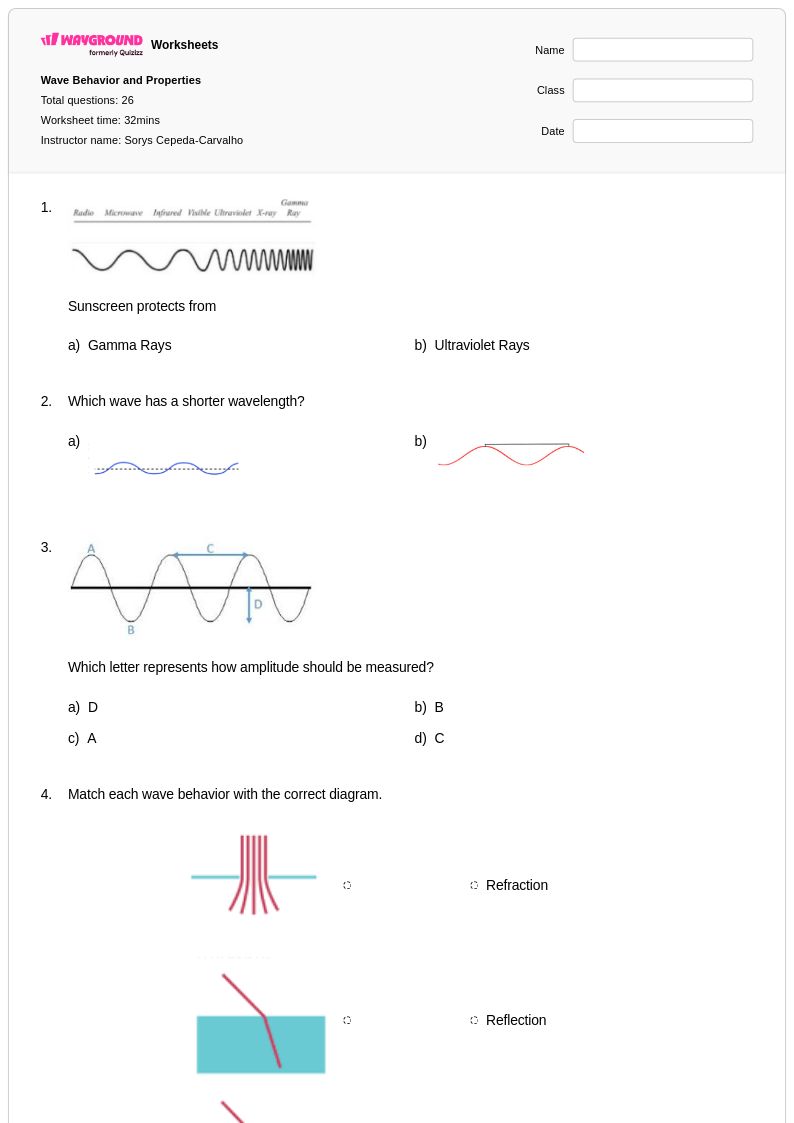
Explore our Class 8 physics rays worksheets featuring free printables and practice problems that help students master light ray behavior, reflection, and refraction concepts with comprehensive answer keys included.
Rays worksheets for Class 8 physics provide comprehensive practice materials that help students master the fundamental concepts of light behavior and optical phenomena. These educational resources from Wayground (formerly Quizizz) strengthen critical thinking skills as students explore how light travels in straight lines, reflects off surfaces, and refracts through different materials. The worksheets feature carefully designed practice problems that guide eighth-grade learners through drawing ray diagrams, calculating angles of incidence and reflection, and analyzing how light interacts with mirrors and lenses. Each free printable resource includes detailed answer keys that support independent learning and self-assessment, while the pdf format ensures easy classroom distribution and homework assignments that reinforce essential physics principles.
Wayground (formerly Quizizz) empowers educators with an extensive collection of teacher-created rays worksheets that streamline lesson planning and enhance student understanding of optical physics concepts. The platform's millions of resources include standards-aligned materials that can be easily located through robust search and filtering capabilities, allowing teachers to quickly find grade-appropriate content that matches their curriculum requirements. These differentiation tools enable instructors to customize worksheets for diverse learning needs, whether providing remediation for struggling students or enrichment challenges for advanced learners. Available in both printable and digital formats, including downloadable pdfs, these flexible resources support various teaching environments while helping educators efficiently deliver targeted skill practice that builds conceptual understanding of how light rays behave in different optical situations.
FAQs
How do I teach students the difference between a ray, a line, and a line segment?
A ray has one endpoint and extends infinitely in one direction, which distinguishes it from a line segment (two endpoints, finite length) and a line (no endpoints, infinite in both directions). The most effective classroom approach is to use visual anchors: draw all three on the board simultaneously and label the endpoint and the arrow. Having students sort diagrams into categories reinforces the distinction before moving to optics applications where rays represent directed paths of light.
What exercises help students practice identifying and drawing rays in physics?
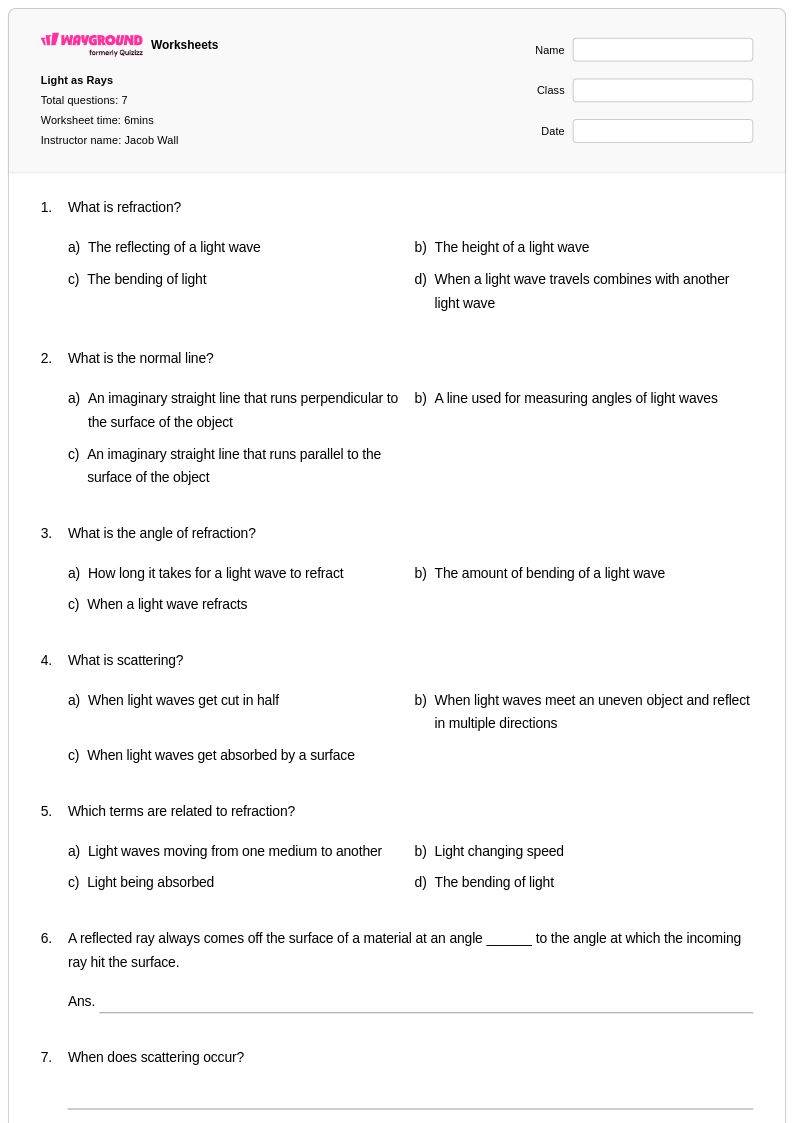
Ray diagram exercises are the most effective practice format because they require students to apply ray properties in context rather than recall definitions in isolation. Effective exercises include drawing incident and reflected rays across a flat mirror, tracing refracted rays through a glass block, and labeling ray components such as the normal line, angle of incidence, and angle of refraction. Worksheets that progress from basic ray identification to full optical system diagrams build both procedural fluency and conceptual understanding.
What are the most common mistakes students make when drawing ray diagrams?
The most frequent errors are forgetting to draw the arrowhead indicating direction, measuring angles from the surface instead of the normal line, and confusing the incident ray with the reflected ray. Students also frequently reverse the direction of refraction, bending the ray toward the normal when it should bend away (or vice versa) depending on whether light is moving into a denser or less dense medium. Targeted practice with labeled diagrams and immediate feedback through answer keys helps students self-correct these errors before they become habitual.
How can I differentiate ray diagram instruction for students at different skill levels?
For students who are still building foundational understanding, start with flat mirror reflection before introducing curved mirrors or lenses, and provide pre-drawn normal lines to reduce cognitive load. Advanced learners can work through multi-surface refraction problems or analyze real optical instruments like periscopes and telescopes. On Wayground, teachers can apply accommodations such as reduced answer choices and read-aloud settings to individual students, allowing the same worksheet to serve a range of learners without creating separate assignments.
How do I use Wayground's rays worksheets in my classroom?
Wayground's rays worksheets are available as printable PDFs for traditional classroom use and in digital formats for technology-integrated learning environments, including the option to host them as a quiz directly on Wayground. Teachers can assign them for targeted skill practice, remediation of challenging ray concepts, enrichment for advanced learners, or assessment preparation. Each worksheet includes a complete answer key, making them practical for both teacher-led instruction and independent student work.
How do I explain refraction to students who are confused about why light bends?
Refraction occurs because light changes speed when it moves from one medium to another, and the change in speed causes the wavefront to bend. A useful analogy is a car driving from pavement onto gravel at an angle: the wheel that hits the gravel first slows down, causing the car to turn. Connecting this physical intuition to ray diagrams before introducing Snell's Law helps students understand why the direction of bending depends on whether light is entering a denser or less dense medium.