Free Printable Temple Grandin Worksheets for Class 5
Explore Class 5 Temple Grandin worksheets and printables that help students learn about this inspiring advocate for autism awareness and animal welfare through engaging practice problems, free PDF activities, and comprehensive answer keys.
Explore printable Temple Grandin worksheets for Class 5
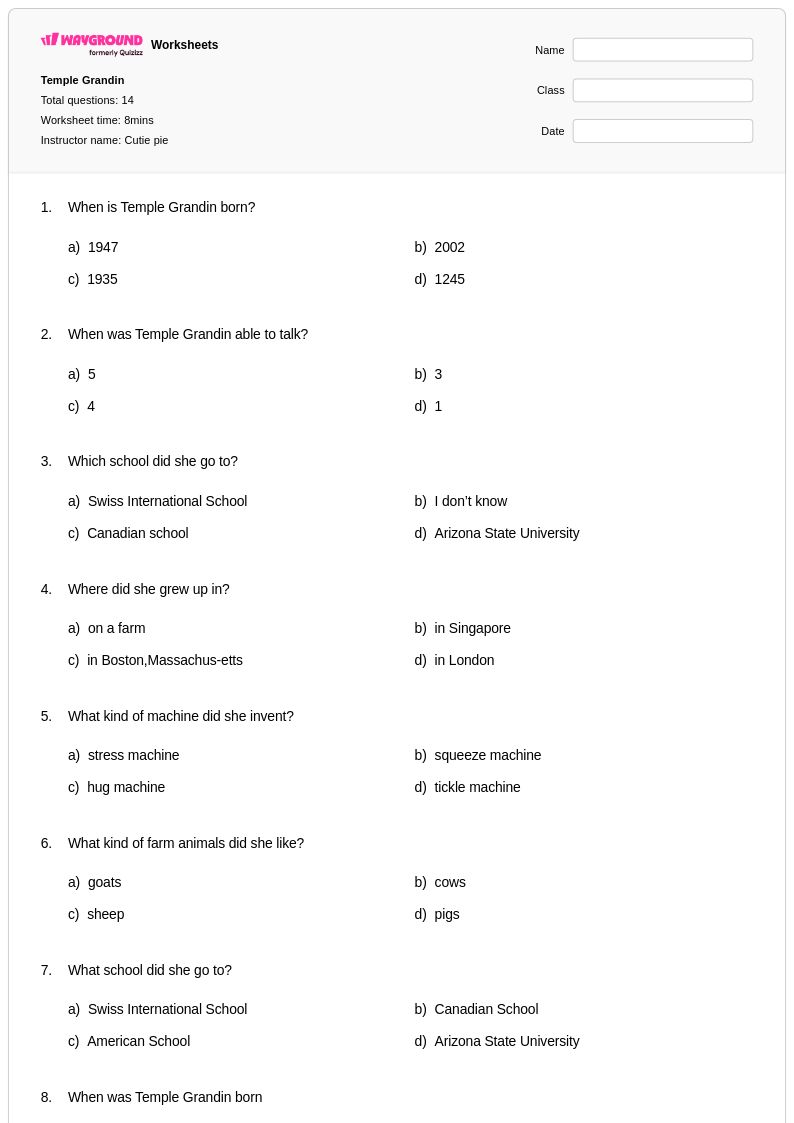
Temple Grandin worksheets for Class 5 students available through Wayground provide an engaging introduction to one of history's most influential advocates for autism awareness and animal welfare. These comprehensive educational materials help students develop critical thinking skills while exploring Grandin's groundbreaking contributions to science, engineering, and social understanding. The worksheets feature a variety of practice problems that encourage students to analyze her innovative designs for livestock handling systems, examine her experiences as a person with autism, and connect her work to broader themes of diversity and inclusion in their communities. Teachers can access complete answer keys alongside these free printables, making it easy to facilitate meaningful discussions about overcoming challenges and celebrating neurodiversity in Class 5 social studies classrooms.
Wayground supports educators with millions of teacher-created resources specifically designed to bring inspiring figures like Temple Grandin into Class 5 community and cultures curriculum. The platform's robust search and filtering capabilities allow teachers to quickly locate standards-aligned materials that match their specific lesson objectives, whether focusing on biography study, scientific innovation, or social advocacy. These differentiation tools enable educators to customize worksheets for various learning levels, ensuring all students can engage meaningfully with Grandin's story and its relevance to understanding diverse communities. Available in both printable pdf format and interactive digital versions, these resources streamline lesson planning while providing flexible options for skill practice, remediation activities, and enrichment opportunities that help students connect historical figures to contemporary discussions about inclusion and acceptance.
FAQs
How do I teach students about Temple Grandin in a social studies class?
Teaching Temple Grandin works best when framed around two intersecting themes: the history of disability rights and the science of animal behavior. Start by establishing context around autism awareness and neurodiversity before introducing her contributions to livestock handling and facility design. Connecting her personal experience as an autistic person to her professional innovations helps students understand how lived perspective can drive scientific advancement and social change.
What kinds of activities help students analyze Temple Grandin's impact?
Effective activities include primary source analysis of Grandin's writing and speeches, compare-and-contrast tasks examining historical versus contemporary views on autism and disability rights, and structured discussions on how individual contributions can shift broader cultural attitudes. Having students evaluate the real-world outcomes of her livestock handling designs alongside her advocacy work reinforces the connection between scientific innovation and social equity.
What misconceptions do students commonly have about Temple Grandin and autism?
A common misconception is that autism is a limitation rather than a different way of processing the world, and students often fail to connect Grandin's sensory-based thinking style directly to her scientific breakthroughs. Some students also conflate autism advocacy with a single narrative, missing the broader spectrum of neurodiversity. Addressing these misconceptions directly, using Grandin's own words and documented achievements, helps students build more accurate and nuanced understanding.
How can I use Temple Grandin worksheets to support diverse learners in my classroom?
Temple Grandin worksheets on Wayground are available as printable PDFs for traditional classroom use and in digital formats for technology-integrated environments, including the option to host them as a quiz on Wayground. For students who need additional support, Wayground's accommodation tools allow teachers to enable read-aloud functionality, extended time, and reduced answer choices on an individual basis without notifying other students. These settings are reusable across sessions, making it straightforward to consistently support learners with different needs while the rest of the class works with default settings.
How do Temple Grandin worksheets connect to social studies standards?
Temple Grandin worksheets connect to social studies standards through strands focused on community and culture, individual contributions to society, and the history of civil and disability rights movements. Students practice skills such as analyzing the role of individuals in driving social change, evaluating historical and contemporary perspectives on neurodiversity, and making evidence-based arguments about the impact of scientific innovation on public policy and cultural norms.
What grade levels are Temple Grandin worksheets appropriate for?
Temple Grandin worksheets are appropriate across a range of grade levels depending on complexity. Foundational materials introducing her life story and key contributions suit upper elementary students, while more analytical tasks involving primary source comparison, disability rights history, and the societal impact of her animal science work are better suited for middle and high school students in social studies, science, or interdisciplinary humanities courses.